PRESENTATION
SSL and TLS
Secure Socket Layer (SSL)
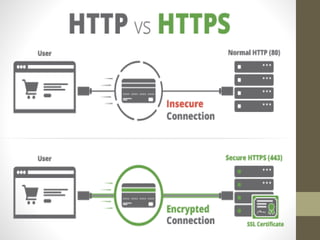
Secure Socket Layer (SSL) provides
security to the data that is transferred
between web browser and server.
 SSL encrypts the link between a web server
and a browser which ensures that all data
passed between them remain private and free
from attack.
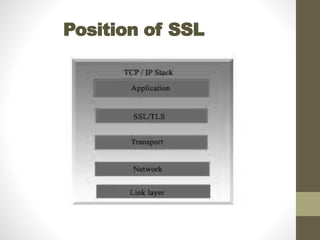
Position of SSL
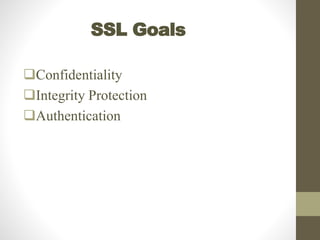
SSL Goals
Confidentiality
Integrity Protection
Authentication
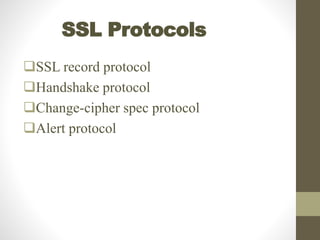
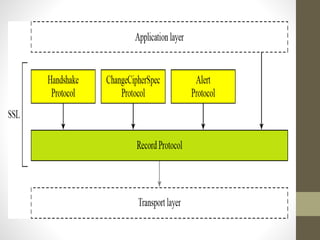
SSL Protocols
SSL record protocol
Handshake protocol
Change-cipher spec protocol
Alert protocol
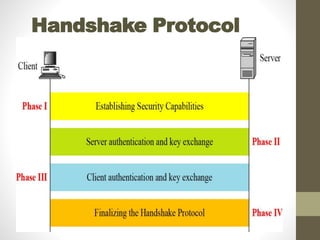
Handshake Protocol
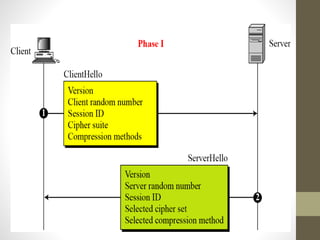
Phase I of Handshake Protocol
After Phase I, the client and server know the
following:
 The version of SSL
The algorithms for key exchange, message
authentication, and encryption
 The compression method
 The two random numbers for key
generation
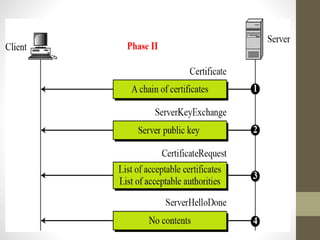
Phase II of Handshake Protocol
After Phase II,
The server is authenticated to the client.
The client knows the public key of the
server if required.
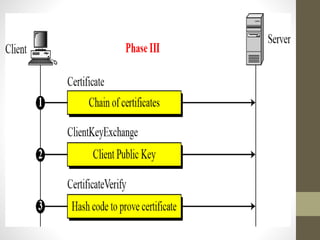
Phase III of Handshake Protocol
After Phase III,
The client is authenticated for the server.
 Both the client and the server know the
pre-master secret.
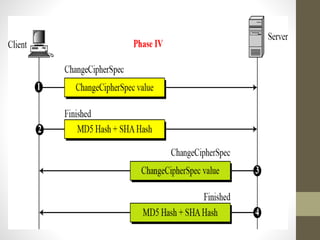
Phase IV of Handshake Protocol
After Phase IV, the client and server are
ready to exchange data.
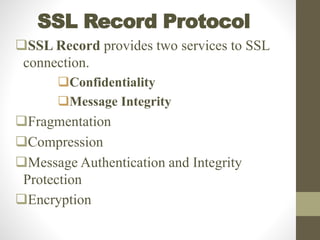
SSL Record Protocol
SSL Record provides two services to SSL
connection.
Confidentiality
Message Integrity
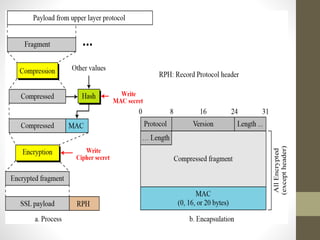
Fragmentation
Compression
Message Authentication and Integrity
Protection
Encryption
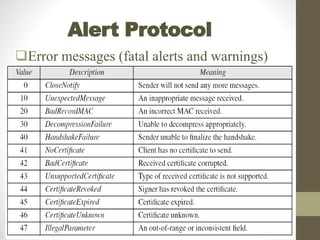
Alert Protocol
Error messages (fatal alerts and warnings)
Change-cipher spec protocol
Change-cipher protocol consists of a single
message which is 1 byte in length and can
have only one value.
This protocol’s purpose is to cause the
pending state to be copied into the current
state.
Evaluation of SSL
SSL 1.0
was never released to the public.
SSL 2.0
was released in 1995.
SSL 3.0
was released in 1996.
SSLv4.0 or TSLv1.0
was released in 1999.
TLSv1.1
was released in 1999.
Transport Layer Security
Transport Layer Security (TLS) was designed
to provide security at the transport layer.
TSL was derived from a security protocol called
Secure Socket Layer(SSL).
TSL is the successor to the Secure Socket Layer
(SSL).
TSL is a protocol that ensures privacy between
communicating applications and their users on
the internet.
SSL.pptx

SSL.pptx

  • 1.
  • 2.
    Secure Socket Layer(SSL) Secure Socket Layer (SSL) provides security to the data that is transferred between web browser and server.  SSL encrypts the link between a web server and a browser which ensures that all data passed between them remain private and free from attack.
  • 4.
  • 5.
  • 6.
    SSL Protocols SSL recordprotocol Handshake protocol Change-cipher spec protocol Alert protocol
  • 8.
  • 10.
    Phase I ofHandshake Protocol After Phase I, the client and server know the following:  The version of SSL The algorithms for key exchange, message authentication, and encryption  The compression method  The two random numbers for key generation
  • 12.
    Phase II ofHandshake Protocol After Phase II, The server is authenticated to the client. The client knows the public key of the server if required.
  • 14.
    Phase III ofHandshake Protocol After Phase III, The client is authenticated for the server.  Both the client and the server know the pre-master secret.
  • 16.
    Phase IV ofHandshake Protocol After Phase IV, the client and server are ready to exchange data.
  • 17.
    SSL Record Protocol SSLRecord provides two services to SSL connection. Confidentiality Message Integrity Fragmentation Compression Message Authentication and Integrity Protection Encryption
  • 19.
    Alert Protocol Error messages(fatal alerts and warnings)
  • 20.
    Change-cipher spec protocol Change-cipherprotocol consists of a single message which is 1 byte in length and can have only one value. This protocol’s purpose is to cause the pending state to be copied into the current state.
  • 21.
    Evaluation of SSL SSL1.0 was never released to the public. SSL 2.0 was released in 1995. SSL 3.0 was released in 1996. SSLv4.0 or TSLv1.0 was released in 1999. TLSv1.1 was released in 1999.
  • 22.
    Transport Layer Security TransportLayer Security (TLS) was designed to provide security at the transport layer. TSL was derived from a security protocol called Secure Socket Layer(SSL). TSL is the successor to the Secure Socket Layer (SSL). TSL is a protocol that ensures privacy between communicating applications and their users on the internet.