c.mukankusi@cgiar.org
CIAT UGANDA BEAN BREEDING
PROGRAM
Mukankusi Clare
TLIII PIP WORKSHOP
1-09-2016
Common Bean Production and Yield in ESA
Annual % Yield Growth by Decades
2.07 - 1.90 1.97
Major food crop
Rapid evolution from
traditional
subsistence to a
market oriented
modern sector crop
• Stagnant yields (0.4-
1 tha-1 for bush
beans and 0.9-2.5
tha-1 for climbers
• Potential yields:
bush; 2-3 tha-1;
climbers; 4-5 tha-1
Constraints to Bean Production in Africa
• ABIOTIC :
• Drought
• Excessive rainfall
• Heat
• Cold
• Low soil fertility
• BIOTIC:
• Pests (field and post harvest)
• Diseases (Fungal, bacterial and viral)
• Other factors:
• Population pressure – migration to drier
areas, less fertile
• Bean utilisation and marketability
• Perceptions
• Limited support
Diseases Pests
Drought
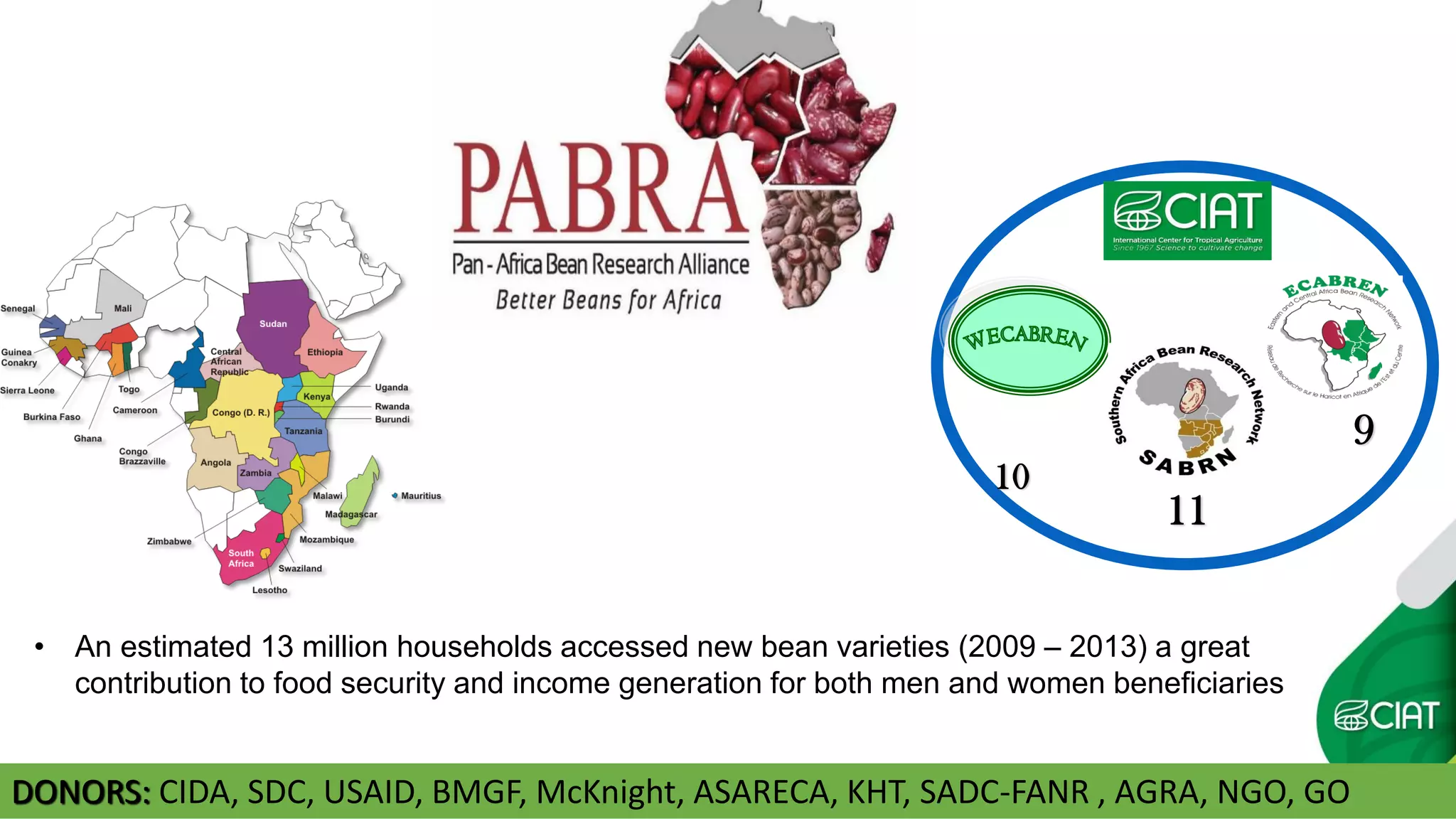
10
9
11
DONORS: CIDA, SDC, USAID, BMGF, McKnight, ASARECA, KHT, SADC-FANR , AGRA, NGO, GO
• An estimated 13 million households accessed new bean varieties (2009 – 2013) a great
contribution to food security and income generation for both men and women beneficiaries
PABRA Breeding strategy
• Diverse market classes
• Diverse constraints
• Diverse research priorities
• Limited resources
• Unequal capacity
Market class Countries*** where the bean types are
of high or moderate importance
A1. Red Mottled UG, KE, DRC, TZ, Su, S.Su, CAM, MD, BU,
ET, RW, MW, ZM, ZIM, GC, CB
AIIa. Large Red Kidneys TZ, KE, RW, MD, ET, CAM, BU, UG, DRC
AIIb. Small & Medium Reds ET, KE, TZ, RW, DRC, LE, ZIM
IIIa. Yellow BU, DRC, DRC, RW, TZ, KE, UG, MD
IIIb. Brown BU, DRC, RW, TZ, KE, MD
IIIc. Tan/Khaki TZ, DRC, RW, RW, UG, BU
IV a. Pinto KE, UG, MD, RSA
IV b. Sugars UU, DRC, KE, RW, BU, RSA, ZIM, ZM, MW
IV c. Carioaca KE, TZ, DRC, MD, RSA
Va. Navy (Cam, DRC, ET, RW, KE, DRC, MD and WECABREN
Vb. Large white kidney MD, DRC, ET, RW, WECABREN, SU, TZ
VIa. Purples/ Mwezimoja
types
TZ, KE, MD
VIb. Blacks DRC, UG, KE, TZ, SU, MD, MOZ
VII. Climbers RW, BU, DRC, BU, UG, KE, ET, TZ, MW,
SW, MOZ, ZAM, SW, RSA, AN, CAM
BREEDING APPROACH
Shared breeding responsibilities
under PABRA:
• CIAT Headquarter breeding
program in Colombia
• Regional breeding programs of
ECABREN and SABRN
• National bean programs
responsible for different types of
beans
• Various universities and
advanced research institutes
(ARIs).
Uganda
Kenya
Rwanda
DR Congo
S. Africa
Malawi
Zambia
Madagascar
Ethiopi
a
Kenya
S. Africa
Ethiopia
S.
Tanzania
Tanzania
ZimbabweDark Red
Kidney
Climbing
Beans
Snap
Beans
(French)
Large
White
Small
White
Carioca
(small
striped)
Sugar,
Tan &
Yellow
Pinto
Small
Red
Uganda,
Malawi Large
Red
Mottled
Ethiopia
S. Africa
Regional Networks/CIAT
Strategic Research
Backstopping, Technical
Support and Capacity
Building
CIAT LAC
PABRA countries without active
Breeding Programs: ECABREN:
Burundi and Sudan, SABRN: Angola,
SDRC, Lesotho, Mauritius, and
Swaziland; WECABREN: Cameroon,
Mali, Central Afr Rep, Ghana, Senegal,
Togo, Burkina Faso, Guinea, S/Leone,
Congo
Universitie
s/ARI
Aim and outputs of PABRA’S Breeding Program
To develop market demanded resilient bean
germplasm (adapted to fluctuations and
extremes of climatic, edaphic factors, pests and
diseases) and maintain stable bean production
and quality in the presence of diverse stresses;
enhancing the capacities of the communities to
cope with stresses
CIAT Uganda PABRA Staff
• Uganda: Five Scientists (Plant breeder, Plant Pathologist, Impact
Assessment; 1, Agricultural Economics;1, M & E; 1)
• Molecular Genetist/breeder, 2 Senior Breeders
• Nutritionist, Market specialist, Agronomist, seed system specialists
• Support Staff:
• Research
• Research Associates (Plant pathologists; 2, Plant breeder; 1, Agricultural
economist; 1, Nutrition; 1, Database officer; 1)
• Research Assistants (Molecular biologist; 1)
• Technical Assistants (Plant pathology/plant breeding; 9)
• Casual laborers >10 (wages)
BPAT Observations (2015)
• The BMS tool has been used by the CIAT dry bean program in Uganda for over two years.
• This program breeds for seven unique market classes (bush and climbers) responding to
ECABREN needs
i. Large-medium red mottled
ii. Large-medium reds
iii. Small reds
iv. Small whites
v. Large whites
vi. Large-medium seeded Sugar beans
vii. Large-medium Yellow beans
• Yield trials grown at 3 locations for two seasons in one year: Kawanda, SW Uganda (Kachwekno),
and NW Tanzania before distribution to partners
• Capable national breeding programs in Uganda, Kenya, Rwanda, Ethiopia, and Tanzania. University
programs exist at the University of Nairobi, Egerton, and SUA in Tanzania. All participate in the
PABRA network.
• For standard analyses, FTA Plant Cards are used for leaf samples without the need for
lyophilization.
• For whole genome sequencing and other high density mapping, leaf punches are used to have
more and higher quality DNA. A lyophilizer is available to use as needed
Key Findings - Positive
Institutional capacity
• Qualified breeder
• Pathologist support
• Seed systems support: Jean Claude Rubyogo, has more than 20 years of
relevant experience in seed systems and diffusion studies
• Nutrition and acceptability studies are led by Dr. Mercy Lung'aho who works
closely with Nutrition contact persons in the bean programs
• Two PhD students and three MSc students from Makerere
• RA breeder (MSc), 1 RA–Biotechnology (BSc), 2 RA pathologists (MSc), 1
senior technician, 3 technicians, and 2 assistant technicians in dry bean
breeding at Kawanda
• The support staff have extensive experience and training. Six support staff are
fully trained in BMS and are using this tool. Continuous training offered by
CIAT
Key Findings - Positive Institutional capacity
• Clare coordinates the PABRA breeding efforts and has excellent connections to
all of the national programs in ECA.
• Clare and Rowland Chirwa (dry bean breeder Malawi) share coordination and
efforts in WCA.
• Dropbox extensively used to backup and share information globally. Although
the system is good, it is not the same as a global database that can be mined
efficiently.
• For released varieties, CIAT has an excellent global database for
characterization. However for unreleased lines, characterization is in Excel
only. The tool should be expanded to include unreleased lines.
• Uganda National Program, NARO, has extensive facilities and staffing at both at
Kawanda and Namulonge in Uganda. CIAT program interacts routinely with
these NARO staff and NARO avails research facilities to CIAT on request
Positive Findings - Research facilities
• Seed Storage: The cold store (160 SQMT)
is well-organized with stable temperature
(15°C) and humidity capable of
maintaining viability for more than 2
years
• Labels and barcodes are used for seed
produced in 2014.
• Accurate seed inventory information
exists in BMS
• Three mesh houses with about 500
SQMT are used extensively by the CIAT
program in Kawanda.
• Fields
• Pathology and biotechnology lab
Negative Findings and recommendations
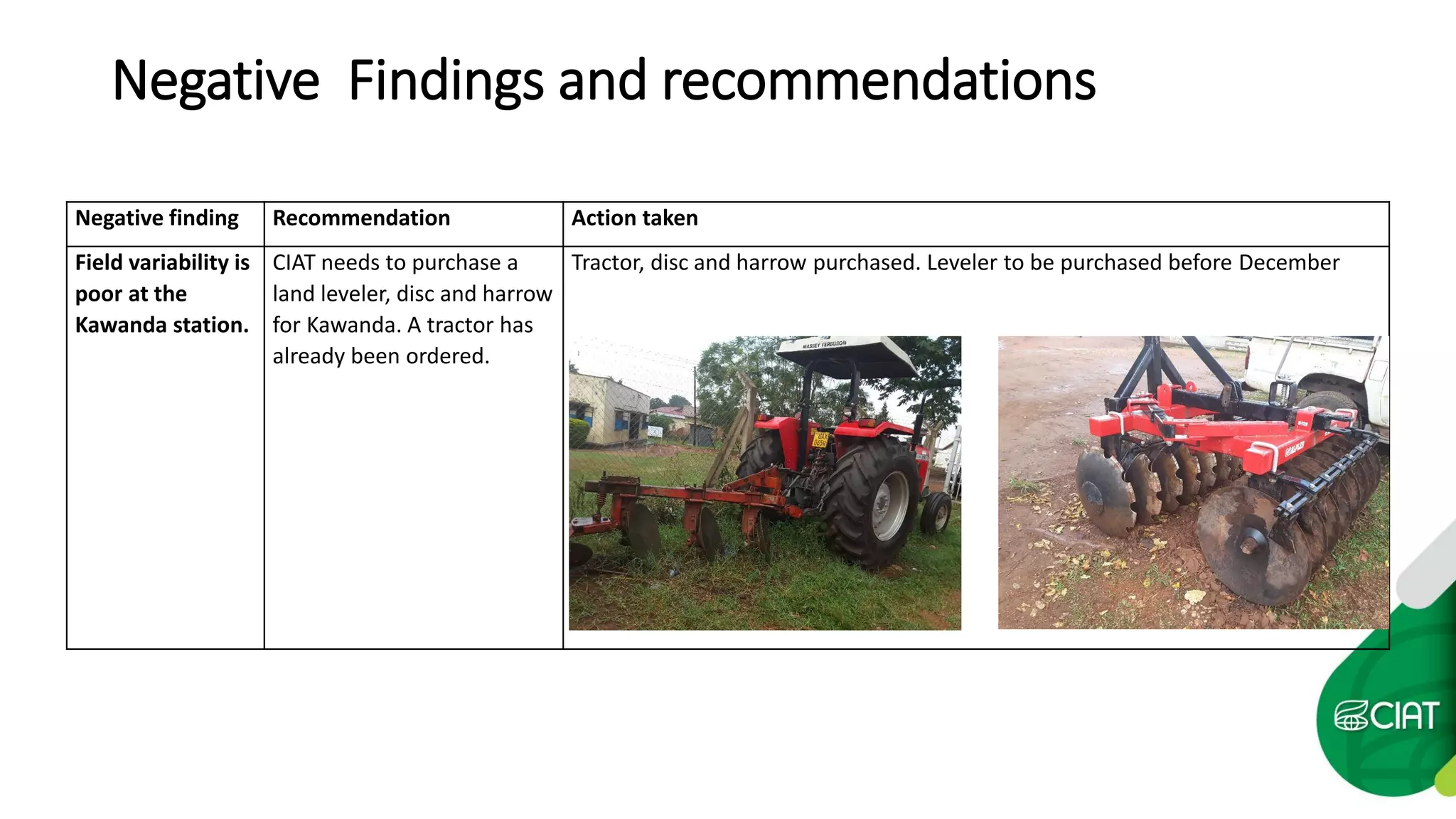
Negative finding Recommendation Action taken
Field variability is
poor at the
Kawanda station.
CIAT needs to purchase a
land leveler, disc and harrow
for Kawanda. A tractor has
already been ordered.
Tractor, disc and harrow purchased. Leveler to be purchased before December
Finding Recommendation Action
Uganda program
currently only
accomplishes two
generations per year.
To accomplish 3 generations per year,
increased work space and drying
equipment is needed to reduce time
between harvest and replanting.
This nursery needs to be at a location
warmer and dryer than Kawanda.
Irrigation equipment is needed.
Movable Drying shade acquired
Considering a site in northern Uganda
Irrigation facility acquired
Four generations currently achieved
Finding Recommendation Action
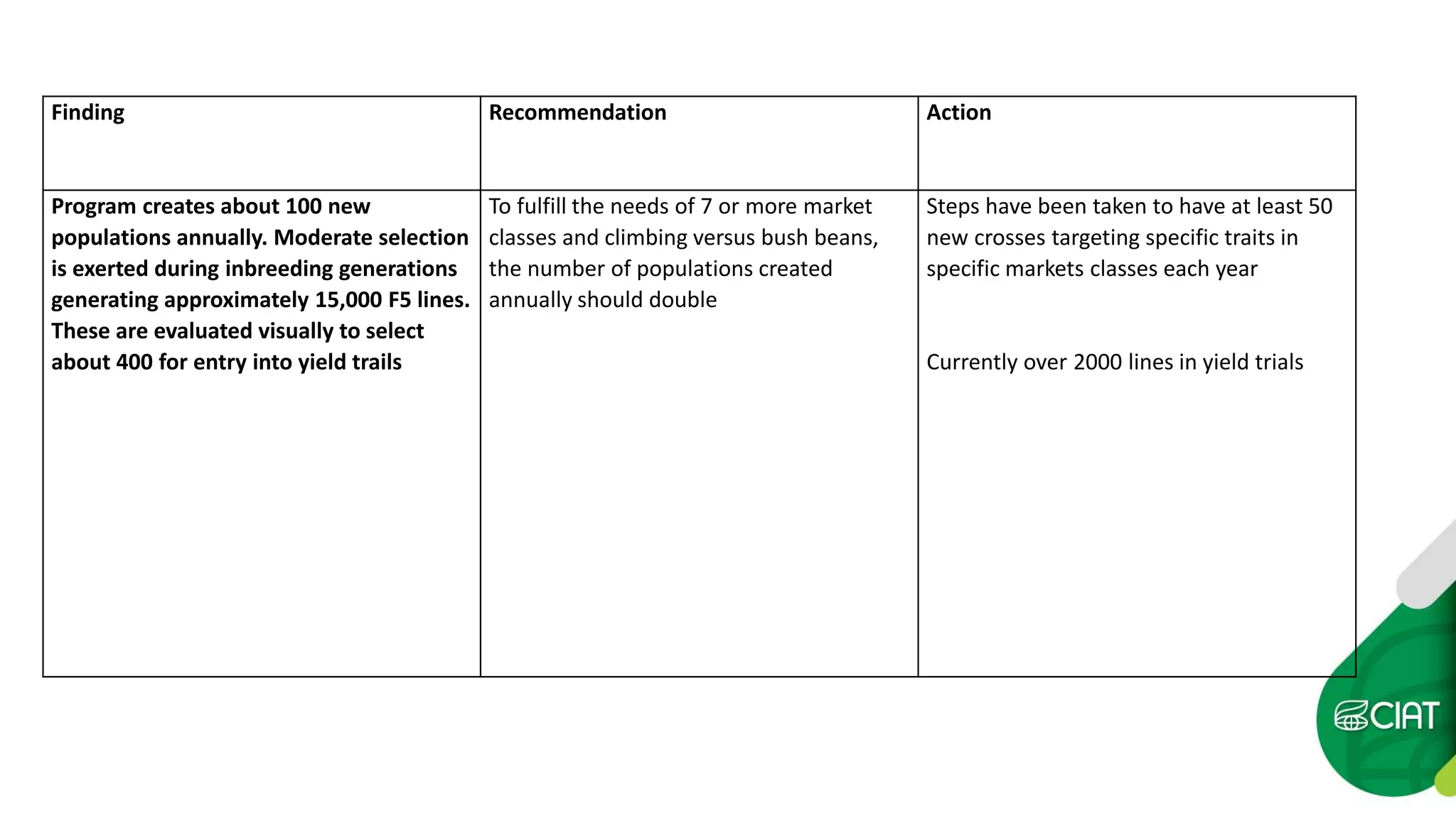
Program creates about 100 new
populations annually. Moderate selection
is exerted during inbreeding generations
generating approximately 15,000 F5 lines.
These are evaluated visually to select
about 400 for entry into yield trails
To fulfill the needs of 7 or more market
classes and climbing versus bush beans,
the number of populations created
annually should double
Steps have been taken to have at least 50
new crosses targeting specific traits in
specific markets classes each year
Currently over 2000 lines in yield trials
Findings Recommendations Action
Currently about 5 different PYTs are
evaluated annually with an average
80 new lines in each (up to 400 lines
are evaluated). Selection intensity
from the current PYTs is low (50%) to
minimize reduction of genetic
variability needed in various agro
climactic zones
The number of entries in PYT should
be increased at least 100%.
To date number of PYT’s have been
tripled
Finding Recommendation Action
A growth chamber has previously
been proposed, but has not yet been
approved. It would be used primarily
for pathology.
None A temperature controlled foliar disease screening chamber
has been installed.
Findings Recommendations Action
The use of molecular
markers currently (2000
samples annually) is too
low to have a significant
impact. These current labs
are very good, but samples
currently analyzed by
electrophoresis are scored
manually.
The plans are to sample approximately
30,000 per year in 2018. Lab space is
adequate, but robotized sample
handling would be needed. Kawanda
should switch to modern technologies
with automated reading capabilities
(Chip).
Kawanda could be a regional hub,
including other species. All released
varieties need to have a high density
fingerprint (not done at present).
GBS-Cornell University
SNP genotyping-KBioscience UK
Common genotyping facility for the CGIAR
Finding Recommendation Action
Drought is a major focus of dry
beans in ESA but there is no one
leading these efforts. There is too
much rainfall in Kawanda to be a
useful location for these studies.
A physiologist is needed for drought
studies for an as yet undetermined
location in ESA.
Two rainout shelters are needed: 15
x 30 m for each.
Drought trials being conducted off
season but surprise showers are very
common making this inadequate
New site being sought
Negative Finding
• Facilities for Foundation Seed do not exist in either the national or CIAT
programs in Africa. Threshing and cleaning are done by manually. This
limits speed of dissemination.
• The needs for foundation seed are complicated greatly by the large
number of dry bean market classes that differ widely between different
countries.
• Recommendation: Building a modern centralized foundation seed
facility in addition to de-centralized facilities would have great value
in purity and speed of adoption. This facility and staff could serve
multiple crops and institutions in ESA. This function could be
coordinated by CIAT if located in Uganda but serve various crops
covered by CGIAR.
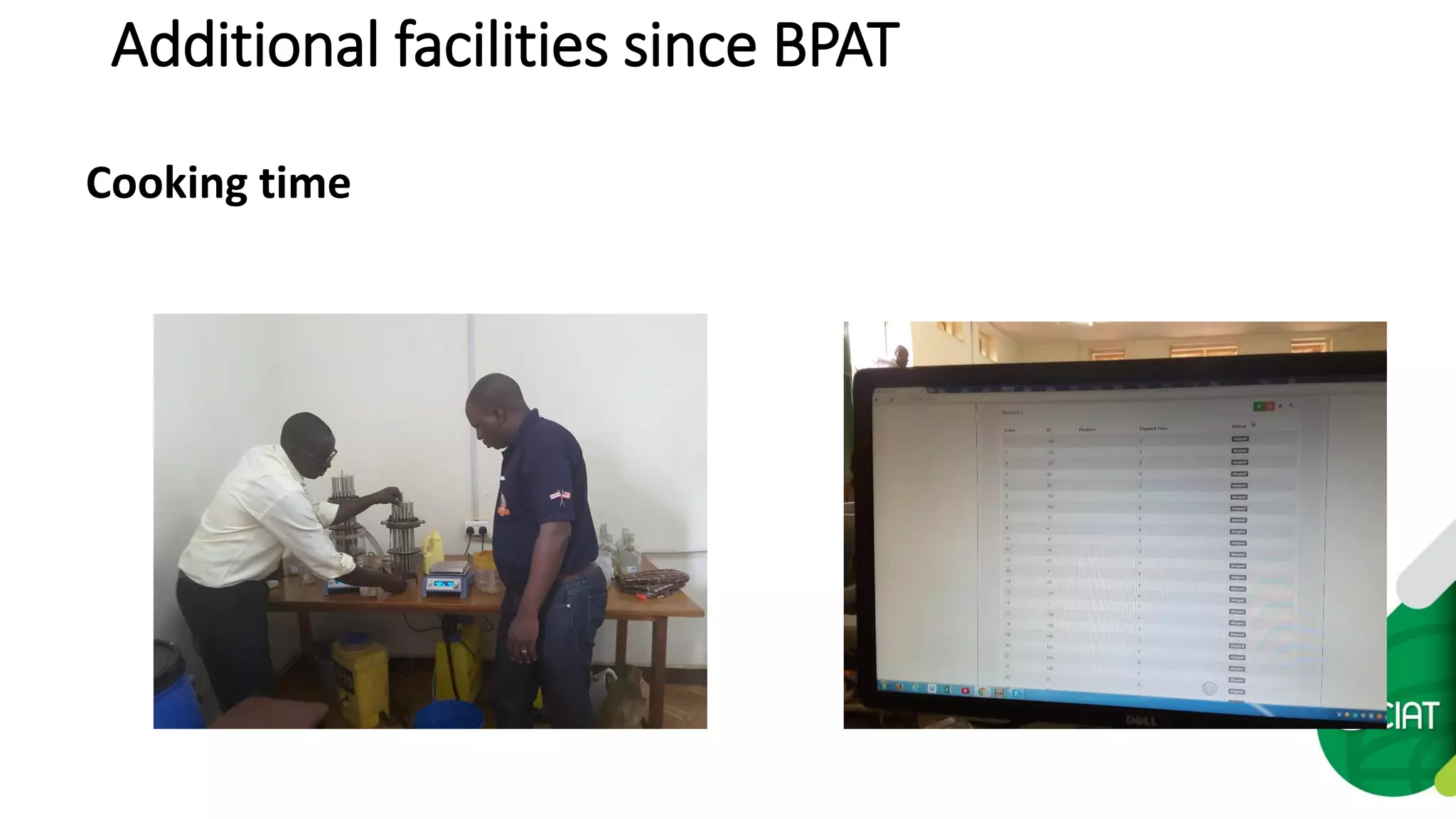
Additional facilities since BPAT
Cooking time
Dry bean (non
more than 3
months harvested)
Canning facility UGANDA
Cooling – Room
Temperature
Hot soaked
• 30 min at
87 °C
• 30 min at 87 °C
Canning continued
UGANDA BEAN
BOILING BRINE
Stack can uniformly in
the basket
Autoclave for 30 minutes at 121°C.
Add boilling brine
solutions, leaving
1-inch headspace
STORE 4 WEEKS
MINIMUM AT
ROOM TEMPETURE
Phenotyping Common Beans for Symbiotic Nitrogen
Fixation (SNF):Protocol for field evaluation
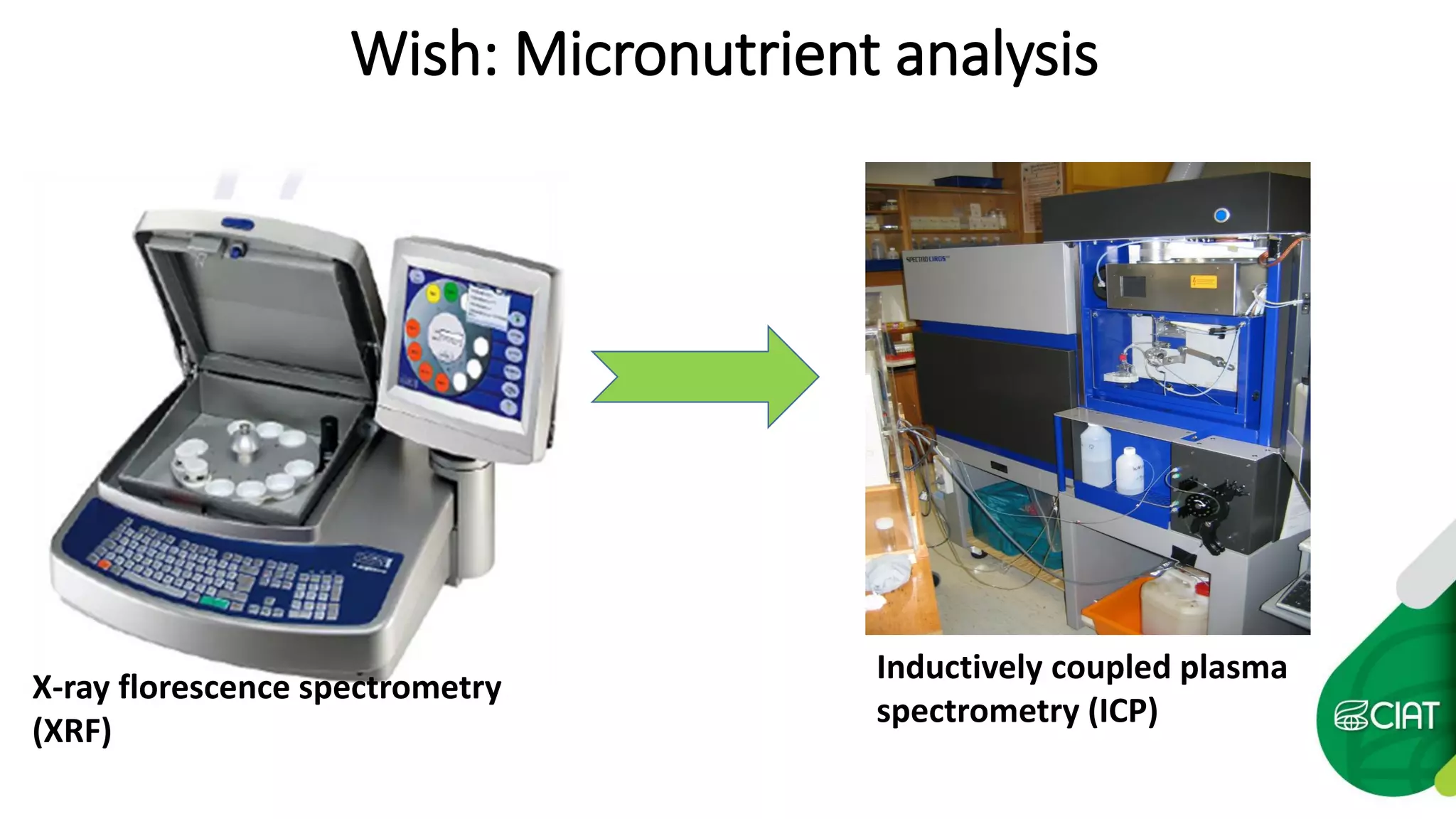
Inductively coupled plasma
spectrometry (ICP)
X-ray florescence spectrometry
(XRF)
Wish: Micronutrient analysis
Wish
• More Human capacity –Breeder, physiologist, agronomist
Thank you

TL III_GG_PIP_BPAT_CIAT_Uganda_Beans

  • 1.
    c.mukankusi@cgiar.org CIAT UGANDA BEANBREEDING PROGRAM Mukankusi Clare TLIII PIP WORKSHOP 1-09-2016
  • 2.
    Common Bean Productionand Yield in ESA Annual % Yield Growth by Decades 2.07 - 1.90 1.97 Major food crop Rapid evolution from traditional subsistence to a market oriented modern sector crop • Stagnant yields (0.4- 1 tha-1 for bush beans and 0.9-2.5 tha-1 for climbers • Potential yields: bush; 2-3 tha-1; climbers; 4-5 tha-1
  • 3.
    Constraints to BeanProduction in Africa • ABIOTIC : • Drought • Excessive rainfall • Heat • Cold • Low soil fertility • BIOTIC: • Pests (field and post harvest) • Diseases (Fungal, bacterial and viral) • Other factors: • Population pressure – migration to drier areas, less fertile • Bean utilisation and marketability • Perceptions • Limited support Diseases Pests Drought
  • 4.
    10 9 11 DONORS: CIDA, SDC,USAID, BMGF, McKnight, ASARECA, KHT, SADC-FANR , AGRA, NGO, GO • An estimated 13 million households accessed new bean varieties (2009 – 2013) a great contribution to food security and income generation for both men and women beneficiaries
  • 5.
    PABRA Breeding strategy •Diverse market classes • Diverse constraints • Diverse research priorities • Limited resources • Unequal capacity Market class Countries*** where the bean types are of high or moderate importance A1. Red Mottled UG, KE, DRC, TZ, Su, S.Su, CAM, MD, BU, ET, RW, MW, ZM, ZIM, GC, CB AIIa. Large Red Kidneys TZ, KE, RW, MD, ET, CAM, BU, UG, DRC AIIb. Small & Medium Reds ET, KE, TZ, RW, DRC, LE, ZIM IIIa. Yellow BU, DRC, DRC, RW, TZ, KE, UG, MD IIIb. Brown BU, DRC, RW, TZ, KE, MD IIIc. Tan/Khaki TZ, DRC, RW, RW, UG, BU IV a. Pinto KE, UG, MD, RSA IV b. Sugars UU, DRC, KE, RW, BU, RSA, ZIM, ZM, MW IV c. Carioaca KE, TZ, DRC, MD, RSA Va. Navy (Cam, DRC, ET, RW, KE, DRC, MD and WECABREN Vb. Large white kidney MD, DRC, ET, RW, WECABREN, SU, TZ VIa. Purples/ Mwezimoja types TZ, KE, MD VIb. Blacks DRC, UG, KE, TZ, SU, MD, MOZ VII. Climbers RW, BU, DRC, BU, UG, KE, ET, TZ, MW, SW, MOZ, ZAM, SW, RSA, AN, CAM
  • 6.
    BREEDING APPROACH Shared breedingresponsibilities under PABRA: • CIAT Headquarter breeding program in Colombia • Regional breeding programs of ECABREN and SABRN • National bean programs responsible for different types of beans • Various universities and advanced research institutes (ARIs). Uganda Kenya Rwanda DR Congo S. Africa Malawi Zambia Madagascar Ethiopi a Kenya S. Africa Ethiopia S. Tanzania Tanzania ZimbabweDark Red Kidney Climbing Beans Snap Beans (French) Large White Small White Carioca (small striped) Sugar, Tan & Yellow Pinto Small Red Uganda, Malawi Large Red Mottled Ethiopia S. Africa Regional Networks/CIAT Strategic Research Backstopping, Technical Support and Capacity Building CIAT LAC PABRA countries without active Breeding Programs: ECABREN: Burundi and Sudan, SABRN: Angola, SDRC, Lesotho, Mauritius, and Swaziland; WECABREN: Cameroon, Mali, Central Afr Rep, Ghana, Senegal, Togo, Burkina Faso, Guinea, S/Leone, Congo Universitie s/ARI
  • 7.
    Aim and outputsof PABRA’S Breeding Program To develop market demanded resilient bean germplasm (adapted to fluctuations and extremes of climatic, edaphic factors, pests and diseases) and maintain stable bean production and quality in the presence of diverse stresses; enhancing the capacities of the communities to cope with stresses
  • 8.
    CIAT Uganda PABRAStaff • Uganda: Five Scientists (Plant breeder, Plant Pathologist, Impact Assessment; 1, Agricultural Economics;1, M & E; 1) • Molecular Genetist/breeder, 2 Senior Breeders • Nutritionist, Market specialist, Agronomist, seed system specialists • Support Staff: • Research • Research Associates (Plant pathologists; 2, Plant breeder; 1, Agricultural economist; 1, Nutrition; 1, Database officer; 1) • Research Assistants (Molecular biologist; 1) • Technical Assistants (Plant pathology/plant breeding; 9) • Casual laborers >10 (wages)
  • 9.
    BPAT Observations (2015) •The BMS tool has been used by the CIAT dry bean program in Uganda for over two years. • This program breeds for seven unique market classes (bush and climbers) responding to ECABREN needs i. Large-medium red mottled ii. Large-medium reds iii. Small reds iv. Small whites v. Large whites vi. Large-medium seeded Sugar beans vii. Large-medium Yellow beans • Yield trials grown at 3 locations for two seasons in one year: Kawanda, SW Uganda (Kachwekno), and NW Tanzania before distribution to partners • Capable national breeding programs in Uganda, Kenya, Rwanda, Ethiopia, and Tanzania. University programs exist at the University of Nairobi, Egerton, and SUA in Tanzania. All participate in the PABRA network. • For standard analyses, FTA Plant Cards are used for leaf samples without the need for lyophilization. • For whole genome sequencing and other high density mapping, leaf punches are used to have more and higher quality DNA. A lyophilizer is available to use as needed
  • 10.
    Key Findings -Positive Institutional capacity • Qualified breeder • Pathologist support • Seed systems support: Jean Claude Rubyogo, has more than 20 years of relevant experience in seed systems and diffusion studies • Nutrition and acceptability studies are led by Dr. Mercy Lung'aho who works closely with Nutrition contact persons in the bean programs • Two PhD students and three MSc students from Makerere • RA breeder (MSc), 1 RA–Biotechnology (BSc), 2 RA pathologists (MSc), 1 senior technician, 3 technicians, and 2 assistant technicians in dry bean breeding at Kawanda • The support staff have extensive experience and training. Six support staff are fully trained in BMS and are using this tool. Continuous training offered by CIAT
  • 11.
    Key Findings -Positive Institutional capacity • Clare coordinates the PABRA breeding efforts and has excellent connections to all of the national programs in ECA. • Clare and Rowland Chirwa (dry bean breeder Malawi) share coordination and efforts in WCA. • Dropbox extensively used to backup and share information globally. Although the system is good, it is not the same as a global database that can be mined efficiently. • For released varieties, CIAT has an excellent global database for characterization. However for unreleased lines, characterization is in Excel only. The tool should be expanded to include unreleased lines. • Uganda National Program, NARO, has extensive facilities and staffing at both at Kawanda and Namulonge in Uganda. CIAT program interacts routinely with these NARO staff and NARO avails research facilities to CIAT on request
  • 12.
    Positive Findings -Research facilities • Seed Storage: The cold store (160 SQMT) is well-organized with stable temperature (15°C) and humidity capable of maintaining viability for more than 2 years • Labels and barcodes are used for seed produced in 2014. • Accurate seed inventory information exists in BMS • Three mesh houses with about 500 SQMT are used extensively by the CIAT program in Kawanda. • Fields • Pathology and biotechnology lab
  • 13.
    Negative Findings andrecommendations Negative finding Recommendation Action taken Field variability is poor at the Kawanda station. CIAT needs to purchase a land leveler, disc and harrow for Kawanda. A tractor has already been ordered. Tractor, disc and harrow purchased. Leveler to be purchased before December
  • 14.
    Finding Recommendation Action Ugandaprogram currently only accomplishes two generations per year. To accomplish 3 generations per year, increased work space and drying equipment is needed to reduce time between harvest and replanting. This nursery needs to be at a location warmer and dryer than Kawanda. Irrigation equipment is needed. Movable Drying shade acquired Considering a site in northern Uganda Irrigation facility acquired Four generations currently achieved
  • 15.
    Finding Recommendation Action Programcreates about 100 new populations annually. Moderate selection is exerted during inbreeding generations generating approximately 15,000 F5 lines. These are evaluated visually to select about 400 for entry into yield trails To fulfill the needs of 7 or more market classes and climbing versus bush beans, the number of populations created annually should double Steps have been taken to have at least 50 new crosses targeting specific traits in specific markets classes each year Currently over 2000 lines in yield trials
  • 16.
    Findings Recommendations Action Currentlyabout 5 different PYTs are evaluated annually with an average 80 new lines in each (up to 400 lines are evaluated). Selection intensity from the current PYTs is low (50%) to minimize reduction of genetic variability needed in various agro climactic zones The number of entries in PYT should be increased at least 100%. To date number of PYT’s have been tripled
  • 17.
    Finding Recommendation Action Agrowth chamber has previously been proposed, but has not yet been approved. It would be used primarily for pathology. None A temperature controlled foliar disease screening chamber has been installed.
  • 18.
    Findings Recommendations Action Theuse of molecular markers currently (2000 samples annually) is too low to have a significant impact. These current labs are very good, but samples currently analyzed by electrophoresis are scored manually. The plans are to sample approximately 30,000 per year in 2018. Lab space is adequate, but robotized sample handling would be needed. Kawanda should switch to modern technologies with automated reading capabilities (Chip). Kawanda could be a regional hub, including other species. All released varieties need to have a high density fingerprint (not done at present). GBS-Cornell University SNP genotyping-KBioscience UK Common genotyping facility for the CGIAR
  • 19.
    Finding Recommendation Action Droughtis a major focus of dry beans in ESA but there is no one leading these efforts. There is too much rainfall in Kawanda to be a useful location for these studies. A physiologist is needed for drought studies for an as yet undetermined location in ESA. Two rainout shelters are needed: 15 x 30 m for each. Drought trials being conducted off season but surprise showers are very common making this inadequate New site being sought
  • 20.
    Negative Finding • Facilitiesfor Foundation Seed do not exist in either the national or CIAT programs in Africa. Threshing and cleaning are done by manually. This limits speed of dissemination. • The needs for foundation seed are complicated greatly by the large number of dry bean market classes that differ widely between different countries. • Recommendation: Building a modern centralized foundation seed facility in addition to de-centralized facilities would have great value in purity and speed of adoption. This facility and staff could serve multiple crops and institutions in ESA. This function could be coordinated by CIAT if located in Uganda but serve various crops covered by CGIAR.
  • 21.
    Additional facilities sinceBPAT Cooking time
  • 22.
    Dry bean (non morethan 3 months harvested) Canning facility UGANDA Cooling – Room Temperature Hot soaked • 30 min at 87 °C • 30 min at 87 °C
  • 23.
    Canning continued UGANDA BEAN BOILINGBRINE Stack can uniformly in the basket Autoclave for 30 minutes at 121°C. Add boilling brine solutions, leaving 1-inch headspace STORE 4 WEEKS MINIMUM AT ROOM TEMPETURE
  • 24.
    Phenotyping Common Beansfor Symbiotic Nitrogen Fixation (SNF):Protocol for field evaluation
  • 25.
    Inductively coupled plasma spectrometry(ICP) X-ray florescence spectrometry (XRF) Wish: Micronutrient analysis
  • 26.
    Wish • More Humancapacity –Breeder, physiologist, agronomist
  • 27.