Tired of not getting band 4 on TKT?
                                                             “I finally found a
                                                             powerful tool to
The purpose of this book is to serve as a tool to help TKT   practice and be
candidates to prepare in a better way to sit the TKT test
from Cambridge ESOL.
                                                             confident enough to
It is divided into three chapters, each covering a
module from the standard TKT test; it contains tasks
                                                             get the best at TKT.”
specifically designed to help candidates know the            George Thompson
structure and learn important tips to really get band 4
on this teaching knowledge qualification.                    English Teacher
                                                             Chelsea NY


           LIBARDO IELTS TOEFL TKT TOEIC FACEBOOK VERSION
INTRODUCTION

The purpose of this book is to be a helping tool in the process of training
candidates to take the Teaching Knowledge Test TKT.

The Teaching Knowledge Test (TKT) is a test from Cambridge ESOL about
teaching English to speakers of other languages. It aims to increase teachers'
confidence and enhance job prospects by focusing on the core teaching
knowledge needed by teachers of primary, secondary or adult learners,
anywhere in the world. This flexible and accessible award will help you to
understand:

      differentmethodologiesforteaching
      the 'language of teaching'
      the ways in which resources can be used
      the key aspects of lesson planning
      classroom management methods for different needs

TKT gives teachers a strong foundation in the core areas of teaching
knowledge needed in the English language teaching classroom. It is ideal for
all teachers, whatever their background and teaching experience, and is
also suitable for people who would like to teach English but do not yet have
a teaching position.
There are no formal entry requirements. However, anyone wishing to take TKT
is strongly advised to have at least an intermediate level of English — Level B1
of the Council of Europe's Common European Framework of Reference for
Languages (CEFR) — e.g. PET, IELTS band score of 4


Each unit consists of plenty of practice exercises and TKT tasks that are very
similar in format to what is evaluated in the real TKT test.


                                  LIBARDO GONZALEZ ALVAREZ
                                  SIT-TESOL

                                  MASTER IN APPLIED LINGUSTICS CANDIDATE

                                  TEACHER TRAINER


                                                                   Leyenda que describe una
                                                                   imagen o un gráfico.


LIBARDO IELTS TOEFL TKT TOEIC FACEBOOK VERSION
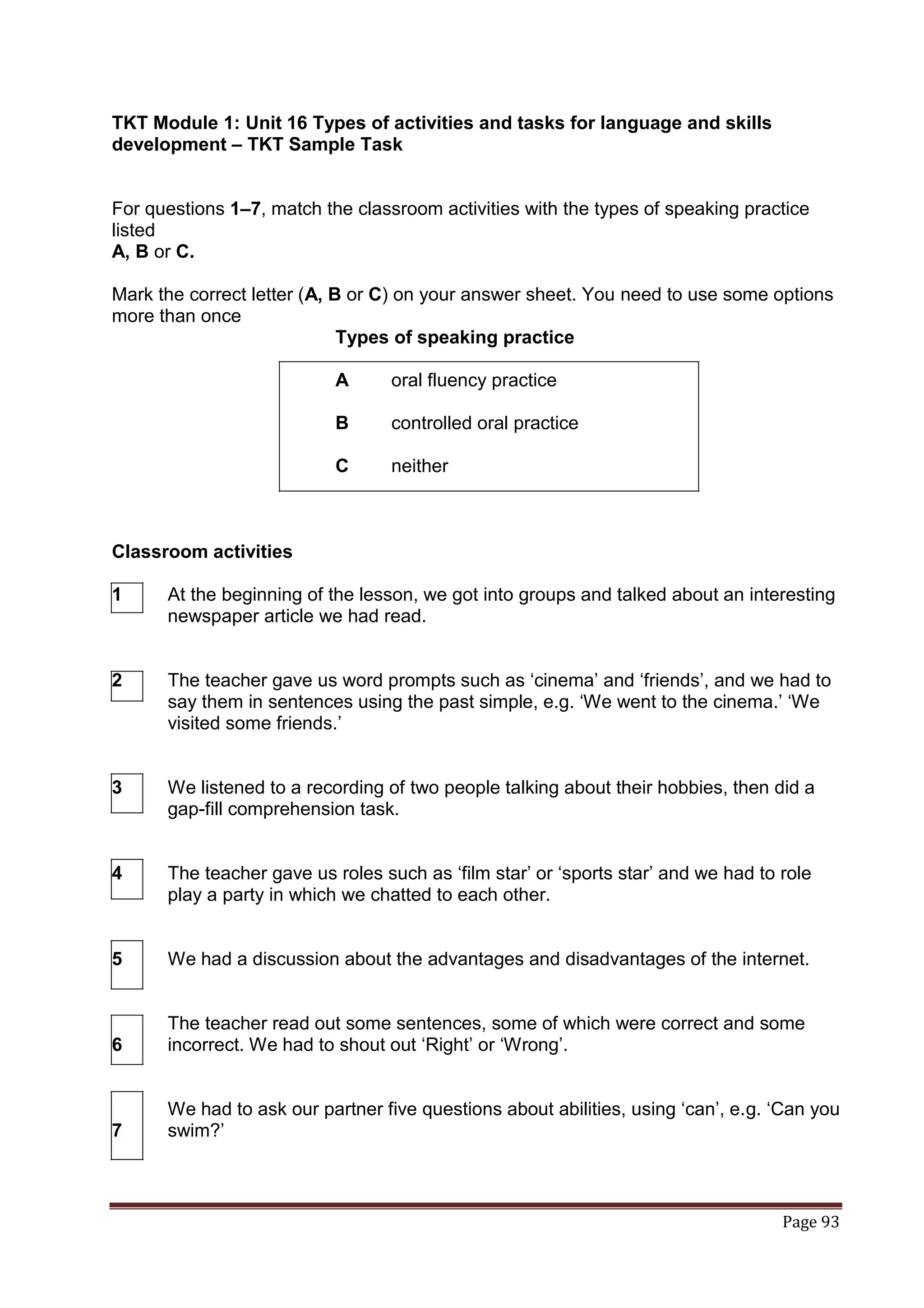
TKT Module 1: Describing language: Unit 1 Grammar – Participant‟s
Activity 1

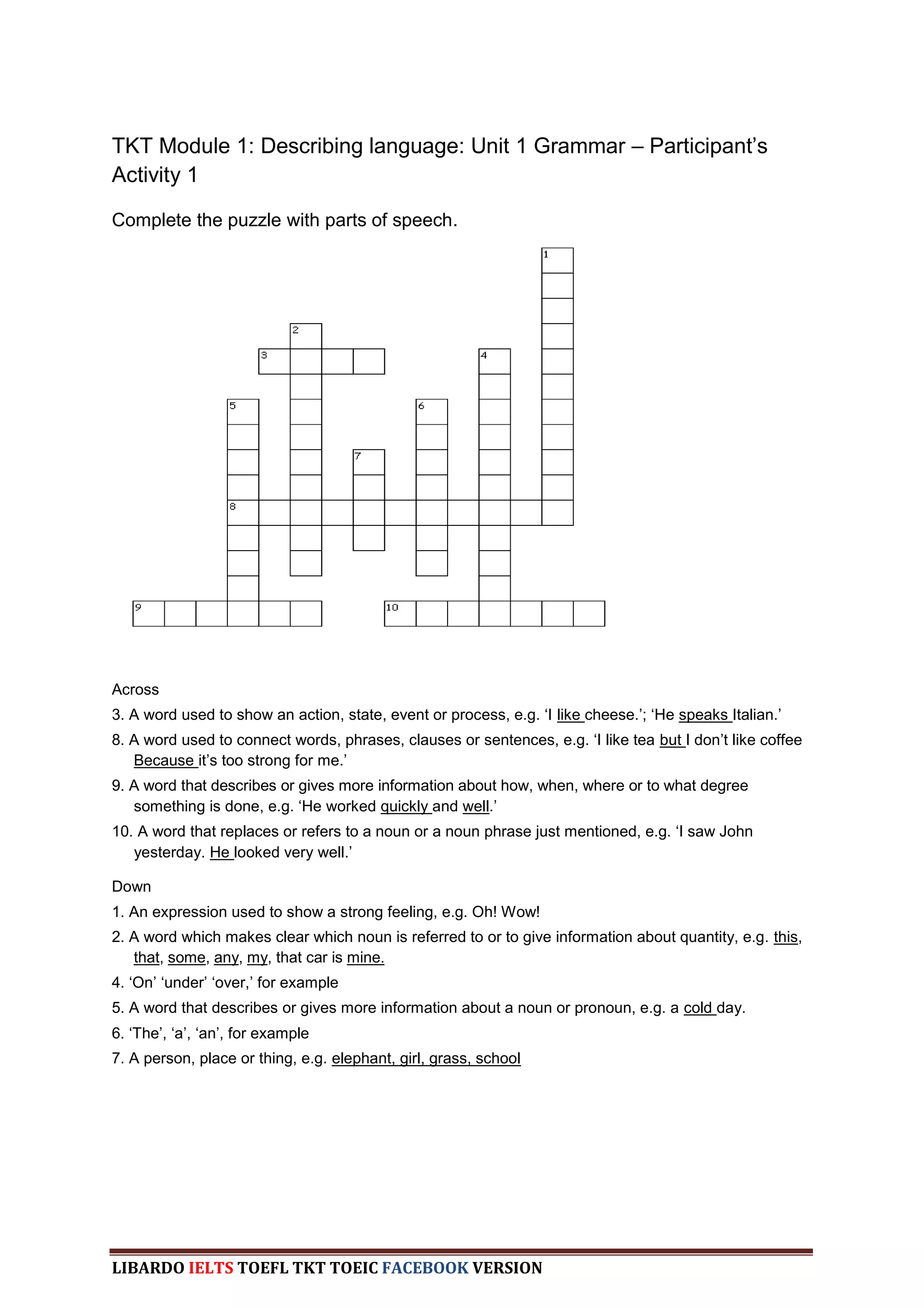
Complete the puzzle with parts of speech.


Across
3. A word used to show an action, state, event or process, e.g. „I like cheese.‟; „He speaks Italian.‟
8. A word used to connect words, phrases, clauses or sentences, e.g. „I like tea but I don‟t like coffee
   Because it‟s too strong for me.‟
9. A word that describes or gives more information about how, when, where or to what degree
   something is done, e.g. „He worked quickly and well.‟
10. A word that replaces or refers to a noun or a noun phrase just mentioned, e.g. „I saw John
   yesterday. He looked very well.‟

Down
1. An expression used to show a strong feeling, e.g. Oh! Wow!
2. A word which makes clear which noun is referred to or to give information about quantity, e.g. this,
   that, some, any, my, that car is mine.
4. „On‟ „under‟ „over,‟ for example
5. A word that describes or gives more information about a noun or pronoun, e.g. a cold day.
6. „The‟, „a‟, „an‟, for example
7. A person, place or thing, e.g. elephant, girl, grass, school


LIBARDO IELTS TOEFL TKT TOEIC FACEBOOK VERSION
TKT Module 1: Describing language: Unit 1 Grammar – Participant‟s
Activity 2

Exercise 1
Look at the underlined words in the sentences below and match them with the words
Participant‟s worksheet 1, given in the box.
from

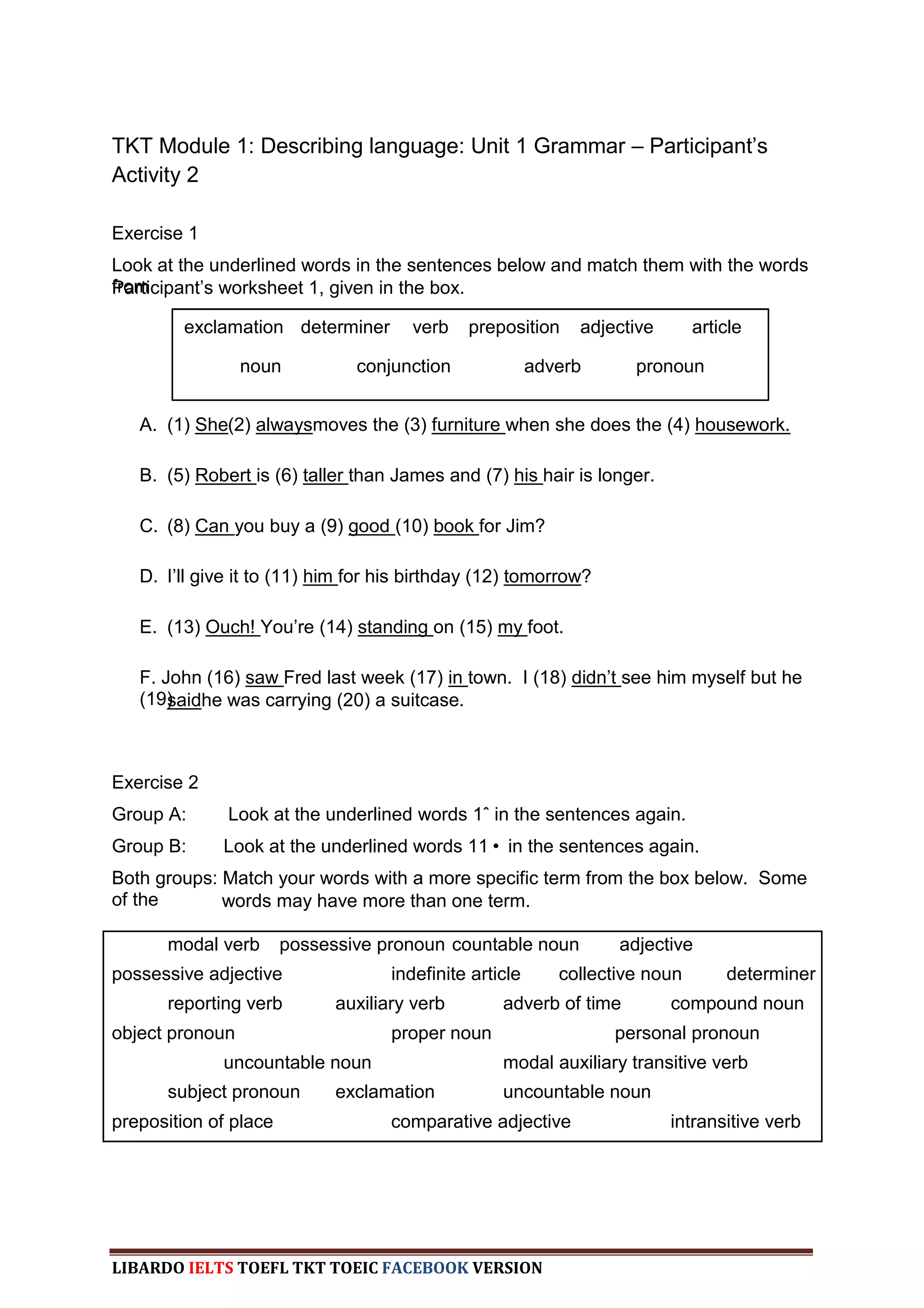
        exclamation determiner        verb    preposition     adjective       article

                 noun          conjunction               adverb      pronoun


   A. (1) She(2) alwaysmoves the (3) furniture when she does the (4) housework.

   B. (5) Robert is (6) taller than James and (7) his hair is longer.

   C. (8) Can you buy a (9) good (10) book for Jim?

   D. I‟ll give it to (11) him for his birthday (12) tomorrow?

   E. (13) Ouch! You‟re (14) standing on (15) my foot.

   F. John (16) saw Fred last week (17) in town. I (18) didn‟t see him myself but he
   (19)saidhe was carrying (20) a suitcase.


Exercise 2
Group A:      Look at the underlined words 1ˆ in the sentences again.
Group B:     Look at the underlined words 11• in the sentences again.
Both groups: Match your words with a more specific term from the box below. Some
of the       words may have more than one term.

      modal verb       possessive pronoun countable noun           adjective
possessive adjective                indefinite article      collective noun       determiner
      reporting verb         auxiliary verb        adverb of time         compound noun
object pronoun                      proper noun                   personal pronoun
             uncountable noun                      modal auxiliary transitive verb
      subject pronoun        exclamation           uncountable noun
preposition of place                comparative adjective                 intransitive verb


LIBARDO IELTS TOEFL TKT TOEIC FACEBOOK VERSION
TKT Module 1: Describing language: Unit 1 Grammar – Participant‟s
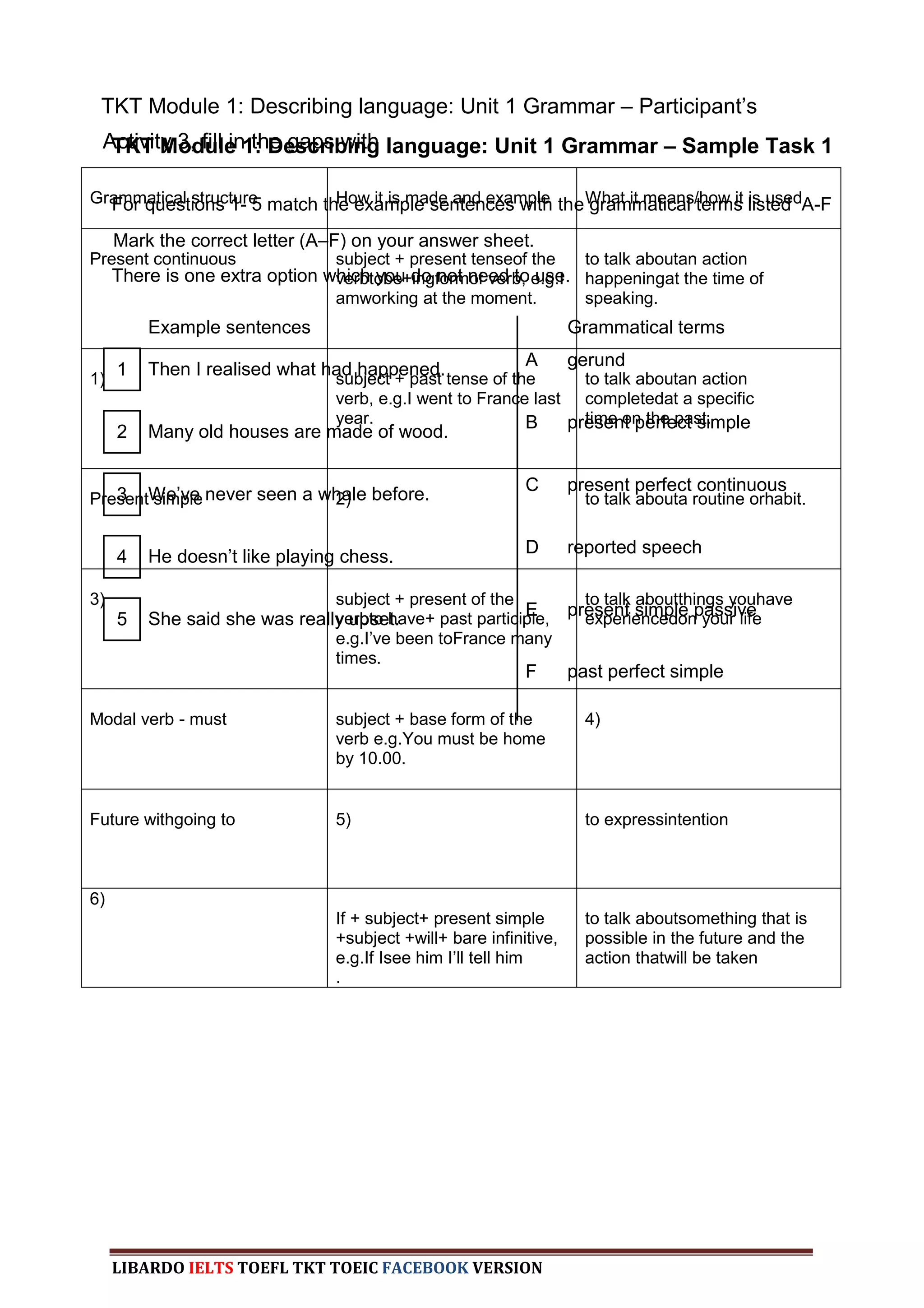
 Activity 3, fill in1: Describing language: Unit 1 Grammar – Sample Task 1
  TKT Module the gaps with

Grammatical structure match the example sentences with the What it means/how it listed A-F
  For questions 1- 5          How it is made and example   grammatical terms is used
     Mark the correct letter (A–F) on your answer sheet.
Present continuous              subject + present tenseof the        to talk aboutan action
     There is one extra option which you do not need to e.g.I happeningat the time of
                                verbtobe+ingformof verb, use.
                                amworking at the moment.             speaking.
         Example sentences                                         Grammatical terms
                                                       A           gerund
1)
     1   Then I realised what had happened. tense of the
                               subject + past                    to talk aboutan action
                                verb, e.g.I went to France last completedat a specific
                                year.                     B      time on the past.
                                                               present perfect simple
     2   Many old houses are made of wood.

                                                           C       present perfect continuous
PresentWe‟ve never seen a whale before.
   3 simple                2)                                        to talk abouta routine orhabit.

                                                           D       reported speech
     4   He doesn‟t like playing chess.

3)                              subject + present of the             to talk aboutthings youhave
     5                         verbto have+ past participle, present simple passive
         She said she was really upset.                 E      experiencedon your life
                                e.g.I‟ve been toFrance many
                                times.
                                                           F       past perfect simple

Modal verb - must               subject + base form of the           4)
                                verb e.g.You must be home
                                by 10.00.


Future withgoing to             5)                                   to expressintention


6)
                                If + subject+ present simple         to talk aboutsomething that is
                                +subject +will+ bare infinitive,     possible in the future and the
                                e.g.If Isee him I‟ll tell him        action thatwill be taken
                                .


     LIBARDO IELTS TOEFL TKT TOEIC FACEBOOK VERSION
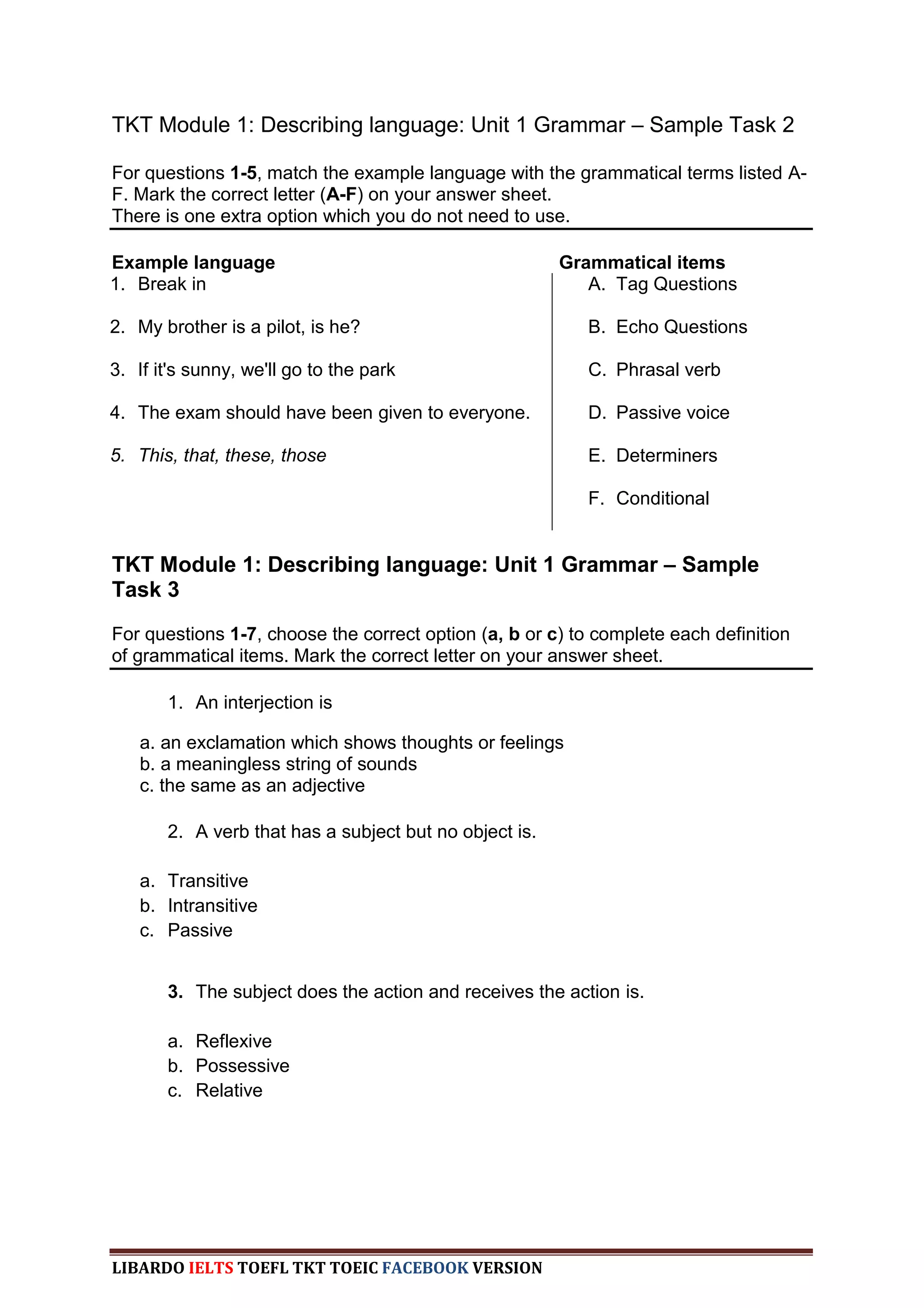
TKT Module 1: Describing language: Unit 1 Grammar – Sample Task 2

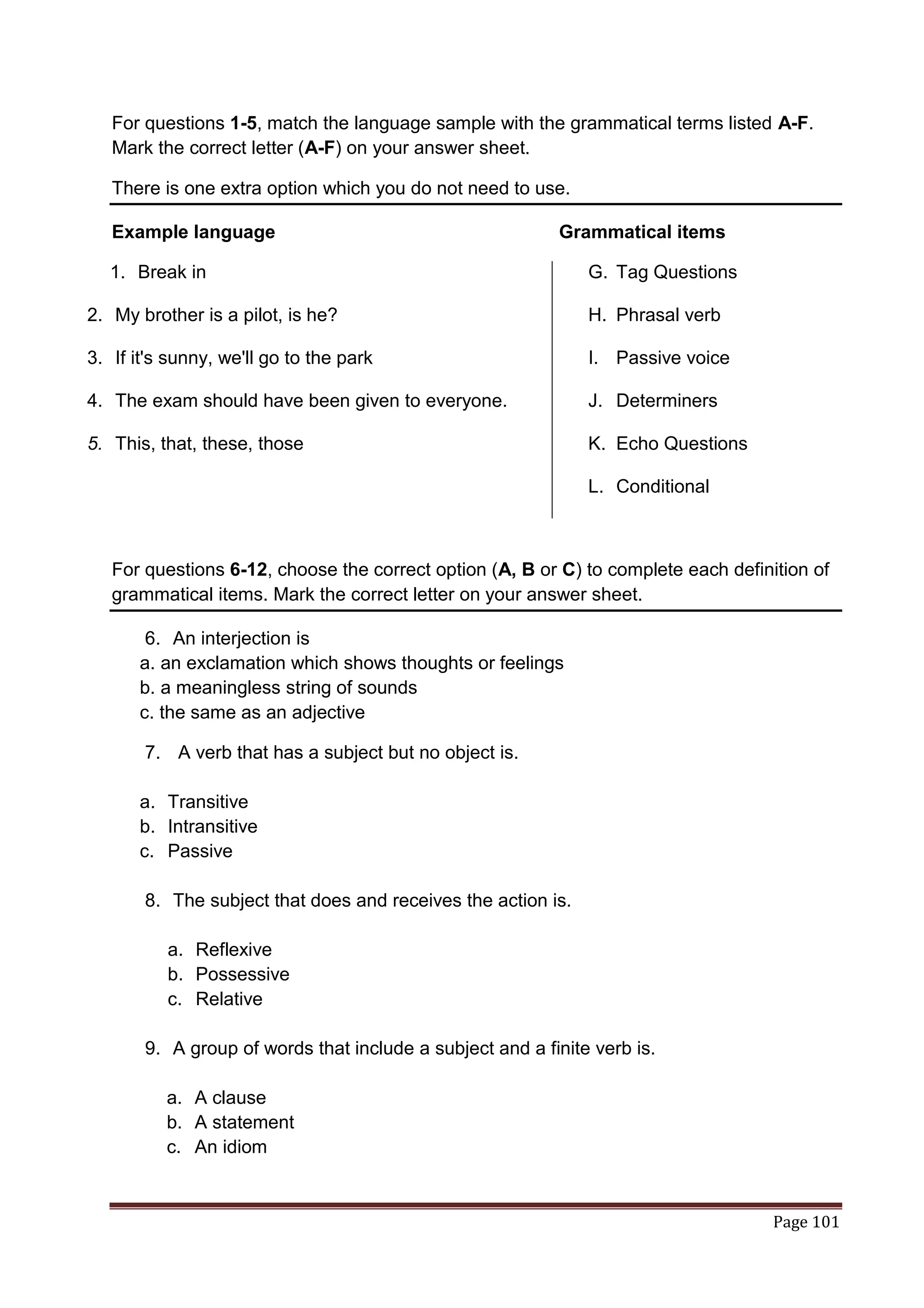
For questions 1-5, match the example language with the grammatical terms listed A-
F. Mark the correct letter (A-F) on your answer sheet.
There is one extra option which you do not need to use.

Example language                                        Grammatical items
1. Break in                                                A. Tag Questions

2. My brother is a pilot, is he?                           B. Echo Questions

3. If it's sunny, we'll go to the park                     C. Phrasal verb

4. The exam should have been given to everyone.            D. Passive voice

5. This, that, these, those                                E. Determiners

                                                           F. Conditional


TKT Module 1: Describing language: Unit 1 Grammar – Sample
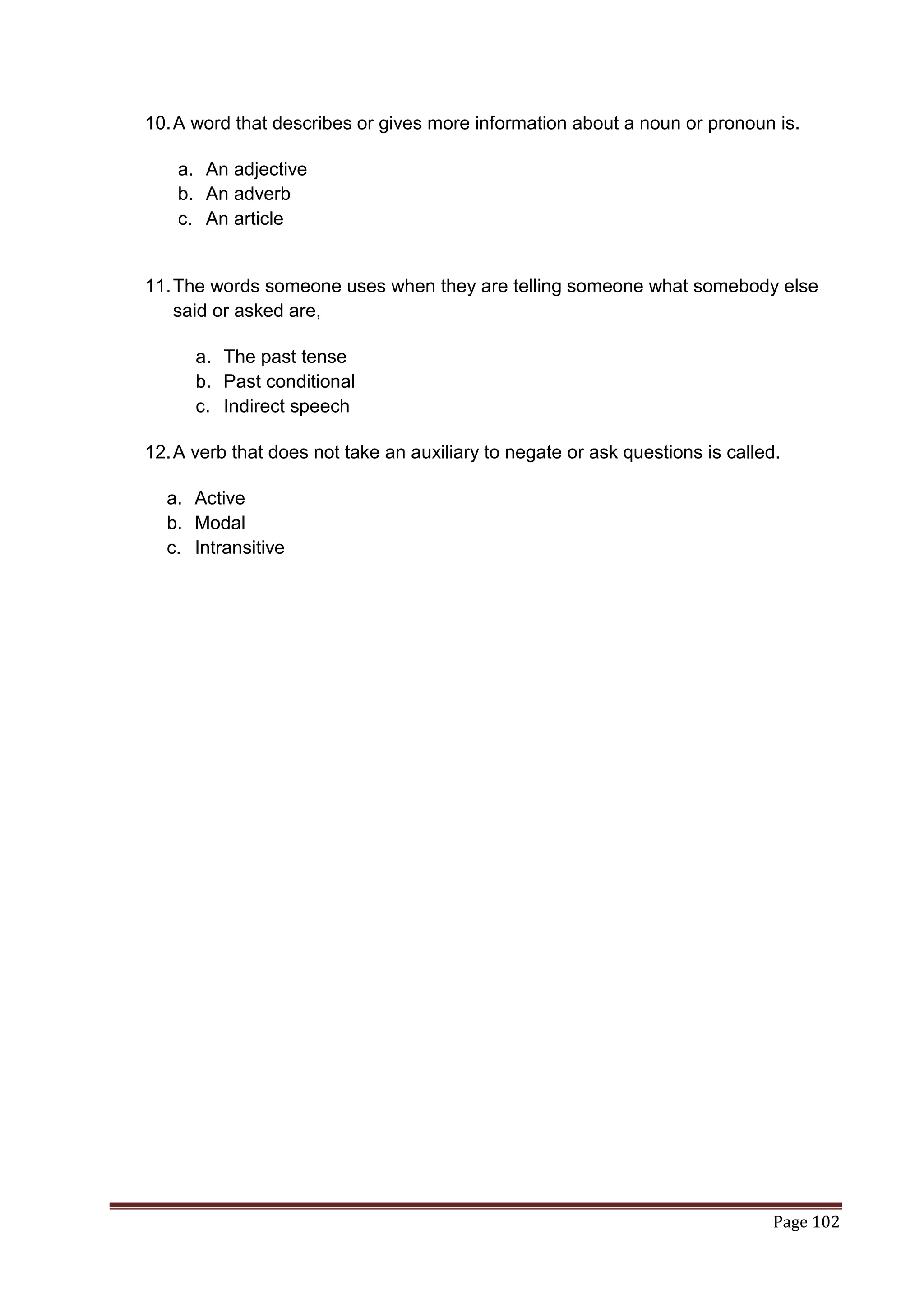
Task 3
For questions 1-7, choose the correct option (a, b or c) to complete each definition
of grammatical items. Mark the correct letter on your answer sheet.

       1. An interjection is

   a. an exclamation which shows thoughts or feelings
   b. a meaningless string of sounds
   c. the same as an adjective

       2. A verb that has a subject but no object is.

   a. Transitive
   b. Intransitive
   c. Passive


       3. The subject does the action and receives the action is.

       a. Reflexive
       b. Possessive
       c. Relative


LIBARDO IELTS TOEFL TKT TOEIC FACEBOOK VERSION
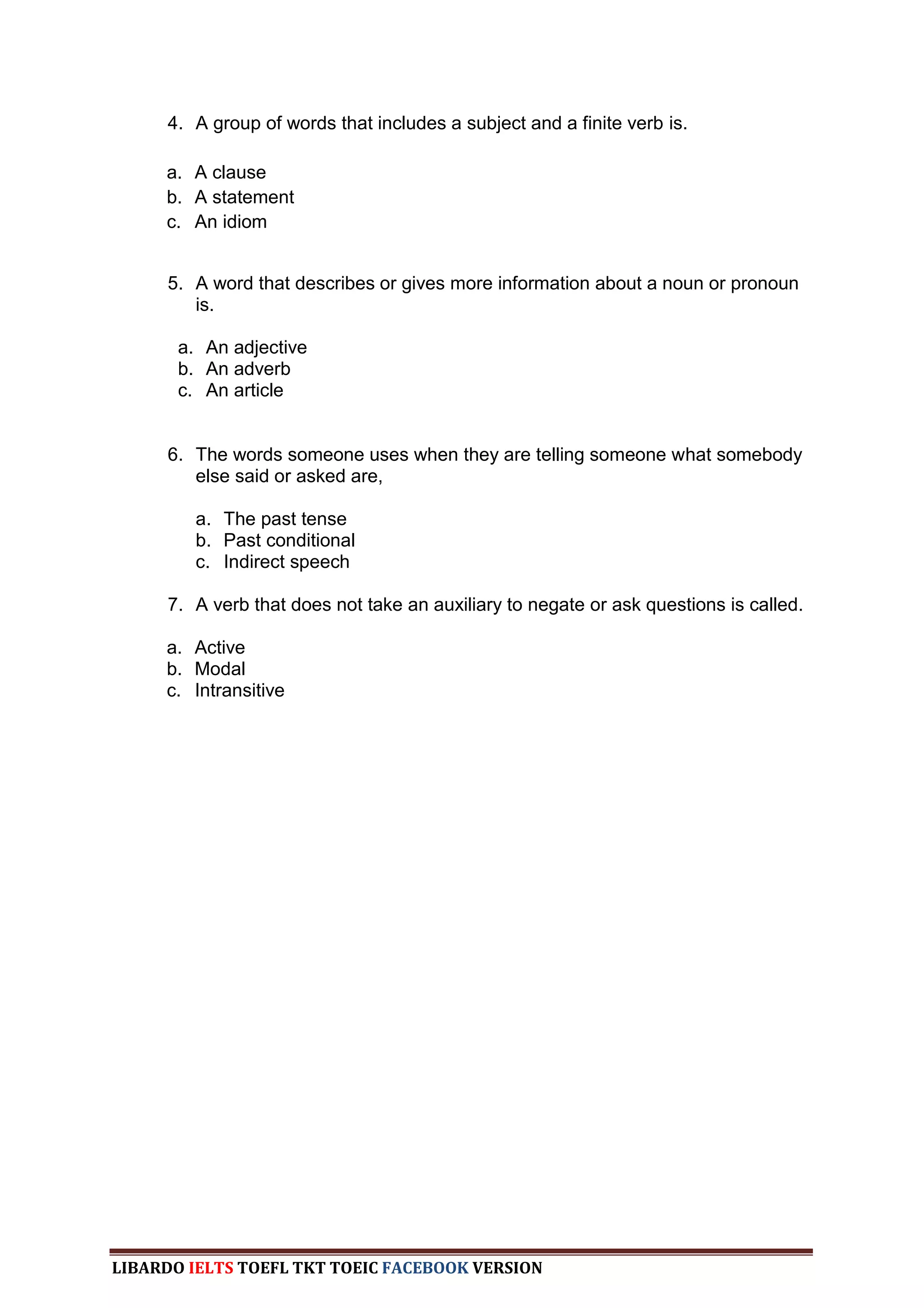
4. A group of words that includes a subject and a finite verb is.

     a. A clause
     b. A statement
     c. An idiom


     5. A word that describes or gives more information about a noun or pronoun
        is.

       a. An adjective
       b. An adverb
       c. An article


     6. The words someone uses when they are telling someone what somebody
        else said or asked are,

         a. The past tense
         b. Past conditional
         c. Indirect speech

     7. A verb that does not take an auxiliary to negate or ask questions is called.

     a. Active
     b. Modal
     c. Intransitive


LIBARDO IELTS TOEFL TKT TOEIC FACEBOOK VERSION
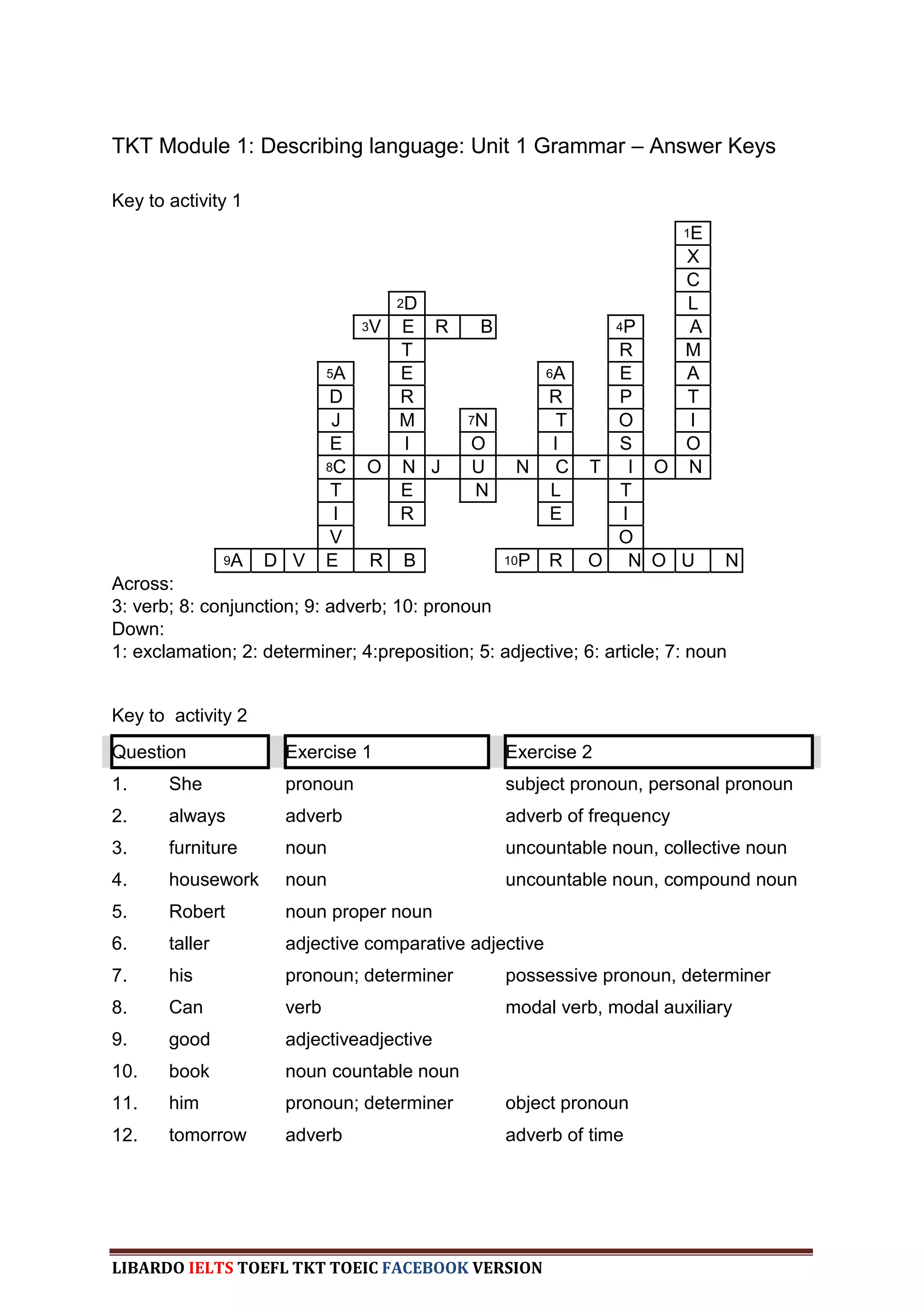
TKT Module 1: Describing language: Unit 1 Grammar – Answer Keys

Key to activity 1
                                                                         1E

                                                                    X
                                                                    C
                                       2D                           L
                                  3VE R        B                4P   A
                                    T                           R   M
                             5A     E                    6A      E  A
                              D     R                    R       P  T
                              J     M        7N           T     O    I
                              E     I        O           I       S  O
                             8C   O N J      U      N    C    T I O N
                              T     E        N           L       T
                              I     R                    E       I
                              V                                 O
                9A   D V     E    R    B           10P R      O N O U          N
Across:
3: verb; 8: conjunction; 9: adverb; 10: pronoun
Down:
1: exclamation; 2: determiner; 4:preposition; 5: adjective; 6: article; 7: noun


Key to activity 2
Question              Exercise 1                   Exercise 2
1.     She            pronoun                      subject pronoun, personal pronoun
2.     always         adverb                       adverb of frequency
3.     furniture      noun                         uncountable noun, collective noun
4.     housework      noun                         uncountable noun, compound noun
5.     Robert         noun proper noun
6.     taller         adjective comparative adjective
7.     his            pronoun; determiner          possessive pronoun, determiner
8.     Can            verb                         modal verb, modal auxiliary
9.     good           adjectiveadjective
10.    book           noun countable noun
11.    him            pronoun; determiner          object pronoun
12.    tomorrow       adverb                       adverb of time


LIBARDO IELTS TOEFL TKT TOEIC FACEBOOK VERSION
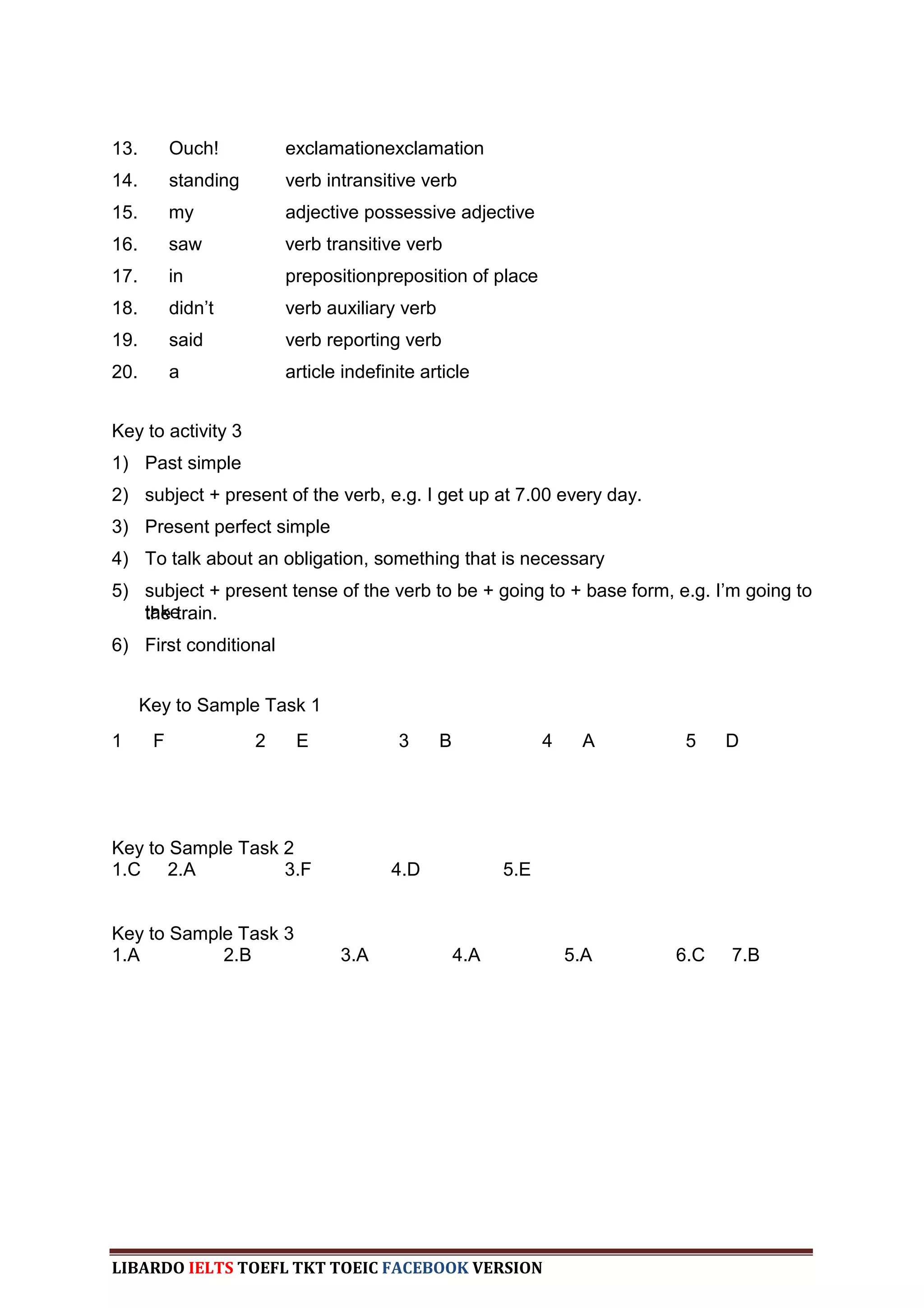
13.        Ouch!          exclamationexclamation
14.        standing       verb intransitive verb
15.        my             adjective possessive adjective
16.        saw            verb transitive verb
17.        in             prepositionpreposition of place
18.        didn‟t         verb auxiliary verb
19.        said           verb reporting verb
20.        a              article indefinite article


Key to activity 3
1) Past simple
2) subject + present of the verb, e.g. I get up at 7.00 every day.
3) Present perfect simple
4) To talk about an obligation, something that is necessary
5) subject + present tense of the verb to be + going to + base form, e.g. I‟m going to
   take
   the train.
6) First conditional


      Key to Sample Task 1
1      F              2    E             3      B               4    A     5    D


Key to Sample Task 2
1.C 2.A            3.F                  4.D               5.E


Key to Sample Task 3
1.A         2.B                  3.A                4.A             5.A   6.C   7.B


LIBARDO IELTS TOEFL TKT TOEIC FACEBOOK VERSION
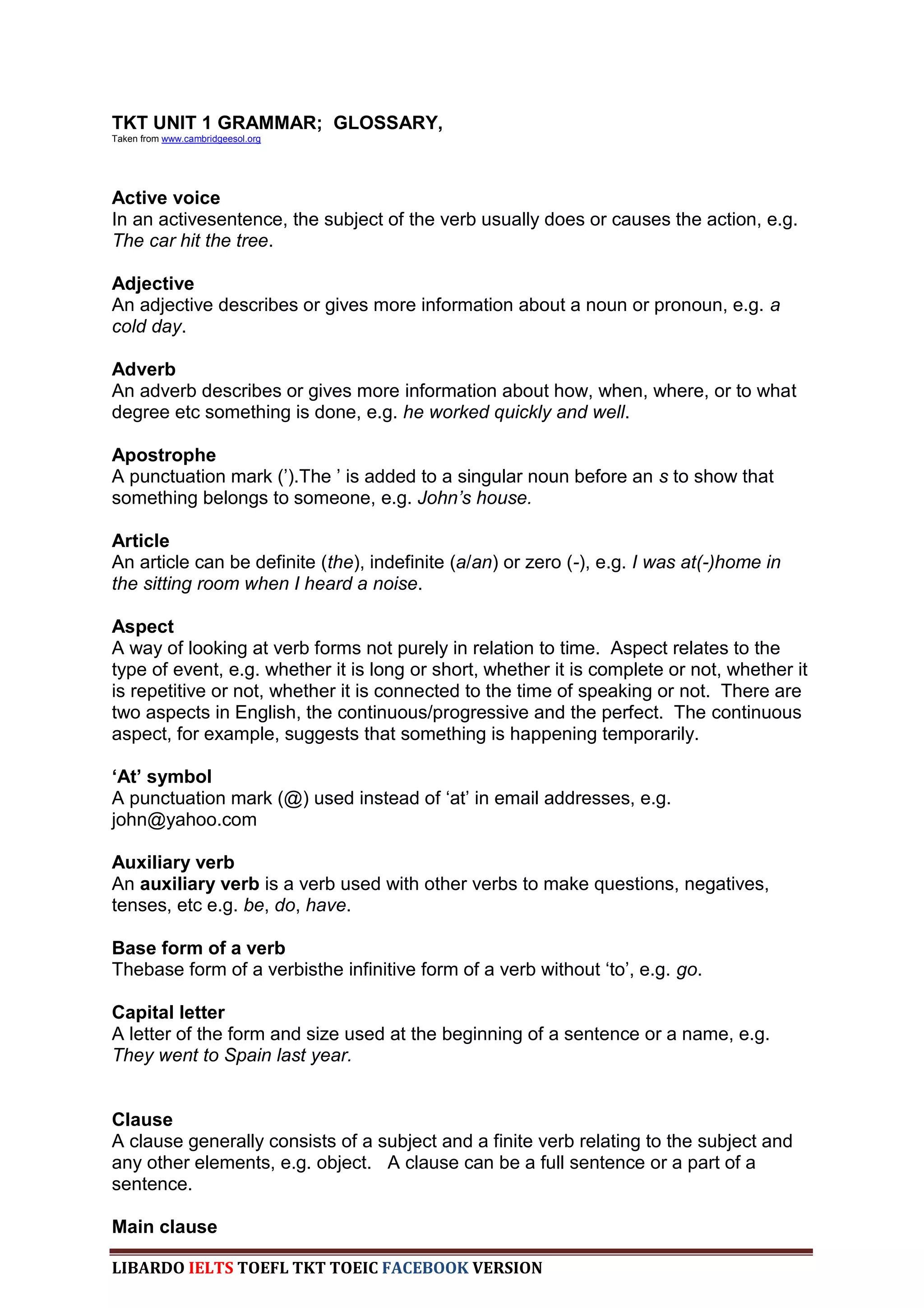
TKT UNIT 1 GRAMMAR; GLOSSARY,
Taken from www.cambridgeesol.org


Active voice
In an activesentence, the subject of the verb usually does or causes the action, e.g.
The car hit the tree.

Adjective
An adjective describes or gives more information about a noun or pronoun, e.g. a
cold day.

Adverb
An adverb describes or gives more information about how, when, where, or to what
degree etc something is done, e.g. he worked quickly and well.

Apostrophe
A punctuation mark (‟).The ‟ is added to a singular noun before an s to show that
something belongs to someone, e.g. John‟s house.

Article
An article can be definite (the), indefinite (a/an) or zero (-), e.g. I was at(-)home in
the sitting room when I heard a noise.

Aspect
A way of looking at verb forms not purely in relation to time. Aspect relates to the
type of event, e.g. whether it is long or short, whether it is complete or not, whether it
is repetitive or not, whether it is connected to the time of speaking or not. There are
two aspects in English, the continuous/progressive and the perfect. The continuous
aspect, for example, suggests that something is happening temporarily.

‘At’ symbol
A punctuation mark (@) used instead of „at‟ in email addresses, e.g.
john@yahoo.com

Auxiliary verb
An auxiliary verb is a verb used with other verbs to make questions, negatives,
tenses, etc e.g. be, do, have.

Base form of a verb
Thebase form of a verbisthe infinitive form of a verb without „to‟, e.g. go.

Capital letter
A letter of the form and size used at the beginning of a sentence or a name, e.g.
They went to Spain last year.


Clause
A clause generally consists of a subject and a finite verb relating to the subject and
any other elements, e.g. object. A clause can be a full sentence or a part of a
sentence.

Main clause

LIBARDO IELTS TOEFL TKT TOEIC FACEBOOK VERSION
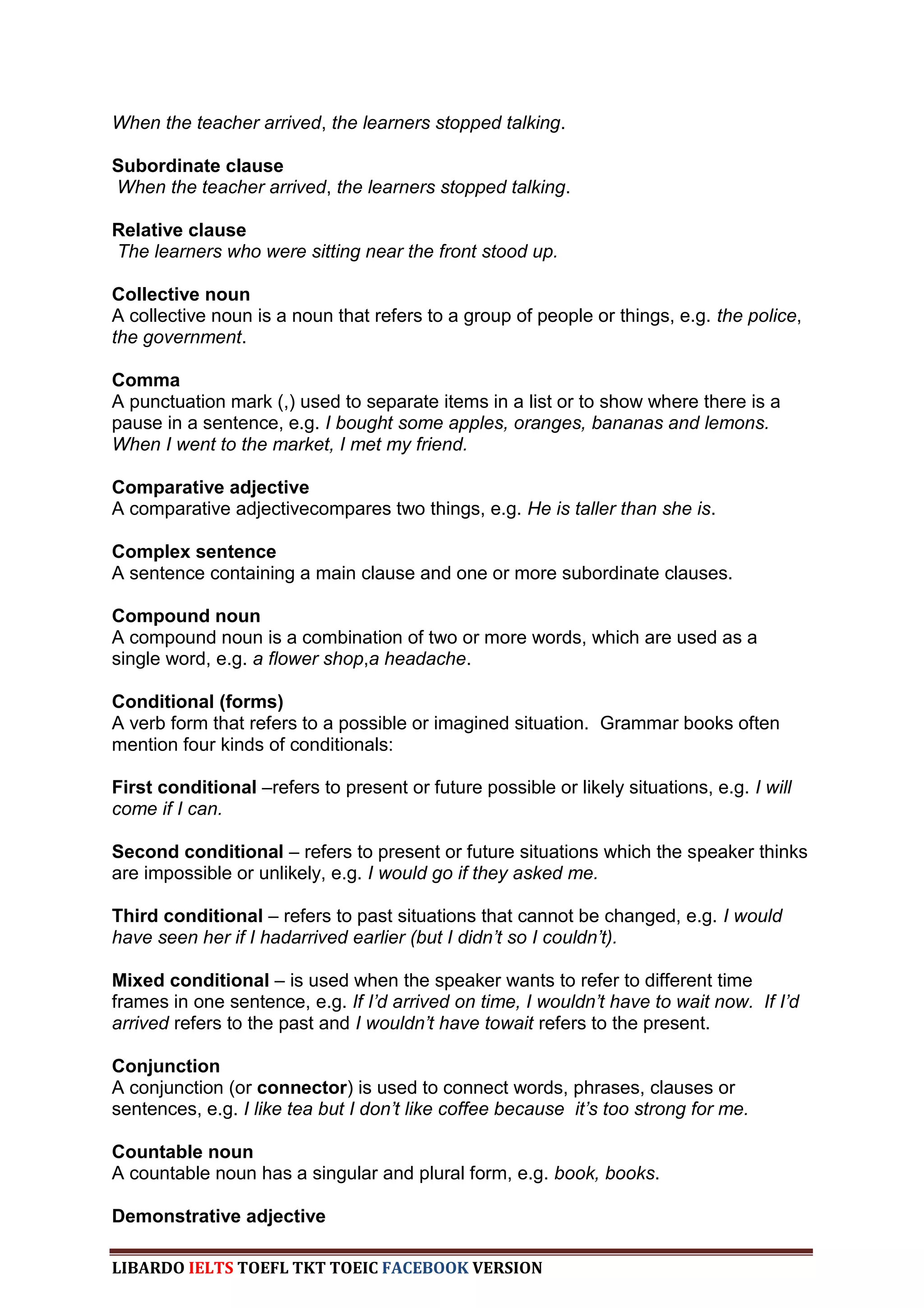
When the teacher arrived, the learners stopped talking.

Subordinate clause
When the teacher arrived, the learners stopped talking.

Relative clause
The learners who were sitting near the front stood up.

Collective noun
A collective noun is a noun that refers to a group of people or things, e.g. the police,
the government.

Comma
A punctuation mark (,) used to separate items in a list or to show where there is a
pause in a sentence, e.g. I bought some apples, oranges, bananas and lemons.
When I went to the market, I met my friend.

Comparative adjective
A comparative adjectivecompares two things, e.g. He is taller than she is.

Complex sentence
A sentence containing a main clause and one or more subordinate clauses.

Compound noun
A compound noun is a combination of two or more words, which are used as a
single word, e.g. a flower shop,a headache.

Conditional (forms)
A verb form that refers to a possible or imagined situation. Grammar books often
mention four kinds of conditionals:

First conditional –refers to present or future possible or likely situations, e.g. I will
come if I can.

Second conditional – refers to present or future situations which the speaker thinks
are impossible or unlikely, e.g. I would go if they asked me.

Third conditional – refers to past situations that cannot be changed, e.g. I would
have seen her if I hadarrived earlier (but I didn‟t so I couldn‟t).

Mixed conditional – is used when the speaker wants to refer to different time
frames in one sentence, e.g. If I‟d arrived on time, I wouldn‟t have to wait now. If I‟d
arrived refers to the past and I wouldn‟t have towait refers to the present.

Conjunction
A conjunction (or connector) is used to connect words, phrases, clauses or
sentences, e.g. I like tea but I don‟t like coffee because it‟s too strong for me.

Countable noun
A countable noun has a singular and plural form, e.g. book, books.

Demonstrative adjective

LIBARDO IELTS TOEFL TKT TOEIC FACEBOOK VERSION
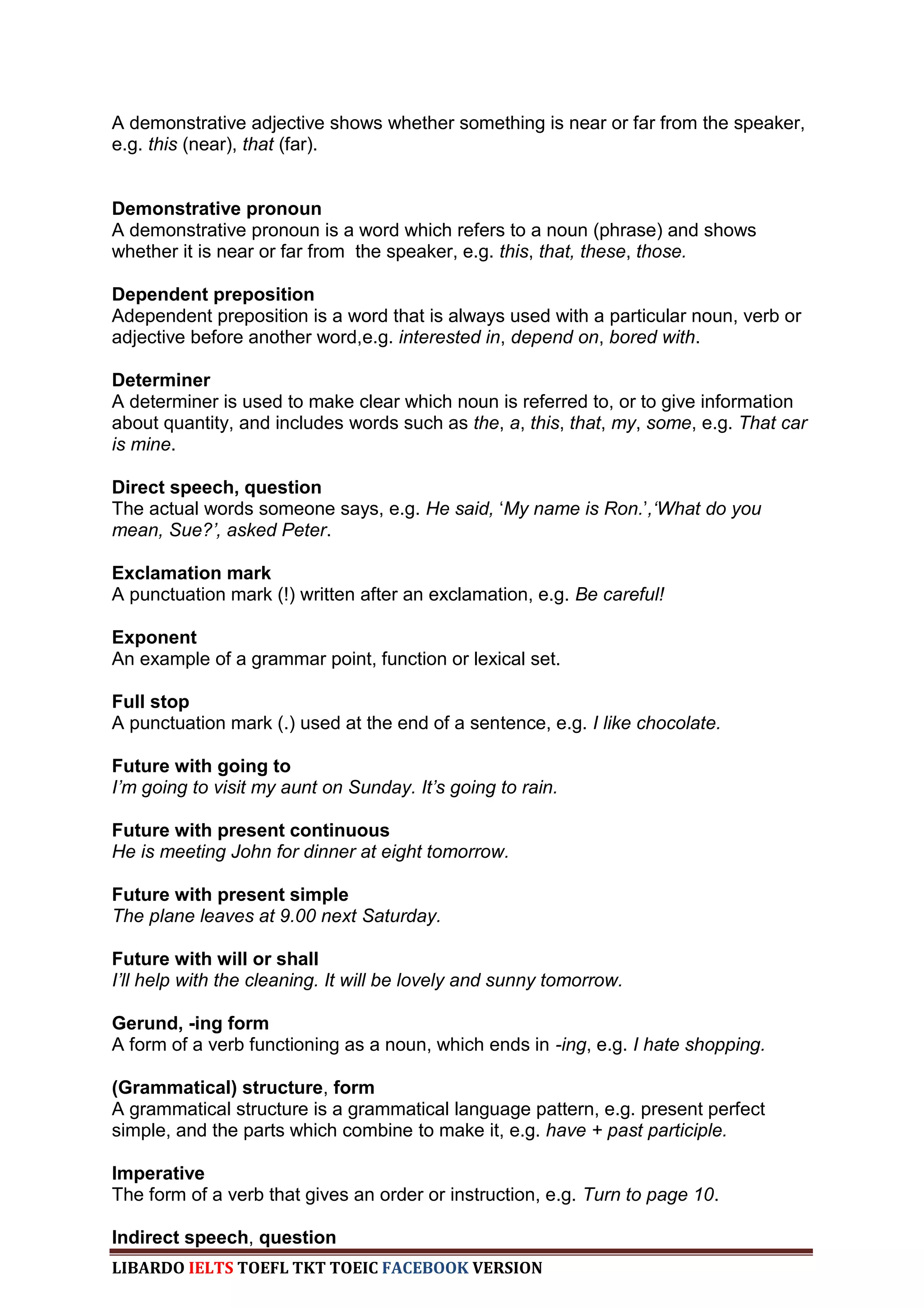
A demonstrative adjective shows whether something is near or far from the speaker,
e.g. this (near), that (far).


Demonstrative pronoun
A demonstrative pronoun is a word which refers to a noun (phrase) and shows
whether it is near or far from the speaker, e.g. this, that, these, those.

Dependent preposition
Adependent preposition is a word that is always used with a particular noun, verb or
adjective before another word,e.g. interested in, depend on, bored with.

Determiner
A determiner is used to make clear which noun is referred to, or to give information
about quantity, and includes words such as the, a, this, that, my, some, e.g. That car
is mine.

Direct speech, question
The actual words someone says, e.g. He said, „My name is Ron.‟,„What do you
mean, Sue?‟, asked Peter.

Exclamation mark
A punctuation mark (!) written after an exclamation, e.g. Be careful!

Exponent
An example of a grammar point, function or lexical set.

Full stop
A punctuation mark (.) used at the end of a sentence, e.g. I like chocolate.

Future with going to
I‟m going to visit my aunt on Sunday. It‟s going to rain.

Future with present continuous
He is meeting John for dinner at eight tomorrow.

Future with present simple
The plane leaves at 9.00 next Saturday.

Future with will or shall
I‟ll help with the cleaning. It will be lovely and sunny tomorrow.

Gerund, -ing form
A form of a verb functioning as a noun, which ends in -ing, e.g. I hate shopping.

(Grammatical) structure, form
A grammatical structure is a grammatical language pattern, e.g. present perfect
simple, and the parts which combine to make it, e.g. have + past participle.

Imperative
The form of a verb that gives an order or instruction, e.g. Turn to page 10.

Indirect speech, question
LIBARDO IELTS TOEFL TKT TOEIC FACEBOOK VERSION
The words someone uses when they are telling someone what somebody else said
or asked, e.g. He told me his name was Ron. Peter asked Sue what she meant.

An indirect question can also be used when someone wants to ask something in a
more polite way, e.g. „I was wondering if you could help me.‟ (indirect question)
instead of „Could you help me?‟ (direct question).

Infinitive
The infinitiveform is the base form of a verb with „to‟. It is used after another verb,
after an adjective or noun or as the subject or object of a sentence, e.g. 'I want to
study.‟, „It‟s difficult to understand. ‟

Infinitive of purpose
This is used to express why something is done, e.g. I went to the lesson to learn
English.

-ing/-ed adjective
An-ing/-ed adjective describes things or feelings. An -ing adjective describes things
or people, e.g. The book is very interesting.
An-ed adjective describes feelings, e.g. I am very interested in the book.

Intensifier
A word used to make the meaning of another word stronger, e.g. He‟s much taller
than his brother. I‟m very tired.

Interrogative
A question form.


Intransitive
Is used to describe a verb which does not take a direct object, e.g. She never cried.

Irregular verb
Anirregular verbdoes not follow the same pattern as regular verbs. Each irregular
verb has its own way of forming the past simple and past participle, e.g. go went
(past simple) gone (past participle).

Modal verb
A modal verb is a verb used with other verbs to show ideas such as ability or
obligationor possibility. They include can, must, will, should, e.g. I can speak
French, but I should study even harder.

Noun
A person, place or thing, e.g. elephant, girl, grass, school.


Object
This is a noun or phrase that describes the thing or person that is affected by the
action of a verb, e.g. I saw Mary in the classroom.

A direct object is the main object of a transitive verb.


LIBARDO IELTS TOEFL TKT TOEIC FACEBOOK VERSION
An indirect object is an object affected by a verb but not directly acted on, e.g. He
gave the book to me. In this sentence, the book is the direct object and me is an
indirect object.

Object pronoun
An object pronoun is a word which replaces an object noun or an object noun
phrase, e.g. him, her.

Participle (past and present)
–ed and –ing forms of the verb, they are often used to make tenses or adjectives,
e.g. an interesting film(present participle); I haven‟t seen him today. (past participle)

Particle
A small grammatical word, often an adverb or preposition which does not change its
form when used in a sentence, e.g. look after, after is a particle.

Passive voice, progressive
In a passive sentence, something is done to or happens to the subject of the verb,
e.g. The tree was hit by the car.

Past continuous, progressive
I was watching TV all evening.

Past perfect continuous, progressive
I had been studying for three hours so I felt tired.

Past perfect simple
After I had phoned Mary, I went out.

Past simple
I went on holiday to France last year.

Person

First person – the person speaking, e.g. I, we.

Second person – the person spoken to, e.g. you.

Third person – the person spoken about, e.g. he, she, they.

Personal pronoun
Personal pronounsare words, which are used instead of the name of that person,
e.g. I (subject pronoun), me (object pronoun).

Phonology noun, phonological adjective The study of sounds in a language or
languages.

Phrase
A group of words often without a finite verb that do not form a sentence, e.g. the
green car, on Friday morning are phrases. Also a group of words that together have
a particular meaning.

Plural noun
LIBARDO IELTS TOEFL TKT TOEIC FACEBOOK VERSION
A plural noun is more than one person, place or thing and can be regular or
irregular, e.g. boys, women.

Possessive adjective
Apossessive adjectiveshows who something belongs to, e.g. my, our.

Possessive pronoun
A possessive pronoun is used to replace a noun and shows something belongs to
someone, e.g. the house is mine.

Possessive ‘s’ and whose
Ways of showing or asking who something belongs to, e.g. „Whose book is it?‟ „It‟s
Sue‟s‟.

Preposition
A word used before a noun, pronoun or gerund to connect it to another word, e.g. He
was in the garden.

Present continuous, progressive
I am working in London now.

Present continuous, progressive for future
He is meeting John for dinner at eight tomorrow.

Present perfect continuous, progressive
I have been studying for three years.

Present perfect simple
I have known him for a long time.

Pronoun
A word that replaces or refers to a noun or noun phrase just mentioned.

Proper noun
A proper noun is the name of a person or place, e.g. Robert, London.

Punctuation
The symbols or marks used to organise writing into clauses, phrasesand sentences
to make the meaning clear, e.g. full stop (.), capital letter (A), apostrophe („),
comma (,), question mark (?), exclamation mark (!),
‘at’ symbol (@) and speech marks (“ ”).

Quantifier
A word or phrase such as much, few or a lotof which is used with a noun to show an
amount, e.g. I don‟t have much time; I have a lot of books.

Question mark
A punctuation mark (?) used in writing after a question, e.g. How are you?

Question tag
A phrase such as isn‟t it?ordoesn‟t he?that is added to the end of a sentence to
make it a question, or to check that someone agrees with the statement just made,
e.g. It‟s very cold, isn‟t it?
LIBARDO IELTS TOEFL TKT TOEIC FACEBOOK VERSION
Reflexive pronoun
A reflexive pronoun is used when the object of a sentence refers to the same person
or thing as the subject of the sentence, e.g. He cut himself.

Regular verb
Aregular verbchanges its forms by adding -edin the past simple and past participle,
e.g. walk, walked.


Relative pronoun
A relative pronounintroduces a relative clause, e.g. the book which I‟m reading is
interesting.

Reported speech, statement, question
When someone‟s words are reported by another person, e.g. She said she was
sorry.

Reporting verb
A verb such as tell, advise, suggest used in indirect, reported speech to report what
someone has said, e.g. Jane advised John to study harder.

Singular noun
A singular noun is one person, place or thing, e.g. boy, park, bicycle.

Speech marks
Punctuation mark (“ ”) They are written before and after a word or a sentence to
show that it is what someone said, e.g. John said “Hello, Sarah”.

Subject
This is the noun or phrase that goes before the verb to show who is doing the action
in an active sentence, e.g. Johnplays tennis every Saturday, or who the action is
done to in a passive sentence, e.g. the food was cookedyesterday.

Subject-verb agreement
When the form of the verb matches the person doing the action of the verb, e.g. I
walk, he walks. If a learner writes, I walks, then it is wrong because there is no
subject-verb agreement.

Superlative adjective
A superlative adjectivecompares more than two things, e.g. He is the tallest boy in
the class.

Tense
A form of the verb that shows whether something happens in the past, present or
future.

Time expression
A word or phrase that indicates time, such as after, last weekend, e.g. I will meet you
after the lesson.

Transitive
LIBARDO IELTS TOEFL TKT TOEIC FACEBOOK VERSION
Is used to describe a verb which takes a direct object, e.g. She wrote a letter.

Uncountable noun
An uncountable noun does not have a plural form, e.g. information.

Used to
A structure that shows something happened in the past but does not happen now,
e.g. I used to live in London, but now I live in Paris.

Verb
A word used to show an action, state, event or process, e.g. I like cheese; He
speaks Italian.

Verb pattern
The form of the words following the verb, e.g. He advised me to get there early.
(advise + object pronoun + to + baseform).


LIBARDO IELTS TOEFL TKT TOEIC FACEBOOK VERSION
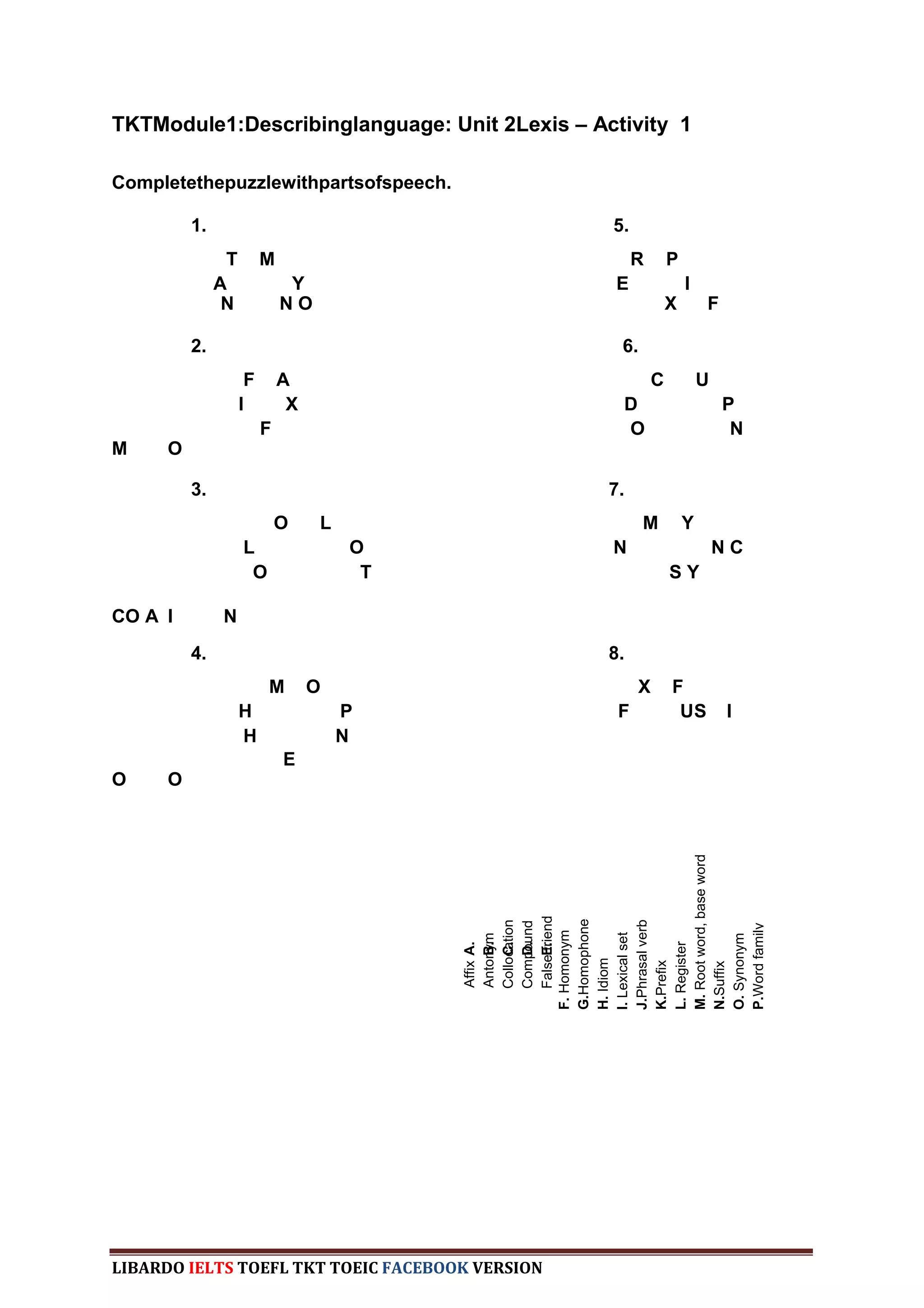
TKTModule1:Describinglanguage: Unit 2Lexis – Activity 1

Completethepuzzlewithpartsofspeech.

         1.                                          5.
               T        M                                 R       P
              A              Y                       E                I
               N            NO                                    X       F

         2.                                           6.
                    F       A                                 C           U
                   I         X                        D                       P
                        F                             O                        N
M    O

         3.                                          7.
                            O    L                         M          Y
                   L                 O               N                        NC
                    O                 T                           SY

CO A I        N
         4.                                          8.
                        M        O                        X       F
                   H                 P                F            US         I
                   H                 N
                            E
O    O
                                          M. Root word, base word
                                                     friend

                                          G.Homophone


                                          J.Phrasal verb
                                              Collocation
                                              Compound


                                          P.Word family
                                          F. Homonym


                                          I. Lexical set
                                              Antonym


                                          O. Synonym
                                          L. Register
                                                    B.
                                                    C.
                                                    D.
                                              Affix A.


                                              FalseE.


                                          H. Idiom


                                          K.Prefix


                                          N.Suffix


LIBARDO IELTS TOEFL TKT TOEIC FACEBOOK VERSION
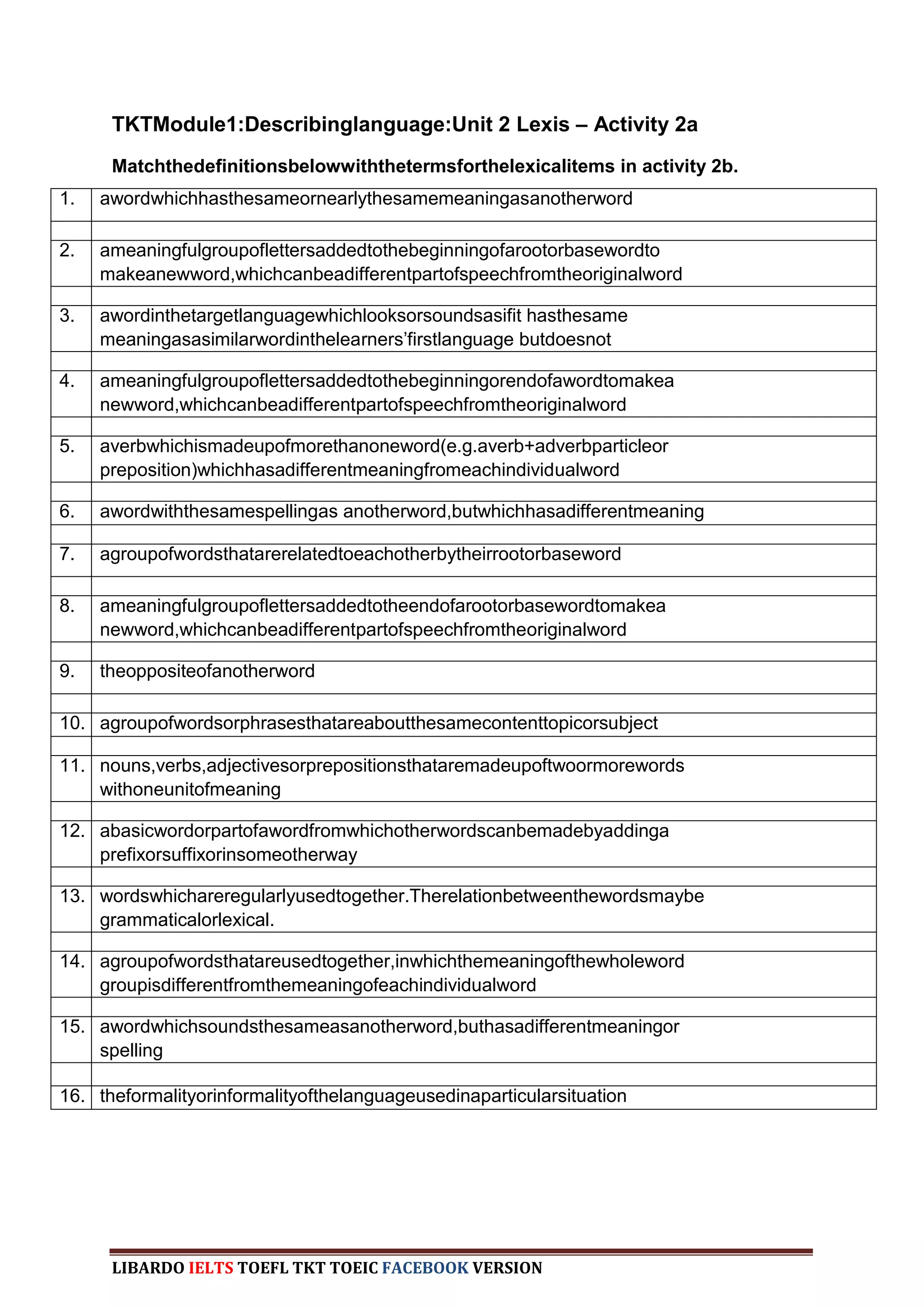
TKTModule1:Describinglanguage:Unit 2 Lexis – Activity 2a
      Matchthedefinitionsbelowwiththetermsforthelexicalitems in activity 2b.
1.   awordwhichhasthesameornearlythesamemeaningasanotherword

2.   ameaningfulgroupoflettersaddedtothebeginningofarootorbasewordto
     makeanewword,whichcanbeadifferentpartofspeechfromtheoriginalword

3.   awordinthetargetlanguagewhichlooksorsoundsasifit hasthesame
     meaningasasimilarwordinthelearners‟firstlanguage butdoesnot

4.   ameaningfulgroupoflettersaddedtothebeginningorendofawordtomakea
     newword,whichcanbeadifferentpartofspeechfromtheoriginalword

5.   averbwhichismadeupofmorethanoneword(e.g.averb+adverbparticleor
     preposition)whichhasadifferentmeaningfromeachindividualword

6.   awordwiththesamespellingas anotherword,butwhichhasadifferentmeaning

7.   agroupofwordsthatarerelatedtoeachotherbytheirrootorbaseword

8.   ameaningfulgroupoflettersaddedtotheendofarootorbasewordtomakea
     newword,whichcanbeadifferentpartofspeechfromtheoriginalword

9.   theoppositeofanotherword

10. agroupofwordsorphrasesthatareaboutthesamecontenttopicorsubject

11. nouns,verbs,adjectivesorprepositionsthataremadeupoftwoormorewords
    withoneunitofmeaning

12. abasicwordorpartofawordfromwhichotherwordscanbemadebyaddinga
    prefixorsuffixorinsomeotherway

13. wordswhichareregularlyusedtogether.Therelationbetweenthewordsmaybe
    grammaticalorlexical.

14. agroupofwordsthatareusedtogether,inwhichthemeaningofthewholeword
    groupisdifferentfromthemeaningofeachindividualword

15. awordwhichsoundsthesameasanotherword,buthasadifferentmeaningor
    spelling

16. theformalityorinformalityofthelanguageusedinaparticularsituation


      LIBARDO IELTS TOEFL TKT TOEIC FACEBOOK VERSION
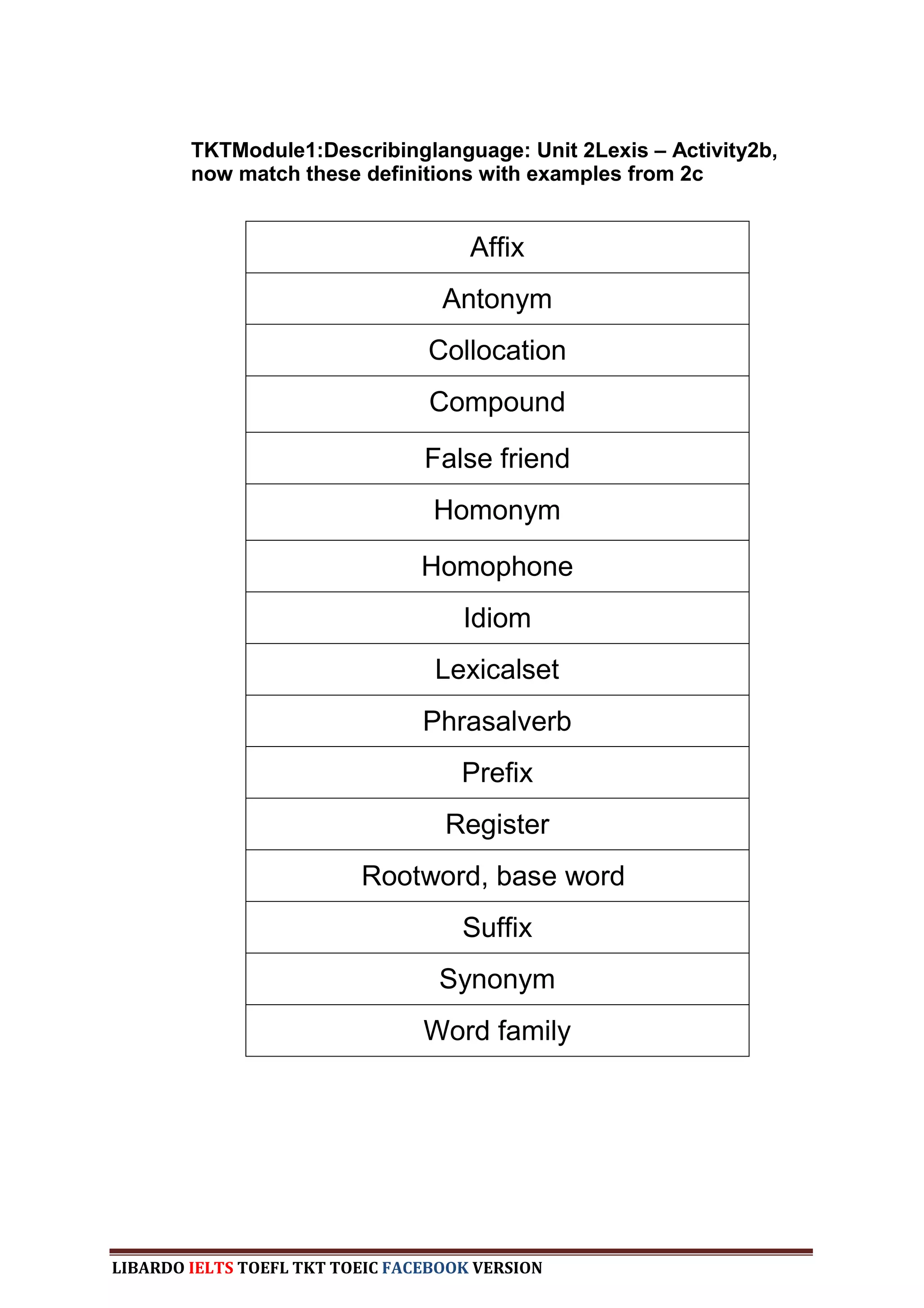
TKTModule1:Describinglanguage: Unit 2Lexis – Activity2b,
        now match these definitions with examples from 2c


                                      Affix
                                   Antonym
                                 Collocation
                                 Compound

                                 False friend
                                  Homonym

                                 Homophone
                                     Idiom
                                  Lexicalset
                                 Phrasalverb
                                     Prefix
                                   Register
                          Rootword, base word
                                     Suffix
                                  Synonym
                                 Word family


LIBARDO IELTS TOEFL TKT TOEIC FACEBOOK VERSION
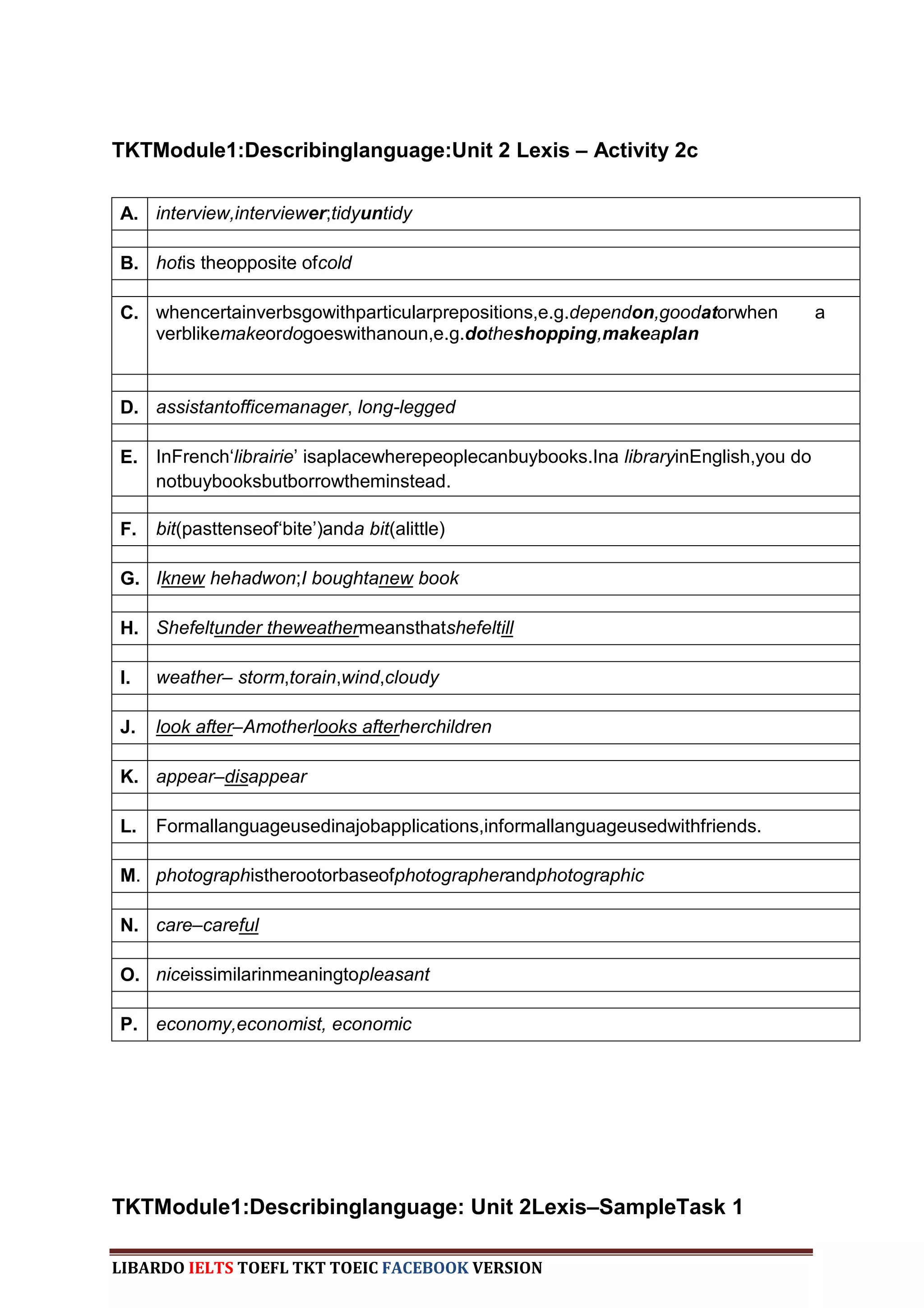
TKTModule1:Describinglanguage:Unit 2 Lexis – Activity 2c

A. interview,interviewer;tidyuntidy

B. hotis theopposite ofcold

C. whencertainverbsgowithparticularprepositions,e.g.dependon,goodatorwhen           a
   verblikemakeordogoeswithanoun,e.g.dotheshopping,makeaplan


D. assistantofficemanager, long-legged

E. InFrench„librairie‟ isaplacewherepeoplecanbuybooks.Ina libraryinEnglish,you do
   notbuybooksbutborrowtheminstead.

F.   bit(pasttenseof„bite‟)anda bit(alittle)

G. Iknew hehadwon;I boughtanew book

H. Shefeltunder theweathermeansthatshefeltill

I.   weather– storm,torain,wind,cloudy

J.   look after–Amotherlooks afterherchildren

K. appear–disappear

L.   Formallanguageusedinajobapplications,informallanguageusedwithfriends.

M. photographistherootorbaseofphotographerandphotographic

N. care–careful

O. niceissimilarinmeaningtopleasant

P. economy,economist, economic


TKTModule1:Describinglanguage: Unit 2Lexis–SampleTask 1

LIBARDO IELTS TOEFL TKT TOEIC FACEBOOK VERSION
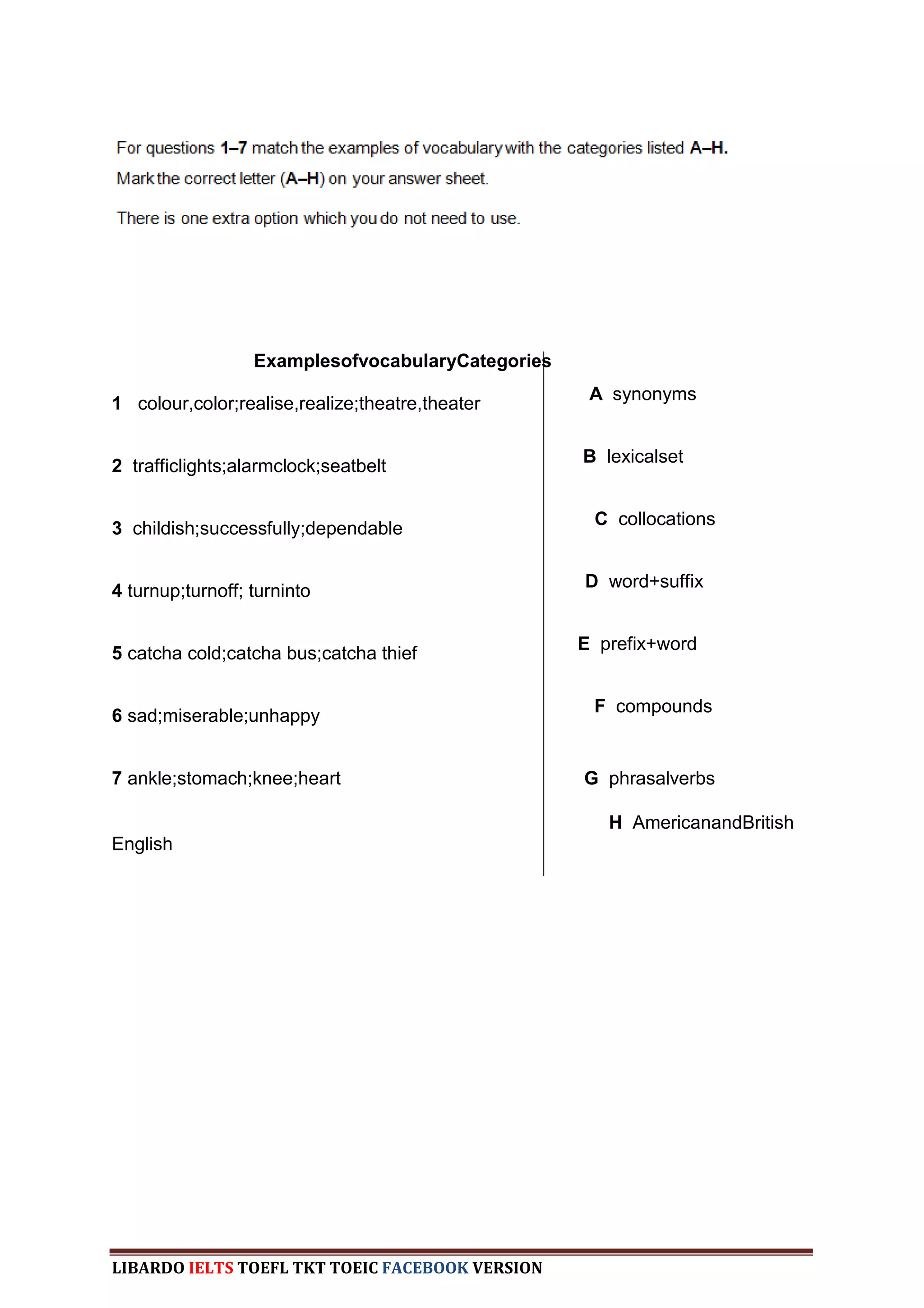
ExamplesofvocabularyCategories
                                                    A synonyms
1 colour,color;realise,realize;theatre,theater

                                                   B lexicalset
2 trafficlights;alarmclock;seatbelt

                                                    C collocations
3 childish;successfully;dependable

                                                   D word+suffix
4 turnup;turnoff; turninto

                                                   E prefix+word
5 catcha cold;catcha bus;catcha thief

                                                    F compounds
6 sad;miserable;unhappy


7 ankle;stomach;knee;heart                         G phrasalverbs

                                                      H AmericanandBritish
English


LIBARDO IELTS TOEFL TKT TOEIC FACEBOOK VERSION
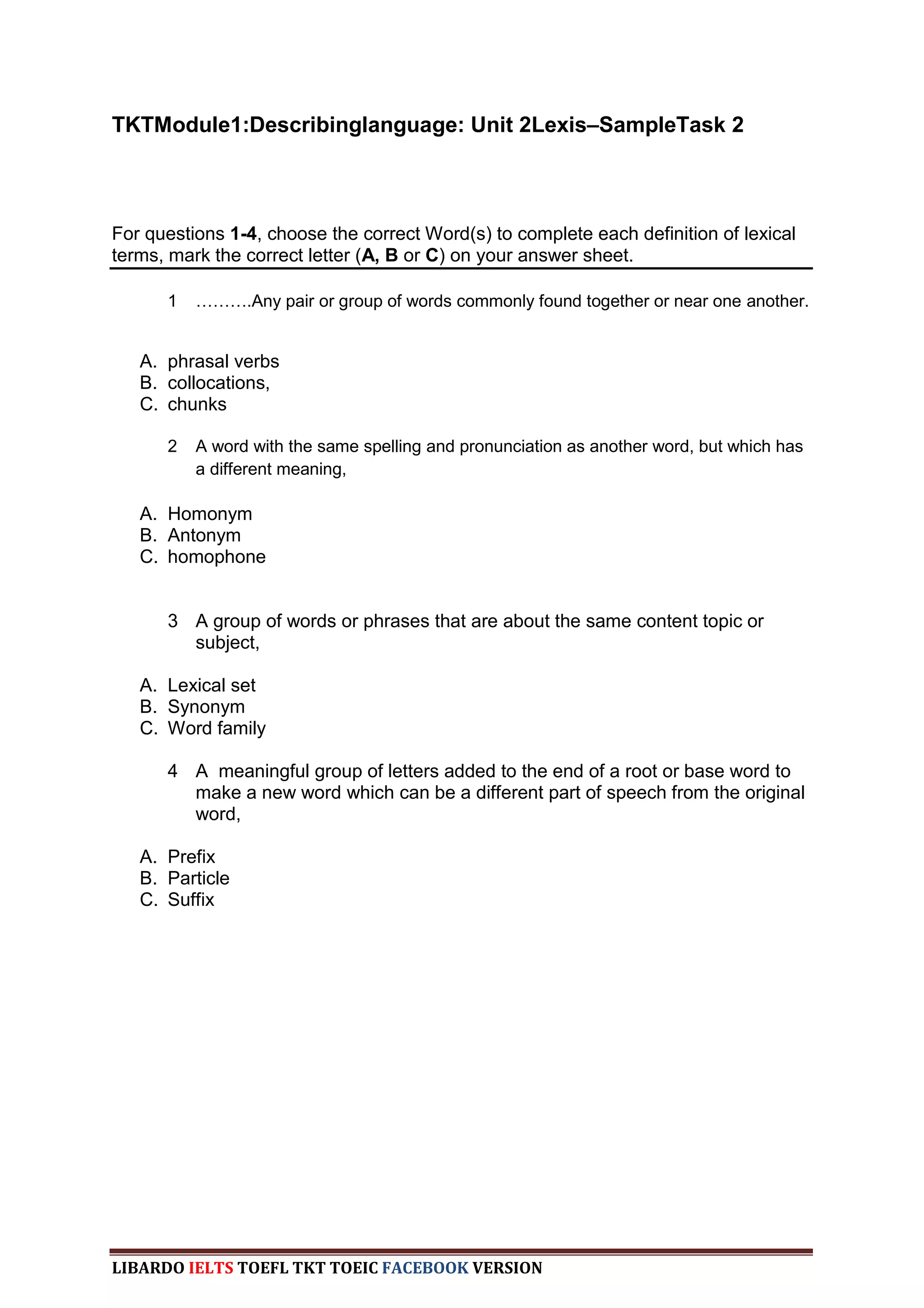
TKTModule1:Describinglanguage: Unit 2Lexis–SampleTask 2


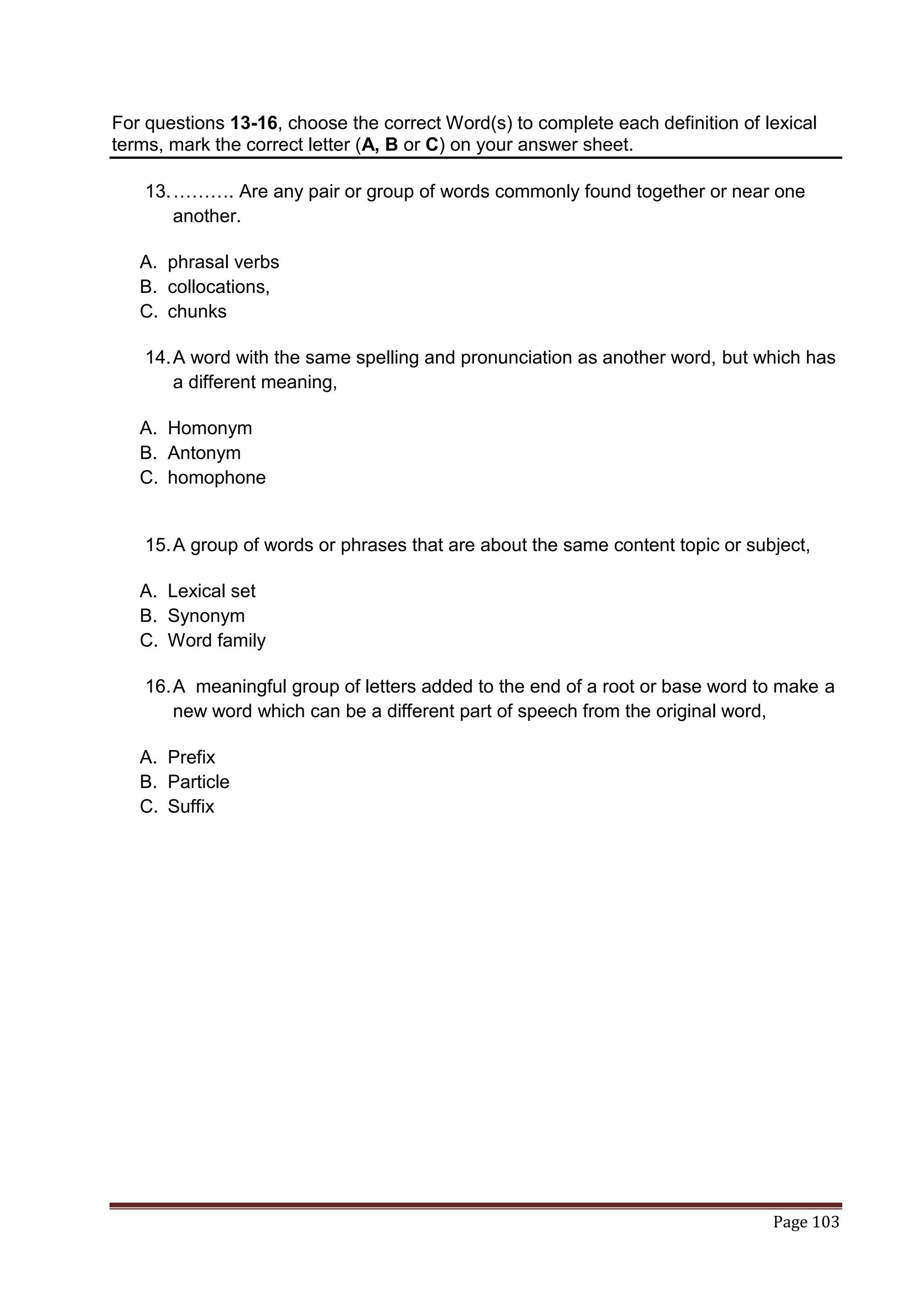
For questions 1-4, choose the correct Word(s) to complete each definition of lexical
terms, mark the correct letter (A, B or C) on your answer sheet.

      1   ……….Any pair or group of words commonly found together or near one another.


   A. phrasal verbs
   B. collocations,
   C. chunks

      2   A word with the same spelling and pronunciation as another word, but which has
          a different meaning,

   A. Homonym
   B. Antonym
   C. homophone


      3 A group of words or phrases that are about the same content topic or
        subject,

   A. Lexical set
   B. Synonym
   C. Word family

      4 A meaningful group of letters added to the end of a root or base word to
        make a new word which can be a different part of speech from the original
        word,

   A. Prefix
   B. Particle
   C. Suffix


LIBARDO IELTS TOEFL TKT TOEIC FACEBOOK VERSION
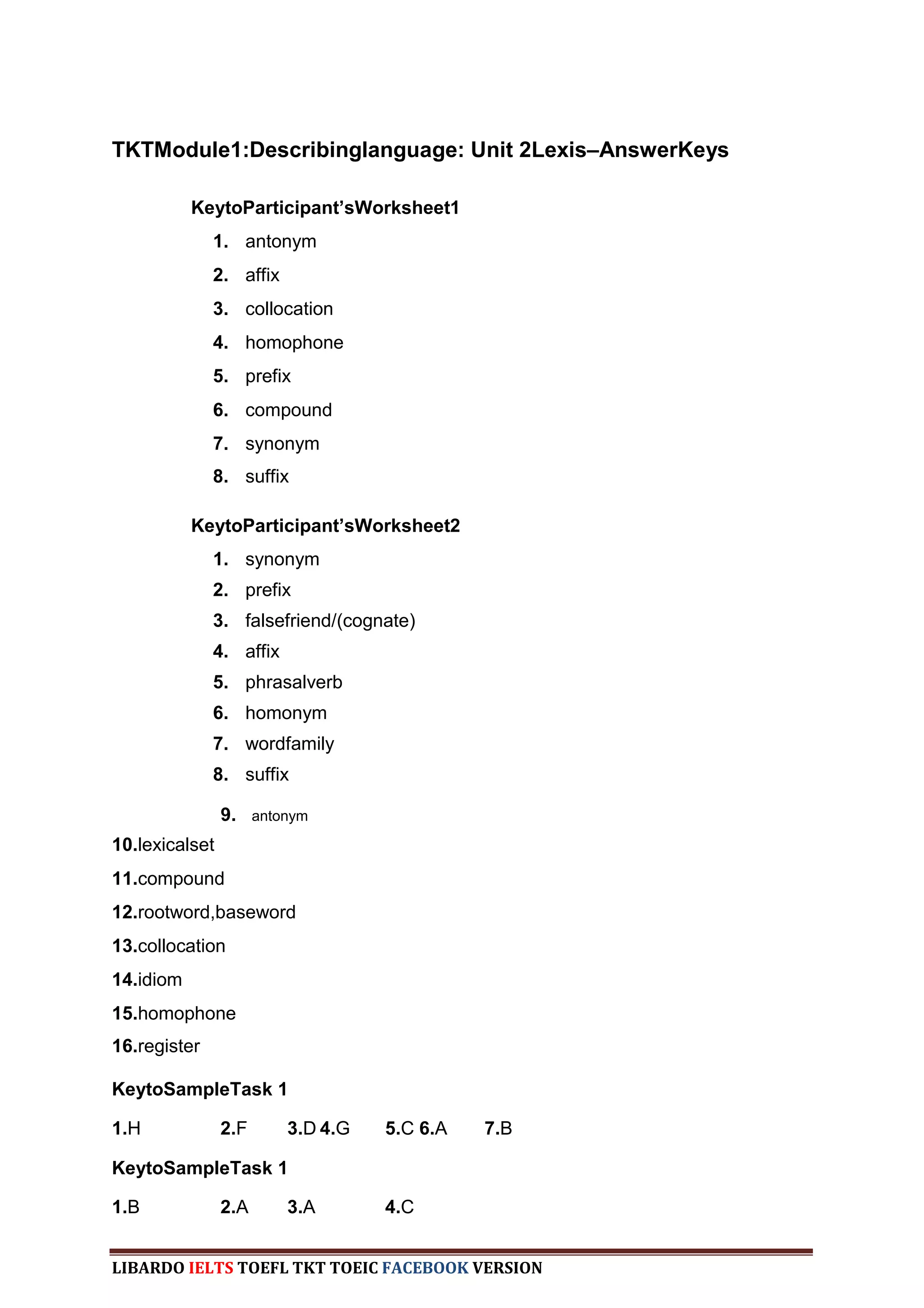
TKTModule1:Describinglanguage: Unit 2Lexis–AnswerKeys

           KeytoParticipant’sWorksheet1
              1. antonym
              2. affix
              3. collocation
              4. homophone
              5. prefix
              6. compound
              7. synonym
              8. suffix

           KeytoParticipant’sWorksheet2
              1. synonym
              2. prefix
              3. falsefriend/(cognate)
              4. affix
              5. phrasalverb
              6. homonym
              7. wordfamily
              8. suffix

                9.    antonym

10.lexicalset
11.compound
12.rootword,baseword
13.collocation
14.idiom
15.homophone
16.register

KeytoSampleTask 1

1.H             2.F       3.D 4.G   5.C 6.A   7.B

KeytoSampleTask 1

1.B             2.A       3.A       4.C


LIBARDO IELTS TOEFL TKT TOEIC FACEBOOK VERSION
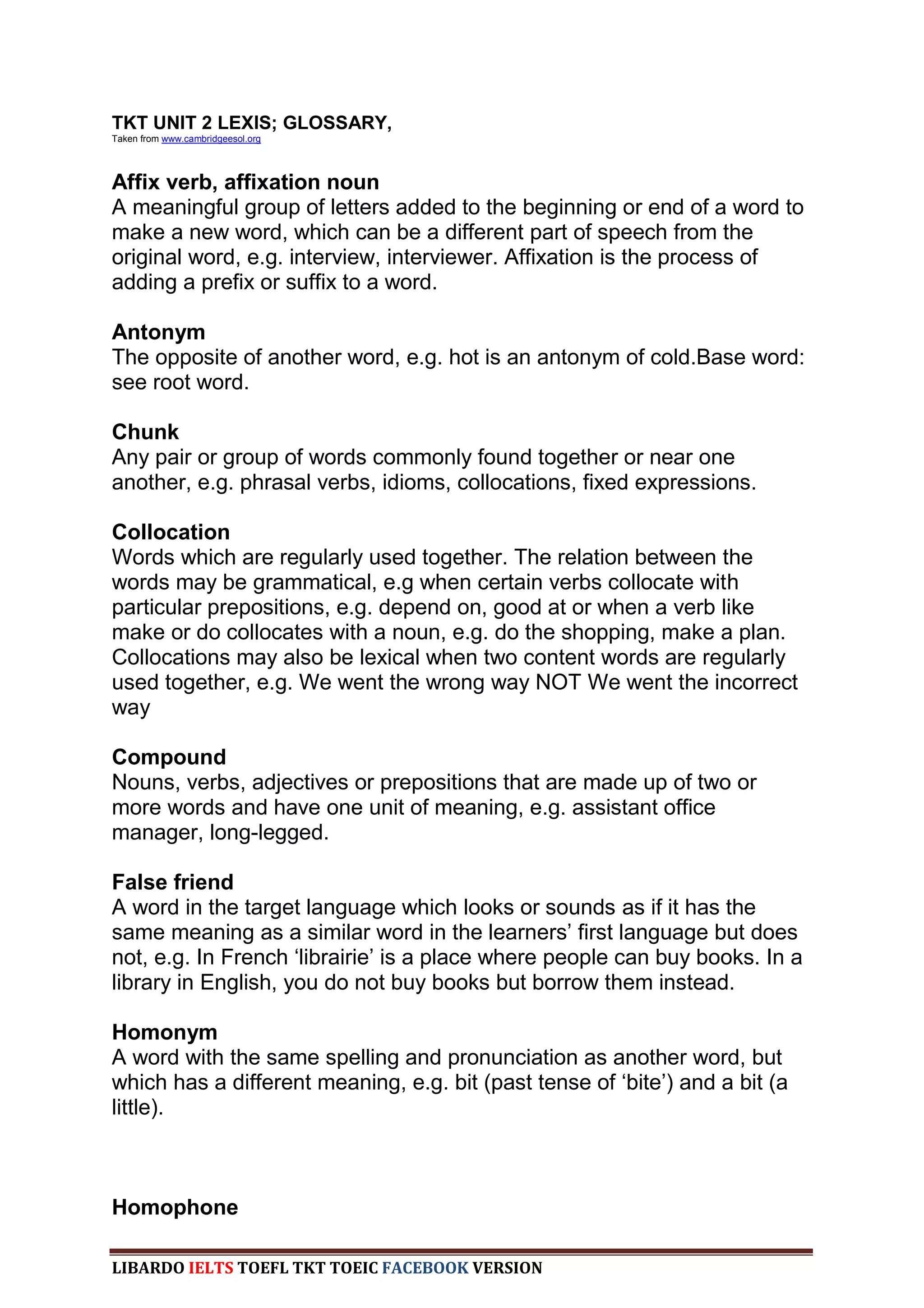
TKT UNIT 2 LEXIS; GLOSSARY,
Taken from www.cambridgeesol.org


Affix verb, affixation noun
A meaningful group of letters added to the beginning or end of a word to
make a new word, which can be a different part of speech from the
original word, e.g. interview, interviewer. Affixation is the process of
adding a prefix or suffix to a word.

Antonym
The opposite of another word, e.g. hot is an antonym of cold.Base word:
see root word.

Chunk
Any pair or group of words commonly found together or near one
another, e.g. phrasal verbs, idioms, collocations, fixed expressions.

Collocation
Words which are regularly used together. The relation between the
words may be grammatical, e.g when certain verbs collocate with
particular prepositions, e.g. depend on, good at or when a verb like
make or do collocates with a noun, e.g. do the shopping, make a plan.
Collocations may also be lexical when two content words are regularly
used together, e.g. We went the wrong way NOT We went the incorrect
way

Compound
Nouns, verbs, adjectives or prepositions that are made up of two or
more words and have one unit of meaning, e.g. assistant office
manager, long-legged.

False friend
A word in the target language which looks or sounds as if it has the
same meaning as a similar word in the learners‟ first language but does
not, e.g. In French „librairie‟ is a place where people can buy books. In a
library in English, you do not buy books but borrow them instead.

Homonym
A word with the same spelling and pronunciation as another word, but
which has a different meaning, e.g. bit (past tense of „bite‟) and a bit (a
little).


Homophone

LIBARDO IELTS TOEFL TKT TOEIC FACEBOOK VERSION
A word which sounds the same as another word, but has a different
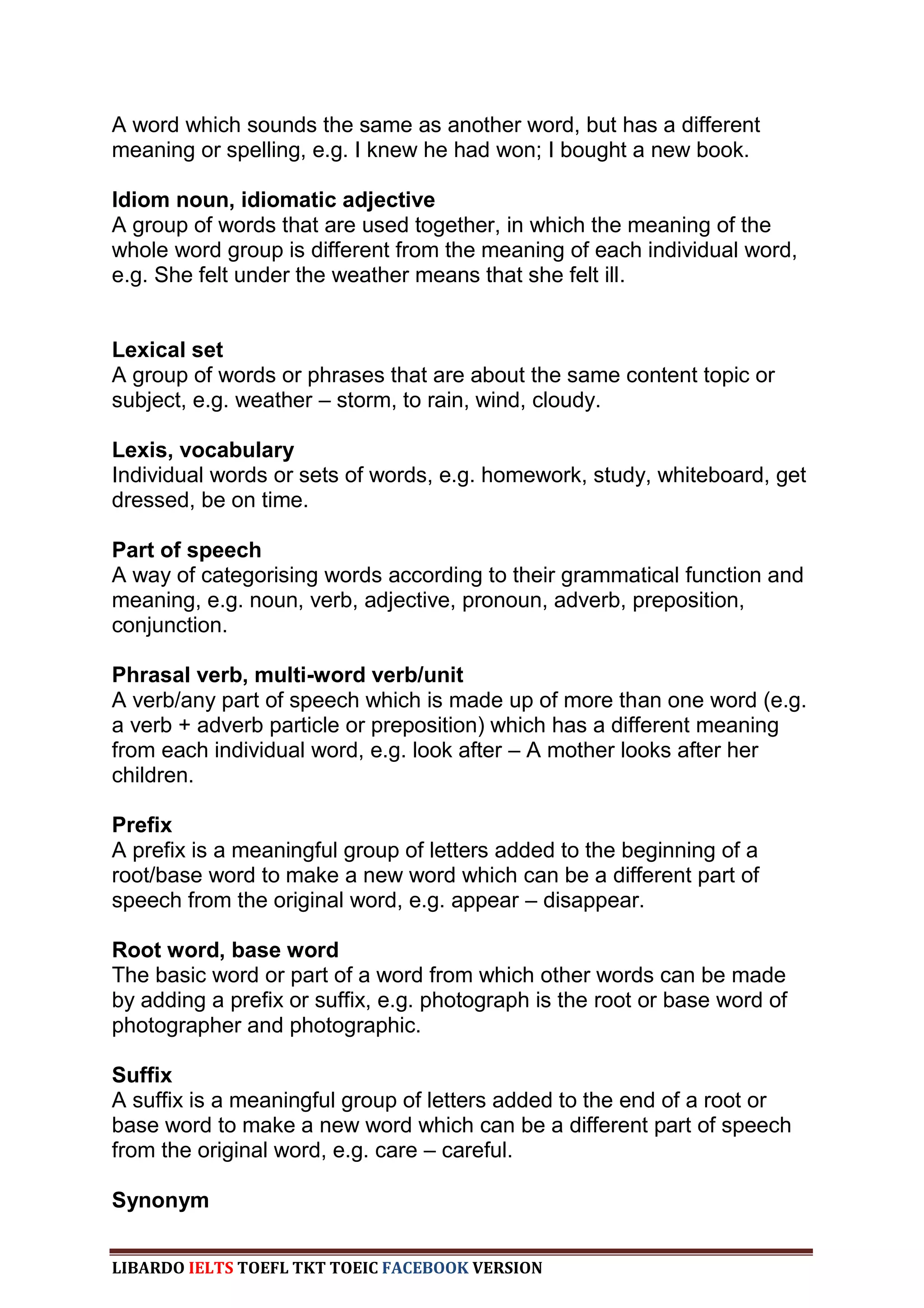
meaning or spelling, e.g. I knew he had won; I bought a new book.

Idiom noun, idiomatic adjective
A group of words that are used together, in which the meaning of the
whole word group is different from the meaning of each individual word,
e.g. She felt under the weather means that she felt ill.


Lexical set
A group of words or phrases that are about the same content topic or
subject, e.g. weather – storm, to rain, wind, cloudy.

Lexis, vocabulary
Individual words or sets of words, e.g. homework, study, whiteboard, get
dressed, be on time.

Part of speech
A way of categorising words according to their grammatical function and
meaning, e.g. noun, verb, adjective, pronoun, adverb, preposition,
conjunction.

Phrasal verb, multi-word verb/unit
A verb/any part of speech which is made up of more than one word (e.g.
a verb + adverb particle or preposition) which has a different meaning
from each individual word, e.g. look after – A mother looks after her
children.

Prefix
A prefix is a meaningful group of letters added to the beginning of a
root/base word to make a new word which can be a different part of
speech from the original word, e.g. appear – disappear.

Root word, base word
The basic word or part of a word from which other words can be made
by adding a prefix or suffix, e.g. photograph is the root or base word of
photographer and photographic.

Suffix
A suffix is a meaningful group of letters added to the end of a root or
base word to make a new word which can be a different part of speech
from the original word, e.g. care – careful.

Synonym


LIBARDO IELTS TOEFL TKT TOEIC FACEBOOK VERSION
A word which has the same or nearly the same meaning as another
word, e.g. nice is a synonym of pleasant.

Word family
A group of words that come from the same root or base word, e.g.
economy, economist, economic or by topic


LIBARDO IELTS TOEFL TKT TOEIC FACEBOOK VERSION
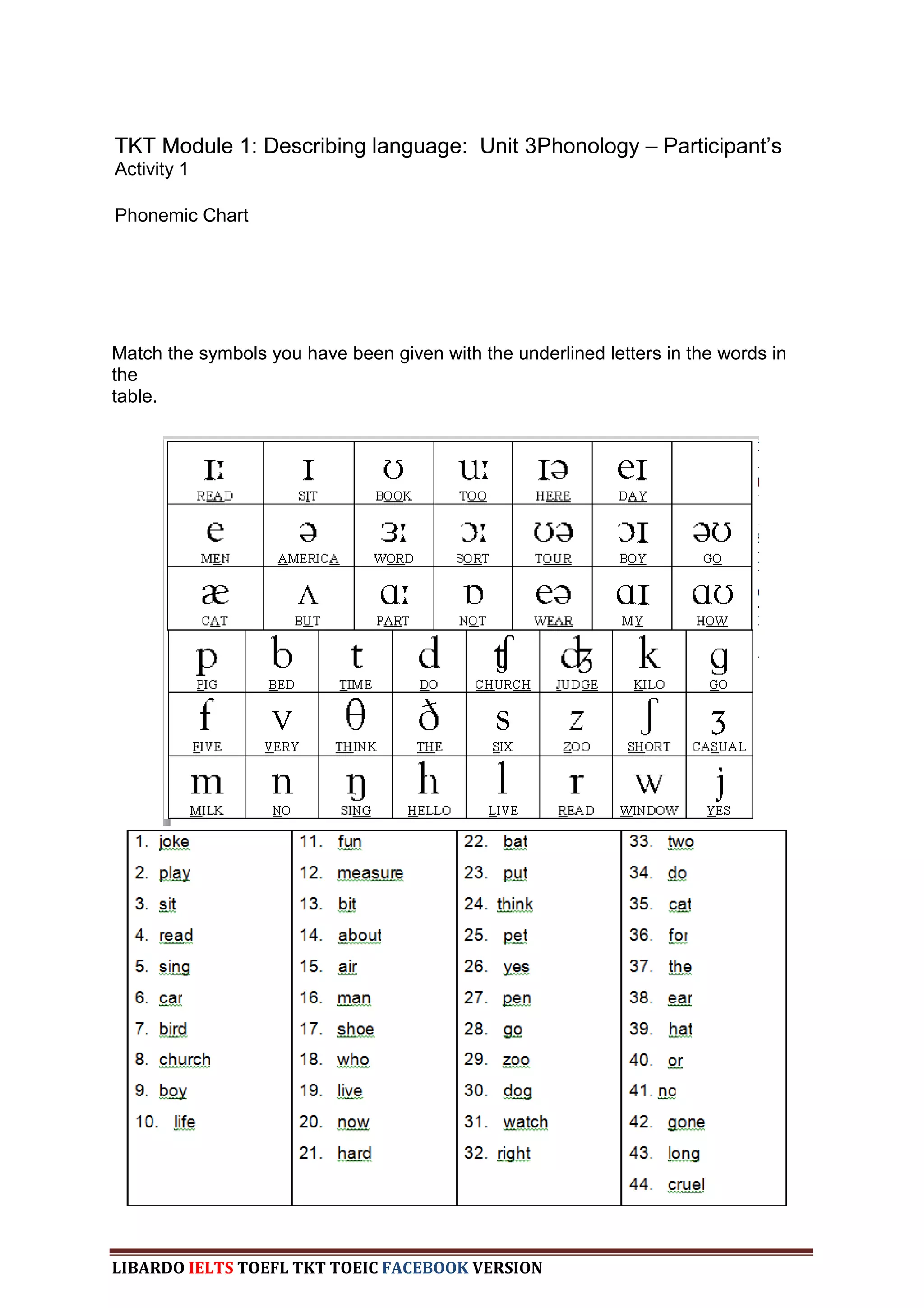
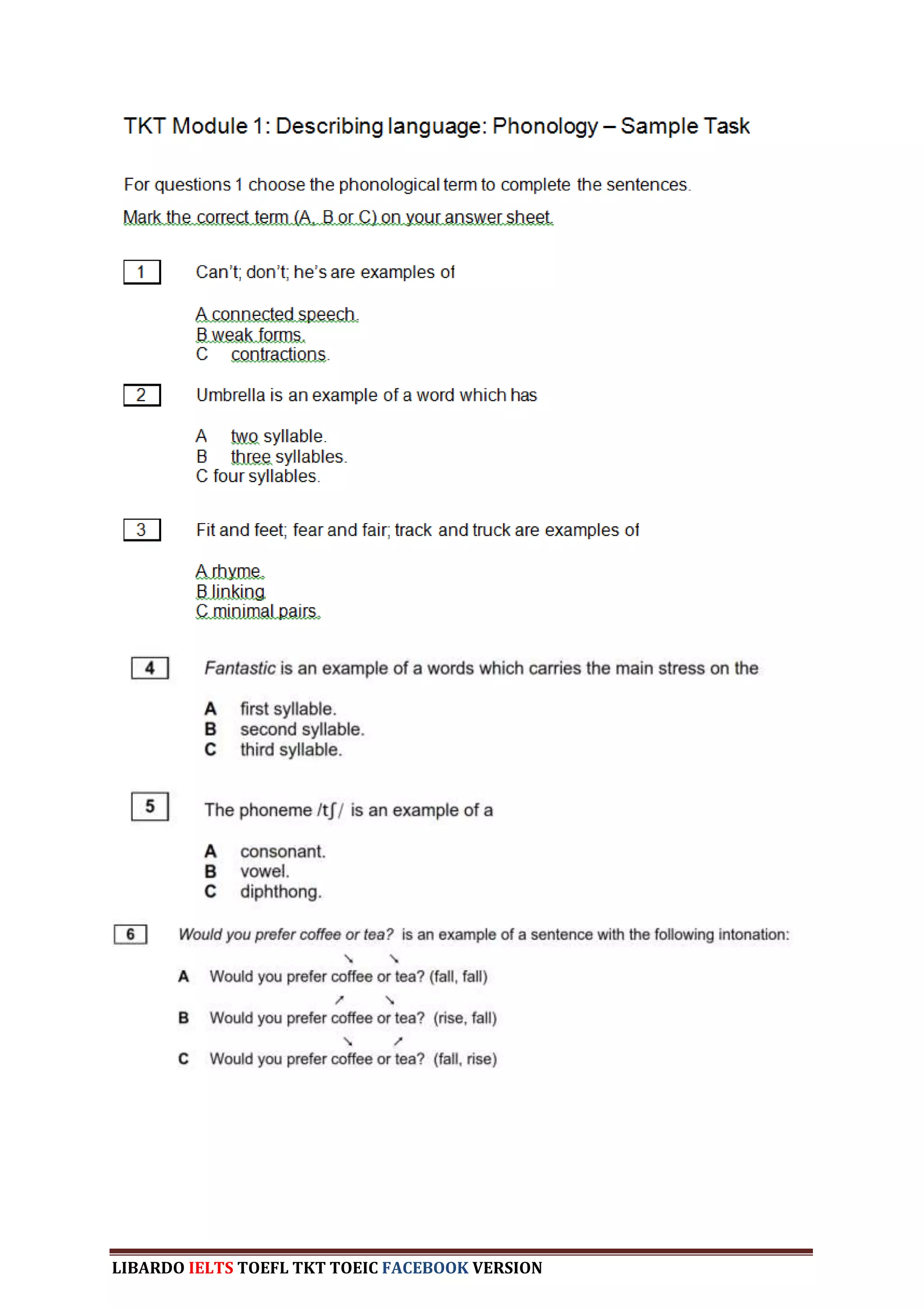
TKT Module 1: Describing language: Unit 3Phonology – Participant‟s
Activity 1

Phonemic Chart


Match the symbols you have been given with the underlined letters in the words in
the
table.


LIBARDO IELTS TOEFL TKT TOEIC FACEBOOK VERSION
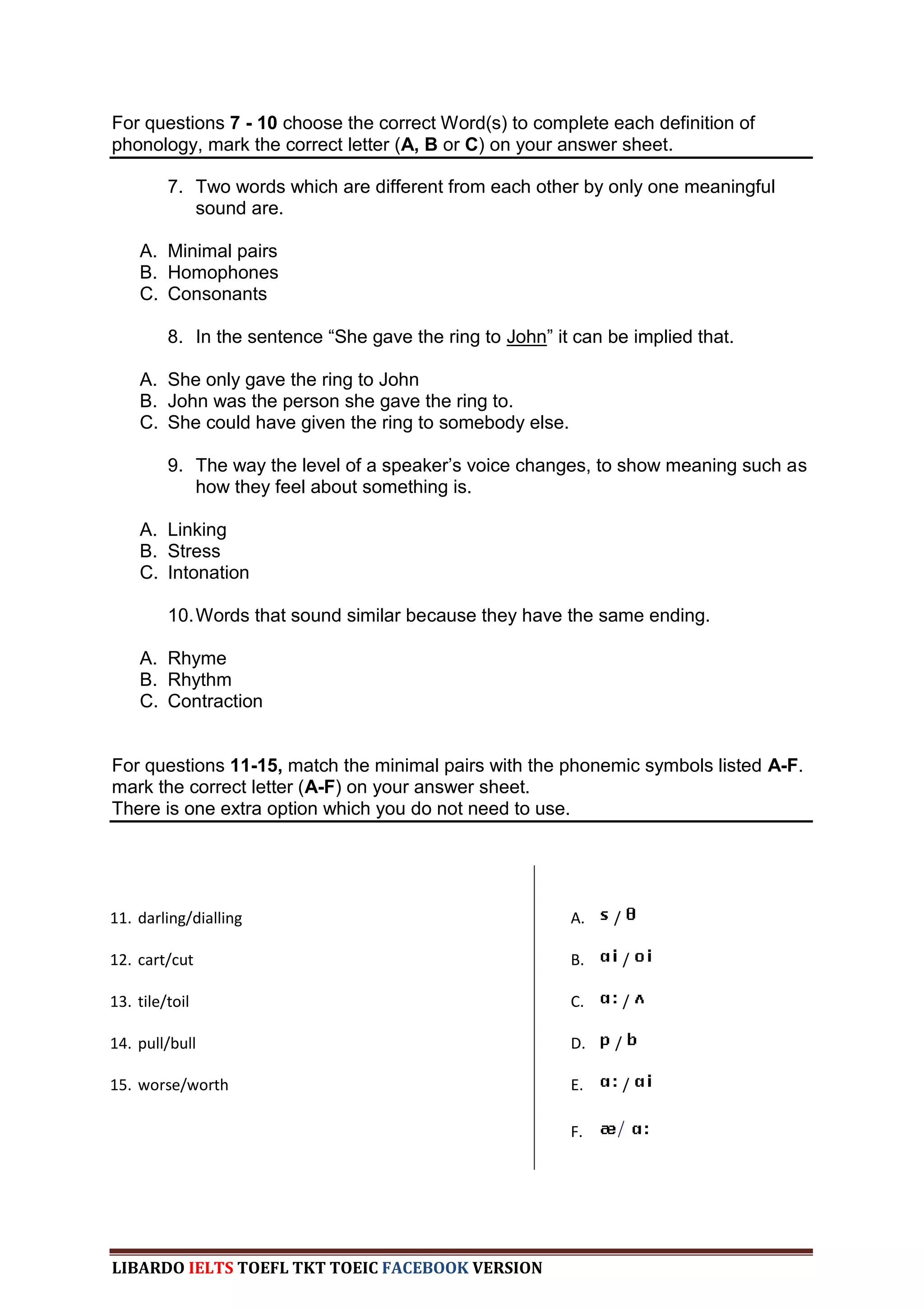
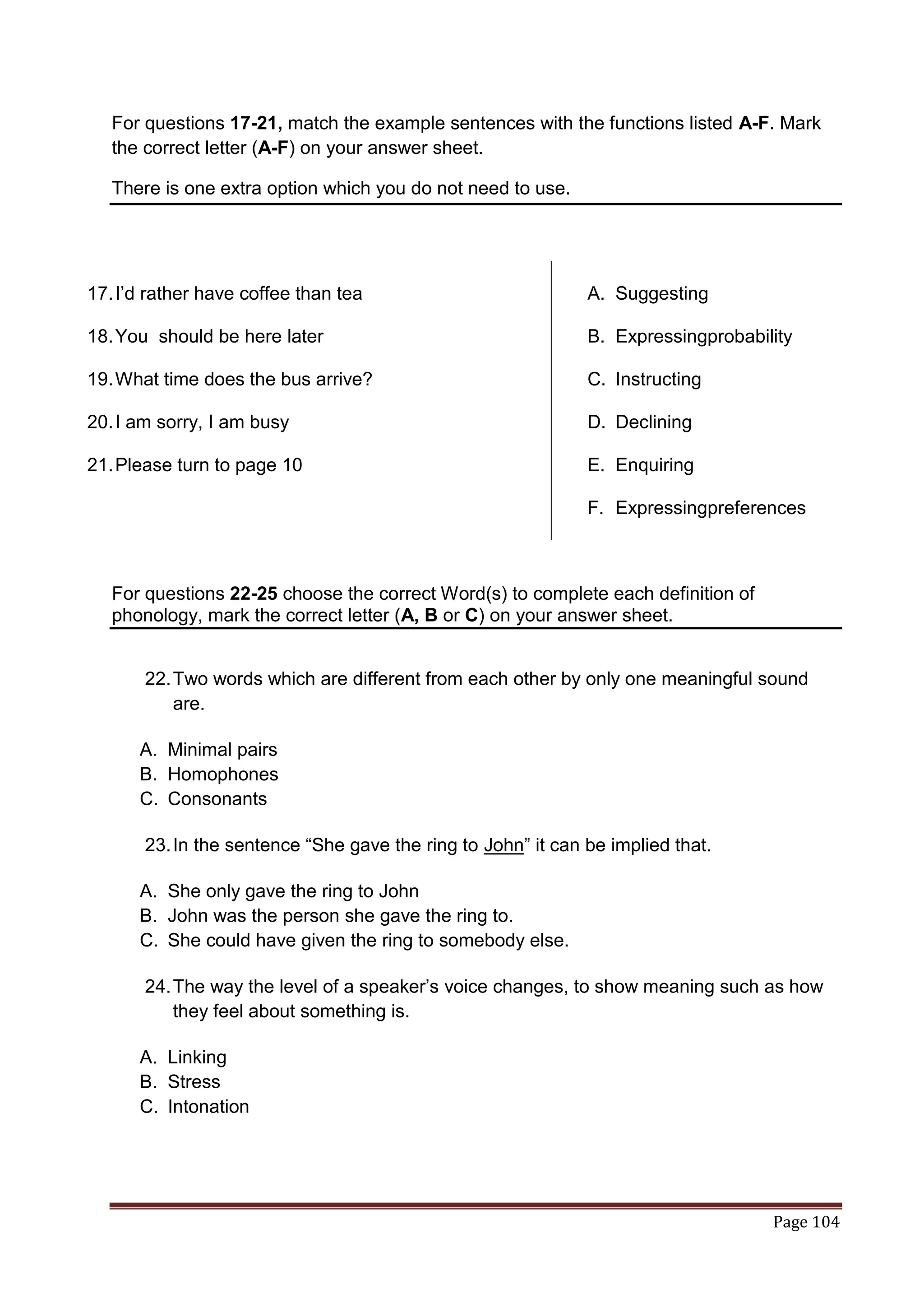
For questions 7 - 10 choose the correct Word(s) to complete each definition of
phonology, mark the correct letter (A, B or C) on your answer sheet.

         7. Two words which are different from each other by only one meaningful
            sound are.

    A. Minimal pairs
    B. Homophones
    C. Consonants

         8. In the sentence “She gave the ring to John” it can be implied that.

    A. She only gave the ring to John
    B. John was the person she gave the ring to.
    C. She could have given the ring to somebody else.

         9. The way the level of a speaker‟s voice changes, to show meaning such as
            how they feel about something is.

    A. Linking
    B. Stress
    C. Intonation

         10. Words that sound similar because they have the same ending.

    A. Rhyme
    B. Rhythm
    C. Contraction


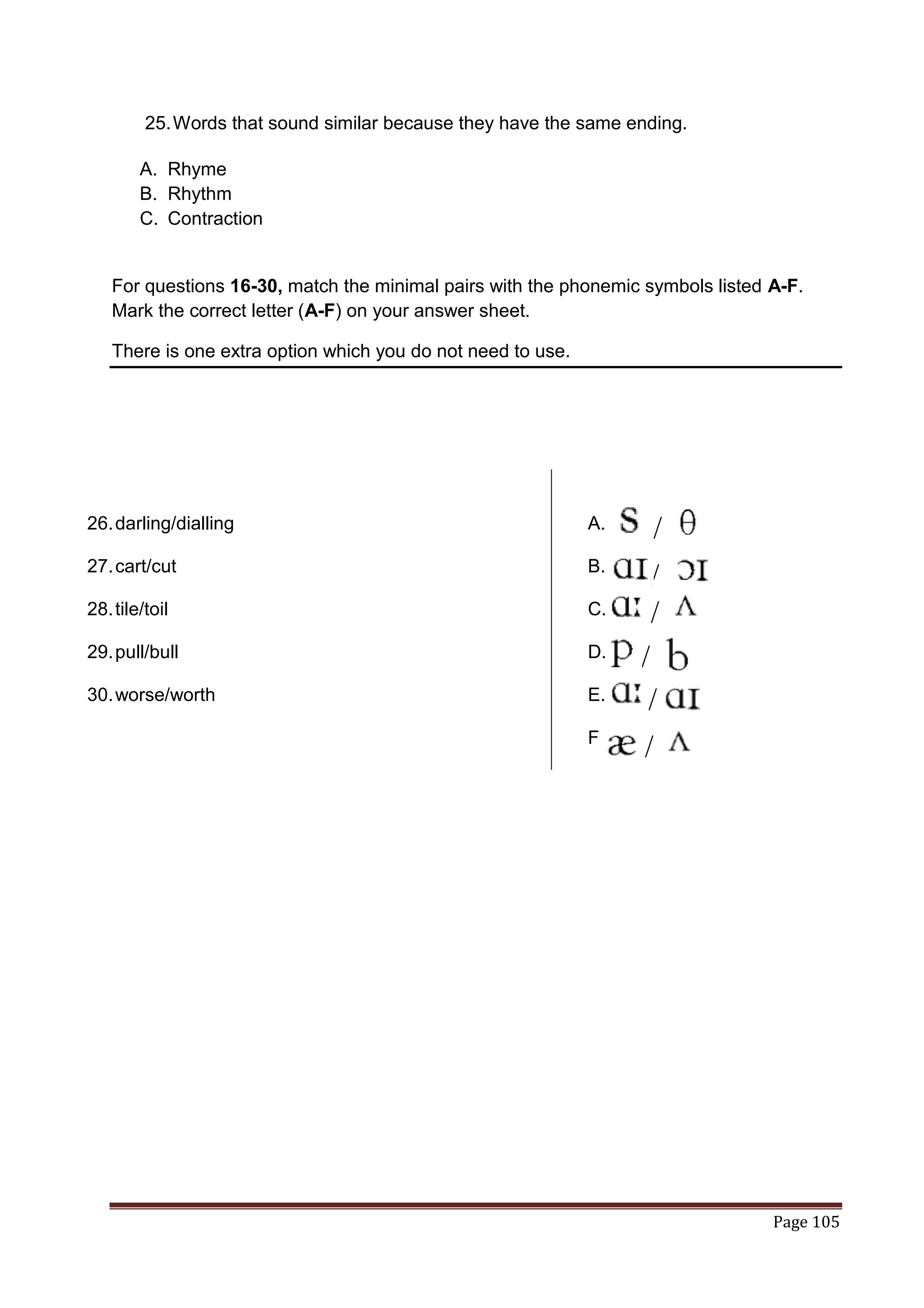
For questions 11-15, match the minimal pairs with the phonemic symbols listed A-F.
mark the correct letter (A-F) on your answer sheet.
There is one extra option which you do not need to use.


11. darling/dialling                                      A.    /

12. cart/cut                                              B.        /

13. tile/toil                                             C.        /

14. pull/bull                                             D.    /

15. worse/worth                                           E.        /

                                                          F.    /


LIBARDO IELTS TOEFL TKT TOEIC FACEBOOK VERSION
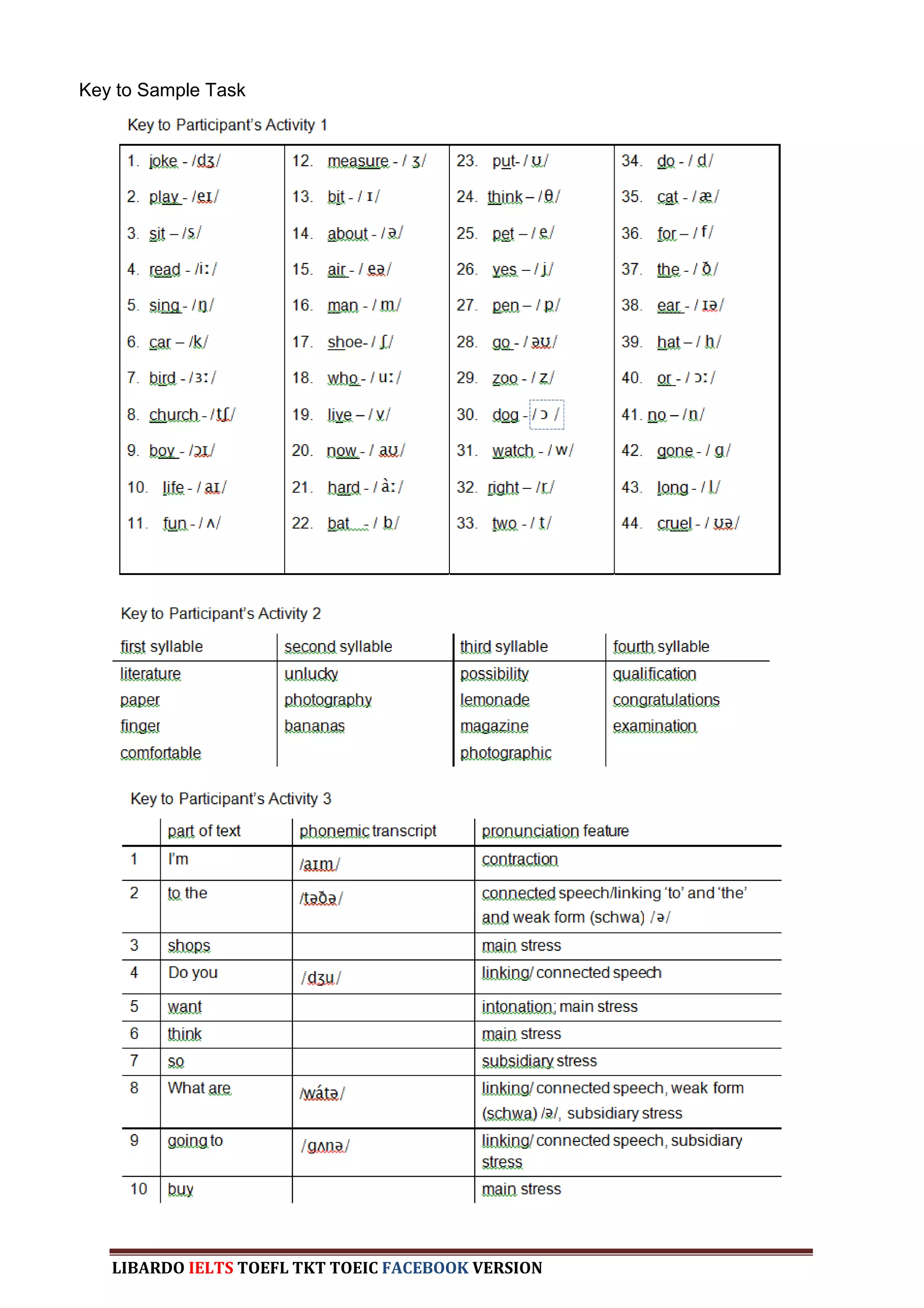
Key to Sample Task


   LIBARDO IELTS TOEFL TKT TOEIC FACEBOOK VERSION
7.     A        8. B               9.C   10.A 11.E   12. C   13.B   14.D   15.A


TKT UNIT 3 PHONOLOGY; GLOSSARY,
Taken from www.cambridgeesol.org


LIBARDO IELTS TOEFL TKT TOEIC FACEBOOK VERSION
TKT Module 1: Describing language: Unit 4 Functions

  1. Find ten functions in this word puzzle


LIBARDO IELTS TOEFL TKT TOEIC FACEBOOK VERSION
TKT Module 1: Describing language: Unit 4 Functions
   2. Read this functions list then match them to the exponents on the next
page

      Are they formal (F), informal (I), or neutral (N)? write down on in front of the
      exponent


                            Asking for an opinion


                             Introducing yourself


                         Introducing someone else


                                  Clarifying


                                   Praising


                                 Requesting


                                  Advising


                                  Agreeing


                                   Inviting


                                  Thanking


                                  Refusing


                                 Suggesting


                                Complaining


                                  Greeting


LIBARDO IELTS TOEFL TKT TOEIC FACEBOOK VERSION
1. Thanks a lot

2. Do you think you could possibly open the window?

3. Come round to my house for a bite to eat?

4. Can you open the window, please?

5. No way! I‟m not doing that.

6. I agreewiththat.

7. Hello, I‟mJosephine.

8. I‟m sorry but I‟m afraid I can‟t.

9. Would you like to come to dinner?

10. I don‟t believe we‟ve met. Myname‟s James Sanders.

11. Open the window, will you?

12. Mr and Mrs Smith request the pleasure of your company for dinner.


13. Yeah. You‟rerightthere.


14. Thank you very much indeed.


LIBARDO IELTS TOEFL TKT TOEIC FACEBOOK VERSION
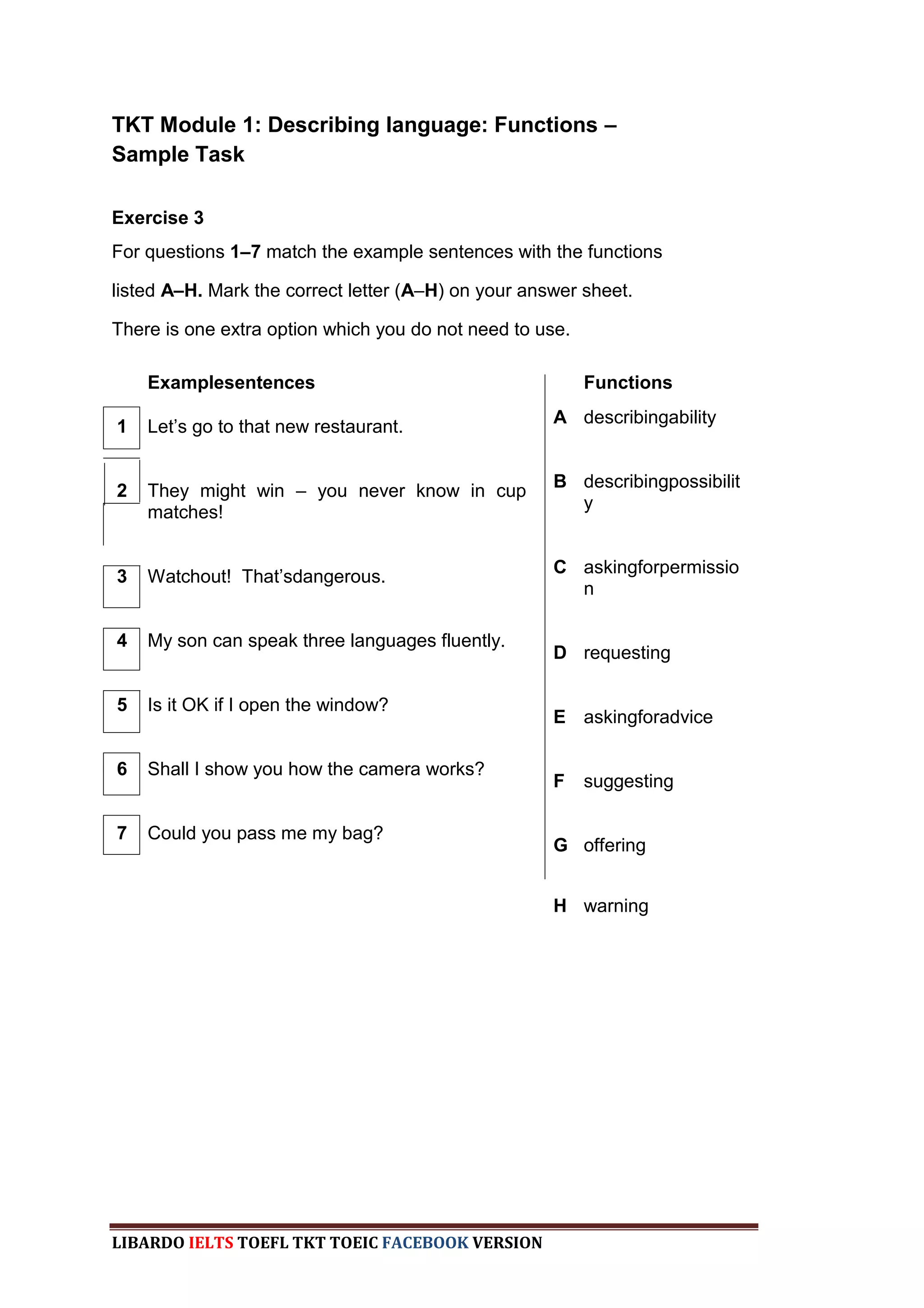
TKT Module 1: Describing language: Functions –
Sample Task

Exercise 3
For questions 1–7 match the example sentences with the functions

listed A–H. Mark the correct letter (A–H) on your answer sheet.

There is one extra option which you do not need to use.

    Examplesentences                                      Functions
                                                     A describingability
1   Let‟s go to that new restaurant.

                                                     B describingpossibilit
2   They might win – you never know in cup
                                                       y
    matches!

                                                     C askingforpermissio
3   Watchout! That‟sdangerous.
                                                       n

4   My son can speak three languages fluently.
                                                     D requesting

5   Is it OK if I open the window?
                                                     E askingforadvice

6   Shall I show you how the camera works?
                                                     F    suggesting

7   Could you pass me my bag?
                                                     G offering


                                                     H warning


LIBARDO IELTS TOEFL TKT TOEIC FACEBOOK VERSION
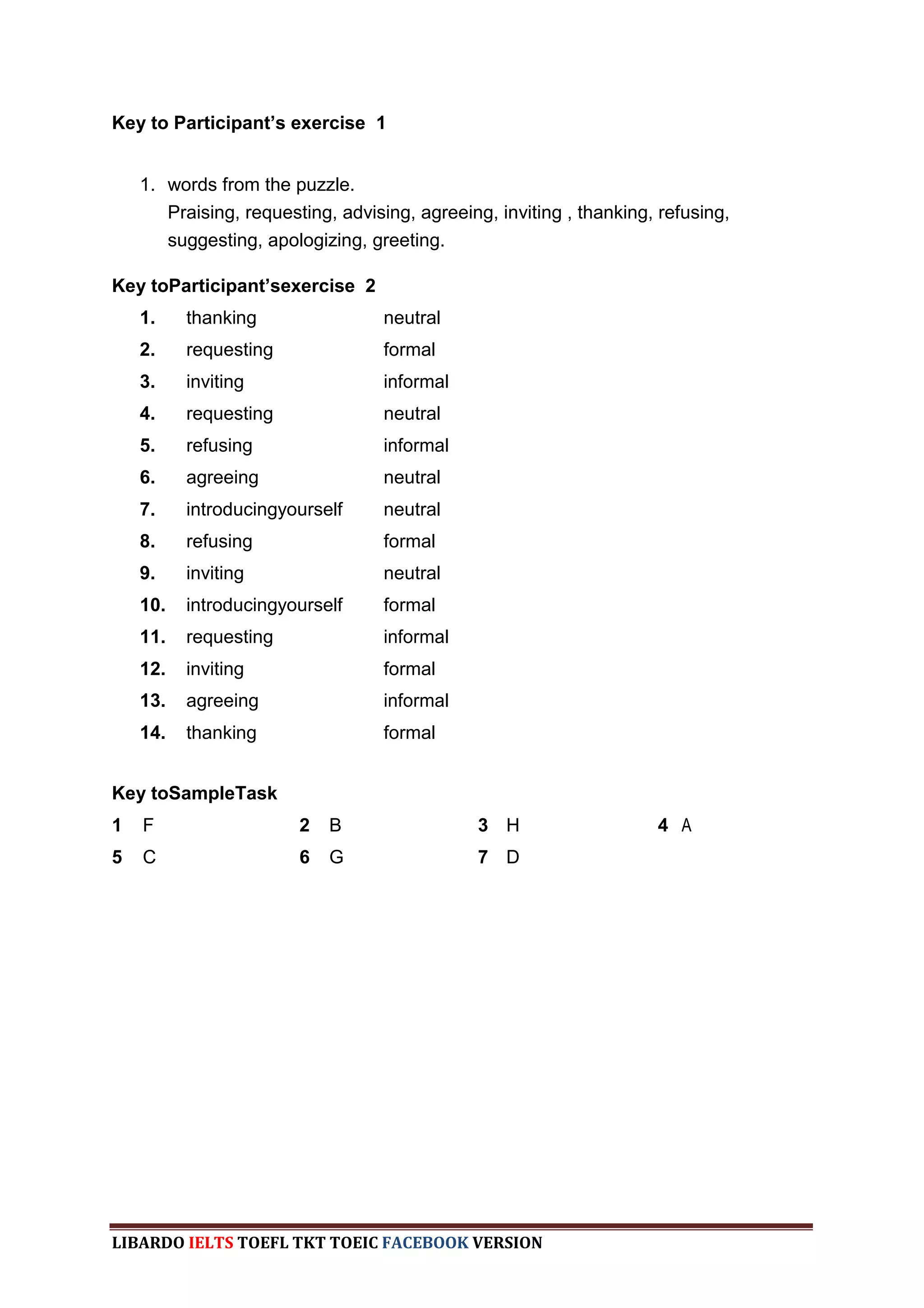
Key to Participant’s exercise 1


    1. words from the puzzle.
       Praising, requesting, advising, agreeing, inviting , thanking, refusing,
       suggesting, apologizing, greeting.

Key toParticipant’sexercise 2
    1.    thanking                 neutral
    2.    requesting               formal
    3.    inviting                 informal
    4.    requesting               neutral
    5.    refusing                 informal
    6.    agreeing                 neutral
    7.    introducingyourself      neutral
    8.    refusing                 formal
    9.    inviting                 neutral
    10.   introducingyourself      formal
    11.   requesting               informal
    12.   inviting                 formal
    13.   agreeing                 informal
    14.   thanking                 formal


Key toSampleTask
1   F                   2   B                 3 H                    4 A
5   C                   6   G                 7 D


LIBARDO IELTS TOEFL TKT TOEIC FACEBOOK VERSION
FUNCTIONS GLOSSARY
Taken from www.cambridgeesol.org


Candidates should already be familiar with common functions such as asking, telling, replying, thanking
and suggesting.

Appropriacynoun, appropriate/inappropriate adjective
Language which is suitable in a particular situation. See register.

Colloquial
Language normally used in informal conversation but not in formal speech or writing, e.g. Give Gran a ring, OK?

Decline, refuse an invitation
To say that you will not accept an invitation, e.g. I‟m sorry but I can‟t.

Enquire
To ask for information, e.g. What time does the train leave?

Express
To show or make known a feeling or an opinion in words.

            Express ability, e.g.Icanswim.

            Express intention, e.g.I‟m planning tovisit him next year.

            Express necessity, e.g.Heneedsto get a new passport.

            Express obligation, e.g.Youmustwear a seatbelt.

______________________________________________________________________________________________


LIBARDO IELTS TOEFL TKT TOEIC FACEBOOK VERSION
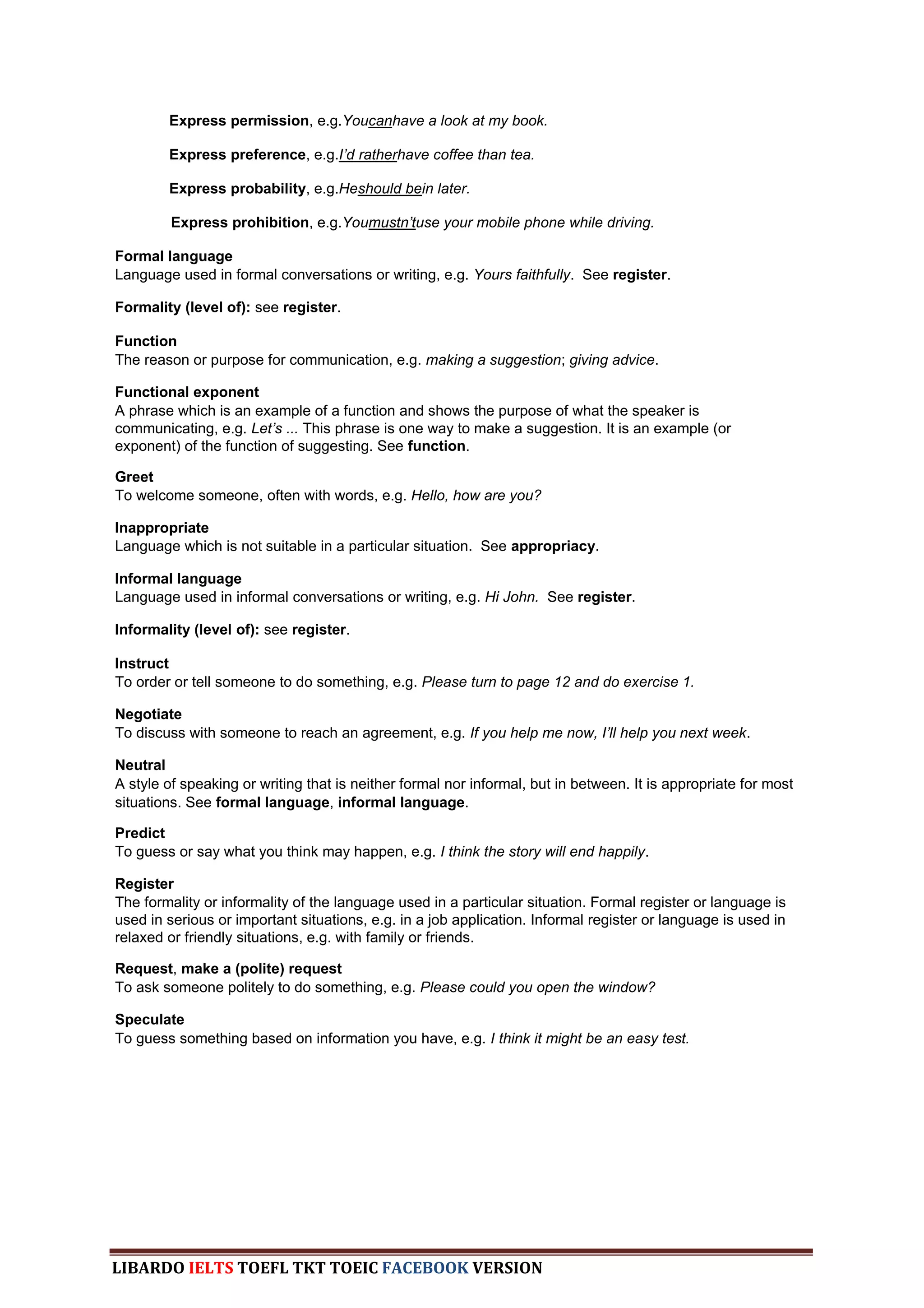
Express permission, e.g.Youcanhave a look at my book.

        Express preference, e.g.I‟d ratherhave coffee than tea.

        Express probability, e.g.Heshould bein later.

         Express prohibition, e.g.Youmustn‟tuse your mobile phone while driving.

Formal language
Language used in formal conversations or writing, e.g. Yours faithfully. See register.

Formality (level of): see register.

Function
The reason or purpose for communication, e.g. making a suggestion; giving advice.

Functional exponent
A phrase which is an example of a function and shows the purpose of what the speaker is
communicating, e.g. Let‟s ... This phrase is one way to make a suggestion. It is an example (or
exponent) of the function of suggesting. See function.

Greet
To welcome someone, often with words, e.g. Hello, how are you?

Inappropriate
Language which is not suitable in a particular situation. See appropriacy.

Informal language
Language used in informal conversations or writing, e.g. Hi John. See register.

Informality (level of): see register.

Instruct
To order or tell someone to do something, e.g. Please turn to page 12 and do exercise 1.

Negotiate
To discuss with someone to reach an agreement, e.g. If you help me now, I‟ll help you next week.

Neutral
A style of speaking or writing that is neither formal nor informal, but in between. It is appropriate for most
situations. See formal language, informal language.

Predict
To guess or say what you think may happen, e.g. I think the story will end happily.

Register
The formality or informality of the language used in a particular situation. Formal register or language is
used in serious or important situations, e.g. in a job application. Informal register or language is used in
relaxed or friendly situations, e.g. with family or friends.

Request, make a (polite) request
To ask someone politely to do something, e.g. Please could you open the window?

Speculate
To guess something based on information you have, e.g. I think it might be an easy test.


LIBARDO IELTS TOEFL TKT TOEIC FACEBOOK VERSION
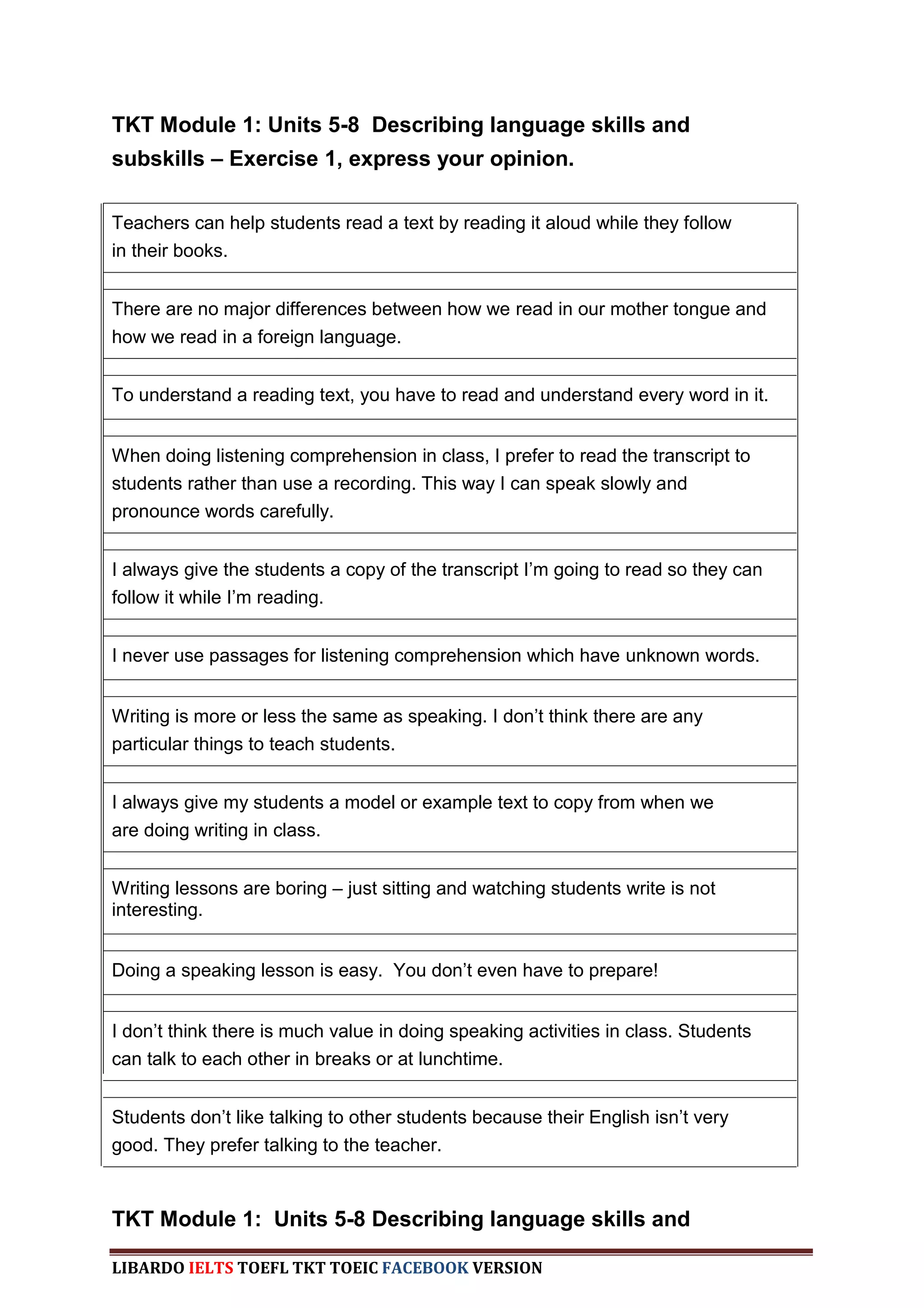
TKT Module 1: Units 5-8 Describing language skills and
subskills – Exercise 1, express your opinion.

Teachers can help students read a text by reading it aloud while they follow
in their books.


There are no major differences between how we read in our mother tongue and
how we read in a foreign language.


To understand a reading text, you have to read and understand every word in it.


When doing listening comprehension in class, I prefer to read the transcript to
students rather than use a recording. This way I can speak slowly and
pronounce words carefully.


I always give the students a copy of the transcript I‟m going to read so they can
follow it while I‟m reading.


I never use passages for listening comprehension which have unknown words.


Writing is more or less the same as speaking. I don‟t think there are any
particular things to teach students.


I always give my students a model or example text to copy from when we
are doing writing in class.


Writing lessons are boring – just sitting and watching students write is not
interesting.


Doing a speaking lesson is easy. You don‟t even have to prepare!


I don‟t think there is much value in doing speaking activities in class. Students
can talk to each other in breaks or at lunchtime.


Students don‟t like talking to other students because their English isn‟t very
good. They prefer talking to the teacher.


TKT Module 1: Units 5-8 Describing language skills and

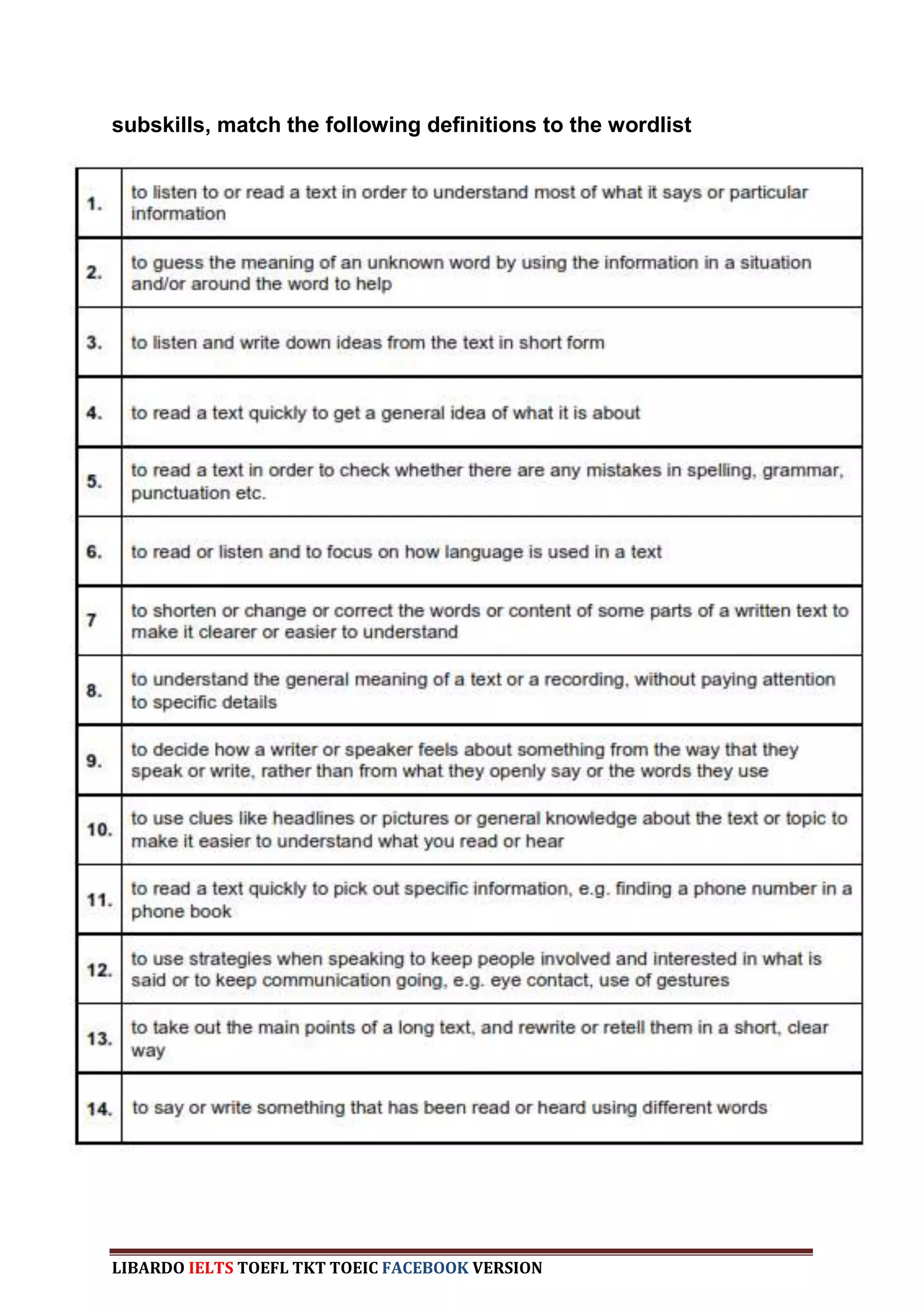
LIBARDO IELTS TOEFL TKT TOEIC FACEBOOK VERSION
subskills, match the following definitions to the wordlist


LIBARDO IELTS TOEFL TKT TOEIC FACEBOOK VERSION
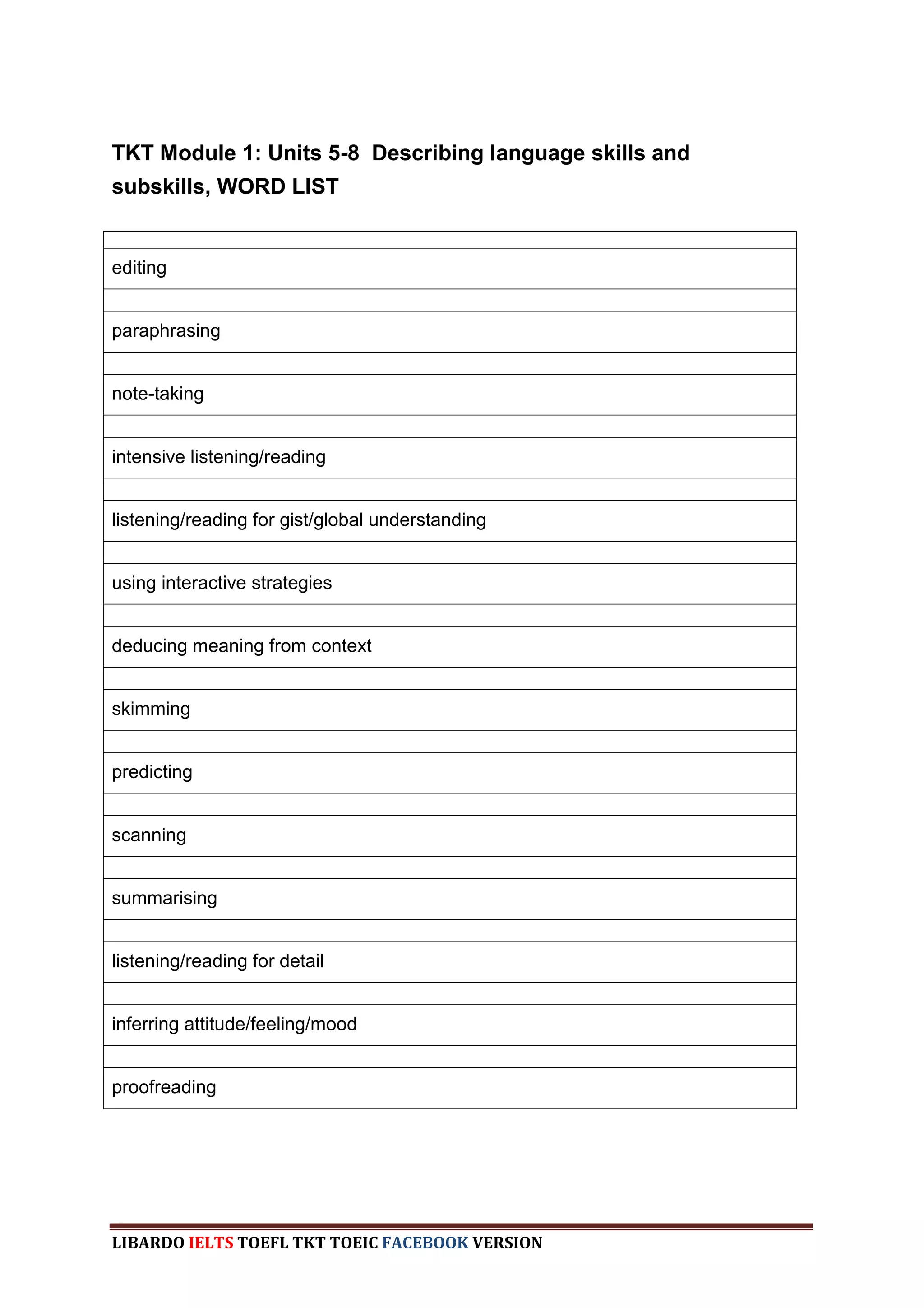
TKT Module 1: Units 5-8 Describing language skills and
subskills, WORD LIST


editing


paraphrasing


note-taking


intensive listening/reading


listening/reading for gist/global understanding


using interactive strategies


deducing meaning from context


skimming


predicting


scanning


summarising


listening/reading for detail


inferring attitude/feeling/mood


proofreading


LIBARDO IELTS TOEFL TKT TOEIC FACEBOOK VERSION
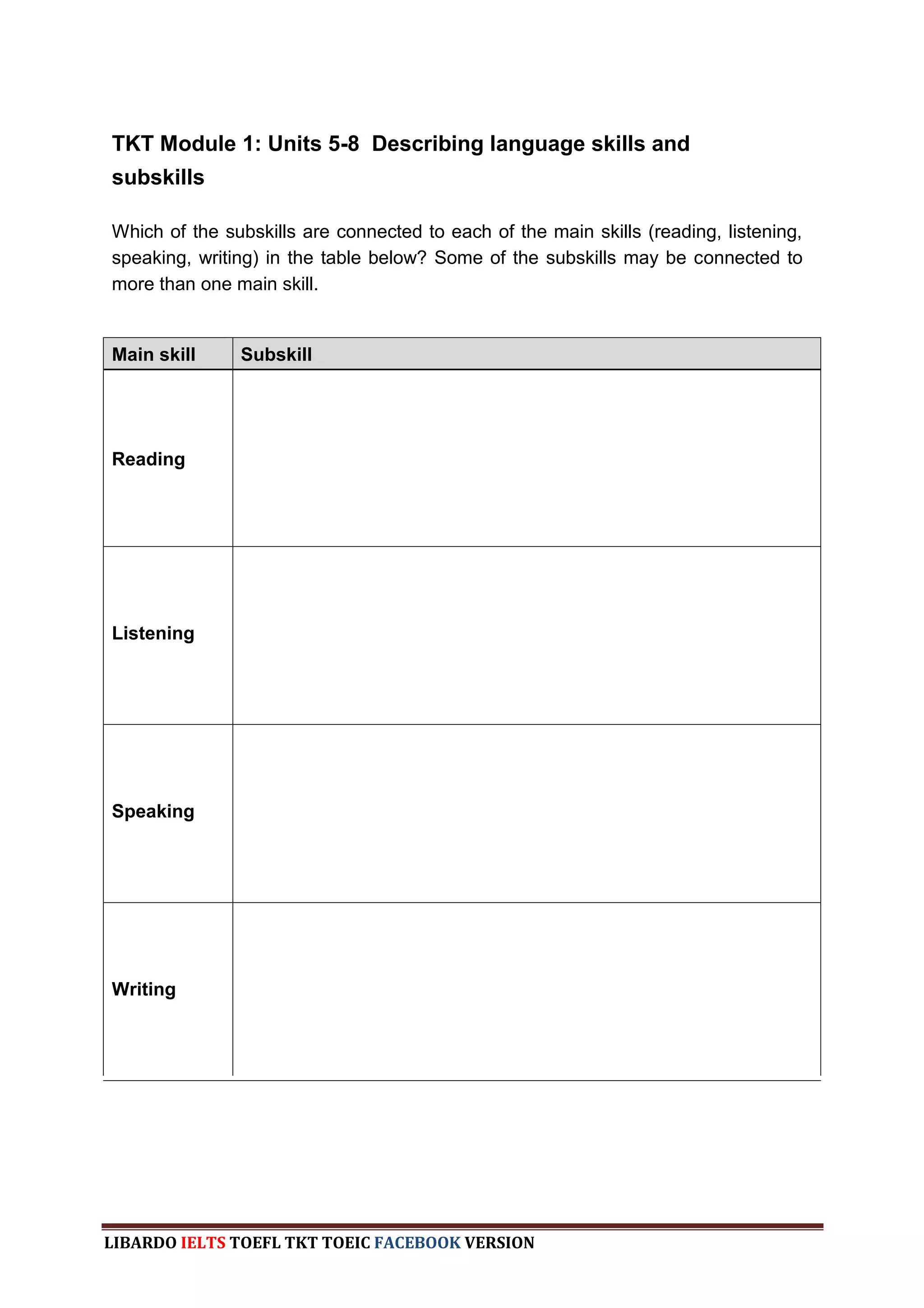
TKT Module 1: Units 5-8 Describing language skills and
subskills

Which of the subskills are connected to each of the main skills (reading, listening,
speaking, writing) in the table below? Some of the subskills may be connected to
more than one main skill.


Main skill     Subskill


Reading


Listening


Speaking


Writing


LIBARDO IELTS TOEFL TKT TOEIC FACEBOOK VERSION
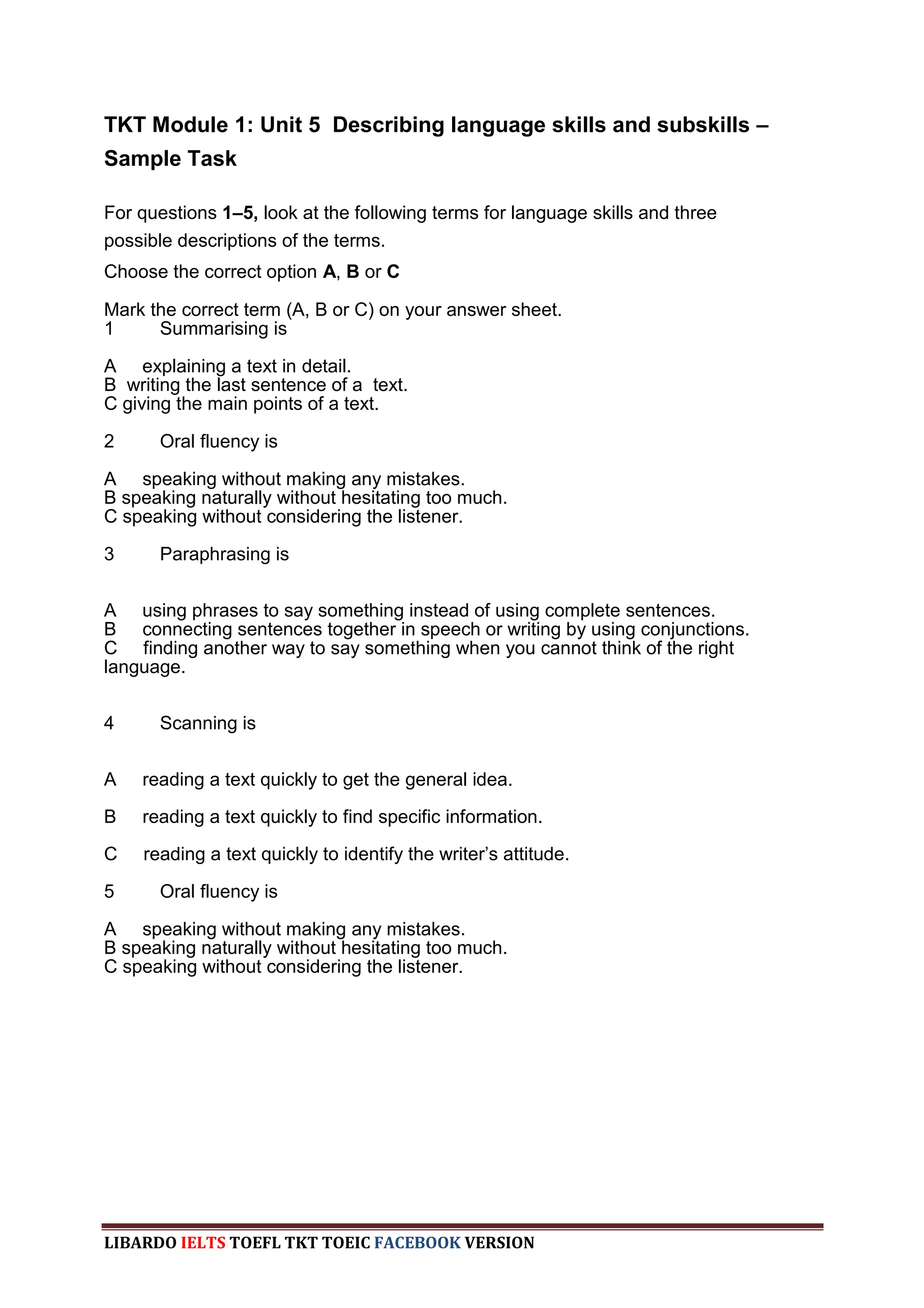
TKT Module 1: Unit 5 Describing language skills and subskills –
Sample Task

For questions 1–5, look at the following terms for language skills and three
possible descriptions of the terms.
Choose the correct option A, B or C

Mark the correct term (A, B or C) on your answer sheet.
1     Summarising is

A explaining a text in detail.
B writing the last sentence of a text.
C giving the main points of a text.

2     Oral fluency is

A speaking without making any mistakes.
B speaking naturally without hesitating too much.
C speaking without considering the listener.

3     Paraphrasing is


A using phrases to say something instead of using complete sentences.
B connecting sentences together in speech or writing by using conjunctions.
C finding another way to say something when you cannot think of the right
language.


4     Scanning is


A   reading a text quickly to get the general idea.

B   reading a text quickly to find specific information.

C   reading a text quickly to identify the writer‟s attitude.

5     Oral fluency is

A speaking without making any mistakes.
B speaking naturally without hesitating too much.
C speaking without considering the listener.


LIBARDO IELTS TOEFL TKT TOEIC FACEBOOK VERSION
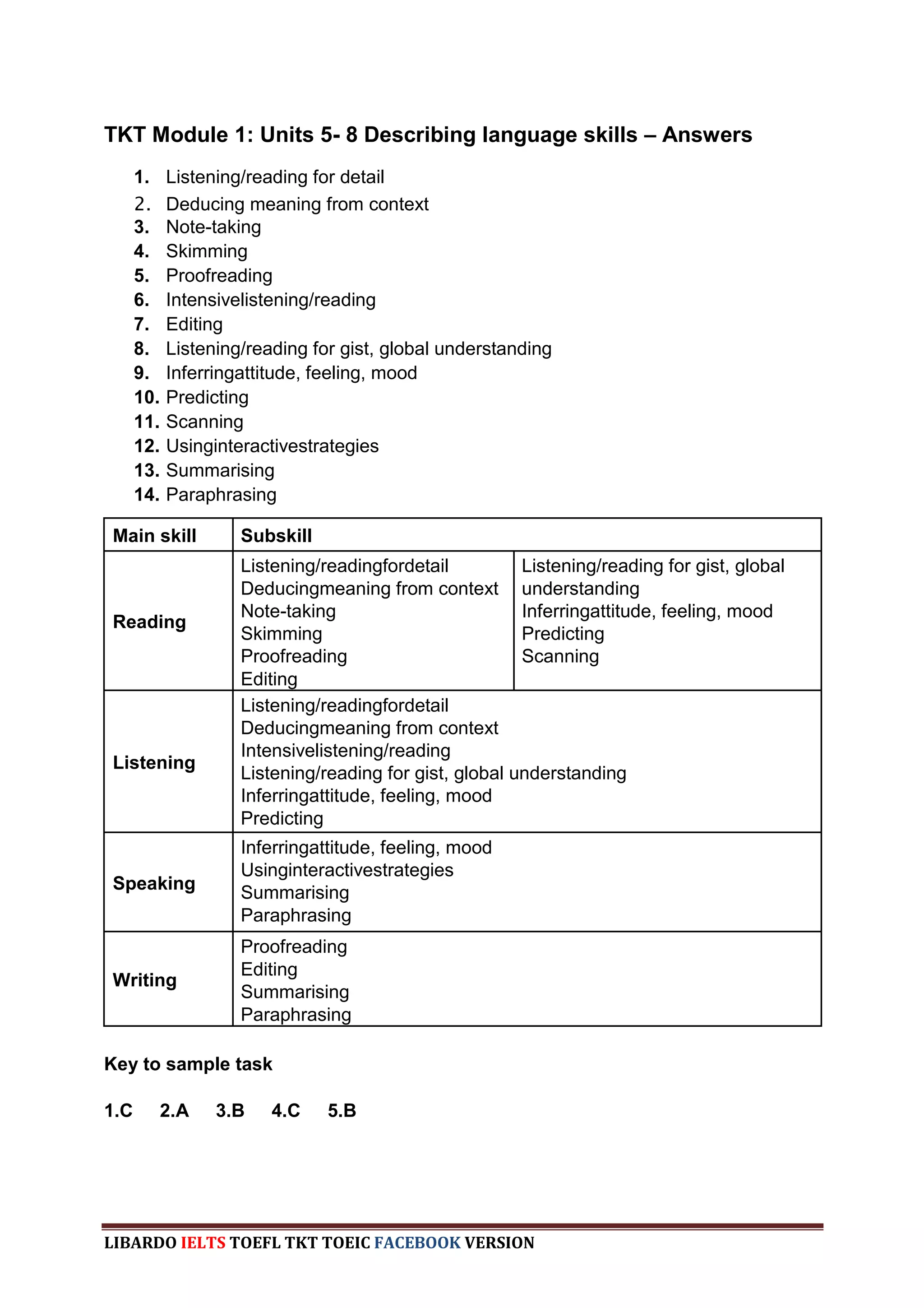
TKT Module 1: Units 5- 8 Describing language skills – Answers
      1.    Listening/reading for detail
      2.    Deducing meaning from context
      3.    Note-taking
      4.    Skimming
      5.    Proofreading
      6.    Intensivelistening/reading
      7.    Editing
      8.    Listening/reading for gist, global understanding
      9.    Inferringattitude, feeling, mood
      10.   Predicting
      11.   Scanning
      12.   Usinginteractivestrategies
      13.   Summarising
      14.   Paraphrasing

Main skill           Subskill
                     Listening/readingfordetail          Listening/reading for gist, global
                     Deducingmeaning from context understanding
                     Note-taking                         Inferringattitude, feeling, mood
Reading
                     Skimming                            Predicting
                     Proofreading                        Scanning
                     Editing
                     Listening/readingfordetail
                     Deducingmeaning from context
                     Intensivelistening/reading
Listening
                     Listening/reading for gist, global understanding
                     Inferringattitude, feeling, mood
                     Predicting
                     Inferringattitude, feeling, mood
                     Usinginteractivestrategies
Speaking             Summarising
                     Paraphrasing
                     Proofreading
                     Editing
Writing
                     Summarising
                     Paraphrasing

Key to sample task

1.C         2.A   3.B    4.C    5.B


LIBARDO IELTS TOEFL TKT TOEIC FACEBOOK VERSION
Concepts and terminology for describing language skills
GLOSSARY
Taken from www.cambridgeesol.org


Abstract
Relating to complex thoughts and ideas rather than simple, basic, concrete concepts. A text or
language can be abstract, e.g. words to express thoughts or feelings are often abstract words.
Seeconcrete.

Accuracy
The use of correct forms of grammar, vocabulary, spelling and pronunciation. In an accuracy activity,
teachers and learners typically focus on using and producing language, spelling correctly. See oral
fluency.

Authenticity: see authentic material.

Coherence noun, coherent adjective
When ideas in a spoken or written text fit together clearly and smoothly, and so are logical and make
sense to the listener or reader.

Cohesion noun, cohesive adjective
The way spoken or written texts are joined together with logical grammar or lexis, e.g. conjunctions (Firstly,
secondly), lexical sets, referring words (it, them, this).

Cohesive device
A feature in a text which provides cohesion, e.g. use of topic-related vocabulary throughout a text, of
sequencing words (then, next, after that etc.), of referencing words (pronouns – he, him, etc.), of
conjunctions (however, although etc.).

Coherence noun, coherent adjective
When ideas in a spoken or written text fit together clearly and smoothly, and so are logical and make
sense to the listener or reader.

Complex
Complicated, not simple.

Comprehension
Understanding a spoken or written text.

Concrete
Relating to real or specific ideas or concepts. Lexis can be concrete, e.g. words for real objects like
clothes, food, animals that can be seen or touched, or abstract, e.g. words to express thoughts, feelings,
complex ideas, which cannot be seen or touched.

Context
1. The situation in which language is used or presented, e.g. a story about a holiday experience could be
   used as the context to present past tenses.
2. The words or phrases before or after a word in discourse which help someone to understand
   that word. Seededuce meaning from context.

Discourse
Spoken or written language in texts or groups of sentences.

Deduce meaning from context
To guess the meaning of an unknown word by using the information in a situation and/or around the word to help,
e.g.
I drove my van to the town centre and parked it in the central car park. Van must be some kind of vehicle
becauseyou drive it and park it.

Develop skills
To help learners to improve their listening, reading, writing and speaking ability. Teachers do this in
class by providing activities which focus on skills development.


LIBARDO IELTS TOEFL TKT TOEIC FACEBOOK VERSION
Draft noun + verb
A draft is a piece of writing that is not yet finished, and may be changed. A writer drafts a piece of writing.
That is, they write it for the first time but not exactly as it will be when it is finished. See re-draft.

Edit
To shorten or change or correct the words or content of some parts of a written text to make it clearer or
easier to understand.

Extensive listening/reading
Listening to or reading long pieces of text, such as stories or newspapers. See intensive listening/reading.

Extract
Part of a text which is removed from an original text.
Fossilisation,fossilised errors
The process in which incorrect language becomes a habit and cannot easily be corrected.

Gist, global listening/reading: see listen/read for gist/global understanding.

Infer attitude, feeling,mood
To decide how a writer or speaker feels about something from the way that they speak or write, rather than
from what they openly say.

Integrated skills
An integrated skills lesson combines work on reading, writing, listening and speaking.

Intensive listening/reading
One meaning of intensive listening/reading is reading or listening to focus on how language is used in a
text. This is how intensive listening/reading is used in TKT. See extensive listening/reading.

Interaction noun, interact verb, interactive strategies
Interaction is „two-way communication‟ between listener and speaker, or reader and text. Interactive
strategies are the means used, especially in speaking, to keep people involved and interested in what is
said or to keep communication going, e.g. eye contact, use of gestures, functions such as repeating,
asking for clarification.

Key word
A word in a piece of discourse or text, which is important for understanding the text.

Layout
The way in which a text is organised and presented on a page. Certain texts have special layouts, e.g.
letters and newspaper articles.

Listen/read for detail
To listen to or read a text in order to understand most of what it says or particular details.

Listen/read for gist, global understanding
To understand the general meaning of a text, without paying attention to specific details.

Listen/read for mood
To read or listen to a text in order to identify the feelings of the writer or speaker. See infer attitude, feeling,
mood.

Note-taking noun, take notes verb
To take notes means to listen and write down ideas from the text in short form.

Oral fluency
The use of connected speech at a natural speed with little hesitation, repetition or self-correction. In a
written or spoken fluency activity, learners typically give attention to the communication of meaning,
rather than trying to be correct. See accuracy.

Paragraph noun + verb
A paragraph is a section in a longer piece of writing such as an essay. It starts on a new line and usually
contains a single new idea. When a writer is paragraphing, he/she is creating paragraphs. See topic
sentence.

LIBARDO IELTS TOEFL TKT TOEIC FACEBOOK VERSION
Paraphrase noun + verb
To say or write something that has been read or heard using different words. Paraphrase can also be used
to describe what a learner does if he/she is not sure of the exact language they need to use, i.e. explain
their meaning using different language.

Prediction noun, predict verb
A technique or learner strategy learners can use to help with listening or reading. Learners think about the
topic before they read or listen. They try to imagine what the topic will be or what they are going to read
about or listen to, using clues like headlines or pictures accompanying the text or their general knowledge
about the text type or topic. This makes it easier for them to understand what they read or hear.

Process noun + verb
To actively think about new information in order to understand it completely and be able to use it in future.


Processwriting
An approach to writing, which thinks of writing as a process which includes different stages of writing
such as planning, drafting, re-drafting, editing, proofreading. See product writing, guided writing.

Product writing
An approach to writing which involves analysing and then reproducing models of particular text types. See
processwriting.

Productive skills
When learners produce language. Speaking and writing are productive skills. See receptive skills.

Proofread
To read a text in order to check whether there are any mistakes in spelling, grammar, punctuation etc.

Re-draft
When a piece of writing is changed with the intention of improving it. A writer‟s first draft may be
re-drafted. See draft.

Receptive skills
When learners do not have to produce language; listening and reading are receptive skills. See productive
skills.

Relevance noun, relevant adjective
The degree to which something is related to or useful in a situation.

Scan
To read a text quickly to pick out specific information, e.g. finding a phone number in a phone book.

Skill
The four language skills are listening, speaking, reading and writing.

Skim
To read a text quickly to get a general idea of what it is about.

Subskill
Each of the four language skills can be divided into smaller subskills that are all part of the main skill, e.g.
identifying text organisation (reading); identifying word stress (listening). See listen/read for gist, global
understanding, scan, listen/read for detail.

Summary noun,summariseverb
To take out the main points of a long text, and rewrite or retell them in a short, clear way.

Text structure
The way a text is organised. For example, an essay typically has an introduction, a main section and a
conclusion.

Text type
Texts that have specific features, e.g. layout, use of language, that make them part of a recognisable
type of text, e.g. letters, emails, news reports.

LIBARDO IELTS TOEFL TKT TOEIC FACEBOOK VERSION
Theme noun, thematic adjective
The main subject of a conversation, a text or a lesson.

Topic
The subject of a text or lesson.

Topic sentence
A sentence that gives the main point or subject of a paragraph. This is usually the opening sentence in a
paragraph.

Turn, turn-taking
When someone speaks in a conversation this is called a turn. Speaking and then allowing another person to
speak in reply is called „turn-taking‟.

Version
A particular form of something in which some details are different from an earlier or later form of it, e.g. a
written text may have different versions.


LIBARDO IELTS TOEFL TKT TOEIC FACEBOOK VERSION
TKT Module 1:Unit 9: Motivation – Participant’s Worksheet 1

Put the teacher characteristics in order (1–6) of how important you think these
characteristics are to be an effective teacher.

The teacher knows English grammar well.
The teacher speaks clearly.
The teacher is friendly.
The teacher is well-organised.
The teacher can speak a foreign language.
The teacher knows her students well

Exercise 1

Compare these ideas with your ‘top tips’ for teachers to maintain motivation in
students.

1.Give students something to work towards. Have goals for yourself and encourage
students to have goals of their own.
2.Be enthusiastic in lessons and enthusiastic about the material you are using. „Sell it‟to the
students.
3.Make sure your material is well presented and attractive for learners.
4.Give clear instructions for tasks so that students can achieve your aims.
5.Provide a good variety of activities in your lessons.
6.Provide a variety of interaction patterns in lessons.
7.Find out about your students‟ interests so that you can provide material on topics that the
students are interested in.
8.Encourage students to relax in lessons and encourage them to talk to each other and to
help each other.
9.Praise all students when they have done something well, especially weaker learners, to
build self-confidence.
10. Encourage students to continue studying outside the classroom.
Exercise2
Matcheachoftheactivitiesbelowwiththe‘toptip’ abovethatitwouldputin action


LIBARDO IELTS TOEFL TKT TOEIC FACEBOOK VERSION
A. Demonstrate tasks so that students know what to do. Check understanding of instructions.
B. If students arrive early for class, encourage them to chat to amongst themselves. C. Try to
do different activities in a lesson, e.g. speaking and reading rather than just
reading.
D. Start your lessons with a warmer to raise energy levels.
E. Set up a research project. Get learners to look things up on the internet.
F. Provide a questionnaire with topics so that students can choose which ones they like best.
G.When monitoring a speaking or writing task, select some examples of good English to put on
the board at the end for everyone to share. .
H. Use pictures on handouts and vary the font size, layout, etc.
I. Tell students what you intend to achieve by the end of the course and find out what they want
to achieve.
J. Do pair work and group work and change students around so they can work with different
people.


LIBARDO IELTS TOEFL TKT TOEIC FACEBOOK VERSION
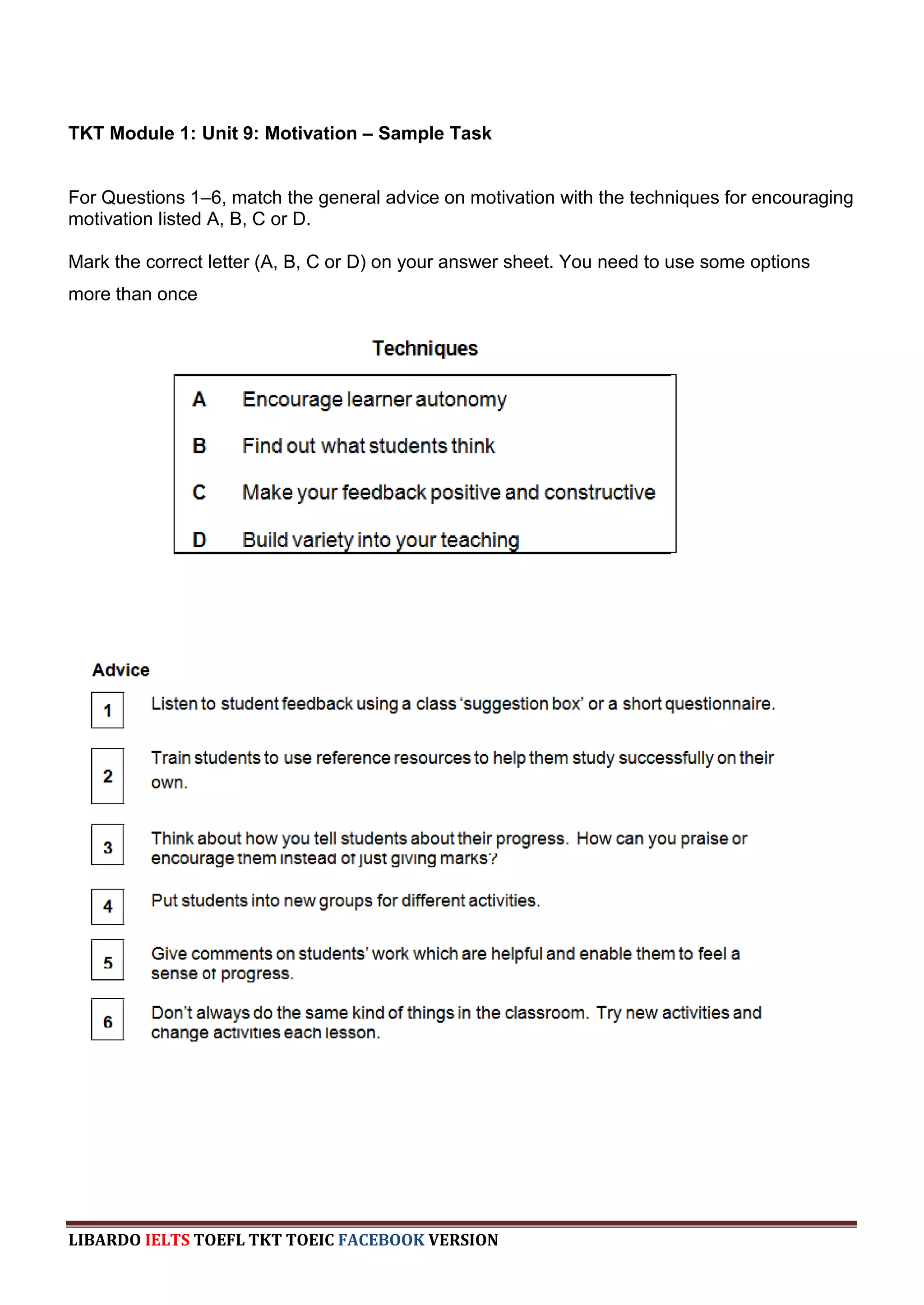
TKT Module 1: Unit 9: Motivation – Sample Task


For Questions 1–6, match the general advice on motivation with the techniques for encouraging
motivation listed A, B, C or D.

Mark the correct letter (A, B, C or D) on your answer sheet. You need to use some options
more than once


LIBARDO IELTS TOEFL TKT TOEIC FACEBOOK VERSION
Key to Participant‟s Worksheet 2

1      I      2      D     3       H    4   A    5    C
6      J      7      F     8       B    9   G    10   E


Key to Sample Task

1. B   2. A   3.C    4.D   5. C    6D


LIBARDO IELTS TOEFL TKT TOEIC FACEBOOK VERSION
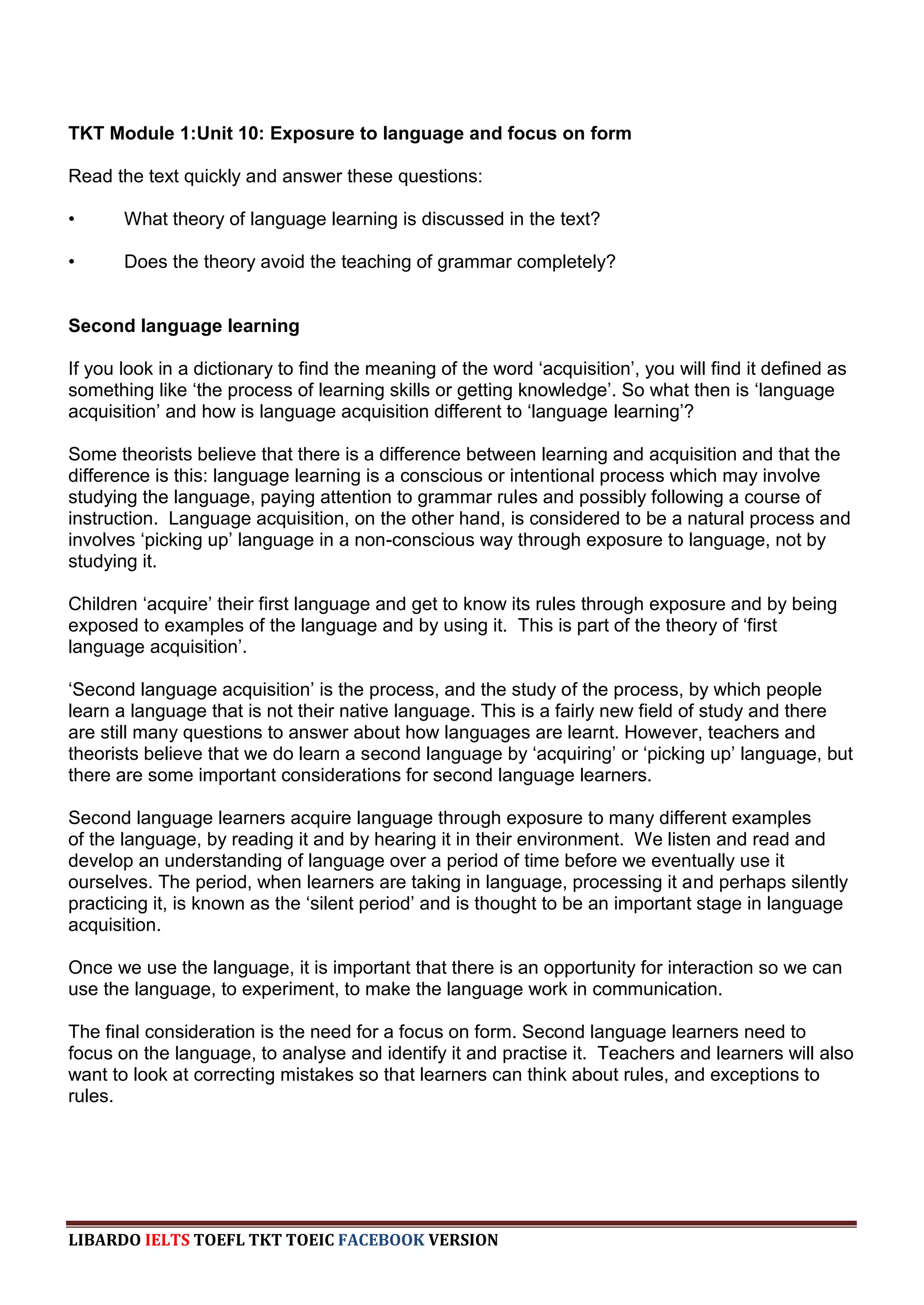
TKT Module 1:Unit 10: Exposure to language and focus on form

Read the text quickly and answer these questions:

•      What theory of language learning is discussed in the text?

•      Does the theory avoid the teaching of grammar completely?


Second language learning

If you look in a dictionary to find the meaning of the word „acquisition‟, you will find it defined as
something like „the process of learning skills or getting knowledge‟. So what then is „language
acquisition‟ and how is language acquisition different to „language learning‟?

Some theorists believe that there is a difference between learning and acquisition and that the
difference is this: language learning is a conscious or intentional process which may involve
studying the language, paying attention to grammar rules and possibly following a course of
instruction. Language acquisition, on the other hand, is considered to be a natural process and
involves „picking up‟ language in a non-conscious way through exposure to language, not by
studying it.

Children „acquire‟ their first language and get to know its rules through exposure and by being
exposed to examples of the language and by using it. This is part of the theory of „first
language acquisition‟.

„Second language acquisition‟ is the process, and the study of the process, by which people
learn a language that is not their native language. This is a fairly new field of study and there
are still many questions to answer about how languages are learnt. However, teachers and
theorists believe that we do learn a second language by „acquiring‟ or „picking up‟ language, but
there are some important considerations for second language learners.

Second language learners acquire language through exposure to many different examples
of the language, by reading it and by hearing it in their environment. We listen and read and
develop an understanding of language over a period of time before we eventually use it
ourselves. The period, when learners are taking in language, processing it and perhaps silently
practicing it, is known as the „silent period‟ and is thought to be an important stage in language
acquisition.

Once we use the language, it is important that there is an opportunity for interaction so we can
use the language, to experiment, to make the language work in communication.

The final consideration is the need for a focus on form. Second language learners need to
focus on the language, to analyse and identify it and practise it. Teachers and learners will also
want to look at correcting mistakes so that learners can think about rules, and exceptions to
rules.


LIBARDO IELTS TOEFL TKT TOEIC FACEBOOK VERSION
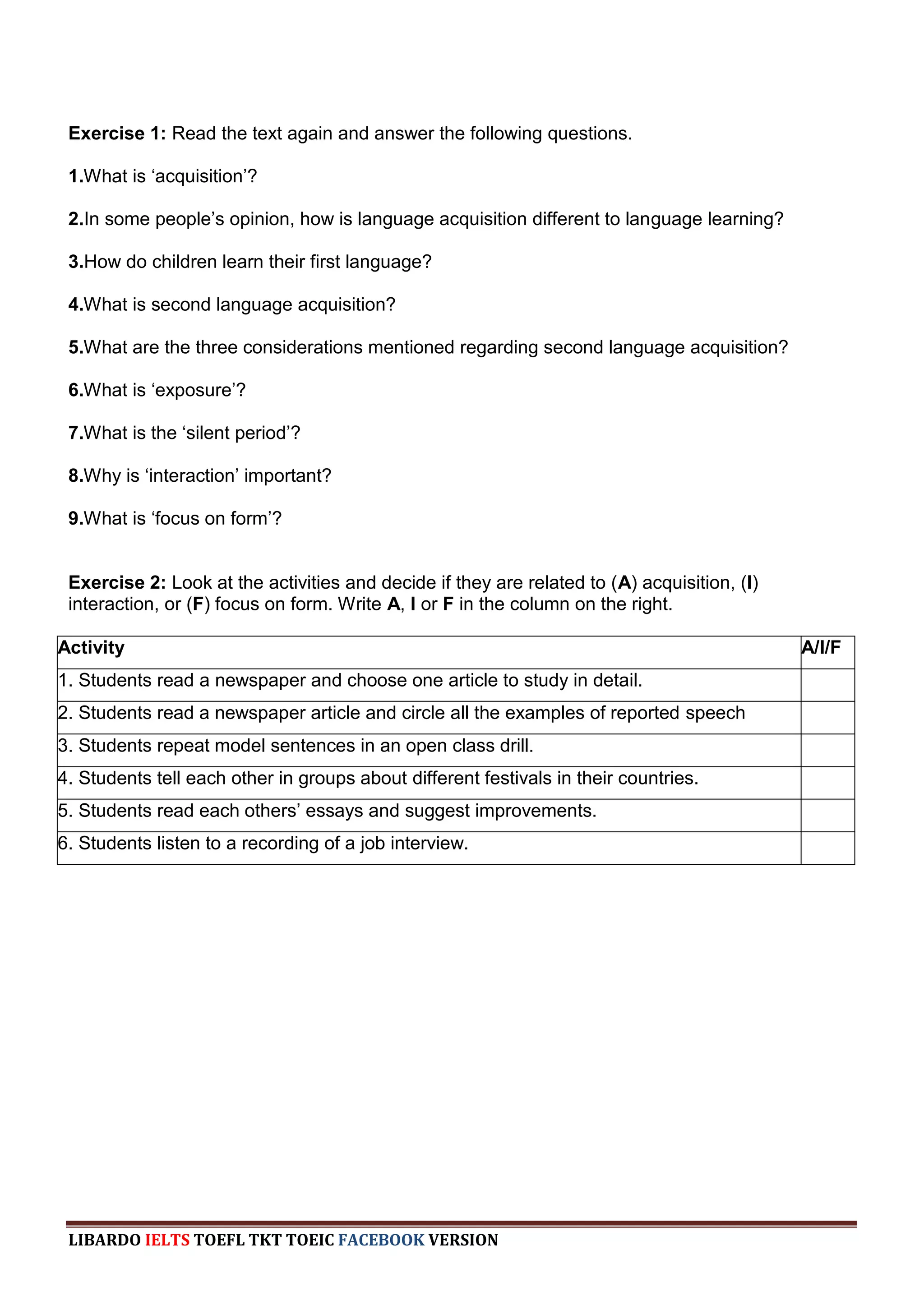
Exercise 1: Read the text again and answer the following questions.

 1.What is „acquisition‟?

 2.In some people‟s opinion, how is language acquisition different to language learning?

 3.How do children learn their first language?

 4.What is second language acquisition?

 5.What are the three considerations mentioned regarding second language acquisition?

 6.What is „exposure‟?

 7.What is the „silent period‟?

 8.Why is „interaction‟ important?

 9.What is „focus on form‟?


 Exercise 2: Look at the activities and decide if they are related to (A) acquisition, (I)
 interaction, or (F) focus on form. Write A, I or F in the column on the right.

Activity                                                                                     A/I/F
1. Students read a newspaper and choose one article to study in detail.
2. Students read a newspaper article and circle all the examples of reported speech
3. Students repeat model sentences in an open class drill.
4. Students tell each other in groups about different festivals in their countries.
5. Students read each others‟ essays and suggest improvements.
6. Students listen to a recording of a job interview.


 LIBARDO IELTS TOEFL TKT TOEIC FACEBOOK VERSION
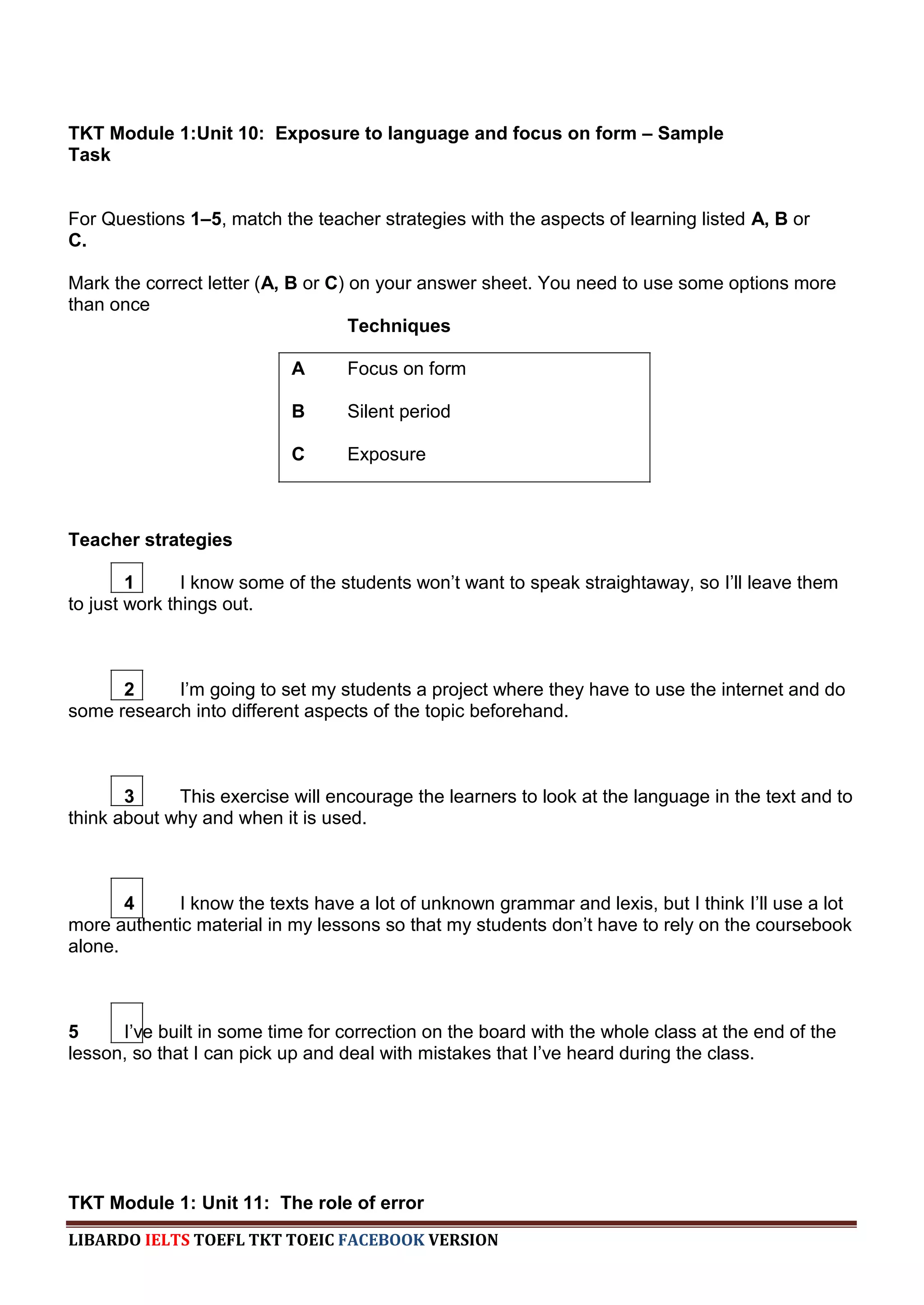
TKT Module 1:Unit 10: Exposure to language and focus on form – Sample
Task


For Questions 1–5, match the teacher strategies with the aspects of learning listed A, B or
C.

Mark the correct letter (A, B or C) on your answer sheet. You need to use some options more
than once
                                    Techniques

                           A      Focus on form

                           B      Silent period

                           C      Exposure


Teacher strategies

        1      I know some of the students won‟t want to speak straightaway, so I‟ll leave them
to just work things out.


      2     I‟m going to set my students a project where they have to use the internet and do
some research into different aspects of the topic beforehand.


       3     This exercise will encourage the learners to look at the language in the text and to
think about why and when it is used.


       4    I know the texts have a lot of unknown grammar and lexis, but I think I‟ll use a lot
more authentic material in my lessons so that my students don‟t have to rely on the coursebook
alone.


5     I‟ve built in some time for correction on the board with the whole class at the end of the
lesson, so that I can pick up and deal with mistakes that I‟ve heard during the class.


TKT Module 1: Unit 11: The role of error
LIBARDO IELTS TOEFL TKT TOEIC FACEBOOK VERSION
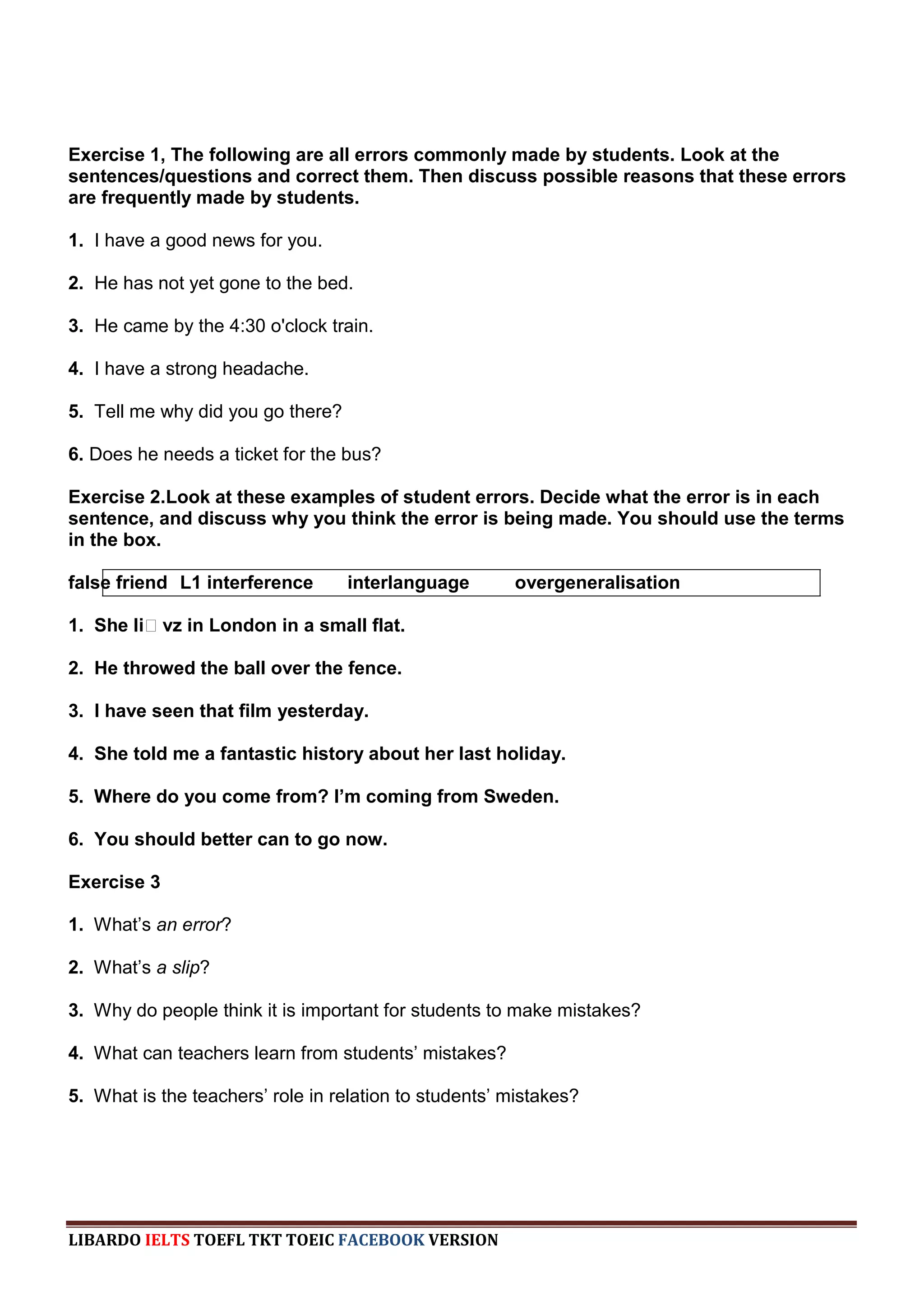
Exercise 1, The following are all errors commonly made by students. Look at the
sentences/questions and correct them. Then discuss possible reasons that these errors
are frequently made by students.

1. I have a good news for you.

2. He has not yet gone to the bed.

3. He came by the 4:30 o'clock train.

4. I have a strong headache.

5. Tell me why did you go there?

6. Does he needs a ticket for the bus?

Exercise 2.Look at these examples of student errors. Decide what the error is in each
sentence, and discuss why you think the error is being made. You should use the terms
in the box.

false friend L1 interference       interlanguage       overgeneralisation

1. She liːvz in London in a small flat.

2. He throwed the ball over the fence.

3. I have seen that film yesterday.

4. She told me a fantastic history about her last holiday.

5. Where do you come from? I’m coming from Sweden.

6. You should better can to go now.

Exercise 3

1. What‟s an error?

2. What‟s a slip?

3. Why do people think it is important for students to make mistakes?

4. What can teachers learn from students‟ mistakes?

5. What is the teachers‟ role in relation to students‟ mistakes?


LIBARDO IELTS TOEFL TKT TOEIC FACEBOOK VERSION
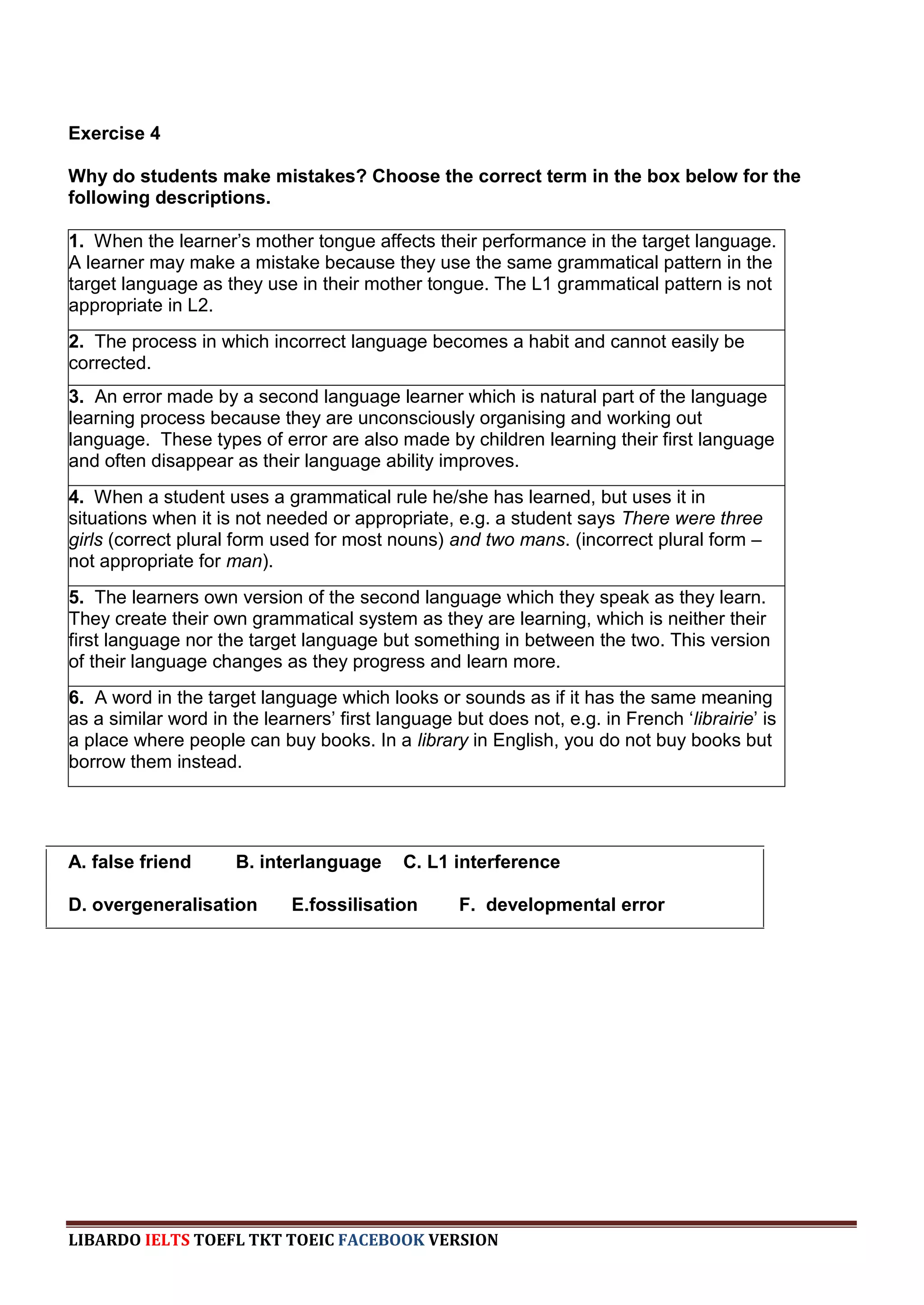
Exercise 4

Why do students make mistakes? Choose the correct term in the box below for the
following descriptions.

1. When the learner‟s mother tongue affects their performance in the target language.
A learner may make a mistake because they use the same grammatical pattern in the
target language as they use in their mother tongue. The L1 grammatical pattern is not
appropriate in L2.
2. The process in which incorrect language becomes a habit and cannot easily be
corrected.
3. An error made by a second language learner which is natural part of the language
learning process because they are unconsciously organising and working out
language. These types of error are also made by children learning their first language
and often disappear as their language ability improves.
4. When a student uses a grammatical rule he/she has learned, but uses it in
situations when it is not needed or appropriate, e.g. a student says There were three
girls (correct plural form used for most nouns) and two mans. (incorrect plural form –
not appropriate for man).
5. The learners own version of the second language which they speak as they learn.
They create their own grammatical system as they are learning, which is neither their
first language nor the target language but something in between the two. This version
of their language changes as they progress and learn more.
6. A word in the target language which looks or sounds as if it has the same meaning
as a similar word in the learners‟ first language but does not, e.g. in French „librairie‟ is
a place where people can buy books. In a library in English, you do not buy books but
borrow them instead.


A. false friend      B. interlanguage      C. L1 interference

D. overgeneralisation        E.fossilisation       F. developmental error


LIBARDO IELTS TOEFL TKT TOEIC FACEBOOK VERSION
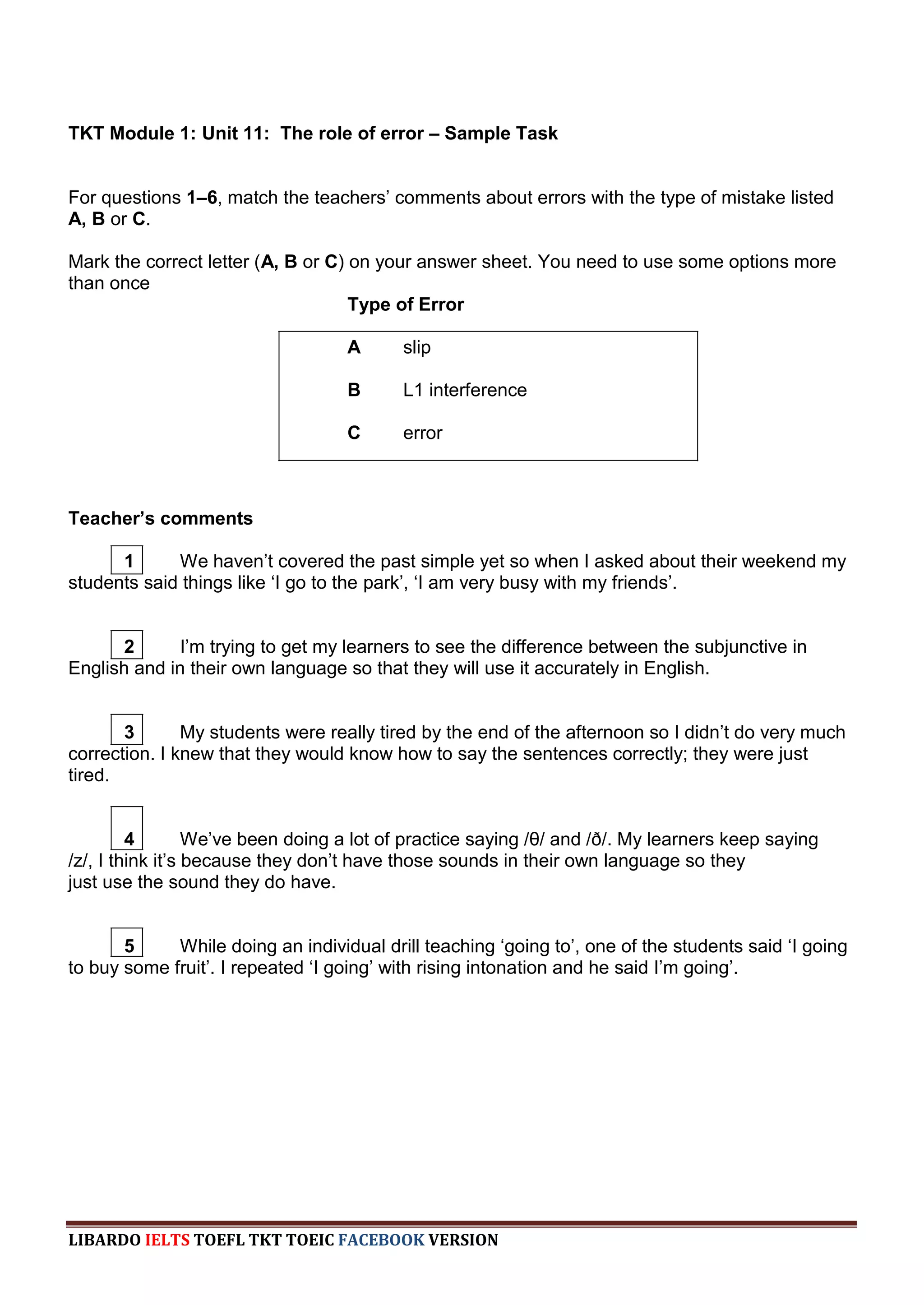
TKT Module 1: Unit 11: The role of error – Sample Task


For questions 1–6, match the teachers‟ comments about errors with the type of mistake listed
A, B or C.

Mark the correct letter (A, B or C) on your answer sheet. You need to use some options more
than once
                                    Type of Error

                                   A      slip

                                   B      L1 interference

                                   C      error


Teacher’s comments

      1      We haven‟t covered the past simple yet so when I asked about their weekend my
students said things like „I go to the park‟, „I am very busy with my friends‟.


       2     I‟m trying to get my learners to see the difference between the subjunctive in
English and in their own language so that they will use it accurately in English.


       3       My students were really tired by the end of the afternoon so I didn‟t do very much
correction. I knew that they would know how to say the sentences correctly; they were just
tired.


         4        We‟ve been doing a lot of practice saying /θ/ and /ð/. My learners keep saying
/z/, I think it‟s because they don‟t have those sounds in their own language so they
just use the sound they do have.


       5     While doing an individual drill teaching „going to‟, one of the students said „I going
to buy some fruit‟. I repeated „I going‟ with rising intonation and he said I‟m going‟.


LIBARDO IELTS TOEFL TKT TOEIC FACEBOOK VERSION
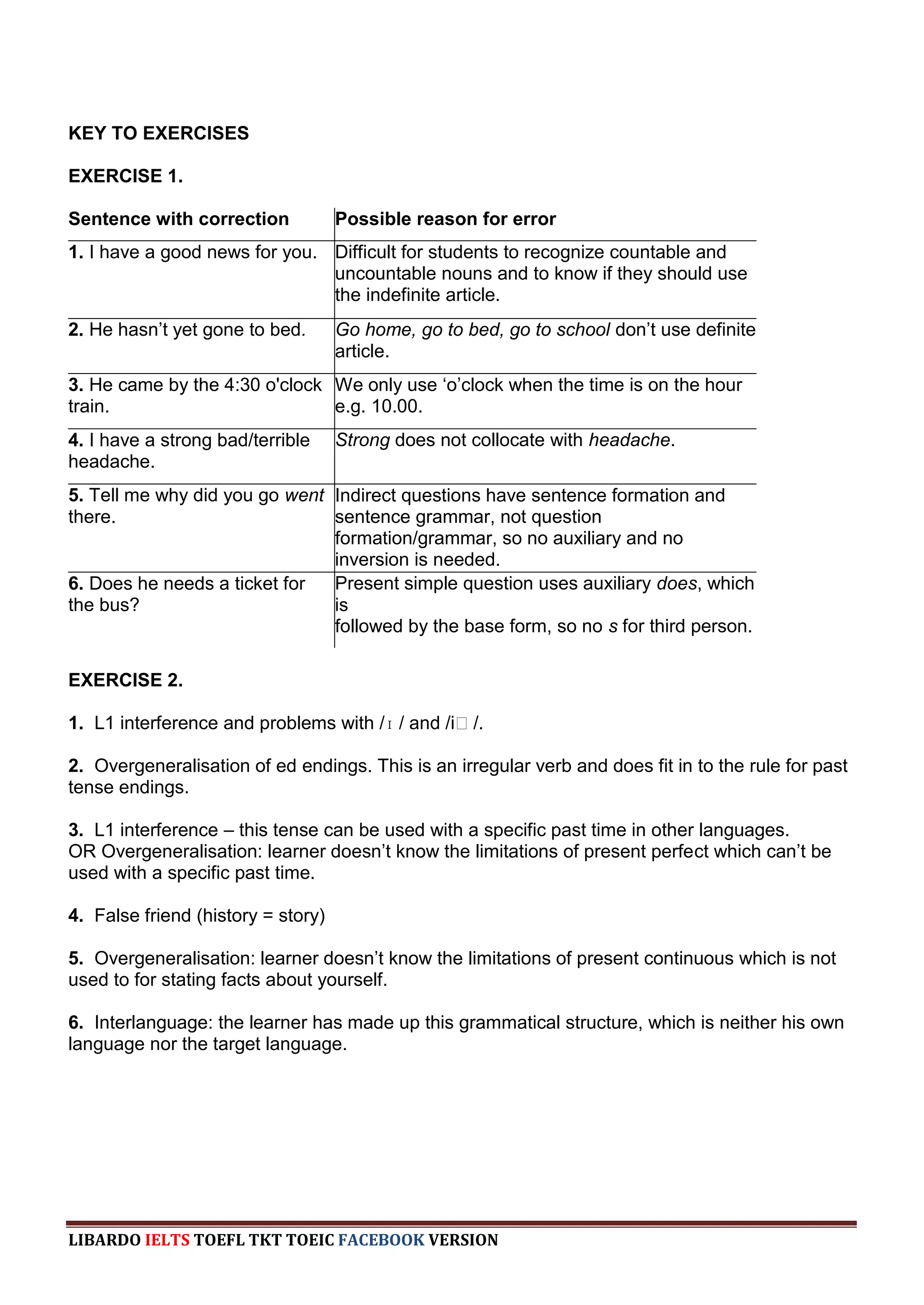
KEY TO EXERCISES

EXERCISE 1.

Sentence with correction            Possible reason for error
1. I have a good news for you. Difficult for students to recognize countable and
                               uncountable nouns and to know if they should use
                               the indefinite article.
2. He hasn‟t yet gone to bed.       Go home, go to bed, go to school don‟t use definite
                                    article.
3. He came by the 4:30 o'clock We only use „o‟clock when the time is on the hour
train.                         e.g. 10.00.
4. I have a strong bad/terrible     Strong does not collocate with headache.
headache.
5. Tell me why did you go went Indirect questions have sentence formation and
there.                         sentence grammar, not question
                               formation/grammar, so no auxiliary and no
                               inversion is needed.
6. Does he needs a ticket for  Present simple question uses auxiliary does, which
the bus?                       is
                               followed by the base form, so no s for third person.

EXERCISE 2.

1. L1 interference and problems with /ɪ / and /iː/.

2. Overgeneralisation of ed endings. This is an irregular verb and does fit in to the rule for past
tense endings.

3. L1 interference – this tense can be used with a specific past time in other languages.
OR Overgeneralisation: learner doesn‟t know the limitations of present perfect which can‟t be
used with a specific past time.

4. False friend (history = story)

5. Overgeneralisation: learner doesn‟t know the limitations of present continuous which is not
used to for stating facts about yourself.

6. Interlanguage: the learner has made up this grammatical structure, which is neither his own
language nor the target language.


LIBARDO IELTS TOEFL TKT TOEIC FACEBOOK VERSION
EXERCISE 3

1. An error is a mistake a learner makes when trying to say something that is above their level
of language. They would not be able to self correct an error.

2. A slip is a mistake a learner makes that they are able to correct themselves.

3. Errors are considered to be important because they are an important and necessary part of
language learning, learners need to experiment with language in order to work out how
language works.

4. Teachers can learn what learners know, what they need to be taught and they can find out
what aspects of language they have processed. This enables teachers to adapt their teaching
programme.

5. The teachers‟ role in relation to students‟ mistakes is deciding if, when and how to correct.

EXERCISE 4

1      C      2      E      3      F      4      D      5      B      6      A


Key to Sample Task


1      C      2      B      3      A      4      B      5      A


LIBARDO IELTS TOEFL TKT TOEIC FACEBOOK VERSION
TKT Module 1: Unit 12: Differences between L1 and L2 learning


Discuss the following questions with a partner or colleague, try answering them
yourself.


ːWhere and when did you start learning your second language?

ːWhat do you think is the best age to start learning a second language?

ːWhy do you think is this the best age to start learning a second language?

ːWhat do you think are some differences between learning your first language and learning a
second language?

ːWhat do you think are some of the difficulties in learning a second language? Are these the
same as the difficulties children have when learning a first language?


Exercise 1 – Text 1

Read the text and decide on an appropriate title for it.

We learn our first language as a baby and as a young child and continue to build our language
as we grow older and learn different kinds of language and language skills.

Babies and children are surrounded by their first language. They hear and see their families,
friends and strangers talking and interacting with each other and friends and family interact with
them. Children are constantly provided with opportunities to use the language and to
experiment with the language as they are learning it and they receive constant praise and
encouragement for their efforts. Parents encourage and persuade their children to talk by
simplifying their own language and directing simple questions and requesting simple
responses. When children‟s language is inaccurate, adults very rarely correct them or make
them repeat accurate forms and they will, more often than not, respond to the utterance in a
natural way.

Babies and children learn language by „acquiring‟ it through exposure and by picking it up. They
are generally highly motivated to learn their first language because they have a great need and
desire to communicate with others around them. They hear and see friends and family
communicating with each other and they will listen and take in this language and process it
during a „silent period‟, possibly lasting many months, before using language themselves.
When children start using language the language they use will be about things they see around
them and they will play and experiment with new language. They learn through this
experimentation and through interaction with family and friends.


Exercise 2 – Text 2
LIBARDO IELTS TOEFL TKT TOEIC FACEBOOK VERSION
Read the text and decide on an appropriate title for it.

Most people learn their second language at school in a classroom. Some start at primary
school or secondary school and their learning might continue in later life. Some people begin
second language learning as adults and attend lessons along with the other things they do in
their lives.

Second language learners do not usually hear or read more than three or four hours a week of
the second language, so they do not have much exposure to the language. The exposure they
do get is generally in the classroom, where they will hear recordings and read texts and will
have the teacher to listen to. Teachers often simplify their language so are not necessarily a
source of additional exposure to language and they usually correct studentsfrequently. In class,
the opportunities for second language learners to use the language vary, as does the amount
of praise and encouragement provided by the teacher and other learners.

Second language learners, like L1 learners, do learn language by „acquiring‟ it through
exposure but they are more likely to learn language in a classroom and the language they learn
is selected by teachers. They learn by interacting with the teacher and with other learners and
by using language in controlled practice activities. In the classroom, learners often want to
produce the language as soon as possible and do not always welcome the opportunity of a
silent period. They use language for talking about experiences and things relating to their lives
outside the classroom. Learning is often dependent on motivation and this can vary in second
language learners, from learners having little or no motivation to learners being very highly
motivated.


LIBARDO IELTS TOEFL TKT TOEIC FACEBOOK VERSION
1. Complete the appropriate column in the table with information from texts 1 and 2

             Group A                           Group B

             First Language (L1) learning      Second Language (L2) Learning

Age


Context


Exposure


Praise


Correction


Simplified
language

Way of
learning

Motivation


Silent
period

Language
used for


LIBARDO IELTS TOEFL TKT TOEIC FACEBOOK VERSION
TKT Module 1: Unit 12: Differences between L1 and L2 learning – Sample
Task 1


For Questions 1–6, match the aspects of learning with the type of learner listed A, B or C.

Mark the correct letter (A, B or C) on your answer sheet. You need to use some options more
than once.
                                    Type of learner

                           A      L1 learner

                           B      L2 adult learner

                           C      Both L1 and L2 adult learner


Aspect of learning

      These learners seem to respond to praise and encouragement and it helps them to
      1develop their language and skills.


      These learners don‟t need to be constantly corrected. They need to experiment
      2and to play with language.


      These learners will listen and process language and will not speak at all,
      3sometimes for many months, before beginning to use language.


      4These learners are able to share experiences and talk about the things they see
      around them and about experiences in their lives.


      5These learners need some controlled practice and a focus on form.


Key to Participant’s worksheet 4
LIBARDO IELTS TOEFL TKT TOEIC FACEBOOK VERSION
Group A                          Group B

           First language (L1) learning     Second language (L2) learning
Age        Baby, young child                Primary, secondary, adults
Context    At home                          Mostly at school in a classroom
                                            Three or four hours a week, recordings,
Exposure Surrounded all the time            texts, the teacher and other students
           Constant praise and
Praise     encouragement                    Varied, depending on the teacher
Correction Rarely                           Frequently by the teacher
Simplified
language Yes, from parents                  Yes
                                            Acquiring some through language
                                            exposure
Way of     Acquiring language through       Interacting with the teacher and other
learning   exposure                         learners
                                            Doing controlled practice activities.

Motivation Highly motivated                 Varies – none, a little, a lot
Silent
period     Yes, sometimes for many months Often not
Language Talking about things they see      Talking about experiences and things
used for around them                        related to lives outside the classroom

Key to Sample task

1     C     2       C    3       A      4    B      5       B


LIBARDO IELTS TOEFL TKT TOEIC FACEBOOK VERSION
TKT Module 1:Unit 13: Learner characteristics


Exercise 1,Complete the puzzle with learning styles using the clues below.


Across
3. A learner who finds it easier to learn when they can see things written down or in a picture.
This type of learner may like the teacher to write a new word on the board and not just say it
aloud.


Down
1. A learner who remembers things more easily when they hear them spoken. This type of
learner may like the teacher to say a new word aloud and not just write it on the board.

2. A learner who learns more easily by doing things physically. This type of learner may like to
move around or move objects while learning.


LIBARDO IELTS TOEFL TKT TOEIC FACEBOOK VERSION
VAK Learning Style Questionnaire

                  Exercise 2, What is your preferred Learning Style?
                            What kind of learner are you?


LIBARDO IELTS TOEFL TKT TOEIC FACEBOOK VERSION
Check your answers. If your answers are mostly A, you are an Auditory Learner. If your
answers are mostly V, you are a Visual Learner. If your answers are mostly K, you are a
Kinaesthetic Learner.


Exercise 3, for what kind of learner would the following strategies be useful?

1. The teacher creates a substitution table with the target language on the board.

2. The teacher contextualises target language by telling the students a story.

3. The teacher asks learners to come to the board and to write their answer to a task.

4. The teacher says the new words she is teaching three times before asking the students to
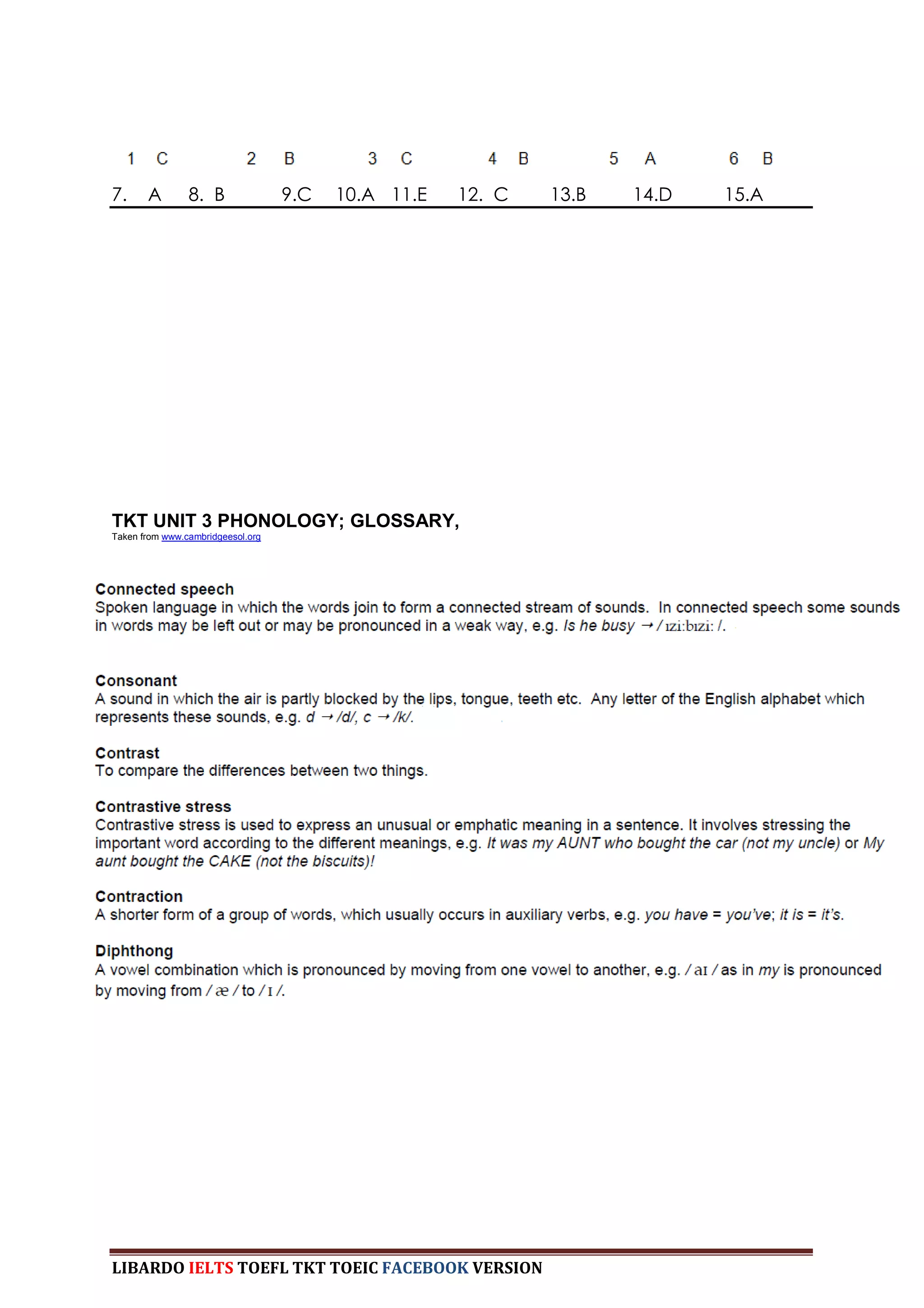
repeat them.

5. The teacher does a mingling activity, where learners walk around asking questions to find
out information from each other.

6. The teacher shows learners a picture of the object she is trying to elicit.


Exercise 4

What learning strategies could learners use to help them improve in the following areas?

1. dealing with words in texts and recordings that you don‟t know

2. remembering new vocabulary

3. learning new grammar

4. improving pronunciation

5. developing oral fluency

6. developing comprehension skills

7. becoming more independent


LIBARDO IELTS TOEFL TKT TOEIC FACEBOOK VERSION
Exercise 5,Match the learner strategies below with the areas for improvement on
Participant’s worksheet 4 Exercise 2.


A.Reading more authentic material (magazines and newspapers etc.) outside class, listening to
English radio/TV programmes outside class, asking people to repeat what they have said when
you don‟t‟ understand.

B.Learning the sounds and symbols in the phonemic chart, asking teachers and other students
to correct your pronunciation, recording your self and listening for pronunciation errors.

C.Using the internet to research language and vocabulary, using English-English dictionaries to
research vocabulary, choosing an area of language or vocabulary to revise/learn and using
resources to self study

D.Saying new words in your head over and over again, writing new words down in your note
book, writing new words down with a translation in your own language next to them, writing
words down on separate cards and storing them in a box.

E.Guessing the meaning from context, looking words up in the dictionary, writing words down to
ask someone about later.

F.Speaking English only in class, speaking English whenever possible outside class, practise
speaking for one minute on a topic without hesitating.

G.Practising the language as soon as you‟ve learnt it, repeating different examples of the
language, writing down the different grammatical components of the language, cutting up the
different components and arranging them in the correct order.


LIBARDO IELTS TOEFL TKT TOEIC FACEBOOK VERSION
TKT Module 1:Unit 13: Learner characteristics – Sample Task


For questions 1–7 match the learners‟ comments to the descriptions of learner preferences
listed A–H.There is one extra option which you do not need to use

Comments

      1       „Most of the time should be spent doing grammar exercises.‟


      2       „I prefer working with other students to speaking to the teacher in front of the
              class.‟


      3       „I really like knowing how language works.‟


      4       „Rules just confuse me – it‟s better to work out language from examples.‟


      5       „Why should I listen to other students‟ mistakes? The teacher should talk most of
              the time.‟


      6       I just want people to understand what I mean. I don‟t worry if I make mistakes.‟


      7       „It‟s important for me to know how well I‟m doing.‟


Preferences

A   The learner wants explanations of grammar use.


B   The learner enjoys explaining language to other students.

C   The learner enjoys practising language in pairs or groups.

D   The learner enjoys doing language practice that focuses on
    accuracy.
E   The learner doesn‟t want to work with other students.

F   The learner needs to feel a sense of progress.

G   The learner focuses on communicating.

H   The learner doesn‟t want the teacher to explain grammar.


LIBARDO IELTS TOEFL TKT TOEIC FACEBOOK VERSION
Key to exercise 1

                       1A           2K
                       U            I
                       D            N
                    3V I  S     U   A L
                       T            E
                       O            S
                       R            T
                       Y            H
                                    E
                                    T
                                    I
                                    C
Exercise 3

        1. Visual               4. Auditory
        2. Auditory             5. Kinaesthetic
        3. Kinaesthetic         6. Visual

Exercises 4 and 5

1. E   2. D   3.G   4.B   5.F     6.A    7.C

Key to Sample Task

1. D   2. C   3.A   4.H   5.E     6.G    7.F

Key to Procedure Step 9

Additional exercises.

What are some of the different learner characteristics of children, teenagers and adults?
Differences in
ː      length of time they can pay attention/ concentrate
ː      ability to stay still
ː      ability to control behaviour
ː      attitude to making mistakes
ː      attitude to taking risks
ː      levels of self consciousness
ː      being able to bring life experiences to learning.

What effect can learners’ past learning experiences have on learner characteristics?
ː      previous experience of learning may be very different to the approach taken by the
current teacher; this change may or may not be welcomed
ː      learners may have tried to learn a language before and failed
ː      learners may have fixed ideas about the best way of learning.

TKT Module 1:Unit 14: Learner needs

LIBARDO IELTS TOEFL TKT TOEIC FACEBOOK VERSION
Exercise 1.


Exercise 2,What can teachers do to respond to learners’ needs? Match the following
answer with the concepts in the boxes below the answers.

•Do a „needs analysis‟ and/or find out about your learners‟ personal needs, learning needs and
future or current professional needs.

•Select topics and subjects for lessons that fit with their interests and needs.

•Select material that meets their needs.

•Choose activities that fit with their learning styles, and are suitable for their needs and
interests.

•Decide on pace and interaction patterns.

•Think about the balance of skills work (reading, listening, speaking, writing) in relation to their
needs.

•Adopt approaches for teaching language that respond to their needs, interests and learning
styles.

•Think about how to give learners feedback on their work.


LIBARDO IELTS TOEFL TKT TOEIC FACEBOOK VERSION
TKT Module 1: Unit 14: Learner needs – Sample Task


For Questions 1–6, match the needs of each group of students with the most suitable type of
course listed A–G.There is one extra option which you do not need to use.

Groups of students
     1      These young adults need a range of study skills before going to a British
     university.


      2      These adult beginners are going on holiday, and need to learn how to
             communicate in an English-speaking environment.


      3      This group of young children have a short attention span; their parents want them
             to learn English while having some fun.


      4      These business people need to meet and work with people from other countries
             at international conferences.


      5      These secretaries and receptionists want to focus on vocabulary and skills which
             are useful for them in their work.


      6      These scientists need to keep up-to-date with the latest developments in their
             subjects.

Types of courses

A   a course focusing on basic language skills for everyday situations.


B   a course focusing on listening and note-taking, and writing academic
    essays
C   a course based on role-plays and situations, such as greeting visitors and
    telephoning clients

D   an activity based course with lots of games, songs and stories

E   a course based on grammar revision and written practice

F   an oral skills course based on cross-cultural material

G   an online course in which students read texts on specific topics and
    answer detailed comprehension.


LIBARDO IELTS TOEFL TKT TOEIC FACEBOOK VERSION
TKT Module 1:Unit 14: Learner needs – Answer Keys


Key to Sample Task

1. B   2. A   3.D   4.F   5.C   6.G


LIBARDO IELTS TOEFL TKT TOEIC FACEBOOK VERSION
TKT GLOSSARY, UNITS 9 TO 14

Background to language learning

Achievement noun, achieve verb, achievable adjective
Something reached by effort; something done successfully. Something which is achievable for
learners is something they can succeed in.

Acquisition noun, acquire verb
To learn a language without studying it, just by hearing and/or reading and then using it. This is
the way people usually learn their first language.

Attention span
How long a learner is able to concentrate at any one time.

Auditory learner: see learning style.

Clue
A piece of information that helps someone to find the answer to a problem, e.g. a teacher could
give the first letter of a word she is trying to elicit as a clue to learners to help them find the
word.

Cognitive (processes)
The mental processes involved in thinking, understanding or learning.

Confidence noun, confident adjective
The feeling someone has when they are sure of their ability to do something well. Teachers
often do activities that help learners to feel more confident about their own ability.

Conscious (of)
To know that something exists or is happening, or to have knowledge or experience of
something; to be aware.

Demotivate: see motivation.

Developmental error: see error.

Effective
Having the intended or desired result.

English-medium school
A school in a non-English speaking country, in which all subjects are taught using English.

Error
A mistake that a learner makes when trying to say something above their level of language or
language processing. See slip.

A developmental error is an error made by a second language learner which could also be
made by a young person learning their mother tongue as part of their normal development, e.g.
I goed there last week (I went there last week).
Expectation
LIBARDO IELTS TOEFL TKT TOEIC FACEBOOK VERSION
A belief about the way something will happen. Learners often have expectations about what
and how they should learn.

Exposure noun, expose verb
When learners listen to or read language without being consciously aware of it.

Factor
A fact or situation which influences the result of something, e.g. the factors which decide
whether someone learns a language successfully or not.

First language: see mother tongue, L1/L2

Focus on form
Paying attention to the words/parts of words that make a language structure or to spelling or
pronunciation.

Goal, target
An aim that a learner or teacher may have.

Guidance noun, guide verb
Help given by a teacher with learning, or with doing a task.

Ignore (errors)
To choose not to pay attention to something such as an error made by a learner. A teacher
may do this if he/she wants to help the learner with fluency, not accuracy.

Independent study
Studying without a teacher present or without the teacher monitoring and directing the learning
very closely,
e.g. learners could carry out research on a topic using reference resources. This could be done
at home or with minimum involvement of the teacher in class.

Intensive course
A course which takes place over a short period of time, but which consists of a high number of
hours.

Interference
When the learner‟s mother tongue affects their performance in the target language. A learner
may make a mistake because they use the same grammatical pattern in the target language as
they use in their mother tongue, but the L1 grammatical pattern is not appropriate in L2.

Interlanguage
Learners‟ own version of the second language which they speak as they learn. Interlanguage is
constantly changing and developing as learners learn more of the second language.


LIBARDO IELTS TOEFL TKT TOEIC FACEBOOK VERSION
L1/L2
L1 is the learner‟s mother tongue or first language; L2 is the learner‟s second language.

Language awareness
A learner‟s understanding of the rules of how language works and his/her ability to notice
language.

‘Learn by heart’
To learn something so that you can remember it perfectly.

Learner autonomy noun, autonomous adjective, learner independence
When a learner can set his/her own aims and organise his/her own study, they are autonomous
and independent. Many activities in coursebooks help learners to be more independent by
developing learning strategies and focusing on learner training.

Learner characteristics
The typical things about a learner or learners that influence their learning, e.g. age, L1, past
learning experience, learning style.

Learner independence: see learner autonomy.

Learner training
The use of activities to help learners understand how they learn and help them to become
autonomous, independent learners.

Learning resources
The materials or tools which help learners learn, e.g. books, computers, CDs etc.

Learning strategies
The techniques which a learner consciously uses to help them when learning or using
language, e.g. deducing the meaning of words from context; predicting content before reading.

Learning style
The way in which an individual learner naturally prefers to learn something. There are many
learning styles. Three of them are below.

Auditory learner
A learner who remembers things more easily when they hear them spoken. This type of learner
may like the teacher to say a new word aloud and not just write it on the board.

Kinaesthetic learner
A learner who learns more easily by doing things physically. This type of learner may like to
move around or move objects while learning.

Visual learner
A learner who finds it easier to learn when they can see things written down or in a picture. This
type of learner may like the teacher to write a new word on the board and not just say it aloud


LIBARDO IELTS TOEFL TKT TOEIC FACEBOOK VERSION
Linguistic
Connected with language or the study of language.

Literacy
The ability to read and write.

Maturity noun, mature adjective
Fully grown or developed. If a learner is mature in attitude, they behave in an adult way. A
learner‟s maturity
(physical, emotional and mental) influences a teacher‟s approaches and/or decisions.

Memoriseverb, memorable adjective
To learn something so that you can remember it later; something which is easy to remember.

Mother tongue
The very first language that you learn as a baby, which is usually the language spoken to you
by your parents. Also called L1 or first language.

Motivation noun, motivate verb
Motivation is the thoughts and feelings which make us want to do something and help us
continue doing it.

Demotivate verb demotivated adjective
To make someone lose motivation.

Unmotivated adjective
Without motivation; having no motivation.

Natural order
Some people believe there is an order in which learners naturally learn some items in their first
or other languages. Some language items are learned before others and it can be difficult for
teachers to influence this order.

Needs
The language, language skills or learning strategies a learner still has to learn in order to reach
their goals, or the conditions they need to help them learn.

Notice language
When a learner becomes aware of the language the speaker or writer uses to express a
particular concept or meaning.

Participation noun, participate verb
To take part in something, e.g. a lesson or classroom activity.

Personalisationnoun, personaliseverb
When a teacher helps a learner to connect new words, topics, texts or grammar to their own
life.

Pick up
To learn language without studying it, just by hearing and/or reading and then using it. See
acquisition.

Proficiency noun, proficient adjective
LIBARDO IELTS TOEFL TKT TOEIC FACEBOOK VERSION
Level of ability; to be very good at something because of training and practice, e.g. speaking
English.

Silent period
The time when learners who are beginning to learn a first (or second) language prefer to listen
(or read) before producing the language, e.g. babies have a silent period when they listen to
their parents before starting to try to speak themselves.

Slip
When a learner makes a language mistake that they are able to correct themselves. See error.

Target language
The language a learner is learning, e.g. English, or the specific language that a teacher wants
to focus on in a lesson, e.g. present perfect.

Target language culture
The traditions and culture of the country whose language is being studied.

Work language out
When learners try to understand how and why a particular piece of language is used.

Unmotivated: see motivation.

Varieties of English
English is spoken as a first or second language in many countries around the world, but the
English spoken may be slightly or significantly different in each country or in different parts of
one country, e.g. different vocabulary or grammar may be used. An example of this is the
English spoken in the USA and that spoken in the UK.

Visual learner: see learning style.


LIBARDO IELTS TOEFL TKT TOEIC FACEBOOK VERSION
TKT Module 1:Unit 15: Presentation techniques and introductory activities
Exercise 1, solve the following puzzle.


Across
1. To ask questions or use other techniques to check that students have understood a
new
structure or item of lexis (two words).
3. To introduce new language, usually by focusing on it formally.
6. To tell students what language means and how it is used.


Down
1. To put new language into a situation that shows what it means.
2. To get students to repeat words or phrases.
4. To use body movements to convey meaning without using words.
5. To ask specially designed questions or give clues to get students to give information
or an opinion.


                                                                                  Page 86
Exercise 2.Look at the introductory activities. For each activity say:

ː      what type of introductory activity is it? (warmer, ice-breaker, lead-in)

ː      why would the activity be used by the teacher?


1. Students stand in a circle. The teacher throws a ball to a student who then introduces
himself and says his favourite game or activity. He then tosses the ball to another
student who repeats the procedure. Give each student a chance to introduce
him/herself.


2. Divide the class into two teams, choose a category, and ask each team to think of an
object in that category. The teams ask each other yes/no questions. Whichever team
guesses the objects with fewer questions, wins.


3. Students work in groups of three. They brainstorm and make a list of the advantages
and the disadvantages of living in a big city.


4. The first student says something about himself, then changes that to make a
question for another student. For example, "My favouritecolour is blue. What's your
favouritecolour?" This can be another circle activity, and it works with large groups of
students, too.


5. The teacher starts off by saying: "Yesterday I went to the park." The first student
must include what the teacher said and then add something they did, e.g. "Yesterday I
went to the park and ate some pizza." The second student must include what the
teacher and the first student said and then add something else, e.g. "Yesterday I
went to the park, ate some pizza and went for a swim in the sea."


6. The teacher asks students to say what news stories they have read about recently.
Several students contribute and the teacher encourages students to ask each other
questions about the stories they have read.


                                                                                    Page 87
Exercise 3.Choose one of the task types (A-K) for each of the activities below (1-7)


A Grammar-translation method       B Guided discovery C Lexical approach

D Presentation practice production (PPP)         E Task-based learning (TBL)

F Test-teach-test    G Total Physical Response (TPR)


1. A way of teaching new language in which the teacher presents the language, gets
students to practise it in exercises or other controlled practice activities and then asks
students to use or produce the same language in a communicative and less controlled
way.

2. A way of teaching in which the teacher gives students meaningful tasks to do. After
this the teacher may ask students to think about the language they have used when
doing the tasks, but the main focus for students is on the task itself.

3. A way of teaching in which the teacher presents language items as instructions and
the students have to do exactly what the teacher tells them, e.g. Open the window!
Stand up! This method is good for beginners when they start to learn a new language,
as they have a silent period and can make fast progress.

4. A way of teaching in which a teacher provides examples of the target language and
then guides the students to work out the language rules for themselves.

5. A way of teaching in which the teacher asks students to do a task to see how well
they know a certain piece of language. The teacher then presents the new language to
the students, then in the final stage asks the students to do another task using the new
language correctly. This way of approaching teaching target language can be helpful if
the teacher thinks the students may already know some of the target language.

6. A way of teaching in which students study grammar and translate words into their
own language. They do not practise communication and there is little focus on
speaking. A teacher presents a grammar rule and vocabulary lists and then students
translate a written text from their own language into the second language.

7. A way of teaching language that focuses on lexical items or chunks such as words,
multi- word units, collocations and fixed expressions rather than grammatical
structures.


                                                                                     Page 88
TKT Module 1: Unit 15: Presentation techniques and introductory activities TKT
– Sample Task


For questions 1–6, match the teacher‟s actions with the introductory activities and
presentation techniques for different lessons listed A–G.

Mark the correct letter (A–G) on your answer sheet. There is one extra option you do
not need to use.
Introductory activities and presentation techniques


                          A         asking concept questions

                          B         eliciting language

                          C         doing a warmer

                          D         miming

                          E         setting the scene

                          F         explaining

                          G         drilling


        Teacher’s
1       actions
       The teacher asks the students to look at pictures of Paris before they listen to a
       recording about tourist attractions there.


2     The teacher asks the students to repeat sentences after her.


3     The teacher checks whether the students understand when the new language is
      used.


4     The teacher does a short game with the students to give them energy.


5     The teacher asks the students for examples of different kinds of fruit and writes
      them on the board.


6     The teacher does an action which shows the meaning of a new word.

                                                                                   Page 89
Key to Exercise 1

                        1C O N C E P T C H E C K
              2D        O
           3P R E S E N T
              I         T
              L         E
              L         X
                 4M     T
                 I      U    5E
                 M      A    L
                 6E X P L A I N
                        I    C
                        S    I
                        E    T

Key to Exercise 2

1. Ice-breaker – students getting to know each other

2. Warmer – to increase energy levels, to relax the class

3. Lead-in – to allow students to bring their own experience to a text/topic, to create
interest in a topic/text

4. Ice-breaker – students getting to know each other

5. Warmer – to increase energy levels, to relax the class

6. Lead-in – to allow students to bring their own experience to a text/topic, to create
interest in a topic/text.

Exercise 3

1. D Presentation, practice, production (PPP)

2. E Task-based learning (TBL)

3. G Total Physical Response (TPR)

4. B Guided discovery

5. F Test-teach-test

6. A Grammar-translation method

7. C Lexical approach
Key to Sample Task

1      E      2        G    3      A      4      C      5      B      6      D

                                                                                    Page 90
TKT Module 1: Unit 16: Types of activities and tasks for language and skills
  development

  Exercise 1

  Choose one of the task types (A–K) for each of the activities below (1–11).


  A guided writing      B role-play   C problem solving D survey

  E brainstorming       F chant       G jumbled text        H warmer

  I rank ordering/prioritising J visualisation       K jigsaw listening /reading

1. Students find out information from others by asking questions or using questionnaires in
order to practise speaking skills and/or specific language.
2. Students repeat a phrase, sentence, rhyme, verse, poem or song, usually with others, in
a regular rhythm.
3. An activity that a teacher uses at the beginning of a lesson to give the class more
energy.
4. A text is divided into two or more different parts. Students listen to or read their part
only, then share their information with other students so that in the end everyone knows all
the information.
5. Students think of ideas (usually quickly) about a topic (often noting these down). This is
often done as preparation before writing or speaking.
6. An activity where the teacher asks students to close their eyes and create the pictures
in their minds of the story she is telling them.
7. Students produce a text after a lot of preparation by the teacher. The teacher may give
the students a plan to follow, or ideas for the language to use.
8. A classroom activity in which students are given parts to act out in a given situation.
They usually work in pairs or groups.
9. Students are given a list of things to put in order of importance. It involves discussion,
agreeing/disagreeing and negotiating.
10.    Students work in pairs or groups talking together to find the solution to a problem.
11.    Students are given a text in which the paragraphs or sentences are not in the
correct order. The students put the paragraphs or sentences into the correct order.


  Exercise 2

  Look at the activities again. Is the activity a comprehension task or a production task? If
  it‟s a comprehension task, which skill?If it‟s a production task, which skill?


                                                                                         Page 91
Exercise 3: match the approach to the procedures given


Frameworks for activities and task                                 Approaches
1. Activity with a task and discussion of the task → activity to
focus on language used in the task
2. Grammar rule → students translate a text


3. The teacher presents language items as instructions → the
students do the actions → the students give the instructions
4. Lead in → pre-teach key vocabulary → gist task → detailed
comprehension task → follow up productive activity
5. Activity with a task to see if students can use a particular
structure → the teacher presents the new language to the
students → students do another task using new language
6. The teacher presents the language in context → controlled
practice activities →less controlled → freer practice
7. Activity with examples of the target language provided →
activity for students to work out language rules for themselves
→ activity for students to practice the language
8. Activity for students to „notice‟ words or chunks of language
→
discussion of the meaning of the chunks of language →
activity to practise the language


                                                                                Page 92
TKT Module 1: Unit 16 Types of activities and tasks for language and skills
development – TKT Sample Task


For questions 1–7, match the classroom activities with the types of speaking practice
listed
A, B or C.

Mark the correct letter (A, B or C) on your answer sheet. You need to use some options
more than once
                             Types of speaking practice

                           A      oral fluency practice

                           B      controlled oral practice

                           C      neither


Classroom activities

1     At the beginning of the lesson, we got into groups and talked about an interesting
      newspaper article we had read.


2     The teacher gave us word prompts such as „cinema‟ and „friends‟, and we had to
      say them in sentences using the past simple, e.g. „We went to the cinema.‟ „We
      visited some friends.‟


3     We listened to a recording of two people talking about their hobbies, then did a
      gap-fill comprehension task.


4     The teacher gave us roles such as „film star‟ or „sports star‟ and we had to role
      play a party in which we chatted to each other.


5     We had a discussion about the advantages and disadvantages of the internet.


      The teacher read out some sentences, some of which were correct and some
6     incorrect. We had to shout out „Right‟ or „Wrong‟.


      We had to ask our partner five questions about abilities, using „can‟, e.g. „Can you
7     swim?‟


                                                                                   Page 93
Key to Exercises 1 and 2


Exercise 1 Exercise 2
                                    speaking, controlled practice, less controlled practice and
1.      D     production            free speaking.
2.      F     production            speaking, controlled practice
3.      H     production            speaking, free practice
4.      K     comprehension         reading or listening
5.      E     production            speaking, free practice
6.      J     comprehension         listening
7.      A     production            writing, controlled practice or less controlled practice
8.      B     production            speaking, less controlled practice or free practice
9.      I     production            speaking, free practice
10. C         production            speaking, free practice
11. G         comprehension         reading

Frameworks for activities and task                                     Approaches
1. Activity with a task and discussion of the task → activity to       Task-based learning
focus on language used in the task                                     (TBL)
2. Grammar rule → students translate a text                            Grammar-translation
                                                                       method
3. The teacher presents language items as instructions → the           Total Physical
students do the actions → the students give the instructions           Response(TPR)
4. Lead in → pre-teach key vocabulary → gist task → detailed           Skills-based lessons
comprehension task → follow up productive activity
5. Activity with a task to see if students can use a particular        Test-teach-test
structure → the teacher presents the new language to the
students → students do another task using new language
6. The teacher presents the language in context → controlled           Presentation, practice
practice activities →less controlled → freer practice                  and production (PPP)
7. Activity with examples of the target language provided →            Guided discovery
activity for students to work out language rules for themselves
→ activity for students to practice the language
8. Activity for students to „notice‟ words or chunks of language → Lexical approach
discussion of the meaning of the chunks of language →
activity to practise the language

     TKT task
                1    A          2          B          3            C         4            A
                5    A          6          C          7            B

                                                                                              Page 94
TKT Module 1:Unit 17 Assessment Types and Tasks


Exercise 1.Discuss the teachers’ comments below on assessment. Do you agree
or disagree? Why/ Why not?


1. I think it‟s important for students to assess themselves, so sometimes I record them
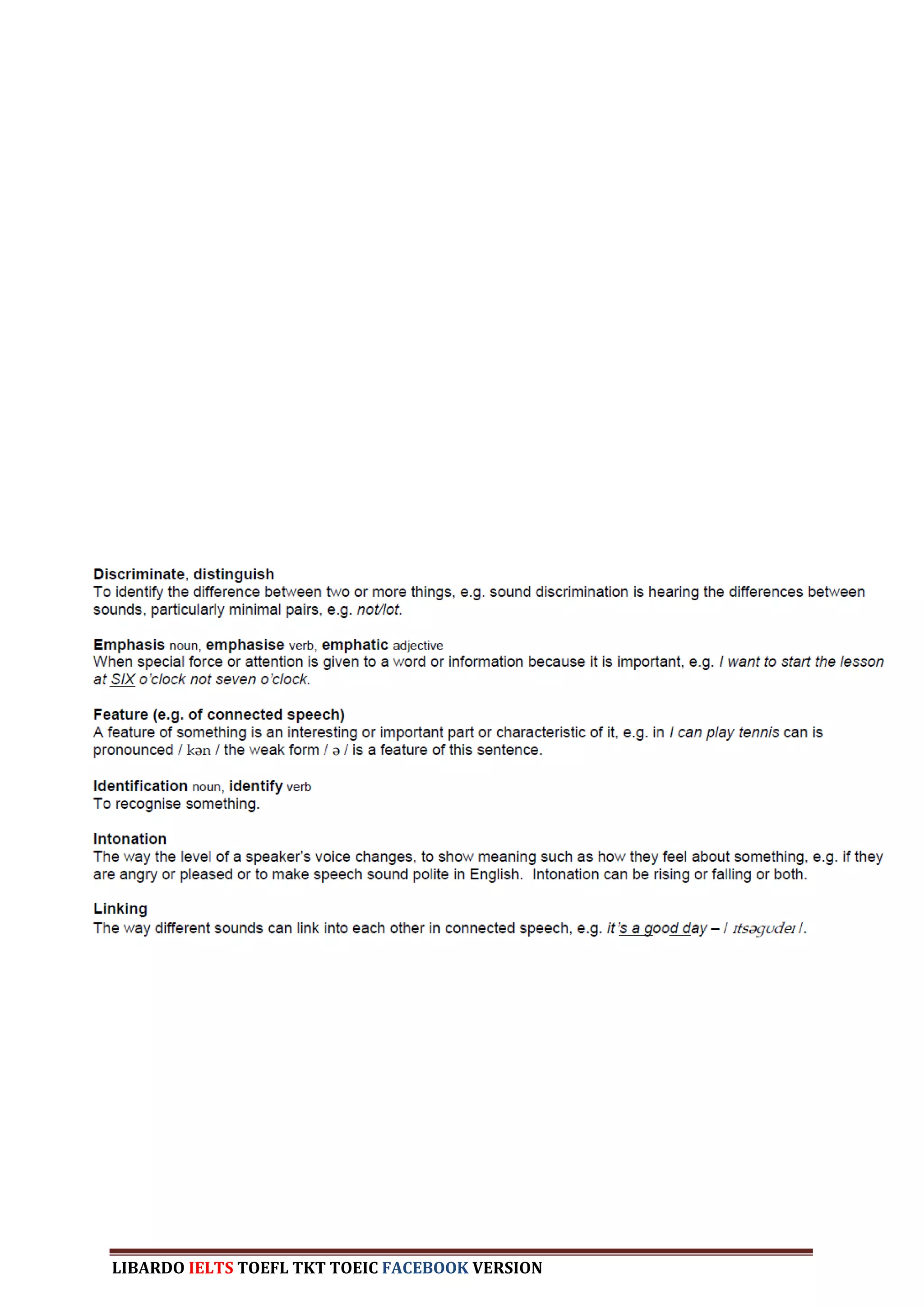
when they are doing a speaking activity and then get them to listen to themselves.


2. I don‟t like giving my students tests and exams. I think they are demotivating,
especially for young learners.


3. I get students to mark each others‟ written work and I tell them to just look at it and
say what‟s wrong. I don‟t ask them to check it against any criteria. I don‟t think they can
look for particular mistakes like spelling mistakes or grammar mistakes.


4. When students are doing a speaking activity, I observe them, but I don‟t make any
notes and I don‟t give marks. Sometimes I talk to students about their strengths and
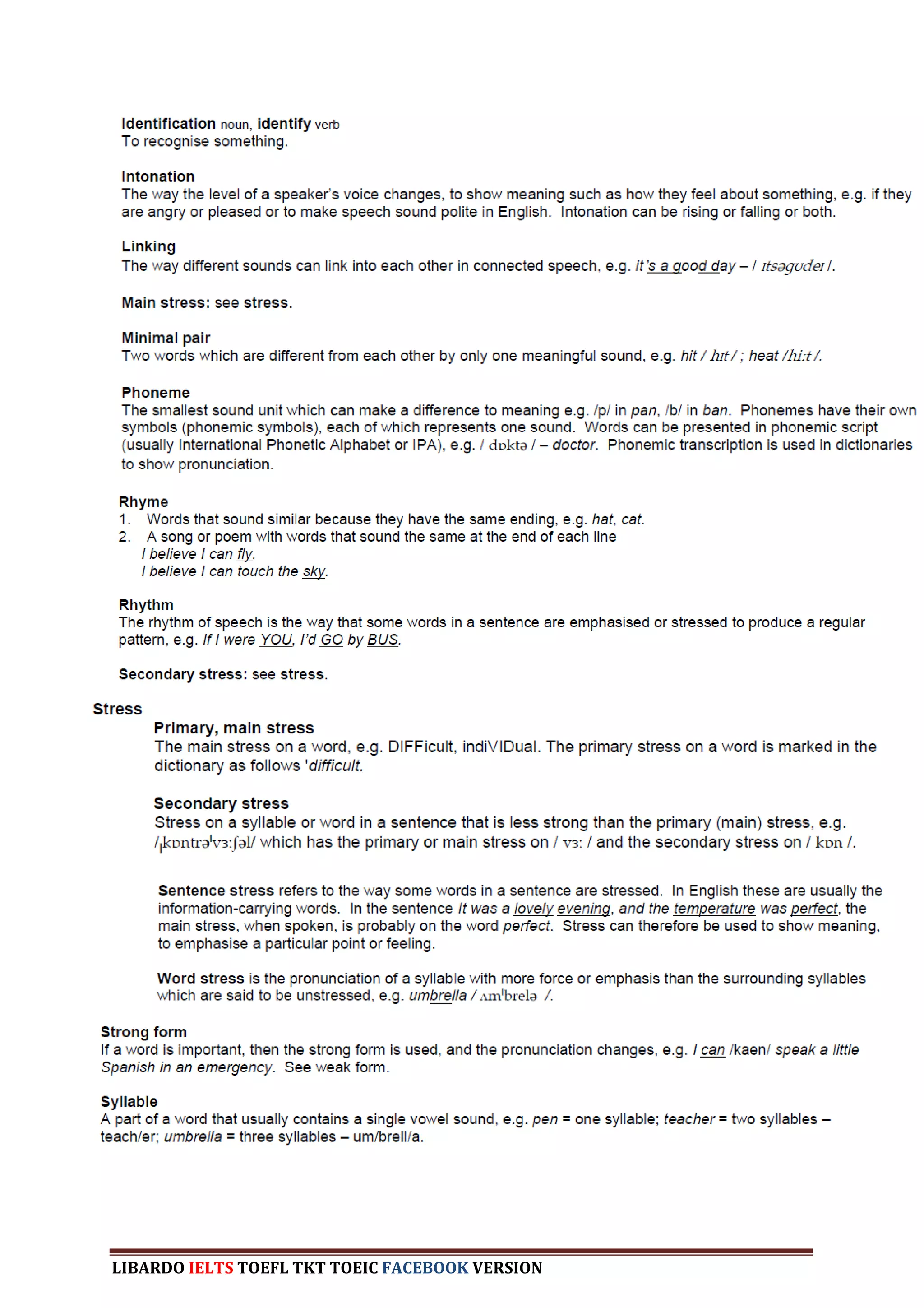
weaknesses in tutorials though.


5. My students choose pieces of their best work during the course and keep them in a
file, which can be looked at during the course. I know some teachers use this as the way
they assess students at the end of the course, but I‟m not sure how that works.


                                                                                     Page 95
Exercise 2.Choose the correct term from the box below for the types of test
described.

A. Placement test B. Diagnostic test

C. Progress test     D. Proficiency test E. Achievement test


1. This type of test is used during a course in order to assess the learning up to
a particular point in the course.

2. This type of test is used to see how well students have learned the language
and skills taught in class. These tests are often at the end of term or end of the
year and test the main points of what has been taught in that time.

3. This type of test is often used at the beginning of a course in a language
school in order to identify a student‟s level of language and find the best class
for them.
4. This type of test is used to identify problems that students have with
language or skills. The teacher tries to find out what language problems
students have. It helps the teacher to plan what to teach in future.

5. This type of test is used to see how good students are at using the language.
The contents of this type of test are not chosen according to what has been
taught, but according to what is needed for a particular purpose.


                                                                                     Page 96
TKT Module 1: Unit 17, Assessment Types and Tasks – exercise 3


Exercise 4 : Which of the activities and tasks are subjective tests and which are
objective tests?


                                                                             Page 97
TKT Module 1: Unit 17: Assessment Types and Tasks - Sample Task

For Questions 1–5, match the descriptions of different tests with the types of test listed
A–F.

Mark the correct letter (A–F) on your answer sheet. You need to use some options more
than once
                                   Types of test


                               A           progress

                               B           achievement

                               C           subjective

                               D           proficiency

                               E           diagnostic

                               F           placement


         Descriptions


1      These tests are designed to test language taught on the whole course.


2      These tests are designed to help teachers to plan course content.


3      The purpose of these tests is to test language taught on part of the course.


4      These tests help teachers to put students in classes at the appropriate level.


5      The marking of these tests depends on decisions made by individual examiners.


                                                                                    Page 98
TKT Module 1: Unit 17: Assessment Types and Tasks – Answer Keys


Key to exercise 1

1.     Self assessment
2.     Formal assessment; summative assessment
3.     Peer assessment.
4.     Informal assessment; formative assessment; continuous assessment.
5.     Portfolio assessment; informal assessment (could be formal if submitted at the
end of a course for evaluation); continuous assessment.


Key to exercise 2

1      C      2      E      3      A      4       B      5      D


Key to exercise 3

1.      Cloze test/gap fill (in a cloze test the gaps are regular e.g. every seventh word, a
gap fill is not regular but selected by the teacher or assessor)
2.      Comprehension task – open comprehension questions (students answer in their
own words)
3.      Matching task
4.      Multiple-choice task
5.      Sentence completion task
6.      Sentence transformation task
7.      Sentence ordering task/Jumbled sentence task
8.      Odd one out task
9.      Essay/letter writing task
10. Speaking task

Key to exercise 4

1. Subjective (many possible answers)
2. Objective
3. Objective
4. Objective
5. Objective
6. Objective
7. Objective
8. Objective
9. Subjective
10. Subjective

Key to Sample Task

1      B      2      E      3      A      4       F      5      C


                                                                                     Page 99
UNIVERSITY OF CAMBRIDGE ESOL EXAMINATIONS

English for Speakers of Other Languages

TEACHING KNOWLEDGE TEST

Module 1

                                                                                001

                                                                      Sample Test

                                                                1 hour 20 minutes


TIME: 1 hour 20 minutes

INSTRUCTIONS TO CANDIDATES

Do not open this booklet until you are told to do so

Write your name, Centre number and candidate number on the answer sheet if
they are not already printed.

There are eighty questions in this paper.

Answer all questions.

Mark your answers on the separate answer sheet. You will have no extra time for
this, so you must finish in one hour and twenty minutes.

At the end of the test, hand in both the question paper and the answer sheet.

INFORMATION FOR CANDIDATES

Each question in this paper carries one mark.


                                                                          Page 100
For questions 1-5, match the language sample with the grammatical terms listed A-F.
   Mark the correct letter (A-F) on your answer sheet.

   There is one extra option which you do not need to use.

   Example language                                       Grammatical items

   1. Break in                                                G. Tag Questions

2. My brother is a pilot, is he?                              H. Phrasal verb

3. If it's sunny, we'll go to the park                        I. Passive voice

4. The exam should have been given to everyone.               J. Determiners

5. This, that, these, those                                   K. Echo Questions

                                                              L. Conditional


   For questions 6-12, choose the correct option (A, B or C) to complete each definition of
   grammatical items. Mark the correct letter on your answer sheet.

       6. An interjection is
      a. an exclamation which shows thoughts or feelings
      b. a meaningless string of sounds
      c. the same as an adjective

       7. A verb that has a subject but no object is.

      a. Transitive
      b. Intransitive
      c. Passive

       8. The subject that does and receives the action is.

          a. Reflexive
          b. Possessive
          c. Relative

       9. A group of words that include a subject and a finite verb is.

          a. A clause
          b. A statement
          c. An idiom


                                                                                    Page 101
10. A word that describes or gives more information about a noun or pronoun is.

    a. An adjective
    b. An adverb
    c. An article


11. The words someone uses when they are telling someone what somebody else
    said or asked are,

      a. The past tense
      b. Past conditional
      c. Indirect speech

12. A verb that does not take an auxiliary to negate or ask questions is called.

  a. Active
  b. Modal
  c. Intransitive


                                                                               Page 102
For questions 13-16, choose the correct Word(s) to complete each definition of lexical
terms, mark the correct letter (A, B or C) on your answer sheet.

    13. ………. Are any pair or group of words commonly found together or near one
        another.

   A. phrasal verbs
   B. collocations,
   C. chunks

    14. A word with the same spelling and pronunciation as another word, but which has
        a different meaning,

   A. Homonym
   B. Antonym
   C. homophone


    15. A group of words or phrases that are about the same content topic or subject,

   A. Lexical set
   B. Synonym
   C. Word family

    16. A meaningful group of letters added to the end of a root or base word to make a
        new word which can be a different part of speech from the original word,

   A. Prefix
   B. Particle
   C. Suffix


                                                                                Page 103
For questions 17-21, match the example sentences with the functions listed A-F. Mark
   the correct letter (A-F) on your answer sheet.

   There is one extra option which you do not need to use.


17. I‟d rather have coffee than tea                           A. Suggesting

18. You should be here later                                  B. Expressingprobability

19. What time does the bus arrive?                            C. Instructing

20. I am sorry, I am busy                                     D. Declining

21. Please turn to page 10                                    E. Enquiring

                                                              F. Expressingpreferences


   For questions 22-25 choose the correct Word(s) to complete each definition of
   phonology, mark the correct letter (A, B or C) on your answer sheet.


       22. Two words which are different from each other by only one meaningful sound
           are.

      A. Minimal pairs
      B. Homophones
      C. Consonants

       23. In the sentence “She gave the ring to John” it can be implied that.

      A. She only gave the ring to John
      B. John was the person she gave the ring to.
      C. She could have given the ring to somebody else.

       24. The way the level of a speaker‟s voice changes, to show meaning such as how
           they feel about something is.

      A. Linking
      B. Stress
      C. Intonation


                                                                                   Page 104
25. Words that sound similar because they have the same ending.

        A. Rhyme
        B. Rhythm
        C. Contraction


   For questions 16-30, match the minimal pairs with the phonemic symbols listed A-F.
   Mark the correct letter (A-F) on your answer sheet.

   There is one extra option which you do not need to use.


26. darling/dialling                                         A.

27. cart/cut                                                 B.

28. tile/toil                                                C.

29. pull/bull                                                D.

30. worse/worth                                              E.

                                                             F.


                                                                                 Page 105
For questions 31-35, match what the writer does with the writing subskills listed A-G.
Mark the correct letter (A-F) on your answer sheet.

There is one extra option which you do not need to use


                               A. Edit

                               B. Proof-reading

                               C. Planning

                               D. Drafting

                               E. Brainstorming

                               F. Extracting


    31. I change or correct the words or content of some parts of my text to make it
        clearer or easier to understand.

    32. Before finishing, I give my work a final check for accuracy

    33. I organize my main ideas into different paragraphs in note form.

    34. I start writing, developing my main ideas.

    35. Before I start, I try to imagine everything I can about the topic and start writing as
        many ideas as I can without an specific order.


                                                                                     Page 106
For questions 36-42 look at the following terms for language skills and three possible
descriptors of terms.
Choose the correct letter (A, B or C) on your answer sheet.


    36. Extensivereading is

   A. reading long pieces of text, such as stories or newspapers.
   B. Part of a text which is removed from an original text.
   C. written language in texts or groups of sentences.

    37. Accuracyis

   A. The use of correct forms of grammar, vocabulary, spelling and pronunciation.
   B. When ideas in a spoken or written text fit together clearly and smoothly,
   C. Understanding a spoken or written text.

    38. Oral fluencyis.

   A. The use of connected speech at a natural speed with little hesitation, repetition or
      self-correction.
   B. The use of connected speech without making mistakes.
   C. The use of intonation to express feelings.

    39. Listen/readformoodis

   A. To read or listen to a text in order to identify the feelings of the writer or speaker.
   B. To listen to or read a text in order to understand most of what it says or particular
      details.
   C. To understand the general meaning of a text, without paying attention to specific
      details.

    40. Intensive listening or reading is

   A. To focus on how language is used in a text
   B. To listen or read in a intensive way
   C. To listen or read with an intense interaction


                                                                                     Page 107
For questions 41-46, match the student‟s comments with the learning characteristics
listed A-G. Mark the correct letter (A-F) on your answer sheet.

There is one extra option which you do not need to use


                                A. Acquisition

                                B. Focus on form

                                C. Ignore errors

                                D. Interference

                                E. Interlanguage

                                F. Learner autonomy

                                G. Language Awareness


Students` Comments

      41. I feel quite confident because I am making less mistakes that those I used to
         make when I was starting to study English
      42. One of my most difficult problems when speaking English is that I make a lot
         of mistakes because I unconsciously use grammatical items and vocabulary
         from my first language.
      43. The teacher really likes paying attention to rules and how language is used
         rather than letting us say what we want even though it is incorrect.
      44. It is strange for me that the teacher just lets me talk and doesn`t really stop
         me when I make mistakes, even if I can notice them.
      45. I am learning English in a very particular way, the teacher just uses it in real
         life situations avoiding grammar revision, I feel like a child learning in this way.


                                                                                    Page 108
For questions 46-53, match the teaching methods description with the names listed A-
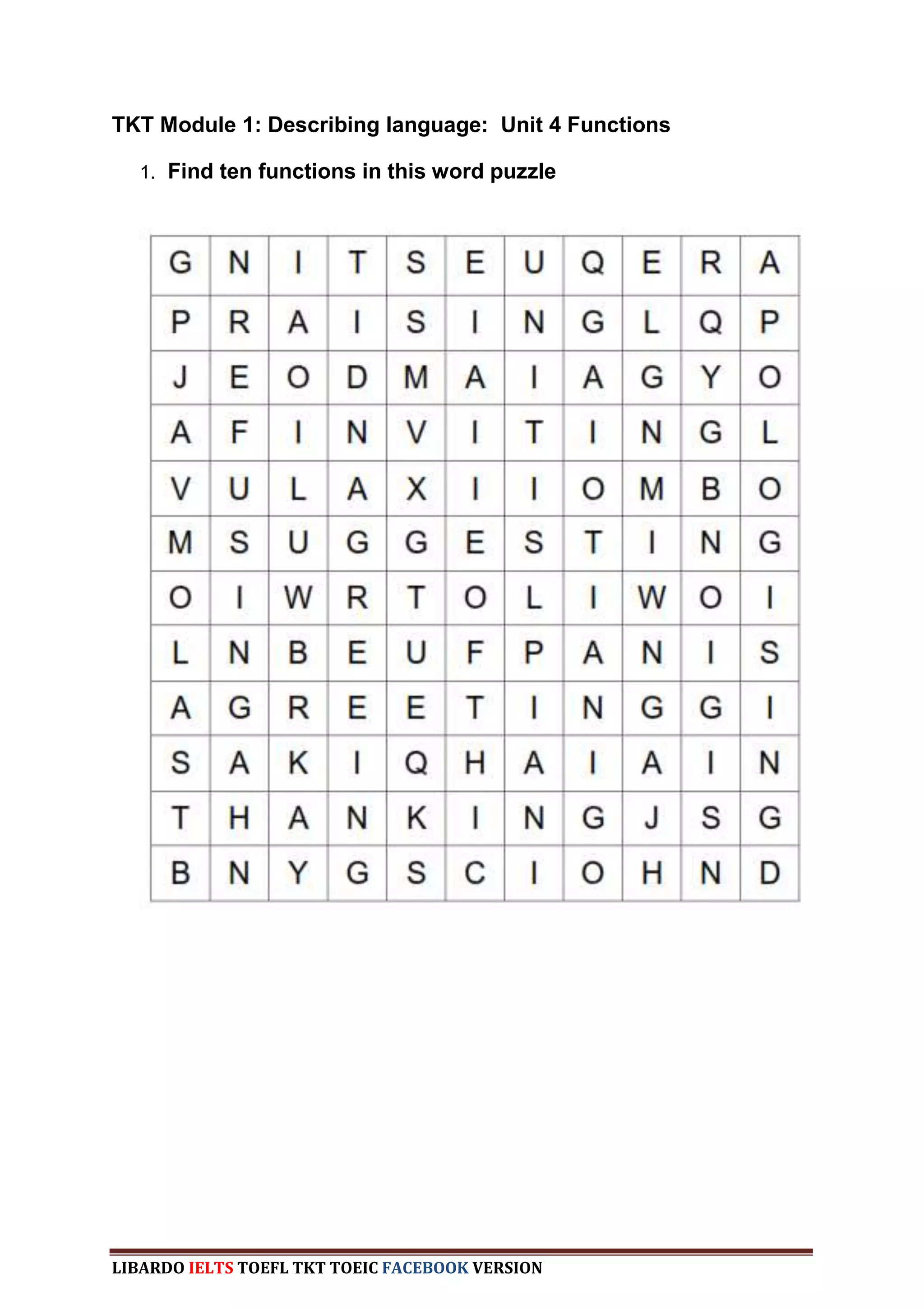
G. mark the correct letter (A-I) on your answer sheet.

There is one extra option which you do not need to use


                       A. Activity based learning
                       B. Communicative approach
                       C. Holistic
                       D. Functional approach
                       E. Total Physical Response
                       F. Grammar-translation method
                       G. Lexical Approach
                       H. Presentation practice and production PPP
                       I. Task based learning TBL


Teaching Methods


      46. A way of teaching in which the teacher gives learners meaningful tasks to do,
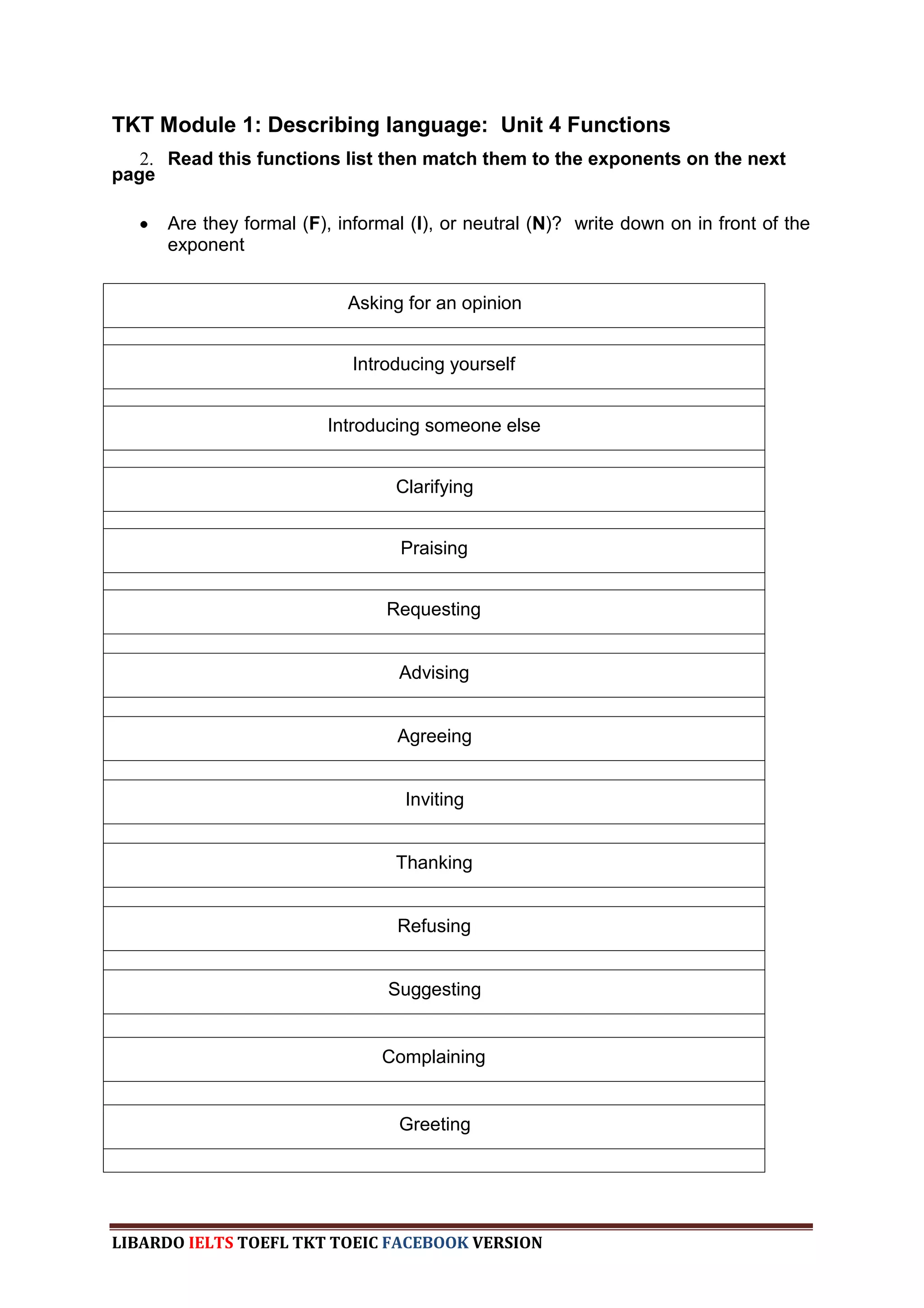
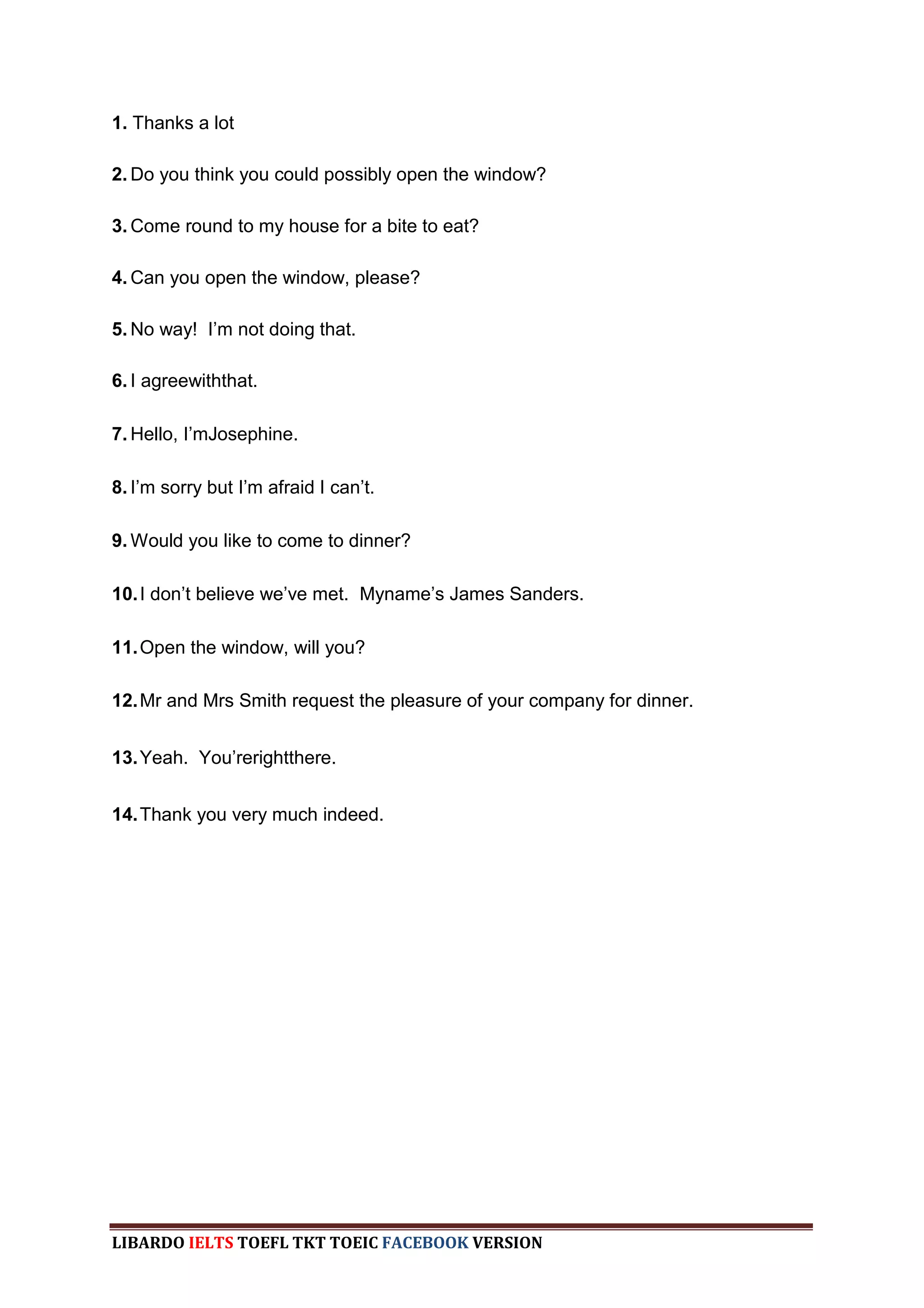
          but the main focus for learners is on the task itself.
      47. Teachers try to focus on meaningful communication, rather than focusing on
          accuracy and correcting mistakes
      48. An approach to language teaching in which the teacher uses techniques and
          activities taken from different methods together in one lesson.
      49. A way of teaching new language in which the teacher presents the language,
          gets learners to practice it in exercises or other controlled practice activities
          and then asks learners to use or produce the same language in a
          communicative and less controlled way
      50. A way of teaching language that focuses on lexical items or chunks such as
          words.
      51. A way of teaching in which learners study grammar and translate words and
          texts into their own language or the target language.
      52. A way of teaching which uses a syllabus based on functions
      53. A way of learning by doing activities. The rules of language used in the activity
          are looked at either after the activity or not at all


                                                                                  Page 109
For questions 54-59, match the teachers` comments on the strategies described with
the names listed A-G. Mark the correct letter (A-G) on your answer sheet.

There is one extra option which you do not need to use


                                      A. Eliciting

                                      B. Substitution Drill

                                      C. Transformation Drill

                                      D. Restricted practice

                                      E. Freer practice

                                      F. Role-play

                                      G. Survey


Teacher`s comments

   54. I like asking targeted questions ahead of time to see whether my learners know
       what I am going to teach them.

   55. I like giving my learners a base sentence and then providing them with different
       words for them to change in that sentence.
   56. I think that less freerpractice is very important because I can work on accuracy.
   57. I think that every time I do fluency based activities my learners feel more
       confident to speak.
   58. I like having my learners to put what they have learnt in context through real life
       exercises.
   59. In my opinion using internet for my students to find information and then working
       based on it in class is very motivating and encourages interaction.


                                                                                     Page 110
For questions 60-67, match the practice activities and tasks listed A-I. with the course
book instructions, mark the correct letter (A-I) on your answer sheet.

There is one extra option which you do not need to use


                         A. Brainstorming
                         B. Sentence transformation
                         C. Jumbled paragraphs
                         D. Labeling
                         E. Gap filling
                         F. Matching
                         G. Odd-one-out
                         H. Reading for gist
                         I. Listening for mood


Practice activities and tasks

     60. Listen to the following conversation and describe how the woman feels.

     61. Read the paragraph and select the best heading for it.

     62. Look at the list of words and underline the one which does not belong to the

        topic

     63. Choose the correct verb in column A and the appropriate preposition in column

        B

     64. Look at the pictures and put the correct names on them.

     65. Listen and fill in the correct word.

     66. Read the text and put all the paragraphs in the appropriate order.

     67. Look at each sentence and use the words provided to re-write them.


                                                                                  Page 111
For questions 68-73, match the aids and resources listed A-I. With the uses described,
mark the correct letter (A-I) on your answer sheet.

There is one extra option which you do not need to use


                        A. OHP
                        B. Realia
                        C. Puppets
                        D. Computer
                        E. Dictionary
                        F. Board
                        G. Skills practice book
                        H. Graded reader
                        I. OHT


Aids and Resources


   68. This can be used by the teacher or learners to show what one or two people are
       talking about by moving it and making it look real.
   69. This can be used for a range of purposes by the teacher to show real meaning of
       concepts.
   70. This can be used to display greater pictures on the wall or to work on group-
       reading.
   71. This is an excellent tool for students to research information when working on a
       project; it enables them to share what they find with other people.
   72. This is a tool help learners enhance autonomy.
   73. This is a tool used by the teacher to display grammatical structures, vocabulary
       items, etc.
   74. This is a resource that enables the learner to extend his/her knowledge about a
       language area.
   75. This is an excellent tool to encourage extensive reading.


                                                                               Page 112
For questions 75-80, match the assessment types A-F With the definitions described
by a teacher, mark the correct letter (A-I) on your answer sheet.

There is one extra option which you do not need to use


                             A. Formal assessment

                             B. Informal assessment

                             C. Self assessment

                             D. Assessment criteria

                             E. Objective test

                             F. Subjective test


Teacher comments

     76. I like giving my learners tests that make them reflect on their own progresses.

     77. I like using software to evaluate what my learners learn in a neutral way,

        without interference from what I think about them.

     78. I want my learners to take a test based on a third examiner`s opinion.

     79. “The topics for next exam are the following; simple present, simple past and

        plurals”.

     80. Put your name on the answer sheet and write all answers on it.


                                                                                  Page 113
TKT MODULE 1 KEY
1H                 41 E
2K                 42 D
3L                 43 B
4I                 44 C
5J                 45 A
6A                 46 I
7B                 47 B
8A                 48 C
9A                 49 H
10 A               50 G
11 C               51 F
12 B               52 D
13 B               53 A
14 A               54 A
15 A               55 B
16 C               56 D
17 F               57 E
18 A               58 F
19 E               59 G
20 D               60 I
21 C               61H
22 A               62 G
23 B               63 F
24 C               64 D
25 A               65 E
26 E               66 C
27 C               67 B
28 B               68 C
29 D               69 B
30 A               70 I
31 A               71D
32 B               72 E
33 C               73 F
34 D               74 G
35 E               75 H
36 A               76 C
37 A               77 E
38 A               78 F
39 A               79 D
40 A               80 A


                          Page 114
Page 115
Page 116
Page 117

TKT WORKBOOK, https://tkt.gnomio.com

  • 1.
    Tired of notgetting band 4 on TKT? “I finally found a powerful tool to The purpose of this book is to serve as a tool to help TKT practice and be candidates to prepare in a better way to sit the TKT test from Cambridge ESOL. confident enough to It is divided into three chapters, each covering a module from the standard TKT test; it contains tasks get the best at TKT.” specifically designed to help candidates know the George Thompson structure and learn important tips to really get band 4 on this teaching knowledge qualification. English Teacher Chelsea NY LIBARDO IELTS TOEFL TKT TOEIC FACEBOOK VERSION
  • 2.
    INTRODUCTION The purpose ofthis book is to be a helping tool in the process of training candidates to take the Teaching Knowledge Test TKT. The Teaching Knowledge Test (TKT) is a test from Cambridge ESOL about teaching English to speakers of other languages. It aims to increase teachers' confidence and enhance job prospects by focusing on the core teaching knowledge needed by teachers of primary, secondary or adult learners, anywhere in the world. This flexible and accessible award will help you to understand: differentmethodologiesforteaching the 'language of teaching' the ways in which resources can be used the key aspects of lesson planning classroom management methods for different needs TKT gives teachers a strong foundation in the core areas of teaching knowledge needed in the English language teaching classroom. It is ideal for all teachers, whatever their background and teaching experience, and is also suitable for people who would like to teach English but do not yet have a teaching position. There are no formal entry requirements. However, anyone wishing to take TKT is strongly advised to have at least an intermediate level of English — Level B1 of the Council of Europe's Common European Framework of Reference for Languages (CEFR) — e.g. PET, IELTS band score of 4 Each unit consists of plenty of practice exercises and TKT tasks that are very similar in format to what is evaluated in the real TKT test. LIBARDO GONZALEZ ALVAREZ SIT-TESOL MASTER IN APPLIED LINGUSTICS CANDIDATE TEACHER TRAINER Leyenda que describe una imagen o un gráfico. LIBARDO IELTS TOEFL TKT TOEIC FACEBOOK VERSION
  • 3.
    TKT Module 1:Describing language: Unit 1 Grammar – Participant‟s Activity 1 Complete the puzzle with parts of speech. Across 3. A word used to show an action, state, event or process, e.g. „I like cheese.‟; „He speaks Italian.‟ 8. A word used to connect words, phrases, clauses or sentences, e.g. „I like tea but I don‟t like coffee Because it‟s too strong for me.‟ 9. A word that describes or gives more information about how, when, where or to what degree something is done, e.g. „He worked quickly and well.‟ 10. A word that replaces or refers to a noun or a noun phrase just mentioned, e.g. „I saw John yesterday. He looked very well.‟ Down 1. An expression used to show a strong feeling, e.g. Oh! Wow! 2. A word which makes clear which noun is referred to or to give information about quantity, e.g. this, that, some, any, my, that car is mine. 4. „On‟ „under‟ „over,‟ for example 5. A word that describes or gives more information about a noun or pronoun, e.g. a cold day. 6. „The‟, „a‟, „an‟, for example 7. A person, place or thing, e.g. elephant, girl, grass, school LIBARDO IELTS TOEFL TKT TOEIC FACEBOOK VERSION
  • 4.
    TKT Module 1:Describing language: Unit 1 Grammar – Participant‟s Activity 2 Exercise 1 Look at the underlined words in the sentences below and match them with the words Participant‟s worksheet 1, given in the box. from exclamation determiner verb preposition adjective article noun conjunction adverb pronoun A. (1) She(2) alwaysmoves the (3) furniture when she does the (4) housework. B. (5) Robert is (6) taller than James and (7) his hair is longer. C. (8) Can you buy a (9) good (10) book for Jim? D. I‟ll give it to (11) him for his birthday (12) tomorrow? E. (13) Ouch! You‟re (14) standing on (15) my foot. F. John (16) saw Fred last week (17) in town. I (18) didn‟t see him myself but he (19)saidhe was carrying (20) a suitcase. Exercise 2 Group A: Look at the underlined words 1ˆ in the sentences again. Group B: Look at the underlined words 11• in the sentences again. Both groups: Match your words with a more specific term from the box below. Some of the words may have more than one term. modal verb possessive pronoun countable noun adjective possessive adjective indefinite article collective noun determiner reporting verb auxiliary verb adverb of time compound noun object pronoun proper noun personal pronoun uncountable noun modal auxiliary transitive verb subject pronoun exclamation uncountable noun preposition of place comparative adjective intransitive verb LIBARDO IELTS TOEFL TKT TOEIC FACEBOOK VERSION
  • 5.
    TKT Module 1:Describing language: Unit 1 Grammar – Participant‟s Activity 3, fill in1: Describing language: Unit 1 Grammar – Sample Task 1 TKT Module the gaps with Grammatical structure match the example sentences with the What it means/how it listed A-F For questions 1- 5 How it is made and example grammatical terms is used Mark the correct letter (A–F) on your answer sheet. Present continuous subject + present tenseof the to talk aboutan action There is one extra option which you do not need to e.g.I happeningat the time of verbtobe+ingformof verb, use. amworking at the moment. speaking. Example sentences Grammatical terms A gerund 1) 1 Then I realised what had happened. tense of the subject + past to talk aboutan action verb, e.g.I went to France last completedat a specific year. B time on the past. present perfect simple 2 Many old houses are made of wood. C present perfect continuous PresentWe‟ve never seen a whale before. 3 simple 2) to talk abouta routine orhabit. D reported speech 4 He doesn‟t like playing chess. 3) subject + present of the to talk aboutthings youhave 5 verbto have+ past participle, present simple passive She said she was really upset. E experiencedon your life e.g.I‟ve been toFrance many times. F past perfect simple Modal verb - must subject + base form of the 4) verb e.g.You must be home by 10.00. Future withgoing to 5) to expressintention 6) If + subject+ present simple to talk aboutsomething that is +subject +will+ bare infinitive, possible in the future and the e.g.If Isee him I‟ll tell him action thatwill be taken . LIBARDO IELTS TOEFL TKT TOEIC FACEBOOK VERSION
  • 6.
    TKT Module 1:Describing language: Unit 1 Grammar – Sample Task 2 For questions 1-5, match the example language with the grammatical terms listed A- F. Mark the correct letter (A-F) on your answer sheet. There is one extra option which you do not need to use. Example language Grammatical items 1. Break in A. Tag Questions 2. My brother is a pilot, is he? B. Echo Questions 3. If it's sunny, we'll go to the park C. Phrasal verb 4. The exam should have been given to everyone. D. Passive voice 5. This, that, these, those E. Determiners F. Conditional TKT Module 1: Describing language: Unit 1 Grammar – Sample Task 3 For questions 1-7, choose the correct option (a, b or c) to complete each definition of grammatical items. Mark the correct letter on your answer sheet. 1. An interjection is a. an exclamation which shows thoughts or feelings b. a meaningless string of sounds c. the same as an adjective 2. A verb that has a subject but no object is. a. Transitive b. Intransitive c. Passive 3. The subject does the action and receives the action is. a. Reflexive b. Possessive c. Relative LIBARDO IELTS TOEFL TKT TOEIC FACEBOOK VERSION
  • 7.
    4. A groupof words that includes a subject and a finite verb is. a. A clause b. A statement c. An idiom 5. A word that describes or gives more information about a noun or pronoun is. a. An adjective b. An adverb c. An article 6. The words someone uses when they are telling someone what somebody else said or asked are, a. The past tense b. Past conditional c. Indirect speech 7. A verb that does not take an auxiliary to negate or ask questions is called. a. Active b. Modal c. Intransitive LIBARDO IELTS TOEFL TKT TOEIC FACEBOOK VERSION
  • 8.
    TKT Module 1:Describing language: Unit 1 Grammar – Answer Keys Key to activity 1 1E X C 2D L 3VE R B 4P A T R M 5A E 6A E A D R R P T J M 7N T O I E I O I S O 8C O N J U N C T I O N T E N L T I R E I V O 9A D V E R B 10P R O N O U N Across: 3: verb; 8: conjunction; 9: adverb; 10: pronoun Down: 1: exclamation; 2: determiner; 4:preposition; 5: adjective; 6: article; 7: noun Key to activity 2 Question Exercise 1 Exercise 2 1. She pronoun subject pronoun, personal pronoun 2. always adverb adverb of frequency 3. furniture noun uncountable noun, collective noun 4. housework noun uncountable noun, compound noun 5. Robert noun proper noun 6. taller adjective comparative adjective 7. his pronoun; determiner possessive pronoun, determiner 8. Can verb modal verb, modal auxiliary 9. good adjectiveadjective 10. book noun countable noun 11. him pronoun; determiner object pronoun 12. tomorrow adverb adverb of time LIBARDO IELTS TOEFL TKT TOEIC FACEBOOK VERSION
  • 9.
    13. Ouch! exclamationexclamation 14. standing verb intransitive verb 15. my adjective possessive adjective 16. saw verb transitive verb 17. in prepositionpreposition of place 18. didn‟t verb auxiliary verb 19. said verb reporting verb 20. a article indefinite article Key to activity 3 1) Past simple 2) subject + present of the verb, e.g. I get up at 7.00 every day. 3) Present perfect simple 4) To talk about an obligation, something that is necessary 5) subject + present tense of the verb to be + going to + base form, e.g. I‟m going to take the train. 6) First conditional Key to Sample Task 1 1 F 2 E 3 B 4 A 5 D Key to Sample Task 2 1.C 2.A 3.F 4.D 5.E Key to Sample Task 3 1.A 2.B 3.A 4.A 5.A 6.C 7.B LIBARDO IELTS TOEFL TKT TOEIC FACEBOOK VERSION
  • 10.
    TKT UNIT 1GRAMMAR; GLOSSARY, Taken from www.cambridgeesol.org Active voice In an activesentence, the subject of the verb usually does or causes the action, e.g. The car hit the tree. Adjective An adjective describes or gives more information about a noun or pronoun, e.g. a cold day. Adverb An adverb describes or gives more information about how, when, where, or to what degree etc something is done, e.g. he worked quickly and well. Apostrophe A punctuation mark (‟).The ‟ is added to a singular noun before an s to show that something belongs to someone, e.g. John‟s house. Article An article can be definite (the), indefinite (a/an) or zero (-), e.g. I was at(-)home in the sitting room when I heard a noise. Aspect A way of looking at verb forms not purely in relation to time. Aspect relates to the type of event, e.g. whether it is long or short, whether it is complete or not, whether it is repetitive or not, whether it is connected to the time of speaking or not. There are two aspects in English, the continuous/progressive and the perfect. The continuous aspect, for example, suggests that something is happening temporarily. ‘At’ symbol A punctuation mark (@) used instead of „at‟ in email addresses, e.g. john@yahoo.com Auxiliary verb An auxiliary verb is a verb used with other verbs to make questions, negatives, tenses, etc e.g. be, do, have. Base form of a verb Thebase form of a verbisthe infinitive form of a verb without „to‟, e.g. go. Capital letter A letter of the form and size used at the beginning of a sentence or a name, e.g. They went to Spain last year. Clause A clause generally consists of a subject and a finite verb relating to the subject and any other elements, e.g. object. A clause can be a full sentence or a part of a sentence. Main clause LIBARDO IELTS TOEFL TKT TOEIC FACEBOOK VERSION
  • 11.
    When the teacherarrived, the learners stopped talking. Subordinate clause When the teacher arrived, the learners stopped talking. Relative clause The learners who were sitting near the front stood up. Collective noun A collective noun is a noun that refers to a group of people or things, e.g. the police, the government. Comma A punctuation mark (,) used to separate items in a list or to show where there is a pause in a sentence, e.g. I bought some apples, oranges, bananas and lemons. When I went to the market, I met my friend. Comparative adjective A comparative adjectivecompares two things, e.g. He is taller than she is. Complex sentence A sentence containing a main clause and one or more subordinate clauses. Compound noun A compound noun is a combination of two or more words, which are used as a single word, e.g. a flower shop,a headache. Conditional (forms) A verb form that refers to a possible or imagined situation. Grammar books often mention four kinds of conditionals: First conditional –refers to present or future possible or likely situations, e.g. I will come if I can. Second conditional – refers to present or future situations which the speaker thinks are impossible or unlikely, e.g. I would go if they asked me. Third conditional – refers to past situations that cannot be changed, e.g. I would have seen her if I hadarrived earlier (but I didn‟t so I couldn‟t). Mixed conditional – is used when the speaker wants to refer to different time frames in one sentence, e.g. If I‟d arrived on time, I wouldn‟t have to wait now. If I‟d arrived refers to the past and I wouldn‟t have towait refers to the present. Conjunction A conjunction (or connector) is used to connect words, phrases, clauses or sentences, e.g. I like tea but I don‟t like coffee because it‟s too strong for me. Countable noun A countable noun has a singular and plural form, e.g. book, books. Demonstrative adjective LIBARDO IELTS TOEFL TKT TOEIC FACEBOOK VERSION
  • 12.
    A demonstrative adjectiveshows whether something is near or far from the speaker, e.g. this (near), that (far). Demonstrative pronoun A demonstrative pronoun is a word which refers to a noun (phrase) and shows whether it is near or far from the speaker, e.g. this, that, these, those. Dependent preposition Adependent preposition is a word that is always used with a particular noun, verb or adjective before another word,e.g. interested in, depend on, bored with. Determiner A determiner is used to make clear which noun is referred to, or to give information about quantity, and includes words such as the, a, this, that, my, some, e.g. That car is mine. Direct speech, question The actual words someone says, e.g. He said, „My name is Ron.‟,„What do you mean, Sue?‟, asked Peter. Exclamation mark A punctuation mark (!) written after an exclamation, e.g. Be careful! Exponent An example of a grammar point, function or lexical set. Full stop A punctuation mark (.) used at the end of a sentence, e.g. I like chocolate. Future with going to I‟m going to visit my aunt on Sunday. It‟s going to rain. Future with present continuous He is meeting John for dinner at eight tomorrow. Future with present simple The plane leaves at 9.00 next Saturday. Future with will or shall I‟ll help with the cleaning. It will be lovely and sunny tomorrow. Gerund, -ing form A form of a verb functioning as a noun, which ends in -ing, e.g. I hate shopping. (Grammatical) structure, form A grammatical structure is a grammatical language pattern, e.g. present perfect simple, and the parts which combine to make it, e.g. have + past participle. Imperative The form of a verb that gives an order or instruction, e.g. Turn to page 10. Indirect speech, question LIBARDO IELTS TOEFL TKT TOEIC FACEBOOK VERSION
  • 13.
    The words someoneuses when they are telling someone what somebody else said or asked, e.g. He told me his name was Ron. Peter asked Sue what she meant. An indirect question can also be used when someone wants to ask something in a more polite way, e.g. „I was wondering if you could help me.‟ (indirect question) instead of „Could you help me?‟ (direct question). Infinitive The infinitiveform is the base form of a verb with „to‟. It is used after another verb, after an adjective or noun or as the subject or object of a sentence, e.g. 'I want to study.‟, „It‟s difficult to understand. ‟ Infinitive of purpose This is used to express why something is done, e.g. I went to the lesson to learn English. -ing/-ed adjective An-ing/-ed adjective describes things or feelings. An -ing adjective describes things or people, e.g. The book is very interesting. An-ed adjective describes feelings, e.g. I am very interested in the book. Intensifier A word used to make the meaning of another word stronger, e.g. He‟s much taller than his brother. I‟m very tired. Interrogative A question form. Intransitive Is used to describe a verb which does not take a direct object, e.g. She never cried. Irregular verb Anirregular verbdoes not follow the same pattern as regular verbs. Each irregular verb has its own way of forming the past simple and past participle, e.g. go went (past simple) gone (past participle). Modal verb A modal verb is a verb used with other verbs to show ideas such as ability or obligationor possibility. They include can, must, will, should, e.g. I can speak French, but I should study even harder. Noun A person, place or thing, e.g. elephant, girl, grass, school. Object This is a noun or phrase that describes the thing or person that is affected by the action of a verb, e.g. I saw Mary in the classroom. A direct object is the main object of a transitive verb. LIBARDO IELTS TOEFL TKT TOEIC FACEBOOK VERSION
  • 14.
    An indirect objectis an object affected by a verb but not directly acted on, e.g. He gave the book to me. In this sentence, the book is the direct object and me is an indirect object. Object pronoun An object pronoun is a word which replaces an object noun or an object noun phrase, e.g. him, her. Participle (past and present) –ed and –ing forms of the verb, they are often used to make tenses or adjectives, e.g. an interesting film(present participle); I haven‟t seen him today. (past participle) Particle A small grammatical word, often an adverb or preposition which does not change its form when used in a sentence, e.g. look after, after is a particle. Passive voice, progressive In a passive sentence, something is done to or happens to the subject of the verb, e.g. The tree was hit by the car. Past continuous, progressive I was watching TV all evening. Past perfect continuous, progressive I had been studying for three hours so I felt tired. Past perfect simple After I had phoned Mary, I went out. Past simple I went on holiday to France last year. Person First person – the person speaking, e.g. I, we. Second person – the person spoken to, e.g. you. Third person – the person spoken about, e.g. he, she, they. Personal pronoun Personal pronounsare words, which are used instead of the name of that person, e.g. I (subject pronoun), me (object pronoun). Phonology noun, phonological adjective The study of sounds in a language or languages. Phrase A group of words often without a finite verb that do not form a sentence, e.g. the green car, on Friday morning are phrases. Also a group of words that together have a particular meaning. Plural noun LIBARDO IELTS TOEFL TKT TOEIC FACEBOOK VERSION
  • 15.
    A plural nounis more than one person, place or thing and can be regular or irregular, e.g. boys, women. Possessive adjective Apossessive adjectiveshows who something belongs to, e.g. my, our. Possessive pronoun A possessive pronoun is used to replace a noun and shows something belongs to someone, e.g. the house is mine. Possessive ‘s’ and whose Ways of showing or asking who something belongs to, e.g. „Whose book is it?‟ „It‟s Sue‟s‟. Preposition A word used before a noun, pronoun or gerund to connect it to another word, e.g. He was in the garden. Present continuous, progressive I am working in London now. Present continuous, progressive for future He is meeting John for dinner at eight tomorrow. Present perfect continuous, progressive I have been studying for three years. Present perfect simple I have known him for a long time. Pronoun A word that replaces or refers to a noun or noun phrase just mentioned. Proper noun A proper noun is the name of a person or place, e.g. Robert, London. Punctuation The symbols or marks used to organise writing into clauses, phrasesand sentences to make the meaning clear, e.g. full stop (.), capital letter (A), apostrophe („), comma (,), question mark (?), exclamation mark (!), ‘at’ symbol (@) and speech marks (“ ”). Quantifier A word or phrase such as much, few or a lotof which is used with a noun to show an amount, e.g. I don‟t have much time; I have a lot of books. Question mark A punctuation mark (?) used in writing after a question, e.g. How are you? Question tag A phrase such as isn‟t it?ordoesn‟t he?that is added to the end of a sentence to make it a question, or to check that someone agrees with the statement just made, e.g. It‟s very cold, isn‟t it? LIBARDO IELTS TOEFL TKT TOEIC FACEBOOK VERSION
  • 16.
    Reflexive pronoun A reflexivepronoun is used when the object of a sentence refers to the same person or thing as the subject of the sentence, e.g. He cut himself. Regular verb Aregular verbchanges its forms by adding -edin the past simple and past participle, e.g. walk, walked. Relative pronoun A relative pronounintroduces a relative clause, e.g. the book which I‟m reading is interesting. Reported speech, statement, question When someone‟s words are reported by another person, e.g. She said she was sorry. Reporting verb A verb such as tell, advise, suggest used in indirect, reported speech to report what someone has said, e.g. Jane advised John to study harder. Singular noun A singular noun is one person, place or thing, e.g. boy, park, bicycle. Speech marks Punctuation mark (“ ”) They are written before and after a word or a sentence to show that it is what someone said, e.g. John said “Hello, Sarah”. Subject This is the noun or phrase that goes before the verb to show who is doing the action in an active sentence, e.g. Johnplays tennis every Saturday, or who the action is done to in a passive sentence, e.g. the food was cookedyesterday. Subject-verb agreement When the form of the verb matches the person doing the action of the verb, e.g. I walk, he walks. If a learner writes, I walks, then it is wrong because there is no subject-verb agreement. Superlative adjective A superlative adjectivecompares more than two things, e.g. He is the tallest boy in the class. Tense A form of the verb that shows whether something happens in the past, present or future. Time expression A word or phrase that indicates time, such as after, last weekend, e.g. I will meet you after the lesson. Transitive LIBARDO IELTS TOEFL TKT TOEIC FACEBOOK VERSION
  • 17.
    Is used todescribe a verb which takes a direct object, e.g. She wrote a letter. Uncountable noun An uncountable noun does not have a plural form, e.g. information. Used to A structure that shows something happened in the past but does not happen now, e.g. I used to live in London, but now I live in Paris. Verb A word used to show an action, state, event or process, e.g. I like cheese; He speaks Italian. Verb pattern The form of the words following the verb, e.g. He advised me to get there early. (advise + object pronoun + to + baseform). LIBARDO IELTS TOEFL TKT TOEIC FACEBOOK VERSION
  • 18.
    TKTModule1:Describinglanguage: Unit 2Lexis– Activity 1 Completethepuzzlewithpartsofspeech. 1. 5. T M R P A Y E I N NO X F 2. 6. F A C U I X D P F O N M O 3. 7. O L M Y L O N NC O T SY CO A I N 4. 8. M O X F H P F US I H N E O O M. Root word, base word friend G.Homophone J.Phrasal verb Collocation Compound P.Word family F. Homonym I. Lexical set Antonym O. Synonym L. Register B. C. D. Affix A. FalseE. H. Idiom K.Prefix N.Suffix LIBARDO IELTS TOEFL TKT TOEIC FACEBOOK VERSION
  • 19.
    TKTModule1:Describinglanguage:Unit 2 Lexis– Activity 2a Matchthedefinitionsbelowwiththetermsforthelexicalitems in activity 2b. 1. awordwhichhasthesameornearlythesamemeaningasanotherword 2. ameaningfulgroupoflettersaddedtothebeginningofarootorbasewordto makeanewword,whichcanbeadifferentpartofspeechfromtheoriginalword 3. awordinthetargetlanguagewhichlooksorsoundsasifit hasthesame meaningasasimilarwordinthelearners‟firstlanguage butdoesnot 4. ameaningfulgroupoflettersaddedtothebeginningorendofawordtomakea newword,whichcanbeadifferentpartofspeechfromtheoriginalword 5. averbwhichismadeupofmorethanoneword(e.g.averb+adverbparticleor preposition)whichhasadifferentmeaningfromeachindividualword 6. awordwiththesamespellingas anotherword,butwhichhasadifferentmeaning 7. agroupofwordsthatarerelatedtoeachotherbytheirrootorbaseword 8. ameaningfulgroupoflettersaddedtotheendofarootorbasewordtomakea newword,whichcanbeadifferentpartofspeechfromtheoriginalword 9. theoppositeofanotherword 10. agroupofwordsorphrasesthatareaboutthesamecontenttopicorsubject 11. nouns,verbs,adjectivesorprepositionsthataremadeupoftwoormorewords withoneunitofmeaning 12. abasicwordorpartofawordfromwhichotherwordscanbemadebyaddinga prefixorsuffixorinsomeotherway 13. wordswhichareregularlyusedtogether.Therelationbetweenthewordsmaybe grammaticalorlexical. 14. agroupofwordsthatareusedtogether,inwhichthemeaningofthewholeword groupisdifferentfromthemeaningofeachindividualword 15. awordwhichsoundsthesameasanotherword,buthasadifferentmeaningor spelling 16. theformalityorinformalityofthelanguageusedinaparticularsituation LIBARDO IELTS TOEFL TKT TOEIC FACEBOOK VERSION
  • 20.
    TKTModule1:Describinglanguage: Unit 2Lexis– Activity2b, now match these definitions with examples from 2c Affix Antonym Collocation Compound False friend Homonym Homophone Idiom Lexicalset Phrasalverb Prefix Register Rootword, base word Suffix Synonym Word family LIBARDO IELTS TOEFL TKT TOEIC FACEBOOK VERSION
  • 21.
    TKTModule1:Describinglanguage:Unit 2 Lexis– Activity 2c A. interview,interviewer;tidyuntidy B. hotis theopposite ofcold C. whencertainverbsgowithparticularprepositions,e.g.dependon,goodatorwhen a verblikemakeordogoeswithanoun,e.g.dotheshopping,makeaplan D. assistantofficemanager, long-legged E. InFrench„librairie‟ isaplacewherepeoplecanbuybooks.Ina libraryinEnglish,you do notbuybooksbutborrowtheminstead. F. bit(pasttenseof„bite‟)anda bit(alittle) G. Iknew hehadwon;I boughtanew book H. Shefeltunder theweathermeansthatshefeltill I. weather– storm,torain,wind,cloudy J. look after–Amotherlooks afterherchildren K. appear–disappear L. Formallanguageusedinajobapplications,informallanguageusedwithfriends. M. photographistherootorbaseofphotographerandphotographic N. care–careful O. niceissimilarinmeaningtopleasant P. economy,economist, economic TKTModule1:Describinglanguage: Unit 2Lexis–SampleTask 1 LIBARDO IELTS TOEFL TKT TOEIC FACEBOOK VERSION
  • 22.
    ExamplesofvocabularyCategories A synonyms 1 colour,color;realise,realize;theatre,theater B lexicalset 2 trafficlights;alarmclock;seatbelt C collocations 3 childish;successfully;dependable D word+suffix 4 turnup;turnoff; turninto E prefix+word 5 catcha cold;catcha bus;catcha thief F compounds 6 sad;miserable;unhappy 7 ankle;stomach;knee;heart G phrasalverbs H AmericanandBritish English LIBARDO IELTS TOEFL TKT TOEIC FACEBOOK VERSION
  • 23.
    TKTModule1:Describinglanguage: Unit 2Lexis–SampleTask2 For questions 1-4, choose the correct Word(s) to complete each definition of lexical terms, mark the correct letter (A, B or C) on your answer sheet. 1 ……….Any pair or group of words commonly found together or near one another. A. phrasal verbs B. collocations, C. chunks 2 A word with the same spelling and pronunciation as another word, but which has a different meaning, A. Homonym B. Antonym C. homophone 3 A group of words or phrases that are about the same content topic or subject, A. Lexical set B. Synonym C. Word family 4 A meaningful group of letters added to the end of a root or base word to make a new word which can be a different part of speech from the original word, A. Prefix B. Particle C. Suffix LIBARDO IELTS TOEFL TKT TOEIC FACEBOOK VERSION
  • 24.
    TKTModule1:Describinglanguage: Unit 2Lexis–AnswerKeys KeytoParticipant’sWorksheet1 1. antonym 2. affix 3. collocation 4. homophone 5. prefix 6. compound 7. synonym 8. suffix KeytoParticipant’sWorksheet2 1. synonym 2. prefix 3. falsefriend/(cognate) 4. affix 5. phrasalverb 6. homonym 7. wordfamily 8. suffix 9. antonym 10.lexicalset 11.compound 12.rootword,baseword 13.collocation 14.idiom 15.homophone 16.register KeytoSampleTask 1 1.H 2.F 3.D 4.G 5.C 6.A 7.B KeytoSampleTask 1 1.B 2.A 3.A 4.C LIBARDO IELTS TOEFL TKT TOEIC FACEBOOK VERSION
  • 25.
    TKT UNIT 2LEXIS; GLOSSARY, Taken from www.cambridgeesol.org Affix verb, affixation noun A meaningful group of letters added to the beginning or end of a word to make a new word, which can be a different part of speech from the original word, e.g. interview, interviewer. Affixation is the process of adding a prefix or suffix to a word. Antonym The opposite of another word, e.g. hot is an antonym of cold.Base word: see root word. Chunk Any pair or group of words commonly found together or near one another, e.g. phrasal verbs, idioms, collocations, fixed expressions. Collocation Words which are regularly used together. The relation between the words may be grammatical, e.g when certain verbs collocate with particular prepositions, e.g. depend on, good at or when a verb like make or do collocates with a noun, e.g. do the shopping, make a plan. Collocations may also be lexical when two content words are regularly used together, e.g. We went the wrong way NOT We went the incorrect way Compound Nouns, verbs, adjectives or prepositions that are made up of two or more words and have one unit of meaning, e.g. assistant office manager, long-legged. False friend A word in the target language which looks or sounds as if it has the same meaning as a similar word in the learners‟ first language but does not, e.g. In French „librairie‟ is a place where people can buy books. In a library in English, you do not buy books but borrow them instead. Homonym A word with the same spelling and pronunciation as another word, but which has a different meaning, e.g. bit (past tense of „bite‟) and a bit (a little). Homophone LIBARDO IELTS TOEFL TKT TOEIC FACEBOOK VERSION
  • 26.
    A word whichsounds the same as another word, but has a different meaning or spelling, e.g. I knew he had won; I bought a new book. Idiom noun, idiomatic adjective A group of words that are used together, in which the meaning of the whole word group is different from the meaning of each individual word, e.g. She felt under the weather means that she felt ill. Lexical set A group of words or phrases that are about the same content topic or subject, e.g. weather – storm, to rain, wind, cloudy. Lexis, vocabulary Individual words or sets of words, e.g. homework, study, whiteboard, get dressed, be on time. Part of speech A way of categorising words according to their grammatical function and meaning, e.g. noun, verb, adjective, pronoun, adverb, preposition, conjunction. Phrasal verb, multi-word verb/unit A verb/any part of speech which is made up of more than one word (e.g. a verb + adverb particle or preposition) which has a different meaning from each individual word, e.g. look after – A mother looks after her children. Prefix A prefix is a meaningful group of letters added to the beginning of a root/base word to make a new word which can be a different part of speech from the original word, e.g. appear – disappear. Root word, base word The basic word or part of a word from which other words can be made by adding a prefix or suffix, e.g. photograph is the root or base word of photographer and photographic. Suffix A suffix is a meaningful group of letters added to the end of a root or base word to make a new word which can be a different part of speech from the original word, e.g. care – careful. Synonym LIBARDO IELTS TOEFL TKT TOEIC FACEBOOK VERSION
  • 27.
    A word whichhas the same or nearly the same meaning as another word, e.g. nice is a synonym of pleasant. Word family A group of words that come from the same root or base word, e.g. economy, economist, economic or by topic LIBARDO IELTS TOEFL TKT TOEIC FACEBOOK VERSION
  • 28.
    TKT Module 1:Describing language: Unit 3Phonology – Participant‟s Activity 1 Phonemic Chart Match the symbols you have been given with the underlined letters in the words in the table. LIBARDO IELTS TOEFL TKT TOEIC FACEBOOK VERSION
  • 29.
    LIBARDO IELTS TOEFLTKT TOEIC FACEBOOK VERSION
  • 30.
    LIBARDO IELTS TOEFLTKT TOEIC FACEBOOK VERSION
  • 31.
    LIBARDO IELTS TOEFLTKT TOEIC FACEBOOK VERSION
  • 32.
    For questions 7- 10 choose the correct Word(s) to complete each definition of phonology, mark the correct letter (A, B or C) on your answer sheet. 7. Two words which are different from each other by only one meaningful sound are. A. Minimal pairs B. Homophones C. Consonants 8. In the sentence “She gave the ring to John” it can be implied that. A. She only gave the ring to John B. John was the person she gave the ring to. C. She could have given the ring to somebody else. 9. The way the level of a speaker‟s voice changes, to show meaning such as how they feel about something is. A. Linking B. Stress C. Intonation 10. Words that sound similar because they have the same ending. A. Rhyme B. Rhythm C. Contraction For questions 11-15, match the minimal pairs with the phonemic symbols listed A-F. mark the correct letter (A-F) on your answer sheet. There is one extra option which you do not need to use. 11. darling/dialling A. / 12. cart/cut B. / 13. tile/toil C. / 14. pull/bull D. / 15. worse/worth E. / F. / LIBARDO IELTS TOEFL TKT TOEIC FACEBOOK VERSION
  • 33.
    Key to SampleTask LIBARDO IELTS TOEFL TKT TOEIC FACEBOOK VERSION
  • 34.
    7. A 8. B 9.C 10.A 11.E 12. C 13.B 14.D 15.A TKT UNIT 3 PHONOLOGY; GLOSSARY, Taken from www.cambridgeesol.org LIBARDO IELTS TOEFL TKT TOEIC FACEBOOK VERSION
  • 35.
    LIBARDO IELTS TOEFLTKT TOEIC FACEBOOK VERSION
  • 36.
    LIBARDO IELTS TOEFLTKT TOEIC FACEBOOK VERSION
  • 37.
    TKT Module 1:Describing language: Unit 4 Functions 1. Find ten functions in this word puzzle LIBARDO IELTS TOEFL TKT TOEIC FACEBOOK VERSION
  • 38.
    TKT Module 1:Describing language: Unit 4 Functions 2. Read this functions list then match them to the exponents on the next page Are they formal (F), informal (I), or neutral (N)? write down on in front of the exponent Asking for an opinion Introducing yourself Introducing someone else Clarifying Praising Requesting Advising Agreeing Inviting Thanking Refusing Suggesting Complaining Greeting LIBARDO IELTS TOEFL TKT TOEIC FACEBOOK VERSION
  • 39.
    1. Thanks alot 2. Do you think you could possibly open the window? 3. Come round to my house for a bite to eat? 4. Can you open the window, please? 5. No way! I‟m not doing that. 6. I agreewiththat. 7. Hello, I‟mJosephine. 8. I‟m sorry but I‟m afraid I can‟t. 9. Would you like to come to dinner? 10. I don‟t believe we‟ve met. Myname‟s James Sanders. 11. Open the window, will you? 12. Mr and Mrs Smith request the pleasure of your company for dinner. 13. Yeah. You‟rerightthere. 14. Thank you very much indeed. LIBARDO IELTS TOEFL TKT TOEIC FACEBOOK VERSION
  • 40.
    TKT Module 1:Describing language: Functions – Sample Task Exercise 3 For questions 1–7 match the example sentences with the functions listed A–H. Mark the correct letter (A–H) on your answer sheet. There is one extra option which you do not need to use. Examplesentences Functions A describingability 1 Let‟s go to that new restaurant. B describingpossibilit 2 They might win – you never know in cup y matches! C askingforpermissio 3 Watchout! That‟sdangerous. n 4 My son can speak three languages fluently. D requesting 5 Is it OK if I open the window? E askingforadvice 6 Shall I show you how the camera works? F suggesting 7 Could you pass me my bag? G offering H warning LIBARDO IELTS TOEFL TKT TOEIC FACEBOOK VERSION
  • 41.
    Key to Participant’sexercise 1 1. words from the puzzle. Praising, requesting, advising, agreeing, inviting , thanking, refusing, suggesting, apologizing, greeting. Key toParticipant’sexercise 2 1. thanking neutral 2. requesting formal 3. inviting informal 4. requesting neutral 5. refusing informal 6. agreeing neutral 7. introducingyourself neutral 8. refusing formal 9. inviting neutral 10. introducingyourself formal 11. requesting informal 12. inviting formal 13. agreeing informal 14. thanking formal Key toSampleTask 1 F 2 B 3 H 4 A 5 C 6 G 7 D LIBARDO IELTS TOEFL TKT TOEIC FACEBOOK VERSION
  • 42.
    FUNCTIONS GLOSSARY Taken fromwww.cambridgeesol.org Candidates should already be familiar with common functions such as asking, telling, replying, thanking and suggesting. Appropriacynoun, appropriate/inappropriate adjective Language which is suitable in a particular situation. See register. Colloquial Language normally used in informal conversation but not in formal speech or writing, e.g. Give Gran a ring, OK? Decline, refuse an invitation To say that you will not accept an invitation, e.g. I‟m sorry but I can‟t. Enquire To ask for information, e.g. What time does the train leave? Express To show or make known a feeling or an opinion in words. Express ability, e.g.Icanswim. Express intention, e.g.I‟m planning tovisit him next year. Express necessity, e.g.Heneedsto get a new passport. Express obligation, e.g.Youmustwear a seatbelt. ______________________________________________________________________________________________ LIBARDO IELTS TOEFL TKT TOEIC FACEBOOK VERSION
  • 43.
    Express permission, e.g.Youcanhavea look at my book. Express preference, e.g.I‟d ratherhave coffee than tea. Express probability, e.g.Heshould bein later. Express prohibition, e.g.Youmustn‟tuse your mobile phone while driving. Formal language Language used in formal conversations or writing, e.g. Yours faithfully. See register. Formality (level of): see register. Function The reason or purpose for communication, e.g. making a suggestion; giving advice. Functional exponent A phrase which is an example of a function and shows the purpose of what the speaker is communicating, e.g. Let‟s ... This phrase is one way to make a suggestion. It is an example (or exponent) of the function of suggesting. See function. Greet To welcome someone, often with words, e.g. Hello, how are you? Inappropriate Language which is not suitable in a particular situation. See appropriacy. Informal language Language used in informal conversations or writing, e.g. Hi John. See register. Informality (level of): see register. Instruct To order or tell someone to do something, e.g. Please turn to page 12 and do exercise 1. Negotiate To discuss with someone to reach an agreement, e.g. If you help me now, I‟ll help you next week. Neutral A style of speaking or writing that is neither formal nor informal, but in between. It is appropriate for most situations. See formal language, informal language. Predict To guess or say what you think may happen, e.g. I think the story will end happily. Register The formality or informality of the language used in a particular situation. Formal register or language is used in serious or important situations, e.g. in a job application. Informal register or language is used in relaxed or friendly situations, e.g. with family or friends. Request, make a (polite) request To ask someone politely to do something, e.g. Please could you open the window? Speculate To guess something based on information you have, e.g. I think it might be an easy test. LIBARDO IELTS TOEFL TKT TOEIC FACEBOOK VERSION
  • 44.
    TKT Module 1:Units 5-8 Describing language skills and subskills – Exercise 1, express your opinion. Teachers can help students read a text by reading it aloud while they follow in their books. There are no major differences between how we read in our mother tongue and how we read in a foreign language. To understand a reading text, you have to read and understand every word in it. When doing listening comprehension in class, I prefer to read the transcript to students rather than use a recording. This way I can speak slowly and pronounce words carefully. I always give the students a copy of the transcript I‟m going to read so they can follow it while I‟m reading. I never use passages for listening comprehension which have unknown words. Writing is more or less the same as speaking. I don‟t think there are any particular things to teach students. I always give my students a model or example text to copy from when we are doing writing in class. Writing lessons are boring – just sitting and watching students write is not interesting. Doing a speaking lesson is easy. You don‟t even have to prepare! I don‟t think there is much value in doing speaking activities in class. Students can talk to each other in breaks or at lunchtime. Students don‟t like talking to other students because their English isn‟t very good. They prefer talking to the teacher. TKT Module 1: Units 5-8 Describing language skills and LIBARDO IELTS TOEFL TKT TOEIC FACEBOOK VERSION
  • 45.
    subskills, match thefollowing definitions to the wordlist LIBARDO IELTS TOEFL TKT TOEIC FACEBOOK VERSION
  • 46.
    TKT Module 1:Units 5-8 Describing language skills and subskills, WORD LIST editing paraphrasing note-taking intensive listening/reading listening/reading for gist/global understanding using interactive strategies deducing meaning from context skimming predicting scanning summarising listening/reading for detail inferring attitude/feeling/mood proofreading LIBARDO IELTS TOEFL TKT TOEIC FACEBOOK VERSION
  • 47.
    TKT Module 1:Units 5-8 Describing language skills and subskills Which of the subskills are connected to each of the main skills (reading, listening, speaking, writing) in the table below? Some of the subskills may be connected to more than one main skill. Main skill Subskill Reading Listening Speaking Writing LIBARDO IELTS TOEFL TKT TOEIC FACEBOOK VERSION
  • 48.
    TKT Module 1:Unit 5 Describing language skills and subskills – Sample Task For questions 1–5, look at the following terms for language skills and three possible descriptions of the terms. Choose the correct option A, B or C Mark the correct term (A, B or C) on your answer sheet. 1 Summarising is A explaining a text in detail. B writing the last sentence of a text. C giving the main points of a text. 2 Oral fluency is A speaking without making any mistakes. B speaking naturally without hesitating too much. C speaking without considering the listener. 3 Paraphrasing is A using phrases to say something instead of using complete sentences. B connecting sentences together in speech or writing by using conjunctions. C finding another way to say something when you cannot think of the right language. 4 Scanning is A reading a text quickly to get the general idea. B reading a text quickly to find specific information. C reading a text quickly to identify the writer‟s attitude. 5 Oral fluency is A speaking without making any mistakes. B speaking naturally without hesitating too much. C speaking without considering the listener. LIBARDO IELTS TOEFL TKT TOEIC FACEBOOK VERSION
  • 49.
    TKT Module 1:Units 5- 8 Describing language skills – Answers 1. Listening/reading for detail 2. Deducing meaning from context 3. Note-taking 4. Skimming 5. Proofreading 6. Intensivelistening/reading 7. Editing 8. Listening/reading for gist, global understanding 9. Inferringattitude, feeling, mood 10. Predicting 11. Scanning 12. Usinginteractivestrategies 13. Summarising 14. Paraphrasing Main skill Subskill Listening/readingfordetail Listening/reading for gist, global Deducingmeaning from context understanding Note-taking Inferringattitude, feeling, mood Reading Skimming Predicting Proofreading Scanning Editing Listening/readingfordetail Deducingmeaning from context Intensivelistening/reading Listening Listening/reading for gist, global understanding Inferringattitude, feeling, mood Predicting Inferringattitude, feeling, mood Usinginteractivestrategies Speaking Summarising Paraphrasing Proofreading Editing Writing Summarising Paraphrasing Key to sample task 1.C 2.A 3.B 4.C 5.B LIBARDO IELTS TOEFL TKT TOEIC FACEBOOK VERSION
  • 50.
    Concepts and terminologyfor describing language skills GLOSSARY Taken from www.cambridgeesol.org Abstract Relating to complex thoughts and ideas rather than simple, basic, concrete concepts. A text or language can be abstract, e.g. words to express thoughts or feelings are often abstract words. Seeconcrete. Accuracy The use of correct forms of grammar, vocabulary, spelling and pronunciation. In an accuracy activity, teachers and learners typically focus on using and producing language, spelling correctly. See oral fluency. Authenticity: see authentic material. Coherence noun, coherent adjective When ideas in a spoken or written text fit together clearly and smoothly, and so are logical and make sense to the listener or reader. Cohesion noun, cohesive adjective The way spoken or written texts are joined together with logical grammar or lexis, e.g. conjunctions (Firstly, secondly), lexical sets, referring words (it, them, this). Cohesive device A feature in a text which provides cohesion, e.g. use of topic-related vocabulary throughout a text, of sequencing words (then, next, after that etc.), of referencing words (pronouns – he, him, etc.), of conjunctions (however, although etc.). Coherence noun, coherent adjective When ideas in a spoken or written text fit together clearly and smoothly, and so are logical and make sense to the listener or reader. Complex Complicated, not simple. Comprehension Understanding a spoken or written text. Concrete Relating to real or specific ideas or concepts. Lexis can be concrete, e.g. words for real objects like clothes, food, animals that can be seen or touched, or abstract, e.g. words to express thoughts, feelings, complex ideas, which cannot be seen or touched. Context 1. The situation in which language is used or presented, e.g. a story about a holiday experience could be used as the context to present past tenses. 2. The words or phrases before or after a word in discourse which help someone to understand that word. Seededuce meaning from context. Discourse Spoken or written language in texts or groups of sentences. Deduce meaning from context To guess the meaning of an unknown word by using the information in a situation and/or around the word to help, e.g. I drove my van to the town centre and parked it in the central car park. Van must be some kind of vehicle becauseyou drive it and park it. Develop skills To help learners to improve their listening, reading, writing and speaking ability. Teachers do this in class by providing activities which focus on skills development. LIBARDO IELTS TOEFL TKT TOEIC FACEBOOK VERSION
  • 51.
    Draft noun +verb A draft is a piece of writing that is not yet finished, and may be changed. A writer drafts a piece of writing. That is, they write it for the first time but not exactly as it will be when it is finished. See re-draft. Edit To shorten or change or correct the words or content of some parts of a written text to make it clearer or easier to understand. Extensive listening/reading Listening to or reading long pieces of text, such as stories or newspapers. See intensive listening/reading. Extract Part of a text which is removed from an original text. Fossilisation,fossilised errors The process in which incorrect language becomes a habit and cannot easily be corrected. Gist, global listening/reading: see listen/read for gist/global understanding. Infer attitude, feeling,mood To decide how a writer or speaker feels about something from the way that they speak or write, rather than from what they openly say. Integrated skills An integrated skills lesson combines work on reading, writing, listening and speaking. Intensive listening/reading One meaning of intensive listening/reading is reading or listening to focus on how language is used in a text. This is how intensive listening/reading is used in TKT. See extensive listening/reading. Interaction noun, interact verb, interactive strategies Interaction is „two-way communication‟ between listener and speaker, or reader and text. Interactive strategies are the means used, especially in speaking, to keep people involved and interested in what is said or to keep communication going, e.g. eye contact, use of gestures, functions such as repeating, asking for clarification. Key word A word in a piece of discourse or text, which is important for understanding the text. Layout The way in which a text is organised and presented on a page. Certain texts have special layouts, e.g. letters and newspaper articles. Listen/read for detail To listen to or read a text in order to understand most of what it says or particular details. Listen/read for gist, global understanding To understand the general meaning of a text, without paying attention to specific details. Listen/read for mood To read or listen to a text in order to identify the feelings of the writer or speaker. See infer attitude, feeling, mood. Note-taking noun, take notes verb To take notes means to listen and write down ideas from the text in short form. Oral fluency The use of connected speech at a natural speed with little hesitation, repetition or self-correction. In a written or spoken fluency activity, learners typically give attention to the communication of meaning, rather than trying to be correct. See accuracy. Paragraph noun + verb A paragraph is a section in a longer piece of writing such as an essay. It starts on a new line and usually contains a single new idea. When a writer is paragraphing, he/she is creating paragraphs. See topic sentence. LIBARDO IELTS TOEFL TKT TOEIC FACEBOOK VERSION
  • 52.
    Paraphrase noun +verb To say or write something that has been read or heard using different words. Paraphrase can also be used to describe what a learner does if he/she is not sure of the exact language they need to use, i.e. explain their meaning using different language. Prediction noun, predict verb A technique or learner strategy learners can use to help with listening or reading. Learners think about the topic before they read or listen. They try to imagine what the topic will be or what they are going to read about or listen to, using clues like headlines or pictures accompanying the text or their general knowledge about the text type or topic. This makes it easier for them to understand what they read or hear. Process noun + verb To actively think about new information in order to understand it completely and be able to use it in future. Processwriting An approach to writing, which thinks of writing as a process which includes different stages of writing such as planning, drafting, re-drafting, editing, proofreading. See product writing, guided writing. Product writing An approach to writing which involves analysing and then reproducing models of particular text types. See processwriting. Productive skills When learners produce language. Speaking and writing are productive skills. See receptive skills. Proofread To read a text in order to check whether there are any mistakes in spelling, grammar, punctuation etc. Re-draft When a piece of writing is changed with the intention of improving it. A writer‟s first draft may be re-drafted. See draft. Receptive skills When learners do not have to produce language; listening and reading are receptive skills. See productive skills. Relevance noun, relevant adjective The degree to which something is related to or useful in a situation. Scan To read a text quickly to pick out specific information, e.g. finding a phone number in a phone book. Skill The four language skills are listening, speaking, reading and writing. Skim To read a text quickly to get a general idea of what it is about. Subskill Each of the four language skills can be divided into smaller subskills that are all part of the main skill, e.g. identifying text organisation (reading); identifying word stress (listening). See listen/read for gist, global understanding, scan, listen/read for detail. Summary noun,summariseverb To take out the main points of a long text, and rewrite or retell them in a short, clear way. Text structure The way a text is organised. For example, an essay typically has an introduction, a main section and a conclusion. Text type Texts that have specific features, e.g. layout, use of language, that make them part of a recognisable type of text, e.g. letters, emails, news reports. LIBARDO IELTS TOEFL TKT TOEIC FACEBOOK VERSION
  • 53.
    Theme noun, thematicadjective The main subject of a conversation, a text or a lesson. Topic The subject of a text or lesson. Topic sentence A sentence that gives the main point or subject of a paragraph. This is usually the opening sentence in a paragraph. Turn, turn-taking When someone speaks in a conversation this is called a turn. Speaking and then allowing another person to speak in reply is called „turn-taking‟. Version A particular form of something in which some details are different from an earlier or later form of it, e.g. a written text may have different versions. LIBARDO IELTS TOEFL TKT TOEIC FACEBOOK VERSION
  • 54.
    TKT Module 1:Unit9: Motivation – Participant’s Worksheet 1 Put the teacher characteristics in order (1–6) of how important you think these characteristics are to be an effective teacher. The teacher knows English grammar well. The teacher speaks clearly. The teacher is friendly. The teacher is well-organised. The teacher can speak a foreign language. The teacher knows her students well Exercise 1 Compare these ideas with your ‘top tips’ for teachers to maintain motivation in students. 1.Give students something to work towards. Have goals for yourself and encourage students to have goals of their own. 2.Be enthusiastic in lessons and enthusiastic about the material you are using. „Sell it‟to the students. 3.Make sure your material is well presented and attractive for learners. 4.Give clear instructions for tasks so that students can achieve your aims. 5.Provide a good variety of activities in your lessons. 6.Provide a variety of interaction patterns in lessons. 7.Find out about your students‟ interests so that you can provide material on topics that the students are interested in. 8.Encourage students to relax in lessons and encourage them to talk to each other and to help each other. 9.Praise all students when they have done something well, especially weaker learners, to build self-confidence. 10. Encourage students to continue studying outside the classroom. Exercise2 Matcheachoftheactivitiesbelowwiththe‘toptip’ abovethatitwouldputin action LIBARDO IELTS TOEFL TKT TOEIC FACEBOOK VERSION
  • 55.
    A. Demonstrate tasksso that students know what to do. Check understanding of instructions. B. If students arrive early for class, encourage them to chat to amongst themselves. C. Try to do different activities in a lesson, e.g. speaking and reading rather than just reading. D. Start your lessons with a warmer to raise energy levels. E. Set up a research project. Get learners to look things up on the internet. F. Provide a questionnaire with topics so that students can choose which ones they like best. G.When monitoring a speaking or writing task, select some examples of good English to put on the board at the end for everyone to share. . H. Use pictures on handouts and vary the font size, layout, etc. I. Tell students what you intend to achieve by the end of the course and find out what they want to achieve. J. Do pair work and group work and change students around so they can work with different people. LIBARDO IELTS TOEFL TKT TOEIC FACEBOOK VERSION
  • 56.
    TKT Module 1:Unit 9: Motivation – Sample Task For Questions 1–6, match the general advice on motivation with the techniques for encouraging motivation listed A, B, C or D. Mark the correct letter (A, B, C or D) on your answer sheet. You need to use some options more than once LIBARDO IELTS TOEFL TKT TOEIC FACEBOOK VERSION
  • 57.
    Key to Participant‟sWorksheet 2 1 I 2 D 3 H 4 A 5 C 6 J 7 F 8 B 9 G 10 E Key to Sample Task 1. B 2. A 3.C 4.D 5. C 6D LIBARDO IELTS TOEFL TKT TOEIC FACEBOOK VERSION
  • 58.
    TKT Module 1:Unit10: Exposure to language and focus on form Read the text quickly and answer these questions: • What theory of language learning is discussed in the text? • Does the theory avoid the teaching of grammar completely? Second language learning If you look in a dictionary to find the meaning of the word „acquisition‟, you will find it defined as something like „the process of learning skills or getting knowledge‟. So what then is „language acquisition‟ and how is language acquisition different to „language learning‟? Some theorists believe that there is a difference between learning and acquisition and that the difference is this: language learning is a conscious or intentional process which may involve studying the language, paying attention to grammar rules and possibly following a course of instruction. Language acquisition, on the other hand, is considered to be a natural process and involves „picking up‟ language in a non-conscious way through exposure to language, not by studying it. Children „acquire‟ their first language and get to know its rules through exposure and by being exposed to examples of the language and by using it. This is part of the theory of „first language acquisition‟. „Second language acquisition‟ is the process, and the study of the process, by which people learn a language that is not their native language. This is a fairly new field of study and there are still many questions to answer about how languages are learnt. However, teachers and theorists believe that we do learn a second language by „acquiring‟ or „picking up‟ language, but there are some important considerations for second language learners. Second language learners acquire language through exposure to many different examples of the language, by reading it and by hearing it in their environment. We listen and read and develop an understanding of language over a period of time before we eventually use it ourselves. The period, when learners are taking in language, processing it and perhaps silently practicing it, is known as the „silent period‟ and is thought to be an important stage in language acquisition. Once we use the language, it is important that there is an opportunity for interaction so we can use the language, to experiment, to make the language work in communication. The final consideration is the need for a focus on form. Second language learners need to focus on the language, to analyse and identify it and practise it. Teachers and learners will also want to look at correcting mistakes so that learners can think about rules, and exceptions to rules. LIBARDO IELTS TOEFL TKT TOEIC FACEBOOK VERSION
  • 59.
    Exercise 1: Readthe text again and answer the following questions. 1.What is „acquisition‟? 2.In some people‟s opinion, how is language acquisition different to language learning? 3.How do children learn their first language? 4.What is second language acquisition? 5.What are the three considerations mentioned regarding second language acquisition? 6.What is „exposure‟? 7.What is the „silent period‟? 8.Why is „interaction‟ important? 9.What is „focus on form‟? Exercise 2: Look at the activities and decide if they are related to (A) acquisition, (I) interaction, or (F) focus on form. Write A, I or F in the column on the right. Activity A/I/F 1. Students read a newspaper and choose one article to study in detail. 2. Students read a newspaper article and circle all the examples of reported speech 3. Students repeat model sentences in an open class drill. 4. Students tell each other in groups about different festivals in their countries. 5. Students read each others‟ essays and suggest improvements. 6. Students listen to a recording of a job interview. LIBARDO IELTS TOEFL TKT TOEIC FACEBOOK VERSION
  • 60.
    TKT Module 1:Unit10: Exposure to language and focus on form – Sample Task For Questions 1–5, match the teacher strategies with the aspects of learning listed A, B or C. Mark the correct letter (A, B or C) on your answer sheet. You need to use some options more than once Techniques A Focus on form B Silent period C Exposure Teacher strategies 1 I know some of the students won‟t want to speak straightaway, so I‟ll leave them to just work things out. 2 I‟m going to set my students a project where they have to use the internet and do some research into different aspects of the topic beforehand. 3 This exercise will encourage the learners to look at the language in the text and to think about why and when it is used. 4 I know the texts have a lot of unknown grammar and lexis, but I think I‟ll use a lot more authentic material in my lessons so that my students don‟t have to rely on the coursebook alone. 5 I‟ve built in some time for correction on the board with the whole class at the end of the lesson, so that I can pick up and deal with mistakes that I‟ve heard during the class. TKT Module 1: Unit 11: The role of error LIBARDO IELTS TOEFL TKT TOEIC FACEBOOK VERSION
  • 61.
    Exercise 1, Thefollowing are all errors commonly made by students. Look at the sentences/questions and correct them. Then discuss possible reasons that these errors are frequently made by students. 1. I have a good news for you. 2. He has not yet gone to the bed. 3. He came by the 4:30 o'clock train. 4. I have a strong headache. 5. Tell me why did you go there? 6. Does he needs a ticket for the bus? Exercise 2.Look at these examples of student errors. Decide what the error is in each sentence, and discuss why you think the error is being made. You should use the terms in the box. false friend L1 interference interlanguage overgeneralisation 1. She liːvz in London in a small flat. 2. He throwed the ball over the fence. 3. I have seen that film yesterday. 4. She told me a fantastic history about her last holiday. 5. Where do you come from? I’m coming from Sweden. 6. You should better can to go now. Exercise 3 1. What‟s an error? 2. What‟s a slip? 3. Why do people think it is important for students to make mistakes? 4. What can teachers learn from students‟ mistakes? 5. What is the teachers‟ role in relation to students‟ mistakes? LIBARDO IELTS TOEFL TKT TOEIC FACEBOOK VERSION
  • 62.
    Exercise 4 Why dostudents make mistakes? Choose the correct term in the box below for the following descriptions. 1. When the learner‟s mother tongue affects their performance in the target language. A learner may make a mistake because they use the same grammatical pattern in the target language as they use in their mother tongue. The L1 grammatical pattern is not appropriate in L2. 2. The process in which incorrect language becomes a habit and cannot easily be corrected. 3. An error made by a second language learner which is natural part of the language learning process because they are unconsciously organising and working out language. These types of error are also made by children learning their first language and often disappear as their language ability improves. 4. When a student uses a grammatical rule he/she has learned, but uses it in situations when it is not needed or appropriate, e.g. a student says There were three girls (correct plural form used for most nouns) and two mans. (incorrect plural form – not appropriate for man). 5. The learners own version of the second language which they speak as they learn. They create their own grammatical system as they are learning, which is neither their first language nor the target language but something in between the two. This version of their language changes as they progress and learn more. 6. A word in the target language which looks or sounds as if it has the same meaning as a similar word in the learners‟ first language but does not, e.g. in French „librairie‟ is a place where people can buy books. In a library in English, you do not buy books but borrow them instead. A. false friend B. interlanguage C. L1 interference D. overgeneralisation E.fossilisation F. developmental error LIBARDO IELTS TOEFL TKT TOEIC FACEBOOK VERSION
  • 63.
    TKT Module 1:Unit 11: The role of error – Sample Task For questions 1–6, match the teachers‟ comments about errors with the type of mistake listed A, B or C. Mark the correct letter (A, B or C) on your answer sheet. You need to use some options more than once Type of Error A slip B L1 interference C error Teacher’s comments 1 We haven‟t covered the past simple yet so when I asked about their weekend my students said things like „I go to the park‟, „I am very busy with my friends‟. 2 I‟m trying to get my learners to see the difference between the subjunctive in English and in their own language so that they will use it accurately in English. 3 My students were really tired by the end of the afternoon so I didn‟t do very much correction. I knew that they would know how to say the sentences correctly; they were just tired. 4 We‟ve been doing a lot of practice saying /θ/ and /ð/. My learners keep saying /z/, I think it‟s because they don‟t have those sounds in their own language so they just use the sound they do have. 5 While doing an individual drill teaching „going to‟, one of the students said „I going to buy some fruit‟. I repeated „I going‟ with rising intonation and he said I‟m going‟. LIBARDO IELTS TOEFL TKT TOEIC FACEBOOK VERSION
  • 64.
    KEY TO EXERCISES EXERCISE1. Sentence with correction Possible reason for error 1. I have a good news for you. Difficult for students to recognize countable and uncountable nouns and to know if they should use the indefinite article. 2. He hasn‟t yet gone to bed. Go home, go to bed, go to school don‟t use definite article. 3. He came by the 4:30 o'clock We only use „o‟clock when the time is on the hour train. e.g. 10.00. 4. I have a strong bad/terrible Strong does not collocate with headache. headache. 5. Tell me why did you go went Indirect questions have sentence formation and there. sentence grammar, not question formation/grammar, so no auxiliary and no inversion is needed. 6. Does he needs a ticket for Present simple question uses auxiliary does, which the bus? is followed by the base form, so no s for third person. EXERCISE 2. 1. L1 interference and problems with /ɪ / and /iː/. 2. Overgeneralisation of ed endings. This is an irregular verb and does fit in to the rule for past tense endings. 3. L1 interference – this tense can be used with a specific past time in other languages. OR Overgeneralisation: learner doesn‟t know the limitations of present perfect which can‟t be used with a specific past time. 4. False friend (history = story) 5. Overgeneralisation: learner doesn‟t know the limitations of present continuous which is not used to for stating facts about yourself. 6. Interlanguage: the learner has made up this grammatical structure, which is neither his own language nor the target language. LIBARDO IELTS TOEFL TKT TOEIC FACEBOOK VERSION
  • 65.
    EXERCISE 3 1. Anerror is a mistake a learner makes when trying to say something that is above their level of language. They would not be able to self correct an error. 2. A slip is a mistake a learner makes that they are able to correct themselves. 3. Errors are considered to be important because they are an important and necessary part of language learning, learners need to experiment with language in order to work out how language works. 4. Teachers can learn what learners know, what they need to be taught and they can find out what aspects of language they have processed. This enables teachers to adapt their teaching programme. 5. The teachers‟ role in relation to students‟ mistakes is deciding if, when and how to correct. EXERCISE 4 1 C 2 E 3 F 4 D 5 B 6 A Key to Sample Task 1 C 2 B 3 A 4 B 5 A LIBARDO IELTS TOEFL TKT TOEIC FACEBOOK VERSION
  • 66.
    TKT Module 1:Unit 12: Differences between L1 and L2 learning Discuss the following questions with a partner or colleague, try answering them yourself. ːWhere and when did you start learning your second language? ːWhat do you think is the best age to start learning a second language? ːWhy do you think is this the best age to start learning a second language? ːWhat do you think are some differences between learning your first language and learning a second language? ːWhat do you think are some of the difficulties in learning a second language? Are these the same as the difficulties children have when learning a first language? Exercise 1 – Text 1 Read the text and decide on an appropriate title for it. We learn our first language as a baby and as a young child and continue to build our language as we grow older and learn different kinds of language and language skills. Babies and children are surrounded by their first language. They hear and see their families, friends and strangers talking and interacting with each other and friends and family interact with them. Children are constantly provided with opportunities to use the language and to experiment with the language as they are learning it and they receive constant praise and encouragement for their efforts. Parents encourage and persuade their children to talk by simplifying their own language and directing simple questions and requesting simple responses. When children‟s language is inaccurate, adults very rarely correct them or make them repeat accurate forms and they will, more often than not, respond to the utterance in a natural way. Babies and children learn language by „acquiring‟ it through exposure and by picking it up. They are generally highly motivated to learn their first language because they have a great need and desire to communicate with others around them. They hear and see friends and family communicating with each other and they will listen and take in this language and process it during a „silent period‟, possibly lasting many months, before using language themselves. When children start using language the language they use will be about things they see around them and they will play and experiment with new language. They learn through this experimentation and through interaction with family and friends. Exercise 2 – Text 2 LIBARDO IELTS TOEFL TKT TOEIC FACEBOOK VERSION
  • 67.
    Read the textand decide on an appropriate title for it. Most people learn their second language at school in a classroom. Some start at primary school or secondary school and their learning might continue in later life. Some people begin second language learning as adults and attend lessons along with the other things they do in their lives. Second language learners do not usually hear or read more than three or four hours a week of the second language, so they do not have much exposure to the language. The exposure they do get is generally in the classroom, where they will hear recordings and read texts and will have the teacher to listen to. Teachers often simplify their language so are not necessarily a source of additional exposure to language and they usually correct studentsfrequently. In class, the opportunities for second language learners to use the language vary, as does the amount of praise and encouragement provided by the teacher and other learners. Second language learners, like L1 learners, do learn language by „acquiring‟ it through exposure but they are more likely to learn language in a classroom and the language they learn is selected by teachers. They learn by interacting with the teacher and with other learners and by using language in controlled practice activities. In the classroom, learners often want to produce the language as soon as possible and do not always welcome the opportunity of a silent period. They use language for talking about experiences and things relating to their lives outside the classroom. Learning is often dependent on motivation and this can vary in second language learners, from learners having little or no motivation to learners being very highly motivated. LIBARDO IELTS TOEFL TKT TOEIC FACEBOOK VERSION
  • 68.
    1. Complete theappropriate column in the table with information from texts 1 and 2 Group A Group B First Language (L1) learning Second Language (L2) Learning Age Context Exposure Praise Correction Simplified language Way of learning Motivation Silent period Language used for LIBARDO IELTS TOEFL TKT TOEIC FACEBOOK VERSION
  • 69.
    TKT Module 1:Unit 12: Differences between L1 and L2 learning – Sample Task 1 For Questions 1–6, match the aspects of learning with the type of learner listed A, B or C. Mark the correct letter (A, B or C) on your answer sheet. You need to use some options more than once. Type of learner A L1 learner B L2 adult learner C Both L1 and L2 adult learner Aspect of learning These learners seem to respond to praise and encouragement and it helps them to 1develop their language and skills. These learners don‟t need to be constantly corrected. They need to experiment 2and to play with language. These learners will listen and process language and will not speak at all, 3sometimes for many months, before beginning to use language. 4These learners are able to share experiences and talk about the things they see around them and about experiences in their lives. 5These learners need some controlled practice and a focus on form. Key to Participant’s worksheet 4 LIBARDO IELTS TOEFL TKT TOEIC FACEBOOK VERSION
  • 70.
    Group A Group B First language (L1) learning Second language (L2) learning Age Baby, young child Primary, secondary, adults Context At home Mostly at school in a classroom Three or four hours a week, recordings, Exposure Surrounded all the time texts, the teacher and other students Constant praise and Praise encouragement Varied, depending on the teacher Correction Rarely Frequently by the teacher Simplified language Yes, from parents Yes Acquiring some through language exposure Way of Acquiring language through Interacting with the teacher and other learning exposure learners Doing controlled practice activities. Motivation Highly motivated Varies – none, a little, a lot Silent period Yes, sometimes for many months Often not Language Talking about things they see Talking about experiences and things used for around them related to lives outside the classroom Key to Sample task 1 C 2 C 3 A 4 B 5 B LIBARDO IELTS TOEFL TKT TOEIC FACEBOOK VERSION
  • 71.
    TKT Module 1:Unit13: Learner characteristics Exercise 1,Complete the puzzle with learning styles using the clues below. Across 3. A learner who finds it easier to learn when they can see things written down or in a picture. This type of learner may like the teacher to write a new word on the board and not just say it aloud. Down 1. A learner who remembers things more easily when they hear them spoken. This type of learner may like the teacher to say a new word aloud and not just write it on the board. 2. A learner who learns more easily by doing things physically. This type of learner may like to move around or move objects while learning. LIBARDO IELTS TOEFL TKT TOEIC FACEBOOK VERSION
  • 72.
    VAK Learning StyleQuestionnaire Exercise 2, What is your preferred Learning Style? What kind of learner are you? LIBARDO IELTS TOEFL TKT TOEIC FACEBOOK VERSION
  • 73.
    Check your answers.If your answers are mostly A, you are an Auditory Learner. If your answers are mostly V, you are a Visual Learner. If your answers are mostly K, you are a Kinaesthetic Learner. Exercise 3, for what kind of learner would the following strategies be useful? 1. The teacher creates a substitution table with the target language on the board. 2. The teacher contextualises target language by telling the students a story. 3. The teacher asks learners to come to the board and to write their answer to a task. 4. The teacher says the new words she is teaching three times before asking the students to repeat them. 5. The teacher does a mingling activity, where learners walk around asking questions to find out information from each other. 6. The teacher shows learners a picture of the object she is trying to elicit. Exercise 4 What learning strategies could learners use to help them improve in the following areas? 1. dealing with words in texts and recordings that you don‟t know 2. remembering new vocabulary 3. learning new grammar 4. improving pronunciation 5. developing oral fluency 6. developing comprehension skills 7. becoming more independent LIBARDO IELTS TOEFL TKT TOEIC FACEBOOK VERSION
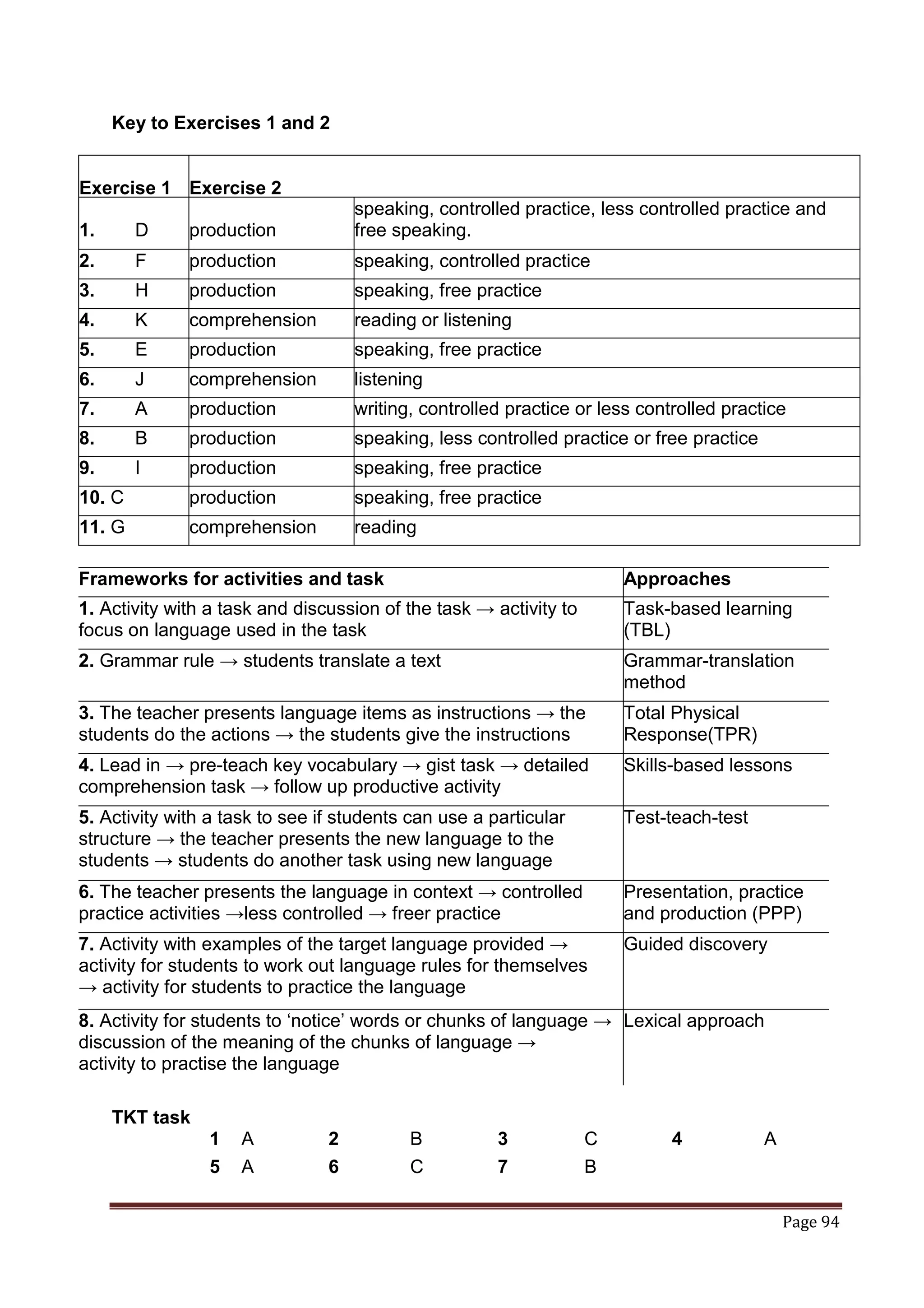
  • 74.
    Exercise 5,Match thelearner strategies below with the areas for improvement on Participant’s worksheet 4 Exercise 2. A.Reading more authentic material (magazines and newspapers etc.) outside class, listening to English radio/TV programmes outside class, asking people to repeat what they have said when you don‟t‟ understand. B.Learning the sounds and symbols in the phonemic chart, asking teachers and other students to correct your pronunciation, recording your self and listening for pronunciation errors. C.Using the internet to research language and vocabulary, using English-English dictionaries to research vocabulary, choosing an area of language or vocabulary to revise/learn and using resources to self study D.Saying new words in your head over and over again, writing new words down in your note book, writing new words down with a translation in your own language next to them, writing words down on separate cards and storing them in a box. E.Guessing the meaning from context, looking words up in the dictionary, writing words down to ask someone about later. F.Speaking English only in class, speaking English whenever possible outside class, practise speaking for one minute on a topic without hesitating. G.Practising the language as soon as you‟ve learnt it, repeating different examples of the language, writing down the different grammatical components of the language, cutting up the different components and arranging them in the correct order. LIBARDO IELTS TOEFL TKT TOEIC FACEBOOK VERSION
  • 75.
    TKT Module 1:Unit13: Learner characteristics – Sample Task For questions 1–7 match the learners‟ comments to the descriptions of learner preferences listed A–H.There is one extra option which you do not need to use Comments 1 „Most of the time should be spent doing grammar exercises.‟ 2 „I prefer working with other students to speaking to the teacher in front of the class.‟ 3 „I really like knowing how language works.‟ 4 „Rules just confuse me – it‟s better to work out language from examples.‟ 5 „Why should I listen to other students‟ mistakes? The teacher should talk most of the time.‟ 6 I just want people to understand what I mean. I don‟t worry if I make mistakes.‟ 7 „It‟s important for me to know how well I‟m doing.‟ Preferences A The learner wants explanations of grammar use. B The learner enjoys explaining language to other students. C The learner enjoys practising language in pairs or groups. D The learner enjoys doing language practice that focuses on accuracy. E The learner doesn‟t want to work with other students. F The learner needs to feel a sense of progress. G The learner focuses on communicating. H The learner doesn‟t want the teacher to explain grammar. LIBARDO IELTS TOEFL TKT TOEIC FACEBOOK VERSION
  • 76.
    Key to exercise1 1A 2K U I D N 3V I S U A L T E O S R T Y H E T I C Exercise 3 1. Visual 4. Auditory 2. Auditory 5. Kinaesthetic 3. Kinaesthetic 6. Visual Exercises 4 and 5 1. E 2. D 3.G 4.B 5.F 6.A 7.C Key to Sample Task 1. D 2. C 3.A 4.H 5.E 6.G 7.F Key to Procedure Step 9 Additional exercises. What are some of the different learner characteristics of children, teenagers and adults? Differences in ː length of time they can pay attention/ concentrate ː ability to stay still ː ability to control behaviour ː attitude to making mistakes ː attitude to taking risks ː levels of self consciousness ː being able to bring life experiences to learning. What effect can learners’ past learning experiences have on learner characteristics? ː previous experience of learning may be very different to the approach taken by the current teacher; this change may or may not be welcomed ː learners may have tried to learn a language before and failed ː learners may have fixed ideas about the best way of learning. TKT Module 1:Unit 14: Learner needs LIBARDO IELTS TOEFL TKT TOEIC FACEBOOK VERSION
  • 77.
    Exercise 1. Exercise 2,Whatcan teachers do to respond to learners’ needs? Match the following answer with the concepts in the boxes below the answers. •Do a „needs analysis‟ and/or find out about your learners‟ personal needs, learning needs and future or current professional needs. •Select topics and subjects for lessons that fit with their interests and needs. •Select material that meets their needs. •Choose activities that fit with their learning styles, and are suitable for their needs and interests. •Decide on pace and interaction patterns. •Think about the balance of skills work (reading, listening, speaking, writing) in relation to their needs. •Adopt approaches for teaching language that respond to their needs, interests and learning styles. •Think about how to give learners feedback on their work. LIBARDO IELTS TOEFL TKT TOEIC FACEBOOK VERSION
  • 78.
    LIBARDO IELTS TOEFLTKT TOEIC FACEBOOK VERSION
  • 79.
    TKT Module 1:Unit 14: Learner needs – Sample Task For Questions 1–6, match the needs of each group of students with the most suitable type of course listed A–G.There is one extra option which you do not need to use. Groups of students 1 These young adults need a range of study skills before going to a British university. 2 These adult beginners are going on holiday, and need to learn how to communicate in an English-speaking environment. 3 This group of young children have a short attention span; their parents want them to learn English while having some fun. 4 These business people need to meet and work with people from other countries at international conferences. 5 These secretaries and receptionists want to focus on vocabulary and skills which are useful for them in their work. 6 These scientists need to keep up-to-date with the latest developments in their subjects. Types of courses A a course focusing on basic language skills for everyday situations. B a course focusing on listening and note-taking, and writing academic essays C a course based on role-plays and situations, such as greeting visitors and telephoning clients D an activity based course with lots of games, songs and stories E a course based on grammar revision and written practice F an oral skills course based on cross-cultural material G an online course in which students read texts on specific topics and answer detailed comprehension. LIBARDO IELTS TOEFL TKT TOEIC FACEBOOK VERSION
  • 80.
    TKT Module 1:Unit14: Learner needs – Answer Keys Key to Sample Task 1. B 2. A 3.D 4.F 5.C 6.G LIBARDO IELTS TOEFL TKT TOEIC FACEBOOK VERSION
  • 81.
    TKT GLOSSARY, UNITS9 TO 14 Background to language learning Achievement noun, achieve verb, achievable adjective Something reached by effort; something done successfully. Something which is achievable for learners is something they can succeed in. Acquisition noun, acquire verb To learn a language without studying it, just by hearing and/or reading and then using it. This is the way people usually learn their first language. Attention span How long a learner is able to concentrate at any one time. Auditory learner: see learning style. Clue A piece of information that helps someone to find the answer to a problem, e.g. a teacher could give the first letter of a word she is trying to elicit as a clue to learners to help them find the word. Cognitive (processes) The mental processes involved in thinking, understanding or learning. Confidence noun, confident adjective The feeling someone has when they are sure of their ability to do something well. Teachers often do activities that help learners to feel more confident about their own ability. Conscious (of) To know that something exists or is happening, or to have knowledge or experience of something; to be aware. Demotivate: see motivation. Developmental error: see error. Effective Having the intended or desired result. English-medium school A school in a non-English speaking country, in which all subjects are taught using English. Error A mistake that a learner makes when trying to say something above their level of language or language processing. See slip. A developmental error is an error made by a second language learner which could also be made by a young person learning their mother tongue as part of their normal development, e.g. I goed there last week (I went there last week). Expectation LIBARDO IELTS TOEFL TKT TOEIC FACEBOOK VERSION
  • 82.
    A belief aboutthe way something will happen. Learners often have expectations about what and how they should learn. Exposure noun, expose verb When learners listen to or read language without being consciously aware of it. Factor A fact or situation which influences the result of something, e.g. the factors which decide whether someone learns a language successfully or not. First language: see mother tongue, L1/L2 Focus on form Paying attention to the words/parts of words that make a language structure or to spelling or pronunciation. Goal, target An aim that a learner or teacher may have. Guidance noun, guide verb Help given by a teacher with learning, or with doing a task. Ignore (errors) To choose not to pay attention to something such as an error made by a learner. A teacher may do this if he/she wants to help the learner with fluency, not accuracy. Independent study Studying without a teacher present or without the teacher monitoring and directing the learning very closely, e.g. learners could carry out research on a topic using reference resources. This could be done at home or with minimum involvement of the teacher in class. Intensive course A course which takes place over a short period of time, but which consists of a high number of hours. Interference When the learner‟s mother tongue affects their performance in the target language. A learner may make a mistake because they use the same grammatical pattern in the target language as they use in their mother tongue, but the L1 grammatical pattern is not appropriate in L2. Interlanguage Learners‟ own version of the second language which they speak as they learn. Interlanguage is constantly changing and developing as learners learn more of the second language. LIBARDO IELTS TOEFL TKT TOEIC FACEBOOK VERSION
  • 83.
    L1/L2 L1 is thelearner‟s mother tongue or first language; L2 is the learner‟s second language. Language awareness A learner‟s understanding of the rules of how language works and his/her ability to notice language. ‘Learn by heart’ To learn something so that you can remember it perfectly. Learner autonomy noun, autonomous adjective, learner independence When a learner can set his/her own aims and organise his/her own study, they are autonomous and independent. Many activities in coursebooks help learners to be more independent by developing learning strategies and focusing on learner training. Learner characteristics The typical things about a learner or learners that influence their learning, e.g. age, L1, past learning experience, learning style. Learner independence: see learner autonomy. Learner training The use of activities to help learners understand how they learn and help them to become autonomous, independent learners. Learning resources The materials or tools which help learners learn, e.g. books, computers, CDs etc. Learning strategies The techniques which a learner consciously uses to help them when learning or using language, e.g. deducing the meaning of words from context; predicting content before reading. Learning style The way in which an individual learner naturally prefers to learn something. There are many learning styles. Three of them are below. Auditory learner A learner who remembers things more easily when they hear them spoken. This type of learner may like the teacher to say a new word aloud and not just write it on the board. Kinaesthetic learner A learner who learns more easily by doing things physically. This type of learner may like to move around or move objects while learning. Visual learner A learner who finds it easier to learn when they can see things written down or in a picture. This type of learner may like the teacher to write a new word on the board and not just say it aloud LIBARDO IELTS TOEFL TKT TOEIC FACEBOOK VERSION
  • 84.
    Linguistic Connected with languageor the study of language. Literacy The ability to read and write. Maturity noun, mature adjective Fully grown or developed. If a learner is mature in attitude, they behave in an adult way. A learner‟s maturity (physical, emotional and mental) influences a teacher‟s approaches and/or decisions. Memoriseverb, memorable adjective To learn something so that you can remember it later; something which is easy to remember. Mother tongue The very first language that you learn as a baby, which is usually the language spoken to you by your parents. Also called L1 or first language. Motivation noun, motivate verb Motivation is the thoughts and feelings which make us want to do something and help us continue doing it. Demotivate verb demotivated adjective To make someone lose motivation. Unmotivated adjective Without motivation; having no motivation. Natural order Some people believe there is an order in which learners naturally learn some items in their first or other languages. Some language items are learned before others and it can be difficult for teachers to influence this order. Needs The language, language skills or learning strategies a learner still has to learn in order to reach their goals, or the conditions they need to help them learn. Notice language When a learner becomes aware of the language the speaker or writer uses to express a particular concept or meaning. Participation noun, participate verb To take part in something, e.g. a lesson or classroom activity. Personalisationnoun, personaliseverb When a teacher helps a learner to connect new words, topics, texts or grammar to their own life. Pick up To learn language without studying it, just by hearing and/or reading and then using it. See acquisition. Proficiency noun, proficient adjective LIBARDO IELTS TOEFL TKT TOEIC FACEBOOK VERSION
  • 85.
    Level of ability;to be very good at something because of training and practice, e.g. speaking English. Silent period The time when learners who are beginning to learn a first (or second) language prefer to listen (or read) before producing the language, e.g. babies have a silent period when they listen to their parents before starting to try to speak themselves. Slip When a learner makes a language mistake that they are able to correct themselves. See error. Target language The language a learner is learning, e.g. English, or the specific language that a teacher wants to focus on in a lesson, e.g. present perfect. Target language culture The traditions and culture of the country whose language is being studied. Work language out When learners try to understand how and why a particular piece of language is used. Unmotivated: see motivation. Varieties of English English is spoken as a first or second language in many countries around the world, but the English spoken may be slightly or significantly different in each country or in different parts of one country, e.g. different vocabulary or grammar may be used. An example of this is the English spoken in the USA and that spoken in the UK. Visual learner: see learning style. LIBARDO IELTS TOEFL TKT TOEIC FACEBOOK VERSION
  • 86.
    TKT Module 1:Unit15: Presentation techniques and introductory activities Exercise 1, solve the following puzzle. Across 1. To ask questions or use other techniques to check that students have understood a new structure or item of lexis (two words). 3. To introduce new language, usually by focusing on it formally. 6. To tell students what language means and how it is used. Down 1. To put new language into a situation that shows what it means. 2. To get students to repeat words or phrases. 4. To use body movements to convey meaning without using words. 5. To ask specially designed questions or give clues to get students to give information or an opinion. Page 86
  • 87.
    Exercise 2.Look atthe introductory activities. For each activity say: ː what type of introductory activity is it? (warmer, ice-breaker, lead-in) ː why would the activity be used by the teacher? 1. Students stand in a circle. The teacher throws a ball to a student who then introduces himself and says his favourite game or activity. He then tosses the ball to another student who repeats the procedure. Give each student a chance to introduce him/herself. 2. Divide the class into two teams, choose a category, and ask each team to think of an object in that category. The teams ask each other yes/no questions. Whichever team guesses the objects with fewer questions, wins. 3. Students work in groups of three. They brainstorm and make a list of the advantages and the disadvantages of living in a big city. 4. The first student says something about himself, then changes that to make a question for another student. For example, "My favouritecolour is blue. What's your favouritecolour?" This can be another circle activity, and it works with large groups of students, too. 5. The teacher starts off by saying: "Yesterday I went to the park." The first student must include what the teacher said and then add something they did, e.g. "Yesterday I went to the park and ate some pizza." The second student must include what the teacher and the first student said and then add something else, e.g. "Yesterday I went to the park, ate some pizza and went for a swim in the sea." 6. The teacher asks students to say what news stories they have read about recently. Several students contribute and the teacher encourages students to ask each other questions about the stories they have read. Page 87
  • 88.
    Exercise 3.Choose oneof the task types (A-K) for each of the activities below (1-7) A Grammar-translation method B Guided discovery C Lexical approach D Presentation practice production (PPP) E Task-based learning (TBL) F Test-teach-test G Total Physical Response (TPR) 1. A way of teaching new language in which the teacher presents the language, gets students to practise it in exercises or other controlled practice activities and then asks students to use or produce the same language in a communicative and less controlled way. 2. A way of teaching in which the teacher gives students meaningful tasks to do. After this the teacher may ask students to think about the language they have used when doing the tasks, but the main focus for students is on the task itself. 3. A way of teaching in which the teacher presents language items as instructions and the students have to do exactly what the teacher tells them, e.g. Open the window! Stand up! This method is good for beginners when they start to learn a new language, as they have a silent period and can make fast progress. 4. A way of teaching in which a teacher provides examples of the target language and then guides the students to work out the language rules for themselves. 5. A way of teaching in which the teacher asks students to do a task to see how well they know a certain piece of language. The teacher then presents the new language to the students, then in the final stage asks the students to do another task using the new language correctly. This way of approaching teaching target language can be helpful if the teacher thinks the students may already know some of the target language. 6. A way of teaching in which students study grammar and translate words into their own language. They do not practise communication and there is little focus on speaking. A teacher presents a grammar rule and vocabulary lists and then students translate a written text from their own language into the second language. 7. A way of teaching language that focuses on lexical items or chunks such as words, multi- word units, collocations and fixed expressions rather than grammatical structures. Page 88
  • 89.
    TKT Module 1:Unit 15: Presentation techniques and introductory activities TKT – Sample Task For questions 1–6, match the teacher‟s actions with the introductory activities and presentation techniques for different lessons listed A–G. Mark the correct letter (A–G) on your answer sheet. There is one extra option you do not need to use. Introductory activities and presentation techniques A asking concept questions B eliciting language C doing a warmer D miming E setting the scene F explaining G drilling Teacher’s 1 actions The teacher asks the students to look at pictures of Paris before they listen to a recording about tourist attractions there. 2 The teacher asks the students to repeat sentences after her. 3 The teacher checks whether the students understand when the new language is used. 4 The teacher does a short game with the students to give them energy. 5 The teacher asks the students for examples of different kinds of fruit and writes them on the board. 6 The teacher does an action which shows the meaning of a new word. Page 89
  • 90.
    Key to Exercise1 1C O N C E P T C H E C K 2D O 3P R E S E N T I T L E L X 4M T I U 5E M A L 6E X P L A I N I C S I E T Key to Exercise 2 1. Ice-breaker – students getting to know each other 2. Warmer – to increase energy levels, to relax the class 3. Lead-in – to allow students to bring their own experience to a text/topic, to create interest in a topic/text 4. Ice-breaker – students getting to know each other 5. Warmer – to increase energy levels, to relax the class 6. Lead-in – to allow students to bring their own experience to a text/topic, to create interest in a topic/text. Exercise 3 1. D Presentation, practice, production (PPP) 2. E Task-based learning (TBL) 3. G Total Physical Response (TPR) 4. B Guided discovery 5. F Test-teach-test 6. A Grammar-translation method 7. C Lexical approach Key to Sample Task 1 E 2 G 3 A 4 C 5 B 6 D Page 90
  • 91.
    TKT Module 1:Unit 16: Types of activities and tasks for language and skills development Exercise 1 Choose one of the task types (A–K) for each of the activities below (1–11). A guided writing B role-play C problem solving D survey E brainstorming F chant G jumbled text H warmer I rank ordering/prioritising J visualisation K jigsaw listening /reading 1. Students find out information from others by asking questions or using questionnaires in order to practise speaking skills and/or specific language. 2. Students repeat a phrase, sentence, rhyme, verse, poem or song, usually with others, in a regular rhythm. 3. An activity that a teacher uses at the beginning of a lesson to give the class more energy. 4. A text is divided into two or more different parts. Students listen to or read their part only, then share their information with other students so that in the end everyone knows all the information. 5. Students think of ideas (usually quickly) about a topic (often noting these down). This is often done as preparation before writing or speaking. 6. An activity where the teacher asks students to close their eyes and create the pictures in their minds of the story she is telling them. 7. Students produce a text after a lot of preparation by the teacher. The teacher may give the students a plan to follow, or ideas for the language to use. 8. A classroom activity in which students are given parts to act out in a given situation. They usually work in pairs or groups. 9. Students are given a list of things to put in order of importance. It involves discussion, agreeing/disagreeing and negotiating. 10. Students work in pairs or groups talking together to find the solution to a problem. 11. Students are given a text in which the paragraphs or sentences are not in the correct order. The students put the paragraphs or sentences into the correct order. Exercise 2 Look at the activities again. Is the activity a comprehension task or a production task? If it‟s a comprehension task, which skill?If it‟s a production task, which skill? Page 91
  • 92.
    Exercise 3: matchthe approach to the procedures given Frameworks for activities and task Approaches 1. Activity with a task and discussion of the task → activity to focus on language used in the task 2. Grammar rule → students translate a text 3. The teacher presents language items as instructions → the students do the actions → the students give the instructions 4. Lead in → pre-teach key vocabulary → gist task → detailed comprehension task → follow up productive activity 5. Activity with a task to see if students can use a particular structure → the teacher presents the new language to the students → students do another task using new language 6. The teacher presents the language in context → controlled practice activities →less controlled → freer practice 7. Activity with examples of the target language provided → activity for students to work out language rules for themselves → activity for students to practice the language 8. Activity for students to „notice‟ words or chunks of language → discussion of the meaning of the chunks of language → activity to practise the language Page 92
  • 93.
    TKT Module 1:Unit 16 Types of activities and tasks for language and skills development – TKT Sample Task For questions 1–7, match the classroom activities with the types of speaking practice listed A, B or C. Mark the correct letter (A, B or C) on your answer sheet. You need to use some options more than once Types of speaking practice A oral fluency practice B controlled oral practice C neither Classroom activities 1 At the beginning of the lesson, we got into groups and talked about an interesting newspaper article we had read. 2 The teacher gave us word prompts such as „cinema‟ and „friends‟, and we had to say them in sentences using the past simple, e.g. „We went to the cinema.‟ „We visited some friends.‟ 3 We listened to a recording of two people talking about their hobbies, then did a gap-fill comprehension task. 4 The teacher gave us roles such as „film star‟ or „sports star‟ and we had to role play a party in which we chatted to each other. 5 We had a discussion about the advantages and disadvantages of the internet. The teacher read out some sentences, some of which were correct and some 6 incorrect. We had to shout out „Right‟ or „Wrong‟. We had to ask our partner five questions about abilities, using „can‟, e.g. „Can you 7 swim?‟ Page 93
  • 94.
    Key to Exercises1 and 2 Exercise 1 Exercise 2 speaking, controlled practice, less controlled practice and 1. D production free speaking. 2. F production speaking, controlled practice 3. H production speaking, free practice 4. K comprehension reading or listening 5. E production speaking, free practice 6. J comprehension listening 7. A production writing, controlled practice or less controlled practice 8. B production speaking, less controlled practice or free practice 9. I production speaking, free practice 10. C production speaking, free practice 11. G comprehension reading Frameworks for activities and task Approaches 1. Activity with a task and discussion of the task → activity to Task-based learning focus on language used in the task (TBL) 2. Grammar rule → students translate a text Grammar-translation method 3. The teacher presents language items as instructions → the Total Physical students do the actions → the students give the instructions Response(TPR) 4. Lead in → pre-teach key vocabulary → gist task → detailed Skills-based lessons comprehension task → follow up productive activity 5. Activity with a task to see if students can use a particular Test-teach-test structure → the teacher presents the new language to the students → students do another task using new language 6. The teacher presents the language in context → controlled Presentation, practice practice activities →less controlled → freer practice and production (PPP) 7. Activity with examples of the target language provided → Guided discovery activity for students to work out language rules for themselves → activity for students to practice the language 8. Activity for students to „notice‟ words or chunks of language → Lexical approach discussion of the meaning of the chunks of language → activity to practise the language TKT task 1 A 2 B 3 C 4 A 5 A 6 C 7 B Page 94
  • 95.
    TKT Module 1:Unit17 Assessment Types and Tasks Exercise 1.Discuss the teachers’ comments below on assessment. Do you agree or disagree? Why/ Why not? 1. I think it‟s important for students to assess themselves, so sometimes I record them when they are doing a speaking activity and then get them to listen to themselves. 2. I don‟t like giving my students tests and exams. I think they are demotivating, especially for young learners. 3. I get students to mark each others‟ written work and I tell them to just look at it and say what‟s wrong. I don‟t ask them to check it against any criteria. I don‟t think they can look for particular mistakes like spelling mistakes or grammar mistakes. 4. When students are doing a speaking activity, I observe them, but I don‟t make any notes and I don‟t give marks. Sometimes I talk to students about their strengths and weaknesses in tutorials though. 5. My students choose pieces of their best work during the course and keep them in a file, which can be looked at during the course. I know some teachers use this as the way they assess students at the end of the course, but I‟m not sure how that works. Page 95
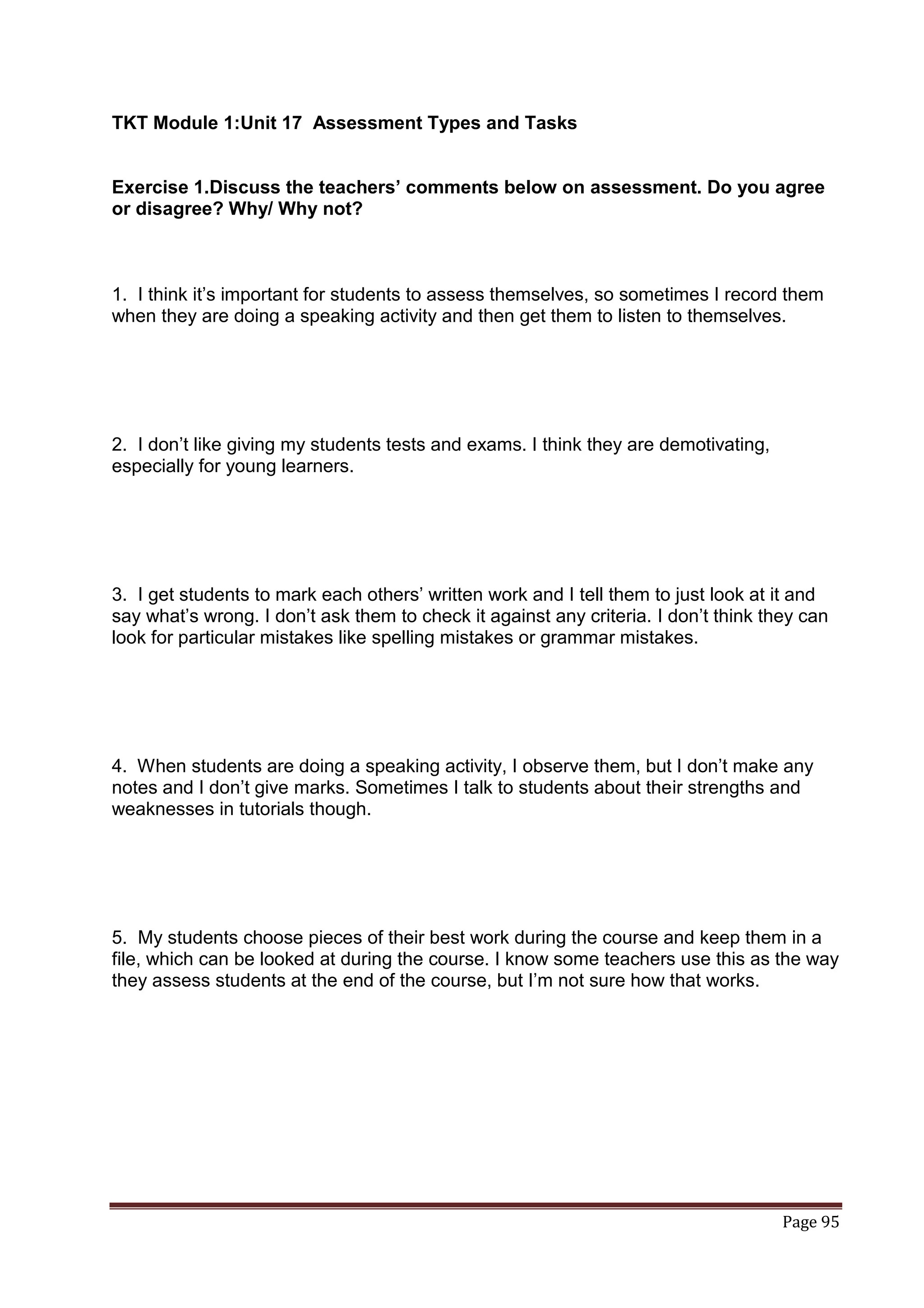
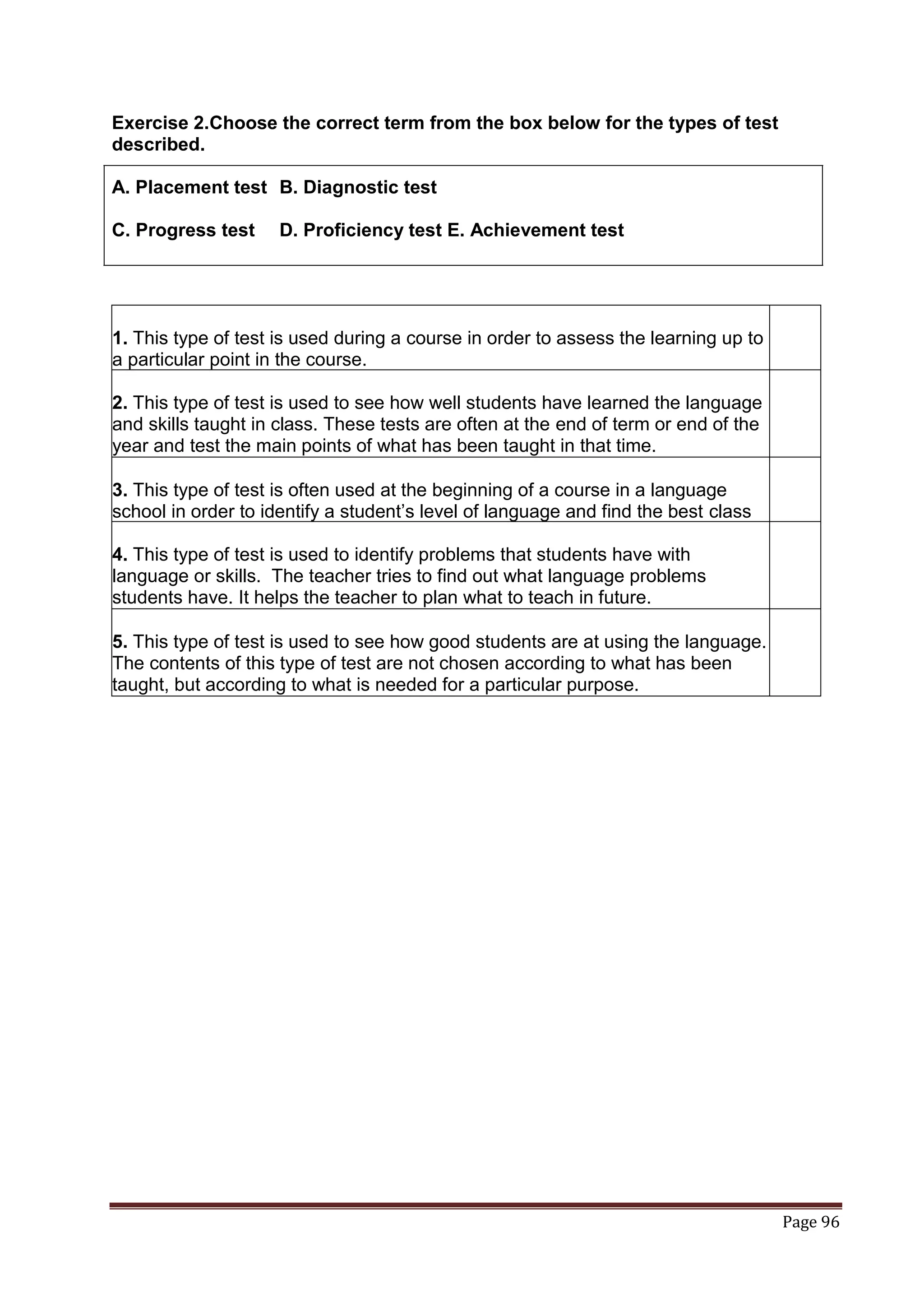
  • 96.
    Exercise 2.Choose thecorrect term from the box below for the types of test described. A. Placement test B. Diagnostic test C. Progress test D. Proficiency test E. Achievement test 1. This type of test is used during a course in order to assess the learning up to a particular point in the course. 2. This type of test is used to see how well students have learned the language and skills taught in class. These tests are often at the end of term or end of the year and test the main points of what has been taught in that time. 3. This type of test is often used at the beginning of a course in a language school in order to identify a student‟s level of language and find the best class for them. 4. This type of test is used to identify problems that students have with language or skills. The teacher tries to find out what language problems students have. It helps the teacher to plan what to teach in future. 5. This type of test is used to see how good students are at using the language. The contents of this type of test are not chosen according to what has been taught, but according to what is needed for a particular purpose. Page 96
  • 97.
    TKT Module 1:Unit 17, Assessment Types and Tasks – exercise 3 Exercise 4 : Which of the activities and tasks are subjective tests and which are objective tests? Page 97
  • 98.
    TKT Module 1:Unit 17: Assessment Types and Tasks - Sample Task For Questions 1–5, match the descriptions of different tests with the types of test listed A–F. Mark the correct letter (A–F) on your answer sheet. You need to use some options more than once Types of test A progress B achievement C subjective D proficiency E diagnostic F placement Descriptions 1 These tests are designed to test language taught on the whole course. 2 These tests are designed to help teachers to plan course content. 3 The purpose of these tests is to test language taught on part of the course. 4 These tests help teachers to put students in classes at the appropriate level. 5 The marking of these tests depends on decisions made by individual examiners. Page 98
  • 99.
    TKT Module 1:Unit 17: Assessment Types and Tasks – Answer Keys Key to exercise 1 1. Self assessment 2. Formal assessment; summative assessment 3. Peer assessment. 4. Informal assessment; formative assessment; continuous assessment. 5. Portfolio assessment; informal assessment (could be formal if submitted at the end of a course for evaluation); continuous assessment. Key to exercise 2 1 C 2 E 3 A 4 B 5 D Key to exercise 3 1. Cloze test/gap fill (in a cloze test the gaps are regular e.g. every seventh word, a gap fill is not regular but selected by the teacher or assessor) 2. Comprehension task – open comprehension questions (students answer in their own words) 3. Matching task 4. Multiple-choice task 5. Sentence completion task 6. Sentence transformation task 7. Sentence ordering task/Jumbled sentence task 8. Odd one out task 9. Essay/letter writing task 10. Speaking task Key to exercise 4 1. Subjective (many possible answers) 2. Objective 3. Objective 4. Objective 5. Objective 6. Objective 7. Objective 8. Objective 9. Subjective 10. Subjective Key to Sample Task 1 B 2 E 3 A 4 F 5 C Page 99
  • 100.
    UNIVERSITY OF CAMBRIDGEESOL EXAMINATIONS English for Speakers of Other Languages TEACHING KNOWLEDGE TEST Module 1 001 Sample Test 1 hour 20 minutes TIME: 1 hour 20 minutes INSTRUCTIONS TO CANDIDATES Do not open this booklet until you are told to do so Write your name, Centre number and candidate number on the answer sheet if they are not already printed. There are eighty questions in this paper. Answer all questions. Mark your answers on the separate answer sheet. You will have no extra time for this, so you must finish in one hour and twenty minutes. At the end of the test, hand in both the question paper and the answer sheet. INFORMATION FOR CANDIDATES Each question in this paper carries one mark. Page 100
  • 101.
    For questions 1-5,match the language sample with the grammatical terms listed A-F. Mark the correct letter (A-F) on your answer sheet. There is one extra option which you do not need to use. Example language Grammatical items 1. Break in G. Tag Questions 2. My brother is a pilot, is he? H. Phrasal verb 3. If it's sunny, we'll go to the park I. Passive voice 4. The exam should have been given to everyone. J. Determiners 5. This, that, these, those K. Echo Questions L. Conditional For questions 6-12, choose the correct option (A, B or C) to complete each definition of grammatical items. Mark the correct letter on your answer sheet. 6. An interjection is a. an exclamation which shows thoughts or feelings b. a meaningless string of sounds c. the same as an adjective 7. A verb that has a subject but no object is. a. Transitive b. Intransitive c. Passive 8. The subject that does and receives the action is. a. Reflexive b. Possessive c. Relative 9. A group of words that include a subject and a finite verb is. a. A clause b. A statement c. An idiom Page 101
  • 102.
    10. A wordthat describes or gives more information about a noun or pronoun is. a. An adjective b. An adverb c. An article 11. The words someone uses when they are telling someone what somebody else said or asked are, a. The past tense b. Past conditional c. Indirect speech 12. A verb that does not take an auxiliary to negate or ask questions is called. a. Active b. Modal c. Intransitive Page 102
  • 103.
    For questions 13-16,choose the correct Word(s) to complete each definition of lexical terms, mark the correct letter (A, B or C) on your answer sheet. 13. ………. Are any pair or group of words commonly found together or near one another. A. phrasal verbs B. collocations, C. chunks 14. A word with the same spelling and pronunciation as another word, but which has a different meaning, A. Homonym B. Antonym C. homophone 15. A group of words or phrases that are about the same content topic or subject, A. Lexical set B. Synonym C. Word family 16. A meaningful group of letters added to the end of a root or base word to make a new word which can be a different part of speech from the original word, A. Prefix B. Particle C. Suffix Page 103
  • 104.
    For questions 17-21,match the example sentences with the functions listed A-F. Mark the correct letter (A-F) on your answer sheet. There is one extra option which you do not need to use. 17. I‟d rather have coffee than tea A. Suggesting 18. You should be here later B. Expressingprobability 19. What time does the bus arrive? C. Instructing 20. I am sorry, I am busy D. Declining 21. Please turn to page 10 E. Enquiring F. Expressingpreferences For questions 22-25 choose the correct Word(s) to complete each definition of phonology, mark the correct letter (A, B or C) on your answer sheet. 22. Two words which are different from each other by only one meaningful sound are. A. Minimal pairs B. Homophones C. Consonants 23. In the sentence “She gave the ring to John” it can be implied that. A. She only gave the ring to John B. John was the person she gave the ring to. C. She could have given the ring to somebody else. 24. The way the level of a speaker‟s voice changes, to show meaning such as how they feel about something is. A. Linking B. Stress C. Intonation Page 104
  • 105.
    25. Words thatsound similar because they have the same ending. A. Rhyme B. Rhythm C. Contraction For questions 16-30, match the minimal pairs with the phonemic symbols listed A-F. Mark the correct letter (A-F) on your answer sheet. There is one extra option which you do not need to use. 26. darling/dialling A. 27. cart/cut B. 28. tile/toil C. 29. pull/bull D. 30. worse/worth E. F. Page 105
  • 106.
    For questions 31-35,match what the writer does with the writing subskills listed A-G. Mark the correct letter (A-F) on your answer sheet. There is one extra option which you do not need to use A. Edit B. Proof-reading C. Planning D. Drafting E. Brainstorming F. Extracting 31. I change or correct the words or content of some parts of my text to make it clearer or easier to understand. 32. Before finishing, I give my work a final check for accuracy 33. I organize my main ideas into different paragraphs in note form. 34. I start writing, developing my main ideas. 35. Before I start, I try to imagine everything I can about the topic and start writing as many ideas as I can without an specific order. Page 106
  • 107.
    For questions 36-42look at the following terms for language skills and three possible descriptors of terms. Choose the correct letter (A, B or C) on your answer sheet. 36. Extensivereading is A. reading long pieces of text, such as stories or newspapers. B. Part of a text which is removed from an original text. C. written language in texts or groups of sentences. 37. Accuracyis A. The use of correct forms of grammar, vocabulary, spelling and pronunciation. B. When ideas in a spoken or written text fit together clearly and smoothly, C. Understanding a spoken or written text. 38. Oral fluencyis. A. The use of connected speech at a natural speed with little hesitation, repetition or self-correction. B. The use of connected speech without making mistakes. C. The use of intonation to express feelings. 39. Listen/readformoodis A. To read or listen to a text in order to identify the feelings of the writer or speaker. B. To listen to or read a text in order to understand most of what it says or particular details. C. To understand the general meaning of a text, without paying attention to specific details. 40. Intensive listening or reading is A. To focus on how language is used in a text B. To listen or read in a intensive way C. To listen or read with an intense interaction Page 107
  • 108.
    For questions 41-46,match the student‟s comments with the learning characteristics listed A-G. Mark the correct letter (A-F) on your answer sheet. There is one extra option which you do not need to use A. Acquisition B. Focus on form C. Ignore errors D. Interference E. Interlanguage F. Learner autonomy G. Language Awareness Students` Comments 41. I feel quite confident because I am making less mistakes that those I used to make when I was starting to study English 42. One of my most difficult problems when speaking English is that I make a lot of mistakes because I unconsciously use grammatical items and vocabulary from my first language. 43. The teacher really likes paying attention to rules and how language is used rather than letting us say what we want even though it is incorrect. 44. It is strange for me that the teacher just lets me talk and doesn`t really stop me when I make mistakes, even if I can notice them. 45. I am learning English in a very particular way, the teacher just uses it in real life situations avoiding grammar revision, I feel like a child learning in this way. Page 108
  • 109.
    For questions 46-53,match the teaching methods description with the names listed A- G. mark the correct letter (A-I) on your answer sheet. There is one extra option which you do not need to use A. Activity based learning B. Communicative approach C. Holistic D. Functional approach E. Total Physical Response F. Grammar-translation method G. Lexical Approach H. Presentation practice and production PPP I. Task based learning TBL Teaching Methods 46. A way of teaching in which the teacher gives learners meaningful tasks to do, but the main focus for learners is on the task itself. 47. Teachers try to focus on meaningful communication, rather than focusing on accuracy and correcting mistakes 48. An approach to language teaching in which the teacher uses techniques and activities taken from different methods together in one lesson. 49. A way of teaching new language in which the teacher presents the language, gets learners to practice it in exercises or other controlled practice activities and then asks learners to use or produce the same language in a communicative and less controlled way 50. A way of teaching language that focuses on lexical items or chunks such as words. 51. A way of teaching in which learners study grammar and translate words and texts into their own language or the target language. 52. A way of teaching which uses a syllabus based on functions 53. A way of learning by doing activities. The rules of language used in the activity are looked at either after the activity or not at all Page 109
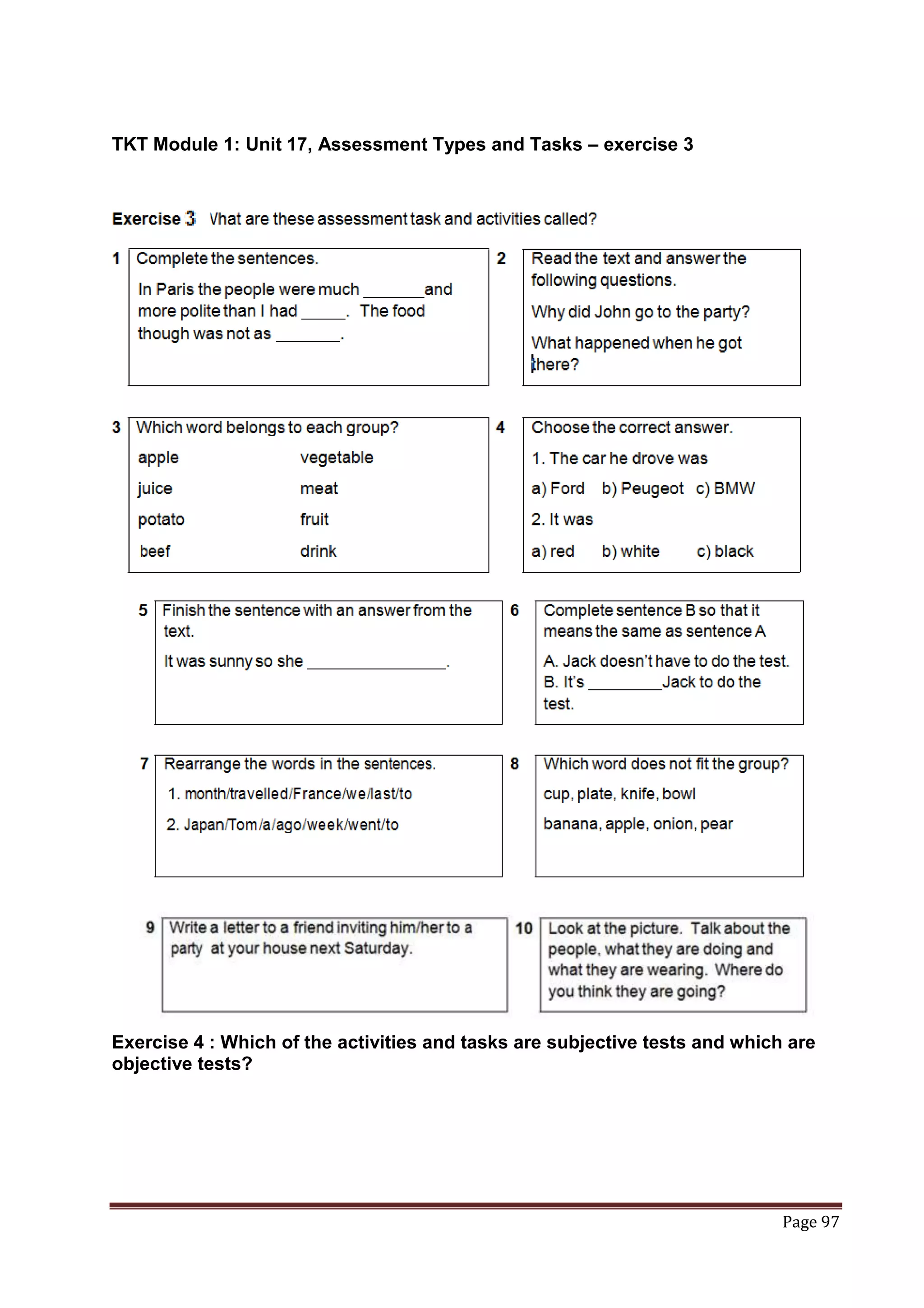
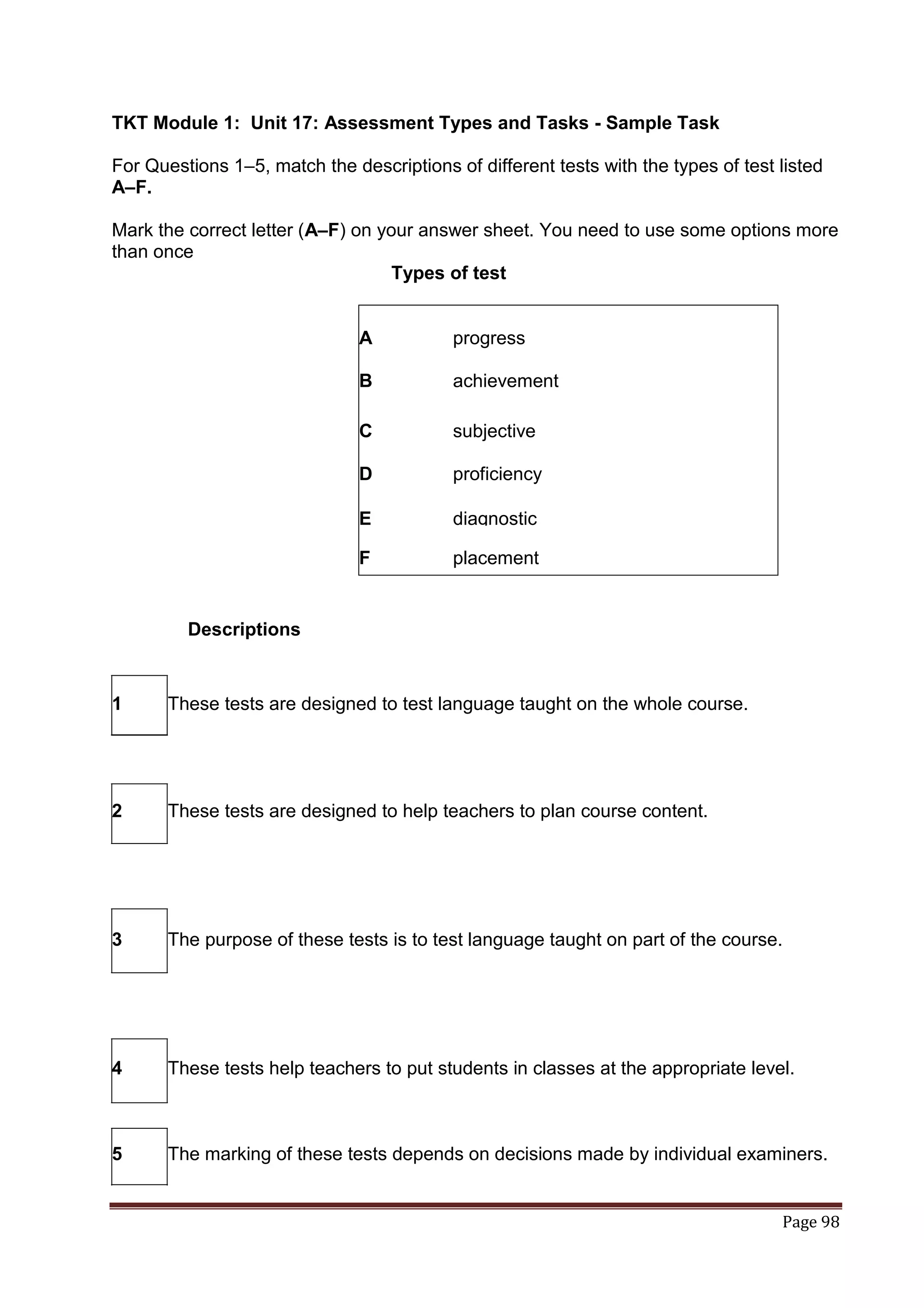
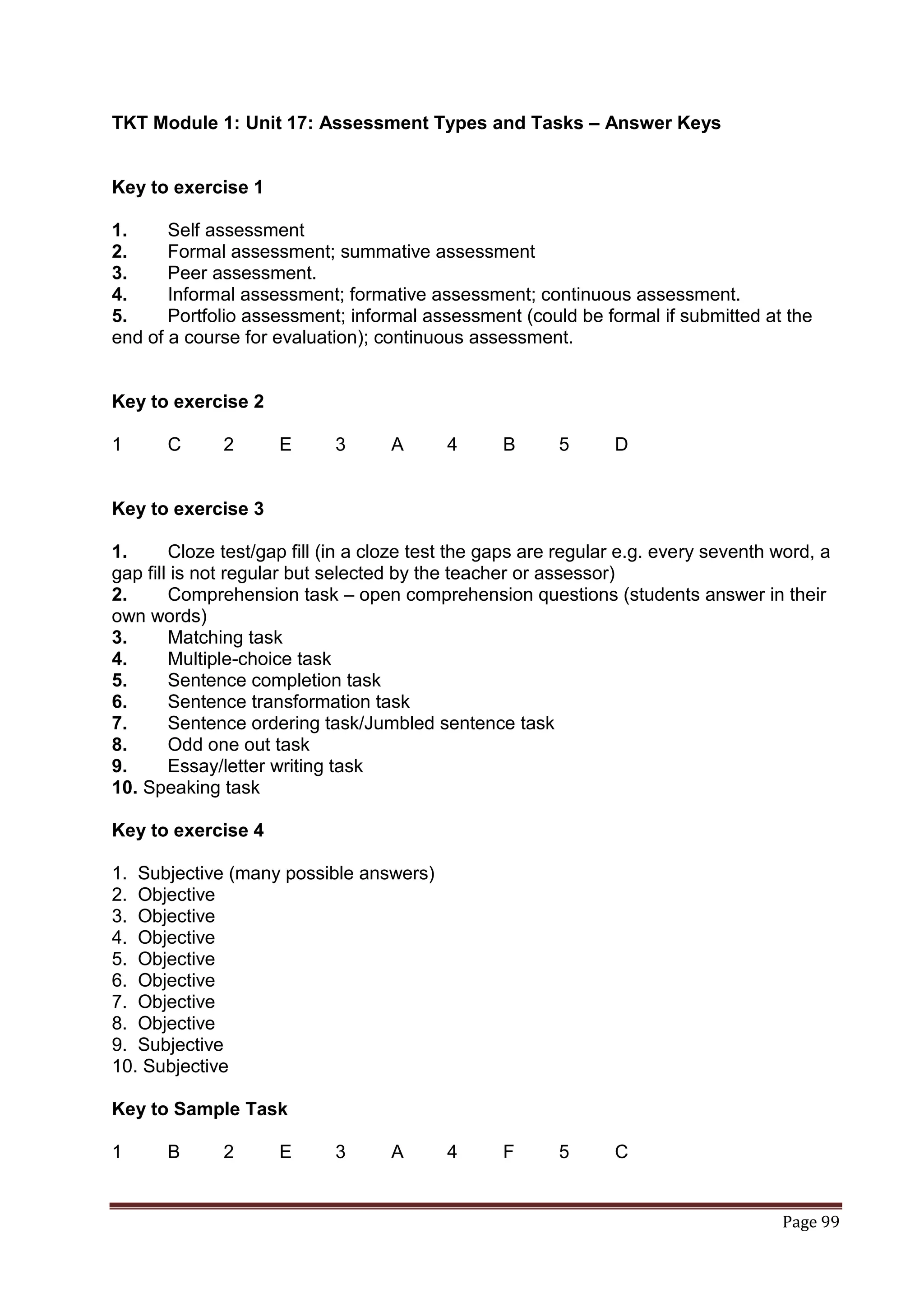
  • 110.
    For questions 54-59,match the teachers` comments on the strategies described with the names listed A-G. Mark the correct letter (A-G) on your answer sheet. There is one extra option which you do not need to use A. Eliciting B. Substitution Drill C. Transformation Drill D. Restricted practice E. Freer practice F. Role-play G. Survey Teacher`s comments 54. I like asking targeted questions ahead of time to see whether my learners know what I am going to teach them. 55. I like giving my learners a base sentence and then providing them with different words for them to change in that sentence. 56. I think that less freerpractice is very important because I can work on accuracy. 57. I think that every time I do fluency based activities my learners feel more confident to speak. 58. I like having my learners to put what they have learnt in context through real life exercises. 59. In my opinion using internet for my students to find information and then working based on it in class is very motivating and encourages interaction. Page 110
  • 111.
    For questions 60-67,match the practice activities and tasks listed A-I. with the course book instructions, mark the correct letter (A-I) on your answer sheet. There is one extra option which you do not need to use A. Brainstorming B. Sentence transformation C. Jumbled paragraphs D. Labeling E. Gap filling F. Matching G. Odd-one-out H. Reading for gist I. Listening for mood Practice activities and tasks 60. Listen to the following conversation and describe how the woman feels. 61. Read the paragraph and select the best heading for it. 62. Look at the list of words and underline the one which does not belong to the topic 63. Choose the correct verb in column A and the appropriate preposition in column B 64. Look at the pictures and put the correct names on them. 65. Listen and fill in the correct word. 66. Read the text and put all the paragraphs in the appropriate order. 67. Look at each sentence and use the words provided to re-write them. Page 111
  • 112.
    For questions 68-73,match the aids and resources listed A-I. With the uses described, mark the correct letter (A-I) on your answer sheet. There is one extra option which you do not need to use A. OHP B. Realia C. Puppets D. Computer E. Dictionary F. Board G. Skills practice book H. Graded reader I. OHT Aids and Resources 68. This can be used by the teacher or learners to show what one or two people are talking about by moving it and making it look real. 69. This can be used for a range of purposes by the teacher to show real meaning of concepts. 70. This can be used to display greater pictures on the wall or to work on group- reading. 71. This is an excellent tool for students to research information when working on a project; it enables them to share what they find with other people. 72. This is a tool help learners enhance autonomy. 73. This is a tool used by the teacher to display grammatical structures, vocabulary items, etc. 74. This is a resource that enables the learner to extend his/her knowledge about a language area. 75. This is an excellent tool to encourage extensive reading. Page 112
  • 113.
    For questions 75-80,match the assessment types A-F With the definitions described by a teacher, mark the correct letter (A-I) on your answer sheet. There is one extra option which you do not need to use A. Formal assessment B. Informal assessment C. Self assessment D. Assessment criteria E. Objective test F. Subjective test Teacher comments 76. I like giving my learners tests that make them reflect on their own progresses. 77. I like using software to evaluate what my learners learn in a neutral way, without interference from what I think about them. 78. I want my learners to take a test based on a third examiner`s opinion. 79. “The topics for next exam are the following; simple present, simple past and plurals”. 80. Put your name on the answer sheet and write all answers on it. Page 113
  • 114.
    TKT MODULE 1KEY 1H 41 E 2K 42 D 3L 43 B 4I 44 C 5J 45 A 6A 46 I 7B 47 B 8A 48 C 9A 49 H 10 A 50 G 11 C 51 F 12 B 52 D 13 B 53 A 14 A 54 A 15 A 55 B 16 C 56 D 17 F 57 E 18 A 58 F 19 E 59 G 20 D 60 I 21 C 61H 22 A 62 G 23 B 63 F 24 C 64 D 25 A 65 E 26 E 66 C 27 C 67 B 28 B 68 C 29 D 69 B 30 A 70 I 31 A 71D 32 B 72 E 33 C 73 F 34 D 74 G 35 E 75 H 36 A 76 C 37 A 77 E 38 A 78 F 39 A 79 D 40 A 80 A Page 114
  • 115.
  • 116.
  • 117.