Language courses
Connecting Dots Institute
Live, Love, Learn and Leave a Legacy
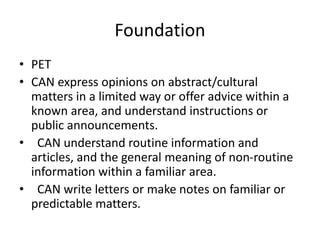
Foundation
• PET
• CAN express opinions on abstract/cultural
matters in a limited way or offer advice within a
known area, and understand instructions or
public announcements.
• CAN understand routine information and
articles, and the general meaning of non-routine
information within a familiar area.
• CAN write letters or make notes on familiar or
predictable matters.
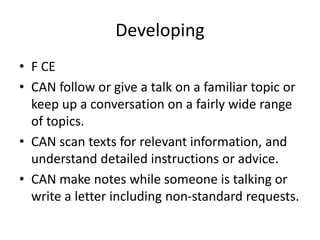
Developing
• F CE
• CAN follow or give a talk on a familiar topic or
keep up a conversation on a fairly wide range
of topics.
• CAN scan texts for relevant information, and
understand detailed instructions or advice.
• CAN make notes while someone is talking or
write a letter including non-standard requests.
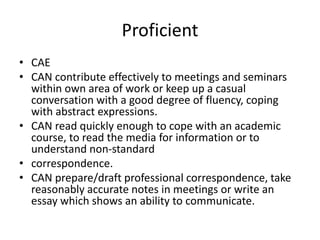
Proficient
• CAE
• CAN contribute effectively to meetings and seminars
within own area of work or keep up a casual
conversation with a good degree of fluency, coping
with abstract expressions.
• CAN read quickly enough to cope with an academic
course, to read the media for information or to
understand non-standard
• correspondence.
• CAN prepare/draft professional correspondence, take
reasonably accurate notes in meetings or write an
essay which shows an ability to communicate.
Expert
• CPE
• CAN advise on or talk about complex or sensitive
issues, understanding colloquial references and
dealing confidently with hostile questions.
• CAN understand documents, correspondence and
reports, including the finer points of complex
texts.
• CAN write letters on any subject and full notes of
meetings or seminars with good expression and
accuracy.
CERTIFICATION/DURATION/ FEES
• PET Cambridge University 3 Months
• FCE Cambridge University 3 Months
• CAE Cambridge University 4 Months
• CPE Cambridge University 4 Year
Teacher’s Development Programme
• TKT – an overview
It is for people who want to prove their
teaching knowledge with a globally recognised
certificate.
http://www.eltconcourse.com/training/ttindex.
html
• TKT is divided into separate modules.
Candidates can take them all, or choose the
modules that meet their needs. A certificate is
received for each module completed.
• The core modules are designed to provide a
foundation in the principles and practice of
English language teaching
Who are TKT Modules 1–3 suitable
for?
• TKT Modules 1, 2 and 3 test knowledge of concepts related to
language, language use and the background to and practice of
language teaching and learning.
• TKT is suitable for teachers of English in primary, secondary or adult
• teaching contexts.
• TKT
• Modules 1, 2 and 3 may be taken by:
• pre-service teachers
• teachers who wish to refresh and extend their teaching knowledge
• teachers who are moving to teaching English after teaching another
subject.
• TKT: Module 1
• Language and background to language
learning and teaching
• There are three areas:
Describing language and language skills
Background to language learning
Background to language teaching
TKT Module 2
• Lesson planning and use of resources for
language teaching
• There are two areas:
Planning and preparing a lesson or sequence of
lessons
Selection and use of resources
TKT Module 3
• Managing the teaching and learning process
• There are two areas:
Teachers' and learners' language in the
classroom
Classroom management
How is TKT assessed?
• For each module there are 80 multiple-choice or matching questions.
You fill in your answers on an answer sheet like this.
You do not have to write anything else.
There are 4 Bands of assessment:
• Band 4:
– comprehensive and accurate / extensive knowledge of areas on the TKT syllabus
– understanding of a full range of topics
• Band 3:
– generally comprehensive and accurate / extensive knowledge of areas on the TKT syllabus
– understanding of most topics
• Band 2:
– basic knowledge of areas on the TKT syllabus
– understanding of some topics
• Band 1:
– restricted knowledge of areas on the TKT Module syllabus
– understanding of a restricted range of topics
OUR AIM
• To come into Band 4, you will need 70 out of
80 possible marks (87.5%).
• To come into band 3, you will need 45-50
marks out of 80 (56.25-62.5%).
TKT pass rates
• Worldwide, the figures look like this*:
• Pass Band 4 10.5%
• Pass Band 3 61.4%
• Pass Band 2 25.5% Pass
• Band 1 2.5%
• You should be aiming for at least Band 3 and
this course is intended to help you do even
better than that.

Types of courses.pptx

  • 1.
    Language courses Connecting DotsInstitute Live, Love, Learn and Leave a Legacy
  • 2.
    Foundation • PET • CANexpress opinions on abstract/cultural matters in a limited way or offer advice within a known area, and understand instructions or public announcements. • CAN understand routine information and articles, and the general meaning of non-routine information within a familiar area. • CAN write letters or make notes on familiar or predictable matters.
  • 3.
    Developing • F CE •CAN follow or give a talk on a familiar topic or keep up a conversation on a fairly wide range of topics. • CAN scan texts for relevant information, and understand detailed instructions or advice. • CAN make notes while someone is talking or write a letter including non-standard requests.
  • 4.
    Proficient • CAE • CANcontribute effectively to meetings and seminars within own area of work or keep up a casual conversation with a good degree of fluency, coping with abstract expressions. • CAN read quickly enough to cope with an academic course, to read the media for information or to understand non-standard • correspondence. • CAN prepare/draft professional correspondence, take reasonably accurate notes in meetings or write an essay which shows an ability to communicate.
  • 5.
    Expert • CPE • CANadvise on or talk about complex or sensitive issues, understanding colloquial references and dealing confidently with hostile questions. • CAN understand documents, correspondence and reports, including the finer points of complex texts. • CAN write letters on any subject and full notes of meetings or seminars with good expression and accuracy.
  • 6.
    CERTIFICATION/DURATION/ FEES • PETCambridge University 3 Months • FCE Cambridge University 3 Months • CAE Cambridge University 4 Months • CPE Cambridge University 4 Year
  • 7.
    Teacher’s Development Programme •TKT – an overview It is for people who want to prove their teaching knowledge with a globally recognised certificate. http://www.eltconcourse.com/training/ttindex. html
  • 8.
    • TKT isdivided into separate modules. Candidates can take them all, or choose the modules that meet their needs. A certificate is received for each module completed. • The core modules are designed to provide a foundation in the principles and practice of English language teaching
  • 9.
    Who are TKTModules 1–3 suitable for? • TKT Modules 1, 2 and 3 test knowledge of concepts related to language, language use and the background to and practice of language teaching and learning. • TKT is suitable for teachers of English in primary, secondary or adult • teaching contexts. • TKT • Modules 1, 2 and 3 may be taken by: • pre-service teachers • teachers who wish to refresh and extend their teaching knowledge • teachers who are moving to teaching English after teaching another subject.
  • 10.
    • TKT: Module1 • Language and background to language learning and teaching • There are three areas: Describing language and language skills Background to language learning Background to language teaching
  • 11.
    TKT Module 2 •Lesson planning and use of resources for language teaching • There are two areas: Planning and preparing a lesson or sequence of lessons Selection and use of resources
  • 12.
    TKT Module 3 •Managing the teaching and learning process • There are two areas: Teachers' and learners' language in the classroom Classroom management
  • 13.
    How is TKTassessed? • For each module there are 80 multiple-choice or matching questions. You fill in your answers on an answer sheet like this. You do not have to write anything else. There are 4 Bands of assessment: • Band 4: – comprehensive and accurate / extensive knowledge of areas on the TKT syllabus – understanding of a full range of topics • Band 3: – generally comprehensive and accurate / extensive knowledge of areas on the TKT syllabus – understanding of most topics • Band 2: – basic knowledge of areas on the TKT syllabus – understanding of some topics • Band 1: – restricted knowledge of areas on the TKT Module syllabus – understanding of a restricted range of topics
  • 14.
    OUR AIM • Tocome into Band 4, you will need 70 out of 80 possible marks (87.5%). • To come into band 3, you will need 45-50 marks out of 80 (56.25-62.5%).
  • 15.
    TKT pass rates •Worldwide, the figures look like this*: • Pass Band 4 10.5% • Pass Band 3 61.4% • Pass Band 2 25.5% Pass • Band 1 2.5% • You should be aiming for at least Band 3 and this course is intended to help you do even better than that.