Preface

This handbook is intended for course providers who are, or intend to become, involved in preparing
candidates for the Teaching Knowledge Test (TKT).

For further information on any of the Cambridge ESOL examinations and teaching awards, please
contact:
Cambridge ESOL Information, 1 Hills Road, Cambridge, CB1 2EU, United Kingdom
Tel: +44 1223 553355, Fax: +44 1223 460278, e-mail: ESOL@ucles.org.uk, www.CambridgeESOL.org


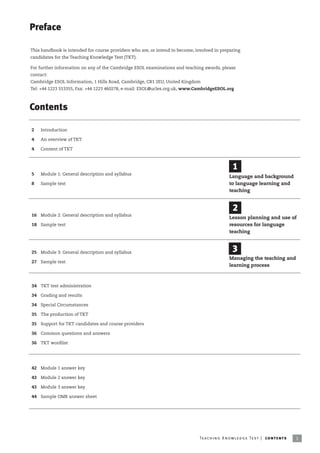
Contents

2   Introduction

4   An overview of TKT

4   Content of TKT


                                                                                                  1
5   Module 1: General description and syllabus
                                                                                                Language and background
8   Sample test                                                                                 to language learning and
                                                                                                teaching


                                                                                                  2
16 Module 2: General description and syllabus
                                                                                                Lesson planning and use of
18 Sample test                                                                                  resources for language
                                                                                                teaching


25 Module 3: General description and syllabus                                                     3
                                                                                                Managing the teaching and
27 Sample test
                                                                                                learning process


34 TKT test administration

34 Grading and results

34 Special Circumstances

35 The production of TKT

35 Support for TKT candidates and course providers

36 Common questions and answers

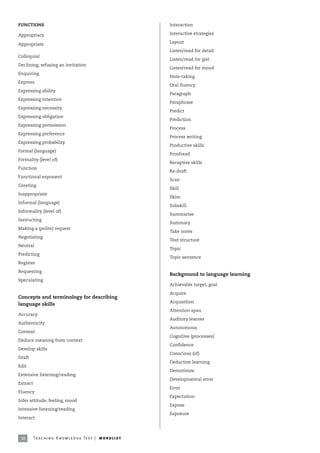
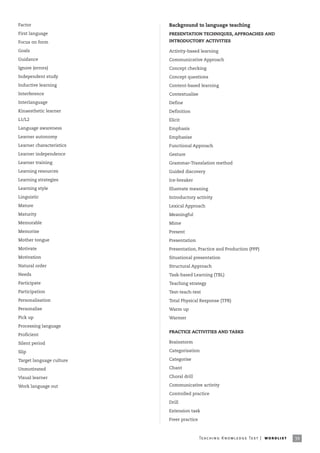
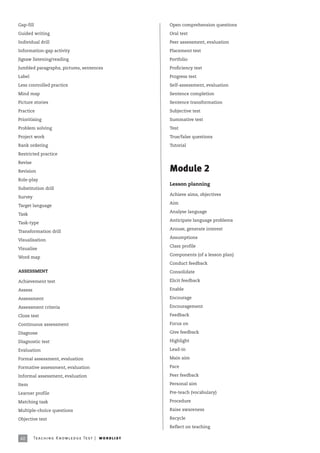
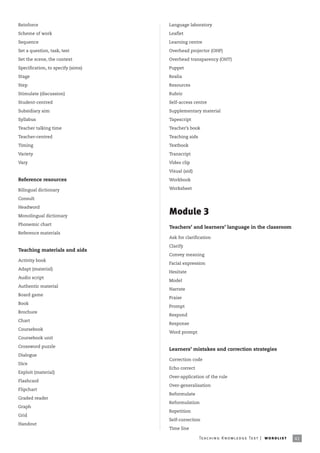
36 TKT wordlist


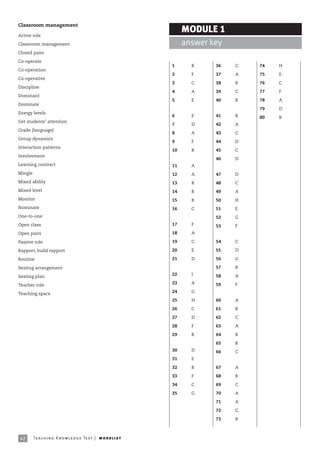
42 Module 1 answer key

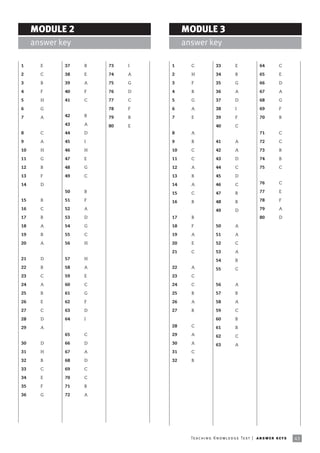
43 Module 2 answer key

43 Module 3 answer key

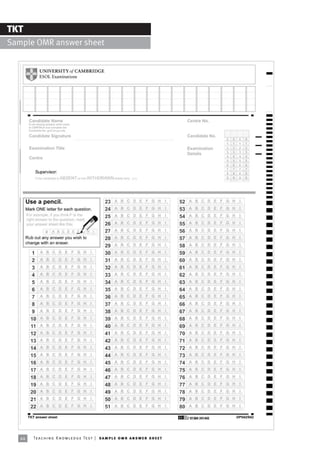
44 Sample OMR answer sheet


                                                                               Te ac h i n g K n o w l e d g e Te s t | co nte nts   1
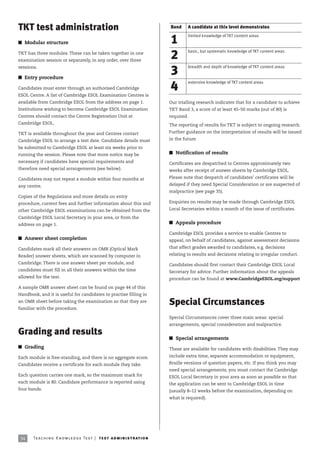
TKT can be taken at any stage in a teacher’s career. It is
Introduction                                                            suitable for pre-service or practising teachers and forms part
I Introduction to Cambridge ESOL                                        of a framework of Teaching Awards offered by Cambridge
                                                                        ESOL. This includes CELTA (Certificate in English Language
The Teaching Knowledge Test (TKT) is designed and produced
                                                                        Teaching to Adults); CELTYL (Certificate in English Language
by University of Cambridge ESOL Examinations (Cambridge
                                                                        Teaching to Young Learners); ICELT (In-service Certificate in
ESOL), a department of the University of Cambridge and part
                                                                        English Language Teaching); and DELTA (Diploma in English
of the University of Cambridge Local Examinations Syndicate,
                                                                        Language Teaching to Adults). These are based on the
which has provided examinations in English for speakers of
                                                                        following content areas: subject knowledge, pedagogical
other languages since 1913. Cambridge ESOL offers an
                                                                        knowledge, pedagogical content knowledge and knowledge of
extensive range of examinations, certificates and diplomas for
                                                                        context. TKT covers the first three of these areas of
learners and teachers of English, taken by over 1.5 million
                                                                        knowledge, but unlike the other Teaching Awards, TKT does
people a year, in more than 130 countries.
                                                                        not assess knowledge of teaching context. This area is most
                                                                        appropriately assessed through teaching practice, which does
I Introduction to TKT – a test of professional
                                                                        not form part of the assessment of TKT.
  knowledge for English language teachers
                                                                        Other teaching qualifications offered by Cambridge ESOL
TKT tests knowledge about the teaching of English to speakers
                                                                        include two specifically designed for the further education
of other languages. This knowledge includes concepts related
                                                                        and skills sector within the UK.
to language, language use and the background to and practice
of language teaching and learning and is assessed by means of           A summary of the entry requirements and content of
objective format tests, which are simple to administer and to           Cambridge ESOL’s Teaching Awards can be found on the
take.                                                                   following page.

TKT is designed to offer maximum flexibility and accessibility
for candidates and therefore does not include a compulsory
course component or compulsory teaching practice. However,
it is likely that centres and other institutions will wish to offer
courses for TKT preparation and these may also include some
teaching practice, if desired. It should be noted that TKT tests
teaching knowledge rather than teaching ability.

TKT offers candidates a step in their professional
development as teachers and enables them to move onto
higher-level teaching qualifications and access professional
support materials, such as journals about English language
teaching (ELT).

TKT candidates are encouraged to keep a portfolio, a record of
their professional development and reflections on their
teaching. Through their portfolio candidates should become
reflective practitioners, analysing their teaching and how this
impacts on their students’ learning. The portfolio does not
form part of the assessment for TKT, however.


 2      Te ac h i n g K n o w l e d g e Te s t | i ntr o d uc t i o n
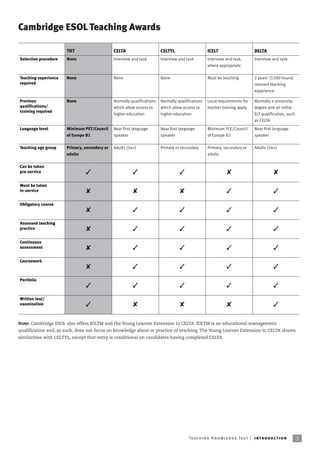
Cambridge ESOL Teaching Awards

                      TKT                     CELTA                     CELTYL                    ICELT                        DELTA
Selection procedure   None                    Interview and task        Interview and task        Interview and task,          Interview and task
                                                                                                  where appropriate

Teaching experience   None                    None                      None                      Must be teaching             2 years’ (1200 hours)
required                                                                                                                       relevant teaching
                                                                                                                               experience

Previous              None                    Normally qualifications   Normally qualifications   Local requirements for       Normally a university
qualifications/                               which allow access to     which allow access to     teacher training apply       degree and an initial
training required
                                              higher education          higher education                                       ELT qualification, such
                                                                                                                               as CELTA
Language level        Minimum PET/Council     Near first language       Near first language       Minimum FCE/Council          Near first language
                      of Europe B1            speaker                   speaker                   of Europe B2                 speaker

Teaching age group    Primary, secondary or   Adults (16+)              Primary or secondary      Primary, secondary or        Adults (16+)
                      adults                                                                      adults

Can be taken
pre-service                                                                                                                            
Must be taken
in-service                                                                                                                             
Obligatory course
                                                                                                                                       
Assessed teaching
practice                                                                                                                               
Continuous
assessment                                                                                                                             
Coursework
                                                                                                                                       
Portfolio
                                                                                                                                       
Written test/
examination                                                                                                                            

Note: Cambridge ESOL also offers IDLTM and the Young Learner Extension to CELTA. IDLTM is an educational management
qualification and, as such, does not focus on knowledge about or practice of teaching. The Young Learner Extension to CELTA shares
similarities with CELTYL, except that entry is conditional on candidates having completed CELTA.


                                                                                       Te ac h i n g K n o w l e d g e Te s t | i ntr o d uc t i o n     3
An overview of TKT                                                       Content of TKT
I The aims of TKT                                                        I TKT content outline

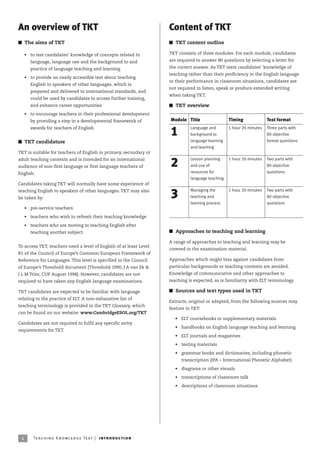
     • to test candidates’ knowledge of concepts related to              TKT consists of three modules. For each module, candidates

       language, language use and the background to and                  are required to answer 80 questions by selecting a letter for

       practice of language teaching and learning                        the correct answer. As TKT tests candidates’ knowledge of
                                                                         teaching rather than their proficiency in the English language
     • to provide an easily accessible test about teaching
                                                                         or their performance in classroom situations, candidates are
       English to speakers of other languages, which is
                                                                         not required to listen, speak or produce extended writing
       prepared and delivered to international standards, and
                                                                         when taking TKT.
       could be used by candidates to access further training,
       and enhance career opportunities                                  I TKT overview
     • to encourage teachers in their professional development
       by providing a step in a developmental framework of               Module Title                  Timing              Test format
       awards for teachers of English                                              Language and        1 hour 20 minutes   Three parts with
                                                                         1         background to                           80 objective
I TKT candidature                                                                  language learning                       format questions
                                                                                   and teaching
TKT is suitable for teachers of English in primary, secondary or
                                                                                   Lesson planning     1 hour 20 minutes   Two parts with
adult teaching contexts and is intended for an international
audience of non-first language or first language teachers of             2         and use of                              80 objective
English.                                                                           resources for                           questions
                                                                                   language teaching
Candidates taking TKT will normally have some experience of
                                                                                   Managing the        1 hour 20 minutes   Two parts with
teaching English to speakers of other languages. TKT may also
be taken by:                                                             3         teaching and                            80 objective
                                                                                   learning process                        questions
     • pre-service teachers

     • teachers who wish to refresh their teaching knowledge

     • teachers who are moving to teaching English after
       teaching another subject.                                         I Approaches to teaching and learning

                                                                         A range of approaches to teaching and learning may be
To access TKT, teachers need a level of English of at least Level
                                                                         covered in the examination material.
B1 of the Council of Europe’s Common European Framework of
Reference for Languages. This level is specified in the Council          Approaches which might bias against candidates from
of Europe’s Threshold document (Threshold 1990, J A van Ek              particular backgrounds or teaching contexts are avoided.
J L M Trim; CUP August 1998). However, candidates are not                Knowledge of communicative and other approaches to
required to have taken any English language examinations.                teaching is expected, as is familiarity with ELT terminology.

TKT candidates are expected to be familiar with language                 I Sources and text types used in TKT
relating to the practice of ELT. A non-exhaustive list of
                                                                         Extracts, original or adapted, from the following sources may
teaching terminology is provided in the TKT Glossary, which
                                                                         feature in TKT:
can be found on our website: www.CambridgeESOL.org/TKT
                                                                           • ELT coursebooks or supplementary materials
Candidates are not required to fulfil any specific entry
                                                                           • handbooks on English language teaching and learning
requirements for TKT.
                                                                           • ELT journals and magazines

                                                                           • testing materials

                                                                           • grammar books and dictionaries, including phonetic
                                                                              transcription (IPA – International Phonetic Alphabet)

                                                                           • diagrams or other visuals

                                                                           • transcriptions of classroom talk

                                                                           • descriptions of classroom situations.


 4       Te ac h i n g K n o w l e d g e Te s t | i ntr o d uc t i o n
Language and background
to language learning and                                                                                          MODULE 1
teaching
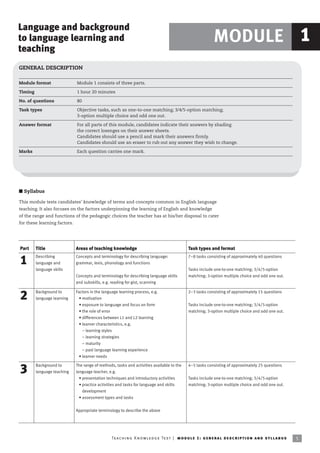
GENERAL DESCRIPTION

Module format                 Module 1 consists of three parts.

Timing                        1 hour 20 minutes

No. of questions              80

Task types                    Objective tasks, such as one-to-one matching; 3/4/5-option matching;
                              3-option multiple choice and odd one out.

Answer format                 For all parts of this module, candidates indicate their answers by shading
                              the correct lozenges on their answer sheets.
                              Candidates should use a pencil and mark their answers firmly.
                              Candidates should use an eraser to rub out any answer they wish to change.

Marks                         Each question carries one mark.


I Syllabus

This module tests candidates’ knowledge of terms and concepts common in English language
teaching. It also focuses on the factors underpinning the learning of English and knowledge
of the range and functions of the pedagogic choices the teacher has at his/her disposal to cater
for these learning factors.


Part     Title                Areas of teaching knowledge                                         Task types and format
         Describing           Concepts and terminology for describing language:                   7–8 tasks consisting of approximately 40 questions
1        language and         grammar, lexis, phonology and functions
         language skills                                                                          Tasks include one-to-one matching; 3/4/5-option
                              Concepts and terminology for describing language skills             matching; 3-option multiple choice and odd one out.
                              and subskills, e.g. reading for gist, scanning

         Background to        Factors in the language learning process, e.g.                      2–3 tasks consisting of approximately 15 questions
2        language learning      • motivation
                                • exposure to language and focus on form                          Tasks include one-to-one matching; 3/4/5-option
                                • the role of error                                               matching; 3-option multiple choice and odd one out.
                                • differences between L1 and L2 learning
                                • learner characteristics, e.g.
                                  – learning styles
                                  – learning strategies
                                  – maturity
                                  – past language learning experience
                                • learner needs

         Background to        The range of methods, tasks and activities available to the         4–5 tasks consisting of approximately 25 questions
3        language teaching    language teacher, e.g.
                                • presentation techniques and introductory activities             Tasks include one-to-one matching; 3/4/5-option
                                • practice activities and tasks for language and skills           matching; 3-option multiple choice and odd one out.
                                  development
                                • assessment types and tasks


                              Appropriate terminology to describe the above


                                                  Te ac h i n g K n o w l e d g e Te s t | mo d u l e 1 : g e n e r a l d e sc r i p t i o n a n d s y l l a b us   5
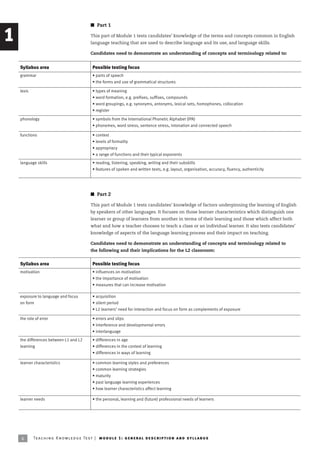
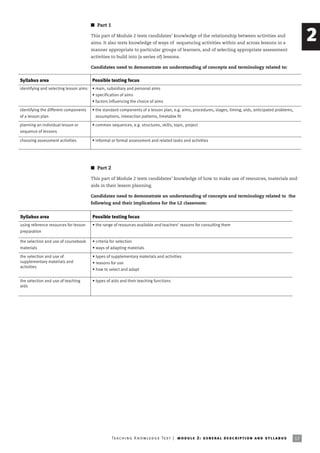
I Part 1

1                                               This part of Module 1 tests candidates’ knowledge of the terms and concepts common in English
                                                language teaching that are used to describe language and its use, and language skills.

                                                Candidates need to demonstrate an understanding of concepts and terminology related to:


    Syllabus area                                Possible testing focus
    grammar                                      • parts of speech
                                                 • the forms and use of grammatical structures

    lexis                                        • types of meaning
                                                 • word formation, e.g. prefixes, suffixes, compounds
                                                 • word groupings, e.g. synonyms, antonyms, lexical sets, homophones, collocation
                                                 • register

    phonology                                    • symbols from the International Phonetic Alphabet (IPA)
                                                 • phonemes, word stress, sentence stress, intonation and connected speech

    functions                                    • context
                                                 • levels of formality
                                                 • appropriacy
                                                 • a range of functions and their typical exponents
    language skills                              • reading, listening, speaking, writing and their subskills
                                                 • features of spoken and written texts, e.g. layout, organisation, accuracy, fluency, authenticity


                                                I Part 2

                                                This part of Module 1 tests candidates’ knowledge of factors underpinning the learning of English
                                                by speakers of other languages. It focuses on those learner characteristics which distinguish one
                                                learner or group of learners from another in terms of their learning and those which affect both
                                                what and how a teacher chooses to teach a class or an individual learner. It also tests candidates’
                                                knowledge of aspects of the language learning process and their impact on teaching.

                                                Candidates need to demonstrate an understanding of concepts and terminology related to
                                                the following and their implications for the L2 classroom:


    Syllabus area                                Possible testing focus
    motivation                                   • influences on motivation
                                                 • the importance of motivation
                                                 • measures that can increase motivation

    exposure to language and focus               • acquisition
    on form                                      • silent period
                                                 • L2 learners’ need for interaction and focus on form as complements of exposure

    the role of error                            • errors and slips
                                                 • interference and developmental errors
                                                 • interlanguage
    the differences between L1 and L2            • differences in age
    learning                                     • differences in the context of learning
                                                 • differences in ways of learning

    learner characteristics                      • common learning styles and preferences
                                                 • common learning strategies
                                                 • maturity
                                                 • past language learning experiences
                                                 • how learner characteristics affect learning

    learner needs                                • the personal, learning and (future) professional needs of learners


    6       Te ac h i n g K n o w l e d g e Te s t | mo d u l e 1 : g e n e r a l d e sc r i p t i o n a n d s y l l a b us
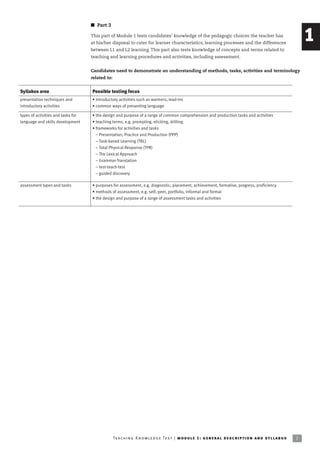
I Part 3

                                    This part of Module 1 tests candidates’ knowledge of the pedagogic choices the teacher has
                                    at his/her disposal to cater for learner characteristics, learning processes and the differences
                                                                                                                                                                        1
                                    between L1 and L2 learning. This part also tests knowledge of concepts and terms related to
                                    teaching and learning procedures and activities, including assessment.


                                    Candidates need to demonstrate an understanding of methods, tasks, activities and terminology
                                    related to:


Syllabus area                       Possible testing focus
presentation techniques and         • introductory activities such as warmers, lead-ins
introductory activities             • common ways of presenting language

types of activities and tasks for   • the design and purpose of a range of common comprehension and production tasks and activities
language and skills development     • teaching terms, e.g. prompting, eliciting, drilling
                                    • frameworks for activities and tasks
                                      – Presentation, Practice and Production (PPP)
                                      – Task-based Learning (TBL)
                                      – Total Physical Response (TPR)
                                      – The Lexical Approach
                                      – Grammar-Translation
                                      – test-teach-test
                                      – guided discovery

assessment types and tasks          • purposes for assessment, e.g. diagnostic, placement, achievement, formative, progress, proficiency
                                    • methods of assessment, e.g. self, peer, portfolio, informal and formal
                                    • the design and purpose of a range of assessment tasks and activities


                                                  Te ac h i n g K n o w l e d g e Te s t | mo d u l e 1 : g e n e r a l d e sc r i p t i o n a n d s y l l a b us   7
8
                                                                                                                                                                            Candidate
                                                                                                                                                                                                                                           2
                                                                                                                                                          Centre Number      Number                                                                                             Sample test
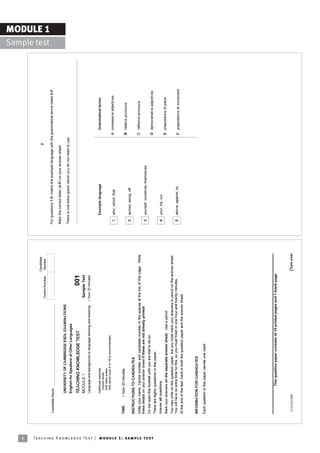
                                                                                                                                                                                                                                                                                              MODULE 1

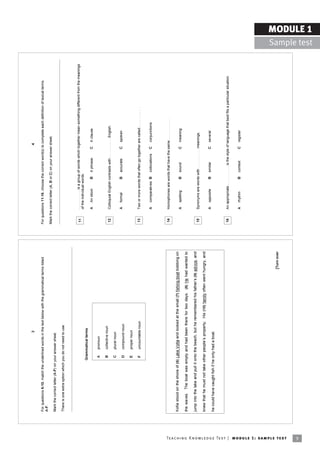
                                                                            Candidate Name                                                                                               For questions 1-5, match the example language with the grammatical terms listed A-F.

                                                                                                                                                                                         Mark the correct letter (A-F) on your answer sheet.
                                                                                            UNIVERSITY OF CAMBRIDGE ESOL EXAMINATIONS
                                                                                                                                                                                         There is one extra option which you do not need to use.
                                                                                            English for Speakers of Other Languages

                                                                                            TEACHING KNOWLEDGE TEST                                               001
                                                                                            MODULE 1                                                      Sample Test
                                                                                            Language and background to language learning and teaching   1 hour 20 minutes


                                                                                            Additional materials:                                                                             Example language                                       Grammatical terms
                                                                                              Answer sheet
                                                                                              Soft clean eraser
                                                                                              Soft pencil (type B or HB is recommended)
                                                                                                                                                                                          1   who, which, that                                     A possessive adjectives


                                                                            TIME       1 hour 20 minutes
                                                                                                                                                                                                                                                   B relative pronouns
                                                                                                                                                                                          2   across, along, off
                                                                            INSTRUCTIONS TO CANDIDATES
                                                                            Write your name, Centre number and candidate number in the spaces at the top of this page. Write                                                                       C reflexive pronouns
                                                                            these details on your answer sheet if these are not already printed.
                                                                                                                                                                                          3   yourself, ourselves, themselves
                                                                            Do not open this booklet until you are told to do so.


Te ac h i n g K n o w l e d g e Te s t | mo d u l e 1 : sa m p l e te s t
                                                                                                                                                                                                                                                   D demonstrative adjectives
                                                                            There are eighty questions in this paper.
                                                                            Answer all questions.                                                                                         4   your, his, our
                                                                            Mark your answers on the separate answer sheet. Use a pencil.                                                                                                          E prepositions of place
                                                                            You may write on the question paper, but you must mark your answers in pencil on the answer sheet.
                                                                            You will have no extra time for this, so you must finish in one hour and twenty minutes.                      5   above, against, by                                   F prepositions of movement
                                                                            At the end of the test, hand in both the question paper and the answer sheet.


                                                                            INFORMATION FOR CANDIDATES

                                                                            Each question in this paper carries one mark.


                                                                            ________________________________________________________
                                                                                                 This question paper consists of 15 printed pages and 1 blank page.


                                                                             © UCLES 2005                                                                                   [Turn over
3                                                                                                             4

                                                                            For questions 6-10, match the underlined words in the text below with the grammatical terms listed     For questions 11-16, choose the correct word(s) to complete each definition of lexical terms.
                                                                            A-F.
                                                                                                                                                                                   Mark the correct letter (A, B or C) on your answer sheet.
                                                                            Mark the correct letter (A-F) on your answer sheet.

                                                                            There is one extra option which you do not need to use.


                                                                                                                                                                                    11      . . . . . . . . . . is a group of words which together mean something different from the meanings
                                                                                                                                                                                            of the individual words.
                                                                                                            Grammatical terms
                                                                                                                                                                                            A    An idiom         B    A phrase         C       A clause
                                                                                                              A    pronoun

                                                                                                              B    collective noun
                                                                                                                                                                                    12      Colloquial English contrasts with . . . . . . . . . . English.
                                                                                                              C    plural noun
                                                                                                                                                                                            A    formal           B    accurate         C       spoken
                                                                                                              D    compound noun

                                                                                                              E    proper noun

                                                                                                              F    uncountable noun                                                 13      Two or more words that often go together are called . . . . . . . . . .


                                                                                                                                                                                            A    comparatives B        collocations     C       conjunctions


                                                                                                                                                                                    14      Homophones are words that have the same . . . . . . . . . . .

                                                                            Kofie stood on the shore of (6) Lake Volta and looked at the small (7) fishing boat bobbing on
                                                                                                                                                                                            A    spelling         B    sound            C       meaning
                                                                            the waves. The boat was empty and had been there for two days. (8) He had wanted to

                                                                            jump into the lake and pull it onto the beach, but he remembered his fatherís (9) advice, and
                                                                                                                                                                                    15      Synonyms are words with . . . . . . . . . . meanings.
                                                                            knew that he must not take other peopleís property. His (10) family often went hungry, and
                                                                                                                                                                                            A    opposite         B    similar          C       several
                                                                            he could have caught fish if he only had a boat.


                                                                                                                                                                                    16      An appropriate . . . . . . . . . . is the style of language that best fits a particular situation.


                                                                                                                                                                                            A    rhythm           B    context          C       register


                                                                                                                                                                      [Turn over


Te ac h i n g K n o w l e d g e Te s t | mo d u l e 1 : sa m p l e te s t
9
                                                                                                                                                                                                                                                                                                               MODULE 1
                                                                                                                                                                                                                                                                                                 Sample test
10
                                                                                                                                 5                                                                                                      6

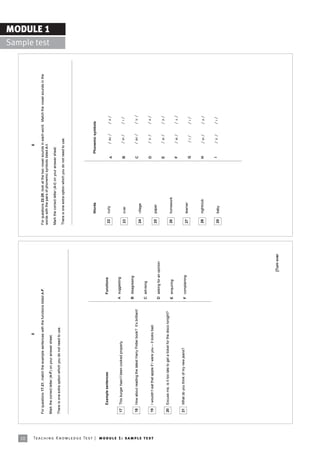
                                                                            For questions 17-21, match the example sentences with the functions listed A-F.                       For questions 22-29, look at the two vowel sounds in each word. Match the vowel sounds in the
                                                                                                                                                                                  words with the pairs of phonemic symbols listed A-I.
                                                                                                                                                                                                                                                                                  Sample test
                                                                                                                                                                                                                                                                                                MODULE 1

                                                                            Mark the correct letter (A-F) on your answer sheet.
                                                                                                                                                                                  Mark the correct letter (A-I) on your answer sheet.
                                                                            There is one extra option which you do not need to use.
                                                                                                                                                                                  There is one extra option which you do not need to use.


                                                                                                                                                                                         Words                                   Phonemic symbols


                                                                                  Example sentences                                                     Functions                  22    curly                                          / W¬ /       /W/
                                                                                                                                                                                                                             A

                                                                             17   This burger hasnít been cooked properly.                           A suggesting
                                                                                                                                                                                   23    over                                B              / eö /   /ö/

                                                                                                                                                     B disagreeing
                                                                             18   How about reading the latest Harry Potter book? Itís brilliant!                                                                            C          / W¬ /       / ±É /
                                                                                                                                                                                   24    village
                                                                                                                                                     C advising
                                                                                                                                                                                                                             D              / ±É /   /W/


Te ac h i n g K n o w l e d g e Te s t | mo d u l e 1 : sa m p l e te s t
                                                                             19   I wouldnít eat that apple if I were you ñ it looks bad.
                                                                                                                                                                                   25    paper
                                                                                                                                                     D asking for an opinion
                                                                                                                                                                                                                             E              / aö /   /W/
                                                                             20   Excuse me, is it too late to get a ticket for the disco tonight?
                                                                                                                                                     E enquiring                   26    homework
                                                                                                                                                                                                                             F              / aö /   /Ã/
                                                                             21   What do you think of my new jeans?                                 F complaining                 27    learner
                                                                                                                                                                                                                             G              /ö/      /ö/


                                                                                                                                                                                   28    nightclub                           H              / eö /   /W/


                                                                                                                                                                                                                             I              / ±É /   /ö/
                                                                                                                                                                                   29    baby


                                                                                                                                                                     [Turn over
7                                                                                                        8

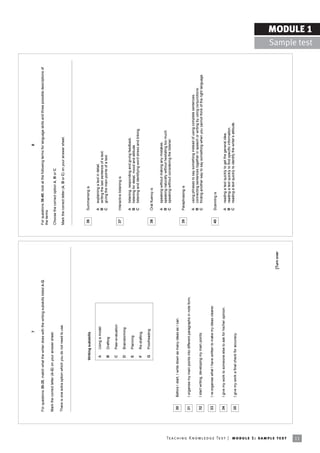
                                                                            For questions 30-35, match what the writer does with the writing subskills listed A-G.                For questions 36-40, look at the following terms for language skills and three possible descriptions of
                                                                                                                                                                                  the terms.
                                                                            Mark the correct letter (A-G) on your answer sheet.
                                                                                                                                                                                  Choose the correct option A, B or C.
                                                                            There is one extra option which you do not need to use.                                               Mark the correct letter (A, B or C) on your answer sheet.


                                                                                                             Writing subskills                                                     36      Summarising is

                                                                                                                                                                                           A    explaining a text in detail.
                                                                                                               A    Using a model
                                                                                                                                                                                           B    writing the last sentence of a text.
                                                                                                                                                                                           C    giving the main points of a text.
                                                                                                               B    Drafting

                                                                                                               C    Peer-evaluation
                                                                                                                                                                                   37      Interactive listening is
                                                                                                               D    Brainstorming
                                                                                                                                                                                           A    listening, responding and giving feedback.
                                                                                                               E    Planning                                                               B    listening for detail, mood and attitude.
                                                                                                                                                                                           C    listening and identifying word stress and linking.
                                                                                                               F    Re-drafting

                                                                                                              G     Proofreading
                                                                                                                                                                                   38      Oral fluency is

                                                                                                                                                                                           A    speaking without making any mistakes.
                                                                                                                                                                                           B    speaking naturally without hesitating too much.
                                                                                                                                                                                           C    speaking without considering the listener.

                                                                             30      Before I start, I write down as many ideas as I can.
                                                                                                                                                                                   39      Paraphrasing is
                                                                             31      I organise my main points into different paragraphs in note form.
                                                                                                                                                                                           A    using phrases to say something instead of using complete sentences.
                                                                                                                                                                                           B    connecting sentences together in speech or writing by using conjunctions.
                                                                             32      I start writing, developing my main points.                                                           C    finding another way to say something when you cannot think of the right language.

                                                                             33      I re-organise what I have written to make my ideas clearer.
                                                                                                                                                                                   40      Scanning is

                                                                             34      I give my work to someone else to ask for his/her opinion.                                            A    reading a text quickly to get the general idea.
                                                                                                                                                                                           B    reading a text quickly to find specific information.
                                                                                                                                                                                           C    reading a text quickly to identify the writerís attitude.
                                                                             35      I give my work a final check for accuracy.


                                                                                                                                                                     [Turn over


Te ac h i n g K n o w l e d g e Te s t | mo d u l e 1 : sa m p l e te s t
11
                                                                                                                                                                                                                                                                                                          MODULE 1
                                                                                                                                                                                                                                                                                            Sample test
12
                                                                                                                                9                                                                                                      10

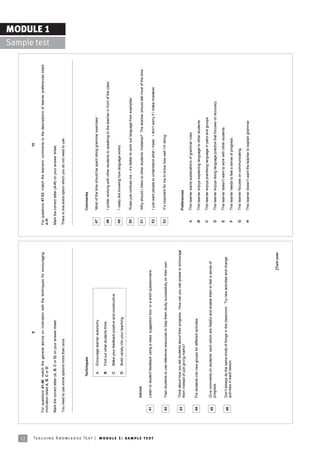
                                                                            For questions 41-46, match the general advice on motivation with the techniques for encouraging         For questions 47-53, match the learnersí comments to the descriptions of learner preferences listed
                                                                            motivation listed A, B, C or D.                                                                         A-H.
                                                                                                                                                                                                                                                                                            Sample test
                                                                                                                                                                                                                                                                                                          MODULE 1

                                                                            Mark the correct letter (A, B, C or D) on your answer sheet.                                            Mark the correct letter (A-H) on your answer sheet.

                                                                            You need to use some options more than once.                                                            There is one extra option which you do not need to use.


                                                                                                   Techniques                                                                                Comments

                                                                                                     A    Encourage learner autonomy.                                                47      ëMost of the time should be spent doing grammar exercises.í

                                                                                                    B     Find out what students think.
                                                                                                                                                                                     48      ëI prefer working with other students to speaking to the teacher in front of the class.í
                                                                                                    C     Make your feedback positive and constructive.
                                                                                                                                                                                     49      ëI really like knowing how language works.í
                                                                                                    D     Build variety into your teaching.

                                                                                                                                                                                     50      ëRules just confuse me ñ itís better to work out language from examples.í

                                                                                     Advice                                                                                          51      ëWhy should I listen to other studentsí mistakes? The teacher should talk most of the time.í

                                                                             41      Listen to student feedback using a class ësuggestion boxí or a short questionnaire.


Te ac h i n g K n o w l e d g e Te s t | mo d u l e 1 : sa m p l e te s t
                                                                                                                                                                                     52      ëI just want people to understand what I mean. I donít worry if I make mistakes.í


                                                                             42      Train students to use reference resources to help them study successfully on their own.         53      ëItís important for me to know how well Iím doing.í


                                                                             43      Think about how you tell students about their progress. How can you can praise or encourage
                                                                                     them instead of just giving marks?                                                                      Preferences

                                                                                                                                                                                     A       This learner wants explanations of grammar rules.
                                                                             44      Put students into new groups for different activities.
                                                                                                                                                                                     B       This learner enjoys explaining language to other students.

                                                                                                                                                                                     C       This learner enjoys practising language in pairs and groups.
                                                                             45      Give comments on studentsí work which are helpful and enable them to feel a sense of
                                                                                     progress.                                                                                       D       This learner enjoys doing language practice that focuses on accuracy.

                                                                                                                                                                                     E       This learner doesnít want to work with other students.
                                                                             46      Donít always do the same kinds of things in the classroom. Try new activities and change
                                                                                     activities in each lesson.                                                                      F       This learner needs to feel a sense of progress.

                                                                                                                                                                                     G       This learner focuses on communicating.

                                                                                                                                                                                     H       This learner doesnít want the teacher to explain grammar.


                                                                                                                                                                       [Turn over
11                                                                                                           12

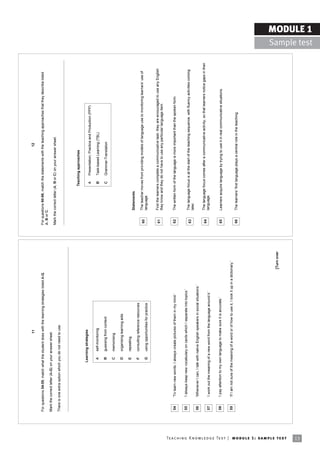
                                                                            For questions 54-59, match what the student does with the learning strategies listed A-G.                     For questions 60-66, match the statements with the teaching approaches that they describe listed
                                                                                                                                                                                          A, B or C.
                                                                            Mark the correct letter (A-G) on your answer sheet.
                                                                                                                                                                                          Mark the correct letter (A, B or C) on your answer sheet.
                                                                            There is one extra option which you do not need to use.


                                                                                                                                                                                                                   Teaching approaches

                                                                                                             Learning strategies
                                                                                                                                                                                                                    A     Presentation, Practice and Production (PPP)

                                                                                                              A     self-monitoring                                                                                 B     Task-based Learning (TBL)

                                                                                                              B     guessing from context                                                                           C     Grammar-Translation

                                                                                                              C     memorising

                                                                                                              D     organising learning aids

                                                                                                              E     repeating
                                                                                                                                                                                                   Statements
                                                                                                              F     consulting reference resources
                                                                                                                                                                                           60      The teacher moves from providing models of language use to monitoring learnersí use of
                                                                                                              G     using opportunities for practice                                               language.


                                                                                                                                                                                           61      First the learners complete a communicative task: they are encouraged to use any English
                                                                                                                                                                                                   they know and they do not have to use any particular language item.


                                                                             54      ëTo learn new words, I always create pictures of them in my mind.í                                    62      The written form of the language is more important than the spoken form.


                                                                             55      ëI always keep new vocabulary on cards which I separate into topics.í
                                                                                                                                                                                           63      The language focus is at the start of the teaching sequence, with fluency activities coming
                                                                                                                                                                                                   later.
                                                                             56      ëWhenever I can, I talk with native English speakers in social situations.í

                                                                                                                                                                                           64      The language focus comes after a communicative activity, so that learners notice gaps in their
                                                                             57      ëI work out the meaning of a new word from the language around it.í                                           language.


                                                                             58      ëI pay attention to my own language to make sure it is accurate.í                                     65      Learners acquire language by trying to use it in real communicative situations.

                                                                             59      ëIf I am not sure of the meaning of a word or of how to use it, I look it up in a dictionary.í
                                                                                                                                                                                           66      The learnersí first language plays a central role in the teaching.


                                                                                                                                                                             [Turn over


Te ac h i n g K n o w l e d g e Te s t | mo d u l e 1 : sa m p l e te s t
13
                                                                                                                                                                                                                                                                                                                  MODULE 1
                                                                                                                                                                                                                                                                                                    Sample test
14
                                                                                                                               13                                                                                                           14

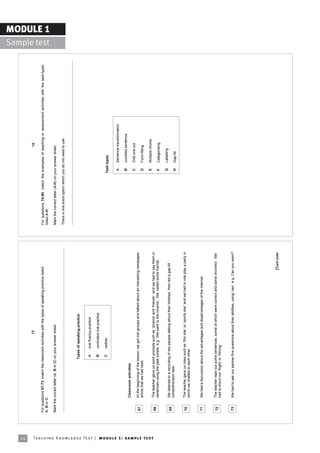
                                                                            For questions 67-73, match the classroom activities with the types of speaking practice listed               For questions 74-80, match the examples of teaching or assessment activities with the task-types
                                                                            A, B or C.                                                                                                   listed A-H.
                                                                                                                                                                                                                                                                                            Sample test
                                                                                                                                                                                                                                                                                                          MODULE 1

                                                                            Mark the correct letter (A, B or C) on your answer sheet.                                                    Mark the correct letter (A-H) on your answer sheet.

                                                                                                                                                                                         There is one extra option which you do not need to use.


                                                                                                              Types of speaking practice


                                                                                                                A    oral fluency practice

                                                                                                                B    controlled oral practice

                                                                                                                C    neither                                                                                             Task-types

                                                                                                                                                                                                                           A    Sentence transformation

                                                                                                                                                                                                                           B    Jumbled sentence
                                                                                     Classroom activities
                                                                                                                                                                                                                           C    Odd one out
                                                                             67      At the beginning of the lesson, we got into groups and talked about an interesting newspaper
                                                                                     article that we had read.                                                                                                             D    Form-filling

                                                                                                                                                                                                                           E    Multiple choice


Te ac h i n g K n o w l e d g e Te s t | mo d u l e 1 : sa m p l e te s t
                                                                             68      The teacher gave us word prompts such as ëcinemaí and ëfriendsí, and we had to say them in
                                                                                     sentences using the past simple, e.g. ëWe went to the cinemaí; ëWe visited some friendsí.                                             F    Categorising

                                                                                                                                                                                                                           G    Labelling
                                                                             69      We listened to a recording of two people talking about their hobbies, then did a gap-fill
                                                                                     comprehension task.                                                                                                                   H    Gap-fill


                                                                             70      The teacher gave us roles such as ëfilm starí or ësports starí and we had to role play a party in
                                                                                     which we chatted to each other.


                                                                             71      We had a discussion about the advantages and disadvantages of the internet.


                                                                             72      The teacher read out some sentences, some of which were correct and some incorrect. We
                                                                                     had to shout out ëRightí or ëWrongí.


                                                                             73      We had to ask our partner five questions about their abilities, using ëcaní, e.g. Can you swim?


                                                                                                                                                                          [Turn over
15


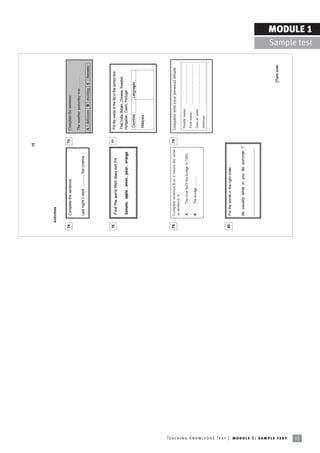
                                                                                 Activities


                                                                            74       Complete the sentence.                                    75   Complete the sentence.

                                                                                                                                                    The weather yesterday was ...........
                                                                                     Last night I went ........... the cinema.
                                                                                                                                                    A delicious B exciting C fantastic


                                                                            76                                                                 77   Put the words in the list in the correct box.
                                                                                      Find the word that does not fit.
                                                                                                                                                    Thai, India, Britain, Chinese, Swedish,
                                                                                      banana, apple, onion, pear, orange                            Hungarian, Czech, Portugal
                                                                                                                                                     Countries               Languages

                                                                                                                                                     Malaysia


                                                                            78       Complete sentence B so it means the same                  79   Complete with your personal details
                                                                                     as sentence A.
                                                                                                                                                     Family name:      .......................................
                                                                                     A        The man built the bridge in 1892
                                                                                                                                                     First name:       .......................................
                                                                                     B        The bridge ...........
                                                                                                                                                     Date of birth:    .......................................
                                                                                                                                                     Address:          .......................................


                                                                            80       Put the words in the right order.


                                                                                     do usually what in you do summer ?

                                                                                     ......................................................


                                                                                                                                                                                            [Turn over


Te ac h i n g K n o w l e d g e Te s t | mo d u l e 1 : sa m p l e te s t
15
                                                                                                                                                                                                                               MODULE 1
                                                                                                                                                                                                                 Sample test
Lesson planning and use of
           MODULE 2                                                                       resources for language teaching

GENERAL DESCRIPTION

Module format                      Module 2 consists of two parts.

Timing                             1 hour 20 minutes

No. of questions                   80

Task types                         Objective tasks, such as one-to-one matching; 3/4/5-option matching;
                                   sequencing; 3-option multiple choice and odd one out.

Answer format                      For all parts of this module, candidates indicate their answers by shading
                                   the correct lozenges on their answer sheets.
                                   Candidates should use a pencil and mark their answers firmly.
                                   Candidates should use an eraser to rub out any answer they wish to change.

Marks                              Each question carries one mark.


I Syllabus

This module focuses on what teachers consider and do while planning their teaching
of a lesson or series of lessons. Teaching in this context is intended also to refer to
assessment. It focuses too on the linguistic and methodological reference resources that
are available to guide teachers in their lesson planning as well as on the range and
function of materials and teaching aids that teachers could consider making use of in
their lessons. Knowledge of any particular book is not required.


Part     Title                    Areas of teaching knowledge                                               Task types and format
         Planning and             Lesson planning                                                           5–6 tasks consisting of approximately 40 questions
1        preparing a lesson         • identifying and selecting aims appropriate to learners,
         or sequence of               the stage of learning and lesson types                                Tasks include one-to-one matching; 3/4/5-option
         lessons                    • identifying the different components of a lesson plan                 matching; 3-option multiple choice; odd one out and
                                    • planning an individual lesson (or a sequence of lessons)              sequencing.
                                      by choosing and sequencing activities appropriate to
                                      learners and aims
                                    • choosing assessment activities appropriate to learners,
                                      aims and stages of learning


         Selection and use        Consulting reference resources to help in lesson preparation              5–7 tasks consisting of approximately 40 questions
2        of resources
                                  Selection and use of:                                                     Tasks include one-to-one matching; 3/4/5-option
                                   • coursebook materials                                                   matching; 3-option multiple choice and odd one out.
                                   • supplementary materials and activities
                                   • teaching aids

                                  appropriate to learners and aims


 16     Te ac h i n g K n o w l e d g e Te s t | mo d u l e 2 : g e n e r a l d e sc r i p t i o n a n d s y l l a b us
I Part 1

                                        This part of Module 2 tests candidates’ knowledge of the relationship between activities and
                                        aims. It also tests knowledge of ways of sequencing activities within and across lessons in a
                                                                                                                                                                          2
                                        manner appropriate to particular groups of learners, and of selecting appropriate assessment
                                        activities to build into (a series of) lessons.

                                        Candidates need to demonstrate an understanding of concepts and terminology related to:


Syllabus area                           Possible testing focus
identifying and selecting lesson aims   • main, subsidiary and personal aims
                                        • specification of aims
                                        • factors influencing the choice of aims
identifying the different components    • the standard components of a lesson plan, e.g. aims, procedures, stages, timing, aids, anticipated problems,
of a lesson plan                          assumptions, interaction patterns, timetable fit

planning an individual lesson or        • common sequences, e.g. structures, skills, topic, project
sequence of lessons

choosing assessment activities          • informal or formal assessment and related tasks and activities


                                        I Part 2

                                        This part of Module 2 tests candidates’ knowledge of how to make use of resources, materials and
                                        aids in their lesson planning.

                                        Candidates need to demonstrate an understanding of concepts and terminology related to the
                                        following and their implications for the L2 classroom:


Syllabus area                           Possible testing focus
using reference resources for lesson    • the range of resources available and teachers’ reasons for consulting them
preparation

the selection and use of coursebook     • criteria for selection
materials                               • ways of adapting materials

the selection and use of                • types of supplementary materials and activities
supplementary materials and             • reasons for use
activities
                                        • how to select and adapt

the selection and use of teaching       • types of aids and their teaching functions
aids


                                                   Te ac h i n g K n o w l e d g e Te s t | mo d u l e 2 : g e n e r a l d e sc r i p t i o n a n d s y l l a b us   17
18
                                                                                                                                                                             Candidate
                                                                                                                                                                                                                                              2
                                                                                                                                                           Centre Number      Number

                                                                            Candidate Name
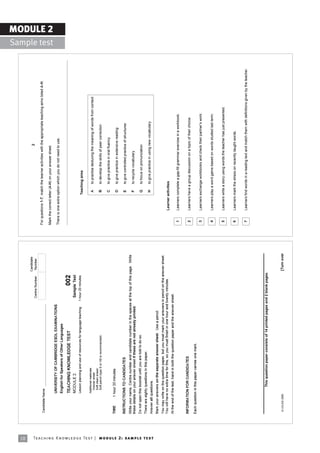
                                                                                                                                                                                          For questions 1-7, match the learner activities with the appropriate teaching aims listed A-H.

                                                                                                                                                                                          Mark the correct letter (A-H) on your answer sheet.
                                                                                                                                                                                                                                                                                                               MODULE 2
                                                                                                                                                                                                                                                                                                 Sample test
                                                                                            UNIVERSITY OF CAMBRIDGE ESOL EXAMINATIONS
                                                                                                                                                                                          There is one extra option which you do not need to use.
                                                                                            English for Speakers of Other Languages

                                                                                            TEACHING KNOWLEDGE TEST                                                002
                                                                                            MODULE 2                                                       Sample Test
                                                                                            Lesson planning and use of resources for language teaching   1 hour 20 minutes
                                                                                                                                                                                                             Teaching aims

                                                                                            Additional materials:
                                                                                              Answer sheet                                                                                                     A    to practise deducing the meaning of words from context
                                                                                              Soft clean eraser
                                                                                              Soft pencil (type B or HB is recommended)                                                                        B    to develop the skills of peer correction

                                                                                                                                                                                                               C    to give practice in oral fluency
                                                                            TIME       1 hour 20 minutes
                                                                                                                                                                                                               D    to give practice in extensive reading

                                                                            INSTRUCTIONS TO CANDIDATES                                                                                                         E    to give controlled practice of structures
                                                                            Write your name, Centre number and candidate number in the spaces at the top of this page. Write
                                                                            these details on your answer sheet if these are not already printed.                                                               F    to recycle vocabulary
                                                                            Do not open this booklet until you are told to do so.                                                                              G    to focus on pronunciation
                                                                            There are eighty questions in this paper.
                                                                                                                                                                                                               H    to give practice in using new vocabulary
                                                                            Answer all questions.


Te ac h i n g K n o w l e d g e Te s t | mo d u l e 2 : sa m p l e te s t
                                                                            Mark your answers on the separate answer sheet. Use a pencil.
                                                                            You may write on the question paper, but you must mark your answers in pencil on the answer sheet.
                                                                            You will have no extra time for this, so you must finish in one hour and twenty minutes.                               Learner activities
                                                                            At the end of the test, hand in both the question paper and the answer sheet.
                                                                                                                                                                                           1       Learners complete a gap-fill grammar exercise in a workbook.

                                                                            INFORMATION FOR CANDIDATES                                                                                     2       Learners have a group discussion on a topic of their choice.
                                                                            Each question in this paper carries one mark.
                                                                                                                                                                                           3       Learners exchange workbooks and check their partnerís work.


                                                                                                                                                                                           4       Learners play a word game based on words studied last term.


                                                                                                                                                                                           5       Learners write a story using words the teacher has just presented.


                                                                                                                                                                                           6       Learners mark the stress on recently taught words.


                                                                                                                                                                                           7       Learners find words in a reading text and match them with definitions given by the teacher.


                                                                            ________________________________________________________
                                                                                                This question paper consists of 14 printed pages and 2 blank pages.


                                                                             © UCLES 2005                                                                                    [Turn over
3                                                                                             4

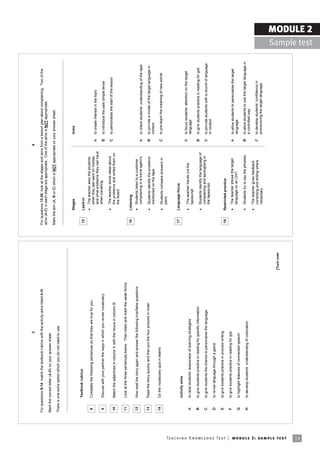
                                                                            For questions 8-14, match the textbook rubrics with the activity aims listed A-H.                For questions 15-20, look at the stages and aims from a lesson plan about complaining. Two of the
                                                                                                                                                                             aims (A-C) in each stage are appropriate. One of the aims is NOT appropriate.
                                                                            Mark the correct letter (A-H) on your answer sheet.
                                                                                                                                                                             Mark the aim (A, B or C) which is NOT appropriate on your answer sheet.
                                                                            There is one extra option which you do not need to use.


                                                                                                                                                                                      Stages                                          Aims

                                                                                     Textbook rubrics                                                                         15      Lead-in
                                                                                                                                                                                      •   The teacher asks the students
                                                                             8       Complete the following sentences so that they are true for you.
                                                                                                                                                                                          when they last went on holiday
                                                                                                                                                                                                                                  A   to create interest in the topic
                                                                                                                                                                                          and what problems they can have
                                                                             9       Discuss with your partner the ways in which you revise vocabulary.                                   when travelling.
                                                                                                                                                                                                                                  B   to introduce the past simple tense
                                                                                                                                                                                      •   The teacher elicits ideas about         C   to personalise the start of the lesson
                                                                             10      Match the adjectives in column A with the nouns in column B.                                         the problems and writes them on
                                                                                                                                                                                          the board.

                                                                             11      Look at the three sentences below. Then listen and mark the weak forms.
                                                                                                                                                                              16      Listening
                                                                             12      Now read the story again and answer the following true/false questions.                          •   Students listen to a customer
                                                                                                                                                                                          complaining in a travel agentís.        A   to check studentsí understanding of the tape
                                                                             13      Read the story quickly and then put the four pictures in order.                                  •   Students identify the problems          B   to provide a model of the target language in
                                                                                                                                                                                          mentioned on the tape.                      context
                                                                             14      Do the vocabulary quiz in teams.                                                                                                             C   to pre-teach the meaning of new words
                                                                                                                                                                                      •   Students compare answers in
                                                                                                                                                                                          pairs.


                                                                                                                                                                              17      Language focus
                                                                                     Activity aims
                                                                                                                                                                                                                                  A   to focus studentsí attention on the target
                                                                                                                                                                                      •   The teacher hands out the
                                                                             A       to raise studentsí awareness of learning strategies                                                                                              language
                                                                                                                                                                                          tapescript.
                                                                             B       to give students practice in reading for specific information                                                                                B   to give students practice in reading for gist
                                                                                                                                                                                      •   Students identify the language of
                                                                             C       to give students the chance to personalise the language                                              complaining and apologising in          C   to provide students with a record of language
                                                                                                                                                                                          the tapescript.                             in context
                                                                             D       to revise language through a game

                                                                             E       to give students practice in process writing
                                                                                                                                                                              18      Restricted practice
                                                                             F       to give students practice in reading for gist                                                        The teacher shows the target
                                                                                                                                                                                      •                                           A   to allow students to personalise the target
                                                                                                                                                                                          language on an OHT.                         language
                                                                             G       to highlight features of connected speech
                                                                                                                                                                                      •   Students try to say the phrases.        B   to allow students to use the target language in
                                                                             H       to develop studentsí understanding of collocation
                                                                                                                                                                                                                                      a controlled way
                                                                                                                                                                                      •   The teacher gives feedback,
                                                                                                                                                                                          correcting and drilling where           C   to develop studentsí confidence in
                                                                                                                                                                                          necessary.                                  pronouncing the target language


                                                                                                                                                                [Turn over


Te ac h i n g K n o w l e d g e Te s t | mo d u l e 2 : sa m p l e te s t
19
                                                                                                                                                                                                                                                                                                      MODULE 2
                                                                                                                                                                                                                                                                                        Sample test
20
                                                                                                                         5                                                                                                               6

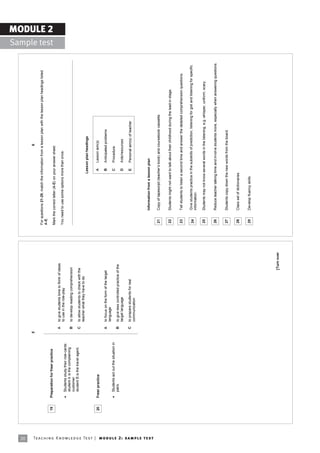
                                                                                                                                                                                   For questions 21-29, match the information from a lesson plan with the lesson plan headings listed
                                                                                                                                                                                   A-E.
                                                                                                                                                                                                                                                                                                                 MODULE 2
                                                                                                                                                                                                                                                                                                   Sample test
                                                                            19   Preparation for freer practice
                                                                                                                                                                                   Mark the correct letter (A-E) on your answer sheet.
                                                                                                                             A   to give students time to think of ideas
                                                                                                                                 to use in the role-play                           You need to use some options more than once.
                                                                                 •   Students study their role-cards:
                                                                                     student A is the complaining
                                                                                                                             B   to develop reading comprehension
                                                                                     customer
                                                                                     student B is the travel agent.          C   to allow students to check with the
                                                                                                                                 teacher what they have to do
                                                                                                                                                                                                                      Lesson plan headings


                                                                            20   Freer practice                                                                                                                          A   Lesson aim(s)

                                                                                                                             A   to focus on the form of the target                                                      B   Anticipated problems
                                                                                                                                 language
                                                                                 •   Students act out the situation in                                                                                                   C   Procedure
                                                                                     pairs.                                  B   to give less controlled practice of the
                                                                                                                                 target language                                                                         D   Aids/resources

                                                                                                                             C   to prepare students for real                                                            E   Personal aim(s) of teacher
                                                                                                                                 communication


                                                                                                                                                                                            Information from a lesson plan


Te ac h i n g K n o w l e d g e Te s t | mo d u l e 2 : sa m p l e te s t
                                                                                                                                                                                    21      Copy of tapescript (teacherís book) and coursebook cassette.


                                                                                                                                                                                    22      Students might not want to talk about their childhood during the lead-in stage.


                                                                                                                                                                                    23      Tell students to listen a second time and answer the detailed comprehension questions.


                                                                                                                                                                                    24      Give students practice in the subskills of prediction, listening for gist and listening for specific
                                                                                                                                                                                            information.

                                                                                                                                                                                    25      Students may not know several words in the listening, e.g. whisper, uniform, scary.


                                                                                                                                                                                    26      Reduce teacher talking time and involve students more, especially when answering questions.


                                                                                                                                                                                    27      Students copy down the new words from the board.


                                                                                                                                                                                    28      Class set of dictionaries.


                                                                                                                                                                                    29      Develop fluency skills.


                                                                                                                                                                      [Turn over
7                                                                                                            8

                                                                            For questions 30-36, put the stages (A-H) of a reading skills lesson plan in order.                         For questions 37-41, match the situations in which a teacher sets a test with the reasons for
                                                                                                                                                                                        assessment listed A-F.
                                                                            Mark the correct letter (B-H) on your answer sheet.
                                                                                                                                                                                        Mark the correct letter (A-F) on your answer sheet.
                                                                            The first stage (A) is done for you. You do not need to use option A again.
                                                                                                                                                                                        There is one extra option which you do not need to use.


                                                                                                                                                                                                 Situations

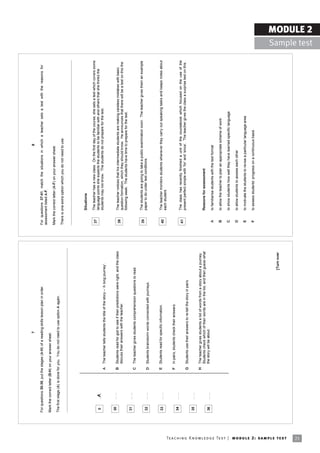
                                                                                                                                                                                         37      The teacher has a new class. On the first day of the course, she sets a test which covers some
                                                                             0      ... ...
                                                                                      A                                                                                                          language points she expects the students to be familiar with and others that she thinks the
                                                                                                                                                                                                 students may not know. The students do not prepare for the test.
                                                                                                       A The teacher tells students the title of the story ñ ëA long journeyí.


                                                                             30     ... ...
                                                                                                       B Students read for gist to see if their predictions were right, and the class
                                                                                                                                                                                         38      The teacher notices that his intermediate students are making careless mistakes with basic
                                                                                                         discuss their answers with the teacher.                                                 question formation, which they should know. He announces that there will be a test on this the
                                                                                                                                                                                                 following week. The students have time to prepare for the test.
                                                                             31     ... ...
                                                                                                       C The teacher gives students comprehension questions to read.

                                                                                                                                                                                         39      The students are going to take a public examination soon. The teacher gives them an example
                                                                             32     ... ...                                                                                                      paper to do under test conditions.
                                                                                                       D Students brainstorm words connected with journeys.


                                                                             33     ... ...            E Students read for specific information.                                         40      The teacher monitors students whenever they carry out speaking tasks and keeps notes about
                                                                                                                                                                                                 each student.

                                                                                                        F   In pairs, students check their answers.
                                                                             34     ... ...
                                                                                                                                                                                         41      The class has recently finished a unit of the coursebook which focused on the use of the
                                                                                                                                                                                                 present perfect simple with ëforí and ësinceí. The teacher gives the class a surprise test on this.
                                                                                                       G Students use their answers to re-tell the story in pairs.
                                                                             35     ... ...
                                                                                                       H The teacher gives students a list of words from a story about a journey.
                                                                                                         Students check which of their words are in the list, and then guess what                Reasons for assessment
                                                                             36     ... ...              the story will be about.
                                                                                                                                                                                         A       to familiarise students with the test format

                                                                                                                                                                                         B       to allow the teacher to plan an appropriate scheme of work

                                                                                                                                                                                         C       to show students how well they have learned specific language

                                                                                                                                                                                         D       to allow students to assess each other

                                                                                                                                                                                         E       to motivate the students to revise a particular language area

                                                                                                                                                                                         F       to assess studentsí progress on a continuous basis


                                                                                                                                                                         [Turn over


Te ac h i n g K n o w l e d g e Te s t | mo d u l e 2 : sa m p l e te s t
21
                                                                                                                                                                                                                                                                                                                     MODULE 2
                                                                                                                                                                                                                                                                                                       Sample test
22
                                                                                                                                  9                                                                                                    10

                                                                            For questions 42-49, match the examples of unit content with the unit headings from a book on lexis   For questions 50-56, read the dictionary entry. Match the extracts from the dictionary entry with the
                                                                            listed A-I.                                                                                           information they provide listed A-H.
                                                                                                                                                                                                                                                                                                        MODULE 2
                                                                                                                                                                                                                                                                                          Sample test
                                                                            Mark the correct letter (A-I) on your answer sheet.                                                   Mark the correct letter (A-H) on your answer sheet.

                                                                            There is one extra option which you do not need to use.                                               There is one extra option which you do not need to use.


                                                                                                                                                                                  Dictionary entry


                                                                                                                                                                                   convince / kWnÇvöns / v [ T (of) ] to make someone completely certain about something;
                                                                                  Examples of unit content                                          Unit headings
                                                                                                                                                                                   persuade: We finally convinced them of our innocence.
                                                                                                                                                                                   [ + obj + (that) ] They failed to convince the directors that their proposals would work / I'm
                                                                                                                                                                                   convinced that she is telling the truth.
                                                                             42   Suffixes
                                                                                                                                                 A Introduction


                                                                             43   General advice about learning vocabulary                       B Word formation


                                                                                                                                                 C Connecting and linking
                                                                             44   The difference between ësome experienceí and ëan experienceí


Te ac h i n g K n o w l e d g e Te s t | mo d u l e 2 : sa m p l e te s t
                                                                                                                                                                                   50   Iím convinced that she is telling the truth.                     A Part of speech
                                                                                                                                                 D Countables and uncountables
                                                                             45   American and British spelling
                                                                                                                                                                                   51   convince                                                         B Example sentence
                                                                                                                                                 E Topics

                                                                             46   Get up, run out of, set off                                                                                                                                            C Dependent preposition
                                                                                                                                                 F Feelings and actions            52   v

                                                                                                                                                                                                                                                         D Single-word synonym
                                                                             47   Vocabulary about science
                                                                                                                                                 G Fixed expressions
                                                                                                                                                                                   53   persuade
                                                                                                                                                                                                                                                         E Phonemic transcription
                                                                             48   Idioms like ëover the mooní                                    H Phrasal verbs
                                                                                                                                                                                   54   [ + obj + (that) ]
                                                                                                                                                                                                                                                         F Headword
                                                                                                                                                 I Varieties of English
                                                                             49   Unless, besides, although
                                                                                                                                                                                   55   (of)                                                             G Verb pattern


                                                                                                                                                                                   56   to make someone completely certain about something               H Definition


                                                                                                                                                                    [Turn over
11                                                                                                              12

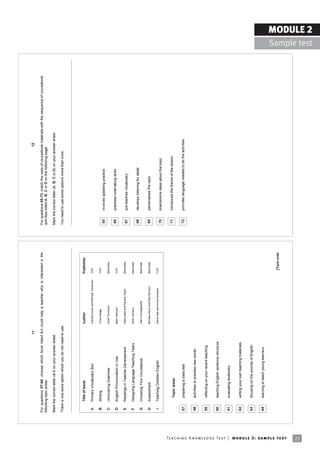
                                                                            For questions 57-64, choose which book listed A-I could help a teacher who is interested in the                 For questions 65-72, match the uses of coursebook materials with the sequence of coursebook
                                                                            following topic areas.                                                                                          activities listed A, B, C or D on the following page.

                                                                            Mark the correct letter (A-I) on your answer sheet.                                                             Mark the correct letter (A, B, C or D) on your answer sheet.

                                                                            There is one extra option which you do not need to use.                                                         You need to use some options more than once.


                                                                                   Title of book                                      Author                                 Publisher

                                                                             A     Primary Vocabulary Box                             Caroline Nixon and Michael Tomlinson   CUP


                                                                             B     Writing                                            Tricia Hedge                           OUP
                                                                                                                                                                                             65      involves speaking practice
                                                                             C     Uncovering Grammar                                 Scott Thornbury                        Macmillan


                                                                             D     English Pronunciation in Use                       Mark Hancock                           CUP
                                                                                                                                                                                             66      practises note-taking skills

                                                                             E     Readings in Teacher Development                    Katie Head and Pauline Taylor          Macmillan
                                                                                                                                                                                             67      pre-teaches vocabulary
                                                                             F     Designing Language Teaching Tasks                  Keith Johnson                          Macmillan
                                                                                                                                                                                             68      develops listening for detail
                                                                             G     Choosing Your Coursebook                           Alan Cunningsworth                     Macmillan


                                                                             H     Assessment                                         Michael Harris and Paul McCann         Macmillan       69      personalises the topic

                                                                              I    Teaching Children English                          David Vale and Anna Feunteun           CUP
                                                                                                                                                                                             70      brainstorms ideas about the topic


                                                                                                                                                                                             71      introduces the theme of the lesson
                                                                                     Topic areas

                                                                             57      preparing a class test                                                                                  72      provides language needed to do the activities


                                                                             58      activities to practise new words


                                                                             59      reflecting on your recent teaching


                                                                             60      teaching English sentence structure


                                                                             61      evaluating textbooks


                                                                             62      writing your own teaching materials


                                                                             63      focusing on the sounds of English


                                                                             64      learning to teach young learners


                                                                                                                                                                               [Turn over


Te ac h i n g K n o w l e d g e Te s t | mo d u l e 2 : sa m p l e te s t
23
                                                                                                                                                                                                                                                                                                        MODULE 2
                                                                                                                                                                                                                                                                                          Sample test
24
                                                                                                                           13                                                                                                        14

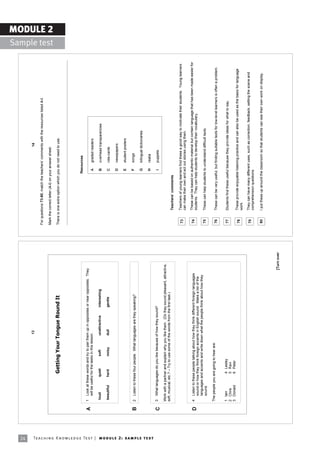
                                                                                                                                                                                   For questions 73-80, match the teachersí comments with the resources listed A-I.

                                                                                                                                                                                   Mark the correct letter (A-I) on your answer sheet.
                                                                                                                                                                                                                                                                                                            MODULE 2
                                                                                                                                                                                                                                                                                              Sample test
                                                                                                  Getting Your Tongue Round It                                                     There is one extra option which you do not need to use.


                                                                                                                                                                                                                    Resources

                                                                            A   1   Look at these words and try to pair them up in opposites or near opposites. They
                                                                                    will be useful for the tasks in this lesson.                                                                                      A    graded readers

                                                                                 loud           quiet        soft         unattractive       interesting                                                              B    overhead transparencies

                                                                                 beautiful      hard         noisy        dull               gentle                                                                   C    role-cards

                                                                                                                                                                                                                      D    newspapers

                                                                                                                                                                                                                      E    student posters

                                                                                2   Listen to these four people. What languages are they speaking?                                                                    F    songs
                                                                            B
                                                                                                                                                                                                                     G     bilingual dictionaries

                                                                                                                                                                                                                      H    realia


Te ac h i n g K n o w l e d g e Te s t | mo d u l e 2 : sa m p l e te s t
                                                                            C   3   What languages do you like because of how they sound?                                                                             I    puppets

                                                                                Work with a partner and explain why you like them. (Do they sound pleasant, attractive,
                                                                                soft, musical, etc.? ñ Try to use some of the words from the first task.)
                                                                                                                                                                                            Teachersí comments

                                                                                                                                                                                    73      Teachers of young learners find these a good way to motivate their students. Young learners
                                                                                                                                                                                            can make their own and act out stories using them.

                                                                                4   Listen to these people talking about how they think different foreign languages                 74      These can be based on authentic material but contain language that has been made easier for
                                                                            D                                                                                                               students. They can help students to develop their vocabulary.
                                                                                    sound or how they think foreign accents in English sound. Make a list of the
                                                                                    languages and accents and write down what the people think about how they
                                                                                    sound.                                                                                          75      These can help students to understand difficult texts.

                                                                                The people you are going to hear are:
                                                                                                                                                                                    76      These can be very useful, but finding suitable texts for low-level learners is often a problem.

                                                                                1 lain            4 Lesley                                                                          77      Students find these useful because they provide ideas for what to say.
                                                                                2 Chris           5 Ravi
                                                                                3 Donald          6 Peter
                                                                                                                                                                                    78      These provide enjoyable listening practice and can also be used as the basis for language
                                                                                                                                                                                            work.

                                                                                                                                                                                    79      They can have many different uses, such as correction, feedback, setting the scene and
                                                                                                                                                                                            comprehension questions.

                                                                                                                                                                                    80      I put these up around the classroom so that students can see their own work on display.


                                                                                                                                                                      [Turn over
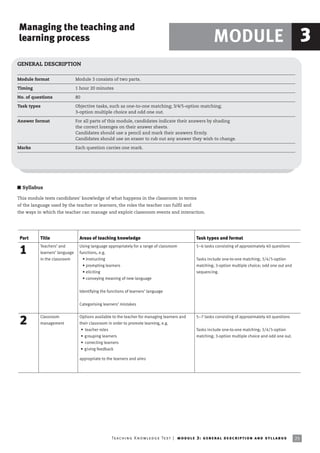
Managing the teaching and
learning process                                                                                                   MODULE 3
GENERAL DESCRIPTION

Module format                   Module 3 consists of two parts.

Timing                          1 hour 20 minutes

No. of questions                80

Task types                      Objective tasks, such as one-to-one matching; 3/4/5-option matching;
                                3-option multiple choice and odd one out.

Answer format                   For all parts of this module, candidates indicate their answers by shading
                                the correct lozenges on their answer sheets.
                                Candidates should use a pencil and mark their answers firmly.
                                Candidates should use an eraser to rub out any answer they wish to change.

Marks                           Each question carries one mark.


I Syllabus

This module tests candidates’ knowledge of what happens in the classroom in terms
of the language used by the teacher or learners, the roles the teacher can fulfil and
the ways in which the teacher can manage and exploit classroom events and interaction.


 Part      Title                 Areas of teaching knowledge                                            Task types and format
           Teachers’ and         Using language appropriately for a range of classroom                  5–6 tasks consisting of approximately 40 questions
 1         learners’ language    functions, e.g.
           in the classroom        • instructing                                                        Tasks include one-to-one matching; 3/4/5-option
                                   • prompting learners                                                 matching; 3-option multiple choice; odd one out and
                                   • eliciting                                                          sequencing.
                                   • conveying meaning of new language


                                 Identifying the functions of learners’ language


                                 Categorising learners’ mistakes

           Classroom             Options available to the teacher for managing learners and             5–7 tasks consisting of approximately 40 questions
 2         management            their classroom in order to promote learning, e.g.
                                  • teacher roles                                                       Tasks include one-to-one matching; 3/4/5-option
                                  • grouping learners                                                   matching; 3-option multiple choice and odd one out.
                                  • correcting learners
                                  • giving feedback

                                 appropriate to the learners and aims


                                                   Te ac h i n g K n o w l e d g e Te s t | mo d u l e 3 : g e n e r a l d e sc r i p t i o n a n d s y l l a b us   25
I Part 1

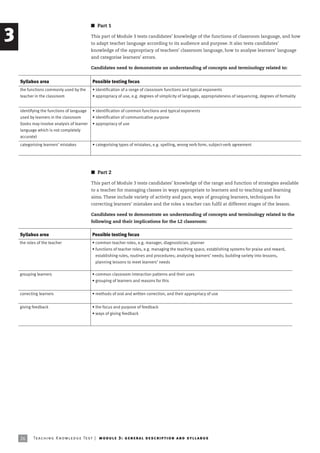
3                                              This part of Module 3 tests candidates’ knowledge of the functions of classroom language, and how
                                               to adapt teacher language according to its audience and purpose. It also tests candidates’
                                               knowledge of the appropriacy of teachers’ classroom language, how to analyse learners’ language
                                               and categorise learners’ errors.

                                               Candidates need to demonstrate an understanding of concepts and terminology related to:


    Syllabus area                               Possible testing focus
    the functions commonly used by the          • identification of a range of classroom functions and typical exponents
    teacher in the classroom                    • appropriacy of use, e.g. degrees of simplicity of language, appropriateness of sequencing, degrees of formality


    identifying the functions of language       • identification of common functions and typical exponents
    used by learners in the classroom           • identification of communicative purpose
    (tasks may involve analysis of learner      • appropriacy of use
    language which is not completely
    accurate)
    categorising learners’ mistakes             • categorising types of mistakes, e.g. spelling, wrong verb form, subject-verb agreement


                                               I Part 2

                                               This part of Module 3 tests candidates’ knowledge of the range and function of strategies available
                                               to a teacher for managing classes in ways appropriate to learners and to teaching and learning
                                               aims. These include variety of activity and pace, ways of grouping learners, techniques for
                                               correcting learners’ mistakes and the roles a teacher can fulfil at different stages of the lesson.

                                               Candidates need to demonstrate an understanding of concepts and terminology related to the
                                               following and their implications for the L2 classroom:


    Syllabus area                               Possible testing focus
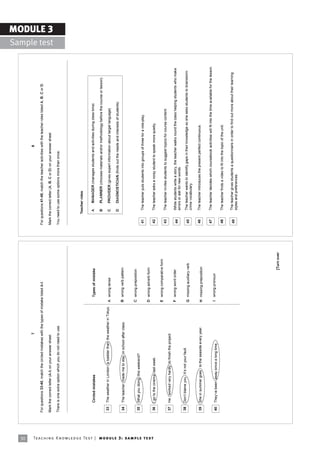
    the roles of the teacher                    • common teacher roles, e.g. manager, diagnostician, planner
                                                • functions of teacher roles, e.g. managing the teaching space, establishing systems for praise and reward,
                                                  establishing rules, routines and procedures; analysing learners’ needs; building variety into lessons,
                                                  planning lessons to meet learners’ needs

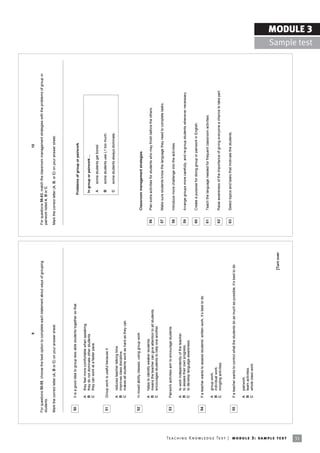
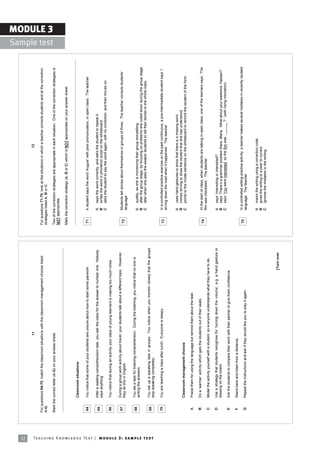
    grouping learners                           • common classroom interaction patterns and their uses
                                                • grouping of learners and reasons for this


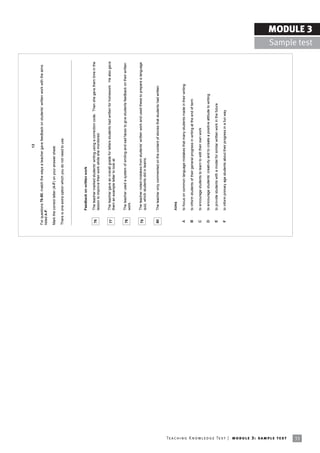
    correcting learners                         • methods of oral and written correction, and their appropriacy of use


    giving feedback                             • the focus and purpose of feedback
                                                • ways of giving feedback


    26     Te ac h i n g K n o w l e d g e Te s t | mo d u l e 3 : g e n e r a l d e sc r i p t i o n a n d s y l l a b us
Candidate
                                                                                                                                                                                                                                          2
                                                                                                                                                      Centre Number      Number

                                                                            Candidate Name
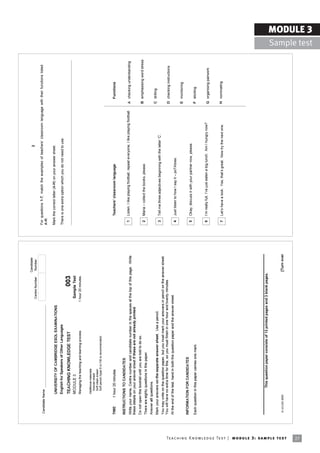
                                                                                                                                                                                     For questions 1-7, match the examples of teachersí classroom language with their functions listed
                                                                                                                                                                                     A-H.

                                                                                            UNIVERSITY OF CAMBRIDGE ESOL EXAMINATIONS                                                Mark the correct letter (A-H) on your answer sheet.

                                                                                            English for Speakers of Other Languages                                                  There is one extra option which you do not need to use.
                                                                                            TEACHING KNOWLEDGE TEST                                           003
                                                                                            MODULE 3                                                  Sample Test
                                                                                            Managing the teaching and learning process              1 hour 20 minutes


                                                                                            Additional materials:
                                                                                              Answer sheet
                                                                                              Soft clean eraser
                                                                                              Soft pencil (type B or HB is recommended)


                                                                            TIME       1 hour 20 minutes                                                                                  Teachersí classroom language                                                    Functions

                                                                            INSTRUCTIONS TO CANDIDATES
                                                                                                                                                                                      1   Listen, I like playing football, repeat everyone, I like playing football.   A checking understanding
                                                                            Write your name, Centre number and candidate number in the spaces at the top of this page. Write
                                                                            these details on your answer sheet if these are not already printed.
                                                                            Do not open this booklet until you are told to do so.
                                                                                                                                                                                      2   Maria ñ collect the books, please.                                           B emphasising word stress
                                                                            There are eighty questions in this paper.
                                                                            Answer all questions.
                                                                            Mark your answers on the separate answer sheet. Use a pencil.                                                                                                                              C drilling
                                                                                                                                                                                      3   Tell me three adjectives beginning with the letter ëCí.
                                                                            You may write on the question paper, but you must mark your answers in pencil on the answer sheet.
                                                                            You will have no extra time for this, so you must finish in one hour and twenty minutes.                                                                                                   D checking instructions
                                                                            At the end of the test, hand in both the question paper and the answer sheet.
                                                                                                                                                                                      4   Just listen to how I say it ñ poTAtoes.
                                                                                                                                                                                                                                                                       E monitoring
                                                                            INFORMATION FOR CANDIDATES
                                                                                                                                                                                      5   Okay, discuss it with your partner now, please.
                                                                            Each question in this paper carries one mark.                                                                                                                                              F eliciting


                                                                                                                                                                                      6   Iím really full, Iíve just eaten a big lunch. Am I hungry now?               G organising pairwork


                                                                                                                                                                                      7   Letís have a look. Yes, thatís great. Now try the next one.                  H nominating


                                                                            ________________________________________________________
                                                                                                This question paper consists of 13 printed pages and 3 blank pages.


                                                                             © UCLES 2005                                                                               [Turn over


Te ac h i n g K n o w l e d g e Te s t | mo d u l e 3 : sa m p l e te s t
27
                                                                                                                                                                                                                                                                                                                 MODULE 3
                                                                                                                                                                                                                                                                                                   Sample test
28
                                                                                                                                 3                                                                                                    4

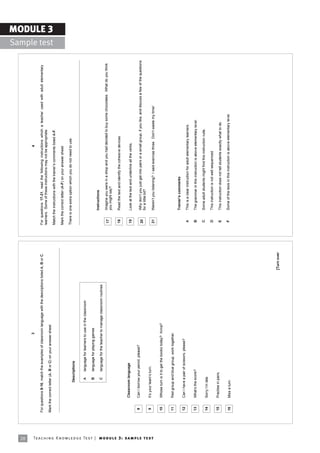
                                                                            For questions 8-16, match the examples of classroom language with the descriptions listed A, B or C.   For questions 17-21, read the following instructions which a teacher used with adult elementary
                                                                                                                                                                                   learners. Some of these instructions may not be appropriate.
                                                                            Mark the correct letter (A, B or C) on your answer sheet.
                                                                                                                                                                                                                                                                                                                MODULE 3
                                                                                                                                                                                                                                                                                                  Sample test
                                                                                                                                                                                   Match the instructions with the trainerís comments listed A-F.

                                                                                                                                                                                   Mark the correct letter (A-F) on your answer sheet.

                                                                                                                                                                                   There is one extra option which you do not need to use.
                                                                                               Descriptions


                                                                                                 A        language for learners to use in the classroom

                                                                                                 B        language for playing games
                                                                                                                                                                                            Instructions
                                                                                                 C        language for the teacher to manage classroom routines
                                                                                                                                                                                    17      Imagine you were in a shop and you had decided to buy some chocolates. What do you think
                                                                                                                                                                                            you might say?

                                                                                                                                                                                    18      Read the text and identify the cohesive devices.

                                                                                     Classroom language                                                                             19      Look at the text and underline all the verbs.

                                                                             8       Can I borrow your pencil, please?
                                                                                                                                                                                    20      Why donít you just get into pairs or a small group, if you like, and discuss a few of the questions
                                                                                                                                                                                            for a little bit?
                                                                             9       Itís your teamís turn.


Te ac h i n g K n o w l e d g e Te s t | mo d u l e 3 : sa m p l e te s t
                                                                                                                                                                                    21      Werenít you listening? I said exercise three. Donít waste my time!

                                                                             10      Whose turn is it to get the books today? Anna?


                                                                             11      Red group and blue group, work together.
                                                                                                                                                                                            Trainerís comments
                                                                             12      Can I have a pair of scissors, please?
                                                                                                                                                                                    A       This is a clear instruction for adult elementary learners.

                                                                             13      Whatís the score?                                                                              B       The grammar in this instruction is above elementary level.

                                                                                                                                                                                    C       Some adult students might find this instruction rude.
                                                                             14      Sorry Iím late.
                                                                                                                                                                                    D       This instruction is not well sequenced.
                                                                             15      Practise in pairs.
                                                                                                                                                                                    E       This instruction does not tell students exactly what to do.

                                                                             16      Miss a turn.                                                                                   F       Some of the lexis in this instruction is above elementary level.


                                                                                                                                                                     [Turn over
5                                                                                                                6

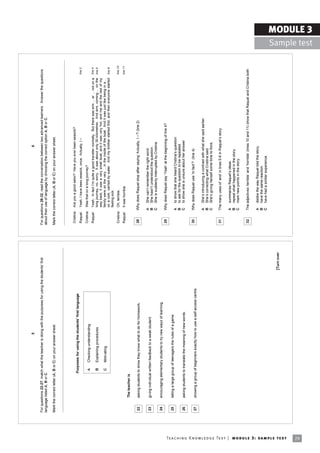
                                                                            For questions 22-27, match what the teacher is doing with the purposes for using the studentsí first     For questions 28-32, read the conversation between two advanced learners. Answer the questions
                                                                            language listed A, B or C.                                                                               about their use of language by choosing the correct option A, B or C.

                                                                            Mark the correct letter (A, B or C) on your answer sheet.                                                Mark the correct letter (A, B or C) on your answer sheet.


                                                                                                                                                                                      Cristina:       Are you a good sailor? Have you ever been seasick?
                                                                                                      Purposes for using the studentsí first language
                                                                                                                                                                                      Raquel:         Yeah, I have been seasick, once. Actually, I ñ                                               line 2

                                                                                                                                                                                      Cristina:       Was that on a long journey?
                                                                                                       A    Checking understanding
                                                                                                                                                                                      Raquel:         Yeah. In fact Iím quite a good traveller normally. But there was erm ... er ... not on a     line 4
                                                                                                       B    Explaining procedures                                                                     long journey, no, sorry. It was about only 30 kilometres. And erm, coming ... on the         line 5
                                                                                                                                                                                                      way back, it was a very small boat, and it was very hot, and me and the rest of my
                                                                                                       C    Motivating                                                                                family were on the very ... in the inside of the boat. And it was just like being in a ...
                                                                                                                                                                                                      on a cork, carried by water. And my brother started first, and then everyone started         line 8
                                                                                                                                                                                                      feeling sick.
                                                                                                                                                                                      Cristina:       Oh, terrible.                                                                                line 10

                                                                                                                                                                                      Raquel:         It was horrible.                                                                             line 11
                                                                                     The teacher is

                                                                             22      asking students to show they know what to do for homework.                                       28          Why does Raquel stop after saying ëActually, I ñí? (line 2)

                                                                                                                                                                                                  A      She canít remember the right word.
                                                                             23      giving individual written feedback to a weak student.                                                        B      She hasnít understood the question.
                                                                                                                                                                                                  C      She is suddenly interrupted by Cristina.
                                                                             24      encouraging elementary students to try new ways of learning.
                                                                                                                                                                                      29          Why does Raquel say ëYeahí at the beginning of line 4?
                                                                             25      telling a large group of teenagers the rules of a game.
                                                                                                                                                                                                  A      to show that she heard Cristinaís question
                                                                                                                                                                                                  B      to ask for the question to be repeated
                                                                             26      asking students to translate the meaning of new words.                                                       C      to show she is unsure about her answer

                                                                                                                                                                                      30          Why does Raquel use ëIn factí? (line 4)
                                                                             27      showing a group of beginners exactly how to use a self-access centre.

                                                                                                                                                                                                  A      Sheís introducing a contrast with what she said earlier.
                                                                                                                                                                                                  B      Sheís correcting what Cristina said.
                                                                                                                                                                                                  C      Sheís giving herself some time to think.

                                                                                                                                                                                      31          The many uses of ëandí in lines 5-8 in Raquelís story

                                                                                                                                                                                                  A      summarise Raquelís ideas.
                                                                                                                                                                                                  B      repeat what happened in the story.
                                                                                                                                                                                                  C      mark new points in the story.

                                                                                                                                                                                      32          The adjectives ëterribleí and ëhorribleí (lines 10 and 11) show that Raquel and Cristina both

                                                                                                                                                                                                  A      dislike the way Raquel told the story.
                                                                                                                                                                                                  B      have the same reaction.
                                                                                                                                                                                                  C      have had a similar experience.


                                                                                                                                                                        [Turn over


Te ac h i n g K n o w l e d g e Te s t | mo d u l e 3 : sa m p l e te s t
29
                                                                                                                                                                                                                                                                                                                           MODULE 3
                                                                                                                                                                                                                                                                                                             Sample test
30
                                                                                                                              7                                                                                                         8

                                                                            For questions 33-40, match the circled mistakes with the types of mistake listed A-I.                  For questions 41-49, match the teacher activities with the teacher roles listed A, B, C or D.

                                                                            Mark the correct letter (A-I) on your answer sheet.                                                    Mark the correct letter (A, B, C or D) on your answer sheet.
                                                                                                                                                                                                                                                                                                             MODULE 3
                                                                                                                                                                                                                                                                                               Sample test
                                                                            There is one extra option which you do not need to use.                                                You need to use some options more than once.


                                                                                                                                                                                          Teacher roles


                                                                                  Circled mistakes                                                    Types of mistake                     A     MANAGER (manages students and activities during class time)

                                                                                                                                                                                           B     PLANNER (chooses materials and/or methodology before the course or lesson)
                                                                             33   The weather in London is badder than the weather in Tokyo.       A wrong tense                           C     PROVIDER (gives expert information about target language)

                                                                                                                                                                                           D     DIAGNOSTICIAN (finds out the needs and interests of students)
                                                                             34   The teacher made me to stay in school after class.               B wrong verb pattern


                                                                                                                                                   C wrong preposition
                                                                             35   What you doing this weekend?
                                                                                                                                                                                    41      The teacher puts students into groups of three for a role-play.
                                                                                                                                                   D wrong adverb form


Te ac h i n g K n o w l e d g e Te s t | mo d u l e 3 : sa m p l e te s t
                                                                             36   I go to the cinema last week.                                                                     42      The teacher asks a noisy student to speak more quietly.

                                                                                                                                                   E wrong comparative form
                                                                                                                                                                                    43      The teacher invites students to suggest topics for course content.
                                                                             37   He worked very hardly to finish the project.
                                                                                                                                                   F wrong word order
                                                                                                                                                                                    44      While students write a story, the teacher walks round the class helping students who make
                                                                                                                                                                                            errors or ask for new words.
                                                                             38   Donít blame you. Itís not your fault.                                                                     The teacher wants to identify gaps in their knowledge so she asks students to brainstorm
                                                                                                                                                   G missing auxiliary verb         45
                                                                                                                                                                                            crime vocabulary.

                                                                             39   She in summer goes to the seaside every year.                    H missing preposition            46      The teacher introduces the present perfect continuous.


                                                                                                                                                                                    47      The teacher decides which coursebook activities will fit into the time available for the lesson.
                                                                             40   Theyíve been away since a long time.                             I wrong pronoun

                                                                                                                                                                                    48      The teacher finds a video to fit into the topic of the unit.


                                                                                                                                                                                    49      The teacher gives students a questionnaire in order to find out more about their learning
                                                                                                                                                                                            styles and preferences.


                                                                                                                                                                      [Turn over
9                                                                                                       10

                                                                            For questions 50-55, choose the best option to complete each statement about ways of grouping            For questions 56-63, match the classroom management strategies with the problems of group or
                                                                            students.                                                                                                pairwork listed A, B or C.

                                                                            Mark the correct letter (A, B or C) on your answer sheet.                                                Mark the correct letter (A, B, or C) on your answer sheet.


                                                                             50      It is a good idea to group less able students together so that
                                                                                                                                                                                                        Problems of group or pairwork

                                                                                     A    they feel more comfortable when speaking.
                                                                                     B    they do not dominate other students.                                                                           In group or pairwork ...
                                                                                     C    they can work at a faster pace.
                                                                                                                                                                                                          A    some students get bored.

                                                                             51      Group work is useful because it                                                                                      B    some students use L1 too much.

                                                                                                                                                                                                          C    some students always dominate.
                                                                                     A    reduces teacher talking time.
                                                                                     B    improves class discipline.
                                                                                     C    makes all students work as hard as they can.


                                                                             52      In mixed ability classes, using group work
                                                                                                                                                                                              Classroom management strategies

                                                                                     A    helps to identify weaker students.
                                                                                     B    means the teacher can give attention to all students.                                       56      Plan extra activities for students who may finish before the others.
                                                                                     C    encourages students to help one another.
                                                                                                                                                                                      57      Make sure students know the language they need to complete tasks.

                                                                             53      Pairwork activities aim to encourage students
                                                                                                                                                                                      58      Introduce more challenge into the activities.
                                                                                     A    to work independently of the teacher.
                                                                                     B    to assess their own progress.                                                               59      Arrange groups more carefully, and re-group students whenever necessary.
                                                                                     C    to develop language awareness.

                                                                                                                                                                                      60      Create a purpose for doing group or pairwork in English.
                                                                             54      If a teacher wants to assess studentsí written work, itís best to do
                                                                                                                                                                                      61      Teach the language needed for frequent classroom activities.
                                                                                     A    group work.
                                                                                     B    individual work.
                                                                                     C    mingling activities.                                                                        62      Raise awareness of the importance of giving everyone a chance to take part.


                                                                                                                                                                                      63      Select topics and tasks that motivate the students.
                                                                             55      If a teacher wants to control what the students do as much as possible, itís best to do

                                                                                     A    pairwork.
                                                                                     B    team activities.
                                                                                     C    whole class work.


                                                                                                                                                                        [Turn over


Te ac h i n g K n o w l e d g e Te s t | mo d u l e 3 : sa m p l e te s t
31
                                                                                                                                                                                                                                                                                                  MODULE 3
                                                                                                                                                                                                                                                                                    Sample test
32
                                                                                                                              11                                                                                                         12

                                                                            For questions 64-70, match the classroom situations with the classroom management choices listed           For questions 71-75, look at the situations in which a teacher corrects students and at the correction
                                                                            A-G.                                                                                                       strategies listed A, B or C.
                                                                                                                                                                                                                                                                                                                MODULE 3
                                                                                                                                                                                                                                                                                                  Sample test
                                                                            Mark the correct letter (A-G) on your answer sheet.                                                        Two of the correction strategies are appropriate in each situation. One of the correction strategies is
                                                                                                                                                                                       NOT appropriate.

                                                                                                                                                                                       Mark the correction strategy (A, B or C) which is NOT appropriate on your answer sheet.


                                                                                     Classroom situations

                                                                             64      You notice that some of your students are unsure about how to start some pairwork.                 71      A student says the word ëAugustí with poor pronunciation, in open class. The teacher


                                                                             65      After a reading comprehension task, you ask the class for the answer to number one. Nobody                 A    says the word correctly, and asks the student to repeat it.
                                                                                     says anything.                                                                                             B    writes the word in phonemic script on the whiteboard.
                                                                                                                                                                                                C    asks the student to say the word again, with no correction, and then moves on.
                                                                             66      You notice that during an activity your class of young learners is making too much noise.


                                                                             67      During a group work activity about travel, your students talk about a different topic. However,            Students tell stories about themselves in groups of three. The teacher corrects studentsí
                                                                                     they do this in English.                                                                           72
                                                                                                                                                                                                language

                                                                             68      You set a task for listening comprehension. During the listening, you notice that no one is
                                                                                     writing the answers.                                                                                       A    quietly, as she is monitoring their group storytelling.
                                                                                                                                                                                                B    after the group stage, by focusing on problems she noted down during the group stage.
                                                                                                                                                                                                C    later when she asks the weaker students to tell their stories to the whole class.
                                                                             69      You set up a speaking task in groups. You notice when you monitor closely that the groups


Te ac h i n g K n o w l e d g e Te s t | mo d u l e 3 : sa m p l e te s t
                                                                                     stop speaking completely.

                                                                             70      You are teaching a class after lunch. Everyone is sleepy.                                          73      In a controlled practice exercise on the past continuous, a pre-intermediate student says ëI
                                                                                                                                                                                                driving down the road when it happened.í The teacher


                                                                                                                                                                                                A    uses hand gestures to show that there is a missing word.
                                                                                                                                                                                                B    mimes driving to show the student that she has understood.
                                                                                     Classroom management choices                                                                               C    points to the model sentence on the whiteboard to remind the student of the form.
                                                                             A       Praise them for using the language but remind them about the task.

                                                                             B       Do a ëwarmerí activity which gets the students out of their seats.                                         At the start of class, when students are talking in open class, one of the learners says, ëThe
                                                                                                                                                                                        74
                                                                                                                                                                                                film was interested.í The teacher
                                                                             C       Model the activity yourself with a student, so everyone understands what they have to do.

                                                                             D       Use a strategy that students recognise for ëturning down the volumeí, e.g. a hand gesture or               A    says ëInteresting or interested?í
                                                                                     drawing on the board.                                                                                      B    says ëThereís a grammar problem there, Maria. What about your weekend, Hassan?í
                                                                                                                                                                                                C    says ëYou were interested, so the film was ______ ?í (with rising intonation)
                                                                             E       Ask the students to compare their work with their partner to give them confidence.

                                                                             F       Stand back and listen from a distance.
                                                                                                                                                                                        75      In a controlled writing practice activity, a learner makes several mistakes in recently studied
                                                                             G       Repeat the instructions and ask if they would like you to play it again.                                   language. The teacher


                                                                                                                                                                                                A    marks the writing using a correction code.
                                                                                                                                                                                                B    gives the writing to a peer to correct.
                                                                                                                                                                                                C    ignores the mistakes in the writing.


                                                                                                                                                                        [Turn over
13

                                                                            For questions 76-80, match the ways a teacher gave feedback on studentsí written work with the aims
                                                                            listed A-F.

                                                                            Mark the correct letter (A-F) on your answer sheet.

                                                                            There is one extra option which you do not need to use.


                                                                                     Feedback on written work

                                                                             76      The teacher marked studentsí writing using a correction code. Then she gave them time in the
                                                                                     lesson to improve their work while she monitored.


                                                                             77      The teacher gave an overall grade for letters students had written for homework. He also gave
                                                                                     them an example letter to look at.


                                                                             78      The teacher used a system of smiling and sad faces to give students feedback on their written
                                                                                     work.


                                                                             79      The teacher noted mistakes from studentsí written work and used these to prepare a language
                                                                                     quiz, which students did in teams.


                                                                             80      The teacher only commented on the content of stories that students had written.


                                                                                     Aims

                                                                             A       to focus on common language mistakes that many students made in their writing

                                                                             B       to inform students of their general progress in writing at the end of term

                                                                             C       to encourage students to learn to edit their own work

                                                                             D       to encourage studentsí creativity and to create a positive attitude to writing

                                                                             E       to provide students with a model for similar written work in the future

                                                                             F       to inform primary age students about their progress in a fun way


Te ac h i n g K n o w l e d g e Te s t | mo d u l e 3 : sa m p l e te s t
33
                                                                                                                                                                                                   MODULE 3
                                                                                                                                                                                     Sample test
TKT test administration                                                          Band     A candidate at this level demonstrates
                                                                                          limited knowledge of TKT content areas
I Modular structure                                                              1
                                                                                          basic, but systematic knowledge of TKT content areas
TKT has three modules. These can be taken together in one
examination session or separately, in any order, over three
                                                                                 2
                                                                                          breadth and depth of knowledge of TKT content areas
sessions.

I Entry procedure
                                                                                 3
                                                                                          extensive knowledge of TKT content areas
Candidates must enter through an authorised Cambridge                            4
ESOL Centre. A list of Cambridge ESOL Examination Centres is
available from Cambridge ESOL from the address on page 1.                        Our trialling research indicates that for a candidate to achieve
Institutions wishing to become Cambridge ESOL Examination                        TKT Band 3, a score of at least 45–50 marks (out of 80) is
Centres should contact the Centre Registration Unit at                           required.
Cambridge ESOL.                                                                  The reporting of results for TKT is subject to ongoing research.

TKT is available throughout the year and Centres contact                         Further guidance on the interpretation of results will be issued

Cambridge ESOL to arrange a test date. Candidate details must                    in the future.

be submitted to Cambridge ESOL at least six weeks prior to
running the session. Please note that more notice may be                         I Notification of results
necessary if candidates have special requirements and                            Certificates are despatched to Centres approximately two
therefore need special arrangements (see below).                                 weeks after receipt of answer sheets by Cambridge ESOL.

Candidates may not repeat a module within four months at                         Please note that despatch of candidates’ certificates will be

any centre.                                                                      delayed if they need Special Consideration or are suspected of
                                                                                 malpractice (see page 35).
Copies of the Regulations and more details on entry
procedure, current fees and further information about this and                   Enquiries on results may be made through Cambridge ESOL

other Cambridge ESOL examinations can be obtained from the                       Local Secretaries within a month of the issue of certificates.

Cambridge ESOL Local Secretary in your area, or from the
address on page 1.                                                               I Appeals procedure

                                                                                 Cambridge ESOL provides a service to enable Centres to
I Answer sheet completion                                                        appeal, on behalf of candidates, against assessment decisions

Candidates mark all their answers on OMR (Optical Mark                           that affect grades awarded to candidates, e.g. decisions

Reader) answer sheets, which are scanned by computer in                          relating to results and decisions relating to irregular conduct.

Cambridge. There is one answer sheet per module, and                             Candidates should first contact their Cambridge ESOL Local
candidates must fill in all their answers within the time                        Secretary for advice. Further information about the appeals
allowed for the test.                                                            procedure can be found at www.CambridgeESOL.org/support

A sample OMR answer sheet can be found on page 44 of this
Handbook, and it is useful for candidates to practise filling in
an OMR sheet before taking the examination so that they are                      Special Circumstances
familiar with the procedure.

                                                                                 Special Circumstances cover three main areas: special
                                                                                 arrangements, special consideration and malpractice.

Grading and results
                                                                                 I Special arrangements
I Grading                                                                        These are available for candidates with disabilities. They may

Each module is free-standing, and there is no aggregate score.                   include extra time, separate accommodation or equipment,

Candidates receive a certificate for each module they take.                      Braille versions of question papers, etc. If you think you may
                                                                                 need special arrangements, you must contact the Cambridge
Each question carries one mark, so the maximum mark for                          ESOL Local Secretary in your area as soon as possible so that
each module is 80. Candidate performance is reported using                       the application can be sent to Cambridge ESOL in time
four bands.                                                                      (usually 8–12 weeks before the examination, depending on
                                                                                 what is required).


 34    Te ac h i n g K n o w l e d g e Te s t | te s t a dm i n is tr at i o n
I Special consideration                                            I Question paper production cycle

Cambridge ESOL will give special consideration to candidates       Pretesting of TKT test material provides Cambridge ESOL with
affected by adverse circumstances before or during an              valuable information about candidates’ performance on
examination. Special consideration can be given where an           particular tasks. Pretesting is also useful for Centres or
application is sent through the Centre and is made within ten      institutions as it gives candidates the opportunity to
working days of the examination date. Examples of acceptable       familiarise themselves with TKT task-types under test
reasons for giving special consideration are cases of illness or   conditions and to receive feedback on areas of strength and
other unexpected events.                                           weakness. If your Centre or institution would like to be
                                                                   involved in TKT pretesting, please contact the Pretesting Unit
I Malpractice                                                      TKT Administrator on + 44 1223 553772.

The Malpractice Committee will consider cases where
candidates are suspected of copying, collusion or breaking the
examination regulations in some other way. Results may be          Support for TKT candidates
withheld because further investigation is needed or because of
infringement of regulations. Centres are notified if a
                                                                   and course providers
candidate’s results are being investigated.
                                                                   General information on TKT, including administration details
                                                                   and downloadable versions of this Handbook and sample
                                                                   materials, can be found by visiting
The production of TKT                                              www.CambridgeESOL.org/TKT

                                                                   Course providers and individual candidates can also access
Cambridge ESOL is committed to providing examinations of
                                                                   the TKT Glossary on this website.
the highest possible quality. This commitment is underpinned
by an extensive programme of research and evaluation, and by       Support material for teacher trainers is available on the
continuous monitoring of the marking and grading of all            Teaching Resources website
Cambridge ESOL examinations. Of particular importance is the       www.CambridgeESOL.org/teach/TKT
rigorous set of procedures which are used in the production
                                                                   The TKT Course, published by Cambridge University Press in
and pretesting of question papers.
                                                                   collaboration with Cambridge ESOL, is available from mid-
The production process for TKT is the same as that for the         April 2005. This coursebook provides approximately 60–90
Cambridge ESOL language examinations. It begins with the           hours of classroom-based or self-access study, and includes
commissioning of materials and ends with the printing of           practice tasks and tests.
question papers.
                                                                   Further support is also available in the form of seminar
There are five main stages in the production process               programmes in different countries. Contact Cambridge ESOL
                                                                   Information for further details by e-mailing:
   • commissioning
                                                                   ESOLinfo@ucles.org.uk
   • pre-editing and editing

   • pretesting

   • analysis and banking of materials

   • question paper construction


                   Commissioning of material
                      for question papers


                     Pre-editing and editing
                           of material


      Revision        Pretest construction      Rejection

                           Pretesting


                         Item analysis

                      Live materials bank


                        Question paper
                         construction


                                                                    Te ac h i n g K n o w l e d g e Te s t | te s t a dm i n is tr at i o n   35
Common questions and                                                                  TKT wordlist
answers                                                                               This list is indicative only. Other terms may also be used in TKT.

                                                                                      The words are entered into categories so as to help the reader.
Can candidates make notes on the question paper?
                                                                                      Some words could fall into more than one category and could
Candidates may write on the question paper during the
                                                                                      appear in different modules. However, to economise on space
examination, but their notes will not be marked. Candidates
                                                                                      each word has been entered only once. Candidates who are
must complete an answer sheet, which is then scanned.
                                                                                      preparing for only one module should ensure they have an
Does it matter if candidates write in pen or pencil?                                  understanding of all the TKT terminology.
Candidates must use a pencil to mark their answers on the
                                                                                      The TKT Glossary contains definitions of the words in this list
answer sheet. Answer sheets marked in pen cannot be read by
                                                                                      and can be downloaded from www.CambridgeESOL.org/TKT
computer.

Is the use of dictionaries allowed?
No.                                                                                   Module 1
What is the mark allocation?                                                          Concepts and terminology for describing language
One mark is given for each correct answer.
                                                                                      GRAMMAR
Do candidates have to take all three modules?
                                                                                      Active voice
No. The modules are free-standing. Candidates may enter for
                                                                                      Adjective
any number of modules in any order.
                                                                                      Adverb
What is the pass mark?
                                                                                      Article
Results are reported in four bands. There is no pass or fail.
Candidates receive a certificate for each module taken.                               Aspect

                                                                                      Auxiliary verb
What is the date of the TKT examination?
Dates are set by Centres in consultation with Cambridge ESOL,                         Base form of the verb

taking into account local needs and conditions.                                       Clause

Where can candidates enrol?                                                           Collective noun

Your Cambridge ESOL Local Secretary can give you                                      Comparative adjective
information about Centres where the examination is taken.                             Compound noun
Candidates enrol through local Centres, and not through the
                                                                                      Conditional
Cambridge ESOL office in Cambridge. Fees are payable to the
                                                                                      Conditional forms
local Centre.
                                                                                      Conjunction
How do candidates get their results?
                                                                                      Connector
TKT certificates are issued to Centres approximately two
weeks after receipt of answer sheets by Cambridge ESOL.                               Countable noun

                                                                                      Demonstrative adjective
Do candidates need to have taken a particular English
language examination before taking TKT?                                               Demonstrative pronoun
No. However, it is advisable for candidates to have a minimum                         Dependent preposition
language level of Council of Europe Framework level B1.                               Determiner

What kind of teaching terminology will be tested in TKT?                              Direct question
Opposite is the TKT wordlist which contains terms which may                           Direct speech
be used in TKT.
                                                                                      First conditional
A non-exhaustive list of the teaching terms and their
                                                                                      Gerund, -ing form
definitions which could be tested in TKT can be found in the
                                                                                      Grammatical structure
TKT Glossary at www.CambridgeESOL.org/TKT
                                                                                      Imperative
What is the TKT portfolio?
                                                                                      Indirect question
The portfolio is an electronic resource in which candidates
keep a record of their teaching experience, beliefs and                               Indirect speech
aspirations for the future. The portfolio does not form part of                       Infinitive
the assessment for TKT. Candidates who register for TKT will
                                                                                      Infinitive of purpose
receive more information on how to access their portfolio.
                                                                                      -ing/-ed adjective

                                                                                      Intensifier


36     Te ac h i n g K n o w l e d g e Te s t | com mo n q u e s t i o ns a n d a ns w e r s
Interrogative                                        LEXIS

Irregular verb                                       Affix
Main clause                                          Affixation
Modal verb                                           Antonym
Noun                                                 Collocation
Object                                               Compounds
Object pronoun                                       False friend
Participle (past and present)                        Homophone
Passive voice                                        Idiom
Past perfect simple and continuous, progressive      Lexical set
Past simple and past continuous, progressive         Lexis
Personal pronoun                                     Multi-word verb
Phrase                                               Part(s) of speech
Plural noun                                          Phrasal verb
Possessive adjective                                 Prefix
Possessive pronoun                                   Suffix
Possessive ‘s’ and whose                             Synonym
Preposition

Present continuous, progressive for future           PHONOLOGY

Present perfect simple and continuous, progressive   Connected speech

Present simple and continuous, progressive           Consonant

Pronoun                                              Contraction

Proper noun                                          Diphthong

Punctuation                                          Feature (of connected speech)

Quantifier                                           Intonation

Question tag                                         Linking

Reflexive pronoun                                    Main stress

Regular verb                                         Minimal pair

Relative clause                                      Phoneme

Relative pronoun                                     Phonemic script

Reported statement                                   Phonemic symbols

Reporting verb                                       Phonemic transcription

Second conditional                                   Rhyme

Singular noun                                        Rhythm

Subject                                              Schwa

Subject-verb agreement                               Sentence stress

Subordinate clause                                   Stress

Superlative adjective                                Strong forms

Tense                                                Syllable

Third conditional                                    Unvoiced sound

Third person                                         Voiced sound

Time expression                                      Vowel

Uncountable noun                                     Weak forms

Used to                                              Word stress

Verb

Verb pattern


                                                                    Te ac h i n g K n o w l e d g e Te s t | w o r d l is t   37
FUNCTIONS                                                           Interaction

Appropriacy                                                         Interactive strategies

Appropriate                                                         Layout

                                                                    Listen/read for detail
Colloquial
                                                                    Listen/read for gist
Declining, refusing an invitation
                                                                    Listen/read for mood
Enquiring
                                                                    Note-taking
Express
                                                                    Oral fluency
Expressing ability
                                                                    Paragraph
Expressing intention
                                                                    Paraphrase
Expressing necessity
                                                                    Predict
Expressing obligation
                                                                    Prediction
Expressing permission
                                                                    Process
Expressing preference
                                                                    Process writing
Expressing probability
                                                                    Productive skills
Formal (language)
                                                                    Proofread
Formality (level of)
                                                                    Receptive skills
Function
                                                                    Re-draft
Functional exponent
                                                                    Scan
Greeting
                                                                    Skill
Inappropriate
                                                                    Skim
Informal (language)
                                                                    Subskill
Informality (level of)
                                                                    Summarise
Instructing
                                                                    Summary
Making a (polite) request
                                                                    Take notes
Negotiating
                                                                    Text structure
Neutral
                                                                    Topic
Predicting
                                                                    Topic sentence
Register

Requesting
                                                                    Background to language learning
Speculating
                                                                    Achievable target, goal

                                                                    Acquire
Concepts and terminology for describing
                                                                    Acquisition
language skills
                                                                    Attention span
Accuracy
                                                                    Auditory learner
Authenticity
                                                                    Autonomous
Context
                                                                    Cognitive (processes)
Deduce meaning from context
                                                                    Confidence
Develop skills
                                                                    Conscious (of)
Draft
                                                                    Deductive learning
Edit
                                                                    Demotivate
Extensive listening/reading
                                                                    Developmental error
Extract
                                                                    Error
Fluency
                                                                    Expectation
Infer attitude, feeling, mood
                                                                    Expose
Intensive listening/reading
                                                                    Exposure
Interact


 38       Te ac h i n g K n o w l e d g e Te s t | w o r d l is t
Factor                    Background to language teaching
First language            PRESENTATION TECHNIQUES, APPROACHES AND
Focus on form             INTRODUCTORY ACTIVITIES

Goals                     Activity-based learning
Guidance                  Communicative Approach
Ignore (errors)           Concept checking
Independent study         Concept questions
Inductive learning        Content-based learning
Interference              Contextualise
Interlanguage             Define
Kinaesthetic learner      Definition
L1/L2                     Elicit
Language awareness        Emphasis
Learner autonomy          Emphasise
Learner characteristics   Functional Approach
Learner independence      Gesture
Learner training          Grammar-Translation method
Learning resources        Guided discovery
Learning strategies       Ice-breaker
Learning style            Illustrate meaning
Linguistic                Introductory activity
Mature                    Lexical Approach
Maturity                  Meaningful
Memorable                 Mime
Memorise                  Present
Mother tongue             Presentation
Motivate                  Presentation, Practice and Production (PPP)
Motivation                Situational presentation
Natural order             Structural Approach
Needs                     Task-based Learning (TBL)
Participate               Teaching strategy
Participation             Test-teach-test
Personalisation           Total Physical Response (TPR)
Personalise               Warm up
Pick up                   Warmer
Processing language
                          PRACTICE ACTIVITIES AND TASKS
Proficient

Silent period             Brainstorm

Slip                      Categorisation

Target language culture   Categorise

Unmotivated               Chant

Visual learner            Choral drill

Work language out         Communicative activity

                          Controlled practice

                          Drill

                          Extension task

                          Freer practice


                                           Te ac h i n g K n o w l e d g e Te s t | w o r d l is t   39
Gap-fill                                                           Open comprehension questions
Guided writing                                                     Oral test
Individual drill                                                   Peer assessment, evaluation
Information-gap activity                                           Placement test
Jigsaw listening/reading                                           Portfolio
Jumbled paragraphs, pictures, sentences                            Proficiency test
Label                                                              Progress test
Less controlled practice                                           Self-assessment, evaluation
Mind map                                                           Sentence completion
Picture stories                                                    Sentence transformation
Practice                                                           Subjective test
Prioritising                                                       Summative test
Problem solving                                                    Test
Project work                                                       True/false questions
Rank ordering                                                      Tutorial
Restricted practice

Revise

Revision                                                           Module 2
Role-play
                                                                   Lesson planning
Substitution drill
                                                                   Achieve aims, objectives
Survey
                                                                   Aim
Target language
                                                                   Analyse language
Task
                                                                   Anticipate language problems
Task-type
                                                                   Arouse, generate interest
Transformation drill
                                                                   Assumptions
Visualisation
                                                                   Class profile
Visualise
                                                                   Components (of a lesson plan)
Word map
                                                                   Conduct feedback
ASSESSMENT                                                         Consolidate

Achievement test                                                   Elicit feedback

Assess                                                             Enable

Assessment                                                         Encourage

Assessment criteria                                                Encouragement

Cloze test                                                         Feedback

Continuous assessment                                              Focus on

Diagnose                                                           Give feedback

Diagnostic test                                                    Highlight

Evaluation                                                         Lead-in

Formal assessment, evaluation                                      Main aim

Formative assessment, evaluation                                   Pace

Informal assessment, evaluation                                    Peer feedback

Item                                                               Personal aim

Learner profile                                                    Pre-teach (vocabulary)

Matching task                                                      Procedure

Multiple-choice questions                                          Raise awareness

Objective test                                                     Recycle

                                                                   Reflect on teaching

 40      Te ac h i n g K n o w l e d g e Te s t | w o r d l is t
Reinforce                          Language laboratory
Scheme of work                     Leaflet
Sequence                           Learning centre
Set a question, task, test         Overhead projector (OHP)
Set the scene, the context         Overhead transparency (OHT)
Specification, to specify (aims)   Puppet
Stage                              Realia
Step                               Resources
Stimulate (discussion)             Rubric
Student-centred                    Self-access centre
Subsidiary aim                     Supplementary material
Syllabus                           Tapescript
Teacher talking time               Teacher’s book
Teacher-centred                    Teaching aids
Timing                             Textbook
Variety                            Transcript
Vary                               Video clip

                                   Visual (aid)

Reference resources                Workbook

Bilingual dictionary               Worksheet

Consult

Headword

Monolingual dictionary
                                   Module 3
Phonemic chart
                                   Teachers’ and learners’ language in the classroom
Reference materials
                                   Ask for clarification

                                   Clarify
Teaching materials and aids
                                   Convey meaning
Activity book
                                   Facial expression
Adapt (material)
                                   Hesitate
Audio script
                                   Model
Authentic material
                                   Narrate
Board game
                                   Praise
Book
                                   Prompt
Brochure
                                   Respond
Chart
                                   Response
Coursebook
                                   Word prompt
Coursebook unit

Crossword puzzle
                                   Learners’ mistakes and correction strategies
Dialogue
                                   Correction code
Dice
                                   Echo correct
Exploit (material)
                                   Over-application of the rule
Flashcard
                                   Over-generalisation
Flipchart
                                   Reformulate
Graded reader
                                   Reformulation
Graph
                                   Repetition
Grid
                                   Self-correction
Handout
                                   Time line

                                                   Te ac h i n g K n o w l e d g e Te s t | w o r d l is t   41
Classroom management

Active role
                                                                        MODULE 1
Classroom management                                                    answer key
Closed pairs

Co-operate
                                                                   1      B     36   C   74   H
Co-operation
                                                                   2      F     37   A   75   E
Co-operative
                                                                   3      C     38   B   76   C
Discipline
                                                                   4      A     39   C   77   F
Dominant
                                                                   5      E     40   B   78   A
Dominate
                                                                                         79   D
Energy levels
                                                                   6      E     41   B   80   B
Get students’ attention
                                                                   7      D     42   A
Grade (language)
                                                                   8      A     43   C
Group dynamics
                                                                   9      F     44   D
Interaction patterns
                                                                   10     B     45   C
Involvement
                                                                                46   D
Learning contract                                                  11     A
Mingle                                                             12     A     47   D
Mixed ability                                                      13     B     48   C
Mixed level                                                        14     B     49   A
Monitor                                                            15     B     50   H
Nominate                                                           16     C     51   E
One-to-one                                                                      52   G
Open class                                                         17     F     53   F
Open pairs                                                         18     A

Passive role                                                       19     C     54   C

Rapport, build rapport                                             20     E     55   D

Routine                                                            21     D     56   G

Seating arrangement                                                             57   B

Seating plan                                                       22     I     58   A

Teacher role                                                       23     A     59   F

Teaching space                                                     24     G

                                                                   25     H     60   A

                                                                   26     C     61   B

                                                                   27     D     62   C

                                                                   28     F     63   A

                                                                   29     B     64   B

                                                                                65   B
                                                                   30     D     66   C
                                                                   31     E

                                                                   32     B     67   A

                                                                   33     F     68   B

                                                                   34     C     69   C

                                                                   35     G     70   A

                                                                                71   A

                                                                                72   C

                                                                                73   B


42       Te ac h i n g K n o w l e d g e Te s t | w o r d l is t
MODULE 2                       MODULE 3
     answer key                     answer key

1      E     37   B   73   I   1      C              33         E              64          C

2      C     38   E   74   A   2      H              34         B              65          E

3      B     39   A   75   G   3      F              35         G              66          D

4      F     40   F   76   D   4      B              36         A              67          A

5      H     41   C   77   C   5      G              37         D              68          G

6      G              78   F   6      A              38         I              69          F

7      A     42   B   79   B   7      E              39         F              70          B
             43   A   80   E                         40         C
8      C     44   D            8      A                                        71          C

9      A     45   I            9      B              41         A              72          C

10     H     46   H            10     C              42         A              73          B

11     G     47   E            11     C              43         D              74          B

12     B     48   G            12     A              44         C              75          C

13     F     49   C            13     B              45         D
14     D                       14     A              46         C              76          C

             50   B            15     C              47         B              77          E

15     B     51   F            16     B              48         B              78          F

16     C     52   A                                  49         D              79          A

17     B     53   D            17     B                                        80          D

18     A     54   G            18     F              50         A
19     B     55   C            19     A              51         A
20     A     56   H            20     E              52         C
                               21     C              53         A
21     D     57   H                                  54         B
22     B     58   A            22     A              55         C
23     C     59   E            23     C

24     A     60   C            24     C              56         A
25     B     61   G            25     B              57         B
26     E     62   F            26     A              58         A
27     C     63   D            27     B              59         C
28     D     64   I                                  60         B
29     A                       28     C              61         B
             65   C            29     A              62         C
30     D     66   D            30     A              63         A
31     H     67   A            31     C

32     B     68   D            32     B

33     C     69   C
34     E     70   C
35     F     71   B
36     G     72   A


                                      Te ac h i n g K n o w l e d g e Te s t | a ns w e r k e ys   43
TKT
Sample OMR answer sheet


   44   Te ac h i n g K n o w l e d g e Te s t | sa m p l e om r a ns w e r s h e e t

1232521187tkt hb

  • 1.
    Preface This handbook isintended for course providers who are, or intend to become, involved in preparing candidates for the Teaching Knowledge Test (TKT). For further information on any of the Cambridge ESOL examinations and teaching awards, please contact: Cambridge ESOL Information, 1 Hills Road, Cambridge, CB1 2EU, United Kingdom Tel: +44 1223 553355, Fax: +44 1223 460278, e-mail: ESOL@ucles.org.uk, www.CambridgeESOL.org Contents 2 Introduction 4 An overview of TKT 4 Content of TKT 1 5 Module 1: General description and syllabus Language and background 8 Sample test to language learning and teaching 2 16 Module 2: General description and syllabus Lesson planning and use of 18 Sample test resources for language teaching 25 Module 3: General description and syllabus 3 Managing the teaching and 27 Sample test learning process 34 TKT test administration 34 Grading and results 34 Special Circumstances 35 The production of TKT 35 Support for TKT candidates and course providers 36 Common questions and answers 36 TKT wordlist 42 Module 1 answer key 43 Module 2 answer key 43 Module 3 answer key 44 Sample OMR answer sheet Te ac h i n g K n o w l e d g e Te s t | co nte nts 1
  • 2.
    TKT can betaken at any stage in a teacher’s career. It is Introduction suitable for pre-service or practising teachers and forms part I Introduction to Cambridge ESOL of a framework of Teaching Awards offered by Cambridge ESOL. This includes CELTA (Certificate in English Language The Teaching Knowledge Test (TKT) is designed and produced Teaching to Adults); CELTYL (Certificate in English Language by University of Cambridge ESOL Examinations (Cambridge Teaching to Young Learners); ICELT (In-service Certificate in ESOL), a department of the University of Cambridge and part English Language Teaching); and DELTA (Diploma in English of the University of Cambridge Local Examinations Syndicate, Language Teaching to Adults). These are based on the which has provided examinations in English for speakers of following content areas: subject knowledge, pedagogical other languages since 1913. Cambridge ESOL offers an knowledge, pedagogical content knowledge and knowledge of extensive range of examinations, certificates and diplomas for context. TKT covers the first three of these areas of learners and teachers of English, taken by over 1.5 million knowledge, but unlike the other Teaching Awards, TKT does people a year, in more than 130 countries. not assess knowledge of teaching context. This area is most appropriately assessed through teaching practice, which does I Introduction to TKT – a test of professional not form part of the assessment of TKT. knowledge for English language teachers Other teaching qualifications offered by Cambridge ESOL TKT tests knowledge about the teaching of English to speakers include two specifically designed for the further education of other languages. This knowledge includes concepts related and skills sector within the UK. to language, language use and the background to and practice of language teaching and learning and is assessed by means of A summary of the entry requirements and content of objective format tests, which are simple to administer and to Cambridge ESOL’s Teaching Awards can be found on the take. following page. TKT is designed to offer maximum flexibility and accessibility for candidates and therefore does not include a compulsory course component or compulsory teaching practice. However, it is likely that centres and other institutions will wish to offer courses for TKT preparation and these may also include some teaching practice, if desired. It should be noted that TKT tests teaching knowledge rather than teaching ability. TKT offers candidates a step in their professional development as teachers and enables them to move onto higher-level teaching qualifications and access professional support materials, such as journals about English language teaching (ELT). TKT candidates are encouraged to keep a portfolio, a record of their professional development and reflections on their teaching. Through their portfolio candidates should become reflective practitioners, analysing their teaching and how this impacts on their students’ learning. The portfolio does not form part of the assessment for TKT, however. 2 Te ac h i n g K n o w l e d g e Te s t | i ntr o d uc t i o n
  • 3.
    Cambridge ESOL TeachingAwards TKT CELTA CELTYL ICELT DELTA Selection procedure None Interview and task Interview and task Interview and task, Interview and task where appropriate Teaching experience None None None Must be teaching 2 years’ (1200 hours) required relevant teaching experience Previous None Normally qualifications Normally qualifications Local requirements for Normally a university qualifications/ which allow access to which allow access to teacher training apply degree and an initial training required higher education higher education ELT qualification, such as CELTA Language level Minimum PET/Council Near first language Near first language Minimum FCE/Council Near first language of Europe B1 speaker speaker of Europe B2 speaker Teaching age group Primary, secondary or Adults (16+) Primary or secondary Primary, secondary or Adults (16+) adults adults Can be taken pre-service Must be taken in-service Obligatory course Assessed teaching practice Continuous assessment Coursework Portfolio Written test/ examination Note: Cambridge ESOL also offers IDLTM and the Young Learner Extension to CELTA. IDLTM is an educational management qualification and, as such, does not focus on knowledge about or practice of teaching. The Young Learner Extension to CELTA shares similarities with CELTYL, except that entry is conditional on candidates having completed CELTA. Te ac h i n g K n o w l e d g e Te s t | i ntr o d uc t i o n 3
  • 4.
    An overview ofTKT Content of TKT I The aims of TKT I TKT content outline • to test candidates’ knowledge of concepts related to TKT consists of three modules. For each module, candidates language, language use and the background to and are required to answer 80 questions by selecting a letter for practice of language teaching and learning the correct answer. As TKT tests candidates’ knowledge of teaching rather than their proficiency in the English language • to provide an easily accessible test about teaching or their performance in classroom situations, candidates are English to speakers of other languages, which is not required to listen, speak or produce extended writing prepared and delivered to international standards, and when taking TKT. could be used by candidates to access further training, and enhance career opportunities I TKT overview • to encourage teachers in their professional development by providing a step in a developmental framework of Module Title Timing Test format awards for teachers of English Language and 1 hour 20 minutes Three parts with 1 background to 80 objective I TKT candidature language learning format questions and teaching TKT is suitable for teachers of English in primary, secondary or Lesson planning 1 hour 20 minutes Two parts with adult teaching contexts and is intended for an international audience of non-first language or first language teachers of 2 and use of 80 objective English. resources for questions language teaching Candidates taking TKT will normally have some experience of Managing the 1 hour 20 minutes Two parts with teaching English to speakers of other languages. TKT may also be taken by: 3 teaching and 80 objective learning process questions • pre-service teachers • teachers who wish to refresh their teaching knowledge • teachers who are moving to teaching English after teaching another subject. I Approaches to teaching and learning A range of approaches to teaching and learning may be To access TKT, teachers need a level of English of at least Level covered in the examination material. B1 of the Council of Europe’s Common European Framework of Reference for Languages. This level is specified in the Council Approaches which might bias against candidates from of Europe’s Threshold document (Threshold 1990, J A van Ek particular backgrounds or teaching contexts are avoided. J L M Trim; CUP August 1998). However, candidates are not Knowledge of communicative and other approaches to required to have taken any English language examinations. teaching is expected, as is familiarity with ELT terminology. TKT candidates are expected to be familiar with language I Sources and text types used in TKT relating to the practice of ELT. A non-exhaustive list of Extracts, original or adapted, from the following sources may teaching terminology is provided in the TKT Glossary, which feature in TKT: can be found on our website: www.CambridgeESOL.org/TKT • ELT coursebooks or supplementary materials Candidates are not required to fulfil any specific entry • handbooks on English language teaching and learning requirements for TKT. • ELT journals and magazines • testing materials • grammar books and dictionaries, including phonetic transcription (IPA – International Phonetic Alphabet) • diagrams or other visuals • transcriptions of classroom talk • descriptions of classroom situations. 4 Te ac h i n g K n o w l e d g e Te s t | i ntr o d uc t i o n
  • 5.
    Language and background tolanguage learning and MODULE 1 teaching GENERAL DESCRIPTION Module format Module 1 consists of three parts. Timing 1 hour 20 minutes No. of questions 80 Task types Objective tasks, such as one-to-one matching; 3/4/5-option matching; 3-option multiple choice and odd one out. Answer format For all parts of this module, candidates indicate their answers by shading the correct lozenges on their answer sheets. Candidates should use a pencil and mark their answers firmly. Candidates should use an eraser to rub out any answer they wish to change. Marks Each question carries one mark. I Syllabus This module tests candidates’ knowledge of terms and concepts common in English language teaching. It also focuses on the factors underpinning the learning of English and knowledge of the range and functions of the pedagogic choices the teacher has at his/her disposal to cater for these learning factors. Part Title Areas of teaching knowledge Task types and format Describing Concepts and terminology for describing language: 7–8 tasks consisting of approximately 40 questions 1 language and grammar, lexis, phonology and functions language skills Tasks include one-to-one matching; 3/4/5-option Concepts and terminology for describing language skills matching; 3-option multiple choice and odd one out. and subskills, e.g. reading for gist, scanning Background to Factors in the language learning process, e.g. 2–3 tasks consisting of approximately 15 questions 2 language learning • motivation • exposure to language and focus on form Tasks include one-to-one matching; 3/4/5-option • the role of error matching; 3-option multiple choice and odd one out. • differences between L1 and L2 learning • learner characteristics, e.g. – learning styles – learning strategies – maturity – past language learning experience • learner needs Background to The range of methods, tasks and activities available to the 4–5 tasks consisting of approximately 25 questions 3 language teaching language teacher, e.g. • presentation techniques and introductory activities Tasks include one-to-one matching; 3/4/5-option • practice activities and tasks for language and skills matching; 3-option multiple choice and odd one out. development • assessment types and tasks Appropriate terminology to describe the above Te ac h i n g K n o w l e d g e Te s t | mo d u l e 1 : g e n e r a l d e sc r i p t i o n a n d s y l l a b us 5
  • 6.
    I Part 1 1 This part of Module 1 tests candidates’ knowledge of the terms and concepts common in English language teaching that are used to describe language and its use, and language skills. Candidates need to demonstrate an understanding of concepts and terminology related to: Syllabus area Possible testing focus grammar • parts of speech • the forms and use of grammatical structures lexis • types of meaning • word formation, e.g. prefixes, suffixes, compounds • word groupings, e.g. synonyms, antonyms, lexical sets, homophones, collocation • register phonology • symbols from the International Phonetic Alphabet (IPA) • phonemes, word stress, sentence stress, intonation and connected speech functions • context • levels of formality • appropriacy • a range of functions and their typical exponents language skills • reading, listening, speaking, writing and their subskills • features of spoken and written texts, e.g. layout, organisation, accuracy, fluency, authenticity I Part 2 This part of Module 1 tests candidates’ knowledge of factors underpinning the learning of English by speakers of other languages. It focuses on those learner characteristics which distinguish one learner or group of learners from another in terms of their learning and those which affect both what and how a teacher chooses to teach a class or an individual learner. It also tests candidates’ knowledge of aspects of the language learning process and their impact on teaching. Candidates need to demonstrate an understanding of concepts and terminology related to the following and their implications for the L2 classroom: Syllabus area Possible testing focus motivation • influences on motivation • the importance of motivation • measures that can increase motivation exposure to language and focus • acquisition on form • silent period • L2 learners’ need for interaction and focus on form as complements of exposure the role of error • errors and slips • interference and developmental errors • interlanguage the differences between L1 and L2 • differences in age learning • differences in the context of learning • differences in ways of learning learner characteristics • common learning styles and preferences • common learning strategies • maturity • past language learning experiences • how learner characteristics affect learning learner needs • the personal, learning and (future) professional needs of learners 6 Te ac h i n g K n o w l e d g e Te s t | mo d u l e 1 : g e n e r a l d e sc r i p t i o n a n d s y l l a b us
  • 7.
    I Part 3 This part of Module 1 tests candidates’ knowledge of the pedagogic choices the teacher has at his/her disposal to cater for learner characteristics, learning processes and the differences 1 between L1 and L2 learning. This part also tests knowledge of concepts and terms related to teaching and learning procedures and activities, including assessment. Candidates need to demonstrate an understanding of methods, tasks, activities and terminology related to: Syllabus area Possible testing focus presentation techniques and • introductory activities such as warmers, lead-ins introductory activities • common ways of presenting language types of activities and tasks for • the design and purpose of a range of common comprehension and production tasks and activities language and skills development • teaching terms, e.g. prompting, eliciting, drilling • frameworks for activities and tasks – Presentation, Practice and Production (PPP) – Task-based Learning (TBL) – Total Physical Response (TPR) – The Lexical Approach – Grammar-Translation – test-teach-test – guided discovery assessment types and tasks • purposes for assessment, e.g. diagnostic, placement, achievement, formative, progress, proficiency • methods of assessment, e.g. self, peer, portfolio, informal and formal • the design and purpose of a range of assessment tasks and activities Te ac h i n g K n o w l e d g e Te s t | mo d u l e 1 : g e n e r a l d e sc r i p t i o n a n d s y l l a b us 7
  • 8.
    8 Candidate 2 Centre Number Number Sample test MODULE 1 Candidate Name For questions 1-5, match the example language with the grammatical terms listed A-F. Mark the correct letter (A-F) on your answer sheet. UNIVERSITY OF CAMBRIDGE ESOL EXAMINATIONS There is one extra option which you do not need to use. English for Speakers of Other Languages TEACHING KNOWLEDGE TEST 001 MODULE 1 Sample Test Language and background to language learning and teaching 1 hour 20 minutes Additional materials: Example language Grammatical terms Answer sheet Soft clean eraser Soft pencil (type B or HB is recommended) 1 who, which, that A possessive adjectives TIME 1 hour 20 minutes B relative pronouns 2 across, along, off INSTRUCTIONS TO CANDIDATES Write your name, Centre number and candidate number in the spaces at the top of this page. Write C reflexive pronouns these details on your answer sheet if these are not already printed. 3 yourself, ourselves, themselves Do not open this booklet until you are told to do so. Te ac h i n g K n o w l e d g e Te s t | mo d u l e 1 : sa m p l e te s t D demonstrative adjectives There are eighty questions in this paper. Answer all questions. 4 your, his, our Mark your answers on the separate answer sheet. Use a pencil. E prepositions of place You may write on the question paper, but you must mark your answers in pencil on the answer sheet. You will have no extra time for this, so you must finish in one hour and twenty minutes. 5 above, against, by F prepositions of movement At the end of the test, hand in both the question paper and the answer sheet. INFORMATION FOR CANDIDATES Each question in this paper carries one mark. ________________________________________________________ This question paper consists of 15 printed pages and 1 blank page. © UCLES 2005 [Turn over
  • 9.
    3 4 For questions 6-10, match the underlined words in the text below with the grammatical terms listed For questions 11-16, choose the correct word(s) to complete each definition of lexical terms. A-F. Mark the correct letter (A, B or C) on your answer sheet. Mark the correct letter (A-F) on your answer sheet. There is one extra option which you do not need to use. 11 . . . . . . . . . . is a group of words which together mean something different from the meanings of the individual words. Grammatical terms A An idiom B A phrase C A clause A pronoun B collective noun 12 Colloquial English contrasts with . . . . . . . . . . English. C plural noun A formal B accurate C spoken D compound noun E proper noun F uncountable noun 13 Two or more words that often go together are called . . . . . . . . . . A comparatives B collocations C conjunctions 14 Homophones are words that have the same . . . . . . . . . . . Kofie stood on the shore of (6) Lake Volta and looked at the small (7) fishing boat bobbing on A spelling B sound C meaning the waves. The boat was empty and had been there for two days. (8) He had wanted to jump into the lake and pull it onto the beach, but he remembered his fatherís (9) advice, and 15 Synonyms are words with . . . . . . . . . . meanings. knew that he must not take other peopleís property. His (10) family often went hungry, and A opposite B similar C several he could have caught fish if he only had a boat. 16 An appropriate . . . . . . . . . . is the style of language that best fits a particular situation. A rhythm B context C register [Turn over Te ac h i n g K n o w l e d g e Te s t | mo d u l e 1 : sa m p l e te s t 9 MODULE 1 Sample test
  • 10.
    10 5 6 For questions 17-21, match the example sentences with the functions listed A-F. For questions 22-29, look at the two vowel sounds in each word. Match the vowel sounds in the words with the pairs of phonemic symbols listed A-I. Sample test MODULE 1 Mark the correct letter (A-F) on your answer sheet. Mark the correct letter (A-I) on your answer sheet. There is one extra option which you do not need to use. There is one extra option which you do not need to use. Words Phonemic symbols Example sentences Functions 22 curly / W¬ / /W/ A 17 This burger hasnít been cooked properly. A suggesting 23 over B / eö / /ö/ B disagreeing 18 How about reading the latest Harry Potter book? Itís brilliant! C / W¬ / / ±É / 24 village C advising D / ±É / /W/ Te ac h i n g K n o w l e d g e Te s t | mo d u l e 1 : sa m p l e te s t 19 I wouldnít eat that apple if I were you ñ it looks bad. 25 paper D asking for an opinion E / aö / /W/ 20 Excuse me, is it too late to get a ticket for the disco tonight? E enquiring 26 homework F / aö / /Ã/ 21 What do you think of my new jeans? F complaining 27 learner G /ö/ /ö/ 28 nightclub H / eö / /W/ I / ±É / /ö/ 29 baby [Turn over
  • 11.
    7 8 For questions 30-35, match what the writer does with the writing subskills listed A-G. For questions 36-40, look at the following terms for language skills and three possible descriptions of the terms. Mark the correct letter (A-G) on your answer sheet. Choose the correct option A, B or C. There is one extra option which you do not need to use. Mark the correct letter (A, B or C) on your answer sheet. Writing subskills 36 Summarising is A explaining a text in detail. A Using a model B writing the last sentence of a text. C giving the main points of a text. B Drafting C Peer-evaluation 37 Interactive listening is D Brainstorming A listening, responding and giving feedback. E Planning B listening for detail, mood and attitude. C listening and identifying word stress and linking. F Re-drafting G Proofreading 38 Oral fluency is A speaking without making any mistakes. B speaking naturally without hesitating too much. C speaking without considering the listener. 30 Before I start, I write down as many ideas as I can. 39 Paraphrasing is 31 I organise my main points into different paragraphs in note form. A using phrases to say something instead of using complete sentences. B connecting sentences together in speech or writing by using conjunctions. 32 I start writing, developing my main points. C finding another way to say something when you cannot think of the right language. 33 I re-organise what I have written to make my ideas clearer. 40 Scanning is 34 I give my work to someone else to ask for his/her opinion. A reading a text quickly to get the general idea. B reading a text quickly to find specific information. C reading a text quickly to identify the writerís attitude. 35 I give my work a final check for accuracy. [Turn over Te ac h i n g K n o w l e d g e Te s t | mo d u l e 1 : sa m p l e te s t 11 MODULE 1 Sample test
  • 12.
    12 9 10 For questions 41-46, match the general advice on motivation with the techniques for encouraging For questions 47-53, match the learnersí comments to the descriptions of learner preferences listed motivation listed A, B, C or D. A-H. Sample test MODULE 1 Mark the correct letter (A, B, C or D) on your answer sheet. Mark the correct letter (A-H) on your answer sheet. You need to use some options more than once. There is one extra option which you do not need to use. Techniques Comments A Encourage learner autonomy. 47 ëMost of the time should be spent doing grammar exercises.í B Find out what students think. 48 ëI prefer working with other students to speaking to the teacher in front of the class.í C Make your feedback positive and constructive. 49 ëI really like knowing how language works.í D Build variety into your teaching. 50 ëRules just confuse me ñ itís better to work out language from examples.í Advice 51 ëWhy should I listen to other studentsí mistakes? The teacher should talk most of the time.í 41 Listen to student feedback using a class ësuggestion boxí or a short questionnaire. Te ac h i n g K n o w l e d g e Te s t | mo d u l e 1 : sa m p l e te s t 52 ëI just want people to understand what I mean. I donít worry if I make mistakes.í 42 Train students to use reference resources to help them study successfully on their own. 53 ëItís important for me to know how well Iím doing.í 43 Think about how you tell students about their progress. How can you can praise or encourage them instead of just giving marks? Preferences A This learner wants explanations of grammar rules. 44 Put students into new groups for different activities. B This learner enjoys explaining language to other students. C This learner enjoys practising language in pairs and groups. 45 Give comments on studentsí work which are helpful and enable them to feel a sense of progress. D This learner enjoys doing language practice that focuses on accuracy. E This learner doesnít want to work with other students. 46 Donít always do the same kinds of things in the classroom. Try new activities and change activities in each lesson. F This learner needs to feel a sense of progress. G This learner focuses on communicating. H This learner doesnít want the teacher to explain grammar. [Turn over
  • 13.
    11 12 For questions 54-59, match what the student does with the learning strategies listed A-G. For questions 60-66, match the statements with the teaching approaches that they describe listed A, B or C. Mark the correct letter (A-G) on your answer sheet. Mark the correct letter (A, B or C) on your answer sheet. There is one extra option which you do not need to use. Teaching approaches Learning strategies A Presentation, Practice and Production (PPP) A self-monitoring B Task-based Learning (TBL) B guessing from context C Grammar-Translation C memorising D organising learning aids E repeating Statements F consulting reference resources 60 The teacher moves from providing models of language use to monitoring learnersí use of G using opportunities for practice language. 61 First the learners complete a communicative task: they are encouraged to use any English they know and they do not have to use any particular language item. 54 ëTo learn new words, I always create pictures of them in my mind.í 62 The written form of the language is more important than the spoken form. 55 ëI always keep new vocabulary on cards which I separate into topics.í 63 The language focus is at the start of the teaching sequence, with fluency activities coming later. 56 ëWhenever I can, I talk with native English speakers in social situations.í 64 The language focus comes after a communicative activity, so that learners notice gaps in their 57 ëI work out the meaning of a new word from the language around it.í language. 58 ëI pay attention to my own language to make sure it is accurate.í 65 Learners acquire language by trying to use it in real communicative situations. 59 ëIf I am not sure of the meaning of a word or of how to use it, I look it up in a dictionary.í 66 The learnersí first language plays a central role in the teaching. [Turn over Te ac h i n g K n o w l e d g e Te s t | mo d u l e 1 : sa m p l e te s t 13 MODULE 1 Sample test
  • 14.
    14 13 14 For questions 67-73, match the classroom activities with the types of speaking practice listed For questions 74-80, match the examples of teaching or assessment activities with the task-types A, B or C. listed A-H. Sample test MODULE 1 Mark the correct letter (A, B or C) on your answer sheet. Mark the correct letter (A-H) on your answer sheet. There is one extra option which you do not need to use. Types of speaking practice A oral fluency practice B controlled oral practice C neither Task-types A Sentence transformation B Jumbled sentence Classroom activities C Odd one out 67 At the beginning of the lesson, we got into groups and talked about an interesting newspaper article that we had read. D Form-filling E Multiple choice Te ac h i n g K n o w l e d g e Te s t | mo d u l e 1 : sa m p l e te s t 68 The teacher gave us word prompts such as ëcinemaí and ëfriendsí, and we had to say them in sentences using the past simple, e.g. ëWe went to the cinemaí; ëWe visited some friendsí. F Categorising G Labelling 69 We listened to a recording of two people talking about their hobbies, then did a gap-fill comprehension task. H Gap-fill 70 The teacher gave us roles such as ëfilm starí or ësports starí and we had to role play a party in which we chatted to each other. 71 We had a discussion about the advantages and disadvantages of the internet. 72 The teacher read out some sentences, some of which were correct and some incorrect. We had to shout out ëRightí or ëWrongí. 73 We had to ask our partner five questions about their abilities, using ëcaní, e.g. Can you swim? [Turn over
  • 15.
    15 Activities 74 Complete the sentence. 75 Complete the sentence. The weather yesterday was ........... Last night I went ........... the cinema. A delicious B exciting C fantastic 76 77 Put the words in the list in the correct box. Find the word that does not fit. Thai, India, Britain, Chinese, Swedish, banana, apple, onion, pear, orange Hungarian, Czech, Portugal Countries Languages Malaysia 78 Complete sentence B so it means the same 79 Complete with your personal details as sentence A. Family name: ....................................... A The man built the bridge in 1892 First name: ....................................... B The bridge ........... Date of birth: ....................................... Address: ....................................... 80 Put the words in the right order. do usually what in you do summer ? ...................................................... [Turn over Te ac h i n g K n o w l e d g e Te s t | mo d u l e 1 : sa m p l e te s t 15 MODULE 1 Sample test
  • 16.
    Lesson planning anduse of MODULE 2 resources for language teaching GENERAL DESCRIPTION Module format Module 2 consists of two parts. Timing 1 hour 20 minutes No. of questions 80 Task types Objective tasks, such as one-to-one matching; 3/4/5-option matching; sequencing; 3-option multiple choice and odd one out. Answer format For all parts of this module, candidates indicate their answers by shading the correct lozenges on their answer sheets. Candidates should use a pencil and mark their answers firmly. Candidates should use an eraser to rub out any answer they wish to change. Marks Each question carries one mark. I Syllabus This module focuses on what teachers consider and do while planning their teaching of a lesson or series of lessons. Teaching in this context is intended also to refer to assessment. It focuses too on the linguistic and methodological reference resources that are available to guide teachers in their lesson planning as well as on the range and function of materials and teaching aids that teachers could consider making use of in their lessons. Knowledge of any particular book is not required. Part Title Areas of teaching knowledge Task types and format Planning and Lesson planning 5–6 tasks consisting of approximately 40 questions 1 preparing a lesson • identifying and selecting aims appropriate to learners, or sequence of the stage of learning and lesson types Tasks include one-to-one matching; 3/4/5-option lessons • identifying the different components of a lesson plan matching; 3-option multiple choice; odd one out and • planning an individual lesson (or a sequence of lessons) sequencing. by choosing and sequencing activities appropriate to learners and aims • choosing assessment activities appropriate to learners, aims and stages of learning Selection and use Consulting reference resources to help in lesson preparation 5–7 tasks consisting of approximately 40 questions 2 of resources Selection and use of: Tasks include one-to-one matching; 3/4/5-option • coursebook materials matching; 3-option multiple choice and odd one out. • supplementary materials and activities • teaching aids appropriate to learners and aims 16 Te ac h i n g K n o w l e d g e Te s t | mo d u l e 2 : g e n e r a l d e sc r i p t i o n a n d s y l l a b us
  • 17.
    I Part 1 This part of Module 2 tests candidates’ knowledge of the relationship between activities and aims. It also tests knowledge of ways of sequencing activities within and across lessons in a 2 manner appropriate to particular groups of learners, and of selecting appropriate assessment activities to build into (a series of) lessons. Candidates need to demonstrate an understanding of concepts and terminology related to: Syllabus area Possible testing focus identifying and selecting lesson aims • main, subsidiary and personal aims • specification of aims • factors influencing the choice of aims identifying the different components • the standard components of a lesson plan, e.g. aims, procedures, stages, timing, aids, anticipated problems, of a lesson plan assumptions, interaction patterns, timetable fit planning an individual lesson or • common sequences, e.g. structures, skills, topic, project sequence of lessons choosing assessment activities • informal or formal assessment and related tasks and activities I Part 2 This part of Module 2 tests candidates’ knowledge of how to make use of resources, materials and aids in their lesson planning. Candidates need to demonstrate an understanding of concepts and terminology related to the following and their implications for the L2 classroom: Syllabus area Possible testing focus using reference resources for lesson • the range of resources available and teachers’ reasons for consulting them preparation the selection and use of coursebook • criteria for selection materials • ways of adapting materials the selection and use of • types of supplementary materials and activities supplementary materials and • reasons for use activities • how to select and adapt the selection and use of teaching • types of aids and their teaching functions aids Te ac h i n g K n o w l e d g e Te s t | mo d u l e 2 : g e n e r a l d e sc r i p t i o n a n d s y l l a b us 17
  • 18.
    18 Candidate 2 Centre Number Number Candidate Name For questions 1-7, match the learner activities with the appropriate teaching aims listed A-H. Mark the correct letter (A-H) on your answer sheet. MODULE 2 Sample test UNIVERSITY OF CAMBRIDGE ESOL EXAMINATIONS There is one extra option which you do not need to use. English for Speakers of Other Languages TEACHING KNOWLEDGE TEST 002 MODULE 2 Sample Test Lesson planning and use of resources for language teaching 1 hour 20 minutes Teaching aims Additional materials: Answer sheet A to practise deducing the meaning of words from context Soft clean eraser Soft pencil (type B or HB is recommended) B to develop the skills of peer correction C to give practice in oral fluency TIME 1 hour 20 minutes D to give practice in extensive reading INSTRUCTIONS TO CANDIDATES E to give controlled practice of structures Write your name, Centre number and candidate number in the spaces at the top of this page. Write these details on your answer sheet if these are not already printed. F to recycle vocabulary Do not open this booklet until you are told to do so. G to focus on pronunciation There are eighty questions in this paper. H to give practice in using new vocabulary Answer all questions. Te ac h i n g K n o w l e d g e Te s t | mo d u l e 2 : sa m p l e te s t Mark your answers on the separate answer sheet. Use a pencil. You may write on the question paper, but you must mark your answers in pencil on the answer sheet. You will have no extra time for this, so you must finish in one hour and twenty minutes. Learner activities At the end of the test, hand in both the question paper and the answer sheet. 1 Learners complete a gap-fill grammar exercise in a workbook. INFORMATION FOR CANDIDATES 2 Learners have a group discussion on a topic of their choice. Each question in this paper carries one mark. 3 Learners exchange workbooks and check their partnerís work. 4 Learners play a word game based on words studied last term. 5 Learners write a story using words the teacher has just presented. 6 Learners mark the stress on recently taught words. 7 Learners find words in a reading text and match them with definitions given by the teacher. ________________________________________________________ This question paper consists of 14 printed pages and 2 blank pages. © UCLES 2005 [Turn over
  • 19.
    3 4 For questions 8-14, match the textbook rubrics with the activity aims listed A-H. For questions 15-20, look at the stages and aims from a lesson plan about complaining. Two of the aims (A-C) in each stage are appropriate. One of the aims is NOT appropriate. Mark the correct letter (A-H) on your answer sheet. Mark the aim (A, B or C) which is NOT appropriate on your answer sheet. There is one extra option which you do not need to use. Stages Aims Textbook rubrics 15 Lead-in • The teacher asks the students 8 Complete the following sentences so that they are true for you. when they last went on holiday A to create interest in the topic and what problems they can have 9 Discuss with your partner the ways in which you revise vocabulary. when travelling. B to introduce the past simple tense • The teacher elicits ideas about C to personalise the start of the lesson 10 Match the adjectives in column A with the nouns in column B. the problems and writes them on the board. 11 Look at the three sentences below. Then listen and mark the weak forms. 16 Listening 12 Now read the story again and answer the following true/false questions. • Students listen to a customer complaining in a travel agentís. A to check studentsí understanding of the tape 13 Read the story quickly and then put the four pictures in order. • Students identify the problems B to provide a model of the target language in mentioned on the tape. context 14 Do the vocabulary quiz in teams. C to pre-teach the meaning of new words • Students compare answers in pairs. 17 Language focus Activity aims A to focus studentsí attention on the target • The teacher hands out the A to raise studentsí awareness of learning strategies language tapescript. B to give students practice in reading for specific information B to give students practice in reading for gist • Students identify the language of C to give students the chance to personalise the language complaining and apologising in C to provide students with a record of language the tapescript. in context D to revise language through a game E to give students practice in process writing 18 Restricted practice F to give students practice in reading for gist The teacher shows the target • A to allow students to personalise the target language on an OHT. language G to highlight features of connected speech • Students try to say the phrases. B to allow students to use the target language in H to develop studentsí understanding of collocation a controlled way • The teacher gives feedback, correcting and drilling where C to develop studentsí confidence in necessary. pronouncing the target language [Turn over Te ac h i n g K n o w l e d g e Te s t | mo d u l e 2 : sa m p l e te s t 19 MODULE 2 Sample test
  • 20.
    20 5 6 For questions 21-29, match the information from a lesson plan with the lesson plan headings listed A-E. MODULE 2 Sample test 19 Preparation for freer practice Mark the correct letter (A-E) on your answer sheet. A to give students time to think of ideas to use in the role-play You need to use some options more than once. • Students study their role-cards: student A is the complaining B to develop reading comprehension customer student B is the travel agent. C to allow students to check with the teacher what they have to do Lesson plan headings 20 Freer practice A Lesson aim(s) A to focus on the form of the target B Anticipated problems language • Students act out the situation in C Procedure pairs. B to give less controlled practice of the target language D Aids/resources C to prepare students for real E Personal aim(s) of teacher communication Information from a lesson plan Te ac h i n g K n o w l e d g e Te s t | mo d u l e 2 : sa m p l e te s t 21 Copy of tapescript (teacherís book) and coursebook cassette. 22 Students might not want to talk about their childhood during the lead-in stage. 23 Tell students to listen a second time and answer the detailed comprehension questions. 24 Give students practice in the subskills of prediction, listening for gist and listening for specific information. 25 Students may not know several words in the listening, e.g. whisper, uniform, scary. 26 Reduce teacher talking time and involve students more, especially when answering questions. 27 Students copy down the new words from the board. 28 Class set of dictionaries. 29 Develop fluency skills. [Turn over
  • 21.
    7 8 For questions 30-36, put the stages (A-H) of a reading skills lesson plan in order. For questions 37-41, match the situations in which a teacher sets a test with the reasons for assessment listed A-F. Mark the correct letter (B-H) on your answer sheet. Mark the correct letter (A-F) on your answer sheet. The first stage (A) is done for you. You do not need to use option A again. There is one extra option which you do not need to use. Situations 37 The teacher has a new class. On the first day of the course, she sets a test which covers some 0 ... ... A language points she expects the students to be familiar with and others that she thinks the students may not know. The students do not prepare for the test. A The teacher tells students the title of the story ñ ëA long journeyí. 30 ... ... B Students read for gist to see if their predictions were right, and the class 38 The teacher notices that his intermediate students are making careless mistakes with basic discuss their answers with the teacher. question formation, which they should know. He announces that there will be a test on this the following week. The students have time to prepare for the test. 31 ... ... C The teacher gives students comprehension questions to read. 39 The students are going to take a public examination soon. The teacher gives them an example 32 ... ... paper to do under test conditions. D Students brainstorm words connected with journeys. 33 ... ... E Students read for specific information. 40 The teacher monitors students whenever they carry out speaking tasks and keeps notes about each student. F In pairs, students check their answers. 34 ... ... 41 The class has recently finished a unit of the coursebook which focused on the use of the present perfect simple with ëforí and ësinceí. The teacher gives the class a surprise test on this. G Students use their answers to re-tell the story in pairs. 35 ... ... H The teacher gives students a list of words from a story about a journey. Students check which of their words are in the list, and then guess what Reasons for assessment 36 ... ... the story will be about. A to familiarise students with the test format B to allow the teacher to plan an appropriate scheme of work C to show students how well they have learned specific language D to allow students to assess each other E to motivate the students to revise a particular language area F to assess studentsí progress on a continuous basis [Turn over Te ac h i n g K n o w l e d g e Te s t | mo d u l e 2 : sa m p l e te s t 21 MODULE 2 Sample test
  • 22.
    22 9 10 For questions 42-49, match the examples of unit content with the unit headings from a book on lexis For questions 50-56, read the dictionary entry. Match the extracts from the dictionary entry with the listed A-I. information they provide listed A-H. MODULE 2 Sample test Mark the correct letter (A-I) on your answer sheet. Mark the correct letter (A-H) on your answer sheet. There is one extra option which you do not need to use. There is one extra option which you do not need to use. Dictionary entry convince / kWnÇvöns / v [ T (of) ] to make someone completely certain about something; Examples of unit content Unit headings persuade: We finally convinced them of our innocence. [ + obj + (that) ] They failed to convince the directors that their proposals would work / I'm convinced that she is telling the truth. 42 Suffixes A Introduction 43 General advice about learning vocabulary B Word formation C Connecting and linking 44 The difference between ësome experienceí and ëan experienceí Te ac h i n g K n o w l e d g e Te s t | mo d u l e 2 : sa m p l e te s t 50 Iím convinced that she is telling the truth. A Part of speech D Countables and uncountables 45 American and British spelling 51 convince B Example sentence E Topics 46 Get up, run out of, set off C Dependent preposition F Feelings and actions 52 v D Single-word synonym 47 Vocabulary about science G Fixed expressions 53 persuade E Phonemic transcription 48 Idioms like ëover the mooní H Phrasal verbs 54 [ + obj + (that) ] F Headword I Varieties of English 49 Unless, besides, although 55 (of) G Verb pattern 56 to make someone completely certain about something H Definition [Turn over
  • 23.
    11 12 For questions 57-64, choose which book listed A-I could help a teacher who is interested in the For questions 65-72, match the uses of coursebook materials with the sequence of coursebook following topic areas. activities listed A, B, C or D on the following page. Mark the correct letter (A-I) on your answer sheet. Mark the correct letter (A, B, C or D) on your answer sheet. There is one extra option which you do not need to use. You need to use some options more than once. Title of book Author Publisher A Primary Vocabulary Box Caroline Nixon and Michael Tomlinson CUP B Writing Tricia Hedge OUP 65 involves speaking practice C Uncovering Grammar Scott Thornbury Macmillan D English Pronunciation in Use Mark Hancock CUP 66 practises note-taking skills E Readings in Teacher Development Katie Head and Pauline Taylor Macmillan 67 pre-teaches vocabulary F Designing Language Teaching Tasks Keith Johnson Macmillan 68 develops listening for detail G Choosing Your Coursebook Alan Cunningsworth Macmillan H Assessment Michael Harris and Paul McCann Macmillan 69 personalises the topic I Teaching Children English David Vale and Anna Feunteun CUP 70 brainstorms ideas about the topic 71 introduces the theme of the lesson Topic areas 57 preparing a class test 72 provides language needed to do the activities 58 activities to practise new words 59 reflecting on your recent teaching 60 teaching English sentence structure 61 evaluating textbooks 62 writing your own teaching materials 63 focusing on the sounds of English 64 learning to teach young learners [Turn over Te ac h i n g K n o w l e d g e Te s t | mo d u l e 2 : sa m p l e te s t 23 MODULE 2 Sample test
  • 24.
    24 13 14 For questions 73-80, match the teachersí comments with the resources listed A-I. Mark the correct letter (A-I) on your answer sheet. MODULE 2 Sample test Getting Your Tongue Round It There is one extra option which you do not need to use. Resources A 1 Look at these words and try to pair them up in opposites or near opposites. They will be useful for the tasks in this lesson. A graded readers loud quiet soft unattractive interesting B overhead transparencies beautiful hard noisy dull gentle C role-cards D newspapers E student posters 2 Listen to these four people. What languages are they speaking? F songs B G bilingual dictionaries H realia Te ac h i n g K n o w l e d g e Te s t | mo d u l e 2 : sa m p l e te s t C 3 What languages do you like because of how they sound? I puppets Work with a partner and explain why you like them. (Do they sound pleasant, attractive, soft, musical, etc.? ñ Try to use some of the words from the first task.) Teachersí comments 73 Teachers of young learners find these a good way to motivate their students. Young learners can make their own and act out stories using them. 4 Listen to these people talking about how they think different foreign languages 74 These can be based on authentic material but contain language that has been made easier for D students. They can help students to develop their vocabulary. sound or how they think foreign accents in English sound. Make a list of the languages and accents and write down what the people think about how they sound. 75 These can help students to understand difficult texts. The people you are going to hear are: 76 These can be very useful, but finding suitable texts for low-level learners is often a problem. 1 lain 4 Lesley 77 Students find these useful because they provide ideas for what to say. 2 Chris 5 Ravi 3 Donald 6 Peter 78 These provide enjoyable listening practice and can also be used as the basis for language work. 79 They can have many different uses, such as correction, feedback, setting the scene and comprehension questions. 80 I put these up around the classroom so that students can see their own work on display. [Turn over
  • 25.
    Managing the teachingand learning process MODULE 3 GENERAL DESCRIPTION Module format Module 3 consists of two parts. Timing 1 hour 20 minutes No. of questions 80 Task types Objective tasks, such as one-to-one matching; 3/4/5-option matching; 3-option multiple choice and odd one out. Answer format For all parts of this module, candidates indicate their answers by shading the correct lozenges on their answer sheets. Candidates should use a pencil and mark their answers firmly. Candidates should use an eraser to rub out any answer they wish to change. Marks Each question carries one mark. I Syllabus This module tests candidates’ knowledge of what happens in the classroom in terms of the language used by the teacher or learners, the roles the teacher can fulfil and the ways in which the teacher can manage and exploit classroom events and interaction. Part Title Areas of teaching knowledge Task types and format Teachers’ and Using language appropriately for a range of classroom 5–6 tasks consisting of approximately 40 questions 1 learners’ language functions, e.g. in the classroom • instructing Tasks include one-to-one matching; 3/4/5-option • prompting learners matching; 3-option multiple choice; odd one out and • eliciting sequencing. • conveying meaning of new language Identifying the functions of learners’ language Categorising learners’ mistakes Classroom Options available to the teacher for managing learners and 5–7 tasks consisting of approximately 40 questions 2 management their classroom in order to promote learning, e.g. • teacher roles Tasks include one-to-one matching; 3/4/5-option • grouping learners matching; 3-option multiple choice and odd one out. • correcting learners • giving feedback appropriate to the learners and aims Te ac h i n g K n o w l e d g e Te s t | mo d u l e 3 : g e n e r a l d e sc r i p t i o n a n d s y l l a b us 25
  • 26.
    I Part 1 3 This part of Module 3 tests candidates’ knowledge of the functions of classroom language, and how to adapt teacher language according to its audience and purpose. It also tests candidates’ knowledge of the appropriacy of teachers’ classroom language, how to analyse learners’ language and categorise learners’ errors. Candidates need to demonstrate an understanding of concepts and terminology related to: Syllabus area Possible testing focus the functions commonly used by the • identification of a range of classroom functions and typical exponents teacher in the classroom • appropriacy of use, e.g. degrees of simplicity of language, appropriateness of sequencing, degrees of formality identifying the functions of language • identification of common functions and typical exponents used by learners in the classroom • identification of communicative purpose (tasks may involve analysis of learner • appropriacy of use language which is not completely accurate) categorising learners’ mistakes • categorising types of mistakes, e.g. spelling, wrong verb form, subject-verb agreement I Part 2 This part of Module 3 tests candidates’ knowledge of the range and function of strategies available to a teacher for managing classes in ways appropriate to learners and to teaching and learning aims. These include variety of activity and pace, ways of grouping learners, techniques for correcting learners’ mistakes and the roles a teacher can fulfil at different stages of the lesson. Candidates need to demonstrate an understanding of concepts and terminology related to the following and their implications for the L2 classroom: Syllabus area Possible testing focus the roles of the teacher • common teacher roles, e.g. manager, diagnostician, planner • functions of teacher roles, e.g. managing the teaching space, establishing systems for praise and reward, establishing rules, routines and procedures; analysing learners’ needs; building variety into lessons, planning lessons to meet learners’ needs grouping learners • common classroom interaction patterns and their uses • grouping of learners and reasons for this correcting learners • methods of oral and written correction, and their appropriacy of use giving feedback • the focus and purpose of feedback • ways of giving feedback 26 Te ac h i n g K n o w l e d g e Te s t | mo d u l e 3 : g e n e r a l d e sc r i p t i o n a n d s y l l a b us
  • 27.
    Candidate 2 Centre Number Number Candidate Name For questions 1-7, match the examples of teachersí classroom language with their functions listed A-H. UNIVERSITY OF CAMBRIDGE ESOL EXAMINATIONS Mark the correct letter (A-H) on your answer sheet. English for Speakers of Other Languages There is one extra option which you do not need to use. TEACHING KNOWLEDGE TEST 003 MODULE 3 Sample Test Managing the teaching and learning process 1 hour 20 minutes Additional materials: Answer sheet Soft clean eraser Soft pencil (type B or HB is recommended) TIME 1 hour 20 minutes Teachersí classroom language Functions INSTRUCTIONS TO CANDIDATES 1 Listen, I like playing football, repeat everyone, I like playing football. A checking understanding Write your name, Centre number and candidate number in the spaces at the top of this page. Write these details on your answer sheet if these are not already printed. Do not open this booklet until you are told to do so. 2 Maria ñ collect the books, please. B emphasising word stress There are eighty questions in this paper. Answer all questions. Mark your answers on the separate answer sheet. Use a pencil. C drilling 3 Tell me three adjectives beginning with the letter ëCí. You may write on the question paper, but you must mark your answers in pencil on the answer sheet. You will have no extra time for this, so you must finish in one hour and twenty minutes. D checking instructions At the end of the test, hand in both the question paper and the answer sheet. 4 Just listen to how I say it ñ poTAtoes. E monitoring INFORMATION FOR CANDIDATES 5 Okay, discuss it with your partner now, please. Each question in this paper carries one mark. F eliciting 6 Iím really full, Iíve just eaten a big lunch. Am I hungry now? G organising pairwork 7 Letís have a look. Yes, thatís great. Now try the next one. H nominating ________________________________________________________ This question paper consists of 13 printed pages and 3 blank pages. © UCLES 2005 [Turn over Te ac h i n g K n o w l e d g e Te s t | mo d u l e 3 : sa m p l e te s t 27 MODULE 3 Sample test
  • 28.
    28 3 4 For questions 8-16, match the examples of classroom language with the descriptions listed A, B or C. For questions 17-21, read the following instructions which a teacher used with adult elementary learners. Some of these instructions may not be appropriate. Mark the correct letter (A, B or C) on your answer sheet. MODULE 3 Sample test Match the instructions with the trainerís comments listed A-F. Mark the correct letter (A-F) on your answer sheet. There is one extra option which you do not need to use. Descriptions A language for learners to use in the classroom B language for playing games Instructions C language for the teacher to manage classroom routines 17 Imagine you were in a shop and you had decided to buy some chocolates. What do you think you might say? 18 Read the text and identify the cohesive devices. Classroom language 19 Look at the text and underline all the verbs. 8 Can I borrow your pencil, please? 20 Why donít you just get into pairs or a small group, if you like, and discuss a few of the questions for a little bit? 9 Itís your teamís turn. Te ac h i n g K n o w l e d g e Te s t | mo d u l e 3 : sa m p l e te s t 21 Werenít you listening? I said exercise three. Donít waste my time! 10 Whose turn is it to get the books today? Anna? 11 Red group and blue group, work together. Trainerís comments 12 Can I have a pair of scissors, please? A This is a clear instruction for adult elementary learners. 13 Whatís the score? B The grammar in this instruction is above elementary level. C Some adult students might find this instruction rude. 14 Sorry Iím late. D This instruction is not well sequenced. 15 Practise in pairs. E This instruction does not tell students exactly what to do. 16 Miss a turn. F Some of the lexis in this instruction is above elementary level. [Turn over
  • 29.
    5 6 For questions 22-27, match what the teacher is doing with the purposes for using the studentsí first For questions 28-32, read the conversation between two advanced learners. Answer the questions language listed A, B or C. about their use of language by choosing the correct option A, B or C. Mark the correct letter (A, B or C) on your answer sheet. Mark the correct letter (A, B or C) on your answer sheet. Cristina: Are you a good sailor? Have you ever been seasick? Purposes for using the studentsí first language Raquel: Yeah, I have been seasick, once. Actually, I ñ line 2 Cristina: Was that on a long journey? A Checking understanding Raquel: Yeah. In fact Iím quite a good traveller normally. But there was erm ... er ... not on a line 4 B Explaining procedures long journey, no, sorry. It was about only 30 kilometres. And erm, coming ... on the line 5 way back, it was a very small boat, and it was very hot, and me and the rest of my C Motivating family were on the very ... in the inside of the boat. And it was just like being in a ... on a cork, carried by water. And my brother started first, and then everyone started line 8 feeling sick. Cristina: Oh, terrible. line 10 Raquel: It was horrible. line 11 The teacher is 22 asking students to show they know what to do for homework. 28 Why does Raquel stop after saying ëActually, I ñí? (line 2) A She canít remember the right word. 23 giving individual written feedback to a weak student. B She hasnít understood the question. C She is suddenly interrupted by Cristina. 24 encouraging elementary students to try new ways of learning. 29 Why does Raquel say ëYeahí at the beginning of line 4? 25 telling a large group of teenagers the rules of a game. A to show that she heard Cristinaís question B to ask for the question to be repeated 26 asking students to translate the meaning of new words. C to show she is unsure about her answer 30 Why does Raquel use ëIn factí? (line 4) 27 showing a group of beginners exactly how to use a self-access centre. A Sheís introducing a contrast with what she said earlier. B Sheís correcting what Cristina said. C Sheís giving herself some time to think. 31 The many uses of ëandí in lines 5-8 in Raquelís story A summarise Raquelís ideas. B repeat what happened in the story. C mark new points in the story. 32 The adjectives ëterribleí and ëhorribleí (lines 10 and 11) show that Raquel and Cristina both A dislike the way Raquel told the story. B have the same reaction. C have had a similar experience. [Turn over Te ac h i n g K n o w l e d g e Te s t | mo d u l e 3 : sa m p l e te s t 29 MODULE 3 Sample test
  • 30.
    30 7 8 For questions 33-40, match the circled mistakes with the types of mistake listed A-I. For questions 41-49, match the teacher activities with the teacher roles listed A, B, C or D. Mark the correct letter (A-I) on your answer sheet. Mark the correct letter (A, B, C or D) on your answer sheet. MODULE 3 Sample test There is one extra option which you do not need to use. You need to use some options more than once. Teacher roles Circled mistakes Types of mistake A MANAGER (manages students and activities during class time) B PLANNER (chooses materials and/or methodology before the course or lesson) 33 The weather in London is badder than the weather in Tokyo. A wrong tense C PROVIDER (gives expert information about target language) D DIAGNOSTICIAN (finds out the needs and interests of students) 34 The teacher made me to stay in school after class. B wrong verb pattern C wrong preposition 35 What you doing this weekend? 41 The teacher puts students into groups of three for a role-play. D wrong adverb form Te ac h i n g K n o w l e d g e Te s t | mo d u l e 3 : sa m p l e te s t 36 I go to the cinema last week. 42 The teacher asks a noisy student to speak more quietly. E wrong comparative form 43 The teacher invites students to suggest topics for course content. 37 He worked very hardly to finish the project. F wrong word order 44 While students write a story, the teacher walks round the class helping students who make errors or ask for new words. 38 Donít blame you. Itís not your fault. The teacher wants to identify gaps in their knowledge so she asks students to brainstorm G missing auxiliary verb 45 crime vocabulary. 39 She in summer goes to the seaside every year. H missing preposition 46 The teacher introduces the present perfect continuous. 47 The teacher decides which coursebook activities will fit into the time available for the lesson. 40 Theyíve been away since a long time. I wrong pronoun 48 The teacher finds a video to fit into the topic of the unit. 49 The teacher gives students a questionnaire in order to find out more about their learning styles and preferences. [Turn over
  • 31.
    9 10 For questions 50-55, choose the best option to complete each statement about ways of grouping For questions 56-63, match the classroom management strategies with the problems of group or students. pairwork listed A, B or C. Mark the correct letter (A, B or C) on your answer sheet. Mark the correct letter (A, B, or C) on your answer sheet. 50 It is a good idea to group less able students together so that Problems of group or pairwork A they feel more comfortable when speaking. B they do not dominate other students. In group or pairwork ... C they can work at a faster pace. A some students get bored. 51 Group work is useful because it B some students use L1 too much. C some students always dominate. A reduces teacher talking time. B improves class discipline. C makes all students work as hard as they can. 52 In mixed ability classes, using group work Classroom management strategies A helps to identify weaker students. B means the teacher can give attention to all students. 56 Plan extra activities for students who may finish before the others. C encourages students to help one another. 57 Make sure students know the language they need to complete tasks. 53 Pairwork activities aim to encourage students 58 Introduce more challenge into the activities. A to work independently of the teacher. B to assess their own progress. 59 Arrange groups more carefully, and re-group students whenever necessary. C to develop language awareness. 60 Create a purpose for doing group or pairwork in English. 54 If a teacher wants to assess studentsí written work, itís best to do 61 Teach the language needed for frequent classroom activities. A group work. B individual work. C mingling activities. 62 Raise awareness of the importance of giving everyone a chance to take part. 63 Select topics and tasks that motivate the students. 55 If a teacher wants to control what the students do as much as possible, itís best to do A pairwork. B team activities. C whole class work. [Turn over Te ac h i n g K n o w l e d g e Te s t | mo d u l e 3 : sa m p l e te s t 31 MODULE 3 Sample test
  • 32.
    32 11 12 For questions 64-70, match the classroom situations with the classroom management choices listed For questions 71-75, look at the situations in which a teacher corrects students and at the correction A-G. strategies listed A, B or C. MODULE 3 Sample test Mark the correct letter (A-G) on your answer sheet. Two of the correction strategies are appropriate in each situation. One of the correction strategies is NOT appropriate. Mark the correction strategy (A, B or C) which is NOT appropriate on your answer sheet. Classroom situations 64 You notice that some of your students are unsure about how to start some pairwork. 71 A student says the word ëAugustí with poor pronunciation, in open class. The teacher 65 After a reading comprehension task, you ask the class for the answer to number one. Nobody A says the word correctly, and asks the student to repeat it. says anything. B writes the word in phonemic script on the whiteboard. C asks the student to say the word again, with no correction, and then moves on. 66 You notice that during an activity your class of young learners is making too much noise. 67 During a group work activity about travel, your students talk about a different topic. However, Students tell stories about themselves in groups of three. The teacher corrects studentsí they do this in English. 72 language 68 You set a task for listening comprehension. During the listening, you notice that no one is writing the answers. A quietly, as she is monitoring their group storytelling. B after the group stage, by focusing on problems she noted down during the group stage. C later when she asks the weaker students to tell their stories to the whole class. 69 You set up a speaking task in groups. You notice when you monitor closely that the groups Te ac h i n g K n o w l e d g e Te s t | mo d u l e 3 : sa m p l e te s t stop speaking completely. 70 You are teaching a class after lunch. Everyone is sleepy. 73 In a controlled practice exercise on the past continuous, a pre-intermediate student says ëI driving down the road when it happened.í The teacher A uses hand gestures to show that there is a missing word. B mimes driving to show the student that she has understood. Classroom management choices C points to the model sentence on the whiteboard to remind the student of the form. A Praise them for using the language but remind them about the task. B Do a ëwarmerí activity which gets the students out of their seats. At the start of class, when students are talking in open class, one of the learners says, ëThe 74 film was interested.í The teacher C Model the activity yourself with a student, so everyone understands what they have to do. D Use a strategy that students recognise for ëturning down the volumeí, e.g. a hand gesture or A says ëInteresting or interested?í drawing on the board. B says ëThereís a grammar problem there, Maria. What about your weekend, Hassan?í C says ëYou were interested, so the film was ______ ?í (with rising intonation) E Ask the students to compare their work with their partner to give them confidence. F Stand back and listen from a distance. 75 In a controlled writing practice activity, a learner makes several mistakes in recently studied G Repeat the instructions and ask if they would like you to play it again. language. The teacher A marks the writing using a correction code. B gives the writing to a peer to correct. C ignores the mistakes in the writing. [Turn over
  • 33.
    13 For questions 76-80, match the ways a teacher gave feedback on studentsí written work with the aims listed A-F. Mark the correct letter (A-F) on your answer sheet. There is one extra option which you do not need to use. Feedback on written work 76 The teacher marked studentsí writing using a correction code. Then she gave them time in the lesson to improve their work while she monitored. 77 The teacher gave an overall grade for letters students had written for homework. He also gave them an example letter to look at. 78 The teacher used a system of smiling and sad faces to give students feedback on their written work. 79 The teacher noted mistakes from studentsí written work and used these to prepare a language quiz, which students did in teams. 80 The teacher only commented on the content of stories that students had written. Aims A to focus on common language mistakes that many students made in their writing B to inform students of their general progress in writing at the end of term C to encourage students to learn to edit their own work D to encourage studentsí creativity and to create a positive attitude to writing E to provide students with a model for similar written work in the future F to inform primary age students about their progress in a fun way Te ac h i n g K n o w l e d g e Te s t | mo d u l e 3 : sa m p l e te s t 33 MODULE 3 Sample test
  • 34.
    TKT test administration Band A candidate at this level demonstrates limited knowledge of TKT content areas I Modular structure 1 basic, but systematic knowledge of TKT content areas TKT has three modules. These can be taken together in one examination session or separately, in any order, over three 2 breadth and depth of knowledge of TKT content areas sessions. I Entry procedure 3 extensive knowledge of TKT content areas Candidates must enter through an authorised Cambridge 4 ESOL Centre. A list of Cambridge ESOL Examination Centres is available from Cambridge ESOL from the address on page 1. Our trialling research indicates that for a candidate to achieve Institutions wishing to become Cambridge ESOL Examination TKT Band 3, a score of at least 45–50 marks (out of 80) is Centres should contact the Centre Registration Unit at required. Cambridge ESOL. The reporting of results for TKT is subject to ongoing research. TKT is available throughout the year and Centres contact Further guidance on the interpretation of results will be issued Cambridge ESOL to arrange a test date. Candidate details must in the future. be submitted to Cambridge ESOL at least six weeks prior to running the session. Please note that more notice may be I Notification of results necessary if candidates have special requirements and Certificates are despatched to Centres approximately two therefore need special arrangements (see below). weeks after receipt of answer sheets by Cambridge ESOL. Candidates may not repeat a module within four months at Please note that despatch of candidates’ certificates will be any centre. delayed if they need Special Consideration or are suspected of malpractice (see page 35). Copies of the Regulations and more details on entry procedure, current fees and further information about this and Enquiries on results may be made through Cambridge ESOL other Cambridge ESOL examinations can be obtained from the Local Secretaries within a month of the issue of certificates. Cambridge ESOL Local Secretary in your area, or from the address on page 1. I Appeals procedure Cambridge ESOL provides a service to enable Centres to I Answer sheet completion appeal, on behalf of candidates, against assessment decisions Candidates mark all their answers on OMR (Optical Mark that affect grades awarded to candidates, e.g. decisions Reader) answer sheets, which are scanned by computer in relating to results and decisions relating to irregular conduct. Cambridge. There is one answer sheet per module, and Candidates should first contact their Cambridge ESOL Local candidates must fill in all their answers within the time Secretary for advice. Further information about the appeals allowed for the test. procedure can be found at www.CambridgeESOL.org/support A sample OMR answer sheet can be found on page 44 of this Handbook, and it is useful for candidates to practise filling in an OMR sheet before taking the examination so that they are Special Circumstances familiar with the procedure. Special Circumstances cover three main areas: special arrangements, special consideration and malpractice. Grading and results I Special arrangements I Grading These are available for candidates with disabilities. They may Each module is free-standing, and there is no aggregate score. include extra time, separate accommodation or equipment, Candidates receive a certificate for each module they take. Braille versions of question papers, etc. If you think you may need special arrangements, you must contact the Cambridge Each question carries one mark, so the maximum mark for ESOL Local Secretary in your area as soon as possible so that each module is 80. Candidate performance is reported using the application can be sent to Cambridge ESOL in time four bands. (usually 8–12 weeks before the examination, depending on what is required). 34 Te ac h i n g K n o w l e d g e Te s t | te s t a dm i n is tr at i o n
  • 35.
    I Special consideration I Question paper production cycle Cambridge ESOL will give special consideration to candidates Pretesting of TKT test material provides Cambridge ESOL with affected by adverse circumstances before or during an valuable information about candidates’ performance on examination. Special consideration can be given where an particular tasks. Pretesting is also useful for Centres or application is sent through the Centre and is made within ten institutions as it gives candidates the opportunity to working days of the examination date. Examples of acceptable familiarise themselves with TKT task-types under test reasons for giving special consideration are cases of illness or conditions and to receive feedback on areas of strength and other unexpected events. weakness. If your Centre or institution would like to be involved in TKT pretesting, please contact the Pretesting Unit I Malpractice TKT Administrator on + 44 1223 553772. The Malpractice Committee will consider cases where candidates are suspected of copying, collusion or breaking the examination regulations in some other way. Results may be Support for TKT candidates withheld because further investigation is needed or because of infringement of regulations. Centres are notified if a and course providers candidate’s results are being investigated. General information on TKT, including administration details and downloadable versions of this Handbook and sample materials, can be found by visiting The production of TKT www.CambridgeESOL.org/TKT Course providers and individual candidates can also access Cambridge ESOL is committed to providing examinations of the TKT Glossary on this website. the highest possible quality. This commitment is underpinned by an extensive programme of research and evaluation, and by Support material for teacher trainers is available on the continuous monitoring of the marking and grading of all Teaching Resources website Cambridge ESOL examinations. Of particular importance is the www.CambridgeESOL.org/teach/TKT rigorous set of procedures which are used in the production The TKT Course, published by Cambridge University Press in and pretesting of question papers. collaboration with Cambridge ESOL, is available from mid- The production process for TKT is the same as that for the April 2005. This coursebook provides approximately 60–90 Cambridge ESOL language examinations. It begins with the hours of classroom-based or self-access study, and includes commissioning of materials and ends with the printing of practice tasks and tests. question papers. Further support is also available in the form of seminar There are five main stages in the production process programmes in different countries. Contact Cambridge ESOL Information for further details by e-mailing: • commissioning ESOLinfo@ucles.org.uk • pre-editing and editing • pretesting • analysis and banking of materials • question paper construction Commissioning of material for question papers Pre-editing and editing of material Revision Pretest construction Rejection Pretesting Item analysis Live materials bank Question paper construction Te ac h i n g K n o w l e d g e Te s t | te s t a dm i n is tr at i o n 35
  • 36.
    Common questions and TKT wordlist answers This list is indicative only. Other terms may also be used in TKT. The words are entered into categories so as to help the reader. Can candidates make notes on the question paper? Some words could fall into more than one category and could Candidates may write on the question paper during the appear in different modules. However, to economise on space examination, but their notes will not be marked. Candidates each word has been entered only once. Candidates who are must complete an answer sheet, which is then scanned. preparing for only one module should ensure they have an Does it matter if candidates write in pen or pencil? understanding of all the TKT terminology. Candidates must use a pencil to mark their answers on the The TKT Glossary contains definitions of the words in this list answer sheet. Answer sheets marked in pen cannot be read by and can be downloaded from www.CambridgeESOL.org/TKT computer. Is the use of dictionaries allowed? No. Module 1 What is the mark allocation? Concepts and terminology for describing language One mark is given for each correct answer. GRAMMAR Do candidates have to take all three modules? Active voice No. The modules are free-standing. Candidates may enter for Adjective any number of modules in any order. Adverb What is the pass mark? Article Results are reported in four bands. There is no pass or fail. Candidates receive a certificate for each module taken. Aspect Auxiliary verb What is the date of the TKT examination? Dates are set by Centres in consultation with Cambridge ESOL, Base form of the verb taking into account local needs and conditions. Clause Where can candidates enrol? Collective noun Your Cambridge ESOL Local Secretary can give you Comparative adjective information about Centres where the examination is taken. Compound noun Candidates enrol through local Centres, and not through the Conditional Cambridge ESOL office in Cambridge. Fees are payable to the Conditional forms local Centre. Conjunction How do candidates get their results? Connector TKT certificates are issued to Centres approximately two weeks after receipt of answer sheets by Cambridge ESOL. Countable noun Demonstrative adjective Do candidates need to have taken a particular English language examination before taking TKT? Demonstrative pronoun No. However, it is advisable for candidates to have a minimum Dependent preposition language level of Council of Europe Framework level B1. Determiner What kind of teaching terminology will be tested in TKT? Direct question Opposite is the TKT wordlist which contains terms which may Direct speech be used in TKT. First conditional A non-exhaustive list of the teaching terms and their Gerund, -ing form definitions which could be tested in TKT can be found in the Grammatical structure TKT Glossary at www.CambridgeESOL.org/TKT Imperative What is the TKT portfolio? Indirect question The portfolio is an electronic resource in which candidates keep a record of their teaching experience, beliefs and Indirect speech aspirations for the future. The portfolio does not form part of Infinitive the assessment for TKT. Candidates who register for TKT will Infinitive of purpose receive more information on how to access their portfolio. -ing/-ed adjective Intensifier 36 Te ac h i n g K n o w l e d g e Te s t | com mo n q u e s t i o ns a n d a ns w e r s
  • 37.
    Interrogative LEXIS Irregular verb Affix Main clause Affixation Modal verb Antonym Noun Collocation Object Compounds Object pronoun False friend Participle (past and present) Homophone Passive voice Idiom Past perfect simple and continuous, progressive Lexical set Past simple and past continuous, progressive Lexis Personal pronoun Multi-word verb Phrase Part(s) of speech Plural noun Phrasal verb Possessive adjective Prefix Possessive pronoun Suffix Possessive ‘s’ and whose Synonym Preposition Present continuous, progressive for future PHONOLOGY Present perfect simple and continuous, progressive Connected speech Present simple and continuous, progressive Consonant Pronoun Contraction Proper noun Diphthong Punctuation Feature (of connected speech) Quantifier Intonation Question tag Linking Reflexive pronoun Main stress Regular verb Minimal pair Relative clause Phoneme Relative pronoun Phonemic script Reported statement Phonemic symbols Reporting verb Phonemic transcription Second conditional Rhyme Singular noun Rhythm Subject Schwa Subject-verb agreement Sentence stress Subordinate clause Stress Superlative adjective Strong forms Tense Syllable Third conditional Unvoiced sound Third person Voiced sound Time expression Vowel Uncountable noun Weak forms Used to Word stress Verb Verb pattern Te ac h i n g K n o w l e d g e Te s t | w o r d l is t 37
  • 38.
    FUNCTIONS Interaction Appropriacy Interactive strategies Appropriate Layout Listen/read for detail Colloquial Listen/read for gist Declining, refusing an invitation Listen/read for mood Enquiring Note-taking Express Oral fluency Expressing ability Paragraph Expressing intention Paraphrase Expressing necessity Predict Expressing obligation Prediction Expressing permission Process Expressing preference Process writing Expressing probability Productive skills Formal (language) Proofread Formality (level of) Receptive skills Function Re-draft Functional exponent Scan Greeting Skill Inappropriate Skim Informal (language) Subskill Informality (level of) Summarise Instructing Summary Making a (polite) request Take notes Negotiating Text structure Neutral Topic Predicting Topic sentence Register Requesting Background to language learning Speculating Achievable target, goal Acquire Concepts and terminology for describing Acquisition language skills Attention span Accuracy Auditory learner Authenticity Autonomous Context Cognitive (processes) Deduce meaning from context Confidence Develop skills Conscious (of) Draft Deductive learning Edit Demotivate Extensive listening/reading Developmental error Extract Error Fluency Expectation Infer attitude, feeling, mood Expose Intensive listening/reading Exposure Interact 38 Te ac h i n g K n o w l e d g e Te s t | w o r d l is t
  • 39.
    Factor Background to language teaching First language PRESENTATION TECHNIQUES, APPROACHES AND Focus on form INTRODUCTORY ACTIVITIES Goals Activity-based learning Guidance Communicative Approach Ignore (errors) Concept checking Independent study Concept questions Inductive learning Content-based learning Interference Contextualise Interlanguage Define Kinaesthetic learner Definition L1/L2 Elicit Language awareness Emphasis Learner autonomy Emphasise Learner characteristics Functional Approach Learner independence Gesture Learner training Grammar-Translation method Learning resources Guided discovery Learning strategies Ice-breaker Learning style Illustrate meaning Linguistic Introductory activity Mature Lexical Approach Maturity Meaningful Memorable Mime Memorise Present Mother tongue Presentation Motivate Presentation, Practice and Production (PPP) Motivation Situational presentation Natural order Structural Approach Needs Task-based Learning (TBL) Participate Teaching strategy Participation Test-teach-test Personalisation Total Physical Response (TPR) Personalise Warm up Pick up Warmer Processing language PRACTICE ACTIVITIES AND TASKS Proficient Silent period Brainstorm Slip Categorisation Target language culture Categorise Unmotivated Chant Visual learner Choral drill Work language out Communicative activity Controlled practice Drill Extension task Freer practice Te ac h i n g K n o w l e d g e Te s t | w o r d l is t 39
  • 40.
    Gap-fill Open comprehension questions Guided writing Oral test Individual drill Peer assessment, evaluation Information-gap activity Placement test Jigsaw listening/reading Portfolio Jumbled paragraphs, pictures, sentences Proficiency test Label Progress test Less controlled practice Self-assessment, evaluation Mind map Sentence completion Picture stories Sentence transformation Practice Subjective test Prioritising Summative test Problem solving Test Project work True/false questions Rank ordering Tutorial Restricted practice Revise Revision Module 2 Role-play Lesson planning Substitution drill Achieve aims, objectives Survey Aim Target language Analyse language Task Anticipate language problems Task-type Arouse, generate interest Transformation drill Assumptions Visualisation Class profile Visualise Components (of a lesson plan) Word map Conduct feedback ASSESSMENT Consolidate Achievement test Elicit feedback Assess Enable Assessment Encourage Assessment criteria Encouragement Cloze test Feedback Continuous assessment Focus on Diagnose Give feedback Diagnostic test Highlight Evaluation Lead-in Formal assessment, evaluation Main aim Formative assessment, evaluation Pace Informal assessment, evaluation Peer feedback Item Personal aim Learner profile Pre-teach (vocabulary) Matching task Procedure Multiple-choice questions Raise awareness Objective test Recycle Reflect on teaching 40 Te ac h i n g K n o w l e d g e Te s t | w o r d l is t
  • 41.
    Reinforce Language laboratory Scheme of work Leaflet Sequence Learning centre Set a question, task, test Overhead projector (OHP) Set the scene, the context Overhead transparency (OHT) Specification, to specify (aims) Puppet Stage Realia Step Resources Stimulate (discussion) Rubric Student-centred Self-access centre Subsidiary aim Supplementary material Syllabus Tapescript Teacher talking time Teacher’s book Teacher-centred Teaching aids Timing Textbook Variety Transcript Vary Video clip Visual (aid) Reference resources Workbook Bilingual dictionary Worksheet Consult Headword Monolingual dictionary Module 3 Phonemic chart Teachers’ and learners’ language in the classroom Reference materials Ask for clarification Clarify Teaching materials and aids Convey meaning Activity book Facial expression Adapt (material) Hesitate Audio script Model Authentic material Narrate Board game Praise Book Prompt Brochure Respond Chart Response Coursebook Word prompt Coursebook unit Crossword puzzle Learners’ mistakes and correction strategies Dialogue Correction code Dice Echo correct Exploit (material) Over-application of the rule Flashcard Over-generalisation Flipchart Reformulate Graded reader Reformulation Graph Repetition Grid Self-correction Handout Time line Te ac h i n g K n o w l e d g e Te s t | w o r d l is t 41
  • 42.
    Classroom management Active role MODULE 1 Classroom management answer key Closed pairs Co-operate 1 B 36 C 74 H Co-operation 2 F 37 A 75 E Co-operative 3 C 38 B 76 C Discipline 4 A 39 C 77 F Dominant 5 E 40 B 78 A Dominate 79 D Energy levels 6 E 41 B 80 B Get students’ attention 7 D 42 A Grade (language) 8 A 43 C Group dynamics 9 F 44 D Interaction patterns 10 B 45 C Involvement 46 D Learning contract 11 A Mingle 12 A 47 D Mixed ability 13 B 48 C Mixed level 14 B 49 A Monitor 15 B 50 H Nominate 16 C 51 E One-to-one 52 G Open class 17 F 53 F Open pairs 18 A Passive role 19 C 54 C Rapport, build rapport 20 E 55 D Routine 21 D 56 G Seating arrangement 57 B Seating plan 22 I 58 A Teacher role 23 A 59 F Teaching space 24 G 25 H 60 A 26 C 61 B 27 D 62 C 28 F 63 A 29 B 64 B 65 B 30 D 66 C 31 E 32 B 67 A 33 F 68 B 34 C 69 C 35 G 70 A 71 A 72 C 73 B 42 Te ac h i n g K n o w l e d g e Te s t | w o r d l is t
  • 43.
    MODULE 2 MODULE 3 answer key answer key 1 E 37 B 73 I 1 C 33 E 64 C 2 C 38 E 74 A 2 H 34 B 65 E 3 B 39 A 75 G 3 F 35 G 66 D 4 F 40 F 76 D 4 B 36 A 67 A 5 H 41 C 77 C 5 G 37 D 68 G 6 G 78 F 6 A 38 I 69 F 7 A 42 B 79 B 7 E 39 F 70 B 43 A 80 E 40 C 8 C 44 D 8 A 71 C 9 A 45 I 9 B 41 A 72 C 10 H 46 H 10 C 42 A 73 B 11 G 47 E 11 C 43 D 74 B 12 B 48 G 12 A 44 C 75 C 13 F 49 C 13 B 45 D 14 D 14 A 46 C 76 C 50 B 15 C 47 B 77 E 15 B 51 F 16 B 48 B 78 F 16 C 52 A 49 D 79 A 17 B 53 D 17 B 80 D 18 A 54 G 18 F 50 A 19 B 55 C 19 A 51 A 20 A 56 H 20 E 52 C 21 C 53 A 21 D 57 H 54 B 22 B 58 A 22 A 55 C 23 C 59 E 23 C 24 A 60 C 24 C 56 A 25 B 61 G 25 B 57 B 26 E 62 F 26 A 58 A 27 C 63 D 27 B 59 C 28 D 64 I 60 B 29 A 28 C 61 B 65 C 29 A 62 C 30 D 66 D 30 A 63 A 31 H 67 A 31 C 32 B 68 D 32 B 33 C 69 C 34 E 70 C 35 F 71 B 36 G 72 A Te ac h i n g K n o w l e d g e Te s t | a ns w e r k e ys 43
  • 44.
    TKT Sample OMR answersheet 44 Te ac h i n g K n o w l e d g e Te s t | sa m p l e om r a ns w e r s h e e t