Downloaded 11 times



![b) PROTEINASE
The proteinases of P. gingivalis are considered to be important virulence
factors in the progression of periodontal disease. The proteinases from P.
gingivalis have been shown to degrade types I and IV collagen [major
components of periodontal connective tissue and extracellular matrix proteins
[e.g. fibrinogen, laminin ].
The important proteases of P.gingivalis are the cysteine-proteases that
havebeen given the name gingipains. Gingipains are classified into arginine and
lysine gingipains that are generated by the rgpA and rgpB genes. They cleave
the proteins at the arginine and lysine residues.
They increase gingival vascular permeability in periodontitis sites
resulting in increased gingival fluid flow.They inhibit the generation of oxygen
radicals from activated leukocytes (Yilmaz et al)
Gingipains have the ability to beakdown collagen I, III, V and other
matrix molecules like fibronectin, gelatine and laminin.Theyactivate -
kallikerin/kinin system and coagulation cascade.
COLLAGENASE
The clinical hallmark of periodontal disease is the destruction of the peri-
odontal connective tissue during inflammation. Since collagen (type I) is
resistant to destruction by the majority of the mammalian and bacterially
synthesized proteolytic enzymes, the periodontal tissue destruction observed](https://image.slidesharecdn.com/redcomplexorganisms-221014144043-9747349c/85/RED-COMPLEX-ORGANISMS-docx-14-320.jpg)


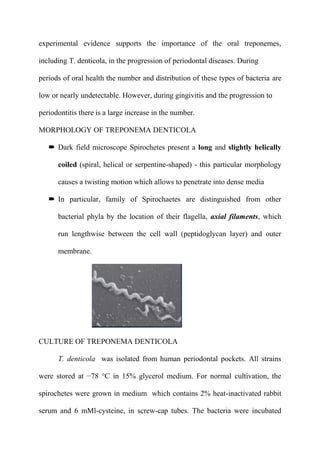


![the literature by Tanner et al. B. forsythus was reclassified by Sakamoto et al on
the basis of 16S rDNA analysis. This latter procedure did not reveal B.
forsythus to be a species within the genus Bacteroides which resulted in the
proposal to adopt a new genus, Tannerella, with one species, T. forsythia (T.
forsythensis).
MORPHOLOGY
Gram –negative obligate anaerobe
Non-motile
spindle-shaped
highly pleomorphic rods
CULTURE OF TANNERELLA FORSYTHIA
Samples were diluted 100 μl of each dilution was plated in media
containing blood agar with N-acetyl muramic acid (NAM) disks (10 mg/l). The
blood agar plates were studied after 5 to 7 days of anaerobic incubation (80%
N2; 10% H2; 10% CO2 at 37°C). Plates were examined for the identification of
T. forsythia based on the morphology of the colony which are tiny and opaque,
pale pink and speckled circular, slightly convex with depressed centre (donut
shape) and by using grams reaction and different standard biochemical tests
(Indole, Catalase and Nitrate reductase test) to confirm the initial
identification.[J Indian SocPeriodontol. 2014]
VIRULENCE FACTORS OF TANNEREELA FORSYTHIA
ADHESINS](https://image.slidesharecdn.com/redcomplexorganisms-221014144043-9747349c/85/RED-COMPLEX-ORGANISMS-docx-28-320.jpg)


1. Periodontal diseases are caused by complex biofilms containing multiple bacterial species that interact with host tissues. A key group is the "red complex" comprising Porphyromonas gingivalis, Treponema denticola, and Tanerella forsythia. 2. These bacteria employ various virulence factors to adhere to surfaces, acquire nutrients, and evade the host immune response in order to colonize and cause disease. Important factors include fimbriae, proteases, and capsules that aid adhesion and facilitate tissue destruction. 3. P. gingivalis possesses specific fimbriae, proteases, and a capsule that help it adhere, acquire iron through hemol


![Wound healing [including healing after periodontal therapy]](https://cdn.slidesharecdn.com/ss_thumbnails/woundhealingjr-150516123855-lva1-app6891-thumbnail.jpg?width=640&height=640&fit=bounds)


![Periodontal microbiology [autosaved]](https://cdn.slidesharecdn.com/ss_thumbnails/periodontalmicrobiologyautosaved-210219050149-thumbnail.jpg?width=640&height=640&fit=bounds)


