TISSUE
ADHESIVES
- Dr S.Roohi Mateen
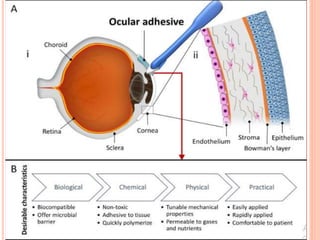
TISSUE ADHESIVES
 They are being used as substitutes to sutures in
Ophthalmic surgery in the recent years as sutures
are known to cause irritation, inflammation and
sometimes even infections.
 Tissue adhesives were developed as suture
adjuncts and alternatives for sealing the wound
tissues.
 They are gaining popularity for their ease of use
and post operative comfort.
 They have high efficacy, relative ease of application
and their ability to delay an otherwise emergency
surgical repair in the OT.
 The use of tissue adhesives is emerging from its
nascent stages. As of now they are used mainly for
adhesive purpose though they could be engineered
in future for drug delivery systems as well.
IDEAL CHARACTERISTICS OF A TISSUE
GLUE
 Ideal glue should have enough working time before
it solidifies
 Should be biocompatible
 Have adequate tensile strength
 Should be permeable to fluids and metabolites to
prevent necrosis
 Should have minimum induced inflammation
 Should not carry risk of disease transmission
 Be easily accessible and affordable.
TYPES
Synthetic adhesives
 Cyanoacrylate derivatives
Biological adhesives
Fibrin derivatives
Other cross linkable polymers
CYANOACRYLATE GLUE
 Cyanoacrylates are a type of synthetic glues that
polymerize rapidly when come in contact with a wet
surface.
 They are produced synthetically by condensation
between cyanoacetic acid and a suitable alcohol.
 The cyanoacetate oil formed is reacted with
paraformaldehyde to form cyanoacrylate oligomers.
 High vacuum (*0.7 mm Hg) and heat (150–180C)
are applied and depolymerization is carried out to
produce clear and colorless liquids monomers.
 Usually, further purification by repeated vacuum
distillations is utilized to get a medical grade
material.
 Cyanoacrylates are a type of synthetic glues that
polymerize rapidly when come in contact with a wet
surface.
 Application of cyanoacrylate leads to a mild
eosinophilic reaction, which occurs within 24 h and
the reaction is minimal by the 7 th day.
 After 1-2 weeks, the glue cast extrudes and it has
significant bacteriostatic properties also
VARIANTS OF CYANOACRYLATE GLUE
 N Butyl 2 cyanoacrylate which is mainly used in
ophthalmology.
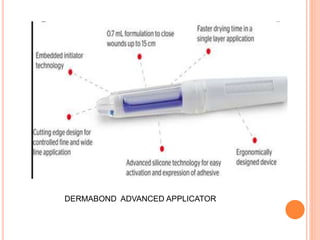
 2-octyl cyanoacrylate (Dermabond) used mainly for
external wound closure in plastic surgery, and
dermatology.
 It is available in Indian Market as Dermabond (Ethicon
Inc., Somerville, NJ).
 It is used in ophthalmology with paraben as a liquid
bandage.
DERMABOND ADVANCED APPLICATOR
ANTI MICROBIAL PROPERTIES
 de Almeida Manzano et al . (
Cornea2006;25(3):350-1 ) analyzed the
antimicrobial properties of ethyl-cyanoacrylate in
vitro against
 Staphylococcus aureus,
 Coagulase-negative Staphylococcus,
 Streptococcus pyogenes,
 Streptococcus pneumoniae,
 Pseudomonas aeruginosa,
 Escherichia coli
 Enterococcus faecalis
 One drop of the glue was dropped directly into the
nutrient broth and the plates were incubated for 24
hours.
 Bactericidal activity of the glue was verified by sampling
inhibition zones when present.
 The samples were plated in blood agar and analyzed
after 24 and 48 hours.
 The ethyl-cyanoacrylate inhibited the growth of every
gram-positive microorganism tested and showed
bactericidal effect over 70% for all of them.
 Among the gram-negative microorganisms, only the E.
coli and the E. faecalis had its growth inhibited.
USES
 Effective and early application of cyanoacrylate
glue as a corneal patch adds in the management
of small corneal perforations, melts, and wound
leaks, though it is also extended to sealing clear
corneal incisions in cataract surgery
 Weiss et al . ( Ophthalmology1983;90(6):610-5 )
reported that eighty patients with either corneal
perforation or impending perforation were treated
with the application of tissue adhesive and it
remained in place on the average of 50 days.
 Forty-four percent of these cases healed with the
application of glue alone.
 Complications occurred in nine patients (11%).
Two developed marked increase in intraocular
pressure which was controlled with antiglaucoma
medications and seven developed corneal infiltrates.
Five of the infiltrates were culture-proven bacterial
infections occurring on an average of 73 days after
gluing.
 Hartnett et al . ( Retina 1998;18(2):125-9 )
reported the experience with cyanoacrylate glue
in posterior retinal breaks associated with
retinal detachments in four consecutive pediatric
patients who underwent vitreoretinal surgery for
retinal detachment.
 In three of the four patients, successful retinal
reattachment with visual function was achieved by
vitreoretinal surgery and cyanoacrylate glue placed on
the apposed edges of posterior retinal breaks or used to
plug a break (postoperative follow-up was 1.5-2 years).
 In two successful cases, the glue was applied onto
the break while the retina was detached, which
resulted in closure of the retinal breaks and
reattachment of the retina.
 Sheta et al . ( Am J Ophthalmol. 1986;102(6):717-22 )
evaluated the use of trans-vitreal cyanoacrylate
retinopexy during vitreous surgery in the treatment
of experimental rhegmatogenous retinal detachment
in rabbit eyes
 The chorioretinal adhesions produced with cyanoacrylate
tissue adhesive were compared with those produced by
trans-scleral retinal cryopexy and were found to be more
rapid in onset as well as stronger.
 An exaggerated tissue response adjacent to the
cyanoacrylate site suggested a potential toxic chemical or
thermal reaction, or both, to the tissue adhesive.
 Sonmez et al . ( Eur J Ophthalmol. 2008;18(4):529-
31 ) reported the effectiveness of cyanoacrylate
glue blepharorrhaphy in immobilized patients with
recalcitrant exposure keratopathy.
 Temporal two thirds of upper eyelid eyelashes were
glued to lower eyelid skin with tissue adhesive n-butyl-2-
cyanoacrylate after application of a contact lens in 12
eyes of 9 patients.
 All the corneal ulcers healed within 4 to 11 days (mean:
5.5 days).
 Blepharorrhaphy opened spontaneously in 4 to 21 days
(mean: 8.6 days)
 Yuen et al . ( Ophthal Plast Reconstr
Surg.2008;24(3):238-40 ) reported successful sealing
of leakage of CSF complicated by orbital
exenteration by the application of cyanoacrylate
tissue glue
 Shorr et al . ( Ophthal Plast Reconstr
Surg.1991;7(3):190-3 ) reported a clinical series of 18
patients in which eyelid skin grafts were placed with
a combination of sutures and cyanoacrylate tissue
glue. No complication was encountered.
 The postoperative course and results were identical to the
skin grafts closed with suture alone.
 Gallemore et al . ( Ophthal Plast Reconstr
Surg.1999;15(3):210-2 ) described a technique to
secure a mucous membrane graft to a custom
conformer during reconstruction of the
conjunctival fornices and socket.
 Cyanoacrylate-based tissue glue was used instead of
sutures to secure the mucous membrane graft to the
conformer.
 The adhesion between the graft and the conformer
weakened over time, permitting easy removal of the
conformer from the socket 6 to 12 weeks
postoperatively.
 No complication was encountered in any of the six
patients in whom this technique was used.
MODE OF APPLICATION OF CYANOACRYLATE
GLUE
 It varies according to surgeon's preference
 Some surgeons use insulin syringe, draw glue on it, and apply a
small amount of glue over the area of perforation after complete
drying of the surface.
 There is a quick polymerization of the glue which then leaves a
brittle opaque piece of glue
 It's rough on surface and needs bandage contact lens to avoid
friction and discomfort.
 Other way of application is to use a special applicator
 In India, it is available as Amycrylate (Concord drug limited, A.P.)
.
Applicator
LIMITATIONS
 Its application is cumbersome
 Too much of glue induces intolerance or extrusion
before healing and too less will leave areas of
leaking.
 Applied on moist surface it will not adhere, which
happens in cases when the corneal wounds
continuously ooze out aqueous.
 Its potential toxicity to the surrounding tissue also is
a limiting factor.
 Toxicity of the glue is mainly by direct contact of the
glue with corneal endothelium, and lens.
 The toxicity of cyanoacrylate glues has been
attributed to several factors including:
 Direct toxicity of monomers such as methyl-2-
cyanoacrylate or of byproducts such as cyanoacetate
and formaldehyde
 Insufficient tissue vascularization
 The heat from the exothermic nature of the reaction
 The major disadvantage of the glue is the
associated inflammation leading to intense
discomfort
 Vigilance in monitoring for secondary infection is
also warranted especially when the glue has been
in place for more than 6 weeks
 As a result, cyanoacrylates are currently limited to
external or temporary applications.
FIBRIN GLUE
 Human fibrin glue may be used in place of
cyanoacrylate tissue adhesives in many conditions with
the advantage of reducing the conjunctival and corneal
inflammation to a large extent.
 It is a biological adhesive which mimics the final stage of
coagulation cascade.
 Fibrin glue includes fibrinogen component and a
thrombin content, both of which are prepared by
processing plasma.
 It also can be prepared at a blood transfusion center or
from patient's own blood also.
FORMATION OF CROSS-LINKED FIBRIN FROM
FIBRINOGEN
 In India, it is available as Tisseel Fibrin Sealant (Baxter
AG Vienna, Austria), and as reliseal (from Relince life-
sciences).
 The kit contains the following in separate vials.
Large Blue Bottle: Sealer protein concentrate (human), Freeze
dried, vapour treated, containing:
 Clottable protein-75-115 mg
 Fibrinogen-70-110 mg
 Plasma fibronectin-2-9 mg
 Factor XIII-10-50 IU
 Plasminogen-40-120 μg (microgram)
 Small blue bottle: Aprotinin solution, bovine 3000 KIU/ml
 White bottle: Thrombin 4 (bovine), freeze dried reconstituted
contains 4 IU/ml
 Large black bottle: Thrombin 500 (bovine), freeze dried
reconstituted contains 500 IU/ml
 Small black bottle: Calcium chloride solution, 40 mmol/L
 Before use, the syringes containing two
components of fibrin glue, namely, Thrombin (black)
and Fibrinogen (blue) are taken out from the deep
freeze and thawed to room temperature.
 Mix
 1 + 2 (fibrin component)
 3 + 5 (thrombin component)-Used for slow release
 4 + 5 (thrombin component)-Used for rapid release
 To slow the process of fibrin formation, only 0.1 ml
of the thrombin-calcium chloride solution is
withdrawn into a disposable syringe to which 0.9 ml
of balanced salt solution (Acorn Inc., Decatur, IL,
USA) is added to achieve a 1:10 dilution.
 This syringe is placed into the duplojet injector
along with a parallel disposable syringe containing
the fibrin sealer protein and fibrinolysis inhibitor.
 The two components of fibrin glue can either be
applied simultaneously or sequentially, depending
on the surgeon's preference.
 In all cases, prior to application of the glue, the
surgical field must be dried meticulously
 .
 After application, the tissue is pressed gently over
the glue for 3 min for firm adhesion.
 At the end of the procedure, pad, and bandage is
applied after instillation of antibiotic drops.
ADVANTAGES
 Fibrin glue reduces the total surgical time when
compared to suturing.
 It is better tolerated, non-toxic and has antimicrobial
activity when compared to the cyanoacrylate glue.
 It also lowers the risk of post-operative wound infection,
and is hypoallergenic.
 The smooth seal along the entire length of the wound
edge results in a higher tensile strength, with the bond
being resistant to greater shearing stress.
DISADVANTAGES
 Anaphylactic reactions following its application
have been reported.
 This reaction has been attributed to the presence of
aprotinin in fibrin glue
 The major drawback to its use is the risk of
transmitted disease mainly viral from pooled blood
donors.
USES
 In Pterygium surgery
 Fibrin glue is a safe and effective method for the
purpose of adhering the graft to the recipient
conjunctival margins.
 It reduces operating time, with reduction in post-
operative inflammation, discomfort with ultimate
reduction in the rate of recurrence in primary surgery.
 When used in recurrent pterygium its anti-inflammatory
effect controls the post-operative fibrosis.
AMG IN PTERYGIUM SURGERY
IN CONJUNCTIVAL SURGERIES
 Fibrin glue is one of the most popular tissue adhesive
used for most of the conjunctival surgical procedure.
 It has promising results in
 Traumatic conjunctival tear repairs
 For conjunctival or amniotic membrane transplant in primary
as well as recurrent pterygium surgery
 Mucous or amniotic membrane transplant after symblepheron
release
 For conjunctivochalasis repair
 For primary and secondary surgeries in chemical injuries and
 Steven Johnson syndrome.
 It is also very effectively used as a substrate transplant
after excision of large conjunctival tumors including
ocular surface squamous neoplasia.
IN STRABISMUS SURGERY
 Conjunctival closure with fibrin glue is a good
alternative to suturing for conjunctival closure in
strabismus surgery.
 It also results in a more comfortable post-operative
course.
 Tonelli et al. in 2004 used glue in a rabbit model to
find the efficacy of the glue in Faden operation.
 Though, the outcome was good in their study, they
commented that in small muscle recessions, the glue
was not strong enough to overcome the contractive
strength of the muscle.
IN CORNEAL SURGERY
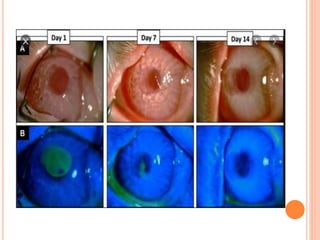
 Corneal perforation and melt
 For perforated corneal ulcer and those with
impending perforations, descemetocele and
extremely thinned out corneas
 Fibrin glue as well as cyanoacrylate tissue adhesives
are both effective in the closure of corneal
perforations up to 3 mm in diameter
 Glue is also used in fixing the amniotic membrane in
refractory and perforated corneal ulcers and found to
be a viable option
 Fibrin glue has the advantage of faster healing and
significantly less corneal inflammation and
neovascularization.
 In irregular corneal tears, fibrin glue act as an adjuvant
to seal leaks left due to poor approximation of the
wound
 . The very advantage of replacing fibrin with
cyanoacrylate lies in controlled post-operative
inflammation, which in effect increases patient's
comfort and reduces corneal neovascularization.
 Furthermore, there is no need for removal of the
glue.
 Amniotic membrane transplantation
 Fibrin glue is the most effective and safe method for
fixing the amniotic membrane to the ocular surface in
almost all surgeries like partial and total limbal stem
cell deficiency as a substrate for cultivation of limbal
stem cells, to fix a polymethylene methacrylate ring
to amniotic membrane patch on the ocular surface
 Amniotic membrane graft (AMG) when used as a
substitute transplant also works better with fibrin
glue rather than with suture.
 All surgeries which needs substitute transplant on
the cornea, conjunctiva or limbus are associated
with use of fibrin glue for better comfort, controlled
inflammation, and better cosmetics as well as for
scarless tissue repair.
 Lamellar Corneal grafts
 Use of sutures in corneal surgeries especially, lamellar
ones increase the risk of interface infilterates through
the suture track.
 Glue has also been used successfully in lamellar graft in
highly vascularized and infiltrated corneas reducing the
risk to the graft.
 Narendran et al. carried out deep lamellar
keratoplasty using fibrin glue supported with overlay
sutures
 They found it to be a time efficient and effective
technique.
 They concluded that fibrin glue is ideally suited when
both recipient bed and donor buttons are of same size
and thickness.
 Penetrating keratoplasty
 Isolated use of fibrin glue is not a choice for obvious
reasons of poor wound strength.
 Combined use of fibrin glue with 8-16 sutures proved to
a good choice.
 In a laboratory situation Bahar et al. concluded that the
use of fibrin glue in top hat PKP was found to be more
mechanically stable than traditional sutures.
 Limbal cell transplantation
 Fibrin glue has also been used effectively and safely to
fix the donor limbal lenticule on the bed of the recipient
in cases of limbal deficiency.
 As suturing the thin tissue in limbal transplantation
creates special problems related to tissue apposition,
suture related inflammation, vascularization and patient
discomfort to the exposed sutures on the ocular surface,
the use of glue was a rational alternative.
 Tissue engineering
 Kazuo Tsubota et al. and Hideyuki et al. have reported a
novel method of engineering transplantable, carrier-
free corneal epithelial sheets by using a
biodegradable fibrin sealant and compared its
characteristics with epithelial sheets cultivated on
denuded amniotic membrane carriers and reported that
tissue engineering with a commercially available fibrin
sealant is effective means of creating a carrier-free,
transplantable corneal epithelial sheet.
 Carrier-free sheets were more differentiated
compared with AM sheets, while retaining similar
levels of colony-forming progenitor cells.
REFRACTIVE SURGERY
 Treating epithelial ingrowth
 In recalcitrant cases of epithelial ingrowth
 The glue forms a mechanical barrier and prevents the
epithelial cells from growing underneath the flap, at least
until the flap is healed.
 The glue typically dissolves gradually over a 2 weeks
period and by then, the epithelial surface and stromal
interface show complete healing with no cells in the
interface.
 However, the major disadvantages of the use of
fibrin glue for flap reattachment is that the glue is
fairly opaque when it polymerizes.
 As a result, it is difficult to see through it to
determine, if there are inflammatory cells in the
interface.
 In addition, it is expensive and requires special
equipment and preparation time
 As a temporary basement membrane
 It is being used on photorefractive keratectomy (PRK)
operated corneas to reduce corneal haze.
 In surface ablations like PRK covering the entire treated
area with fibrin glue not only makes the surface
smoother and regular reducing the post-operative
discomfort, but the glue at the same time also acts as a
temporary basal layer for corneal epithelium.
 This reduces the reepithelization time.
 The fibrin glue also forms a biochemical/mechanical
barrier preventing the direct contact of fibroblast
activating fibers of tears and corneal epithelium to
come in contact with treatment area preventing the
post-treatment haze.
 Use of autologous fibrin additionally will reduce the
risk of disease transmission
 In flap tear/traumatic flap dislocation
 Usually a flap tear occurs secondary to trauma, which
induces some epithelial defect.
 In such scenario, the flap adheres better to the denuded
surface on or around the flap and prevents epithelial
ingrowth.
IN GLAUCOMA
 It is used as an effective method of achieving
conjunctival wound closure after all drainage procedure.
 Its successful use has also been reported in the
management of post trabeculectomy hypotony due to
leaking bleb.
 It is considered as a safe substitute for the sutures used
in glaucoma drainage device [GDD] surgery.
 It does not alter intra ocular pressure control, reduces
post-operative conjunctival inflammation and surgical
time.
 However, further studies are needed to better
understand the role of the glue in GDD implantation.
LENS RELATED SURGERIES
 Its use in cataract surgery to close the capsular
perforation and cataract incision has been tried
since 1987.
 It has also been used for the prevention of post-
operative astigmatism and to seal the wound in
small incision cataract surgery.
 Recently, the glue is being used to fix the haptics
of intraocular lens (IOL) to the tissue in place of
sutures in Glued IOL.
 Wound closure after cataract surgery
 Mester et al . ( J Cataract Refract Surg.1993;19(5):616-9 )
described astigmatism after phacoemulsification with
posterior chamber lens implantation in small incision
technique with fibrin adhesive for wound closure.
 They conducted a comparative study of 385 consecutive
patients; 167 received only fibrin glue for wound closure and
218 had the single-stitch procedure.
 No complication was observed in either group.
 Surgically induced astigmatism was smaller in the fibrin group
 Glued IOL
 Agarwal et al . ( J Cataract Refract
Surg.2008;34(9):1433-8 ) reported a new surgical
technique that uses biological glue to implant a
posterior chamber intraocular lens (PC IOL) in
eyes with a deficient or absent posterior
capsule.
 Two partial-thickness limbal-based scleral flaps
were made 180 degrees apart diagonally, and the
haptics of the PC IOL were externalized to place
them beneath the flaps.
 Fibrin glue was used to attach the haptics to the
scleral bed, beneath the flap.
 This simple method of PC IOL implantation requires
no specially designed haptics.
 It provides good flap closure and IOL centration
 Nair et al . ( Eye Contact Lens2009;35(4):215-7 ) reported a
patient of retinitis pigmentosa with spontaneous bilateral
anterior in-the-bag subluxation of PCIOL who was managed
by IOL explantation followed by fibrin-glue-assisted sutureless
PCIOL implantation.
 Two partial thickness limbal-based scleral flaps were created
about 1.5 mm from the limbus under which sclerotomies were
made.
 Intraocular lens explantation along with capsular bag was
performed through the corneo-scleral tunnel incision.
 Single-piece rigid polymethylmethacrylate 6.5-mm optic IOL
was introduced through the limbal wound with a McPherson
forceps, both the IOL haptics were externalized under the
scleral flap.
 The haptic ends were tucked in the scleral tunnel
made with the 26G needle.
 Scleral flaps and the conjunctiva were closed with
the fibrin glue.
 Preoperative best corrected visual acuity was
20/80 in the right and 20/120 in the left eye.
 Patient gained a best corrected visual acuity of
20/30 in both the eyes, with a bilateral stable PCIOL
and clear cornea.
VITREO-RETINAL SURGERY
 As early as 1988, Zauberman and Hemo have
reported its use for conjunctival wound closure
following retinal detachment surgery.
 Mentens et al. in 2007 compared the efficacy of
fibrin glue in comparison with conjunctival closure
by sutures following 20 gauge needle pars plana
vitrectomy in eyes.
 They commented that fibrin glue offers significantly
better results than suturing for closure of conjunctival
wounds.
LID AND ADNEXAL SURGERY
 Lid surgery
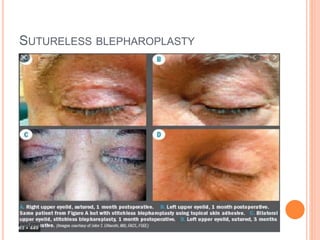
The glue was used in eyelid surgery for fixing the free
autologous skin transplants for covering skin defects and
the procedure is advantageous as early fibrovascular ingrowth
into the transplant is stimulated.
 It is also helpful in lid split procedure combined with free skin
graft for severe upper eyelid entropion.
 In lower eyelid trichiasis, glue has been used for fixation of
free autologous conjunctival transplants from the upper
fornix after separation of the lashes from the posterior lamella
with a lid split technique.
SUTURELESS BLEPHAROPLASTY
 Lacrimal surgery
 It has been used for reconstructing lacerated canaliculi,
 canaliculo-cystotomy,
 canaliculo-dacryocystorhinostomy,
 for the microanastomosis between canaliculi and
lacrimal sac and for attaching lacrimal and nasal
mucosal flaps
COMBINED PROCEDURES
 Glue with AMG
Cyanoacrylate prevents epithelization into the zone of
damaged stroma and prevents the development of
collagenase production that can lead to stromal melting.
 Combination of glue with the biological bandage in the
form of amniotic membrane is highly indicated in these
cases where the lesion is large or there is some amount
of tissue melt seen.
 The membrane protects the glue as well as prevents
further melt, reducing the inflammatory reaction induced
by glue
 Glue with glue
Here, a combination of both cyanoacrylate and
fibrin glue is used.
 In cases where a AMG is required to be used in
corneal perforations, a layer of cyanoacrylate is
used to seal the perforation and then fibrin glue is
used for adhesion of the amniotic graft.
 In cases of infectious keratitis where a large area
infiltrate is associated with a small actual or threatening
perforation, a combined approach is used where in
debulking of infiltrate is combined with application of
cyanoacrylate glue over the area of perforation is
followed by covering the entire pathological area with
amniotic membrane adhered with fibrin glue.
 It serves purpose firstly sealing the perforation as
well as biological bandage serves as a drug delivery
system along with controlling the inflammation
thereby preventing tissue melt
NEWER GENERATION OF TISSUE GLUES
 Biodendrimers, which are made of biodegradable
as well as biocompatible material.
 Because of the unique chemical and structural
composition they have promising application as
drug delivery systems and photoactivated collagen
cross linking.
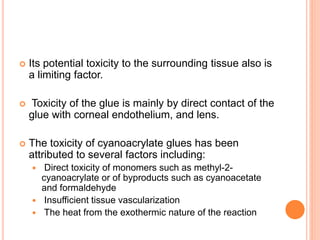
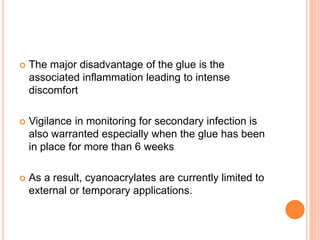
 These include Photo-activated Dendritic Polymers
and Chemical cross linking Linear Polymer
Adhesives.
 The Photo-activated Dendritic Polymers have
ocular applications like repair of central corneal
lacerations, clear corneal cataract incisions, Laser
assisted in situ keratomileusis (LASIK) flaps, scleral
incisions and penetrating keratoplasties.
 Chemical crosslinking (two-component) Dendritic
Polymers also called Chemically derived
bioadhesive (CDB) have significantly improved
bonding strength over commercially available fibrin
glue.
 It is easy to handle and cause minimal to nil effect
on the surrounding tissue.
 This group includes adhesives like Chondroitin
sulphate-aldehyde Adhesive, Gelatin Resorcinol
and Albumin-glutaraldehyde Adhesive
PHOTOCROSSLINKABLE ADHESIVES
 This group includes
 Bovine Serum Albumin-based Bioadhesives.
 It is a photoactivated tissue adhesive and has been
tried in squint surgery for muscle to muscle adhesions,
for sclera to sclera and for muscle to sclera adhesions
because of its very high bioadhesive properties.
 Another photocrosslinkable adhesive is a
Riboflavin-based bioadhesive
 It is cross likable polymer, which contains riboflavin.
 On exposure to ultraviolet A it results in collagen cross
linking of cornea increasing the bio mechanical strength
of the stroma.
 This property is used for treating corneal pathologies
like Keratoconus, post-LASIK ectasia, post-infectious
corneal melts to name a few.
 Hyaluronic Acid-based photocatalytic Glue
 This is applied on a lacerated corneal wound and then
activated with Argon LASER beam.
 The hydrogel polymerizes and seals the wound with
minimal tissue damage.
CONCLUSION
 Tissue glue is increasingly becoming a choice of
material as an alternative or adjuvant to surgical
wound closure in ophthalmology.
 Each of the type of glue is unique in terms of its
advantages as well as limitations and so is used in
different indications.
 Although the presently available tissue adhesives
are good enough for the procedures mentioned,
there is still a demand for newer adhesives with
better biocompatibility, rapid sealing properties and
increased binding forces.
 These novel developing adhesives promises to
overcome the drawbacks and risks associated with
the existing ones.
 The increasing acceptance of these adhesives by
the clinicians promises this to be a standard
procedure for surgical wound closure.
Tissue adhesives
Tissue adhesives

Tissue adhesives

  • 1.
  • 2.
    TISSUE ADHESIVES  Theyare being used as substitutes to sutures in Ophthalmic surgery in the recent years as sutures are known to cause irritation, inflammation and sometimes even infections.  Tissue adhesives were developed as suture adjuncts and alternatives for sealing the wound tissues.  They are gaining popularity for their ease of use and post operative comfort.
  • 3.
     They havehigh efficacy, relative ease of application and their ability to delay an otherwise emergency surgical repair in the OT.  The use of tissue adhesives is emerging from its nascent stages. As of now they are used mainly for adhesive purpose though they could be engineered in future for drug delivery systems as well.
  • 5.
    IDEAL CHARACTERISTICS OFA TISSUE GLUE  Ideal glue should have enough working time before it solidifies  Should be biocompatible  Have adequate tensile strength  Should be permeable to fluids and metabolites to prevent necrosis  Should have minimum induced inflammation
  • 6.
     Should notcarry risk of disease transmission  Be easily accessible and affordable.
  • 9.
    TYPES Synthetic adhesives  Cyanoacrylatederivatives Biological adhesives Fibrin derivatives Other cross linkable polymers
  • 10.
    CYANOACRYLATE GLUE  Cyanoacrylatesare a type of synthetic glues that polymerize rapidly when come in contact with a wet surface.  They are produced synthetically by condensation between cyanoacetic acid and a suitable alcohol.  The cyanoacetate oil formed is reacted with paraformaldehyde to form cyanoacrylate oligomers.
  • 11.
     High vacuum(*0.7 mm Hg) and heat (150–180C) are applied and depolymerization is carried out to produce clear and colorless liquids monomers.  Usually, further purification by repeated vacuum distillations is utilized to get a medical grade material.
  • 12.
     Cyanoacrylates area type of synthetic glues that polymerize rapidly when come in contact with a wet surface.  Application of cyanoacrylate leads to a mild eosinophilic reaction, which occurs within 24 h and the reaction is minimal by the 7 th day.  After 1-2 weeks, the glue cast extrudes and it has significant bacteriostatic properties also
  • 13.
    VARIANTS OF CYANOACRYLATEGLUE  N Butyl 2 cyanoacrylate which is mainly used in ophthalmology.  2-octyl cyanoacrylate (Dermabond) used mainly for external wound closure in plastic surgery, and dermatology.  It is available in Indian Market as Dermabond (Ethicon Inc., Somerville, NJ).  It is used in ophthalmology with paraben as a liquid bandage.
  • 15.
  • 17.
    ANTI MICROBIAL PROPERTIES de Almeida Manzano et al . ( Cornea2006;25(3):350-1 ) analyzed the antimicrobial properties of ethyl-cyanoacrylate in vitro against  Staphylococcus aureus,  Coagulase-negative Staphylococcus,  Streptococcus pyogenes,  Streptococcus pneumoniae,  Pseudomonas aeruginosa,  Escherichia coli  Enterococcus faecalis
  • 18.
     One dropof the glue was dropped directly into the nutrient broth and the plates were incubated for 24 hours.  Bactericidal activity of the glue was verified by sampling inhibition zones when present.  The samples were plated in blood agar and analyzed after 24 and 48 hours.  The ethyl-cyanoacrylate inhibited the growth of every gram-positive microorganism tested and showed bactericidal effect over 70% for all of them.  Among the gram-negative microorganisms, only the E. coli and the E. faecalis had its growth inhibited.
  • 19.
    USES  Effective andearly application of cyanoacrylate glue as a corneal patch adds in the management of small corneal perforations, melts, and wound leaks, though it is also extended to sealing clear corneal incisions in cataract surgery  Weiss et al . ( Ophthalmology1983;90(6):610-5 ) reported that eighty patients with either corneal perforation or impending perforation were treated with the application of tissue adhesive and it remained in place on the average of 50 days.
  • 20.
     Forty-four percentof these cases healed with the application of glue alone.  Complications occurred in nine patients (11%). Two developed marked increase in intraocular pressure which was controlled with antiglaucoma medications and seven developed corneal infiltrates. Five of the infiltrates were culture-proven bacterial infections occurring on an average of 73 days after gluing.
  • 21.
     Hartnett etal . ( Retina 1998;18(2):125-9 ) reported the experience with cyanoacrylate glue in posterior retinal breaks associated with retinal detachments in four consecutive pediatric patients who underwent vitreoretinal surgery for retinal detachment.  In three of the four patients, successful retinal reattachment with visual function was achieved by vitreoretinal surgery and cyanoacrylate glue placed on the apposed edges of posterior retinal breaks or used to plug a break (postoperative follow-up was 1.5-2 years).
  • 22.
     In twosuccessful cases, the glue was applied onto the break while the retina was detached, which resulted in closure of the retinal breaks and reattachment of the retina.
  • 23.
     Sheta etal . ( Am J Ophthalmol. 1986;102(6):717-22 ) evaluated the use of trans-vitreal cyanoacrylate retinopexy during vitreous surgery in the treatment of experimental rhegmatogenous retinal detachment in rabbit eyes  The chorioretinal adhesions produced with cyanoacrylate tissue adhesive were compared with those produced by trans-scleral retinal cryopexy and were found to be more rapid in onset as well as stronger.  An exaggerated tissue response adjacent to the cyanoacrylate site suggested a potential toxic chemical or thermal reaction, or both, to the tissue adhesive.
  • 24.
     Sonmez etal . ( Eur J Ophthalmol. 2008;18(4):529- 31 ) reported the effectiveness of cyanoacrylate glue blepharorrhaphy in immobilized patients with recalcitrant exposure keratopathy.  Temporal two thirds of upper eyelid eyelashes were glued to lower eyelid skin with tissue adhesive n-butyl-2- cyanoacrylate after application of a contact lens in 12 eyes of 9 patients.  All the corneal ulcers healed within 4 to 11 days (mean: 5.5 days).  Blepharorrhaphy opened spontaneously in 4 to 21 days (mean: 8.6 days)
  • 25.
     Yuen etal . ( Ophthal Plast Reconstr Surg.2008;24(3):238-40 ) reported successful sealing of leakage of CSF complicated by orbital exenteration by the application of cyanoacrylate tissue glue  Shorr et al . ( Ophthal Plast Reconstr Surg.1991;7(3):190-3 ) reported a clinical series of 18 patients in which eyelid skin grafts were placed with a combination of sutures and cyanoacrylate tissue glue. No complication was encountered.  The postoperative course and results were identical to the skin grafts closed with suture alone.
  • 26.
     Gallemore etal . ( Ophthal Plast Reconstr Surg.1999;15(3):210-2 ) described a technique to secure a mucous membrane graft to a custom conformer during reconstruction of the conjunctival fornices and socket.  Cyanoacrylate-based tissue glue was used instead of sutures to secure the mucous membrane graft to the conformer.  The adhesion between the graft and the conformer weakened over time, permitting easy removal of the conformer from the socket 6 to 12 weeks postoperatively.  No complication was encountered in any of the six patients in whom this technique was used.
  • 27.
    MODE OF APPLICATIONOF CYANOACRYLATE GLUE  It varies according to surgeon's preference  Some surgeons use insulin syringe, draw glue on it, and apply a small amount of glue over the area of perforation after complete drying of the surface.  There is a quick polymerization of the glue which then leaves a brittle opaque piece of glue  It's rough on surface and needs bandage contact lens to avoid friction and discomfort.  Other way of application is to use a special applicator  In India, it is available as Amycrylate (Concord drug limited, A.P.) .
  • 28.
  • 29.
    LIMITATIONS  Its applicationis cumbersome  Too much of glue induces intolerance or extrusion before healing and too less will leave areas of leaking.  Applied on moist surface it will not adhere, which happens in cases when the corneal wounds continuously ooze out aqueous.
  • 30.
     Its potentialtoxicity to the surrounding tissue also is a limiting factor.  Toxicity of the glue is mainly by direct contact of the glue with corneal endothelium, and lens.  The toxicity of cyanoacrylate glues has been attributed to several factors including:  Direct toxicity of monomers such as methyl-2- cyanoacrylate or of byproducts such as cyanoacetate and formaldehyde  Insufficient tissue vascularization  The heat from the exothermic nature of the reaction
  • 31.
     The majordisadvantage of the glue is the associated inflammation leading to intense discomfort  Vigilance in monitoring for secondary infection is also warranted especially when the glue has been in place for more than 6 weeks  As a result, cyanoacrylates are currently limited to external or temporary applications.
  • 32.
    FIBRIN GLUE  Humanfibrin glue may be used in place of cyanoacrylate tissue adhesives in many conditions with the advantage of reducing the conjunctival and corneal inflammation to a large extent.  It is a biological adhesive which mimics the final stage of coagulation cascade.  Fibrin glue includes fibrinogen component and a thrombin content, both of which are prepared by processing plasma.  It also can be prepared at a blood transfusion center or from patient's own blood also.
  • 33.
    FORMATION OF CROSS-LINKEDFIBRIN FROM FIBRINOGEN
  • 34.
     In India,it is available as Tisseel Fibrin Sealant (Baxter AG Vienna, Austria), and as reliseal (from Relince life- sciences).
  • 35.
     The kitcontains the following in separate vials. Large Blue Bottle: Sealer protein concentrate (human), Freeze dried, vapour treated, containing:  Clottable protein-75-115 mg  Fibrinogen-70-110 mg  Plasma fibronectin-2-9 mg  Factor XIII-10-50 IU  Plasminogen-40-120 μg (microgram)  Small blue bottle: Aprotinin solution, bovine 3000 KIU/ml  White bottle: Thrombin 4 (bovine), freeze dried reconstituted contains 4 IU/ml  Large black bottle: Thrombin 500 (bovine), freeze dried reconstituted contains 500 IU/ml  Small black bottle: Calcium chloride solution, 40 mmol/L
  • 37.
     Before use,the syringes containing two components of fibrin glue, namely, Thrombin (black) and Fibrinogen (blue) are taken out from the deep freeze and thawed to room temperature.  Mix  1 + 2 (fibrin component)  3 + 5 (thrombin component)-Used for slow release  4 + 5 (thrombin component)-Used for rapid release
  • 38.
     To slowthe process of fibrin formation, only 0.1 ml of the thrombin-calcium chloride solution is withdrawn into a disposable syringe to which 0.9 ml of balanced salt solution (Acorn Inc., Decatur, IL, USA) is added to achieve a 1:10 dilution.  This syringe is placed into the duplojet injector along with a parallel disposable syringe containing the fibrin sealer protein and fibrinolysis inhibitor.
  • 39.
     The twocomponents of fibrin glue can either be applied simultaneously or sequentially, depending on the surgeon's preference.  In all cases, prior to application of the glue, the surgical field must be dried meticulously  .  After application, the tissue is pressed gently over the glue for 3 min for firm adhesion.  At the end of the procedure, pad, and bandage is applied after instillation of antibiotic drops.
  • 40.
    ADVANTAGES  Fibrin gluereduces the total surgical time when compared to suturing.  It is better tolerated, non-toxic and has antimicrobial activity when compared to the cyanoacrylate glue.  It also lowers the risk of post-operative wound infection, and is hypoallergenic.  The smooth seal along the entire length of the wound edge results in a higher tensile strength, with the bond being resistant to greater shearing stress.
  • 41.
    DISADVANTAGES  Anaphylactic reactionsfollowing its application have been reported.  This reaction has been attributed to the presence of aprotinin in fibrin glue  The major drawback to its use is the risk of transmitted disease mainly viral from pooled blood donors.
  • 42.
    USES  In Pterygiumsurgery  Fibrin glue is a safe and effective method for the purpose of adhering the graft to the recipient conjunctival margins.  It reduces operating time, with reduction in post- operative inflammation, discomfort with ultimate reduction in the rate of recurrence in primary surgery.  When used in recurrent pterygium its anti-inflammatory effect controls the post-operative fibrosis.
  • 43.
  • 44.
    IN CONJUNCTIVAL SURGERIES Fibrin glue is one of the most popular tissue adhesive used for most of the conjunctival surgical procedure.  It has promising results in  Traumatic conjunctival tear repairs  For conjunctival or amniotic membrane transplant in primary as well as recurrent pterygium surgery  Mucous or amniotic membrane transplant after symblepheron release  For conjunctivochalasis repair  For primary and secondary surgeries in chemical injuries and  Steven Johnson syndrome.  It is also very effectively used as a substrate transplant after excision of large conjunctival tumors including ocular surface squamous neoplasia.
  • 45.
    IN STRABISMUS SURGERY Conjunctival closure with fibrin glue is a good alternative to suturing for conjunctival closure in strabismus surgery.  It also results in a more comfortable post-operative course.  Tonelli et al. in 2004 used glue in a rabbit model to find the efficacy of the glue in Faden operation.  Though, the outcome was good in their study, they commented that in small muscle recessions, the glue was not strong enough to overcome the contractive strength of the muscle.
  • 46.
    IN CORNEAL SURGERY Corneal perforation and melt  For perforated corneal ulcer and those with impending perforations, descemetocele and extremely thinned out corneas  Fibrin glue as well as cyanoacrylate tissue adhesives are both effective in the closure of corneal perforations up to 3 mm in diameter  Glue is also used in fixing the amniotic membrane in refractory and perforated corneal ulcers and found to be a viable option
  • 47.
     Fibrin gluehas the advantage of faster healing and significantly less corneal inflammation and neovascularization.  In irregular corneal tears, fibrin glue act as an adjuvant to seal leaks left due to poor approximation of the wound  . The very advantage of replacing fibrin with cyanoacrylate lies in controlled post-operative inflammation, which in effect increases patient's comfort and reduces corneal neovascularization.  Furthermore, there is no need for removal of the glue.
  • 49.
     Amniotic membranetransplantation  Fibrin glue is the most effective and safe method for fixing the amniotic membrane to the ocular surface in almost all surgeries like partial and total limbal stem cell deficiency as a substrate for cultivation of limbal stem cells, to fix a polymethylene methacrylate ring to amniotic membrane patch on the ocular surface
  • 50.
     Amniotic membranegraft (AMG) when used as a substitute transplant also works better with fibrin glue rather than with suture.  All surgeries which needs substitute transplant on the cornea, conjunctiva or limbus are associated with use of fibrin glue for better comfort, controlled inflammation, and better cosmetics as well as for scarless tissue repair.
  • 51.
     Lamellar Cornealgrafts  Use of sutures in corneal surgeries especially, lamellar ones increase the risk of interface infilterates through the suture track.  Glue has also been used successfully in lamellar graft in highly vascularized and infiltrated corneas reducing the risk to the graft.
  • 52.
     Narendran etal. carried out deep lamellar keratoplasty using fibrin glue supported with overlay sutures  They found it to be a time efficient and effective technique.  They concluded that fibrin glue is ideally suited when both recipient bed and donor buttons are of same size and thickness.
  • 54.
     Penetrating keratoplasty Isolated use of fibrin glue is not a choice for obvious reasons of poor wound strength.  Combined use of fibrin glue with 8-16 sutures proved to a good choice.  In a laboratory situation Bahar et al. concluded that the use of fibrin glue in top hat PKP was found to be more mechanically stable than traditional sutures.
  • 55.
     Limbal celltransplantation  Fibrin glue has also been used effectively and safely to fix the donor limbal lenticule on the bed of the recipient in cases of limbal deficiency.  As suturing the thin tissue in limbal transplantation creates special problems related to tissue apposition, suture related inflammation, vascularization and patient discomfort to the exposed sutures on the ocular surface, the use of glue was a rational alternative.
  • 56.
     Tissue engineering Kazuo Tsubota et al. and Hideyuki et al. have reported a novel method of engineering transplantable, carrier- free corneal epithelial sheets by using a biodegradable fibrin sealant and compared its characteristics with epithelial sheets cultivated on denuded amniotic membrane carriers and reported that tissue engineering with a commercially available fibrin sealant is effective means of creating a carrier-free, transplantable corneal epithelial sheet.
  • 57.
     Carrier-free sheetswere more differentiated compared with AM sheets, while retaining similar levels of colony-forming progenitor cells.
  • 58.
    REFRACTIVE SURGERY  Treatingepithelial ingrowth  In recalcitrant cases of epithelial ingrowth  The glue forms a mechanical barrier and prevents the epithelial cells from growing underneath the flap, at least until the flap is healed.  The glue typically dissolves gradually over a 2 weeks period and by then, the epithelial surface and stromal interface show complete healing with no cells in the interface.
  • 59.
     However, themajor disadvantages of the use of fibrin glue for flap reattachment is that the glue is fairly opaque when it polymerizes.  As a result, it is difficult to see through it to determine, if there are inflammatory cells in the interface.  In addition, it is expensive and requires special equipment and preparation time
  • 60.
     As atemporary basement membrane  It is being used on photorefractive keratectomy (PRK) operated corneas to reduce corneal haze.  In surface ablations like PRK covering the entire treated area with fibrin glue not only makes the surface smoother and regular reducing the post-operative discomfort, but the glue at the same time also acts as a temporary basal layer for corneal epithelium.  This reduces the reepithelization time.
  • 61.
     The fibringlue also forms a biochemical/mechanical barrier preventing the direct contact of fibroblast activating fibers of tears and corneal epithelium to come in contact with treatment area preventing the post-treatment haze.  Use of autologous fibrin additionally will reduce the risk of disease transmission
  • 62.
     In flaptear/traumatic flap dislocation  Usually a flap tear occurs secondary to trauma, which induces some epithelial defect.  In such scenario, the flap adheres better to the denuded surface on or around the flap and prevents epithelial ingrowth.
  • 63.
    IN GLAUCOMA  Itis used as an effective method of achieving conjunctival wound closure after all drainage procedure.  Its successful use has also been reported in the management of post trabeculectomy hypotony due to leaking bleb.  It is considered as a safe substitute for the sutures used in glaucoma drainage device [GDD] surgery.  It does not alter intra ocular pressure control, reduces post-operative conjunctival inflammation and surgical time.  However, further studies are needed to better understand the role of the glue in GDD implantation.
  • 64.
    LENS RELATED SURGERIES Its use in cataract surgery to close the capsular perforation and cataract incision has been tried since 1987.  It has also been used for the prevention of post- operative astigmatism and to seal the wound in small incision cataract surgery.  Recently, the glue is being used to fix the haptics of intraocular lens (IOL) to the tissue in place of sutures in Glued IOL.
  • 65.
     Wound closureafter cataract surgery  Mester et al . ( J Cataract Refract Surg.1993;19(5):616-9 ) described astigmatism after phacoemulsification with posterior chamber lens implantation in small incision technique with fibrin adhesive for wound closure.  They conducted a comparative study of 385 consecutive patients; 167 received only fibrin glue for wound closure and 218 had the single-stitch procedure.  No complication was observed in either group.  Surgically induced astigmatism was smaller in the fibrin group
  • 66.
     Glued IOL Agarwal et al . ( J Cataract Refract Surg.2008;34(9):1433-8 ) reported a new surgical technique that uses biological glue to implant a posterior chamber intraocular lens (PC IOL) in eyes with a deficient or absent posterior capsule.  Two partial-thickness limbal-based scleral flaps were made 180 degrees apart diagonally, and the haptics of the PC IOL were externalized to place them beneath the flaps.
  • 67.
     Fibrin gluewas used to attach the haptics to the scleral bed, beneath the flap.  This simple method of PC IOL implantation requires no specially designed haptics.  It provides good flap closure and IOL centration
  • 68.
     Nair etal . ( Eye Contact Lens2009;35(4):215-7 ) reported a patient of retinitis pigmentosa with spontaneous bilateral anterior in-the-bag subluxation of PCIOL who was managed by IOL explantation followed by fibrin-glue-assisted sutureless PCIOL implantation.  Two partial thickness limbal-based scleral flaps were created about 1.5 mm from the limbus under which sclerotomies were made.  Intraocular lens explantation along with capsular bag was performed through the corneo-scleral tunnel incision.  Single-piece rigid polymethylmethacrylate 6.5-mm optic IOL was introduced through the limbal wound with a McPherson forceps, both the IOL haptics were externalized under the scleral flap.
  • 69.
     The hapticends were tucked in the scleral tunnel made with the 26G needle.  Scleral flaps and the conjunctiva were closed with the fibrin glue.  Preoperative best corrected visual acuity was 20/80 in the right and 20/120 in the left eye.  Patient gained a best corrected visual acuity of 20/30 in both the eyes, with a bilateral stable PCIOL and clear cornea.
  • 70.
    VITREO-RETINAL SURGERY  Asearly as 1988, Zauberman and Hemo have reported its use for conjunctival wound closure following retinal detachment surgery.  Mentens et al. in 2007 compared the efficacy of fibrin glue in comparison with conjunctival closure by sutures following 20 gauge needle pars plana vitrectomy in eyes.  They commented that fibrin glue offers significantly better results than suturing for closure of conjunctival wounds.
  • 71.
    LID AND ADNEXALSURGERY  Lid surgery The glue was used in eyelid surgery for fixing the free autologous skin transplants for covering skin defects and the procedure is advantageous as early fibrovascular ingrowth into the transplant is stimulated.  It is also helpful in lid split procedure combined with free skin graft for severe upper eyelid entropion.  In lower eyelid trichiasis, glue has been used for fixation of free autologous conjunctival transplants from the upper fornix after separation of the lashes from the posterior lamella with a lid split technique.
  • 72.
  • 73.
     Lacrimal surgery It has been used for reconstructing lacerated canaliculi,  canaliculo-cystotomy,  canaliculo-dacryocystorhinostomy,  for the microanastomosis between canaliculi and lacrimal sac and for attaching lacrimal and nasal mucosal flaps
  • 74.
    COMBINED PROCEDURES  Gluewith AMG Cyanoacrylate prevents epithelization into the zone of damaged stroma and prevents the development of collagenase production that can lead to stromal melting.  Combination of glue with the biological bandage in the form of amniotic membrane is highly indicated in these cases where the lesion is large or there is some amount of tissue melt seen.  The membrane protects the glue as well as prevents further melt, reducing the inflammatory reaction induced by glue
  • 75.
     Glue withglue Here, a combination of both cyanoacrylate and fibrin glue is used.  In cases where a AMG is required to be used in corneal perforations, a layer of cyanoacrylate is used to seal the perforation and then fibrin glue is used for adhesion of the amniotic graft.
  • 76.
     In casesof infectious keratitis where a large area infiltrate is associated with a small actual or threatening perforation, a combined approach is used where in debulking of infiltrate is combined with application of cyanoacrylate glue over the area of perforation is followed by covering the entire pathological area with amniotic membrane adhered with fibrin glue.  It serves purpose firstly sealing the perforation as well as biological bandage serves as a drug delivery system along with controlling the inflammation thereby preventing tissue melt
  • 77.
    NEWER GENERATION OFTISSUE GLUES  Biodendrimers, which are made of biodegradable as well as biocompatible material.  Because of the unique chemical and structural composition they have promising application as drug delivery systems and photoactivated collagen cross linking.
  • 78.
     These includePhoto-activated Dendritic Polymers and Chemical cross linking Linear Polymer Adhesives.  The Photo-activated Dendritic Polymers have ocular applications like repair of central corneal lacerations, clear corneal cataract incisions, Laser assisted in situ keratomileusis (LASIK) flaps, scleral incisions and penetrating keratoplasties.
  • 79.
     Chemical crosslinking(two-component) Dendritic Polymers also called Chemically derived bioadhesive (CDB) have significantly improved bonding strength over commercially available fibrin glue.  It is easy to handle and cause minimal to nil effect on the surrounding tissue.  This group includes adhesives like Chondroitin sulphate-aldehyde Adhesive, Gelatin Resorcinol and Albumin-glutaraldehyde Adhesive
  • 80.
    PHOTOCROSSLINKABLE ADHESIVES  Thisgroup includes  Bovine Serum Albumin-based Bioadhesives.  It is a photoactivated tissue adhesive and has been tried in squint surgery for muscle to muscle adhesions, for sclera to sclera and for muscle to sclera adhesions because of its very high bioadhesive properties.
  • 81.
     Another photocrosslinkableadhesive is a Riboflavin-based bioadhesive  It is cross likable polymer, which contains riboflavin.  On exposure to ultraviolet A it results in collagen cross linking of cornea increasing the bio mechanical strength of the stroma.  This property is used for treating corneal pathologies like Keratoconus, post-LASIK ectasia, post-infectious corneal melts to name a few.
  • 82.
     Hyaluronic Acid-basedphotocatalytic Glue  This is applied on a lacerated corneal wound and then activated with Argon LASER beam.  The hydrogel polymerizes and seals the wound with minimal tissue damage.
  • 83.
    CONCLUSION  Tissue glueis increasingly becoming a choice of material as an alternative or adjuvant to surgical wound closure in ophthalmology.  Each of the type of glue is unique in terms of its advantages as well as limitations and so is used in different indications.  Although the presently available tissue adhesives are good enough for the procedures mentioned, there is still a demand for newer adhesives with better biocompatibility, rapid sealing properties and increased binding forces.
  • 84.
     These noveldeveloping adhesives promises to overcome the drawbacks and risks associated with the existing ones.  The increasing acceptance of these adhesives by the clinicians promises this to be a standard procedure for surgical wound closure.