Is That Plagiarism?:
Tips for Citing
Sources
Mandi Goodsett
MPAL Graduate Assistant
goodset2@illinois.edu
By the End of this Workshop, You
Should …
• Understand why we cite sources
• Know the difference between a direct
  quote, paraphrasing, borrowed facts/information, and
  common knowledge
• Recognize your own method of organizing information
  while researching
• Have more confidence citing sources


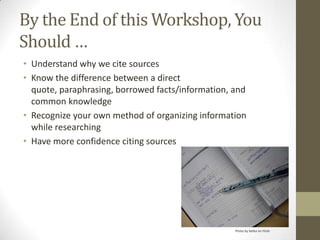
                                                   Photo by betka on Flickr
Citation Basics
• What does it mean to cite my sources?
• What is plagiarism?
• When should I cite my sources?


                                     Photo by dlanb on Flickr
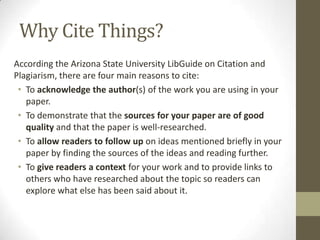
Why Cite Things?
According the Arizona State University LibGuide on Citation and
Plagiarism, there are four main reasons to cite:
 • To acknowledge the author(s) of the work you are using in your
   paper.
 • To demonstrate that the sources for your paper are of good
   quality and that the paper is well-researched.
 • To allow readers to follow up on ideas mentioned briefly in your
   paper by finding the sources of the ideas and reading further.
 • To give readers a context for your work and to provide links to
   others who have researched about the topic so readers can
   explore what else has been said about it.
Helpful Resources
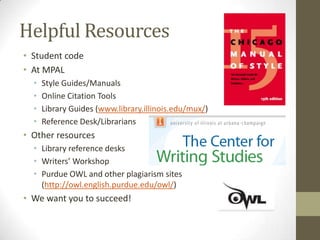
• Student code
• At MPAL
  •   Style Guides/Manuals
  •   Online Citation Tools
  •   Library Guides (www.library.illinois.edu/mux/)
  •   Reference Desk/Librarians
• Other resources
  • Library reference desks
  • Writers’ Workshop
  • Purdue OWL and other plagiarism sites
    (http://owl.english.purdue.edu/owl/)
• We want you to succeed!
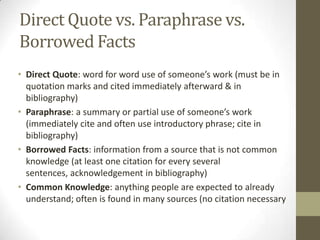
Direct Quote vs. Paraphrase vs.
Borrowed Facts
• Direct Quote: word for word use of someone’s work (must be in
  quotation marks and cited immediately afterward & in
  bibliography)
• Paraphrase: a summary or partial use of someone’s work
  (immediately cite and often use introductory phrase; cite in
  bibliography)
• Borrowed Facts: information from a source that is not common
  knowledge (at least one citation for every several
  sentences, acknowledgement in bibliography)
• Common Knowledge: anything people are expected to already
  understand; often is found in many sources (no citation necessary
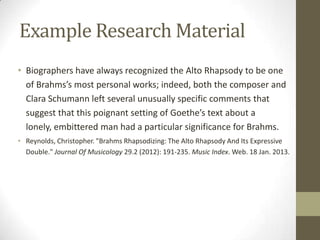
Example Research Material
• Biographers have always recognized the Alto Rhapsody to be one
  of Brahms’s most personal works; indeed, both the composer and
  Clara Schumann left several unusually specific comments that
  suggest that this poignant setting of Goethe’s text about a
  lonely, embittered man had a particular significance for Brahms.
• Reynolds, Christopher. "Brahms Rhapsodizing: The Alto Rhapsody And Its Expressive
  Double." Journal Of Musicology 29.2 (2012): 191-235. Music Index. Web. 18 Jan. 2013.
Direct Quote

• “Both [Brahms] and Clara Schumann left several unusually specific
  comments that suggest that this poignant setting of Goethe’s text
  about a lonely, embittered man had a particular significance for
  Brahms” (Reynolds, 191).


          In bibliography:
          Reynolds, Christopher. "Brahms Rhapsodizing: The Alto
                     Rhapsody And Its Expressive Double." Journal
                     Of Musicology 29.2 (2012): 191-235. Music
                     Index. Web. 18 Jan. 2013.
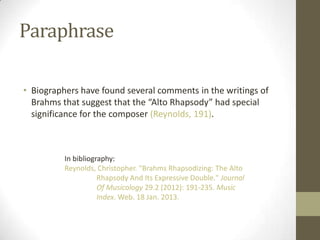
Paraphrase

• Biographers have found several comments in the writings of
  Brahms that suggest that the “Alto Rhapsody” had special
  significance for the composer (Reynolds, 191).


          In bibliography:
          Reynolds, Christopher. "Brahms Rhapsodizing: The Alto
                     Rhapsody And Its Expressive Double." Journal
                     Of Musicology 29.2 (2012): 191-235. Music
                     Index. Web. 18 Jan. 2013.
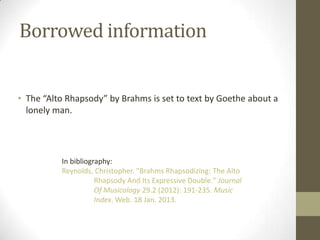
Borrowed information


• The “Alto Rhapsody” by Brahms is set to text by Goethe about a
  lonely man.


          In bibliography:
          Reynolds, Christopher. "Brahms Rhapsodizing: The Alto
                     Rhapsody And Its Expressive Double." Journal
                     Of Musicology 29.2 (2012): 191-235. Music
                     Index. Web. 18 Jan. 2013.
Common Knowledge


• For Brahms, the “Alto Rhapsody” is a very personal work.
Activity
• Decide whether the examples on the handout are
  •   Quotations
  •   Paraphrasing
  •   Borrowed information
  •   Common knowledge
• After about 5 minutes, find a partner and compare answers
• After 5 minutes we’ll compare answers as a group
Keeping Track of Information
When Researching
• Zotero
  • http://uiuc.libguides.com/zotero
• Refworks
  • http://uiuc.libguides.com/content.php?pid=203751
• Savvy Researcher Workshops
  • http://www.library.illinois.edu/sc/services/savvy_researcher.html
• Homegrown Systems
  • What works for you?
What We learned
• Why citing is important
• The difference between a direct quote, a paraphrase,
  borrowed information, and common knowledge
• Some ways to organize information while researching
• Where to go for help


                                                         Photo by
                                                         tbballgirl03
                                                         on Flickr
Reflection
• One thing you learned
• One thing you wish you knew more about
• Comments and/or feedback about the workshop


       Please feel free to contact me with questions!
                       Mandi Goodsett
                    goodset2@illinois.edu

Tips for Citing Sources

  • 1.
    Is That Plagiarism?: Tipsfor Citing Sources Mandi Goodsett MPAL Graduate Assistant goodset2@illinois.edu
  • 2.
    By the Endof this Workshop, You Should … • Understand why we cite sources • Know the difference between a direct quote, paraphrasing, borrowed facts/information, and common knowledge • Recognize your own method of organizing information while researching • Have more confidence citing sources Photo by betka on Flickr
  • 3.
    Citation Basics • Whatdoes it mean to cite my sources? • What is plagiarism? • When should I cite my sources? Photo by dlanb on Flickr
  • 4.
    Why Cite Things? Accordingthe Arizona State University LibGuide on Citation and Plagiarism, there are four main reasons to cite: • To acknowledge the author(s) of the work you are using in your paper. • To demonstrate that the sources for your paper are of good quality and that the paper is well-researched. • To allow readers to follow up on ideas mentioned briefly in your paper by finding the sources of the ideas and reading further. • To give readers a context for your work and to provide links to others who have researched about the topic so readers can explore what else has been said about it.
  • 5.
    Helpful Resources • Studentcode • At MPAL • Style Guides/Manuals • Online Citation Tools • Library Guides (www.library.illinois.edu/mux/) • Reference Desk/Librarians • Other resources • Library reference desks • Writers’ Workshop • Purdue OWL and other plagiarism sites (http://owl.english.purdue.edu/owl/) • We want you to succeed!
  • 6.
    Direct Quote vs.Paraphrase vs. Borrowed Facts • Direct Quote: word for word use of someone’s work (must be in quotation marks and cited immediately afterward & in bibliography) • Paraphrase: a summary or partial use of someone’s work (immediately cite and often use introductory phrase; cite in bibliography) • Borrowed Facts: information from a source that is not common knowledge (at least one citation for every several sentences, acknowledgement in bibliography) • Common Knowledge: anything people are expected to already understand; often is found in many sources (no citation necessary
  • 7.
    Example Research Material •Biographers have always recognized the Alto Rhapsody to be one of Brahms’s most personal works; indeed, both the composer and Clara Schumann left several unusually specific comments that suggest that this poignant setting of Goethe’s text about a lonely, embittered man had a particular significance for Brahms. • Reynolds, Christopher. "Brahms Rhapsodizing: The Alto Rhapsody And Its Expressive Double." Journal Of Musicology 29.2 (2012): 191-235. Music Index. Web. 18 Jan. 2013.
  • 8.
    Direct Quote • “Both[Brahms] and Clara Schumann left several unusually specific comments that suggest that this poignant setting of Goethe’s text about a lonely, embittered man had a particular significance for Brahms” (Reynolds, 191). In bibliography: Reynolds, Christopher. "Brahms Rhapsodizing: The Alto Rhapsody And Its Expressive Double." Journal Of Musicology 29.2 (2012): 191-235. Music Index. Web. 18 Jan. 2013.
  • 9.
    Paraphrase • Biographers havefound several comments in the writings of Brahms that suggest that the “Alto Rhapsody” had special significance for the composer (Reynolds, 191). In bibliography: Reynolds, Christopher. "Brahms Rhapsodizing: The Alto Rhapsody And Its Expressive Double." Journal Of Musicology 29.2 (2012): 191-235. Music Index. Web. 18 Jan. 2013.
  • 10.
    Borrowed information • The“Alto Rhapsody” by Brahms is set to text by Goethe about a lonely man. In bibliography: Reynolds, Christopher. "Brahms Rhapsodizing: The Alto Rhapsody And Its Expressive Double." Journal Of Musicology 29.2 (2012): 191-235. Music Index. Web. 18 Jan. 2013.
  • 11.
    Common Knowledge • ForBrahms, the “Alto Rhapsody” is a very personal work.
  • 12.
    Activity • Decide whetherthe examples on the handout are • Quotations • Paraphrasing • Borrowed information • Common knowledge • After about 5 minutes, find a partner and compare answers • After 5 minutes we’ll compare answers as a group
  • 13.
    Keeping Track ofInformation When Researching • Zotero • http://uiuc.libguides.com/zotero • Refworks • http://uiuc.libguides.com/content.php?pid=203751 • Savvy Researcher Workshops • http://www.library.illinois.edu/sc/services/savvy_researcher.html • Homegrown Systems • What works for you?
  • 14.
    What We learned •Why citing is important • The difference between a direct quote, a paraphrase, borrowed information, and common knowledge • Some ways to organize information while researching • Where to go for help Photo by tbballgirl03 on Flickr
  • 15.
    Reflection • One thingyou learned • One thing you wish you knew more about • Comments and/or feedback about the workshop Please feel free to contact me with questions! Mandi Goodsett goodset2@illinois.edu

Editor's Notes

  • #2 http://youtube/Mwbw9KF-ACY
  • #3 LearningObjectives:-Students will be able to articulate and appreciate why scholars cite their sources in order to become more motivated to cite their own sources.-Students will be able to identify the difference between a direct quote, paraphrased material, and borrowed facts and information and correctly cite any of this material in order to avoid plagiarism.-Students will be able to articulate their personal methods of organizing material while researching in order to avoid accidental plagiarism.-Students will be able to approach citing sources with confidence, diligence, and respect for the original authors.
  • #4 -Citing sources involves the use of in-text citations, footnotes, and works cited or bibliography pages to give credit to scholars whose work you used in your research and to provide a broader context for your work. -Plagiarism is using someone else's work without giving him or her credit, leading your readers to think those words are yours. While this might seem easy to avoid, many people who plagiarize do so unintentionally. Although most people think of plagiarism as recording someone's exact words without crediting him or her, it also includes re-arranging someone else's words (paraphrasing) or using his or her ideas. These forms of plagiarism are more common and require careful attention to avoid.-When using the exact words from a source, when paraphrasing from a source, when using the ideas from a source. *If you are ever in doubt of whether or not to cite an idea, ask a professor or reference librarian, or go ahead and cite the source. It’s better to overcite than undercite!*-Also, remember there is no cut and dry to-do list for citing sources. Citation is complex and situation-specific—it’s not easy for anyone. But, like any art, the more you do it the better you become at it.
  • #5 First, brainstorm a listThe main reason not to plagiarize is because doing so is unfairly attributing ideas of someone else to yourself, whether or not you intend to.
  • #6 -Article 1: Student Rights and Responsibilities – Part 4: Academic Integrity – (d) PlagiarismExamples includedConsequences:http://admin.illinois.edu/policy/code/article1_part4_1-402.htmlResults of plagiarism could include (at discretion of instructor) failing grade for assignment, reduced or failing grade for the course, denial of credit, a recommendation by the instructor that the student be suspended or dismissed. -The library provides style guides/manuals (behind the reference desk), citation tools online, library guides (see homepage -> Music -> Avoid Plagiarism OR Class and Research Guides -> several guides will work, but for sure the first one, Mus 110 -> Citing Sources tab), librarians to help you or refer you-reference desk at any library on campus, the Writers’ Workshop, sites like Purdue OWL or others listed in the LibGuides-We want you to succeed! You want to succeed! People (including you) don’t want their work stolen! Proper citation means everyone wins.
  • #9 This is a direct quote, and should therefore be both in quotation marks and cited properly with both an in-text citation and a full citation in the works cited list.
  • #10 This is a paraphrase or re-wording of an idea from the article, which means it doesn’t need quotation marks but it does need both an in-text citation and a full citation in the works cited list.
  • #11 This idea is supported in the research, even if it isn’t a paraphrase or direct quote from a specific line of text in the article. This information could definitely be cited immediately with an in-text citation, but a citation in the bibliography would suffice.
  • #12 Anything people are expected to knowIn many sourcesLook at published articles for examples
  • #14 -Zotero is a free citation management software plug-in for Firefox and Chrome/Safari. It enables users to collect, manage, and cite research from all types of sources. It lives in your web browser and is free. Zotero allows you to attach pdfs, notes, images and screenshots to your citations, to organize them into collections for different projects, and to create bibliographies using Word or OpenOffice. Zotero detects when a book, article, or other resource is being viewed and, with a mouse click, finds and saves the full reference information to a local file.-RefWorks is a citation management software program, paid for by the University Library and offered FREE to faculty, staff, and students at the University of Illinois.  RefWorks collects, stores, and organizes citations from books, articles, web sites, and other sources.RefWorks automatically converts citations into properly formatted bibliographies and formats references within manuscripts.-Savvy Researcher Workshops-Homegrown systems discussion
  • #16 On back of handoutGive to me on the way out