MMLLAA 
PPaarreenntthheettiiccaall CCiittaattiioonnss 
aanndd 
WWoorrkkss CCiitteedd 
Source: Purdue Owl Online Writing Lab 
http://owl.english.purdue.edu/owl/resource/747/01/
Parenthetical Citations and Works Cited 
are closely related. 
If you cite information in your paper (Parenthetical 
Citation),the complete information on that source must 
be included in Works Cited. 
If a source appears on your Works Cited page, it must be 
cited in your paper.
Parenthetical Citations 
#1 If you note the author’s name in the text of the paper, you only 
need to cite the page number: 
Wordsworth stated that Romantic poetry was marked by a 
"spontaneous overflow of powerful feelings" (263). 
#2. If you do not note the author’s name in the text of your paper, 
you need to cite author’s last name and page number: 
Romantic poetry is characterized by the "spontaneous overflow of 
powerful feelings" (Wordsworth 263). 
PLEASE NOTE THAT THE PARENTHETICAL CITATION IS 
PLACED INSIDE OF END PUNCTUATION.
Works Cited 
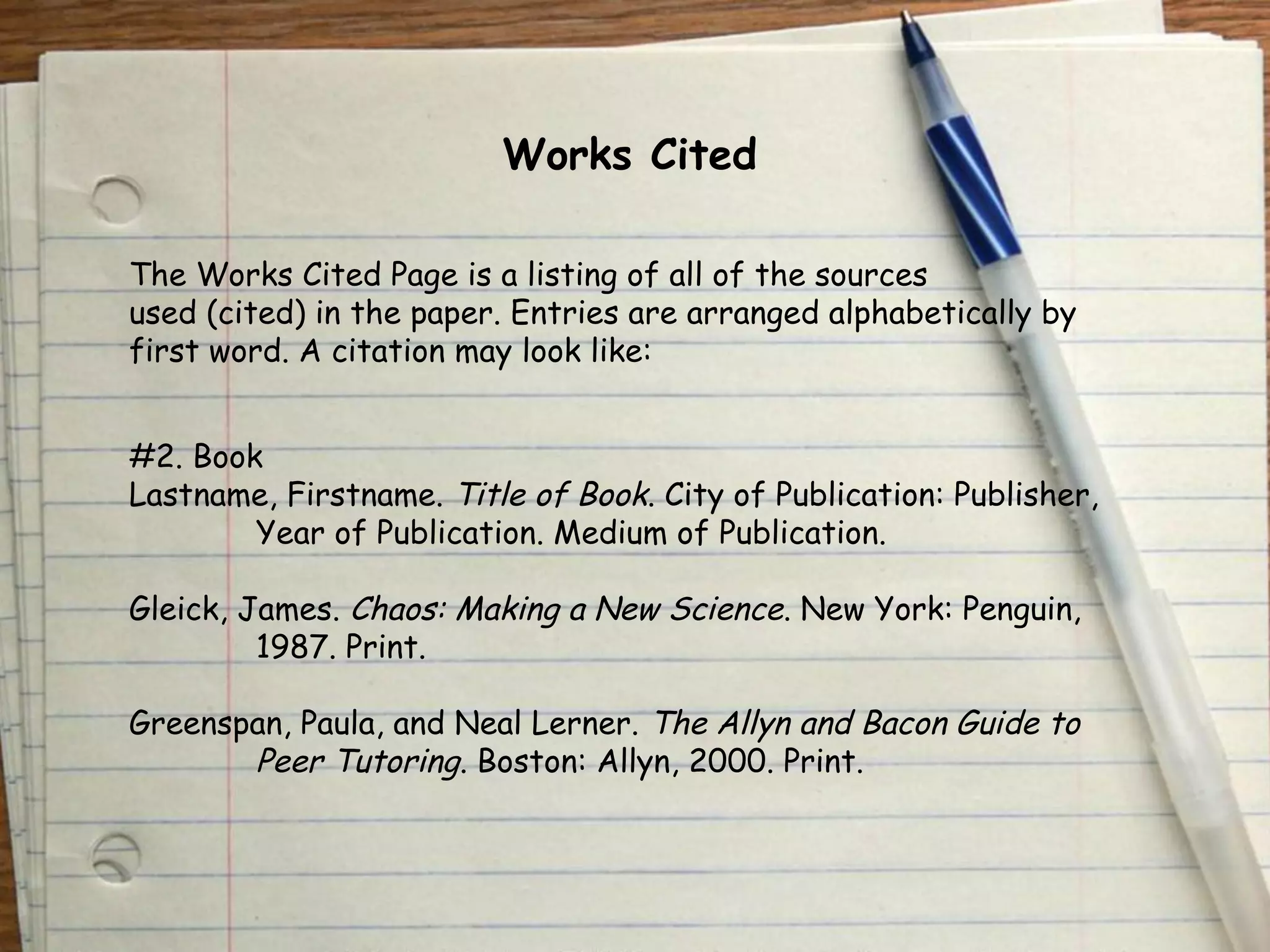
The Works Cited Page is a listing of all of the sources 
used (cited) in the paper. Entries are arranged alphabetically 
by first word. A citation may look like: 
#1. Journal (magazine) 
Author(s). "Title of Article." Title of Periodical Day Month Year: 
pages. Medium of publication. 
Poniewozik, James. "TV Makes a Too-Close Call." Time 20 Nov. 
2000: 70-71. Print.
Works Cited 
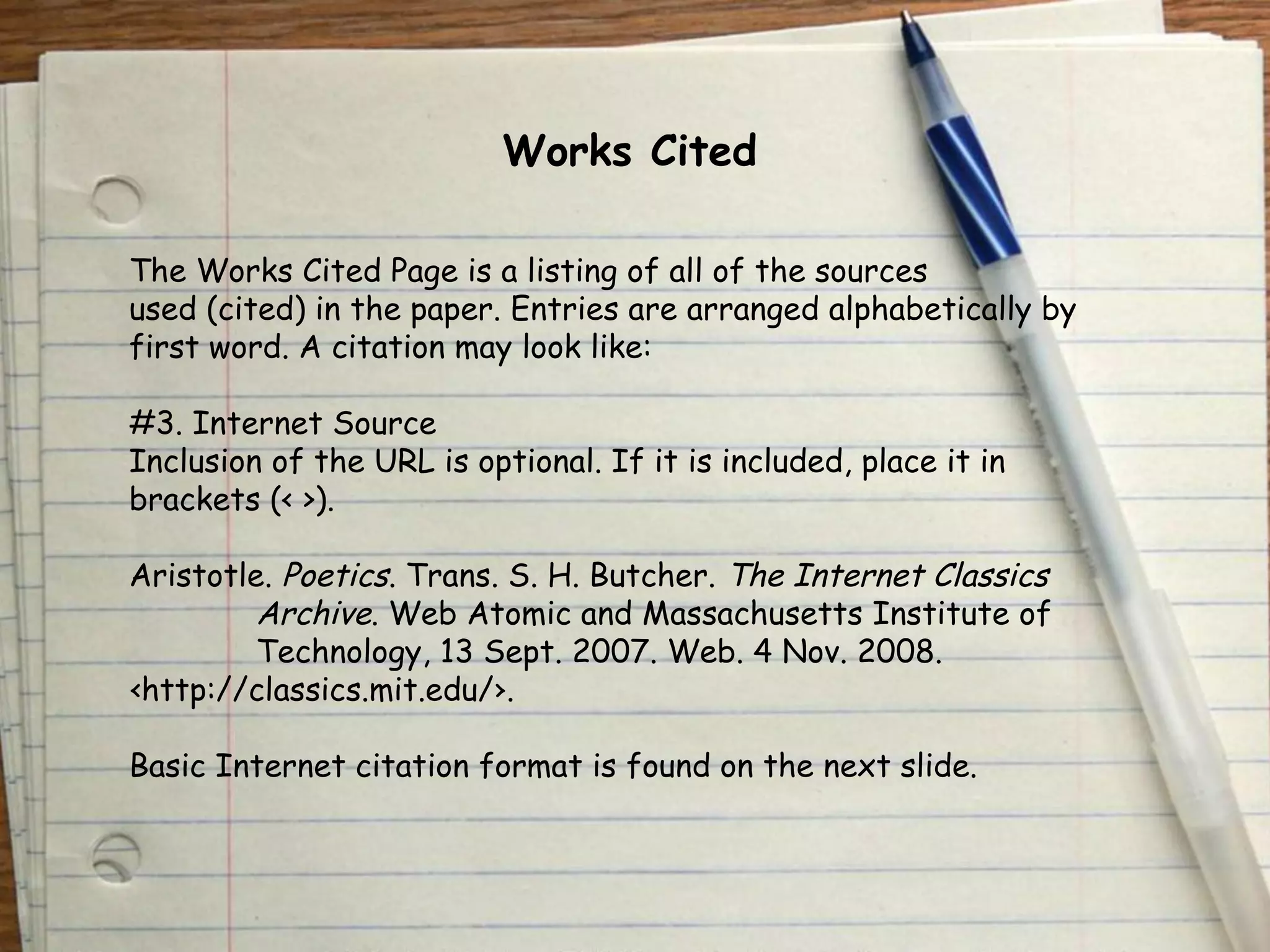
The Works Cited Page is a listing of all of the sources 
used (cited) in the paper. Entries are arranged alphabetically by 
first word. A citation may look like: 
#2. Book 
Lastname, Firstname. Title of Book. City of Publication: Publisher, 
Year of Publication. Medium of Publication. 
Gleick, James. Chaos: Making a New Science. New York: Penguin, 
1987. Print. 
Greenspan, Paula, and Neal Lerner. The Allyn and Bacon Guide to 
Peer Tutoring. Boston: Allyn, 2000. Print.
Works Cited 
The Works Cited Page is a listing of all of the sources 
used (cited) in the paper. Entries are arranged alphabetically by 
first word. A citation may look like: 
#3. Internet Source 
Inclusion of the URL is optional. If it is included, place it in 
brackets (< >). 
Aristotle. Poetics. Trans. S. H. Butcher. The Internet Classics 
Archive. Web Atomic and Massachusetts Institute of 
Technology, 13 Sept. 2007. Web. 4 Nov. 2008. 
‹http://classics.mit.edu/›. 
Basic Internet citation format is found on the next slide.
Works Cited 
Internet Resources 
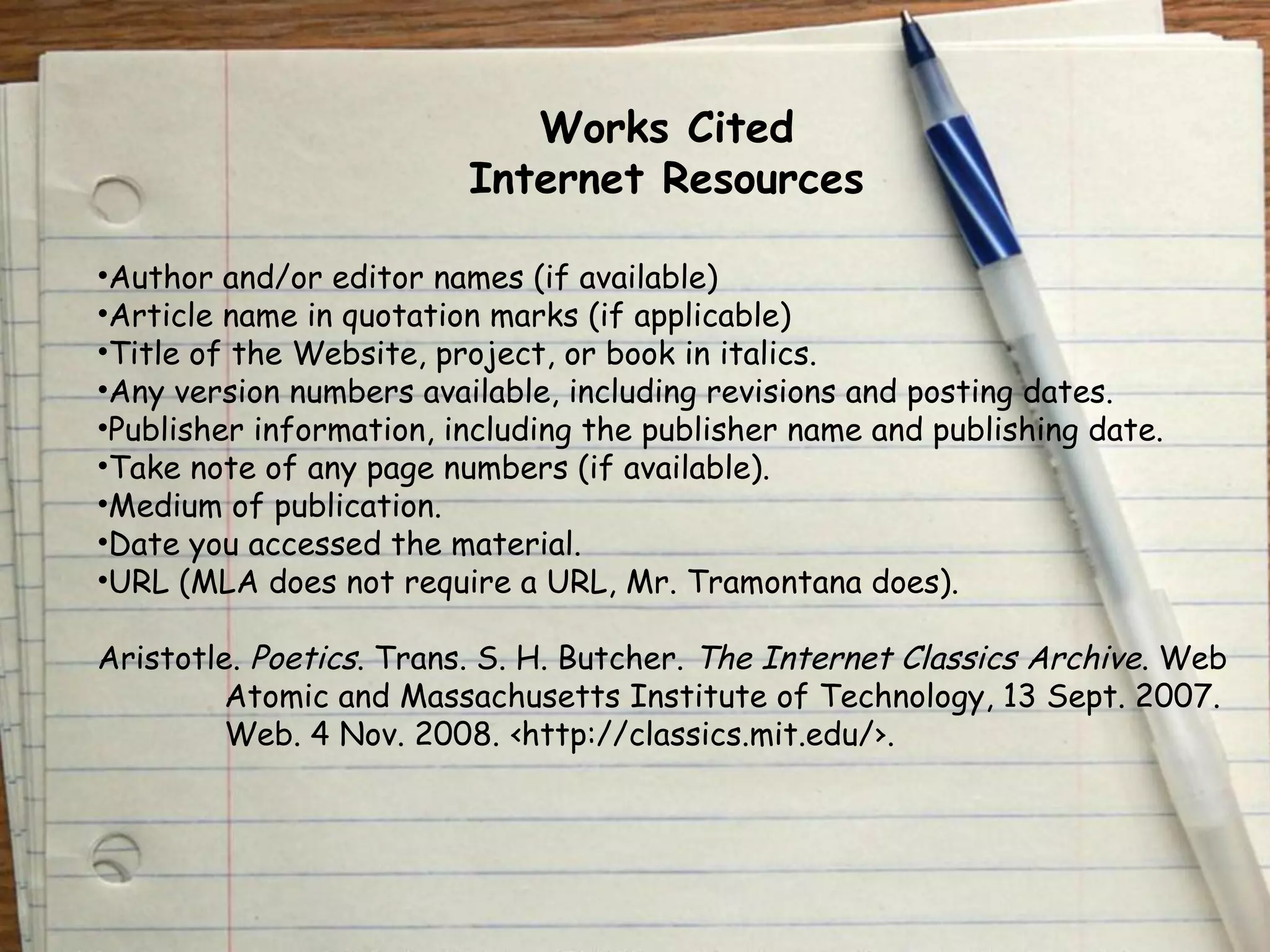
•Author and/or editor names (if available) 
•Article name in quotation marks (if applicable) 
•Title of the Website, project, or book in italics. 
•Any version numbers available, including revisions and posting dates. 
•Publisher information, including the publisher name and publishing date. 
•Take note of any page numbers (if available). 
•Medium of publication. 
•Date you accessed the material. 
•URL (MLA does not require a URL, Mr. Tramontana does). 
Aristotle. Poetics. Trans. S. H. Butcher. The Internet Classics Archive. Web 
Atomic and Massachusetts Institute of Technology, 13 Sept. 2007. 
Web. 4 Nov. 2008. ‹http://classics.mit.edu/›.
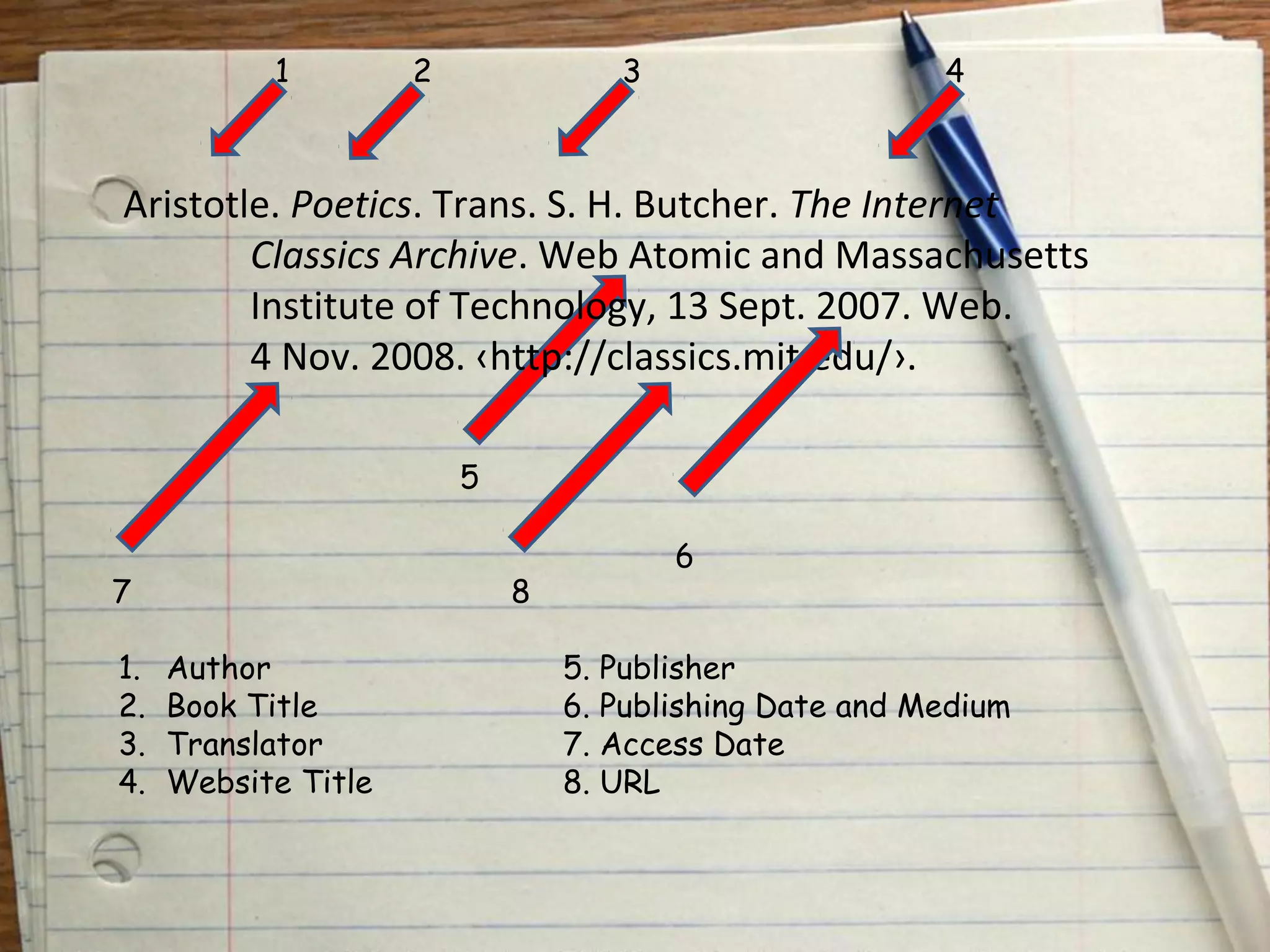
1 2 3 4 
Aristotle. Poetics. Trans. S. H. Butcher. The Internet 
Classics Archive. Web Atomic and Massachusetts 
Institute of Technology, 13 Sept. 2007. Web. 
4 Nov. 2008. ‹http://classics.mit.edu/›. 
5 
6 
7 8 
1. Author 5. Publisher 
2. Book Title 6. Publishing Date and Medium 
3. Translator 7. Access Date 
4. Website Title 8. URL

MLA

  • 1.
    MMLLAA PPaarreenntthheettiiccaall CCiittaattiioonnss aanndd WWoorrkkss CCiitteedd Source: Purdue Owl Online Writing Lab http://owl.english.purdue.edu/owl/resource/747/01/
  • 2.
    Parenthetical Citations andWorks Cited are closely related. If you cite information in your paper (Parenthetical Citation),the complete information on that source must be included in Works Cited. If a source appears on your Works Cited page, it must be cited in your paper.
  • 3.
    Parenthetical Citations #1If you note the author’s name in the text of the paper, you only need to cite the page number: Wordsworth stated that Romantic poetry was marked by a "spontaneous overflow of powerful feelings" (263). #2. If you do not note the author’s name in the text of your paper, you need to cite author’s last name and page number: Romantic poetry is characterized by the "spontaneous overflow of powerful feelings" (Wordsworth 263). PLEASE NOTE THAT THE PARENTHETICAL CITATION IS PLACED INSIDE OF END PUNCTUATION.
  • 4.
    Works Cited TheWorks Cited Page is a listing of all of the sources used (cited) in the paper. Entries are arranged alphabetically by first word. A citation may look like: #1. Journal (magazine) Author(s). "Title of Article." Title of Periodical Day Month Year: pages. Medium of publication. Poniewozik, James. "TV Makes a Too-Close Call." Time 20 Nov. 2000: 70-71. Print.
  • 5.
    Works Cited TheWorks Cited Page is a listing of all of the sources used (cited) in the paper. Entries are arranged alphabetically by first word. A citation may look like: #2. Book Lastname, Firstname. Title of Book. City of Publication: Publisher, Year of Publication. Medium of Publication. Gleick, James. Chaos: Making a New Science. New York: Penguin, 1987. Print. Greenspan, Paula, and Neal Lerner. The Allyn and Bacon Guide to Peer Tutoring. Boston: Allyn, 2000. Print.
  • 6.
    Works Cited TheWorks Cited Page is a listing of all of the sources used (cited) in the paper. Entries are arranged alphabetically by first word. A citation may look like: #3. Internet Source Inclusion of the URL is optional. If it is included, place it in brackets (< >). Aristotle. Poetics. Trans. S. H. Butcher. The Internet Classics Archive. Web Atomic and Massachusetts Institute of Technology, 13 Sept. 2007. Web. 4 Nov. 2008. ‹http://classics.mit.edu/›. Basic Internet citation format is found on the next slide.
  • 7.
    Works Cited InternetResources •Author and/or editor names (if available) •Article name in quotation marks (if applicable) •Title of the Website, project, or book in italics. •Any version numbers available, including revisions and posting dates. •Publisher information, including the publisher name and publishing date. •Take note of any page numbers (if available). •Medium of publication. •Date you accessed the material. •URL (MLA does not require a URL, Mr. Tramontana does). Aristotle. Poetics. Trans. S. H. Butcher. The Internet Classics Archive. Web Atomic and Massachusetts Institute of Technology, 13 Sept. 2007. Web. 4 Nov. 2008. ‹http://classics.mit.edu/›.
  • 8.
    1 2 34 Aristotle. Poetics. Trans. S. H. Butcher. The Internet Classics Archive. Web Atomic and Massachusetts Institute of Technology, 13 Sept. 2007. Web. 4 Nov. 2008. ‹http://classics.mit.edu/›. 5 6 7 8 1. Author 5. Publisher 2. Book Title 6. Publishing Date and Medium 3. Translator 7. Access Date 4. Website Title 8. URL