Krystal M. Reddick
Educator and Blogger
SOCIAL JUSTICE ENGLISH
ELECTIVES: POWER,
PRIVILEGE, AND ACTION VIA
GRAPHIC NOVELS AND
INCARCERATION ACTIVISM
WHITE PRIVILEGE
CONFERENCE 2015
Are you live tweeting?
•The Twitter hashtag is #WPC16
•My handle is Krystallised26
Presentation Overview and Objectives
• Overview
• Speaker Introduction
• Ice Breakers
• Conversation Norms
• Elective Presentations
• Identity & Graphic Novels
• Incarceration & Autodidacts
• Next Steps: Creating your own
social justice elective
• Q & A
• Objectives
• Teaching strategies for
teaching issues of social
justice
• A model of social justice
curricula (texts, resources,
video clips)
• Forum for mediating
difficult issues in the
classroom via Conversation
Norms
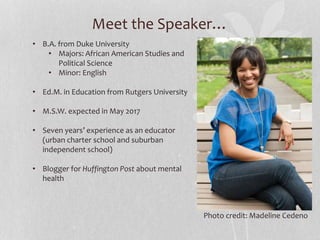
Meet the Speaker…
• B.A. from Duke University
• Majors: African American Studies and
Political Science
• Minor: English
• Ed.M. in Education from Rutgers University
• M.S.W. expected in May 2017
• Seven years’ experience as an educator
(urban charter school and suburban
independent school)
• Blogger for Huffington Post about mental
health
Photo credit: Madeline Cedeno
Who’s in the audience?
•K-12 Teachers?
•Professors?
•Administrators?
•Social workers?
•Activists/organizers?
•Anyone else?
Getting to Know the Audience…
• How do you define social justice?
• Think/Pair/Share
• How old were you when you learned about social justice?
• How old do you think students should be before we as teachers (or
parents, coaches, advisors) broach the topic of social justice, white
privilege, and power with them? Why?
Conversation Norms:
How to Navigate Difficult Conversations
• One speaker at a time
• Share the air; say what’s core
• Use “I” statements
• You are the owner of your own experience and the expert of you
• Practice purity of motive
• “Ouch!,” then educate
• Take responsibility for what you say and how you say it
• Be real, take off the mask
• Maintain confidentiality
• Lean into discomfort; take positive risks
• (Adapted from the Lead for Diversity program norms.)
Identity & Graphic Novels
•What is a graphic novel?
•Think/Pair/Share
•How does your identity shape your experiences?
(Focus only on the following: race, gender,
sexual orientation, religion, socioeconomic
status.)
•Do you generally think of yourself as a privileged
being? Where are you a target and where are
you an agent?
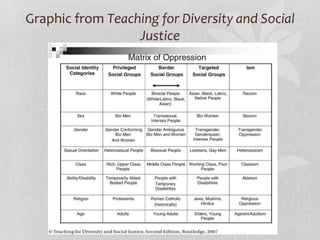
Graphic from Teaching for Diversity and Social
Justice
Identity & Graphic Novels:
Overview of Syllabus and Assessments…
• Texts:
• Ellen Forney’s Marbles: Mania, Depression, Michelangelo, and Me (2012)
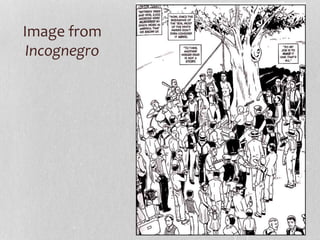
• Mat Johnson’s Incognegro (2009)
• Scott McCloud’s Understanding Comics: The Invisible Art (1994)
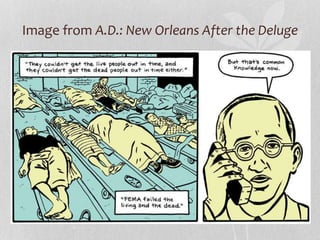
• Josh Neufeld’s A.D.: New Orleans After the Deluge (2010)
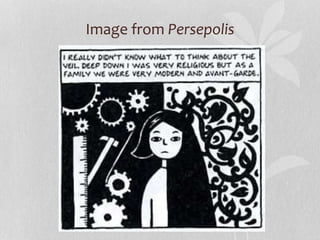
• Marjane Satrapi’s Persepolis (2004)
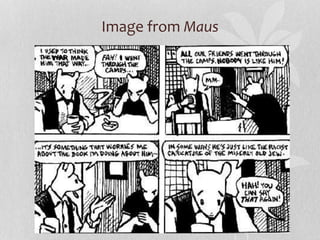
• Art Spiegelman’s Maus (1986)
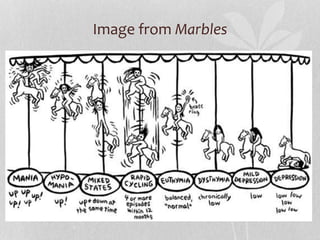
Image from Marbles
Image from Persepolis
Image from A.D.: New Orleans After the Deluge
Image from
Incognegro
Image from Maus
Identity & Graphic Novels:
Overview of Syllabus and Assessments…
• Documentaries and films (all are accessible via YouTube):
• Persepolis
• Up/Down: The Bipolar Documentary
• When the Levees Broke
Identity & Graphic Novels:
Overview of Syllabus and Assessments…
• Topics covered include:
• History of comics and comics vocabulary
• Matrix of Oppression
• Identity
• The Iranian Revolution
• The Holocaust
• Lynching in the American South
• Hurricane Katrina
• Mental illness (Bipolar Disorder)
Identity & Graphic Novels:
Overview of Syllabus and Assessments…
• Assessments:
• Reader Response Papers
• AP prompt essay tests
• Comics assignment
• 3-to-5 page essay
• Fishbowl discussion
• Comics vocabulary quiz
• Today’s Meet discussion while viewing films
Identity and Graphic Novels:
Documentaries
• Clips of the documentaries:
• When the Levees Broke (0:00 to 3:56)
• Up/Down: The Bipolar Documentary (0:00 to 7:18)
• Processing Questions for both films:
• Initial reactions?
• What issues or topics are present in these
documentaries?
• Why do these topics matter for a social justice agenda?
• What questions arise for you?
Incarceration and Autodidacts
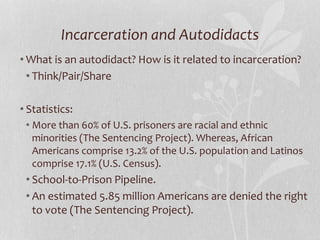
• What is an autodidact? How is it related to incarceration?
• Think/Pair/Share
• Statistics:
• More than 60% of U.S. prisoners are racial and ethnic
minorities (The Sentencing Project). Whereas, African
Americans comprise 13.2% of the U.S. population and Latinos
comprise 17.1% (U.S. Census).
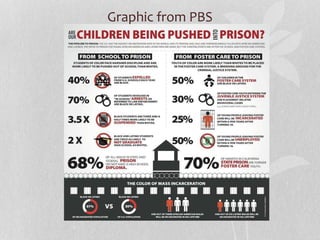
• School-to-Prison Pipeline.
• An estimated 5.85 million Americans are denied the right
to vote (The Sentencing Project).
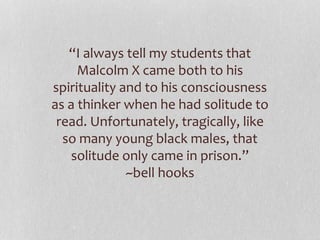
“I always tell my students that
Malcolm X came both to his
spirituality and to his consciousness
as a thinker when he had solitude to
read. Unfortunately, tragically, like
so many young black males, that
solitude only came in prison.”
~bell hooks
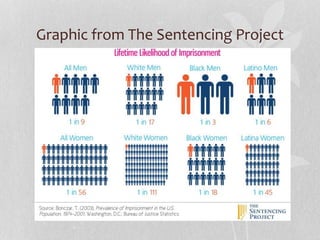
Graphic from The Sentencing Project
Graphic from PBS
Incarceration and Autodidacts:
Overview of Syllabus and Assessments…
• Texts:
• Narrative of the Life of Frederick Douglass (1845)
• Claude Brown’s Manchild in the Promised Land (1965)
• The Autobiography of Malcom X (1965)
• Piri Thomas’ Down These Mean Streets (1967)
• The Autobiography of Assata Shakur (1987)
• Black Artemis’ Picture Me Rollin’ (2005)
Incarceration and Autodidacts:
Overview of Syllabus and Assessments…
• Excerpts from:
• Michelle Alexander
• The New Jim Crow: Mass Incarceration in the Age of Colorblindness
• Angela Davis
• Are Prisons Obsolete
• bell hooks
• “Preface About Black Men” (from We Real Cool: Black Men and Masculinity)
• Jackson Katz
• TED Talk “Violence Against Women”
• Audre Lorde
• “The Transformation of Silence into Language and Action”
• Peggy McIntosh
• “Unpacking the Invisible Knapsack”
• Tupac Shakur’s
• “Picture Me Rollin’”
• The Rose That Grew From Concrete
• LA Times’ article “Tupac Shakur: I am Not a Gangster”
Incarceration and Autodidacts:
Overview of Syllabus and Assessments…
• Topics covered include:
• The benefits and rewards of education
• The disadvantages of not pursuing education
• Institutional/structural racism
• Prison industrial complex
• Violence
• White privilege
Incarceration and Autodidacts:
Overview of Syllabus and Assessments…
• Assessments:
• Reader Response Papers
• AP prompt essay tests
• Today’s Meet discussion while viewing Katz’s TED Talk
• 3-to-5 page essay
• Activism Project
Privilege Activities
• Buzzfeed Privilege Lesson
• http://www.buzzfeed.com/nathanwpyle/this-teacher-taught-his-class-a-
powerful-lesson-about-privil
• Buzzfeed Privilege Quiz
• http://www.buzzfeed.com/regajha/how-privileged-are-you#48cynvy
Incarceration and Autodidacts:
Activism Projects
• What now? Activism projects:
• Students will be guided in creating an action plan to address an area of concern
regarding the prison industrial complex.
• Contact your elected local representatives via phone, email, or Twitter.
• Brainstorm policy reform for a prison issue. The ACLU lists a number of important causes:
• https://www.aclu.org/prisoners-rights
• Start a petition around an important prison cause.
• Hold a fundraiser to raise donations for an organization of your choice.
• Donate new or used Torahs or prayer books to Jewish Prisoner Services International.
• http://jpsi.org/get-involved/
Next Steps…
• How could you use some or all of these texts and/or resources in
your own classrooms?
• What challenges do you foresee? Administration approval? Parental
consent? Teacher autonomy? Others?
• Create Your Own:
• What social justice topics are you interested in creating a curriculum
around?
• Let’s brainstorm together. Tap the human resources in the room. Work in
groups of three or four.
• Jot down your ideas on the handout.
Any last questions,
comments, or
concerns?
Thank You! And Keep in Touch.
• I’d love to know how you implement any of these ideas. Or, if you
want to brainstorm further, please feel free to contact me:
• Twitter: Krystallised26
• If you’re interested in my personal resources on mental health
(when teaching Marbles in the graphic novel elective), please refer
to my blogs:
• Huffington Post
• http://www.huffingtonpost.com/author/krystal-reddick
• International Bipolar Foundation
• http://ibpf.org/tags/krystal-reddick
• The Mighty
• https://themighty.com/author/krystal-reddick/
Additional Resources…
• Jackson Katz’s TED Talk
“Violence Against Women: It’s a
Men’s Issue”
• http://www.ted.com/talks/jackson_
katz_violence_against_women_it_s
_a_men_s_issue?language=en
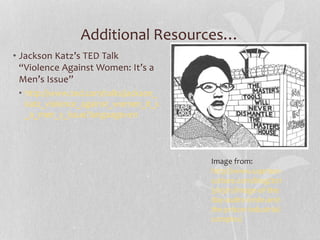
Image from:
http://www.usprison
culture.com/blog/201
3/03/11/image-of-the-
day-audre-lorde-and-
the-prison-industrial-
complex/

White Privilege Conference Presentation_LinkedIn_KReddick

  • 1.
    Krystal M. Reddick Educatorand Blogger SOCIAL JUSTICE ENGLISH ELECTIVES: POWER, PRIVILEGE, AND ACTION VIA GRAPHIC NOVELS AND INCARCERATION ACTIVISM WHITE PRIVILEGE CONFERENCE 2015
  • 2.
    Are you livetweeting? •The Twitter hashtag is #WPC16 •My handle is Krystallised26
  • 3.
    Presentation Overview andObjectives • Overview • Speaker Introduction • Ice Breakers • Conversation Norms • Elective Presentations • Identity & Graphic Novels • Incarceration & Autodidacts • Next Steps: Creating your own social justice elective • Q & A • Objectives • Teaching strategies for teaching issues of social justice • A model of social justice curricula (texts, resources, video clips) • Forum for mediating difficult issues in the classroom via Conversation Norms
  • 4.
    Meet the Speaker… •B.A. from Duke University • Majors: African American Studies and Political Science • Minor: English • Ed.M. in Education from Rutgers University • M.S.W. expected in May 2017 • Seven years’ experience as an educator (urban charter school and suburban independent school) • Blogger for Huffington Post about mental health Photo credit: Madeline Cedeno
  • 5.
    Who’s in theaudience? •K-12 Teachers? •Professors? •Administrators? •Social workers? •Activists/organizers? •Anyone else?
  • 6.
    Getting to Knowthe Audience… • How do you define social justice? • Think/Pair/Share • How old were you when you learned about social justice? • How old do you think students should be before we as teachers (or parents, coaches, advisors) broach the topic of social justice, white privilege, and power with them? Why?
  • 7.
    Conversation Norms: How toNavigate Difficult Conversations • One speaker at a time • Share the air; say what’s core • Use “I” statements • You are the owner of your own experience and the expert of you • Practice purity of motive • “Ouch!,” then educate • Take responsibility for what you say and how you say it • Be real, take off the mask • Maintain confidentiality • Lean into discomfort; take positive risks • (Adapted from the Lead for Diversity program norms.)
  • 8.
    Identity & GraphicNovels •What is a graphic novel? •Think/Pair/Share •How does your identity shape your experiences? (Focus only on the following: race, gender, sexual orientation, religion, socioeconomic status.) •Do you generally think of yourself as a privileged being? Where are you a target and where are you an agent?
  • 9.
    Graphic from Teachingfor Diversity and Social Justice
  • 10.
    Identity & GraphicNovels: Overview of Syllabus and Assessments… • Texts: • Ellen Forney’s Marbles: Mania, Depression, Michelangelo, and Me (2012) • Mat Johnson’s Incognegro (2009) • Scott McCloud’s Understanding Comics: The Invisible Art (1994) • Josh Neufeld’s A.D.: New Orleans After the Deluge (2010) • Marjane Satrapi’s Persepolis (2004) • Art Spiegelman’s Maus (1986)
  • 11.
  • 12.
  • 13.
    Image from A.D.:New Orleans After the Deluge
  • 14.
  • 15.
  • 16.
    Identity & GraphicNovels: Overview of Syllabus and Assessments… • Documentaries and films (all are accessible via YouTube): • Persepolis • Up/Down: The Bipolar Documentary • When the Levees Broke
  • 17.
    Identity & GraphicNovels: Overview of Syllabus and Assessments… • Topics covered include: • History of comics and comics vocabulary • Matrix of Oppression • Identity • The Iranian Revolution • The Holocaust • Lynching in the American South • Hurricane Katrina • Mental illness (Bipolar Disorder)
  • 18.
    Identity & GraphicNovels: Overview of Syllabus and Assessments… • Assessments: • Reader Response Papers • AP prompt essay tests • Comics assignment • 3-to-5 page essay • Fishbowl discussion • Comics vocabulary quiz • Today’s Meet discussion while viewing films
  • 19.
    Identity and GraphicNovels: Documentaries • Clips of the documentaries: • When the Levees Broke (0:00 to 3:56) • Up/Down: The Bipolar Documentary (0:00 to 7:18) • Processing Questions for both films: • Initial reactions? • What issues or topics are present in these documentaries? • Why do these topics matter for a social justice agenda? • What questions arise for you?
  • 20.
    Incarceration and Autodidacts •What is an autodidact? How is it related to incarceration? • Think/Pair/Share • Statistics: • More than 60% of U.S. prisoners are racial and ethnic minorities (The Sentencing Project). Whereas, African Americans comprise 13.2% of the U.S. population and Latinos comprise 17.1% (U.S. Census). • School-to-Prison Pipeline. • An estimated 5.85 million Americans are denied the right to vote (The Sentencing Project).
  • 21.
    “I always tellmy students that Malcolm X came both to his spirituality and to his consciousness as a thinker when he had solitude to read. Unfortunately, tragically, like so many young black males, that solitude only came in prison.” ~bell hooks
  • 22.
    Graphic from TheSentencing Project
  • 23.
  • 24.
    Incarceration and Autodidacts: Overviewof Syllabus and Assessments… • Texts: • Narrative of the Life of Frederick Douglass (1845) • Claude Brown’s Manchild in the Promised Land (1965) • The Autobiography of Malcom X (1965) • Piri Thomas’ Down These Mean Streets (1967) • The Autobiography of Assata Shakur (1987) • Black Artemis’ Picture Me Rollin’ (2005)
  • 25.
    Incarceration and Autodidacts: Overviewof Syllabus and Assessments… • Excerpts from: • Michelle Alexander • The New Jim Crow: Mass Incarceration in the Age of Colorblindness • Angela Davis • Are Prisons Obsolete • bell hooks • “Preface About Black Men” (from We Real Cool: Black Men and Masculinity) • Jackson Katz • TED Talk “Violence Against Women” • Audre Lorde • “The Transformation of Silence into Language and Action” • Peggy McIntosh • “Unpacking the Invisible Knapsack” • Tupac Shakur’s • “Picture Me Rollin’” • The Rose That Grew From Concrete • LA Times’ article “Tupac Shakur: I am Not a Gangster”
  • 26.
    Incarceration and Autodidacts: Overviewof Syllabus and Assessments… • Topics covered include: • The benefits and rewards of education • The disadvantages of not pursuing education • Institutional/structural racism • Prison industrial complex • Violence • White privilege
  • 27.
    Incarceration and Autodidacts: Overviewof Syllabus and Assessments… • Assessments: • Reader Response Papers • AP prompt essay tests • Today’s Meet discussion while viewing Katz’s TED Talk • 3-to-5 page essay • Activism Project
  • 28.
    Privilege Activities • BuzzfeedPrivilege Lesson • http://www.buzzfeed.com/nathanwpyle/this-teacher-taught-his-class-a- powerful-lesson-about-privil • Buzzfeed Privilege Quiz • http://www.buzzfeed.com/regajha/how-privileged-are-you#48cynvy
  • 29.
    Incarceration and Autodidacts: ActivismProjects • What now? Activism projects: • Students will be guided in creating an action plan to address an area of concern regarding the prison industrial complex. • Contact your elected local representatives via phone, email, or Twitter. • Brainstorm policy reform for a prison issue. The ACLU lists a number of important causes: • https://www.aclu.org/prisoners-rights • Start a petition around an important prison cause. • Hold a fundraiser to raise donations for an organization of your choice. • Donate new or used Torahs or prayer books to Jewish Prisoner Services International. • http://jpsi.org/get-involved/
  • 30.
    Next Steps… • Howcould you use some or all of these texts and/or resources in your own classrooms? • What challenges do you foresee? Administration approval? Parental consent? Teacher autonomy? Others? • Create Your Own: • What social justice topics are you interested in creating a curriculum around? • Let’s brainstorm together. Tap the human resources in the room. Work in groups of three or four. • Jot down your ideas on the handout.
  • 31.
  • 32.
    Thank You! AndKeep in Touch. • I’d love to know how you implement any of these ideas. Or, if you want to brainstorm further, please feel free to contact me: • Twitter: Krystallised26 • If you’re interested in my personal resources on mental health (when teaching Marbles in the graphic novel elective), please refer to my blogs: • Huffington Post • http://www.huffingtonpost.com/author/krystal-reddick • International Bipolar Foundation • http://ibpf.org/tags/krystal-reddick • The Mighty • https://themighty.com/author/krystal-reddick/
  • 33.
    Additional Resources… • JacksonKatz’s TED Talk “Violence Against Women: It’s a Men’s Issue” • http://www.ted.com/talks/jackson_ katz_violence_against_women_it_s _a_men_s_issue?language=en Image from: http://www.usprison culture.com/blog/201 3/03/11/image-of-the- day-audre-lorde-and- the-prison-industrial- complex/

Editor's Notes

  • #5 Time yourself for each section. Restart timer at the start of each section to keep you on track. Don’t go over the allotted time!
  • #6 Ask audience to raise hands.
  • #8 Read through these one at a time. For time’s sake, I will not be going through these extensively.
  • #10 Use you as an example: black, woman, cisgendered, heterosexual, middleclass, able-bodied, protestant, adult, college educated
  • #11 Give a brief synopsis of each text. Maus is perhaps the most well-known graphic novel; it won a Pulitzer Prize in 1992.
  • #19 Explain what Today’s Meet is
  • #20 What do you recall about Hurricane Katrina? What do you know about bipolar disorder?
  • #25 Give a brief synopsis of each text
  • #26 Give a brief synopsis
  • #31 Pass out the handouts now. Share how you came up with the idea for the two electives (The Walking Dead and Duke NEH institute).