ENG 101
Library Research
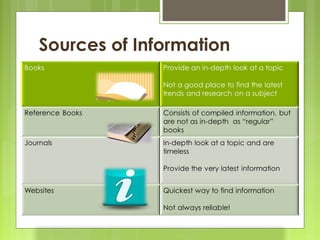
Sources of Information
Websites VS. Databases
A website is a page on the Internet. Anyone can make a website
(entertainment, educational, ???)
       Misinformation!


A database is a collection of material
that is searchable in some format.

Experts or professionals pick and maintain the information that goes
into the database. 

Usually, the library has to pay to have access to the information. 

Items in a database are considered legit sources of information.
BEWARE!!!
Evaluating Sources
   Authority

   Objectivity

   Currency

   Coverage

   Accuracy
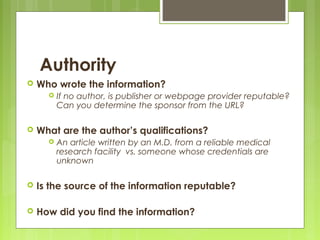
Authority
   Who wrote the information?
         If no author, is publisher or webpage provider reputable?
          Can you determine the sponsor from the URL?

   What are the author’s qualifications?
         An article written by an M.D. from a reliable medical
          research facility vs. someone whose credentials are
          unknown

   Is the source of the information reputable?

   How did you find the information?
Objectivity
 Is   the information biased?


 What  is the purpose of the information? To
  inform? Persuade? Explain? Advertise?
Currency
 Is   the information old/outdated?

 Is   the publication date indicated?

 If   links are provided, do they work?
Coverage
 Is   there enough information?

 Is   the coverage in-depth?

 Does  it cover the topic(s) you need? Does
  it provide the main points or concepts you
  need?
Accuracy
 Are    there any spelling/grammar mistakes?

 Where     did the information come from?

 Is   the information reliable?

 Are    Sources cited?
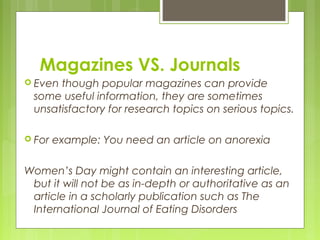
Magazines VS. Journals
 Eventhough popular magazines can provide
 some useful information, they are sometimes
 unsatisfactory for research topics on serious topics.

 For   example: You need an article on anorexia

Women’s Day might contain an interesting article,
 but it will not be as in-depth or authoritative as an
 article in a scholarly publication such as The
 International Journal of Eating Disorders
MLA Citation Style – 7th Edition
What is MLA?
Modern           Language Association

Amethod of citing references in
research papers
  Parenthetical citations in text
  Works Cited page

     The Ultimate Source: MLA Handbook for Writers of Research
       Papers
What are the benefits?
 Gives   you credibility as a writer!

 Proof
      that you have researched your topic
 thoroughly!

 Protects   you from plagiarism!

 Further   research!
When do I cite?
 Therule of thumb to avoid plagiarism is to provide
 a citation for any idea that is not your own.

           Direct quotation

           Paraphrasing

           Summary of another’s idea or research

           Specific reference to an obscure fact, phrase, or figure
In-Text Citations
 In  the body of your paper you acknowledge the
  sources you used with a brief (parenthetical
  citation) that refers to an alphabetical Works Cited
  list at the end of the paper.

            . . . . (Clynes 27).
Basic Works Cited Entry
Author’s last name, first name. Title of the Book. Location:
Publisher, Year. Medium of Publication.

Avery, Elizabeth F. Assessing student learning outcomes for
        information literacy instruction in academic institutions.
        Chicago: Association of College and Research
Libraries, 2003. Print.


Citing and Writing Guides
Purdue Owl
Don’t Forget!
 Titles   are italicized rather than underlined

 Include a medium of publication (Print, Web,
  Film, DVD, etc.)

 ForWeb publications include a URL only if your
  professor requires it or if you think a reader would
  need it order to find citation
Work Cited Page for Database
   (MLA 7th Edition)

Stewart, Melissa. "Dolphin: Flipper or Killer?" Science
     World. 18 Oct. 1999: 2-4. Science Resource
Center. Web. 16 Apr. 2009.


Author’s last, First name. “Title of Article.” Database
     Name. Date of Article. Format. Date
Accessed.
MLA Overview
 Alphabetize   all citations in Works Cited by author’s
 last name. If no author is identified, alphabetize by
 first word of title, ignoring the initial article (e.g. A,
 An, The)

 Citations
         should be double-spaced in Times New
 Roman, size 12 font.
CQ Researcher
(Library Database)
CQ Researcher

Login: Goodwin10


Password: CQEL
Don’t Forget……
        Ask a librarian!!


We are nice, friendly, and have
      a master’s degree!

Eng 101

  • 1.
  • 2.
  • 3.
    Websites VS. Databases Awebsite is a page on the Internet. Anyone can make a website (entertainment, educational, ???)  Misinformation! A database is a collection of material that is searchable in some format. Experts or professionals pick and maintain the information that goes into the database.  Usually, the library has to pay to have access to the information.  Items in a database are considered legit sources of information.
  • 4.
  • 5.
    Evaluating Sources  Authority  Objectivity  Currency  Coverage  Accuracy
  • 6.
    Authority  Who wrote the information?  If no author, is publisher or webpage provider reputable? Can you determine the sponsor from the URL?  What are the author’s qualifications?  An article written by an M.D. from a reliable medical research facility vs. someone whose credentials are unknown  Is the source of the information reputable?  How did you find the information?
  • 7.
    Objectivity  Is the information biased?  What is the purpose of the information? To inform? Persuade? Explain? Advertise?
  • 8.
    Currency  Is the information old/outdated?  Is the publication date indicated?  If links are provided, do they work?
  • 9.
    Coverage  Is there enough information?  Is the coverage in-depth?  Does it cover the topic(s) you need? Does it provide the main points or concepts you need?
  • 10.
    Accuracy  Are there any spelling/grammar mistakes?  Where did the information come from?  Is the information reliable?  Are Sources cited?
  • 11.
    Magazines VS. Journals Eventhough popular magazines can provide some useful information, they are sometimes unsatisfactory for research topics on serious topics.  For example: You need an article on anorexia Women’s Day might contain an interesting article, but it will not be as in-depth or authoritative as an article in a scholarly publication such as The International Journal of Eating Disorders
  • 12.
    MLA Citation Style– 7th Edition
  • 13.
    What is MLA? Modern Language Association Amethod of citing references in research papers Parenthetical citations in text Works Cited page The Ultimate Source: MLA Handbook for Writers of Research Papers
  • 14.
    What are thebenefits?  Gives you credibility as a writer!  Proof that you have researched your topic thoroughly!  Protects you from plagiarism!  Further research!
  • 15.
    When do Icite?  Therule of thumb to avoid plagiarism is to provide a citation for any idea that is not your own.  Direct quotation  Paraphrasing  Summary of another’s idea or research  Specific reference to an obscure fact, phrase, or figure
  • 16.
    In-Text Citations  In the body of your paper you acknowledge the sources you used with a brief (parenthetical citation) that refers to an alphabetical Works Cited list at the end of the paper. . . . . (Clynes 27).
  • 17.
    Basic Works CitedEntry Author’s last name, first name. Title of the Book. Location: Publisher, Year. Medium of Publication. Avery, Elizabeth F. Assessing student learning outcomes for information literacy instruction in academic institutions. Chicago: Association of College and Research Libraries, 2003. Print. Citing and Writing Guides Purdue Owl
  • 18.
    Don’t Forget!  Titles are italicized rather than underlined  Include a medium of publication (Print, Web, Film, DVD, etc.)  ForWeb publications include a URL only if your professor requires it or if you think a reader would need it order to find citation
  • 19.
    Work Cited Pagefor Database (MLA 7th Edition) Stewart, Melissa. "Dolphin: Flipper or Killer?" Science World. 18 Oct. 1999: 2-4. Science Resource Center. Web. 16 Apr. 2009. Author’s last, First name. “Title of Article.” Database Name. Date of Article. Format. Date Accessed.
  • 20.
    MLA Overview  Alphabetize all citations in Works Cited by author’s last name. If no author is identified, alphabetize by first word of title, ignoring the initial article (e.g. A, An, The)  Citations should be double-spaced in Times New Roman, size 12 font.
  • 21.
  • 22.
  • 23.
    Don’t Forget…… Ask a librarian!! We are nice, friendly, and have a master’s degree!