The Tipping point
  Focus, marketing en sales
Hoe bereiken we onze klanten
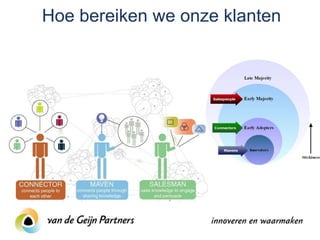
Connectors, Mavens, Salesmen
•   "The Law of the Few", or, as Gladwell states, "The success of any kind of social epidemic is heavily dependent on the
    involvement of people with a particular and rare set of social gifts." According to Gladwell, economists call this the
    "80/20 Principle, which is the idea that in any situation roughly 80 percent of the 'work' will be done by 20 percent of
    the participants." (see Pareto Principle) These people are described in the following ways:
•   Connectors are the people who "link us up with the world ... people with a special gift for bringing the world together."
    They are "a handful of people with a truly extraordinary knack [... for] making friends and acquaintances". He
    characterizes these individuals as having social networks of over one hundred people. To illustrate, Gladwell cites the
    following examples: the midnight ride of Paul Revere, Milgram's experiments in the small world problem, the "Six
    Degrees of Kevin Bacon" trivia game, Dallas businessman Roger Horchow, and Chicagoan Lois Weisberg, a person
    who understands the concept of the weak tie. Gladwell attributes the social success of Connectors to "their ability to
    span many different worlds [... as] a function of something intrinsic to their personality, some combination of curiosity,
    self-confidence, sociability, and energy."
•   Mavens are "information specialists", or "people we rely upon to connect us with new information." They accumulate
    knowledge, especially about the marketplace, and know how to share it with others. Gladwell cites Mark Alpert as a
    prototypical Maven who is "almost pathologically helpful", further adding, "he can't help himself". In this vein, Alpert
    himself concedes, "A Maven is someone who wants to solve other people's problems, generally by solving his own".
    According to Gladwell, Mavens start "word-of-mouth epidemics" due to their knowledge, social skills, and ability to
    communicate. As Gladwell states, "Mavens are really information brokers, sharing and trading what they know".
•   Salesmen are "persuaders", charismatic people with powerful negotiation skills. They tend to have an indefinable trait
    that goes beyond what they say, which makes others want to agree with them. Gladwell's examples include California
    businessman Tom Gau and news anchor Peter Jennings, and he cites several studies about the persuasive
    implications of non-verbal cues, including a headphone nod study (conducted by Gary Wells of the University of
    Alberta and Richard Petty of the University of Missouri) and William Condon's cultural microrhythms study.
10.000 uren makers
In Outliers, Malcolm Gladwell interviews Bill Gates and focuses on the opportunities given to him
    throughout his lifetime that have led to his success.
A common theme that appears throughout Outliers is the "10,000-Hour Rule", based on a study by
    Anders Ericsson. Gladwell claims that greatness requires enormous time, using the source of The
    Beatles' musical talents and Gates' computer savvy as examples. The Beatles performed live in
    Hamburg, Germany over 1,200 times from 1960 to 1964, amassing more than 10,000 hours of
    playing time, therefore meeting the 10,000-Hour Rule. Gladwell asserts that all of the time The
    Beatles spent performing shaped their talent, "so by the time they returned to England from
    Hamburg, Germany, 'they sounded like no one else. It was the making of them.'" Gates met the
    10,000-Hour Rule when he gained access to a high school computer in 1968 at the age of 13, and
    spent 10,000 hours programming on it.
In Outliers, Gladwell interviews Gates, who says that unique access to a computer at a time when they
    were not commonplace helped him succeed. Without that access, Gladwell states that Gates
    would still be "a highly intelligent, driven, charming person and a successful professional", but that
    he might not be worth US$50 billion. Gladwell explains that reaching the 10,000-Hour Rule, which
    he considers the key to success in any field, is simply a matter of practicing a specific task that
    can be accomplished with 20 hours of work a week for 10 years. He also notes that he himself
    took exactly 10 years to meet the 10,000-Hour Rule, during his brief tenure at The American
    Spectator and his more recent job at The Washington Post.
Onze klanten
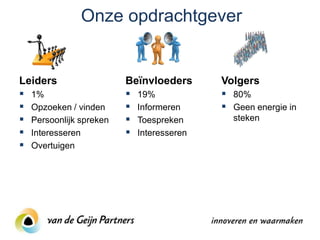
Onze opdrachtgever


Leiders                 Beïnvloeders     Volgers
 1%                     19%             80%
 Opzoeken / vinden      Informeren      Geen energie in
 Persoonlijk spreken    Toespreken       steken
 Interesseren           Interesseren
 Overtuigen
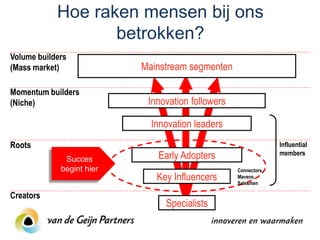
Hoe raken mensen bij ons
                   betrokken?
Volume builders
(Mass market)              Mainstream segmenten

Momentum builders
(Niche)                     Innovation followers

                             Innovation leaders
Roots                                                            Influential

              Succes          Early Adopters                     members

             begint hier                           Connectors,
                              Key Influencers      Mavens,
                                                   Salesmen

Creators
                                Specialists
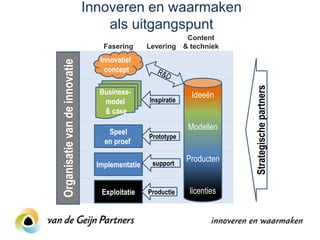
Innoveren en waarmaken
                                   als uitgangspunt
                                                           Content
                                   Fasering      Levering & techniek
                                  Innovatief
Organisatie van de innovatie        concept


                                                                          Strategische partners
                                 Business-                     Ideeën
                                  model          Inspiratie
                                  & case
                                                              Modellen
                                    Speel
                                                 Prototype
                                   en proef

                                                  support
                                                              Producten
                                 Implementatie


                                  Exploitatie    Productie    licenties
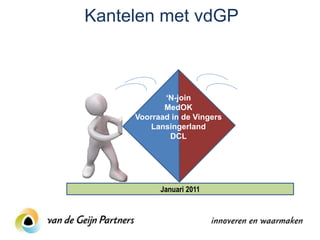
Kantelen met vdGP


            ‘N-join
            MedOK
     Voorraad in de Vingers
        Lansingerland
             DCL


           Januari 2011
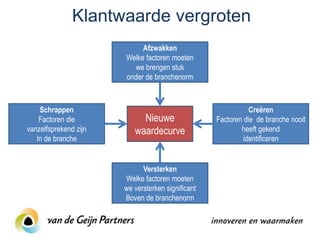
Klantwaarde vergroten
                            Afzwakken
                       Welke factoren moeten
                         we brengen stuk
                       onder de branchenorm


    Schrappen                                                 Creëren
    Factoren die            Nieuwe                 Factoren die de branche nooit
vanzelfsprekend zijn      waardecurve                      heeft gekend
   In de branche                                            identificeren


                             Versterken
                       Welke factoren moeten
                       we versterken significant
                       Boven de branchenorm
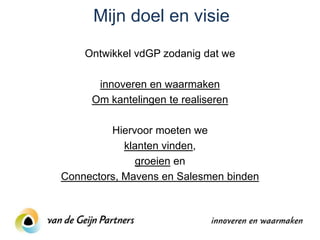
Mijn doel en visie
    Ontwikkel vdGP zodanig dat we

      innoveren en waarmaken
     Om kantelingen te realiseren

         Hiervoor moeten we
            klanten vinden,
               groeien en
Connectors, Mavens en Salesmen binden
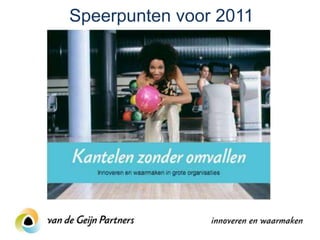
Speerpunten voor 2011

Tipping point

  • 1.
    The Tipping point Focus, marketing en sales
  • 2.
    Hoe bereiken weonze klanten
  • 3.
    Connectors, Mavens, Salesmen • "The Law of the Few", or, as Gladwell states, "The success of any kind of social epidemic is heavily dependent on the involvement of people with a particular and rare set of social gifts." According to Gladwell, economists call this the "80/20 Principle, which is the idea that in any situation roughly 80 percent of the 'work' will be done by 20 percent of the participants." (see Pareto Principle) These people are described in the following ways: • Connectors are the people who "link us up with the world ... people with a special gift for bringing the world together." They are "a handful of people with a truly extraordinary knack [... for] making friends and acquaintances". He characterizes these individuals as having social networks of over one hundred people. To illustrate, Gladwell cites the following examples: the midnight ride of Paul Revere, Milgram's experiments in the small world problem, the "Six Degrees of Kevin Bacon" trivia game, Dallas businessman Roger Horchow, and Chicagoan Lois Weisberg, a person who understands the concept of the weak tie. Gladwell attributes the social success of Connectors to "their ability to span many different worlds [... as] a function of something intrinsic to their personality, some combination of curiosity, self-confidence, sociability, and energy." • Mavens are "information specialists", or "people we rely upon to connect us with new information." They accumulate knowledge, especially about the marketplace, and know how to share it with others. Gladwell cites Mark Alpert as a prototypical Maven who is "almost pathologically helpful", further adding, "he can't help himself". In this vein, Alpert himself concedes, "A Maven is someone who wants to solve other people's problems, generally by solving his own". According to Gladwell, Mavens start "word-of-mouth epidemics" due to their knowledge, social skills, and ability to communicate. As Gladwell states, "Mavens are really information brokers, sharing and trading what they know". • Salesmen are "persuaders", charismatic people with powerful negotiation skills. They tend to have an indefinable trait that goes beyond what they say, which makes others want to agree with them. Gladwell's examples include California businessman Tom Gau and news anchor Peter Jennings, and he cites several studies about the persuasive implications of non-verbal cues, including a headphone nod study (conducted by Gary Wells of the University of Alberta and Richard Petty of the University of Missouri) and William Condon's cultural microrhythms study.
  • 4.
    10.000 uren makers InOutliers, Malcolm Gladwell interviews Bill Gates and focuses on the opportunities given to him throughout his lifetime that have led to his success. A common theme that appears throughout Outliers is the "10,000-Hour Rule", based on a study by Anders Ericsson. Gladwell claims that greatness requires enormous time, using the source of The Beatles' musical talents and Gates' computer savvy as examples. The Beatles performed live in Hamburg, Germany over 1,200 times from 1960 to 1964, amassing more than 10,000 hours of playing time, therefore meeting the 10,000-Hour Rule. Gladwell asserts that all of the time The Beatles spent performing shaped their talent, "so by the time they returned to England from Hamburg, Germany, 'they sounded like no one else. It was the making of them.'" Gates met the 10,000-Hour Rule when he gained access to a high school computer in 1968 at the age of 13, and spent 10,000 hours programming on it. In Outliers, Gladwell interviews Gates, who says that unique access to a computer at a time when they were not commonplace helped him succeed. Without that access, Gladwell states that Gates would still be "a highly intelligent, driven, charming person and a successful professional", but that he might not be worth US$50 billion. Gladwell explains that reaching the 10,000-Hour Rule, which he considers the key to success in any field, is simply a matter of practicing a specific task that can be accomplished with 20 hours of work a week for 10 years. He also notes that he himself took exactly 10 years to meet the 10,000-Hour Rule, during his brief tenure at The American Spectator and his more recent job at The Washington Post.
  • 5.
  • 6.
    Onze opdrachtgever Leiders Beïnvloeders Volgers  1%  19%  80%  Opzoeken / vinden  Informeren  Geen energie in  Persoonlijk spreken  Toespreken steken  Interesseren  Interesseren  Overtuigen
  • 7.
    Hoe raken mensenbij ons betrokken? Volume builders (Mass market) Mainstream segmenten Momentum builders (Niche) Innovation followers Innovation leaders Roots Influential Succes Early Adopters members begint hier Connectors, Key Influencers Mavens, Salesmen Creators Specialists
  • 8.
    Innoveren en waarmaken als uitgangspunt Content Fasering Levering & techniek Innovatief Organisatie van de innovatie concept Strategische partners Business- Ideeën model Inspiratie & case Modellen Speel Prototype en proef support Producten Implementatie Exploitatie Productie licenties
  • 9.
    Kantelen met vdGP ‘N-join MedOK Voorraad in de Vingers Lansingerland DCL Januari 2011
  • 10.
    Klantwaarde vergroten Afzwakken Welke factoren moeten we brengen stuk onder de branchenorm Schrappen Creëren Factoren die Nieuwe Factoren die de branche nooit vanzelfsprekend zijn waardecurve heeft gekend In de branche identificeren Versterken Welke factoren moeten we versterken significant Boven de branchenorm
  • 11.
    Mijn doel envisie Ontwikkel vdGP zodanig dat we innoveren en waarmaken Om kantelingen te realiseren Hiervoor moeten we klanten vinden, groeien en Connectors, Mavens en Salesmen binden
  • 12.