E245 Value Proposition
Ann Miura-Ko
January 2011
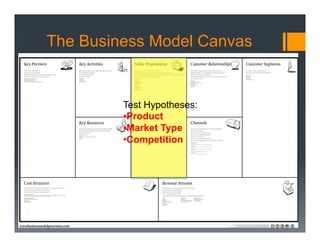
The Business Model Canvas


         Test Hypotheses:
         • Product
         • Market Type
         • Competition
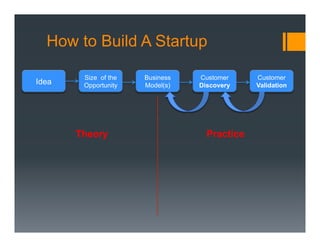
How to Build A Startup

        Size of the   Business   Customer     Customer
Idea    Opportunity   Model(s)   Discovery    Validation


       Theory                      Practice
We start with the theory…
Key Questions for Value Prop

§ Problem Statement: What is the problem?
§ Technology / Market Insight: Why is the problem
 so hard to solve?
§ Market Size: How big is this problem?
§ Competition: What do customers do today?
§ Product: How do you do it?
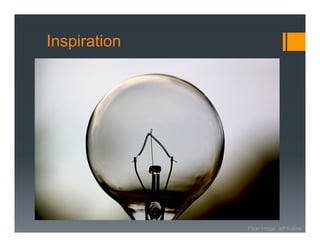
Inspiration


Where do these ideas come
          from?


                      Flickr Image: Jeff Kubina
The Authentic Entrepreneur


http://www.ted.com/talks/
erin_mckean_redefines_the_dictionary.html
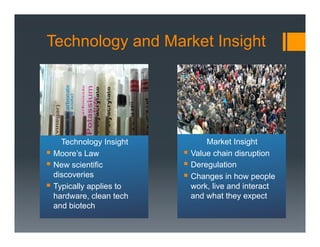
Technology and Market Insight


      Technology Insight           Market Insight
§  Moore’s Law            §  Value chain disruption
§  New scientific         §  Deregulation
    discoveries            §  Changes in how people
§  Typically applies to       work, live and interact
    hardware, clean tech       and what they expect
    and biotech
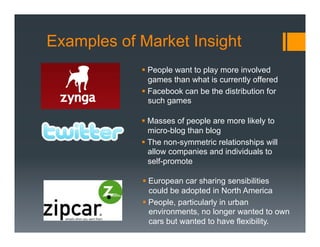
Examples of Market Insight
            §  People want to play more involved
                games than what is currently offered
            §  Facebook can be the distribution for
                such games

            §  Masses of people are more likely to
                micro-blog than blog
            §  The non-symmetric relationships will
                allow companies and individuals to
                self-promote

            §  European car sharing sensibilities
                could be adopted in North America
            §  People, particularly in urban
                environments, no longer wanted to own
                cars but wanted to have flexibility.
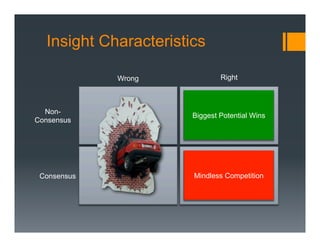
Insight Characteristics

             Wrong             Right


  Non-
                       Biggest Potential Wins
Consensus


 Consensus             Mindless Competition
Key Thought


 What insight do I have that is not
   yet conventional wisdom?
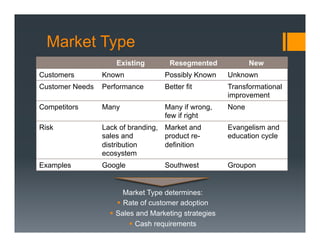
Market Type
                     Existing         Resegmented              New
Customers        Known              Possibly Known      Unknown
Customer Needs   Performance        Better fit          Transformational
                                                        improvement
Competitors      Many               Many if wrong,      None
                                    few if right
Risk             Lack of branding, Market and           Evangelism and
                 sales and         product re-          education cycle
                 distribution      definition
                 ecosystem
Examples         Google             Southwest           Groupon


                           Market Type determines:
                       §  Rate of customer adoption
                   §  Sales and Marketing strategies
                            §  Cash requirements
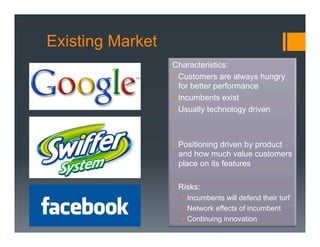
Existing Market
                  Characteristics:
                  §  Customers are always hungry
                      for better performance
                  §  Incumbents exist
                  §  Usually technology driven


                  §  Positioning driven by product
                      and how much value customers
                      place on its features

                  §  Risks:
                     §  Incumbents will defend their turf
                     §  Network effects of incumbent
                     §  Continuing innovation
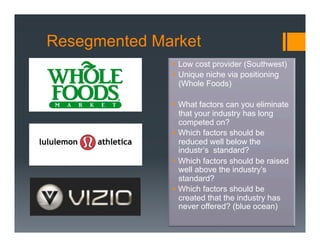
Resegmented Market
              §  Low cost provider (Southwest)
              §  Unique niche via positioning
                  (Whole Foods)

              §  What factors can you eliminate
                  that your industry has long
                  competed on?
              §  Which factors should be
                  reduced well below the
                  industr’s standard?
              §  Which factors should be raised
                  well above the industry’s
                  standard?
              §  Which factors should be
                  created that the industry has
                  never offered? (blue ocean)
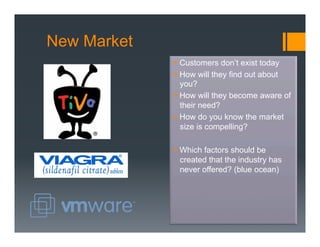
New Market
             §  Customers don’t exist today
             §  How will they find out about
                 you?
             §  How will they become aware of
                 their need?
             §  How do you know the market
                 size is compelling?

             §  Which factors should be
                 created that the industry has
                 never offered? (blue ocean)
The Problem
§ The “problem” justifies why the product is
   valuable to someone
§ The Problem Statement:
 § For whom?
 § What issue do they face?
§ Note: Doesn’t reference the product
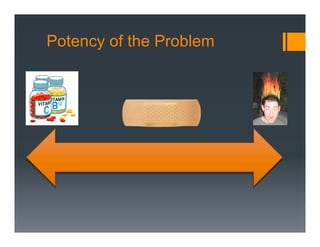
Potency of the Problem
Competition


§  Are substitute products and services available?
§  Are competitors threatening to offer better price or value?
§  How saturated is our market?
§  How likely are customers to defect?
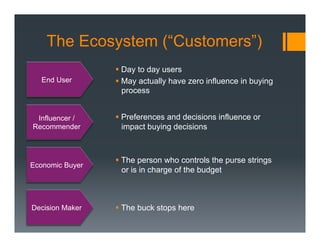
The Ecosystem (“Customers”)
                 §  Day to day users
  End User       §  May actually have zero influence in buying
                     process


 Influencer /    §  Preferences and decisions influence or
Recommender          impact buying decisions


                 §  The person who controls the purse strings
Economic Buyer
                     or is in charge of the budget


Decision Maker   §  The buck stops here
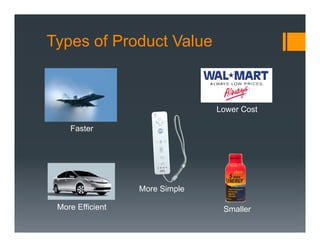
Types of Product Value


                                Lower Cost

    Faster


                  More Simple

 More Efficient                  Smaller
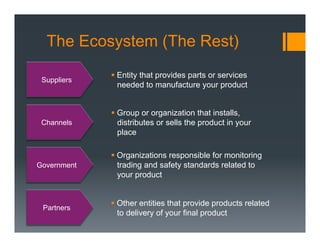
The Ecosystem (The Rest)
             §  Entity that provides parts or services
 Suppliers
                 needed to manufacture your product


             §  Group or organization that installs,
 Channels        distributes or sells the product in your
                 place

             §  Organizations responsible for monitoring
Government       trading and safety standards related to
                 your product


             §  Other entities that provide products related
 Partners
                 to delivery of your final product
Wait! I thought this lecture was
      about products?!?
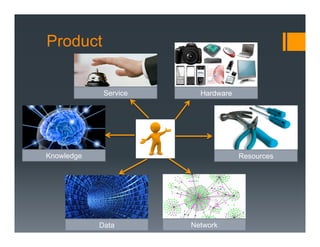
Product


             Service     Hardware


Knowledge                           Resources


            Data       Network
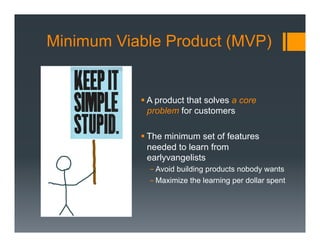
Minimum Viable Product (MVP)


           § A product that solves a core
              problem for customers

           § The minimum set of features
              needed to learn from
              earlyvangelists
             - Avoid building products nobody wants
             - Maximize the learning per dollar spent
The Art of the MVP


§ A MVP is not a minimal product
§ “But my customers don’t know what they want!”
§ At what point of “I don’t get it!” will I declare defeat?
Testing the MVP
§  Smoke testing with landing pages using AdWords
§  In-product split-testing
§  Prototypes (particularly for hardware)
§  Removing features
§  Continued customer discovery and validation
§  Surveys
§  Interviews
Testing the MVP (Web Example)
 Can you get customers to pay for a product
   that doesn’t yet exist (or barely does)?

§ Interview customers to make sure they have a
   matching core problem
§ Set up web site landing page to test for conversion
§ See what offers are required to get customers to use
   the product (e.g. prizes, payment)
§ Use problem definition as described by customers to
   identify key word list – plug into Google search traffic
   estimator - high traffic means there is problem
   awareness
§ Drive traffic to site using Google search and see how
   deep into a registration process customers are willing to
   go through
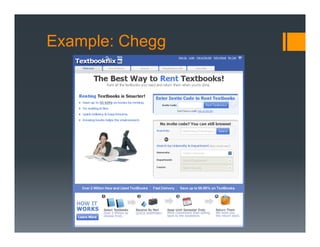
Example: Chegg
Testing the MVP (Non-Web)
 Can you get customers to pay for a product
   that doesn’t yet exist (or barely does)?

§ Interview customers to make sure they have a
   matching core problem
§ Set up web site landing page to test for conversion
§ Set up a Lighthouse Customer Program where
   potential customers pay to get early access to
   product prototypes
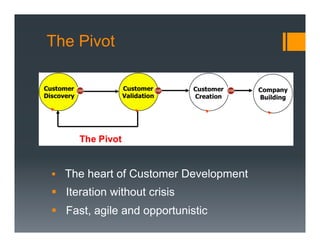
The Pivot


§  The heart of Customer Development
§  Iteration without crisis
§  Fast, agile and opportunistic
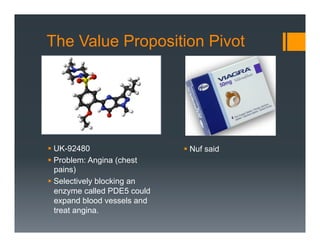
The Value Proposition Pivot


§  UK-92480                   §  Nuf said
§  Problem: Angina (chest
    pains)
§  Selectively blocking an
    enzyme called PDE5 could
    expand blood vessels and
    treat angina.
The Value Proposition Pivot


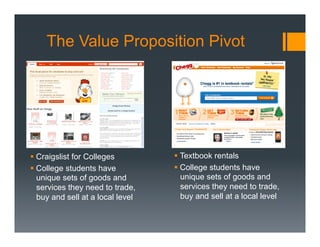
§  Craigslist for Colleges         §  Textbook rentals
§  College students have           §  College students have
    unique sets of goods and            unique sets of goods and
    services they need to trade,        services they need to trade,
    buy and sell at a local level       buy and sell at a local level
Test these hypotheses for next week:

 § Problem Statement: What is the problem? For
  whom?
 § Technology / Market Insight: Why is the problem
  so hard to solve?
 § Competition: What do customers do today?
 § Product: How do you do it? Is this valuable or
  unique? What is the MVP?
 § TEST THE MVP!

Lecture 2 value proposition

  • 1.
    E245 Value Proposition AnnMiura-Ko January 2011
  • 2.
    The Business ModelCanvas Test Hypotheses: • Product • Market Type • Competition
  • 3.
    How to BuildA Startup Size of the Business Customer Customer Idea Opportunity Model(s) Discovery Validation Theory Practice
  • 4.
    We start withthe theory…
  • 5.
    Key Questions forValue Prop § Problem Statement: What is the problem? § Technology / Market Insight: Why is the problem so hard to solve? § Market Size: How big is this problem? § Competition: What do customers do today? § Product: How do you do it?
  • 6.
    Inspiration Where do theseideas come from? Flickr Image: Jeff Kubina
  • 7.
  • 8.
    Technology and MarketInsight Technology Insight Market Insight §  Moore’s Law §  Value chain disruption §  New scientific §  Deregulation discoveries §  Changes in how people §  Typically applies to work, live and interact hardware, clean tech and what they expect and biotech
  • 9.
    Examples of MarketInsight §  People want to play more involved games than what is currently offered §  Facebook can be the distribution for such games §  Masses of people are more likely to micro-blog than blog §  The non-symmetric relationships will allow companies and individuals to self-promote §  European car sharing sensibilities could be adopted in North America §  People, particularly in urban environments, no longer wanted to own cars but wanted to have flexibility.
  • 10.
    Insight Characteristics Wrong Right Non- Biggest Potential Wins Consensus Consensus Mindless Competition
  • 11.
    Key Thought Whatinsight do I have that is not yet conventional wisdom?
  • 12.
    Market Type Existing Resegmented New Customers Known Possibly Known Unknown Customer Needs Performance Better fit Transformational improvement Competitors Many Many if wrong, None few if right Risk Lack of branding, Market and Evangelism and sales and product re- education cycle distribution definition ecosystem Examples Google Southwest Groupon Market Type determines: §  Rate of customer adoption §  Sales and Marketing strategies §  Cash requirements
  • 13.
    Existing Market Characteristics: §  Customers are always hungry for better performance §  Incumbents exist §  Usually technology driven §  Positioning driven by product and how much value customers place on its features §  Risks: §  Incumbents will defend their turf §  Network effects of incumbent §  Continuing innovation
  • 14.
    Resegmented Market §  Low cost provider (Southwest) §  Unique niche via positioning (Whole Foods) §  What factors can you eliminate that your industry has long competed on? §  Which factors should be reduced well below the industr’s standard? §  Which factors should be raised well above the industry’s standard? §  Which factors should be created that the industry has never offered? (blue ocean)
  • 15.
    New Market §  Customers don’t exist today §  How will they find out about you? §  How will they become aware of their need? §  How do you know the market size is compelling? §  Which factors should be created that the industry has never offered? (blue ocean)
  • 16.
    The Problem § The “problem”justifies why the product is valuable to someone § The Problem Statement: § For whom? § What issue do they face? § Note: Doesn’t reference the product
  • 17.
  • 18.
    Competition §  Are substituteproducts and services available? §  Are competitors threatening to offer better price or value? §  How saturated is our market? §  How likely are customers to defect?
  • 19.
    The Ecosystem (“Customers”) §  Day to day users End User §  May actually have zero influence in buying process Influencer / §  Preferences and decisions influence or Recommender impact buying decisions §  The person who controls the purse strings Economic Buyer or is in charge of the budget Decision Maker §  The buck stops here
  • 20.
    Types of ProductValue Lower Cost Faster More Simple More Efficient Smaller
  • 21.
    The Ecosystem (TheRest) §  Entity that provides parts or services Suppliers needed to manufacture your product §  Group or organization that installs, Channels distributes or sells the product in your place §  Organizations responsible for monitoring Government trading and safety standards related to your product §  Other entities that provide products related Partners to delivery of your final product
  • 22.
    Wait! I thoughtthis lecture was about products?!?
  • 23.
    Product Service Hardware Knowledge Resources Data Network
  • 24.
    Minimum Viable Product(MVP) § A product that solves a core problem for customers § The minimum set of features needed to learn from earlyvangelists - Avoid building products nobody wants - Maximize the learning per dollar spent
  • 25.
    The Art ofthe MVP § A MVP is not a minimal product § “But my customers don’t know what they want!” § At what point of “I don’t get it!” will I declare defeat?
  • 26.
    Testing the MVP § Smoke testing with landing pages using AdWords §  In-product split-testing §  Prototypes (particularly for hardware) §  Removing features §  Continued customer discovery and validation §  Surveys §  Interviews
  • 27.
    Testing the MVP(Web Example) Can you get customers to pay for a product that doesn’t yet exist (or barely does)? § Interview customers to make sure they have a matching core problem § Set up web site landing page to test for conversion § See what offers are required to get customers to use the product (e.g. prizes, payment) § Use problem definition as described by customers to identify key word list – plug into Google search traffic estimator - high traffic means there is problem awareness § Drive traffic to site using Google search and see how deep into a registration process customers are willing to go through
  • 28.
  • 29.
    Testing the MVP(Non-Web) Can you get customers to pay for a product that doesn’t yet exist (or barely does)? § Interview customers to make sure they have a matching core problem § Set up web site landing page to test for conversion § Set up a Lighthouse Customer Program where potential customers pay to get early access to product prototypes
  • 30.
    The Pivot §  Theheart of Customer Development §  Iteration without crisis §  Fast, agile and opportunistic
  • 31.
    The Value PropositionPivot §  UK-92480 §  Nuf said §  Problem: Angina (chest pains) §  Selectively blocking an enzyme called PDE5 could expand blood vessels and treat angina.
  • 32.
    The Value PropositionPivot §  Craigslist for Colleges §  Textbook rentals §  College students have §  College students have unique sets of goods and unique sets of goods and services they need to trade, services they need to trade, buy and sell at a local level buy and sell at a local level
  • 33.
    Test these hypothesesfor next week: § Problem Statement: What is the problem? For whom? § Technology / Market Insight: Why is the problem so hard to solve? § Competition: What do customers do today? § Product: How do you do it? Is this valuable or unique? What is the MVP? § TEST THE MVP!