Chapter 2 Time Value of Money
The Time Value of Money The Interest Rate Simple Interest Compound Interest Amortizing a Loan
Obviously,  $10,000 today . You already recognize that there is  TIME VALUE TO MONEY !! The Interest Rate Which would you prefer --  $10,000 today  or  $10,000 in 5 years ?
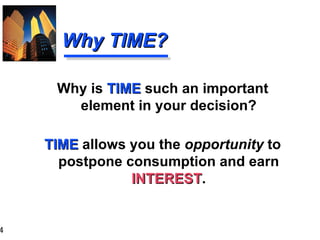
TIME  allows you the  opportunity  to postpone consumption and earn  INTEREST . Why TIME? Why is  TIME  such an important element in your decision?
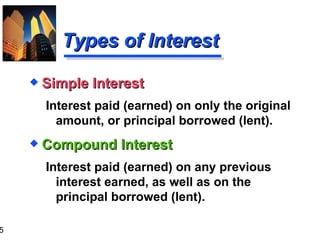
Types of Interest Compound Interest Interest paid (earned) on any previous interest earned, as well as on the principal borrowed (lent). Simple Interest Interest paid (earned) on only the original amount, or principal borrowed (lent).
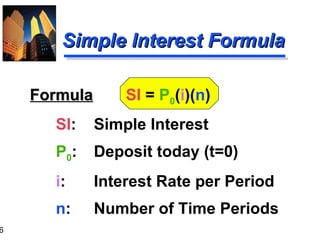
Simple Interest Formula Formula SI  =  P 0 ( i )( n ) SI : Simple Interest P 0 : Deposit today (t=0) i : Interest Rate per Period n : Number of Time Periods
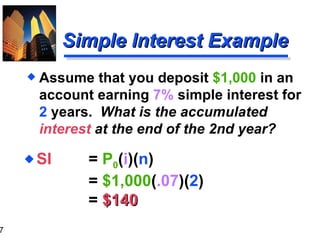
SI  =  P 0 ( i )( n ) =  $1,000 ( .07 )( 2 ) =  $140 Simple Interest Example Assume that you deposit  $1,000  in an account earning  7%  simple interest for  2  years.  What is the accumulated  interest  at the end of the 2nd year?
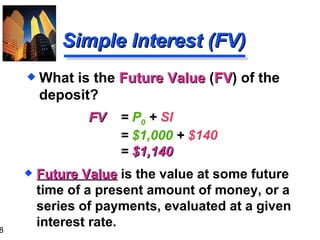
FV   =  P 0  +  SI  =  $1,000   +  $140 =   $1,140 Future Value   is the value at some future time of a present amount of money, or a series of payments, evaluated at a given interest rate. Simple Interest (FV) What is the  Future Value  ( FV ) of the deposit?
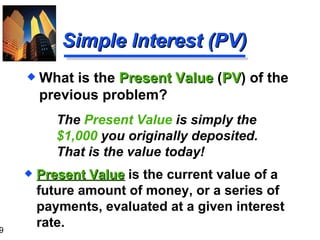
The  Present Value  is simply the  $1,000  you originally deposited.  That is the value today! Present Value   is the current value of a future amount of money, or a series of payments, evaluated at a given interest rate. Simple Interest (PV) What is the  Present Value  ( PV ) of the previous problem?
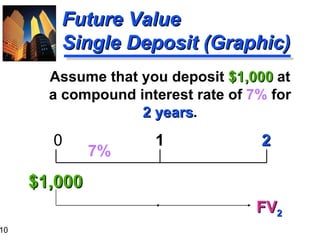
Assume that you deposit  $1,000  at a compound interest rate of  7%  for  2 years . Future Value Single Deposit (Graphic) 0  1   2 $1,000 FV 2 7%
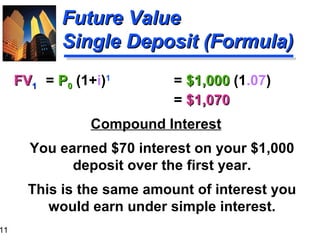
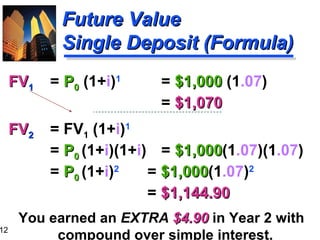
FV 1   =  P 0  (1+ i ) 1   =  $1,000   (1 .07 ) =  $1,070 Compound Interest You earned $70 interest on your $1,000 deposit over the first year. This is the same amount of interest you would earn under simple interest. Future Value Single Deposit (Formula)
FV 1   =  P 0   (1+ i ) 1   =  $1,000  (1 .07 )   =  $1,070 FV 2   = FV 1  (1+ i ) 1   =  P 0  (1+ i )(1+ i )  =  $1,000 (1 .07 )(1 .07 ) =  P 0   (1+ i ) 2 =  $1,000 (1 .07 ) 2 =  $1,144.90 You earned an  EXTRA   $4.90  in Year 2 with compound over simple interest.  Future Value Single Deposit (Formula)
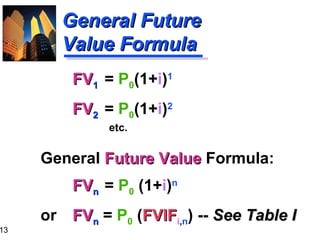
FV 1   =  P 0 (1+ i ) 1 FV 2   =  P 0 (1+ i ) 2 General  Future Value  Formula: FV n   =  P 0  (1+ i ) n   or  FV n  =  P 0  ( FVIF i , n ) --  See Table I General Future Value Formula etc.
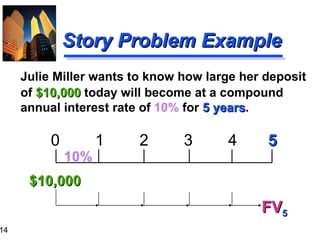
Julie Miller wants to know how large her deposit of  $10,000  today will become at a compound annual interest rate of  10%  for  5 years . Story Problem Example 0  1  2  3  4  5 $10,000 FV 5 10%
Calculation based on Table I: FV 5   =  $10,000   ( FVIF 10% ,  5 ) =  $10,000   (1.611) =  $16,110   [ Due to Rounding ] Story Problem Solution Calculation based on general formula: FV n   =  P 0  (1+ i ) n   FV 5   =  $10,000  (1+  0 .10 ) 5 =  $16,105.10
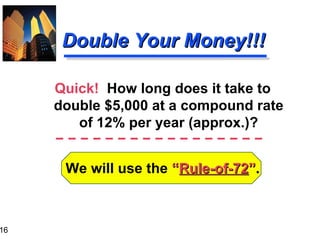
We will use the  “ Rule-of-72 ” . Double Your Money!!! Quick!  How long does it take to double $5,000 at a compound rate of 12% per year (approx.)?
Approx.  Years  to Double  =  72   /  i% 72  /  12%  =  6 Years [Actual Time is 6.12 Years] The “Rule-of-72” Quick!  How long does it take to double $5,000 at a compound rate of 12% per year (approx.)?
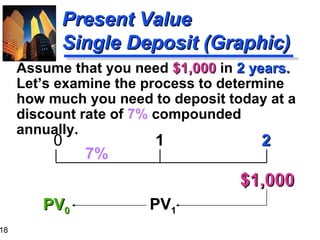
Assume that you need  $1,000   in  2 years.   Let’s examine the process to determine how much you need to deposit today at a discount rate of  7%  compounded annually. Present Value   Single Deposit (Graphic) 0  1   2 $1,000 7% PV 1 PV 0
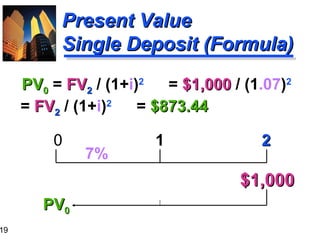
PV 0  =  FV 2  / (1+ i ) 2   =  $1,000   / (1 .07 ) 2     =  FV 2  / (1+ i ) 2   =  $873.44 Present Value  Single Deposit (Formula) 0  1   2 $1,000 7% PV 0
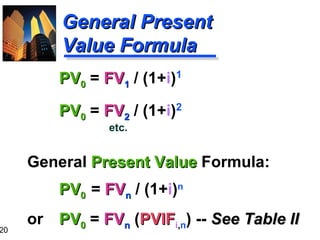
PV 0   =  FV 1  / (1+ i ) 1 PV 0  =  FV 2  / (1+ i ) 2 General  Present Value  Formula: PV 0 =  FV n  / (1+ i ) n   or  PV 0  =  FV n  ( PVIF i , n ) --  See Table II General Present Value Formula etc.
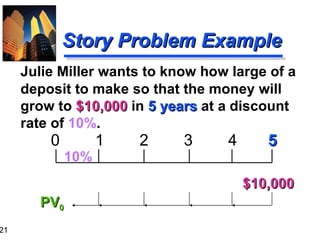
Julie Miller wants to know how large of a deposit to make so that the money will grow to  $10,000   in  5 years  at a discount rate of  10% . Story Problem Example 0  1  2  3  4  5 $10,000 PV 0 10%
Calculation based on general formula:   PV 0   =  FV n  / (1+ i ) n   PV 0   =  $10,000   / (1+  0 .10 ) 5 =  $6,209.21 Calculation based on Table I: PV 0   =  $10,000   ( PVIF 10% ,  5 ) =  $10,000   (.621) =  $6,210.00   [ Due to Rounding ] Story Problem Solution
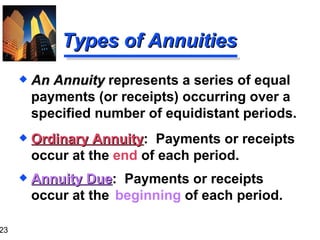
Types of Annuities Ordinary Annuity :  Payments or receipts occur at the  end  of each period. Annuity Due :  Payments or receipts occur at the  beginning  of each period. An Annuity  represents a series of equal payments (or receipts) occurring over a specified number of equidistant periods.
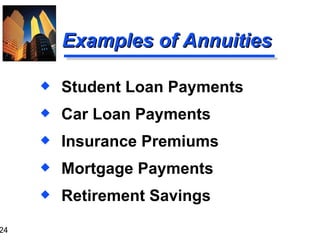
Examples of Annuities Student Loan Payments Car Loan Payments Insurance Premiums Mortgage Payments Retirement Savings
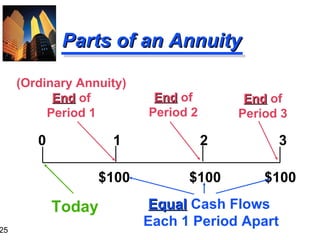
Parts of an Annuity 0  1  2  3 $100  $100  $100 (Ordinary Annuity) End  of Period 1 End  of Period 2 Today Equal  Cash Flows  Each 1 Period Apart End  of Period 3
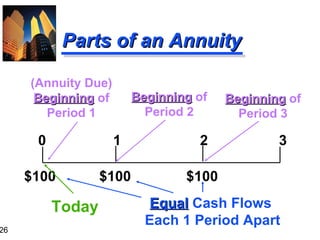
Parts of an Annuity 0  1  2  3 $100  $100  $100 (Annuity Due) Beginning  of Period 1 Beginning  of Period 2 Today Equal  Cash Flows  Each 1 Period Apart Beginning  of Period 3
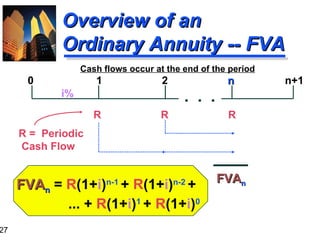
FVA n  =  R (1+ i ) n-1  +  R (1+ i ) n-2  +    ... +  R (1+ i ) 1   +  R (1+ i ) 0 Overview of an  Ordinary Annuity -- FVA R  R  R 0  1  2  n  n+1 FVA n R   =  Periodic  Cash Flow Cash flows occur at the end of the period i% .  .  .
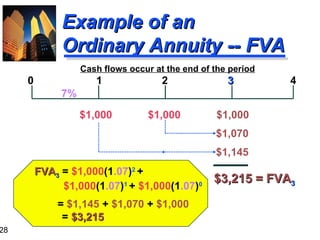
  FVA 3  =  $1,000 (1 .07 ) 2  +    $1,000 (1 .07 ) 1  +  $1,000 (1 .07 ) 0   =  $1,145   +   $1,070   +   $1,000     =   $3,215 Example of an Ordinary Annuity -- FVA $1,000  $1,000  $1,000 0  1  2  3  4 $3,215 = FVA 3 7% $1,070 $1,145 Cash flows occur at the end of the period
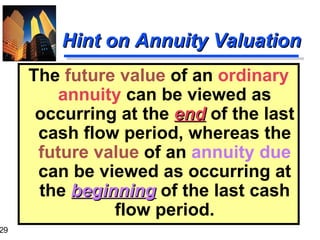
Hint on Annuity Valuation The  future value  of an  ordinary annuity  can be viewed as occurring at the  end  of the last cash flow period, whereas the  future value  of an  annuity due  can be viewed as occurring at the  beginning  of the last cash flow period.
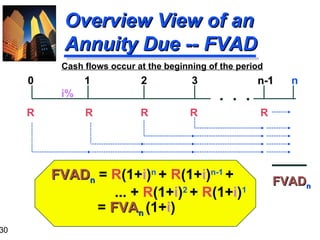
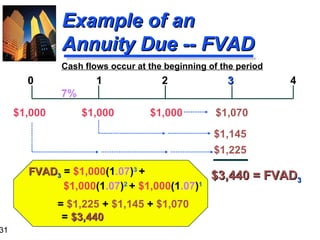
FVAD n  =  R (1+ i ) n  +  R (1+ i ) n-1  +    ... +  R (1+ i ) 2   +  R (1+ i ) 1    =  FVA n  (1+ i ) Overview View of an Annuity Due -- FVAD R  R  R  R  R 0  1  2  3  n-1   n FVAD n i% .  .  . Cash flows occur at the beginning of the period
FVAD 3  =  $1,000 (1 .07 ) 3  +    $1,000 (1 .07 ) 2  +  $1,000 (1 .07 ) 1   =  $1,225   +   $1,145   +   $1,070     =   $3,440 Example of an Annuity Due -- FVAD $1,000  $1,000  $1,000  $1,070 0  1  2  3  4 $3,440 = FVAD 3 7% $1,225 $1,145 Cash flows occur at the beginning of the period
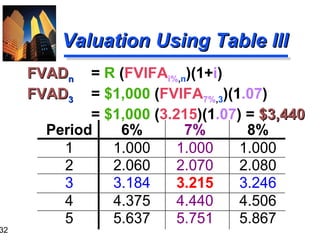
Valuation Using Table III FVAD n   =  R  ( FVIFA i% , n )(1+ i ) FVAD 3   =  $1,000  ( FVIFA 7% , 3 )(1 .07 ) =  $1,000  ( 3.215 )(1 .07 ) =  $3,440
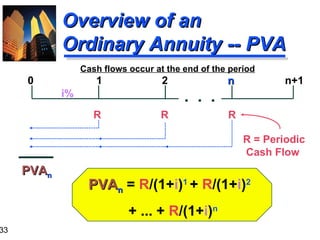
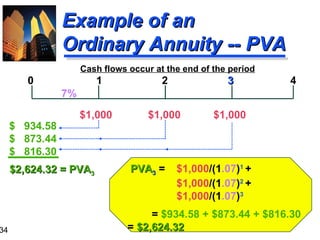
PVA n  =  R /(1+ i ) 1  +  R /(1+ i ) 2    + ... +  R /(1+ i ) n Overview of an Ordinary Annuity -- PVA R  R  R 0  1  2  n  n+1 PVA n R   = Periodic  Cash Flow i% .  .  . Cash flows occur at the end of the period
  PVA 3  =  $1,000 /(1 .07 ) 1  +    $1,000 /(1 .07 ) 2  +  $1,000 /(1 .07 ) 3   =  $934.58 + $873.44 + $816.30    =   $2,624.32 Example of an Ordinary Annuity -- PVA $1,000  $1,000  $1,000 0  1  2  3  4 $2,624.32 = PVA 3 7% $  934.58 $  873.44  $  816.30 Cash flows occur at the end of the period
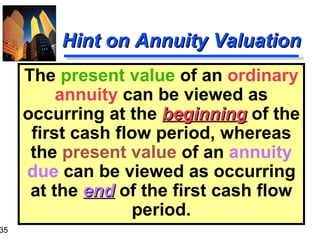
Hint on Annuity Valuation The  present value  of an  ordinary annuity  can be viewed as occurring at the  beginning  of the first cash flow period, whereas the  present value  of an  annuity due  can be viewed as occurring at the  end  of the first cash flow period.
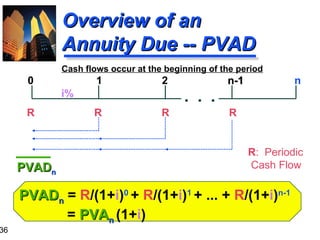
PVAD n  =  R /(1+ i ) 0  +  R /(1+ i ) 1  + ... +  R /(1+ i ) n-1     =  PVA n  (1+ i ) Overview of an Annuity Due -- PVAD R  R  R  R 0  1  2  n-1   n PVAD n R :  Periodic  Cash Flow i% .  .  . Cash flows occur at the beginning of the period
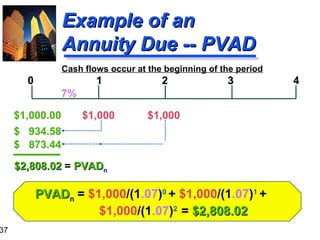
PVAD n  =  $1,000 /(1 .07 ) 0  +  $1,000 /(1 .07 ) 1  +  $1,000 /(1 .07 ) 2  =  $2,808.02 Example of an Annuity Due -- PVAD $1,000.00   $1,000  $1,000 0  1  2  3   4 $2,808.02  =  PVAD n 7% $  934.58 $  873.44 Cash flows occur at the beginning of the period
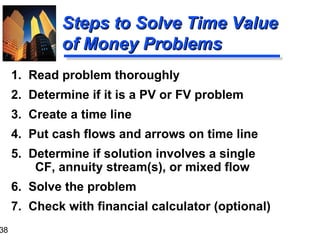
1.  Read problem thoroughly 2.  Determine if it is a PV or FV problem 3.  Create a time line 4.  Put cash flows and arrows on time line 5.  Determine if solution involves a single    CF, annuity stream(s), or mixed flow 6.  Solve the problem 7.  Check with financial calculator (optional) Steps to Solve Time Value of Money Problems
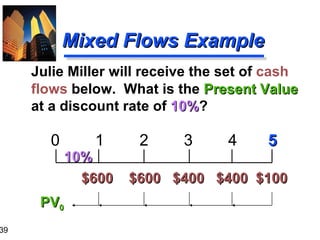
Julie Miller will receive the set of  cash flows  below.  What is the  Present Value  at a discount rate of  10% ? Mixed Flows Example 0  1  2  3  4  5 $600  $600  $400  $400  $100 PV 0 10%
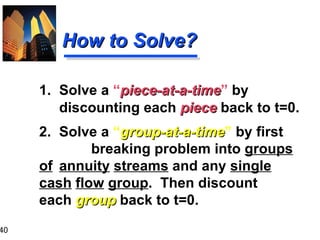
1. Solve a  “ piece-at-a-time ”  by  discounting each  piece  back to t=0. 2. Solve a  “ group-at-a-time ”  by first breaking problem into  groups   of   annuity   streams  and any  single   cash   flow   group .  Then discount  each  group  back to t=0. How to Solve?
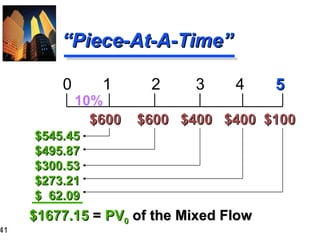
“ Piece-At-A-Time” 0  1  2  3  4  5 $600  $600  $400  $400  $100 10% $545.45 $495.87 $300.53 $273.21 $  62.09 $1677.15  =  PV 0   of the Mixed Flow
“ Group-At-A-Time” (#1) 0  1  2  3  4  5 $600  $600  $400  $400  $100 10% $1,041.60 $  573.57 $  62.10 $1,677.27   =  PV 0   of Mixed Flow  [Using Tables] $600 ( PVIFA 10% , 2 ) =  $600 ( 1.736 ) =  $1,041.60 $400 ( PVIFA 10% , 2 )( PVIF 10% , 2 ) =  $400 ( 1.736 )( 0.826 ) =   $573.57 $100  ( PVIF 10% , 5 ) =  $100  ( 0.621 ) =   $62.10
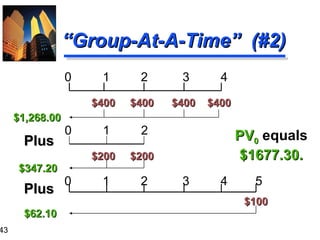
“ Group-At-A-Time”  (#2) 0  1  2  3  4 $400  $400  $400  $400 PV 0   equals $1677.30. 0  1  2 $200  $200 0  1  2  3  4  5 $100 $1,268.00 $347.20 $62.10 Plus Plus
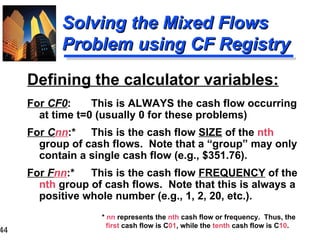
Defining the calculator variables: For  CF0 : This is ALWAYS the cash flow occurring at time t=0 (usually 0 for these problems) For  C nn :* This is the cash flow  SIZE  of the  nth  group of cash flows.  Note that a “group” may only contain a single cash flow (e.g., $351.76). For  F nn :* This is the cash flow  FREQUENCY  of the  nth  group of cash flows.  Note that this is always a positive whole number (e.g., 1, 2, 20, etc.). Solving the Mixed Flows  Problem using CF Registry *  nn  represents the  nth  cash flow or frequency.  Thus, the  first  cash flow is C 01 , while the  tenth  cash flow is C 10 .
General Formula: FV n =  PV 0 (1 + [ i / m ]) m n n :   Number of Years m :   Compounding Periods per Year i :   Annual Interest Rate FV n , m :  FV at the end of Year n PV 0 :   PV of the Cash Flow today Frequency of Compounding
Julie Miller has  $1,000  to invest for  2 years  at an annual interest rate of  12% . Annual    FV 2   =  1,000 (1+ [ .12 / 1 ]) (1) (2)    =  1,254.40 Semi    FV 2   =  1,000 (1+ [ .12 / 2 ]) (2) (2)    =  1,262.48 Impact of Frequency
Quarterly    FV 2 =  1,000 (1+ [ .12 / 4 ]) (4) (2)    =  1,266.77 Monthly  FV 2 =  1,000 (1+ [ .12 / 12 ]) (12) (2)  =  1,269.73 Daily    FV 2 =  1,000 (1+ [ .12 / 365 ] ) (365) (2)  =  1,271.20 Impact of Frequency
Effective Annual Interest Rate The actual rate of interest earned (paid) after adjusting the  nominal rate   for factors such as the number of  compounding periods per year . (1 +  [  i   /  m  ] ) m   - 1 Effective Annual  Interest Rate
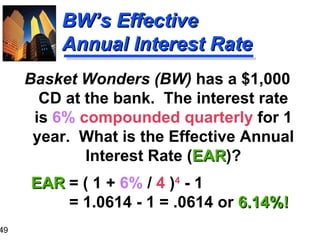
Basket Wonders (BW)  has a $1,000 CD at the bank.  The interest rate is  6%   compounded quarterly  for 1 year.  What is the Effective Annual Interest Rate ( EAR )? EAR = ( 1 +  6%  /  4  ) 4  - 1  = 1.0614 - 1 = .0614 or  6.14%! BW’s Effective  Annual Interest Rate
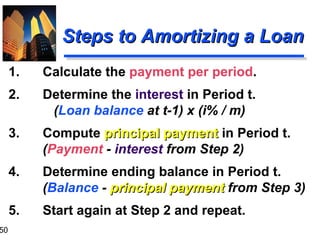
1. Calculate the  payment per period . 2. Determine the  interest  in Period t.   ( Loan balance  at t-1) x (i% / m) 3. Compute  principal payment  in Period t. ( Payment  -  interest  from Step 2) 4. Determine ending balance in Period t. ( Balance  -  principal payment  from Step 3) 5. Start again at Step 2 and repeat. Steps to Amortizing a Loan
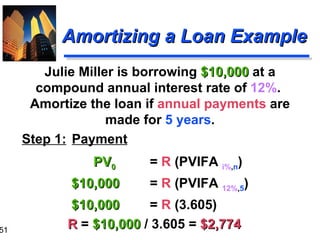
Julie Miller is borrowing  $10,000  at a compound annual interest rate of  12% .  Amortize the loan if  annual payments  are made for  5 years . Step 1: Payment   PV 0   =  R  (PVIFA  i% , n )   $10,000  =  R  (PVIFA  12% , 5 )   $10,000   =  R  (3.605) R  =  $10,000  / 3.605 =  $2,774 Amortizing a Loan Example
Amortizing a Loan Example [Last Payment Slightly Higher Due to Rounding]
Usefulness of Amortization 2. Calculate Debt Outstanding  -- The  quantity of outstanding debt  may be used in financing the  day-to-day activities of the firm. 1. Determine Interest Expense  --  Interest expenses may reduce  taxable income of the firm.

Time+Value+Of+Money

  • 1.
    Chapter 2 TimeValue of Money
  • 2.
    The Time Valueof Money The Interest Rate Simple Interest Compound Interest Amortizing a Loan
  • 3.
    Obviously, $10,000today . You already recognize that there is TIME VALUE TO MONEY !! The Interest Rate Which would you prefer -- $10,000 today or $10,000 in 5 years ?
  • 4.
    TIME allowsyou the opportunity to postpone consumption and earn INTEREST . Why TIME? Why is TIME such an important element in your decision?
  • 5.
    Types of InterestCompound Interest Interest paid (earned) on any previous interest earned, as well as on the principal borrowed (lent). Simple Interest Interest paid (earned) on only the original amount, or principal borrowed (lent).
  • 6.
    Simple Interest FormulaFormula SI = P 0 ( i )( n ) SI : Simple Interest P 0 : Deposit today (t=0) i : Interest Rate per Period n : Number of Time Periods
  • 7.
    SI = P 0 ( i )( n ) = $1,000 ( .07 )( 2 ) = $140 Simple Interest Example Assume that you deposit $1,000 in an account earning 7% simple interest for 2 years. What is the accumulated interest at the end of the 2nd year?
  • 8.
    FV = P 0 + SI = $1,000 + $140 = $1,140 Future Value is the value at some future time of a present amount of money, or a series of payments, evaluated at a given interest rate. Simple Interest (FV) What is the Future Value ( FV ) of the deposit?
  • 9.
    The PresentValue is simply the $1,000 you originally deposited. That is the value today! Present Value is the current value of a future amount of money, or a series of payments, evaluated at a given interest rate. Simple Interest (PV) What is the Present Value ( PV ) of the previous problem?
  • 10.
    Assume that youdeposit $1,000 at a compound interest rate of 7% for 2 years . Future Value Single Deposit (Graphic) 0 1 2 $1,000 FV 2 7%
  • 11.
    FV 1 = P 0 (1+ i ) 1 = $1,000 (1 .07 ) = $1,070 Compound Interest You earned $70 interest on your $1,000 deposit over the first year. This is the same amount of interest you would earn under simple interest. Future Value Single Deposit (Formula)
  • 12.
    FV 1 = P 0 (1+ i ) 1 = $1,000 (1 .07 ) = $1,070 FV 2 = FV 1 (1+ i ) 1 = P 0 (1+ i )(1+ i ) = $1,000 (1 .07 )(1 .07 ) = P 0 (1+ i ) 2 = $1,000 (1 .07 ) 2 = $1,144.90 You earned an EXTRA $4.90 in Year 2 with compound over simple interest. Future Value Single Deposit (Formula)
  • 13.
    FV 1 = P 0 (1+ i ) 1 FV 2 = P 0 (1+ i ) 2 General Future Value Formula: FV n = P 0 (1+ i ) n or FV n = P 0 ( FVIF i , n ) -- See Table I General Future Value Formula etc.
  • 14.
    Julie Miller wantsto know how large her deposit of $10,000 today will become at a compound annual interest rate of 10% for 5 years . Story Problem Example 0 1 2 3 4 5 $10,000 FV 5 10%
  • 15.
    Calculation based onTable I: FV 5 = $10,000 ( FVIF 10% , 5 ) = $10,000 (1.611) = $16,110 [ Due to Rounding ] Story Problem Solution Calculation based on general formula: FV n = P 0 (1+ i ) n FV 5 = $10,000 (1+ 0 .10 ) 5 = $16,105.10
  • 16.
    We will usethe “ Rule-of-72 ” . Double Your Money!!! Quick! How long does it take to double $5,000 at a compound rate of 12% per year (approx.)?
  • 17.
    Approx. Years to Double = 72 / i% 72 / 12% = 6 Years [Actual Time is 6.12 Years] The “Rule-of-72” Quick! How long does it take to double $5,000 at a compound rate of 12% per year (approx.)?
  • 18.
    Assume that youneed $1,000 in 2 years. Let’s examine the process to determine how much you need to deposit today at a discount rate of 7% compounded annually. Present Value Single Deposit (Graphic) 0 1 2 $1,000 7% PV 1 PV 0
  • 19.
    PV 0 = FV 2 / (1+ i ) 2 = $1,000 / (1 .07 ) 2 = FV 2 / (1+ i ) 2 = $873.44 Present Value Single Deposit (Formula) 0 1 2 $1,000 7% PV 0
  • 20.
    PV 0 = FV 1 / (1+ i ) 1 PV 0 = FV 2 / (1+ i ) 2 General Present Value Formula: PV 0 = FV n / (1+ i ) n or PV 0 = FV n ( PVIF i , n ) -- See Table II General Present Value Formula etc.
  • 21.
    Julie Miller wantsto know how large of a deposit to make so that the money will grow to $10,000 in 5 years at a discount rate of 10% . Story Problem Example 0 1 2 3 4 5 $10,000 PV 0 10%
  • 22.
    Calculation based ongeneral formula: PV 0 = FV n / (1+ i ) n PV 0 = $10,000 / (1+ 0 .10 ) 5 = $6,209.21 Calculation based on Table I: PV 0 = $10,000 ( PVIF 10% , 5 ) = $10,000 (.621) = $6,210.00 [ Due to Rounding ] Story Problem Solution
  • 23.
    Types of AnnuitiesOrdinary Annuity : Payments or receipts occur at the end of each period. Annuity Due : Payments or receipts occur at the beginning of each period. An Annuity represents a series of equal payments (or receipts) occurring over a specified number of equidistant periods.
  • 24.
    Examples of AnnuitiesStudent Loan Payments Car Loan Payments Insurance Premiums Mortgage Payments Retirement Savings
  • 25.
    Parts of anAnnuity 0 1 2 3 $100 $100 $100 (Ordinary Annuity) End of Period 1 End of Period 2 Today Equal Cash Flows Each 1 Period Apart End of Period 3
  • 26.
    Parts of anAnnuity 0 1 2 3 $100 $100 $100 (Annuity Due) Beginning of Period 1 Beginning of Period 2 Today Equal Cash Flows Each 1 Period Apart Beginning of Period 3
  • 27.
    FVA n = R (1+ i ) n-1 + R (1+ i ) n-2 + ... + R (1+ i ) 1 + R (1+ i ) 0 Overview of an Ordinary Annuity -- FVA R R R 0 1 2 n n+1 FVA n R = Periodic Cash Flow Cash flows occur at the end of the period i% . . .
  • 28.
    FVA3 = $1,000 (1 .07 ) 2 + $1,000 (1 .07 ) 1 + $1,000 (1 .07 ) 0 = $1,145 + $1,070 + $1,000 = $3,215 Example of an Ordinary Annuity -- FVA $1,000 $1,000 $1,000 0 1 2 3 4 $3,215 = FVA 3 7% $1,070 $1,145 Cash flows occur at the end of the period
  • 29.
    Hint on AnnuityValuation The future value of an ordinary annuity can be viewed as occurring at the end of the last cash flow period, whereas the future value of an annuity due can be viewed as occurring at the beginning of the last cash flow period.
  • 30.
    FVAD n = R (1+ i ) n + R (1+ i ) n-1 + ... + R (1+ i ) 2 + R (1+ i ) 1 = FVA n (1+ i ) Overview View of an Annuity Due -- FVAD R R R R R 0 1 2 3 n-1 n FVAD n i% . . . Cash flows occur at the beginning of the period
  • 31.
    FVAD 3 = $1,000 (1 .07 ) 3 + $1,000 (1 .07 ) 2 + $1,000 (1 .07 ) 1 = $1,225 + $1,145 + $1,070 = $3,440 Example of an Annuity Due -- FVAD $1,000 $1,000 $1,000 $1,070 0 1 2 3 4 $3,440 = FVAD 3 7% $1,225 $1,145 Cash flows occur at the beginning of the period
  • 32.
    Valuation Using TableIII FVAD n = R ( FVIFA i% , n )(1+ i ) FVAD 3 = $1,000 ( FVIFA 7% , 3 )(1 .07 ) = $1,000 ( 3.215 )(1 .07 ) = $3,440
  • 33.
    PVA n = R /(1+ i ) 1 + R /(1+ i ) 2 + ... + R /(1+ i ) n Overview of an Ordinary Annuity -- PVA R R R 0 1 2 n n+1 PVA n R = Periodic Cash Flow i% . . . Cash flows occur at the end of the period
  • 34.
    PVA3 = $1,000 /(1 .07 ) 1 + $1,000 /(1 .07 ) 2 + $1,000 /(1 .07 ) 3 = $934.58 + $873.44 + $816.30 = $2,624.32 Example of an Ordinary Annuity -- PVA $1,000 $1,000 $1,000 0 1 2 3 4 $2,624.32 = PVA 3 7% $ 934.58 $ 873.44 $ 816.30 Cash flows occur at the end of the period
  • 35.
    Hint on AnnuityValuation The present value of an ordinary annuity can be viewed as occurring at the beginning of the first cash flow period, whereas the present value of an annuity due can be viewed as occurring at the end of the first cash flow period.
  • 36.
    PVAD n = R /(1+ i ) 0 + R /(1+ i ) 1 + ... + R /(1+ i ) n-1 = PVA n (1+ i ) Overview of an Annuity Due -- PVAD R R R R 0 1 2 n-1 n PVAD n R : Periodic Cash Flow i% . . . Cash flows occur at the beginning of the period
  • 37.
    PVAD n = $1,000 /(1 .07 ) 0 + $1,000 /(1 .07 ) 1 + $1,000 /(1 .07 ) 2 = $2,808.02 Example of an Annuity Due -- PVAD $1,000.00 $1,000 $1,000 0 1 2 3 4 $2,808.02 = PVAD n 7% $ 934.58 $ 873.44 Cash flows occur at the beginning of the period
  • 38.
    1. Readproblem thoroughly 2. Determine if it is a PV or FV problem 3. Create a time line 4. Put cash flows and arrows on time line 5. Determine if solution involves a single CF, annuity stream(s), or mixed flow 6. Solve the problem 7. Check with financial calculator (optional) Steps to Solve Time Value of Money Problems
  • 39.
    Julie Miller willreceive the set of cash flows below. What is the Present Value at a discount rate of 10% ? Mixed Flows Example 0 1 2 3 4 5 $600 $600 $400 $400 $100 PV 0 10%
  • 40.
    1. Solve a “ piece-at-a-time ” by discounting each piece back to t=0. 2. Solve a “ group-at-a-time ” by first breaking problem into groups of annuity streams and any single cash flow group . Then discount each group back to t=0. How to Solve?
  • 41.
    “ Piece-At-A-Time” 0 1 2 3 4 5 $600 $600 $400 $400 $100 10% $545.45 $495.87 $300.53 $273.21 $ 62.09 $1677.15 = PV 0 of the Mixed Flow
  • 42.
    “ Group-At-A-Time” (#1)0 1 2 3 4 5 $600 $600 $400 $400 $100 10% $1,041.60 $ 573.57 $ 62.10 $1,677.27 = PV 0 of Mixed Flow [Using Tables] $600 ( PVIFA 10% , 2 ) = $600 ( 1.736 ) = $1,041.60 $400 ( PVIFA 10% , 2 )( PVIF 10% , 2 ) = $400 ( 1.736 )( 0.826 ) = $573.57 $100 ( PVIF 10% , 5 ) = $100 ( 0.621 ) = $62.10
  • 43.
    “ Group-At-A-Time” (#2) 0 1 2 3 4 $400 $400 $400 $400 PV 0 equals $1677.30. 0 1 2 $200 $200 0 1 2 3 4 5 $100 $1,268.00 $347.20 $62.10 Plus Plus
  • 44.
    Defining the calculatorvariables: For CF0 : This is ALWAYS the cash flow occurring at time t=0 (usually 0 for these problems) For C nn :* This is the cash flow SIZE of the nth group of cash flows. Note that a “group” may only contain a single cash flow (e.g., $351.76). For F nn :* This is the cash flow FREQUENCY of the nth group of cash flows. Note that this is always a positive whole number (e.g., 1, 2, 20, etc.). Solving the Mixed Flows Problem using CF Registry * nn represents the nth cash flow or frequency. Thus, the first cash flow is C 01 , while the tenth cash flow is C 10 .
  • 45.
    General Formula: FVn = PV 0 (1 + [ i / m ]) m n n : Number of Years m : Compounding Periods per Year i : Annual Interest Rate FV n , m : FV at the end of Year n PV 0 : PV of the Cash Flow today Frequency of Compounding
  • 46.
    Julie Miller has $1,000 to invest for 2 years at an annual interest rate of 12% . Annual FV 2 = 1,000 (1+ [ .12 / 1 ]) (1) (2) = 1,254.40 Semi FV 2 = 1,000 (1+ [ .12 / 2 ]) (2) (2) = 1,262.48 Impact of Frequency
  • 47.
    Quarterly FV 2 = 1,000 (1+ [ .12 / 4 ]) (4) (2) = 1,266.77 Monthly FV 2 = 1,000 (1+ [ .12 / 12 ]) (12) (2) = 1,269.73 Daily FV 2 = 1,000 (1+ [ .12 / 365 ] ) (365) (2) = 1,271.20 Impact of Frequency
  • 48.
    Effective Annual InterestRate The actual rate of interest earned (paid) after adjusting the nominal rate for factors such as the number of compounding periods per year . (1 + [ i / m ] ) m - 1 Effective Annual Interest Rate
  • 49.
    Basket Wonders (BW) has a $1,000 CD at the bank. The interest rate is 6% compounded quarterly for 1 year. What is the Effective Annual Interest Rate ( EAR )? EAR = ( 1 + 6% / 4 ) 4 - 1 = 1.0614 - 1 = .0614 or 6.14%! BW’s Effective Annual Interest Rate
  • 50.
    1. Calculate the payment per period . 2. Determine the interest in Period t. ( Loan balance at t-1) x (i% / m) 3. Compute principal payment in Period t. ( Payment - interest from Step 2) 4. Determine ending balance in Period t. ( Balance - principal payment from Step 3) 5. Start again at Step 2 and repeat. Steps to Amortizing a Loan
  • 51.
    Julie Miller isborrowing $10,000 at a compound annual interest rate of 12% . Amortize the loan if annual payments are made for 5 years . Step 1: Payment PV 0 = R (PVIFA i% , n ) $10,000 = R (PVIFA 12% , 5 ) $10,000 = R (3.605) R = $10,000 / 3.605 = $2,774 Amortizing a Loan Example
  • 52.
    Amortizing a LoanExample [Last Payment Slightly Higher Due to Rounding]
  • 53.
    Usefulness of Amortization2. Calculate Debt Outstanding -- The quantity of outstanding debt may be used in financing the day-to-day activities of the firm. 1. Determine Interest Expense -- Interest expenses may reduce taxable income of the firm.