International Financial Management
0
Time Value of Money
Agenda
After studying this chapter, you should be able to:
• Calculate the future value to which money invested at a given interest rate will grow.
• Calculate the present value of a future payment
• Calculate present and future values of streams of cash payments.
• Find the interest rate implied by the present or future value.
• Explain how we would compare interest rates quoted over different intervals.
1
• Financial decisions require comparisons of cash payments at different dates.
• Since a dollar today does not have the same value as a dollar tomorrow, a
relationship has to be established to compare cash flows at different times.
• Future value is the amount to which a present value will grow after earning interest.
• There are two kinds of interest that money can earn:
• Simple interest
• Compound interest
FutureValues and Compound Interest
3
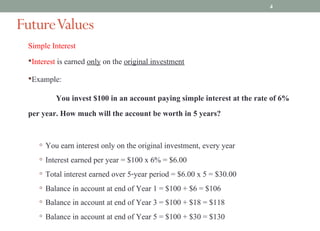
Simple Interest
•Interest is earned only on the original investment
•Example:
You invest $100 in an account paying simple interest at the rate of 6%
per year. How much will the account be worth in 5 years?
◦ You earn interest only on the original investment, every year
◦ Interest earned per year = $100 x 6% = $6.00
◦ Total interest earned over 5-year period = $6.00 x 5 = $30.00
◦ Balance in account at end of Year 1 = $100 + $6 = $106
◦ Balance in account at end of Year 3 = $100 + $18 = $118
◦ Balance in account at end of Year 5 = $100 + $30 = $130
FutureValues
4
FutureValues
• Simple Interest
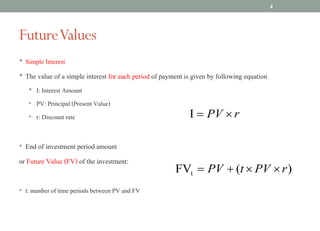
• The value of a simple interest for each period of payment is given by following equation
• I: Interest Amount
• PV: Principal (Present Value)
• r: Discount rate
• End of investment period amount
or Future Value (FV) of the investment:
• t: number of time periods between PV and FV
4
)
(
FVt r
PV
t
PV ´
´
+
=
r
PV ´
=
I
Compound Interest
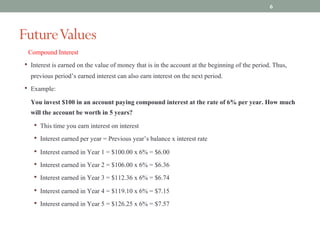
• Interest is earned on the value of money that is in the account at the beginning of the period. Thus,
previous period’s earned interest can also earn interest on the next period.
• Example:
You invest $100 in an account paying compound interest at the rate of 6% per year. How much
will the account be worth in 5 years?
• This time you earn interest on interest
• Interest earned per year = Previous year’s balance x interest rate
• Interest earned in Year 1 = $100.00 x 6% = $6.00
• Interest earned in Year 2 = $106.00 x 6% = $6.36
• Interest earned in Year 3 = $112.36 x 6% = $6.74
• Interest earned in Year 4 = $119.10 x 6% = $7.15
• Interest earned in Year 5 = $126.25 x 6% = $7.57
FutureValues
6
Compound Interest
• Value at the end of Year 1 = $100.00 +[$100 x 6%] = $100 x (1+r)
• Value at the end of Year 2 = $106.00 + [$106 x 6%] = $100 x (1+r)2
• …….
• Value at the end of Year 5 = $100 x (1+r)5
•The formula for the future value of PV dollars at r% interest per period for t periods
is:
FutureValues
t
r
PV
FV )
1
( +
´
=
7
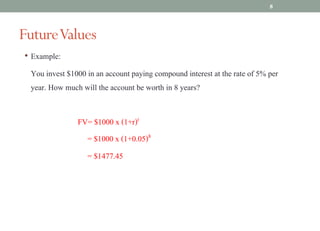
• Example:
You invest $1000 in an account paying compound interest at the rate of 5% per
year. How much will the account be worth in 8 years?
FV= $1000 x (1+r)t
= $1000 x (1+0.05)8
= $1477.45
FutureValues
8
FutureValues
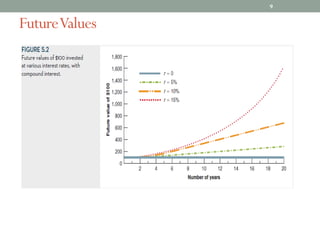
© 2016 McGraw-Hill Education Limited Chapter 5 - 8
9
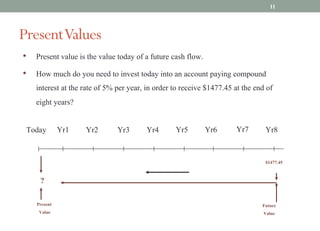
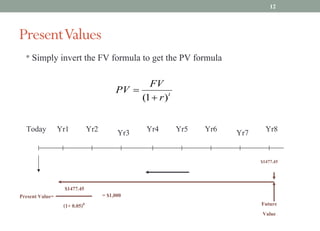
• Present value is the value today of a future cash flow.
• How much do you need to invest today into an account paying compound
interest at the rate of 5% per year, in order to receive $1477.45 at the end of
eight years?
Yr3
$1477.45
?
Present
Value
Future
Value
Today Yr1 Yr2 Yr4 Yr7
Yr5 Yr6 Yr8
PresentValues
11
• Simply invert the FV formula to get the PV formula
Yr3
$1477.45
Future
Value
Today Yr1 Yr2 Yr4 Yr7
Yr5 Yr6 Yr8
$1477.45
(1+ 0.05)8
= $1,000
PresentValues
t
r
FV
PV
)
1
( +
=
Present Value=
12
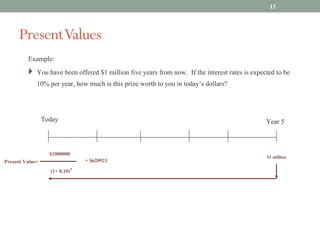
Example:
} You have been offered $1 million five years from now. If the interest rates is expected to be
10% per year, how much is this prize worth to you in today’s dollars?
Today Year 5
$1 million
PresentValues
$1000000
(1+ 0.10)5
= $620921
Present Value=
13
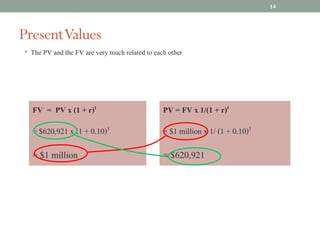
• The PV and the FV are very much related to each other
PV = FV x 1/(1 + r)t
= $1 million x 1/ (1 + 0.10)5
= $620,921
FV = PV x (1 + r)t
= $620,921 x (1 + 0.10)5
= $1 million
PresentValues
14
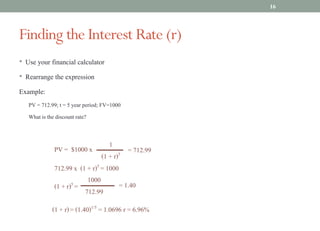
• Use your financial calculator
• Rearrange the expression
Example:
PV = 712.99; t = 5 year period; FV=1000
What is the discount rate?
PV = $1000 x
1
(1 + r)5
= 712.99
712.99 x (1 + r)5 = 1000
(1 + r)5 =
1000
712.99
= 1.40
(1 + r)= (1.40)1/5 = 1.0696 r = 6.96%
Finding the Interest Rate (r)
16
• Can be found the same way
• Use your financial calculator
• Use the tables – look up the discount factor
• Rearrange the expression to solve for “t”
Finding the Investment Period (t)
17
• The basic financial calculator uses 5 keys that correspond to the inputs for common
problems involving the time value of money.
• N = number of periods (t in formula)
• i = the interest rate per period, expressed as a percentage (not a decimal, ie. 8 for 8%, not 0.08)
• PV = present value
• FV = future value
• PMT = amount of any recurring payment (called an annuity). For single cash-flow problems (the
ones we have done so far), PMT = 0.
• Given any 4 of these inputs, the calculator will calculate the 5th.
• Sign convention matters. If you are borrowing, PV will be (+) as it is an inflow of cash.
Payments will be (-) as they are outflows of cash.
Financial Calculator
18
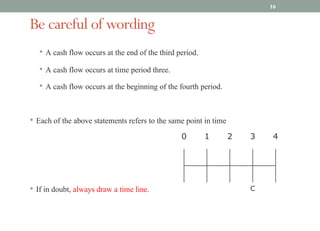
Be careful of wording
• A cash flow occurs at the end of the third period.
• A cash flow occurs at time period three.
• A cash flow occurs at the beginning of the fourth period.
• Each of the above statements refers to the same point in time
• If in doubt, always draw a time line.
16
0 1 2 3 4
C
Future Value of Multiple Cash Flows
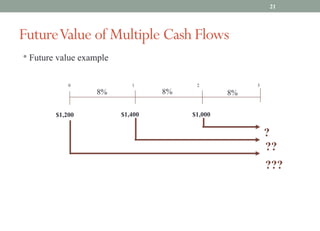
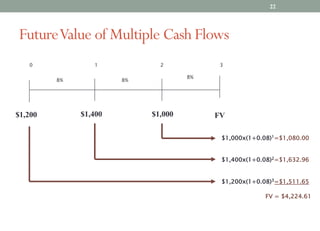
• Example:
You deposit $1,200 in your bank account today; $1,400 one year later;
and $1,000 two years from today. If your bank offers you an 8%
interest rate on your account, how much money will you have in the
account three years from today?
Multiple Cash Flows
20
• Future value example
0 1 2
$1,000
8%
$1,200
8%
$1,400
3
8%
?
??
???
FutureValue of Multiple Cash Flows
21
0 1 2
$1,000
8%
$1,200
8%
$1,400
3
8%
$1,000x(1+0.08)1
=$1,080.00
$1,400x(1+0.08)2=$1,632.96
$1,200x(1+0.08)3
=$1,511.65
FV = $4,224.61
FutureValue of Multiple Cash Flows
FV
22
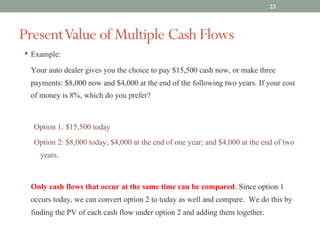
• Example:
Your auto dealer gives you the choice to pay $15,500 cash now, or make three
payments: $8,000 now and $4,000 at the end of the following two years. If your cost
of money is 8%, which do you prefer?
Option 1: $15,500 today
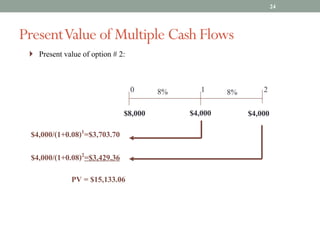
Option 2: $8,000 today; $4,000 at the end of one year; and $4,000 at the end of two
years.
Only cash flows that occur at the same time can be compared. Since option 1
occurs today, we can convert option 2 to today as well and compare. We do this by
finding the PV of each cash flow under option 2 and adding them together.
PresentValue of Multiple Cash Flows
23
0 1
$4,000
8% 2
8%
$4,000/(1+0.08)1=$3,703.70
$4,000
$4,000/(1+0.08)2=$3,429.36
PV = $15,133.06
$8,000
} Present value of option # 2:
PresentValue of Multiple Cash Flows
24
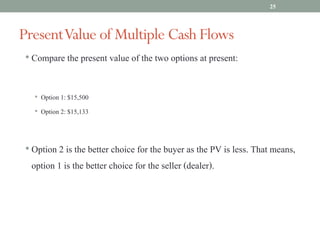
• Compare the present value of the two options at present:
• Option 1: $15,500
• Option 2: $15,133
• Option 2 is the better choice for the buyer as the PV is less. That means,
option 1 is the better choice for the seller (dealer).
PresentValue of Multiple Cash Flows
25
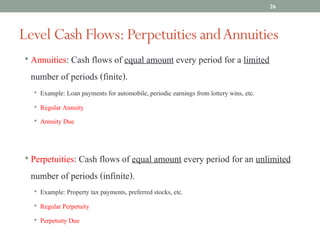
• Annuities: Cash flows of equal amount every period for a limited
number of periods (finite).
• Example: Loan payments for automobile, periodic earnings from lottery wins, etc.
• Regular Annuity
• Annuity Due
• Perpetuities: Cash flows of equal amount every period for an unlimited
number of periods (infinite).
• Example: Property tax payments, preferred stocks, etc.
• Regular Perpetuity
• Perpetuity Due
Level Cash Flows:Perpetuities andAnnuities
26
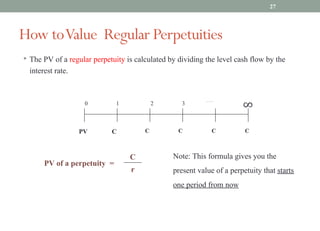
• The PV of a regular perpetuity is calculated by dividing the level cash flow by the
interest rate.
PV of a perpetuity =
C
r
0 1 3
2 …….
∞
C
C
C
C
C
Note: This formula gives you the
present value of a perpetuity that starts
one period from now
PV
How toValue Regular Perpetuities
27
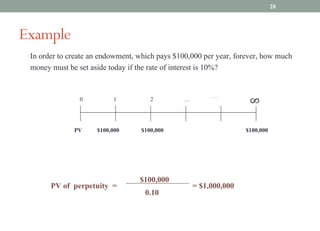
In order to create an endowment, which pays $100,000 per year, forever, how much
money must be set aside today if the rate of interest is 10%?
PV of perpetuity =
$100,000
0.10
0 1 …
2 …….
∞
$100,000
PV $100,000 $100,000
= $1,000,000
Example
28
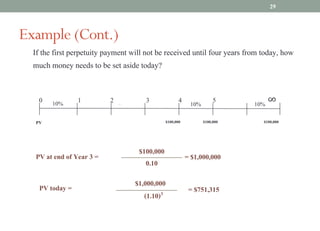
If the first perpetuity payment will not be received until four years from today, how
much money needs to be set aside today?
PV at end of Year 3 =
$100,000
0.10
1 2 4
3 5 ∞
10% 10% 10%
$100,000
PV $100,000 $100,000
= $1,000,000
…
PV today = $1,000,000
(1.10)3 = $751,315
0
Example (Cont.)
29
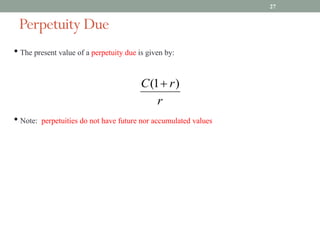
Perpetuity Due
27
• The present value of a perpetuity due is given by:
• Note: perpetuities do not have future nor accumulated values
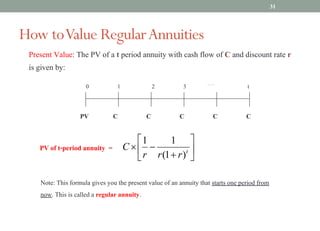
Present Value: The PV of a t period annuity with cash flow of C and discount rate r
is given by:
PV of t-period annuity =
0 1 3
2 …….
t
C
C
C
C
C
PV
Note: This formula gives you the present value of an annuity that starts one period from
now. This is called a regular annuity.
How toValue RegularAnnuities
ú
û
ù
ê
ë
é
+
-
´ t
r
r
r
C
)
1
(
1
1
31
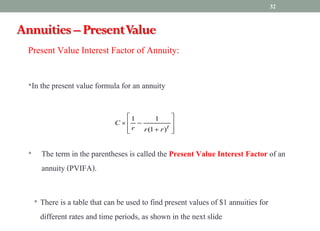
Present Value Interest Factor of Annuity:
•In the present value formula for an annuity
• The term in the parentheses is called the Present Value Interest Factor of an
annuity (PVIFA).
• There is a table that can be used to find present values of $1 annuities for
different rates and time periods, as shown in the next slide
ú
ú
û
ù
ê
ê
ë
é
+
-
´
t
r
r
r
C
)
1
(
1
1
Annuities – PresentValue
32
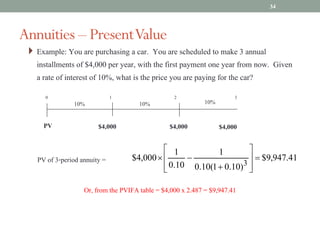
} Example: You are purchasing a car. You are scheduled to make 3 annual
installments of $4,000 per year, with the first payment one year from now. Given
a rate of interest of 10%, what is the price you are paying for the car?
0 1 2
$4,000
10%
$4,000
10%
$4,000
3
10%
PV of 3-period annuity = 41
.
947
,
9
$
)
10
.
0
1
(
10
.
0
1
10
.
0
1
000
,
4
$
3
=
ú
ú
û
ù
ê
ê
ë
é
+
-
´
Or, from the PVIFA table = $4,000 x 2.487 = $9,947.41
Annuities – PresentValue
PV
34
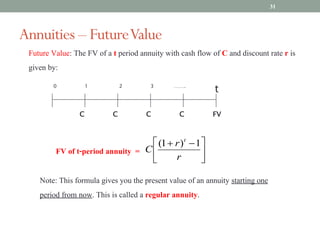
Future Value: The FV of a t period annuity with cash flow of C and discount rate r is
given by:
0 1 3
2 …….
t
FV
C
C
C
C
FV of t-period annuity =
Note: This formula gives you the present value of an annuity starting one
period from now. This is called a regular annuity.
Annuities – FutureValue
ú
û
ù
ê
ë
é -
+
r
r
C
t
1
)
1
(
31
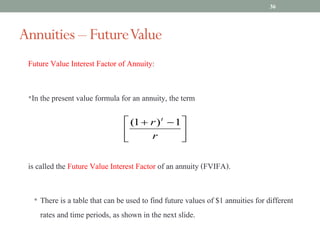
Future Value Interest Factor of Annuity:
•In the present value formula for an annuity, the term
is called the Future Value Interest Factor of an annuity (FVIFA).
• There is a table that can be used to find future values of $1 annuities for different
rates and time periods, as shown in the next slide.
Annuities – FutureValue
ú
û
ù
ê
ë
é -
+
r
r t
1
)
1
(
36
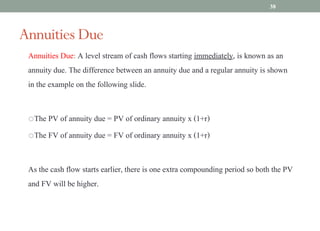
Annuities Due: A level stream of cash flows starting immediately, is known as an
annuity due. The difference between an annuity due and a regular annuity is shown
in the example on the following slide.
oThe PV of annuity due = PV of ordinary annuity x (1+r)
oThe FV of annuity due = FV of ordinary annuity x (1+r)
As the cash flow starts earlier, there is one extra compounding period so both the PV
and FV will be higher.
Annuities Due
38
Cash Flows Growing at a Constant Rate –Variations
on Perpetuities andAnnuities
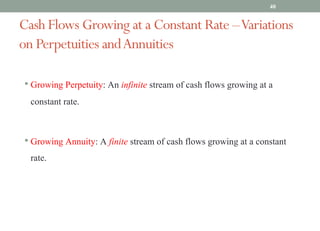
• Growing Perpetuity: An infinite stream of cash flows growing at a
constant rate.
• Growing Annuity: A finite stream of cash flows growing at a constant
rate.
40
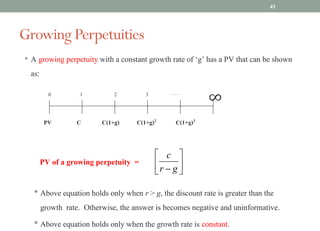
• A growing perpetuity with a constant growth rate of ‘g’ has a PV that can be shown
as:
• Above equation holds only when r > g, the discount rate is greater than the
growth rate. Otherwise, the answer is becomes negative and uninformative.
• Above equation holds only when the growth rate is constant.
0 1 3
2 …….
∞
C(1+g)3
C(1+g)2
C(1+g)
C
PV
PV of a growing perpetuity =
Growing Perpetuities
ú
û
ù
ê
ë
é
- g
r
c
41
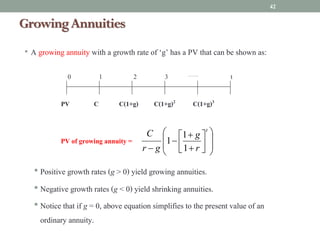
• A growing annuity with a growth rate of ‘g’ has a PV that can be shown as:
• Positive growth rates (g > 0) yield growing annuities.
• Negative growth rates (g < 0) yield shrinking annuities.
• Notice that if g = 0, above equation simplifies to the present value of an
ordinary annuity.
0 1 3
2 ……. t
C(1+g)3
C(1+g)2
C(1+g)
C
PV
÷
÷
ø
ö
ç
ç
è
æ
ú
û
ù
ê
ë
é
+
+
-
-
t
r
g
g
r
C
1
1
1
GrowingAnnuities
PV of growing annuity =
42
GrowingAnnuities
37
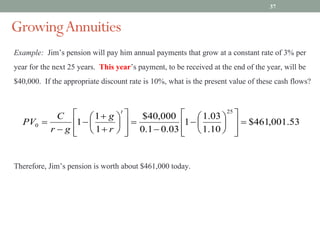
Example: Jim’s pension will pay him annual payments that grow at a constant rate of 3% per
year for the next 25 years. This year’s payment, to be received at the end of the year, will be
$40,000. If the appropriate discount rate is 10%, what is the present value of these cash flows?
Therefore, Jim’s pension is worth about $461,000 today.
53
.
001
,
461
$
10
.
1
03
.
1
1
03
.
0
1
.
0
000
,
40
$
1
1
1
25
0 =
ú
ú
û
ù
ê
ê
ë
é
÷
ø
ö
ç
è
æ
-
-
=
ú
ú
û
ù
ê
ê
ë
é
÷
ø
ö
ç
è
æ
+
+
-
-
=
t
r
g
g
r
C
PV
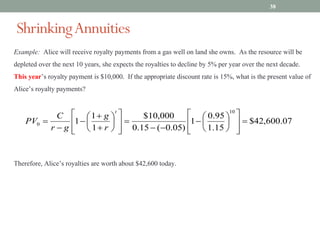
ShrinkingAnnuities
38
Example: Alice will receive royalty payments from a gas well on land she owns. As the resource will be
depleted over the next 10 years, she expects the royalties to decline by 5% per year over the next decade.
This year’s royalty payment is $10,000. If the appropriate discount rate is 15%, what is the present value of
Alice’s royalty payments?
Therefore, Alice’s royalties are worth about $42,600 today.
07
.
600
,
42
$
15
.
1
95
.
0
1
)
05
.
0
(
15
.
0
000
,
10
$
1
1
1
10
0 =
ú
ú
û
ù
ê
ê
ë
é
÷
ø
ö
ç
è
æ
-
-
-
=
ú
ú
û
ù
ê
ê
ë
é
÷
ø
ö
ç
è
æ
+
+
-
-
=
t
r
g
g
r
C
PV
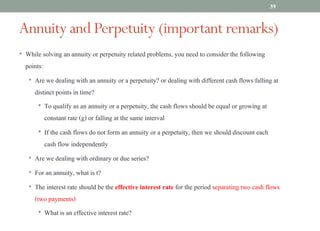
Annuity and Perpetuity (important remarks)
• While solving an annuity or perpetuity related problems, you need to consider the following
points:
• Are we dealing with an annuity or a perpetuity? or dealing with different cash flows falling at
distinct points in time?
• To qualify as an annuity or a perpetuity, the cash flows should be equal or growing at
constant rate (g) or falling at the same interval
• If the cash flows do not form an annuity or a perpetuity, then we should discount each
cash flow independently
• Are we dealing with ordinary or due series?
• For an annuity, what is t?
• The interest rate should be the effective interest rate for the period separating two cash flows
(two payments)
• What is an effective interest rate?
39
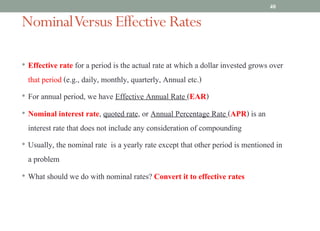
NominalVersus Effective Rates
• Effective rate for a period is the actual rate at which a dollar invested grows over
that period (e.g., daily, monthly, quarterly, Annual etc.)
• For annual period, we have Effective Annual Rate (EAR)
• Nominal interest rate, quoted rate, or Annual Percentage Rate (APR) is an
interest rate that does not include any consideration of compounding
• Usually, the nominal rate is a yearly rate except that other period is mentioned in
a problem
• What should we do with nominal rates? Convert it to effective rates
40
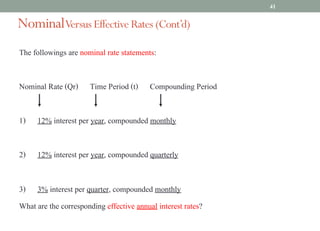
NominalVersus Effective Rates (Cont’d)
The followings are nominal rate statements:
Nominal Rate (Qr) Time Period (t) Compounding Period
1) 12% interest per year, compounded monthly
2) 12% interest per year, compounded quarterly
3) 3% interest per quarter, compounded monthly
What are the corresponding effective annual interest rates?
41
NominalVersus Effective Rates (Cont’d)
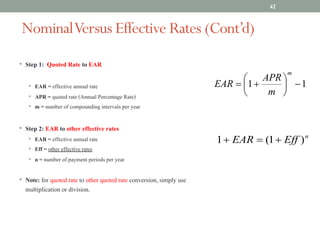
• Step 1: Quoted Rate to EAR
• EAR = effective annual rate
• APR = quoted rate (Annual Percentage Rate)
• m = number of compounding intervals per year
• Step 2: EAR to other effective rates
• EAR = effective annual rate
• Eff = other effective rates
• n = number of payment periods per year
• Note: for quoted rate to other quoted rate conversion, simply use
multiplication or division.
42
1
1 -
÷
ø
ö
ç
è
æ
+
=
m
m
APR
EAR
n
Eff
EAR )
1
(
1 +
=
+
NominalVersus Effective Rates (Cont’d)
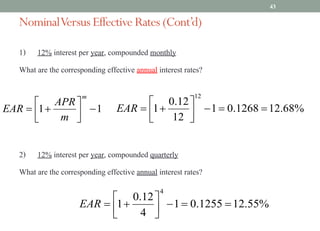
1) 12% interest per year, compounded monthly
What are the corresponding effective annual interest rates?
2) 12% interest per year, compounded quarterly
What are the corresponding effective annual interest rates?
43
1
1 -
ú
û
ù
ê
ë
é
+
=
m
m
APR
EAR %
68
.
12
1268
.
0
1
12
12
.
0
1
12
=
=
-
ú
û
ù
ê
ë
é
+
=
EAR
%
55
.
12
1255
.
0
1
4
12
.
0
1
4
=
=
-
ú
û
ù
ê
ë
é
+
=
EAR
NominalVersus Effective Rates (Cont’d)
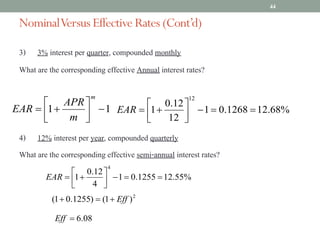
3) 3% interest per quarter, compounded monthly
What are the corresponding effective Annual interest rates?
4) 12% interest per year, compounded quarterly
What are the corresponding effective semi-annual interest rates?
44
1
1 -
ú
û
ù
ê
ë
é
+
=
m
m
APR
EAR %
68
.
12
1268
.
0
1
12
12
.
0
1
12
=
=
-
ú
û
ù
ê
ë
é
+
=
EAR
%
55
.
12
1255
.
0
1
4
12
.
0
1
4
=
=
-
ú
û
ù
ê
ë
é
+
=
EAR
2
)
1
(
)
1255
.
0
1
( Eff
+
=
+
08
.
6
=
Eff
Comprehensive Example:
A Basic Retirement Problem
45
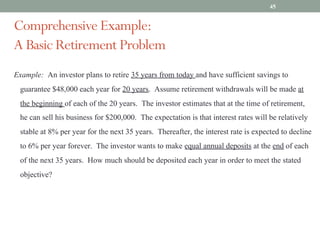
Example: An investor plans to retire 35 years from today and have sufficient savings to
guarantee $48,000 each year for 20 years. Assume retirement withdrawals will be made at
the beginning of each of the 20 years. The investor estimates that at the time of retirement,
he can sell his business for $200,000. The expectation is that interest rates will be relatively
stable at 8% per year for the next 35 years. Thereafter, the interest rate is expected to decline
to 6% per year forever. The investor wants to make equal annual deposits at the end of each
of the next 35 years. How much should be deposited each year in order to meet the stated
objective?
Comprehensive Example:
A Basic Retirement Problem
46
Solution:
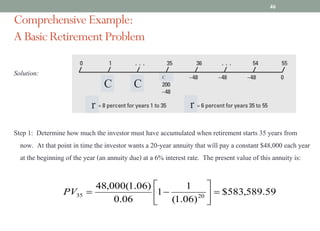
Step 1: Determine how much the investor must have accumulated when retirement starts 35 years from
now. At that point in time the investor wants a 20-year annuity that will pay a constant $48,000 each year
at the beginning of the year (an annuity due) at a 6% interest rate. The present value of this annuity is:
59
.
589
,
583
$
)
06
.
1
(
1
1
06
.
0
)
06
.
1
(
000
,
48
20
35 =
ú
û
ù
ê
ë
é
-
=
PV
C C
C
r r
Comprehensive Example:
A Basic Retirement Problem
47
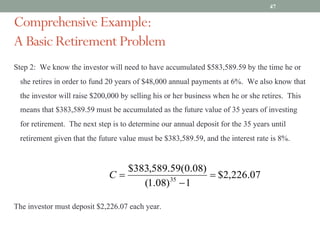
Step 2: We know the investor will need to have accumulated $583,589.59 by the time he or
she retires in order to fund 20 years of $48,000 annual payments at 6%. We also know that
the investor will raise $200,000 by selling his or her business when he or she retires. This
means that $383,589.59 must be accumulated as the future value of 35 years of investing
for retirement. The next step is to determine our annual deposit for the 35 years until
retirement given that the future value must be $383,589.59, and the interest rate is 8%.
The investor must deposit $2,226.07 each year.
07
.
226
,
2
$
1
)
08
.
1
(
)
08
.
0
(
59
.
589
,
383
$
35
=
-
=
C
Extra Examples
49
0 5 6 7 8 9
$500 $500 $500 $500
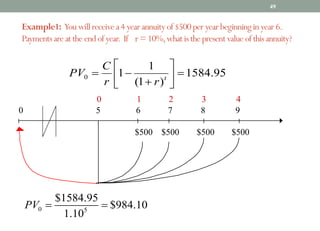
Example1: Youwillreceivea4yearannuityof$500peryearbeginninginyear6.
Paymentsareattheendofyear. If r=10%,whatisthepresentvalueofthisannuity?
0 5
$1584.95
$984.10
1.10
PV = =
0 1 2 3 4
95
.
1584
)
1
(
1
1
0 =
ú
û
ù
ê
ë
é
+
-
= t
r
r
C
PV
50
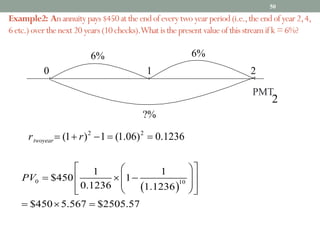
Example2: Anannuitypays$450attheendofeverytwoyearperiod(i.e.,theendofyear2,4,
6etc.)overthenext20years(10checks).Whatisthepresentvalueofthisstreamifk=6%?
0 1 2
2
PMT
6% 6%
?%
( )
0 10
1 1
$450 1
0.1236 1.1236
$450 5.567 $2505.57
PV
é ù
æ ö
ê ú
= ´ -
ç ÷
ç ÷
ê ú
è ø
ë û
= ´ =
1236
.
0
)
06
.
1
(
1
)
1
( 2
2
=
=
-
+
= r
rtwoyear
51
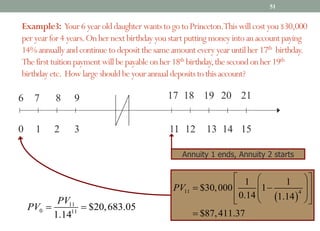
Example3: Your6yearolddaughterwantstogotoPrinceton.Thiswillcostyou$30,000
peryearfor4years.Onhernextbirthdayyoustartputtingmoneyintoanaccountpaying
14%annuallyandcontinuetodepositthesameamounteveryyearuntilher17th birthday.
Thefirsttuitionpaymentwillbepayableonher18th birthday,thesecondonher19th
birthdayetc. Howlargeshouldbeyourannualdepositstothisaccount?
6 7 8 9 17 18 19 20 21
0 1 2 3 11 12 13 14 15
( )
11 4
1 1
$30,000 1
0.14 1.14
$87,411.37
PV
é ù
æ ö
ê ú
= -
ç ÷
ç ÷
ê ú
è ø
ë û
=
Annuity 1 ends, Annuity 2 starts
11
0 11
$20,683.05
1.14
PV
PV = =
52
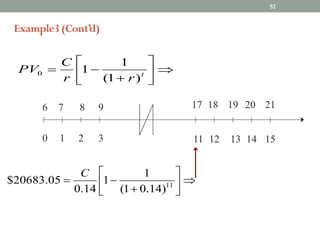
Example3 (Cont’d)
6 7 8 9 17 18 19 20 21
0 1 2 3 11 12 13 14 15
Þ
ú
û
ù
ê
ë
é
+
-
= t
r
r
C
PV
)
1
(
1
1
0
Þ
ú
û
ù
ê
ë
é
+
-
= 11
)
14
.
0
1
(
1
1
14
.
0
05
.
20683
$
C

International Financial Management slides.pdf

  • 1.
  • 2.
    Agenda After studying thischapter, you should be able to: • Calculate the future value to which money invested at a given interest rate will grow. • Calculate the present value of a future payment • Calculate present and future values of streams of cash payments. • Find the interest rate implied by the present or future value. • Explain how we would compare interest rates quoted over different intervals. 1
  • 3.
    • Financial decisionsrequire comparisons of cash payments at different dates. • Since a dollar today does not have the same value as a dollar tomorrow, a relationship has to be established to compare cash flows at different times. • Future value is the amount to which a present value will grow after earning interest. • There are two kinds of interest that money can earn: • Simple interest • Compound interest FutureValues and Compound Interest 3
  • 4.
    Simple Interest •Interest isearned only on the original investment •Example: You invest $100 in an account paying simple interest at the rate of 6% per year. How much will the account be worth in 5 years? ◦ You earn interest only on the original investment, every year ◦ Interest earned per year = $100 x 6% = $6.00 ◦ Total interest earned over 5-year period = $6.00 x 5 = $30.00 ◦ Balance in account at end of Year 1 = $100 + $6 = $106 ◦ Balance in account at end of Year 3 = $100 + $18 = $118 ◦ Balance in account at end of Year 5 = $100 + $30 = $130 FutureValues 4
  • 5.
    FutureValues • Simple Interest •The value of a simple interest for each period of payment is given by following equation • I: Interest Amount • PV: Principal (Present Value) • r: Discount rate • End of investment period amount or Future Value (FV) of the investment: • t: number of time periods between PV and FV 4 ) ( FVt r PV t PV ´ ´ + = r PV ´ = I
  • 6.
    Compound Interest • Interestis earned on the value of money that is in the account at the beginning of the period. Thus, previous period’s earned interest can also earn interest on the next period. • Example: You invest $100 in an account paying compound interest at the rate of 6% per year. How much will the account be worth in 5 years? • This time you earn interest on interest • Interest earned per year = Previous year’s balance x interest rate • Interest earned in Year 1 = $100.00 x 6% = $6.00 • Interest earned in Year 2 = $106.00 x 6% = $6.36 • Interest earned in Year 3 = $112.36 x 6% = $6.74 • Interest earned in Year 4 = $119.10 x 6% = $7.15 • Interest earned in Year 5 = $126.25 x 6% = $7.57 FutureValues 6
  • 7.
    Compound Interest • Valueat the end of Year 1 = $100.00 +[$100 x 6%] = $100 x (1+r) • Value at the end of Year 2 = $106.00 + [$106 x 6%] = $100 x (1+r)2 • ……. • Value at the end of Year 5 = $100 x (1+r)5 •The formula for the future value of PV dollars at r% interest per period for t periods is: FutureValues t r PV FV ) 1 ( + ´ = 7
  • 8.
    • Example: You invest$1000 in an account paying compound interest at the rate of 5% per year. How much will the account be worth in 8 years? FV= $1000 x (1+r)t = $1000 x (1+0.05)8 = $1477.45 FutureValues 8
  • 9.
    FutureValues © 2016 McGraw-HillEducation Limited Chapter 5 - 8 9
  • 10.
    • Present valueis the value today of a future cash flow. • How much do you need to invest today into an account paying compound interest at the rate of 5% per year, in order to receive $1477.45 at the end of eight years? Yr3 $1477.45 ? Present Value Future Value Today Yr1 Yr2 Yr4 Yr7 Yr5 Yr6 Yr8 PresentValues 11
  • 11.
    • Simply invertthe FV formula to get the PV formula Yr3 $1477.45 Future Value Today Yr1 Yr2 Yr4 Yr7 Yr5 Yr6 Yr8 $1477.45 (1+ 0.05)8 = $1,000 PresentValues t r FV PV ) 1 ( + = Present Value= 12
  • 12.
    Example: } You havebeen offered $1 million five years from now. If the interest rates is expected to be 10% per year, how much is this prize worth to you in today’s dollars? Today Year 5 $1 million PresentValues $1000000 (1+ 0.10)5 = $620921 Present Value= 13
  • 13.
    • The PVand the FV are very much related to each other PV = FV x 1/(1 + r)t = $1 million x 1/ (1 + 0.10)5 = $620,921 FV = PV x (1 + r)t = $620,921 x (1 + 0.10)5 = $1 million PresentValues 14
  • 14.
    • Use yourfinancial calculator • Rearrange the expression Example: PV = 712.99; t = 5 year period; FV=1000 What is the discount rate? PV = $1000 x 1 (1 + r)5 = 712.99 712.99 x (1 + r)5 = 1000 (1 + r)5 = 1000 712.99 = 1.40 (1 + r)= (1.40)1/5 = 1.0696 r = 6.96% Finding the Interest Rate (r) 16
  • 15.
    • Can befound the same way • Use your financial calculator • Use the tables – look up the discount factor • Rearrange the expression to solve for “t” Finding the Investment Period (t) 17
  • 16.
    • The basicfinancial calculator uses 5 keys that correspond to the inputs for common problems involving the time value of money. • N = number of periods (t in formula) • i = the interest rate per period, expressed as a percentage (not a decimal, ie. 8 for 8%, not 0.08) • PV = present value • FV = future value • PMT = amount of any recurring payment (called an annuity). For single cash-flow problems (the ones we have done so far), PMT = 0. • Given any 4 of these inputs, the calculator will calculate the 5th. • Sign convention matters. If you are borrowing, PV will be (+) as it is an inflow of cash. Payments will be (-) as they are outflows of cash. Financial Calculator 18
  • 17.
    Be careful ofwording • A cash flow occurs at the end of the third period. • A cash flow occurs at time period three. • A cash flow occurs at the beginning of the fourth period. • Each of the above statements refers to the same point in time • If in doubt, always draw a time line. 16 0 1 2 3 4 C
  • 18.
    Future Value ofMultiple Cash Flows • Example: You deposit $1,200 in your bank account today; $1,400 one year later; and $1,000 two years from today. If your bank offers you an 8% interest rate on your account, how much money will you have in the account three years from today? Multiple Cash Flows 20
  • 19.
    • Future valueexample 0 1 2 $1,000 8% $1,200 8% $1,400 3 8% ? ?? ??? FutureValue of Multiple Cash Flows 21
  • 20.
  • 21.
    • Example: Your autodealer gives you the choice to pay $15,500 cash now, or make three payments: $8,000 now and $4,000 at the end of the following two years. If your cost of money is 8%, which do you prefer? Option 1: $15,500 today Option 2: $8,000 today; $4,000 at the end of one year; and $4,000 at the end of two years. Only cash flows that occur at the same time can be compared. Since option 1 occurs today, we can convert option 2 to today as well and compare. We do this by finding the PV of each cash flow under option 2 and adding them together. PresentValue of Multiple Cash Flows 23
  • 22.
    0 1 $4,000 8% 2 8% $4,000/(1+0.08)1=$3,703.70 $4,000 $4,000/(1+0.08)2=$3,429.36 PV= $15,133.06 $8,000 } Present value of option # 2: PresentValue of Multiple Cash Flows 24
  • 23.
    • Compare thepresent value of the two options at present: • Option 1: $15,500 • Option 2: $15,133 • Option 2 is the better choice for the buyer as the PV is less. That means, option 1 is the better choice for the seller (dealer). PresentValue of Multiple Cash Flows 25
  • 24.
    • Annuities: Cashflows of equal amount every period for a limited number of periods (finite). • Example: Loan payments for automobile, periodic earnings from lottery wins, etc. • Regular Annuity • Annuity Due • Perpetuities: Cash flows of equal amount every period for an unlimited number of periods (infinite). • Example: Property tax payments, preferred stocks, etc. • Regular Perpetuity • Perpetuity Due Level Cash Flows:Perpetuities andAnnuities 26
  • 25.
    • The PVof a regular perpetuity is calculated by dividing the level cash flow by the interest rate. PV of a perpetuity = C r 0 1 3 2 ……. ∞ C C C C C Note: This formula gives you the present value of a perpetuity that starts one period from now PV How toValue Regular Perpetuities 27
  • 26.
    In order tocreate an endowment, which pays $100,000 per year, forever, how much money must be set aside today if the rate of interest is 10%? PV of perpetuity = $100,000 0.10 0 1 … 2 ……. ∞ $100,000 PV $100,000 $100,000 = $1,000,000 Example 28
  • 27.
    If the firstperpetuity payment will not be received until four years from today, how much money needs to be set aside today? PV at end of Year 3 = $100,000 0.10 1 2 4 3 5 ∞ 10% 10% 10% $100,000 PV $100,000 $100,000 = $1,000,000 … PV today = $1,000,000 (1.10)3 = $751,315 0 Example (Cont.) 29
  • 28.
    Perpetuity Due 27 • Thepresent value of a perpetuity due is given by: • Note: perpetuities do not have future nor accumulated values
  • 29.
    Present Value: ThePV of a t period annuity with cash flow of C and discount rate r is given by: PV of t-period annuity = 0 1 3 2 ……. t C C C C C PV Note: This formula gives you the present value of an annuity that starts one period from now. This is called a regular annuity. How toValue RegularAnnuities ú û ù ê ë é + - ´ t r r r C ) 1 ( 1 1 31
  • 30.
    Present Value InterestFactor of Annuity: •In the present value formula for an annuity • The term in the parentheses is called the Present Value Interest Factor of an annuity (PVIFA). • There is a table that can be used to find present values of $1 annuities for different rates and time periods, as shown in the next slide ú ú û ù ê ê ë é + - ´ t r r r C ) 1 ( 1 1 Annuities – PresentValue 32
  • 31.
    } Example: Youare purchasing a car. You are scheduled to make 3 annual installments of $4,000 per year, with the first payment one year from now. Given a rate of interest of 10%, what is the price you are paying for the car? 0 1 2 $4,000 10% $4,000 10% $4,000 3 10% PV of 3-period annuity = 41 . 947 , 9 $ ) 10 . 0 1 ( 10 . 0 1 10 . 0 1 000 , 4 $ 3 = ú ú û ù ê ê ë é + - ´ Or, from the PVIFA table = $4,000 x 2.487 = $9,947.41 Annuities – PresentValue PV 34
  • 32.
    Future Value: TheFV of a t period annuity with cash flow of C and discount rate r is given by: 0 1 3 2 ……. t FV C C C C FV of t-period annuity = Note: This formula gives you the present value of an annuity starting one period from now. This is called a regular annuity. Annuities – FutureValue ú û ù ê ë é - + r r C t 1 ) 1 ( 31
  • 33.
    Future Value InterestFactor of Annuity: •In the present value formula for an annuity, the term is called the Future Value Interest Factor of an annuity (FVIFA). • There is a table that can be used to find future values of $1 annuities for different rates and time periods, as shown in the next slide. Annuities – FutureValue ú û ù ê ë é - + r r t 1 ) 1 ( 36
  • 34.
    Annuities Due: Alevel stream of cash flows starting immediately, is known as an annuity due. The difference between an annuity due and a regular annuity is shown in the example on the following slide. oThe PV of annuity due = PV of ordinary annuity x (1+r) oThe FV of annuity due = FV of ordinary annuity x (1+r) As the cash flow starts earlier, there is one extra compounding period so both the PV and FV will be higher. Annuities Due 38
  • 35.
    Cash Flows Growingat a Constant Rate –Variations on Perpetuities andAnnuities • Growing Perpetuity: An infinite stream of cash flows growing at a constant rate. • Growing Annuity: A finite stream of cash flows growing at a constant rate. 40
  • 36.
    • A growingperpetuity with a constant growth rate of ‘g’ has a PV that can be shown as: • Above equation holds only when r > g, the discount rate is greater than the growth rate. Otherwise, the answer is becomes negative and uninformative. • Above equation holds only when the growth rate is constant. 0 1 3 2 ……. ∞ C(1+g)3 C(1+g)2 C(1+g) C PV PV of a growing perpetuity = Growing Perpetuities ú û ù ê ë é - g r c 41
  • 37.
    • A growingannuity with a growth rate of ‘g’ has a PV that can be shown as: • Positive growth rates (g > 0) yield growing annuities. • Negative growth rates (g < 0) yield shrinking annuities. • Notice that if g = 0, above equation simplifies to the present value of an ordinary annuity. 0 1 3 2 ……. t C(1+g)3 C(1+g)2 C(1+g) C PV ÷ ÷ ø ö ç ç è æ ú û ù ê ë é + + - - t r g g r C 1 1 1 GrowingAnnuities PV of growing annuity = 42
  • 38.
    GrowingAnnuities 37 Example: Jim’s pensionwill pay him annual payments that grow at a constant rate of 3% per year for the next 25 years. This year’s payment, to be received at the end of the year, will be $40,000. If the appropriate discount rate is 10%, what is the present value of these cash flows? Therefore, Jim’s pension is worth about $461,000 today. 53 . 001 , 461 $ 10 . 1 03 . 1 1 03 . 0 1 . 0 000 , 40 $ 1 1 1 25 0 = ú ú û ù ê ê ë é ÷ ø ö ç è æ - - = ú ú û ù ê ê ë é ÷ ø ö ç è æ + + - - = t r g g r C PV
  • 39.
    ShrinkingAnnuities 38 Example: Alice willreceive royalty payments from a gas well on land she owns. As the resource will be depleted over the next 10 years, she expects the royalties to decline by 5% per year over the next decade. This year’s royalty payment is $10,000. If the appropriate discount rate is 15%, what is the present value of Alice’s royalty payments? Therefore, Alice’s royalties are worth about $42,600 today. 07 . 600 , 42 $ 15 . 1 95 . 0 1 ) 05 . 0 ( 15 . 0 000 , 10 $ 1 1 1 10 0 = ú ú û ù ê ê ë é ÷ ø ö ç è æ - - - = ú ú û ù ê ê ë é ÷ ø ö ç è æ + + - - = t r g g r C PV
  • 40.
    Annuity and Perpetuity(important remarks) • While solving an annuity or perpetuity related problems, you need to consider the following points: • Are we dealing with an annuity or a perpetuity? or dealing with different cash flows falling at distinct points in time? • To qualify as an annuity or a perpetuity, the cash flows should be equal or growing at constant rate (g) or falling at the same interval • If the cash flows do not form an annuity or a perpetuity, then we should discount each cash flow independently • Are we dealing with ordinary or due series? • For an annuity, what is t? • The interest rate should be the effective interest rate for the period separating two cash flows (two payments) • What is an effective interest rate? 39
  • 41.
    NominalVersus Effective Rates •Effective rate for a period is the actual rate at which a dollar invested grows over that period (e.g., daily, monthly, quarterly, Annual etc.) • For annual period, we have Effective Annual Rate (EAR) • Nominal interest rate, quoted rate, or Annual Percentage Rate (APR) is an interest rate that does not include any consideration of compounding • Usually, the nominal rate is a yearly rate except that other period is mentioned in a problem • What should we do with nominal rates? Convert it to effective rates 40
  • 42.
    NominalVersus Effective Rates(Cont’d) The followings are nominal rate statements: Nominal Rate (Qr) Time Period (t) Compounding Period 1) 12% interest per year, compounded monthly 2) 12% interest per year, compounded quarterly 3) 3% interest per quarter, compounded monthly What are the corresponding effective annual interest rates? 41
  • 43.
    NominalVersus Effective Rates(Cont’d) • Step 1: Quoted Rate to EAR • EAR = effective annual rate • APR = quoted rate (Annual Percentage Rate) • m = number of compounding intervals per year • Step 2: EAR to other effective rates • EAR = effective annual rate • Eff = other effective rates • n = number of payment periods per year • Note: for quoted rate to other quoted rate conversion, simply use multiplication or division. 42 1 1 - ÷ ø ö ç è æ + = m m APR EAR n Eff EAR ) 1 ( 1 + = +
  • 44.
    NominalVersus Effective Rates(Cont’d) 1) 12% interest per year, compounded monthly What are the corresponding effective annual interest rates? 2) 12% interest per year, compounded quarterly What are the corresponding effective annual interest rates? 43 1 1 - ú û ù ê ë é + = m m APR EAR % 68 . 12 1268 . 0 1 12 12 . 0 1 12 = = - ú û ù ê ë é + = EAR % 55 . 12 1255 . 0 1 4 12 . 0 1 4 = = - ú û ù ê ë é + = EAR
  • 45.
    NominalVersus Effective Rates(Cont’d) 3) 3% interest per quarter, compounded monthly What are the corresponding effective Annual interest rates? 4) 12% interest per year, compounded quarterly What are the corresponding effective semi-annual interest rates? 44 1 1 - ú û ù ê ë é + = m m APR EAR % 68 . 12 1268 . 0 1 12 12 . 0 1 12 = = - ú û ù ê ë é + = EAR % 55 . 12 1255 . 0 1 4 12 . 0 1 4 = = - ú û ù ê ë é + = EAR 2 ) 1 ( ) 1255 . 0 1 ( Eff + = + 08 . 6 = Eff
  • 46.
    Comprehensive Example: A BasicRetirement Problem 45 Example: An investor plans to retire 35 years from today and have sufficient savings to guarantee $48,000 each year for 20 years. Assume retirement withdrawals will be made at the beginning of each of the 20 years. The investor estimates that at the time of retirement, he can sell his business for $200,000. The expectation is that interest rates will be relatively stable at 8% per year for the next 35 years. Thereafter, the interest rate is expected to decline to 6% per year forever. The investor wants to make equal annual deposits at the end of each of the next 35 years. How much should be deposited each year in order to meet the stated objective?
  • 47.
    Comprehensive Example: A BasicRetirement Problem 46 Solution: Step 1: Determine how much the investor must have accumulated when retirement starts 35 years from now. At that point in time the investor wants a 20-year annuity that will pay a constant $48,000 each year at the beginning of the year (an annuity due) at a 6% interest rate. The present value of this annuity is: 59 . 589 , 583 $ ) 06 . 1 ( 1 1 06 . 0 ) 06 . 1 ( 000 , 48 20 35 = ú û ù ê ë é - = PV C C C r r
  • 48.
    Comprehensive Example: A BasicRetirement Problem 47 Step 2: We know the investor will need to have accumulated $583,589.59 by the time he or she retires in order to fund 20 years of $48,000 annual payments at 6%. We also know that the investor will raise $200,000 by selling his or her business when he or she retires. This means that $383,589.59 must be accumulated as the future value of 35 years of investing for retirement. The next step is to determine our annual deposit for the 35 years until retirement given that the future value must be $383,589.59, and the interest rate is 8%. The investor must deposit $2,226.07 each year. 07 . 226 , 2 $ 1 ) 08 . 1 ( ) 08 . 0 ( 59 . 589 , 383 $ 35 = - = C
  • 49.
  • 50.
    49 0 5 67 8 9 $500 $500 $500 $500 Example1: Youwillreceivea4yearannuityof$500peryearbeginninginyear6. Paymentsareattheendofyear. If r=10%,whatisthepresentvalueofthisannuity? 0 5 $1584.95 $984.10 1.10 PV = = 0 1 2 3 4 95 . 1584 ) 1 ( 1 1 0 = ú û ù ê ë é + - = t r r C PV
  • 51.
    50 Example2: Anannuitypays$450attheendofeverytwoyearperiod(i.e.,theendofyear2,4, 6etc.)overthenext20years(10checks).Whatisthepresentvalueofthisstreamifk=6%? 0 12 2 PMT 6% 6% ?% ( ) 0 10 1 1 $450 1 0.1236 1.1236 $450 5.567 $2505.57 PV é ù æ ö ê ú = ´ - ç ÷ ç ÷ ê ú è ø ë û = ´ = 1236 . 0 ) 06 . 1 ( 1 ) 1 ( 2 2 = = - + = r rtwoyear
  • 52.
    51 Example3: Your6yearolddaughterwantstogotoPrinceton.Thiswillcostyou$30,000 peryearfor4years.Onhernextbirthdayyoustartputtingmoneyintoanaccountpaying 14%annuallyandcontinuetodepositthesameamounteveryyearuntilher17th birthday. Thefirsttuitionpaymentwillbepayableonher18thbirthday,thesecondonher19th birthdayetc. Howlargeshouldbeyourannualdepositstothisaccount? 6 7 8 9 17 18 19 20 21 0 1 2 3 11 12 13 14 15 ( ) 11 4 1 1 $30,000 1 0.14 1.14 $87,411.37 PV é ù æ ö ê ú = - ç ÷ ç ÷ ê ú è ø ë û = Annuity 1 ends, Annuity 2 starts 11 0 11 $20,683.05 1.14 PV PV = =
  • 53.
    52 Example3 (Cont’d) 6 78 9 17 18 19 20 21 0 1 2 3 11 12 13 14 15 Þ ú û ù ê ë é + - = t r r C PV ) 1 ( 1 1 0 Þ ú û ù ê ë é + - = 11 ) 14 . 0 1 ( 1 1 14 . 0 05 . 20683 $ C