TIME MANAGEMENT
OBJECTIVES Recognise  signs of chronic disorganisation. Learn to clear your desk of clutter and create a  filing system. Identify the most  common  interruptions of working time and ways to eliminate them.  Determine why and where you procrastinate and overcome procrastination. Apply the practical techniques, concepts, and strategies developed through this program.
A CHALLENGE Let’s Discuss your definition of T I M E  M A N A G E M E N T.
DEFINITION Time management  refers to a range of skills, tools, and techniques used to   manage   time when accomplishing specific tasks, projects and goals. This set encompasses a wide scope of activities, and these include  planning ,  allocating ,  setting goals ,  delegation, analysis of time spent,  monitoring ,  organizing,   scheduling ,  and   prioritising .
TWO HOURS WASTED PER DAY Messy  desk Can’t find things Miss appointments Unprepared for meetings Tired/unable to concentrate
WHY IS IT NECESSARY? What does “Time” (SELF) Management do for you, your job, your group and/or your organisation?
CONTROLLING THE DEMANDS Manage the work  (use time constructively). Improve productivity/effectiveness  (spend time on results-producing activities). Let’s look at this thing called,  “ Time Management.”
TIME WASTING CULPRITS What Are The Most Common Time Wasters, Thieves and Culprits?
TIME WASTING CULPRITS   (1 OF 2) Telephone Interruptions   Inefficient Delegation Extended Lunches or Breaks  Cluttered Work Space Poorly Run Meetings Socializing On The Job  Misfiled Information
TIME WASTING CULPRITS   (2 OF 2) Poor Planning Procrastination Waiting/Delays Paperwork Junk Mail Drop-In Visitors  Not Setting/Sticking  to Priorities
TIME/SELF MANAGEMENT You do not manage time! Yourself,  others and work .   You   manage :
HOW TO USE TIME EFFECTIVELY   (1 OF 2) Consolidate Similar Tasks. Tackle Tough Jobs First. Delegate And Develop Others. Learn To Use Idle Time. Get Control Of The Paper Flow. Avoid The Cluttered Desk Syndrome.
HOW TO USE TIME EFFECTIVELY   (2 OF 2) Get Started Immediately On Important Tasks. More Effective Meetings with Clear Goals. Take Time To Plan. Learn To Say “No.” Remember That Now Is The Time To Put It All Together.
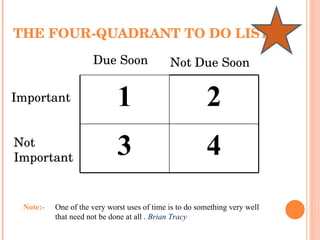
THE FOUR-QUADRANT TO DO LIST Important Not  Important Due Soon Not Due Soon Note:-  One of the very worst uses of time is to do something very well  that need not be done at all .  Brian Tracy 1 2 3 4
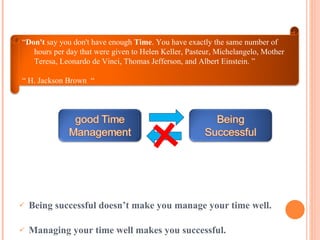
Being successful doesn’t make you manage your time well. Managing your time well makes you successful. “ Don't  say you don't have enough  Time . You have exactly the same number of hours per day that were given to Helen Keller, Pasteur, Michelangelo, Mother Teresa, Leonardo de Vinci, Thomas Jefferson, and Albert Einstein. ” “  H. Jackson Brown  “
The Relationship Between  Stress and Time Management
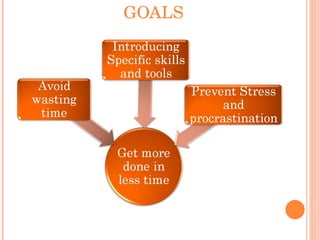
GOALS

Time management

  • 1.
  • 2.
    OBJECTIVES Recognise signs of chronic disorganisation. Learn to clear your desk of clutter and create a filing system. Identify the most common interruptions of working time and ways to eliminate them. Determine why and where you procrastinate and overcome procrastination. Apply the practical techniques, concepts, and strategies developed through this program.
  • 3.
    A CHALLENGE Let’sDiscuss your definition of T I M E M A N A G E M E N T.
  • 4.
    DEFINITION Time management refers to a range of skills, tools, and techniques used to manage time when accomplishing specific tasks, projects and goals. This set encompasses a wide scope of activities, and these include planning , allocating , setting goals , delegation, analysis of time spent, monitoring , organizing, scheduling , and prioritising .
  • 5.
    TWO HOURS WASTEDPER DAY Messy desk Can’t find things Miss appointments Unprepared for meetings Tired/unable to concentrate
  • 6.
    WHY IS ITNECESSARY? What does “Time” (SELF) Management do for you, your job, your group and/or your organisation?
  • 7.
    CONTROLLING THE DEMANDSManage the work (use time constructively). Improve productivity/effectiveness (spend time on results-producing activities). Let’s look at this thing called, “ Time Management.”
  • 8.
    TIME WASTING CULPRITSWhat Are The Most Common Time Wasters, Thieves and Culprits?
  • 9.
    TIME WASTING CULPRITS (1 OF 2) Telephone Interruptions Inefficient Delegation Extended Lunches or Breaks Cluttered Work Space Poorly Run Meetings Socializing On The Job Misfiled Information
  • 10.
    TIME WASTING CULPRITS (2 OF 2) Poor Planning Procrastination Waiting/Delays Paperwork Junk Mail Drop-In Visitors Not Setting/Sticking to Priorities
  • 11.
    TIME/SELF MANAGEMENT Youdo not manage time! Yourself, others and work . You manage :
  • 12.
    HOW TO USETIME EFFECTIVELY (1 OF 2) Consolidate Similar Tasks. Tackle Tough Jobs First. Delegate And Develop Others. Learn To Use Idle Time. Get Control Of The Paper Flow. Avoid The Cluttered Desk Syndrome.
  • 13.
    HOW TO USETIME EFFECTIVELY (2 OF 2) Get Started Immediately On Important Tasks. More Effective Meetings with Clear Goals. Take Time To Plan. Learn To Say “No.” Remember That Now Is The Time To Put It All Together.
  • 14.
    THE FOUR-QUADRANT TODO LIST Important Not Important Due Soon Not Due Soon Note:- One of the very worst uses of time is to do something very well that need not be done at all . Brian Tracy 1 2 3 4
  • 15.
    Being successful doesn’tmake you manage your time well. Managing your time well makes you successful. “ Don't say you don't have enough Time . You have exactly the same number of hours per day that were given to Helen Keller, Pasteur, Michelangelo, Mother Teresa, Leonardo de Vinci, Thomas Jefferson, and Albert Einstein. ” “ H. Jackson Brown “
  • 16.
    The Relationship Between Stress and Time Management
  • 17.