Time Management: Issues &
Challenges
Dr. V. Vijaya Lakshmi
Dean & Professor, Dept. of RMCS
College of Community Science
PJTAU, Saifabad, Hyd'bad-500004
Mrs. M. Siresha
Research Scholar, Dept. of RMCS, CCSc,
PJTAU, Hyderabad
How do we Spend time in our life
27 years
sleeping
3.3 years eating
5 months
waiting at traffic
lights
1 year looking
for misplaced
objects
2 years
attempting to
return phone
calls
4 years doing
housework
5 years waiting
in lines
13.8 years
working
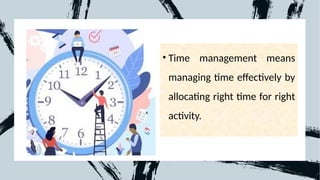
• Time management means
managing time effectively by
allocating right time for right
activity.
Need for time Management
- To save time
- To reduce stress
- To function effectively
- To increase work out put
- To have control over all the
responsibilities
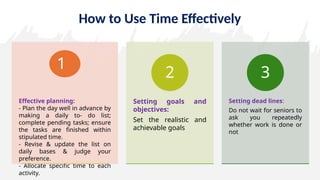
How to Use Time Effectively
Effective planning:
- Plan the day well in advance by
making a daily to- do list;
complete pending tasks; ensure
the tasks are finished within
stipulated time.
- Revise & update the list on
daily bases & judge your
preference.
- Allocate specific time to each
activity.
1
Setting goals and
objectives:
Set the realistic and
achievable goals
2
Setting dead lines:
Do not wait for seniors to
ask you repeatedly
whether work is done or
not
3
How to Use Time Effectively
Delegating
responsibilities: Delegate
the work to the people
according to their skill,
specialization and interest
to ensure work can be
finished within the dead
lines
1
Prioritizing activities:
Prioritize the work based
on importance and
urgency.
- Identify the tasks to be
completed within a day and
within a month.
- 4 D’s will help i.e. Do,
Delegate, Delay & Delete.
2
Spending right time on
right activity:
- Develop the habit of
doing right thing at right
time.
- Differentiate between
personal time and
professional time.
3
4 5 6
Understand the value of time
• Cost per year: Salary+ other sources of income
• Hourly value/rate: cost per year/work hour per year
• For example
• Cost per year: 15,00,000 (salary)+20000 (interest on
deposits)
• Hourly value: 15,20,000/1890(270 working days @7
hrs/day)= 804.23Rs.
• By calculating in this way, you can
• Make a realistic estimate of time
during the day on job orders
• Identify the time spent on low
value jobs
• Find the high yielding time of day
• Avoid to keep stacks of papers/files at work station/ table.
Organized
• Don’t wait till last minute to complete the task.
Don’t misuse
• Set reminders on phones or computers.
• Develop the marking on table calendars or using planners and
organizers
Be Focused
• Adjust the plans during the unavoidable situations and maintain the
productivity.
Adaptability and
Flexibility
• Avoid distractions and stick to the schedule without procrastination
Discipline
• Assign tasks to others when possible, ensuring equal workload
distribution and efficiency
Delegation skills
Characteristics of a Good Time Manager
Time management Techniques
- Set the priorities
- Finish the assignments on time
- Discuss work with sub-ordinates
- Differentiate between urgent and important
- Stay focused by having continuity in work without
breaks
- Include some rest periods to break the monotony
or boredom
- Set realistic targets
- Don’t overload yourself
- Be disciplined and punctual
Time management Techniques
- Arrive at the office on time
- Avoid loitering/gossiping at workplace
- Limit long personal calls during office hours
- Be organized
- Identify time wasters at workplace
- Use your waiting time effectively for ex:
waiting for a train/bus/plane
- Identify the prime time and peak loads
- Balance the time between work, rest and
sleep
- Set SMART goals(Specific, Measurable,
Achievable, Realistic and Time bound)
- Enjoy your work
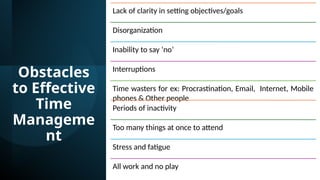
Obstacles
to Effective
Time
Manageme
nt
Lack of clarity in setting objectives/goals
Disorganization
Inability to say ‘no’
Interruptions
Time wasters for ex: Procrastination, Email, Internet, Mobile
phones & Other people
Periods of inactivity
Too many things at once to attend
Stress and fatigue
All work and no play
Obstacles
to Effective
Time
Manageme
nt
Constant rushing (e.g. between meetings or tasks) ·
Frequent delays (e.g. in attending meetings, meeting deadlines) ·
Low productivity, energy and motivation (e.g. ‘I can’t seem to get
worked up about anything’)
Frustration (e.g. ‘Oh, things just don’t move ahead) ·
Impatience (e.g. ‘where the hell is that information I’ve asked him
for?’)·
Chronic vacillation between alternatives (e.g. ‘whichever option I
choose it is going to put me at a big disadvantage. I don’t know
which way to jump’) ·
Difficulty setting and achieving goals (e.g. ‘I’m not sure what is
expected of me’)
Strategies for Beating Procrastination
Reward
yourself for
doing the
work.
01
Ask someone
to check
whether
you’ve done
the work.
02
Consider the
bad things
that will
happen if you
don’t do the
work – like
failing.
03
Break the
work into
small tasks
and do the
easiest first.
04
Do the
hardest or
most
unpleasant
bit first
05
Implications of Poor Time
Management
- Poor work flow
- Wasted time
- Loss of control
- Poor quality of work
- Poor reputation
- Frustration
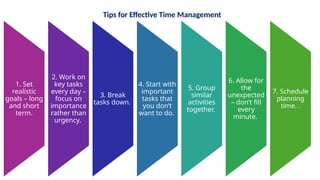
Tips for Effective Time Management
1. Set
realistic
goals – long
and short
term.
2. Work on
key tasks
every day –
focus on
importance
rather than
urgency.
3. Break
tasks down.
4. Start with
important
tasks that
you don’t
want to do.
5. Group
similar
activities
together.
6. Allow for
the
unexpected
– don’t fill
every
minute.
7. Schedule
planning
time. .
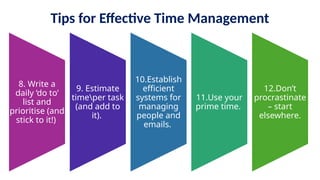
Tips for Effective Time Management
8. Write a
daily ‘do to’
list and
prioritise (and
stick to it!)
9. Estimate
timeper task
(and add to
it).
10.Establish
efficient
systems for
managing
people and
emails.
11.Use your
prime time.
12.Don’t
procrastinate
– start
elsewhere.
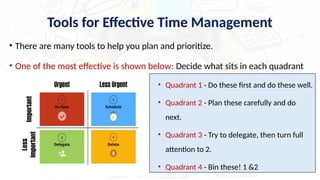
Tools for Effective Time Management
• There are many tools to help you plan and prioritize.
• One of the most effective is shown below: Decide what sits in each quadrant
• Quadrant 1 - Do these first and do these well.
• Quadrant 2 - Plan these carefully and do
next.
• Quadrant 3 - Try to delegate, then turn full
attention to 2.
• Quadrant 4 - Bin these! 1 &2
2. Time Inventory
Activity/ Hrs Monda
y
Tuesda
y
Wednesda
y
Thursda
y
Frida
y
Saturda
y
Sunday Total
Sleep
Hours awake
Office &Home
Commuting & travel
Eating
Dressing & personal hygiene
Family & personal work
Education& self improvement
Community & Professional
activities
Leisure
Conclusion
• Effective time management improves
productivity, reduces stress and
ensures a balanced personal and
professional life.
• By setting the priorities, individuals
can achieve their goals more
effectively.
• Management of time leads to better
decision making, improved efficiency
and long-term success.
References
• daffodilvarsity.edu.bd
• www.e-yearbook.com
• www.mindler.com
• clockify.me
• journal.unjani.ac.id
• www.thefreelibrary.com
• business.purdue.edu
• towardsdatascience.com
• www.bitrine.com
• www.rizvicollege.edu.in
• https://www.mad-hr.co.uk/blog/time-management-tools-and-techniques-for-busy-teams
• https://www.timedoctor.com/blog/timemanagement-tools-and-techniques/
• https://www.freepik.com/premium-photo/words-thank-your-your-attention-alarm-clock-wooden-background_36060952
.htm
• https://medium.com/@nehajagota12/time-and-tide-wait-for-none-essay-ae72604f1343
• https://medium.com/@christalluster/punctuation-of-life-question-mark-a452d23d29b3
• https://www.google.com/imgres?q=time%20management%20%20images&imgurl=https%3A%2F%2Fcoamplifi.com
%2Fwp-content%2Fuploads%2F2022%2F01%2Fcoamplifi_timemgmt-550x550.jpg&imgrefurl=https%3A%2F
%2Fcoamplifi.com%2Fblog%2F5-effective-time-management-tips
%2F&docid=yeNdN27cfbmGsM&tbnid=Ya6C8TSm6SM_2M&vet=12ahUKEwjywcDi-L-
LAxVA2zQHHT9iIKcQM3oECB0QAA..i&w=550&h=550&hcb=2&ved=2ahUKEwjywcDi-L-LAxVA2zQHHT9iIKcQM3oECB0QAA
Time Management: Issues and Challenges.pptx

Time Management: Issues and Challenges.pptx

  • 1.
    Time Management: Issues& Challenges Dr. V. Vijaya Lakshmi Dean & Professor, Dept. of RMCS College of Community Science PJTAU, Saifabad, Hyd'bad-500004 Mrs. M. Siresha Research Scholar, Dept. of RMCS, CCSc, PJTAU, Hyderabad
  • 3.
    How do weSpend time in our life 27 years sleeping 3.3 years eating 5 months waiting at traffic lights 1 year looking for misplaced objects 2 years attempting to return phone calls 4 years doing housework 5 years waiting in lines 13.8 years working
  • 4.
    • Time managementmeans managing time effectively by allocating right time for right activity.
  • 5.
    Need for timeManagement - To save time - To reduce stress - To function effectively - To increase work out put - To have control over all the responsibilities
  • 6.
    How to UseTime Effectively Effective planning: - Plan the day well in advance by making a daily to- do list; complete pending tasks; ensure the tasks are finished within stipulated time. - Revise & update the list on daily bases & judge your preference. - Allocate specific time to each activity. 1 Setting goals and objectives: Set the realistic and achievable goals 2 Setting dead lines: Do not wait for seniors to ask you repeatedly whether work is done or not 3
  • 7.
    How to UseTime Effectively Delegating responsibilities: Delegate the work to the people according to their skill, specialization and interest to ensure work can be finished within the dead lines 1 Prioritizing activities: Prioritize the work based on importance and urgency. - Identify the tasks to be completed within a day and within a month. - 4 D’s will help i.e. Do, Delegate, Delay & Delete. 2 Spending right time on right activity: - Develop the habit of doing right thing at right time. - Differentiate between personal time and professional time. 3 4 5 6
  • 8.
    Understand the valueof time • Cost per year: Salary+ other sources of income • Hourly value/rate: cost per year/work hour per year • For example • Cost per year: 15,00,000 (salary)+20000 (interest on deposits) • Hourly value: 15,20,000/1890(270 working days @7 hrs/day)= 804.23Rs. • By calculating in this way, you can • Make a realistic estimate of time during the day on job orders • Identify the time spent on low value jobs • Find the high yielding time of day
  • 9.
    • Avoid tokeep stacks of papers/files at work station/ table. Organized • Don’t wait till last minute to complete the task. Don’t misuse • Set reminders on phones or computers. • Develop the marking on table calendars or using planners and organizers Be Focused • Adjust the plans during the unavoidable situations and maintain the productivity. Adaptability and Flexibility • Avoid distractions and stick to the schedule without procrastination Discipline • Assign tasks to others when possible, ensuring equal workload distribution and efficiency Delegation skills Characteristics of a Good Time Manager
  • 10.
    Time management Techniques -Set the priorities - Finish the assignments on time - Discuss work with sub-ordinates - Differentiate between urgent and important - Stay focused by having continuity in work without breaks - Include some rest periods to break the monotony or boredom - Set realistic targets - Don’t overload yourself - Be disciplined and punctual
  • 11.
    Time management Techniques -Arrive at the office on time - Avoid loitering/gossiping at workplace - Limit long personal calls during office hours - Be organized - Identify time wasters at workplace - Use your waiting time effectively for ex: waiting for a train/bus/plane - Identify the prime time and peak loads - Balance the time between work, rest and sleep - Set SMART goals(Specific, Measurable, Achievable, Realistic and Time bound) - Enjoy your work
  • 12.
    Obstacles to Effective Time Manageme nt Lack ofclarity in setting objectives/goals Disorganization Inability to say ‘no’ Interruptions Time wasters for ex: Procrastination, Email, Internet, Mobile phones & Other people Periods of inactivity Too many things at once to attend Stress and fatigue All work and no play
  • 13.
    Obstacles to Effective Time Manageme nt Constant rushing(e.g. between meetings or tasks) · Frequent delays (e.g. in attending meetings, meeting deadlines) · Low productivity, energy and motivation (e.g. ‘I can’t seem to get worked up about anything’) Frustration (e.g. ‘Oh, things just don’t move ahead) · Impatience (e.g. ‘where the hell is that information I’ve asked him for?’)· Chronic vacillation between alternatives (e.g. ‘whichever option I choose it is going to put me at a big disadvantage. I don’t know which way to jump’) · Difficulty setting and achieving goals (e.g. ‘I’m not sure what is expected of me’)
  • 14.
    Strategies for BeatingProcrastination Reward yourself for doing the work. 01 Ask someone to check whether you’ve done the work. 02 Consider the bad things that will happen if you don’t do the work – like failing. 03 Break the work into small tasks and do the easiest first. 04 Do the hardest or most unpleasant bit first 05
  • 15.
    Implications of PoorTime Management - Poor work flow - Wasted time - Loss of control - Poor quality of work - Poor reputation - Frustration
  • 16.
    Tips for EffectiveTime Management 1. Set realistic goals – long and short term. 2. Work on key tasks every day – focus on importance rather than urgency. 3. Break tasks down. 4. Start with important tasks that you don’t want to do. 5. Group similar activities together. 6. Allow for the unexpected – don’t fill every minute. 7. Schedule planning time. .
  • 17.
    Tips for EffectiveTime Management 8. Write a daily ‘do to’ list and prioritise (and stick to it!) 9. Estimate timeper task (and add to it). 10.Establish efficient systems for managing people and emails. 11.Use your prime time. 12.Don’t procrastinate – start elsewhere.
  • 18.
    Tools for EffectiveTime Management • There are many tools to help you plan and prioritize. • One of the most effective is shown below: Decide what sits in each quadrant • Quadrant 1 - Do these first and do these well. • Quadrant 2 - Plan these carefully and do next. • Quadrant 3 - Try to delegate, then turn full attention to 2. • Quadrant 4 - Bin these! 1 &2
  • 19.
    2. Time Inventory Activity/Hrs Monda y Tuesda y Wednesda y Thursda y Frida y Saturda y Sunday Total Sleep Hours awake Office &Home Commuting & travel Eating Dressing & personal hygiene Family & personal work Education& self improvement Community & Professional activities Leisure
  • 20.
    Conclusion • Effective timemanagement improves productivity, reduces stress and ensures a balanced personal and professional life. • By setting the priorities, individuals can achieve their goals more effectively. • Management of time leads to better decision making, improved efficiency and long-term success.
  • 21.
    References • daffodilvarsity.edu.bd • www.e-yearbook.com •www.mindler.com • clockify.me • journal.unjani.ac.id • www.thefreelibrary.com • business.purdue.edu • towardsdatascience.com • www.bitrine.com • www.rizvicollege.edu.in • https://www.mad-hr.co.uk/blog/time-management-tools-and-techniques-for-busy-teams • https://www.timedoctor.com/blog/timemanagement-tools-and-techniques/ • https://www.freepik.com/premium-photo/words-thank-your-your-attention-alarm-clock-wooden-background_36060952 .htm • https://medium.com/@nehajagota12/time-and-tide-wait-for-none-essay-ae72604f1343 • https://medium.com/@christalluster/punctuation-of-life-question-mark-a452d23d29b3 • https://www.google.com/imgres?q=time%20management%20%20images&imgurl=https%3A%2F%2Fcoamplifi.com %2Fwp-content%2Fuploads%2F2022%2F01%2Fcoamplifi_timemgmt-550x550.jpg&imgrefurl=https%3A%2F %2Fcoamplifi.com%2Fblog%2F5-effective-time-management-tips %2F&docid=yeNdN27cfbmGsM&tbnid=Ya6C8TSm6SM_2M&vet=12ahUKEwjywcDi-L- LAxVA2zQHHT9iIKcQM3oECB0QAA..i&w=550&h=550&hcb=2&ved=2ahUKEwjywcDi-L-LAxVA2zQHHT9iIKcQM3oECB0QAA