Time Management 
The views expressed are based on personal 1 
experience and information collected from the net.
 
Write a definition of TIME MANAGEMENT 
2
Common Problems 
 
I am very busy. The second crisis comes in before the first has finished. 
 
I don’t feel I have achieved anything today / this month / this year. 
 
I don’t have control on my life. Things pile one on top of the other. 
 
I wish I had more than 24 hours per day so that I can get more things done. 
 
The system overloads me with work. There is no time to breathe. 
3
Objective 
 
To help you introspect and find clues to improve your time management & thereby enhance effectiveness 
4
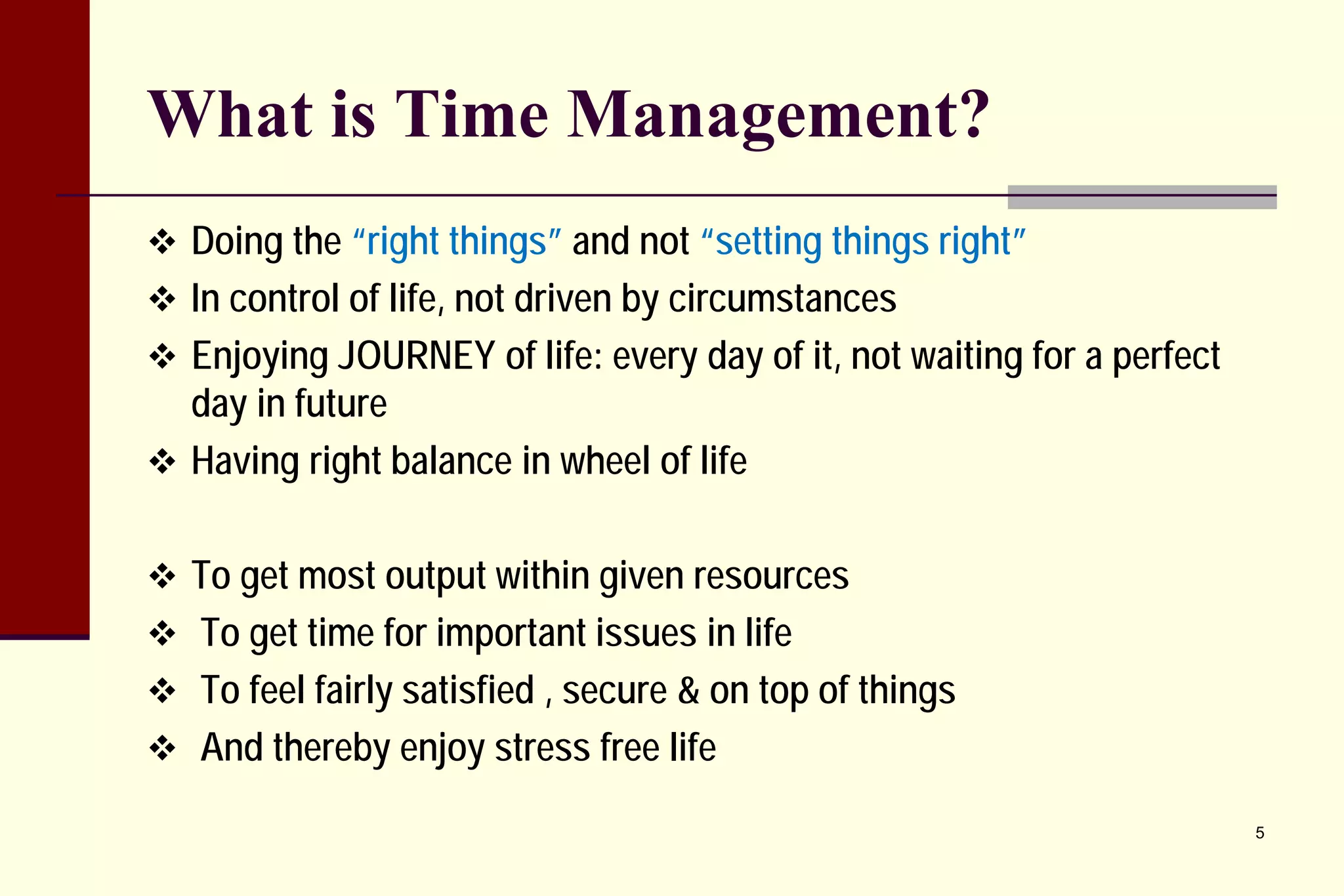
What is Time Management? 
 
Doing the “right things” and not “setting things right” 
 
In control of life, not driven by circumstances 
 
Enjoying JOURNEY of life: every day of it, not waiting for a perfect day in future 
 
Having right balance in wheel of life 
 
To get most output within given resources 
 
To get time for important issues in life 
 
To feel fairly satisfied , secure & on top of things 
 
And thereby enjoy stress free life 
5
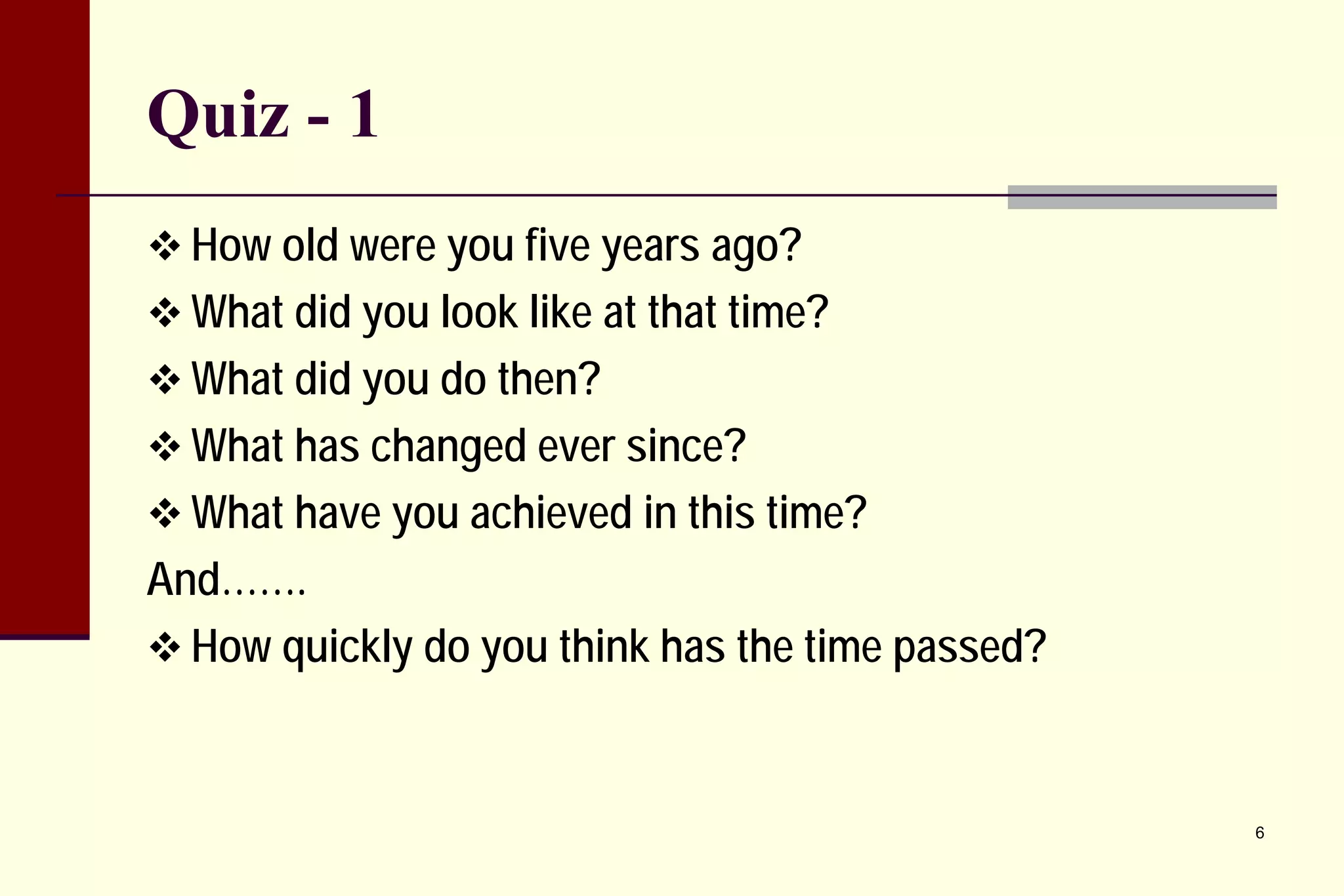
Quiz - 1 
 
How old were you five years ago? 
 
What did you look like at that time? 
 
What did you do then? 
 
What has changed ever since? 
 
What have you achieved in this time? 
And……. 
 
How quickly do you think has the time passed? 
6
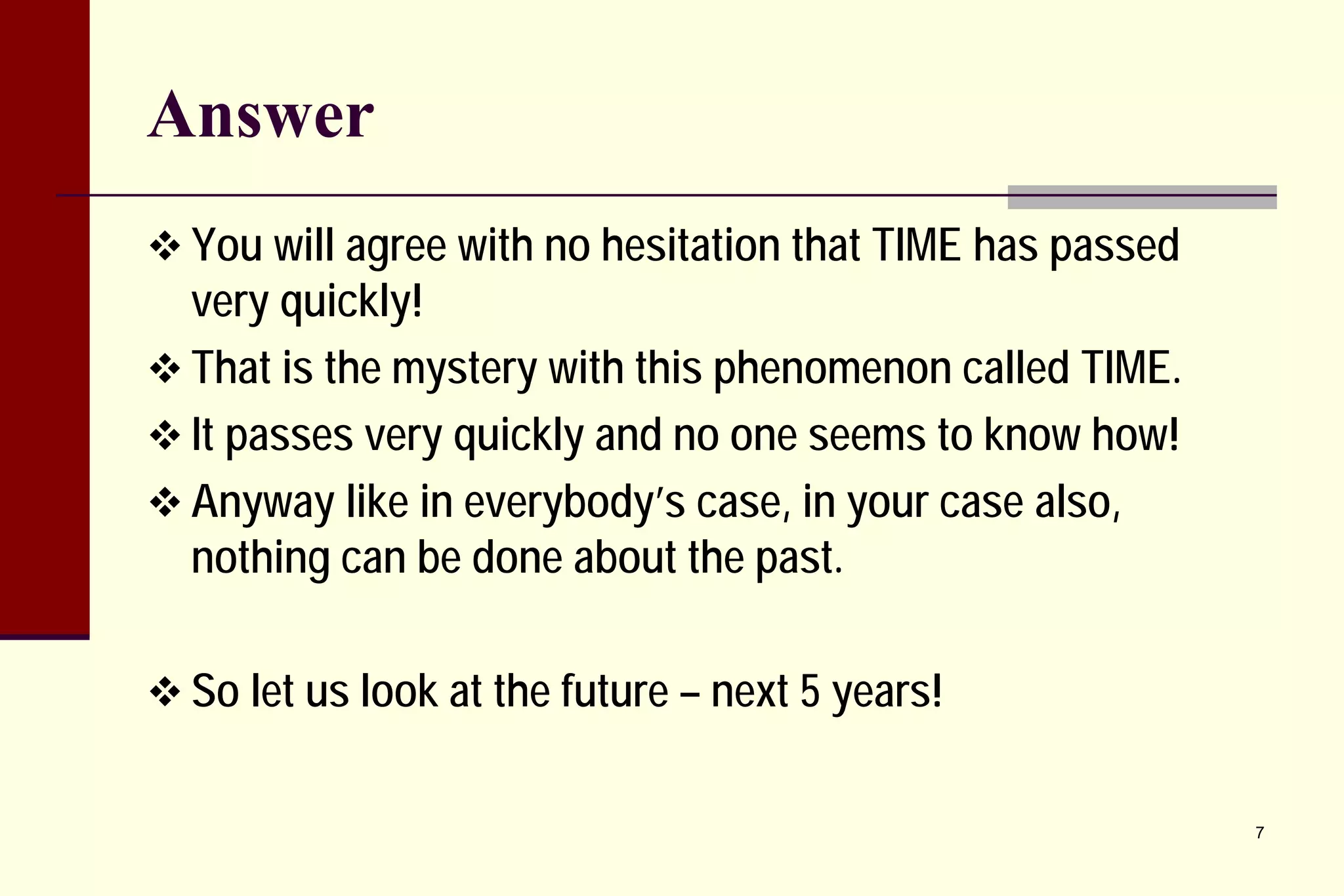
Answer 
 
You will agree with no hesitation that TIME has passed very quickly! 
 
That is the mystery with this phenomenon called TIME. 
 
It passes very quickly and no one seems to know how! 
 
Anyway like in everybody’s case, in your case also, nothing can be done about the past. 
 
So let us look at the future – next 5 years! 
7
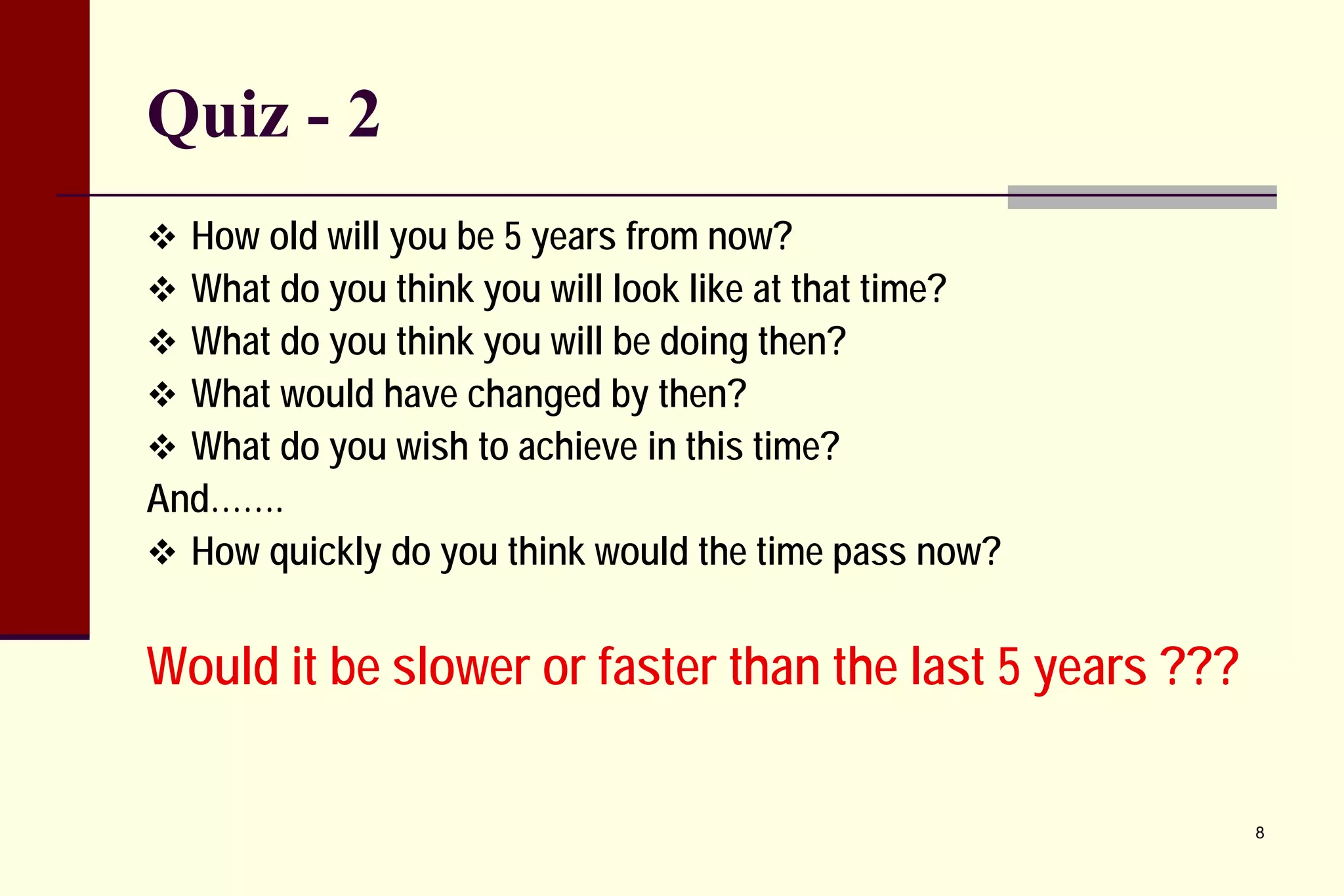
Quiz - 2 
 
How old will you be 5 years from now? 
 
What do you think you will look like at that time? 
 
What do you think you will be doing then? 
 
What would have changed by then? 
 
What do you wish to achieve in this time? 
And……. 
 
How quickly do you think would the time pass now? 
Would it be slower or faster than the last 5 years ??? 
8
Answer 
 
NONE OF THESE! 
 
The time would neither be faster nor slower. 
 
The clock would move at the same speed, one second at a time. 
 
This has never changed and will never change! 
 
What matters is how well YOU keep pace with this speed! 
9
Story Telling Time! 
10
Story Telling Time! 
A king, his attendant and the Prime Minister 
One day, the King looking out from his Palace window 
saw some settlements forming at the banks of the river. 
He said to the attendant “Find out what it is”. 
The attendant ran and reported back after few minutes - 
“Your Highness, they are tents”. 
The King asked again “Where are they from”? 
The attendant ran again and reported back after some 
time – “From Persia”
Story Telling (contd.) 
The King asked again “How many people are there?” 
The attendant once again ran to find out and reported back “675 men”. 
“No women?” asked the King and off went the attendant again. 
Relentless questions and corresponding trips by attendant followed! 
Attendant was already getting irritated and started wondering why the King cannot think cohesively and ask more questions in one go rather than asking one question at a time.
Story Telling (contd.) 
The King was already asking his nth question to the attendant when the PM appeared. 
Hearing the King, the PM intervened and said, “Let us discuss what all we should know about that gathering near the river.” 
They went into a meeting for some time after which the PM went off to find out more. He was back after 2 hours. 
And what did he bring after being gone for 2 hours?
Story Telling (contd.) 
Here was the PM’s report: 
“The tents at the banks of the river belong to a caravan of 
traders from Persia. There are 675 men, 210 women and 
85 children. The leader of the group is ………………..….” 
The PM also said “they have 200 horses which they 
want to sell and I have negotiated the price at…… I need 
your consent on this”. The PM also explained on 
what all benefits the kingdom can accrue from the visit of 
these traders etc etc.
Story Telling (contd.) 
 
Do you realize what the PM has achieved and how ? 
 
And 
 
What is the moral of the story?
Moral of the Story 
 
It does not matter how hard you work or how much time you spend working. 
 
What matters is HOW much you achieve in a given period of time. 
16
Quiz Time 
 
What did PM do differently than the attendent to achieve what he achieved? 
17
Answer 
 
The PM 
 
Made the king explain what all he wanted in one go, 
 
Did proper planning, 
 
Prioritized the job, 
 
Did some value addition of his own and 
 
Put the available time to the best use 
18
Time Management 
 
How do we achieve this in day to day working life in the midst of all pressures and pulls from several tasks? 
 
That is TIME MANAGEMENT and it is all about PRODUCTIVITY. 
19
Obstacles 
 
Obstacles to effective time management 
 
Interruptions / socializing 
 
Multiple tasks at hand and not setting / sticking to priorities 
 
Inability to say “No” 
 
Inefficient delegation / poor planning 
 
Poorly run meetings 
 
Procrastination 
 
Waiting / delays 
 
Unclear objectives 
 
Disorganization / cluttered work space 
20
What can we do? 
 
Recognize obstacles 
 
Identify / isolate them 
 
Employ strategies to overcome 
21
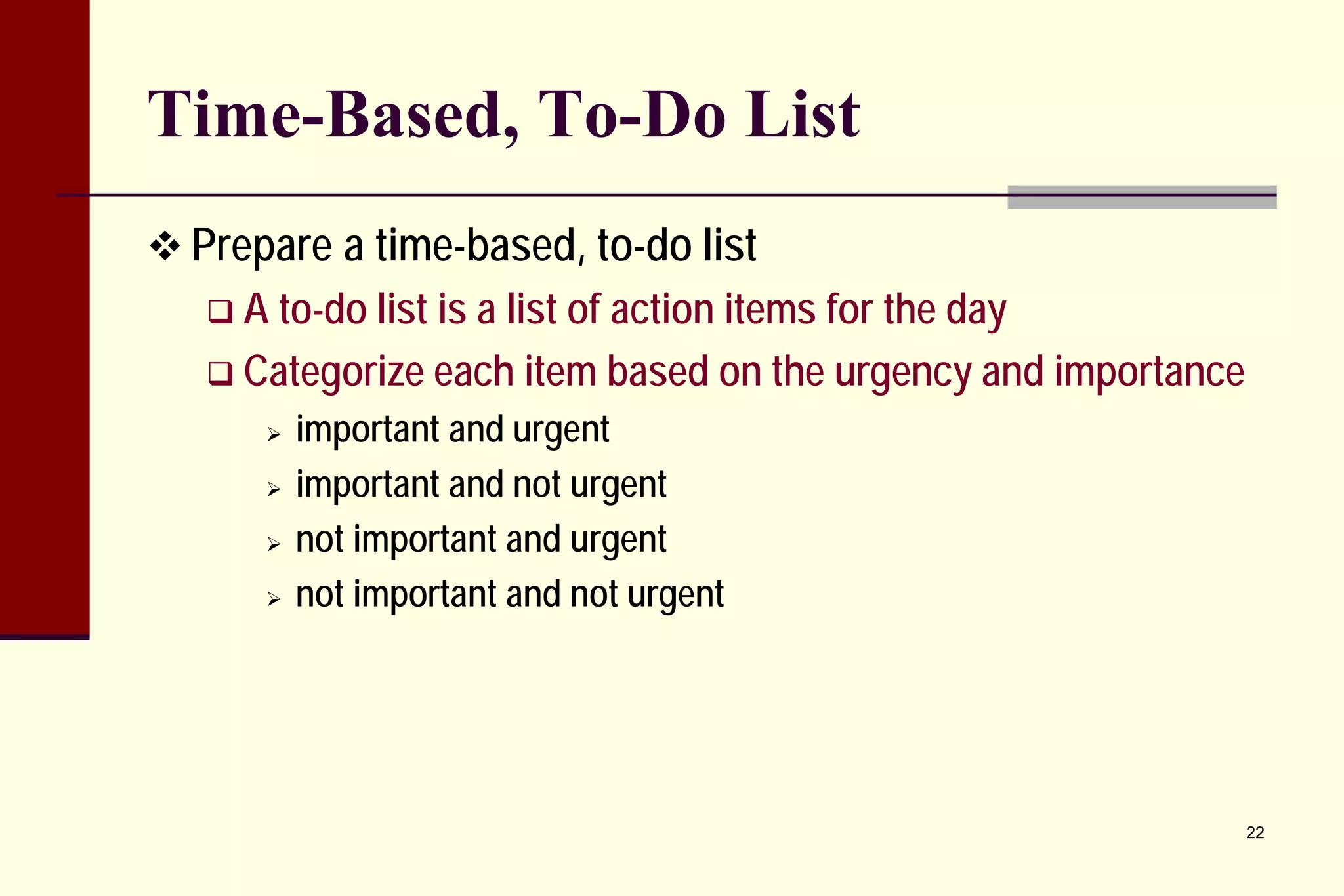
Time-Based, To-Do List 
 
Prepare a time-based, to-do list 
 
A to-do list is a list of action items for the day 
 
Categorize each item based on the urgency and importance 
 
important and urgent 
 
important and not urgent 
 
not important and urgent 
 
not important and not urgent 22
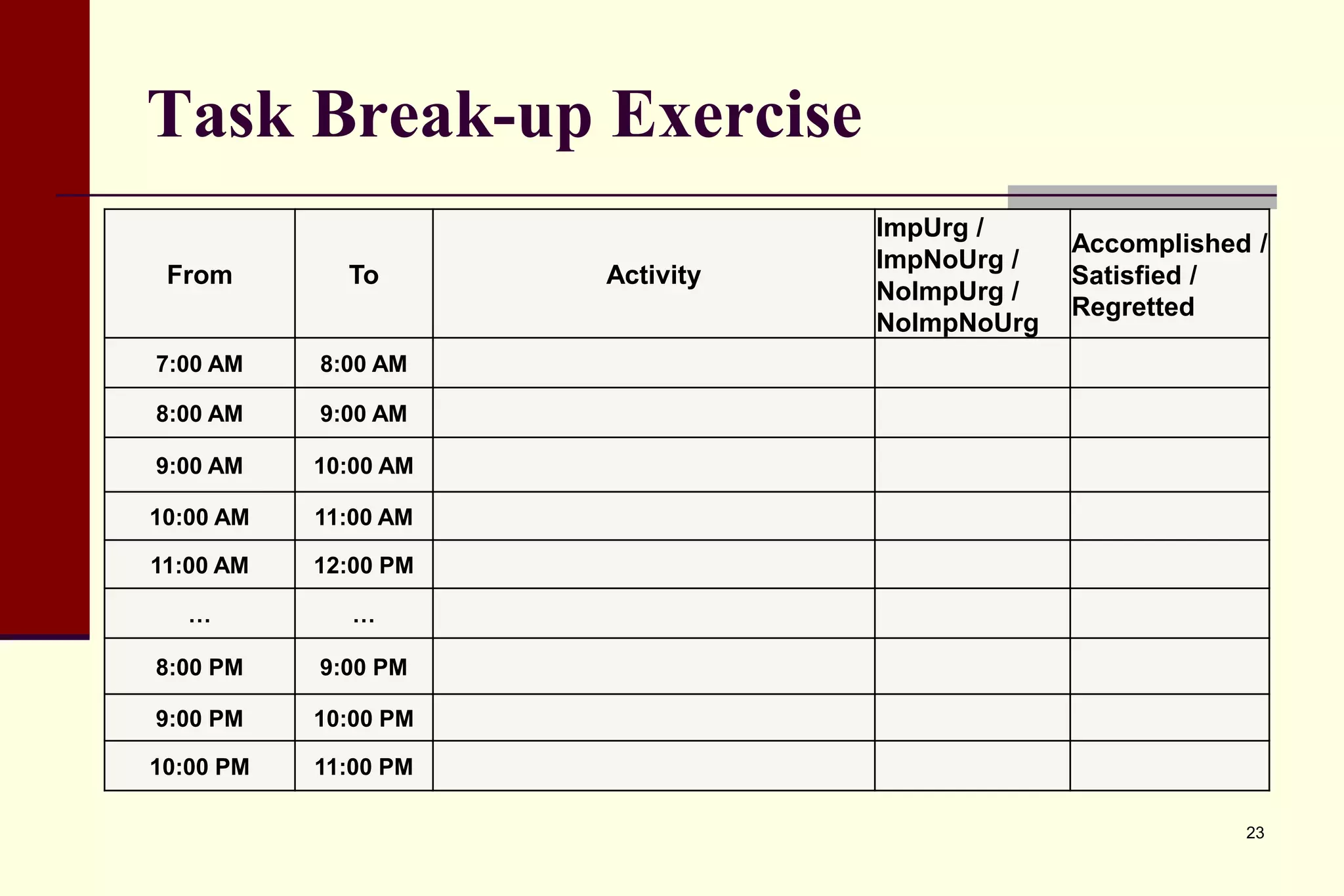
Task Break-up Exercise 
From 
To 
Activity 
ImpUrg / ImpNoUrg / NoImpUrg / NoImpNoUrg 
Accomplished / Satisfied / Regretted 
7:00 AM 
8:00 AM 
8:00 AM 
9:00 AM 
9:00 AM 
10:00 AM 
10:00 AM 
11:00 AM 
11:00 AM 
12:00 PM 
… 
… 
8:00 PM 
9:00 PM 
9:00 PM 
10:00 PM 
10:00 PM 
11:00 PM 
23
Prioritize 
 
Set clear priorities 
 
Do, Delegate, Delay, Delete 
 
Address the urgent 
 
Accomplish what you can early 
 
Attach deadlines to things you delay 
24
Be polite but assertive 
 
Learn when to say “No” 
 
You can’t do everything 
 
Don’t undertake things you can’t complete 
 
Remain consistent to your goals 
 
Be proactive 
 
Ask and force colleagues (including manager) to explain what they want in one go! (like the PM in the story). 
 
Understand thoroughly what are the expectations from you. 
 
Ask, clarify, ask again (if you are not clear) before you start the job 
25
Goal Setting 
 
Set goals – long term v/s short term 
 
Set Rational Goals 
 
Specific, short term goals – short term could be a week, a day or even an hour 
 
Set Directional Goals 
 
General direction for long term – “What do I want to be 3 years from now?” 
 
Set apart some time everyday for your Directional Goals 
 
SMART - Specific, Measurable, Achievable, Realistic, Time-based 
26
Procrastination 
 
Understand what and why of your procrastination tendency 
 
Remember 
“… if we wait for the moment when everything, 
absolutely everything is ready, 
we shall never begin.” 
27
Self-improvement 
 
Improve yourself 
 
Do a SWOT analysis of yourself (with no inhibitions) 
 
S – Strength 
 
W– Weakness 
 
O – Opportunity 
 
T – Threats 28
S-W-O-T 
 
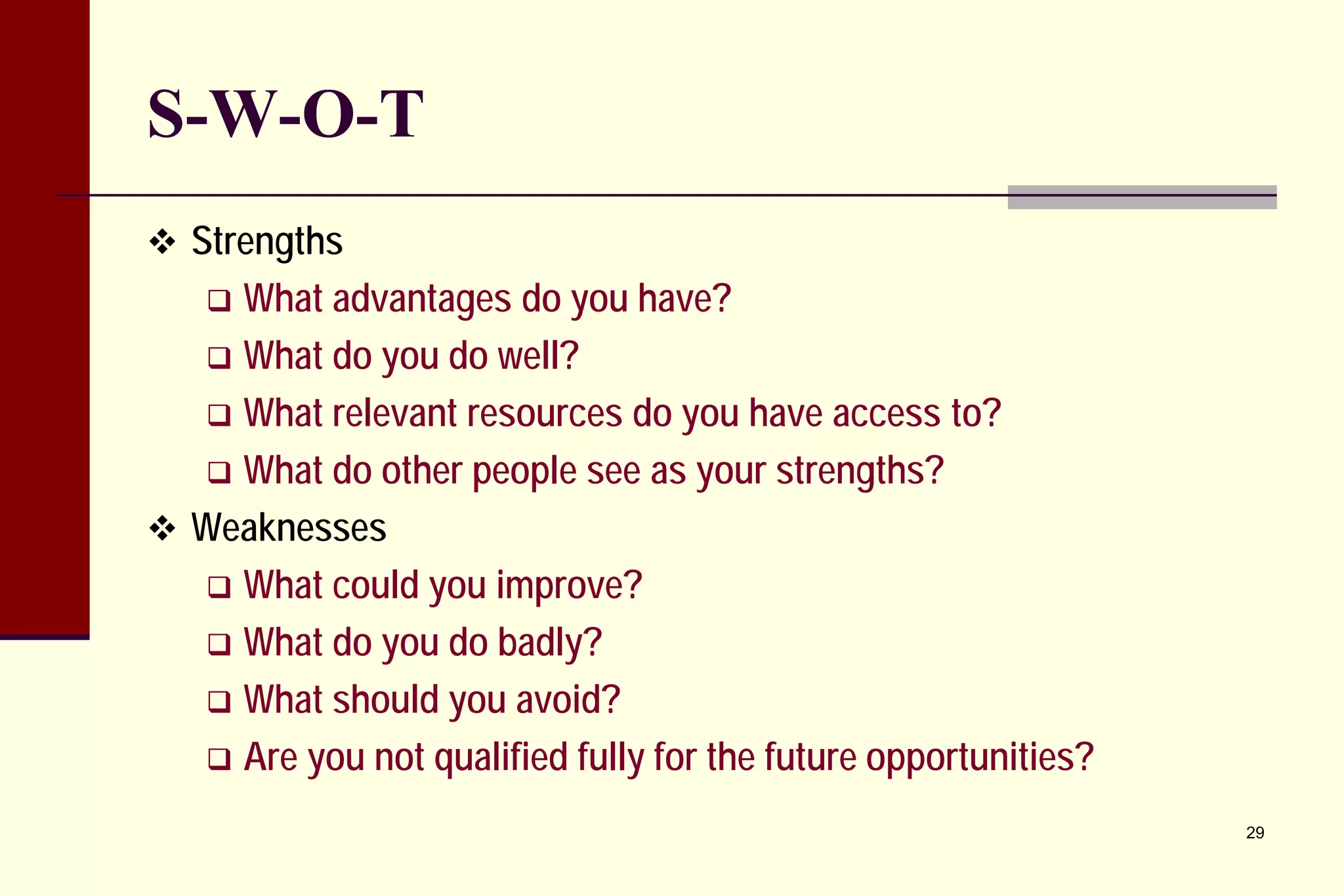
Strengths 
 
What advantages do you have? 
 
What do you do well? 
 
What relevant resources do you have access to? 
 
What do other people see as your strengths? 
 
Weaknesses 
 
What could you improve? 
 
What do you do badly? 
 
What should you avoid? 
 
Are you not qualified fully for the future opportunities? 
29
S-W-O-T 
 
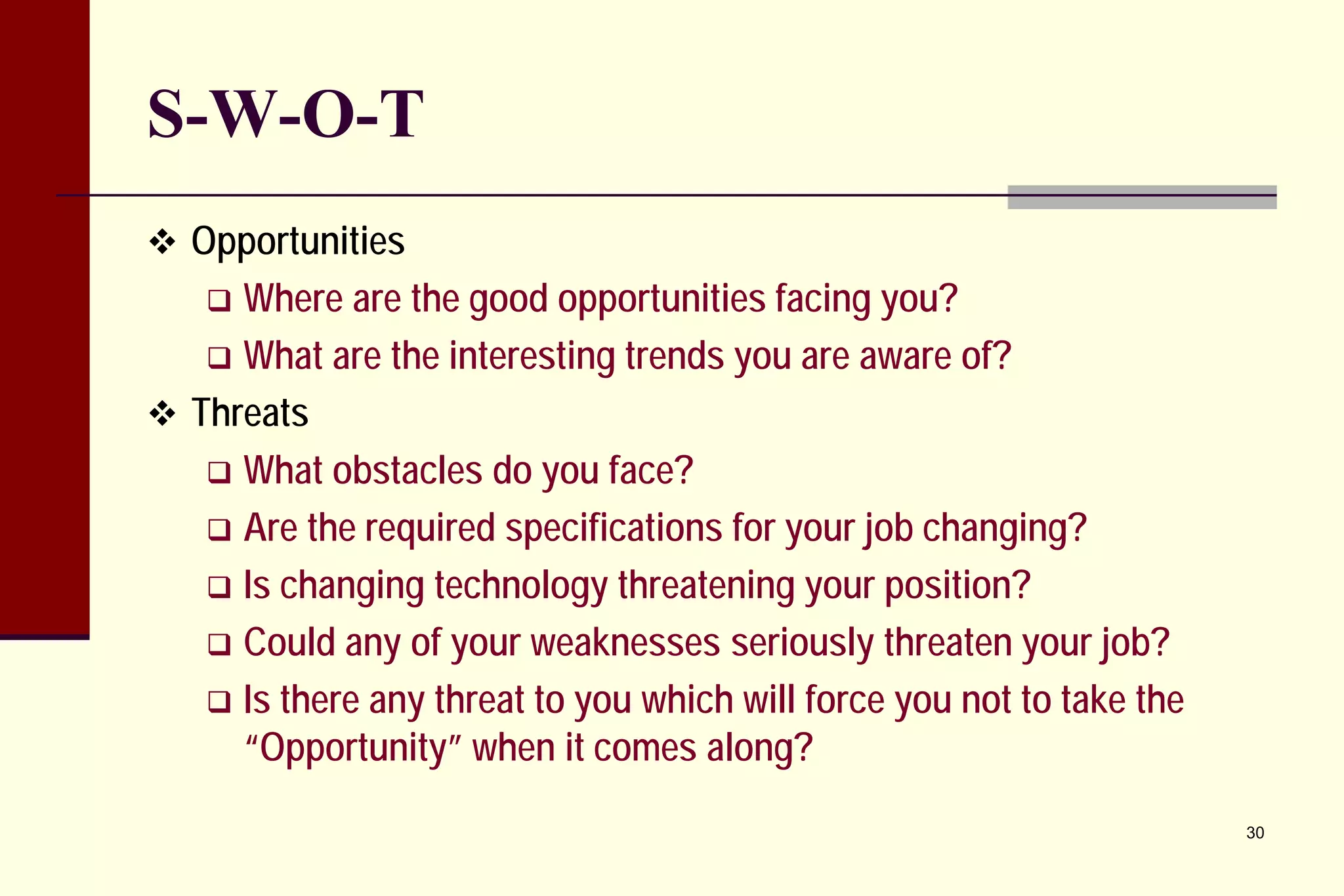
Opportunities 
 
Where are the good opportunities facing you? 
 
What are the interesting trends you are aware of? 
 
Threats 
 
What obstacles do you face? 
 
Are the required specifications for your job changing? 
 
Is changing technology threatening your position? 
 
Could any of your weaknesses seriously threaten your job? 
 
Is there any threat to you which will force you not to take the “Opportunity” when it comes along? 
30
And also… 
 
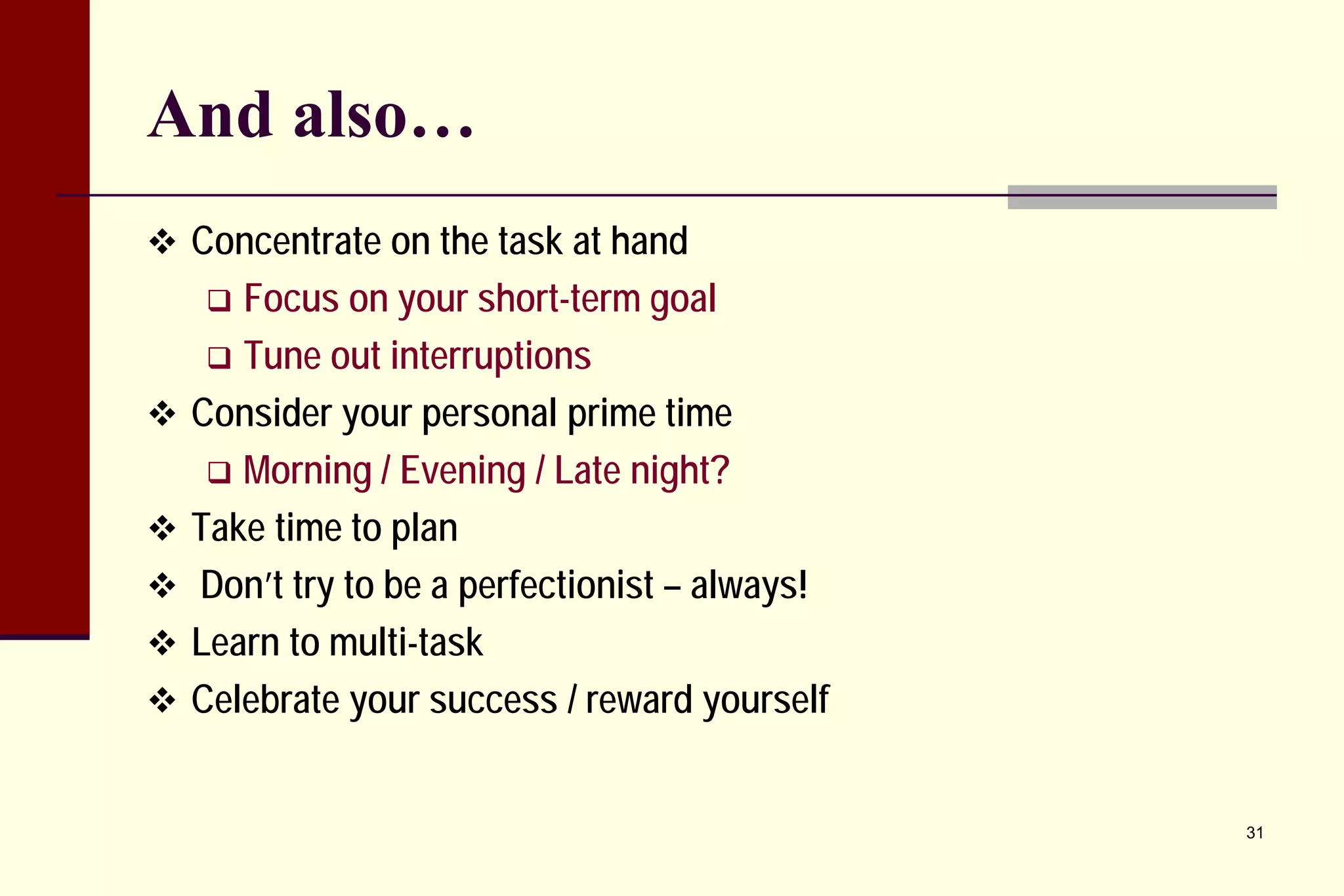
Concentrate on the task at hand 
 
Focus on your short-term goal 
 
Tune out interruptions 
 
Consider your personal prime time 
 
Morning / Evening / Late night? 
 
Take time to plan 
 
Don’t try to be a perfectionist – always! 
 
Learn to multi-task 
 
Celebrate your success / reward yourself 
31
Always remember 
 
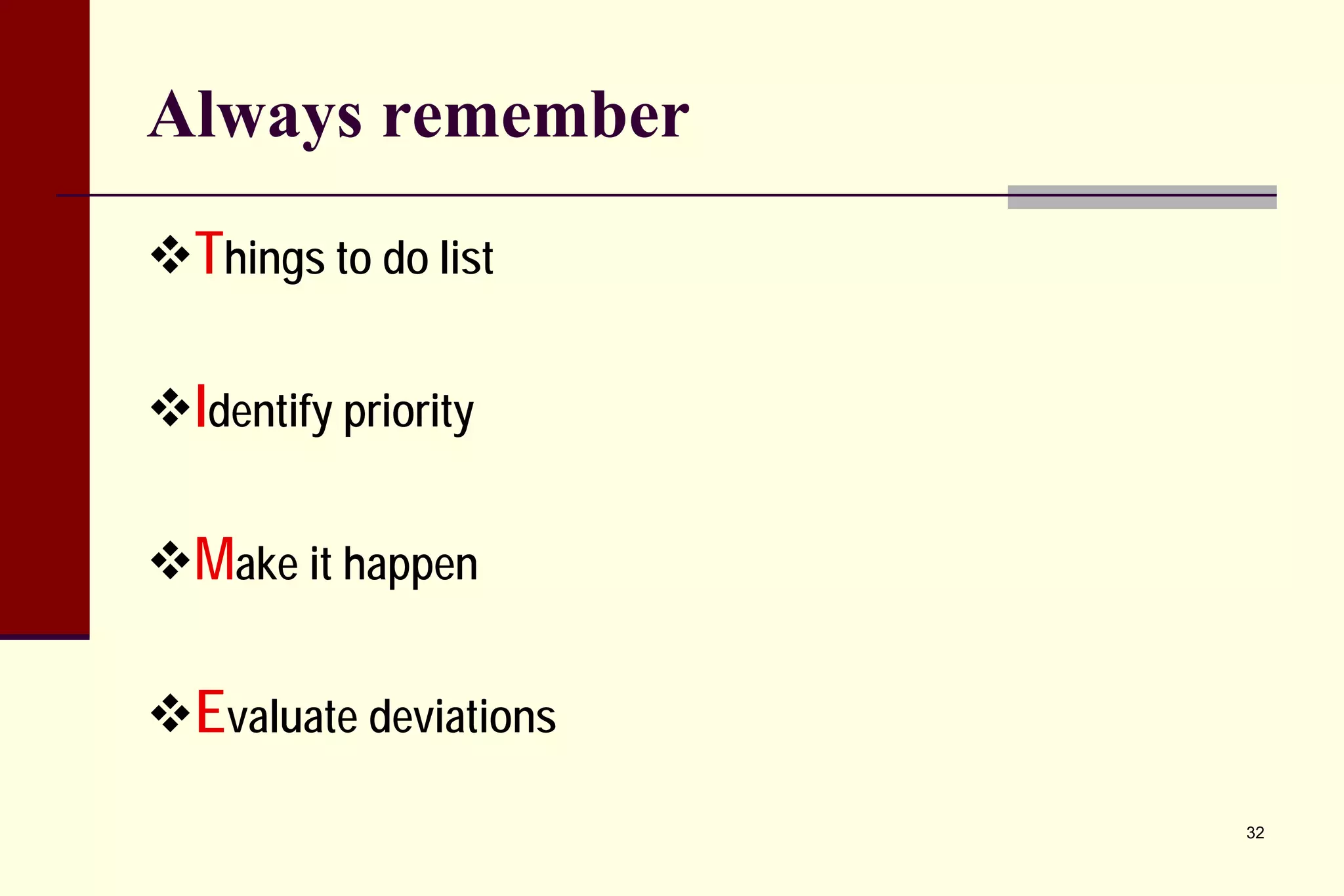
Things to do list 
 
Identify priority 
 
Make it happen 
 
Evaluate deviations 
32
And finally… 
Little drops of Water 
And Little Grains of Sand 
Make the mighty Ocean 
And the Pleasant land 
So the little Minutes 
Humble though they be 
Make the mighty Ages 
Of Eternity 
This is the Time 
This is the Place 
This is your Life 
This is your Opportunity 
Seize the Day 
Use this Moment 
ACT NOW 33
THANK YOU 
34

Time Management

  • 1.
    Time Management Theviews expressed are based on personal 1 experience and information collected from the net.
  • 2.
     Write adefinition of TIME MANAGEMENT 2
  • 3.
    Common Problems  I am very busy. The second crisis comes in before the first has finished.  I don’t feel I have achieved anything today / this month / this year.  I don’t have control on my life. Things pile one on top of the other.  I wish I had more than 24 hours per day so that I can get more things done.  The system overloads me with work. There is no time to breathe. 3
  • 4.
    Objective  Tohelp you introspect and find clues to improve your time management & thereby enhance effectiveness 4
  • 5.
    What is TimeManagement?  Doing the “right things” and not “setting things right”  In control of life, not driven by circumstances  Enjoying JOURNEY of life: every day of it, not waiting for a perfect day in future  Having right balance in wheel of life  To get most output within given resources  To get time for important issues in life  To feel fairly satisfied , secure & on top of things  And thereby enjoy stress free life 5
  • 6.
    Quiz - 1  How old were you five years ago?  What did you look like at that time?  What did you do then?  What has changed ever since?  What have you achieved in this time? And…….  How quickly do you think has the time passed? 6
  • 7.
    Answer  Youwill agree with no hesitation that TIME has passed very quickly!  That is the mystery with this phenomenon called TIME.  It passes very quickly and no one seems to know how!  Anyway like in everybody’s case, in your case also, nothing can be done about the past.  So let us look at the future – next 5 years! 7
  • 8.
    Quiz - 2  How old will you be 5 years from now?  What do you think you will look like at that time?  What do you think you will be doing then?  What would have changed by then?  What do you wish to achieve in this time? And…….  How quickly do you think would the time pass now? Would it be slower or faster than the last 5 years ??? 8
  • 9.
    Answer  NONEOF THESE!  The time would neither be faster nor slower.  The clock would move at the same speed, one second at a time.  This has never changed and will never change!  What matters is how well YOU keep pace with this speed! 9
  • 10.
  • 11.
    Story Telling Time! A king, his attendant and the Prime Minister One day, the King looking out from his Palace window saw some settlements forming at the banks of the river. He said to the attendant “Find out what it is”. The attendant ran and reported back after few minutes - “Your Highness, they are tents”. The King asked again “Where are they from”? The attendant ran again and reported back after some time – “From Persia”
  • 12.
    Story Telling (contd.) The King asked again “How many people are there?” The attendant once again ran to find out and reported back “675 men”. “No women?” asked the King and off went the attendant again. Relentless questions and corresponding trips by attendant followed! Attendant was already getting irritated and started wondering why the King cannot think cohesively and ask more questions in one go rather than asking one question at a time.
  • 13.
    Story Telling (contd.) The King was already asking his nth question to the attendant when the PM appeared. Hearing the King, the PM intervened and said, “Let us discuss what all we should know about that gathering near the river.” They went into a meeting for some time after which the PM went off to find out more. He was back after 2 hours. And what did he bring after being gone for 2 hours?
  • 14.
    Story Telling (contd.) Here was the PM’s report: “The tents at the banks of the river belong to a caravan of traders from Persia. There are 675 men, 210 women and 85 children. The leader of the group is ………………..….” The PM also said “they have 200 horses which they want to sell and I have negotiated the price at…… I need your consent on this”. The PM also explained on what all benefits the kingdom can accrue from the visit of these traders etc etc.
  • 15.
    Story Telling (contd.)  Do you realize what the PM has achieved and how ?  And  What is the moral of the story?
  • 16.
    Moral of theStory  It does not matter how hard you work or how much time you spend working.  What matters is HOW much you achieve in a given period of time. 16
  • 17.
    Quiz Time  What did PM do differently than the attendent to achieve what he achieved? 17
  • 18.
    Answer  ThePM  Made the king explain what all he wanted in one go,  Did proper planning,  Prioritized the job,  Did some value addition of his own and  Put the available time to the best use 18
  • 19.
    Time Management  How do we achieve this in day to day working life in the midst of all pressures and pulls from several tasks?  That is TIME MANAGEMENT and it is all about PRODUCTIVITY. 19
  • 20.
    Obstacles  Obstaclesto effective time management  Interruptions / socializing  Multiple tasks at hand and not setting / sticking to priorities  Inability to say “No”  Inefficient delegation / poor planning  Poorly run meetings  Procrastination  Waiting / delays  Unclear objectives  Disorganization / cluttered work space 20
  • 21.
    What can wedo?  Recognize obstacles  Identify / isolate them  Employ strategies to overcome 21
  • 22.
    Time-Based, To-Do List  Prepare a time-based, to-do list  A to-do list is a list of action items for the day  Categorize each item based on the urgency and importance  important and urgent  important and not urgent  not important and urgent  not important and not urgent 22
  • 23.
    Task Break-up Exercise From To Activity ImpUrg / ImpNoUrg / NoImpUrg / NoImpNoUrg Accomplished / Satisfied / Regretted 7:00 AM 8:00 AM 8:00 AM 9:00 AM 9:00 AM 10:00 AM 10:00 AM 11:00 AM 11:00 AM 12:00 PM … … 8:00 PM 9:00 PM 9:00 PM 10:00 PM 10:00 PM 11:00 PM 23
  • 24.
    Prioritize  Setclear priorities  Do, Delegate, Delay, Delete  Address the urgent  Accomplish what you can early  Attach deadlines to things you delay 24
  • 25.
    Be polite butassertive  Learn when to say “No”  You can’t do everything  Don’t undertake things you can’t complete  Remain consistent to your goals  Be proactive  Ask and force colleagues (including manager) to explain what they want in one go! (like the PM in the story).  Understand thoroughly what are the expectations from you.  Ask, clarify, ask again (if you are not clear) before you start the job 25
  • 26.
    Goal Setting  Set goals – long term v/s short term  Set Rational Goals  Specific, short term goals – short term could be a week, a day or even an hour  Set Directional Goals  General direction for long term – “What do I want to be 3 years from now?”  Set apart some time everyday for your Directional Goals  SMART - Specific, Measurable, Achievable, Realistic, Time-based 26
  • 27.
    Procrastination  Understandwhat and why of your procrastination tendency  Remember “… if we wait for the moment when everything, absolutely everything is ready, we shall never begin.” 27
  • 28.
    Self-improvement  Improveyourself  Do a SWOT analysis of yourself (with no inhibitions)  S – Strength  W– Weakness  O – Opportunity  T – Threats 28
  • 29.
    S-W-O-T  Strengths  What advantages do you have?  What do you do well?  What relevant resources do you have access to?  What do other people see as your strengths?  Weaknesses  What could you improve?  What do you do badly?  What should you avoid?  Are you not qualified fully for the future opportunities? 29
  • 30.
    S-W-O-T  Opportunities  Where are the good opportunities facing you?  What are the interesting trends you are aware of?  Threats  What obstacles do you face?  Are the required specifications for your job changing?  Is changing technology threatening your position?  Could any of your weaknesses seriously threaten your job?  Is there any threat to you which will force you not to take the “Opportunity” when it comes along? 30
  • 31.
    And also…  Concentrate on the task at hand  Focus on your short-term goal  Tune out interruptions  Consider your personal prime time  Morning / Evening / Late night?  Take time to plan  Don’t try to be a perfectionist – always!  Learn to multi-task  Celebrate your success / reward yourself 31
  • 32.
    Always remember  Things to do list  Identify priority  Make it happen  Evaluate deviations 32
  • 33.
    And finally… Littledrops of Water And Little Grains of Sand Make the mighty Ocean And the Pleasant land So the little Minutes Humble though they be Make the mighty Ages Of Eternity This is the Time This is the Place This is your Life This is your Opportunity Seize the Day Use this Moment ACT NOW 33
  • 34.