
Stepping into Professional
World

1
Stepping into Professional World Quiz
 You are
a

professional
 an engineer
 a student
 a manager
 a team member
 (Specify any other)

Yes / No
Yes / No
Yes / No
Yes / No
Yes / No

2
For the ones marked ‘Yes’ above,
identify 2 or 3 qualities that justify your answer
 Professional
 1.

2.

3.

 Engineer
 1.

2.

3.

 Student
 1.

2.

3.

 Manager
 1.

2.

3.

 Team member
 1.

2.

3.
3
Transition Phases in Life
 Name major transition phases in life

4
Transition Phases in Life
 Home to play school / kinder garden
 KG to primary school
 Primary school to high school
 High school to college
 College to professional world!

5
Now you are a “Professional”!

6
What makes you a professional?

7
College to Professional World
 How is this transition different than all the

others listed before it?
 There

is no uniform!
 There is no time table!
 There is no teacher / HOD / authority to exercise
any control on you
 There is no hand holding by your parent
 But …
8
College to Professional World
(contd.)
 There are definite expectations from you about
 Timely

delivery
 High quality output
 Reliability
 Behavioral aspects
…

9
College to Professional World
(contd.)
 Also…
 Once

you are here, there is no going back
 This is life-long – almost!
 There are no formal exams to take you to the next
step in life
 Going to the next level is optional; you are free to
be at the same level – forever!
 What can you do?
 Convert

TRANSITION into TRANSFORMATION!
10
Transition or Transformation?
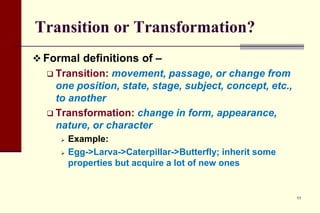
 Formal definitions of –
 Transition:

movement, passage, or change from
one position, state, stage, subject, concept, etc.,
to another
 Transformation: change in form, appearance,
nature, or character



Example:
Egg->Larva->Caterpillar->Butterfly; inherit some
properties but acquire a lot of new ones

11
You want to be transformed
into a professional!

12
Steps required for transformation
 Understand the organizational culture
 Office timings
 Lunch time conversations
 Meeting etiquette
 Approaching seniors / management members
 Advantages of understanding culture
 Helps

you to understand core values of the
organization
 Builds rapport, trust and confidence
 Increases individual effectiveness
13
Steps required for transformation
(contd.)
 Absorb / take input
 Listen
 Observe
 Sense

14
Steps required for transformation
(contd.)
 Exhibit professional behavior
 Dress
 Always seek to blend with your surroundings
 Neat, formal dress for formal occasions
 Dress to look elegant and smart
 Body

language

 Tone
 Walk
 Posture
 Gestures
 Eye

contact
 Smile

15
Steps required for transformation
(contd.)
 Keep your lead updated about the status of your

work
 Respond to mails
 Be on time for meetings, calls, gatherings
 Come up with solutions rather than stating
problems
 Be reliable
 Find answers by searching the net
 Give credits to others when required
 Understand your strengths and weaknesses
 Learn to convert problems into opportunities
 Develop passion for work
16
Steps required for transformation
(contd.)
 Status reporting
 Ownership, reliability
 Confidentiality
 Integrity / keeping commitments
 Objectivity
 Positive attitude
 Expectations – setting and meeting
 Apologizing sincerely when you make a mistake
17
Steps required for transformation
(contd.)
 Be an engineer
 Inquisitive
 Stating

problems v/s finding solutions
 Solutions v/s optimal solution
 Competitors’ products
 Technological advancements and new tools
 Out of box thinking

18
Steps required for transformation
(contd.)
 For development
 Big

picture and attention to details
 Thoroughness and error checking
 Design for extensibility, portability
 Considerations for deployment and support
 Thorough testing
 Develop a sense for organizational perspective
 Understand

your contribution to the overall

picture
19
THANK YOU

20

Stepping into Professional World

  • 1.
  • 2.
    Stepping into ProfessionalWorld Quiz  You are a professional  an engineer  a student  a manager  a team member  (Specify any other) Yes / No Yes / No Yes / No Yes / No Yes / No 2
  • 3.
    For the onesmarked ‘Yes’ above, identify 2 or 3 qualities that justify your answer  Professional  1. 2. 3.  Engineer  1. 2. 3.  Student  1. 2. 3.  Manager  1. 2. 3.  Team member  1. 2. 3. 3
  • 4.
    Transition Phases inLife  Name major transition phases in life 4
  • 5.
    Transition Phases inLife  Home to play school / kinder garden  KG to primary school  Primary school to high school  High school to college  College to professional world! 5
  • 6.
    Now you area “Professional”! 6
  • 7.
    What makes youa professional? 7
  • 8.
    College to ProfessionalWorld  How is this transition different than all the others listed before it?  There is no uniform!  There is no time table!  There is no teacher / HOD / authority to exercise any control on you  There is no hand holding by your parent  But … 8
  • 9.
    College to ProfessionalWorld (contd.)  There are definite expectations from you about  Timely delivery  High quality output  Reliability  Behavioral aspects … 9
  • 10.
    College to ProfessionalWorld (contd.)  Also…  Once you are here, there is no going back  This is life-long – almost!  There are no formal exams to take you to the next step in life  Going to the next level is optional; you are free to be at the same level – forever!  What can you do?  Convert TRANSITION into TRANSFORMATION! 10
  • 11.
    Transition or Transformation? Formal definitions of –  Transition: movement, passage, or change from one position, state, stage, subject, concept, etc., to another  Transformation: change in form, appearance, nature, or character   Example: Egg->Larva->Caterpillar->Butterfly; inherit some properties but acquire a lot of new ones 11
  • 12.
    You want tobe transformed into a professional! 12
  • 13.
    Steps required fortransformation  Understand the organizational culture  Office timings  Lunch time conversations  Meeting etiquette  Approaching seniors / management members  Advantages of understanding culture  Helps you to understand core values of the organization  Builds rapport, trust and confidence  Increases individual effectiveness 13
  • 14.
    Steps required fortransformation (contd.)  Absorb / take input  Listen  Observe  Sense 14
  • 15.
    Steps required fortransformation (contd.)  Exhibit professional behavior  Dress  Always seek to blend with your surroundings  Neat, formal dress for formal occasions  Dress to look elegant and smart  Body language  Tone  Walk  Posture  Gestures  Eye contact  Smile 15
  • 16.
    Steps required fortransformation (contd.)  Keep your lead updated about the status of your work  Respond to mails  Be on time for meetings, calls, gatherings  Come up with solutions rather than stating problems  Be reliable  Find answers by searching the net  Give credits to others when required  Understand your strengths and weaknesses  Learn to convert problems into opportunities  Develop passion for work 16
  • 17.
    Steps required fortransformation (contd.)  Status reporting  Ownership, reliability  Confidentiality  Integrity / keeping commitments  Objectivity  Positive attitude  Expectations – setting and meeting  Apologizing sincerely when you make a mistake 17
  • 18.
    Steps required fortransformation (contd.)  Be an engineer  Inquisitive  Stating problems v/s finding solutions  Solutions v/s optimal solution  Competitors’ products  Technological advancements and new tools  Out of box thinking 18
  • 19.
    Steps required fortransformation (contd.)  For development  Big picture and attention to details  Thoroughness and error checking  Design for extensibility, portability  Considerations for deployment and support  Thorough testing  Develop a sense for organizational perspective  Understand your contribution to the overall picture 19
  • 20.