25-Apr-02 1
Dr. Douglas C. Engelbart
Bootstrap Alliance, USA
www.bootstrap.org
Improving Our Ability to Improve:
A Call for Investment in a New Future
Large scale Facilitated Evolution
Of our Improvement Infrastructure
25-Apr-02 2
The World in the 21st
Century
Creating the Infocomm Future
• Building New Capabilities and Leveraging
Innovation for Key Growth Areas
• Using Infocomm Technologies to Build New
Capability and Capacity
• Being Proactive and Responsive
• Re-inventing Government in the Digital Economy
Proposing our Shared Strategic Objectives
… these objectives are the focus of my talk
25-Apr-02 3
My goal this lecture ...
is to help you see these objectives in a
new light, understanding them as truly:
• long term
• deeply strategic
• transformative
• open ended
25-Apr-02 4
A “What If” Experiment
Imagine that it is the late 1980s
• the Internet exists (the basic capability to
support the “Web” is already in place)
• but the World Wide Web is still in the future
• which means that the field is open for Your
Organization or Your Country to
take a leading position in the technical
revolution that is about to happen
What would your organization or your country
need to be doing to grasp this opportunity?
25-Apr-02 5
Not an idle question ...
The real impact of the Net and Web is just
beginning to be felt.
Some candidate “next big things …”
• the Semantic Web
• the shift in the value of content
• ubiquitous computing
How can your organization learn enough, fast
enough, to grasp the next transformative opportunity?
25-Apr-02 6
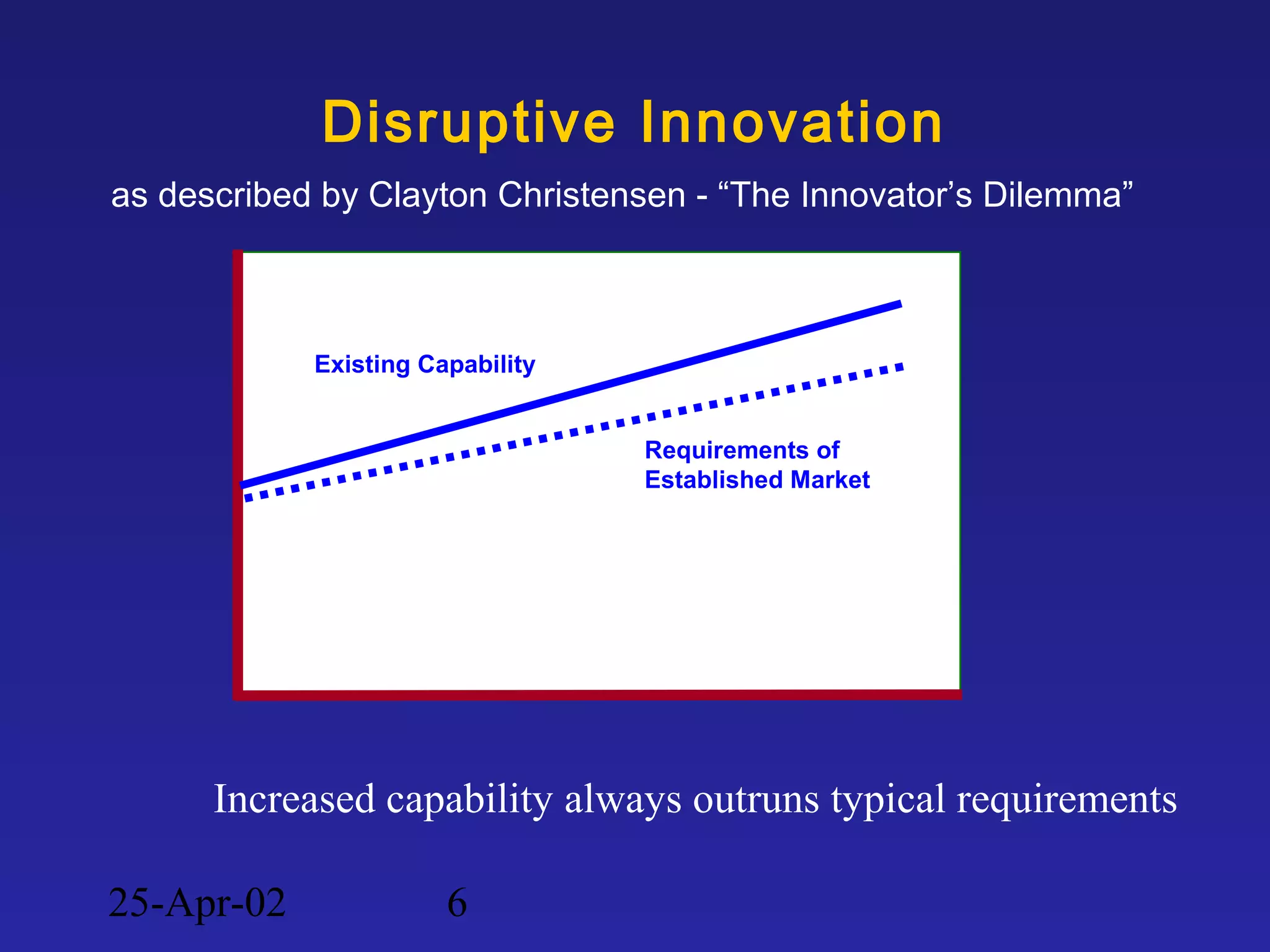
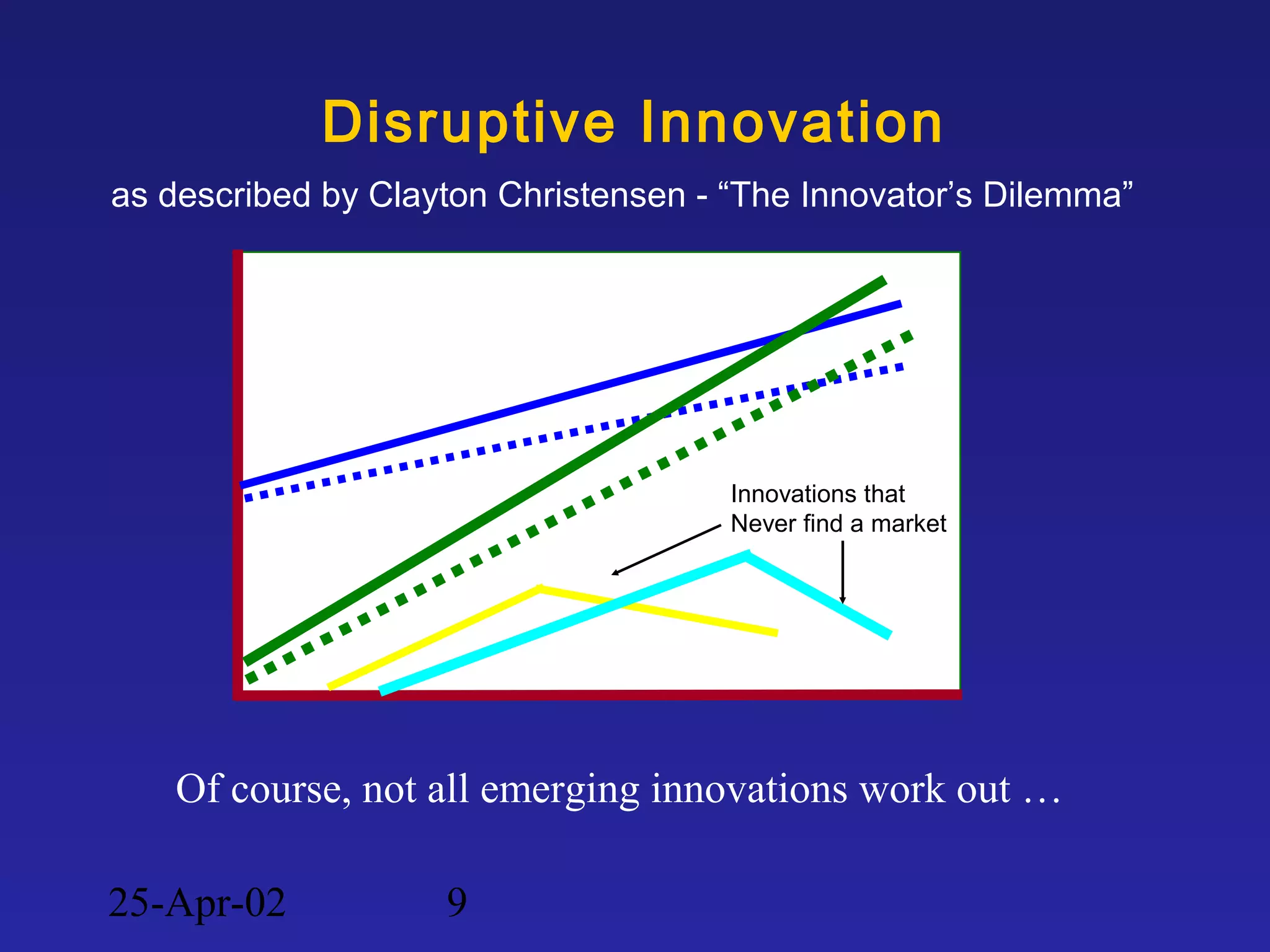
Disruptive Innovation
Existing Capability
Requirements of
Established Market
Increased capability always outruns typical requirements
as described by Clayton Christensen - “The Innovator’s Dilemma”
25-Apr-02 7
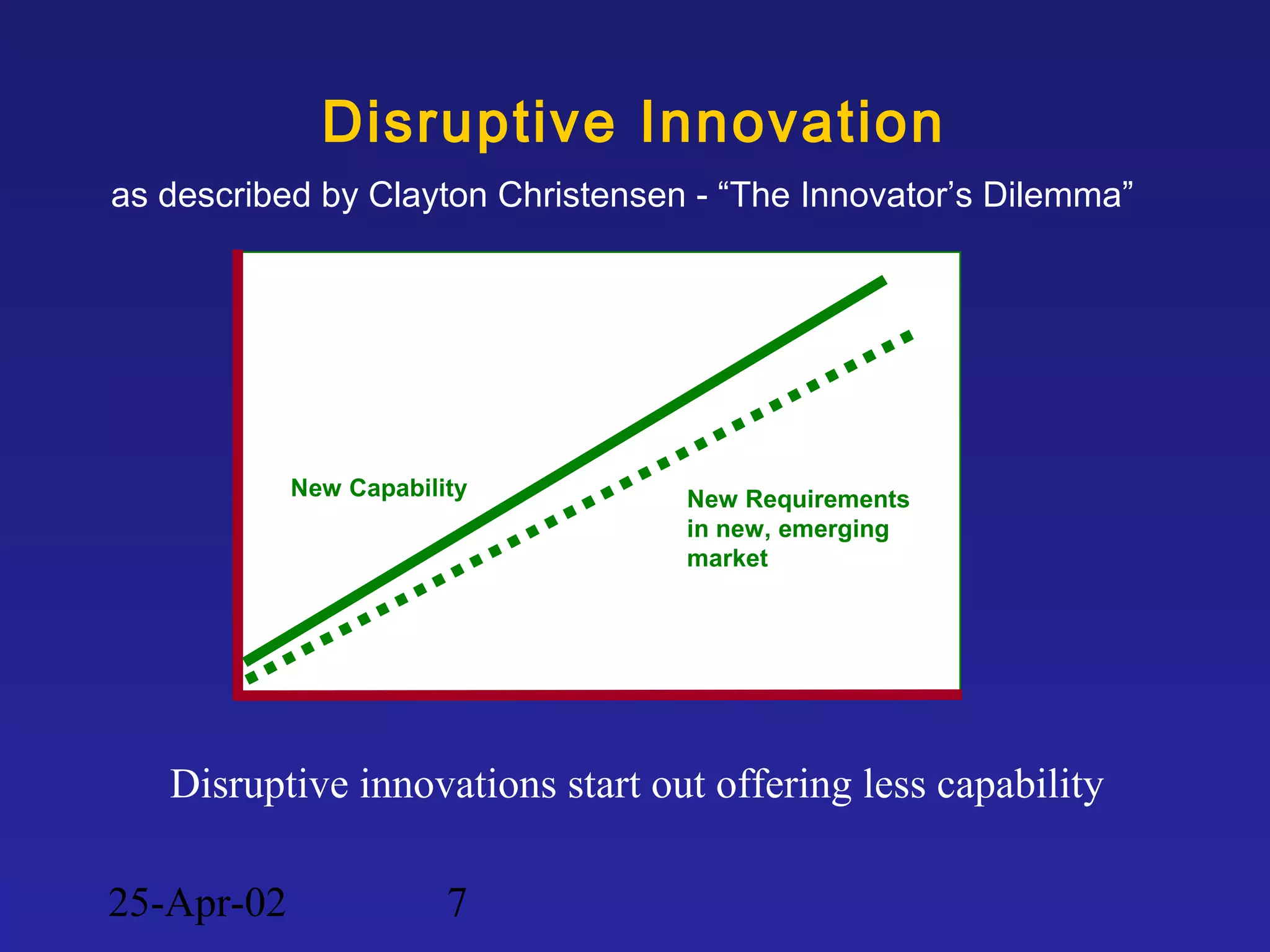
Disruptive Innovation
New Capability New Requirements
in new, emerging
market
Disruptive innovations start out offering less capability
as described by Clayton Christensen - “The Innovator’s Dilemma”
25-Apr-02 8
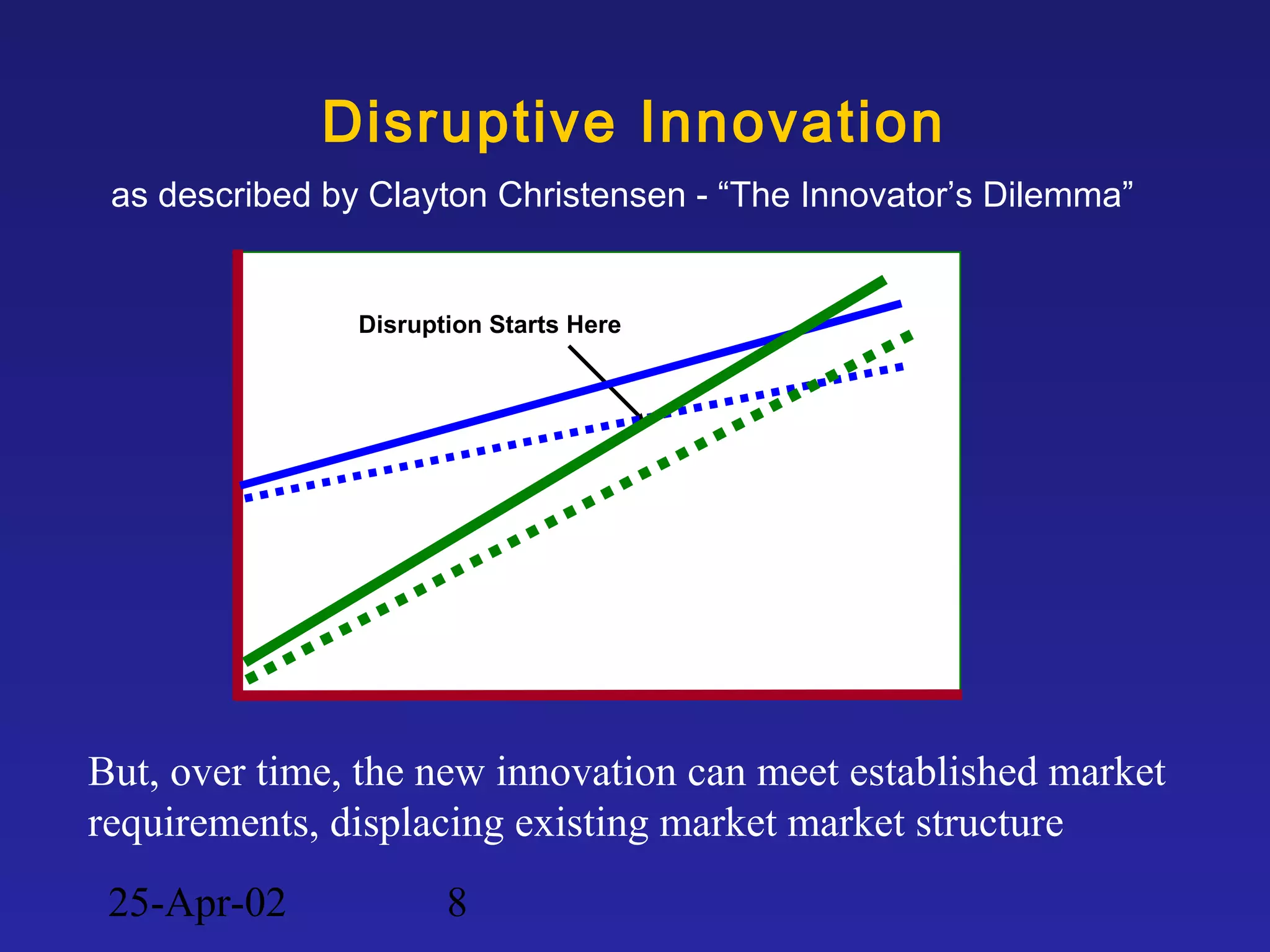
Disruptive Innovation
But, over time, the new innovation can meet established market
requirements, displacing existing market market structure
as described by Clayton Christensen - “The Innovator’s Dilemma”
Disruption Starts Here
25-Apr-02 9
Disruptive Innovation
Innovations that
Never find a market
Of course, not all emerging innovations work out …
as described by Clayton Christensen - “The Innovator’s Dilemma”
25-Apr-02 10
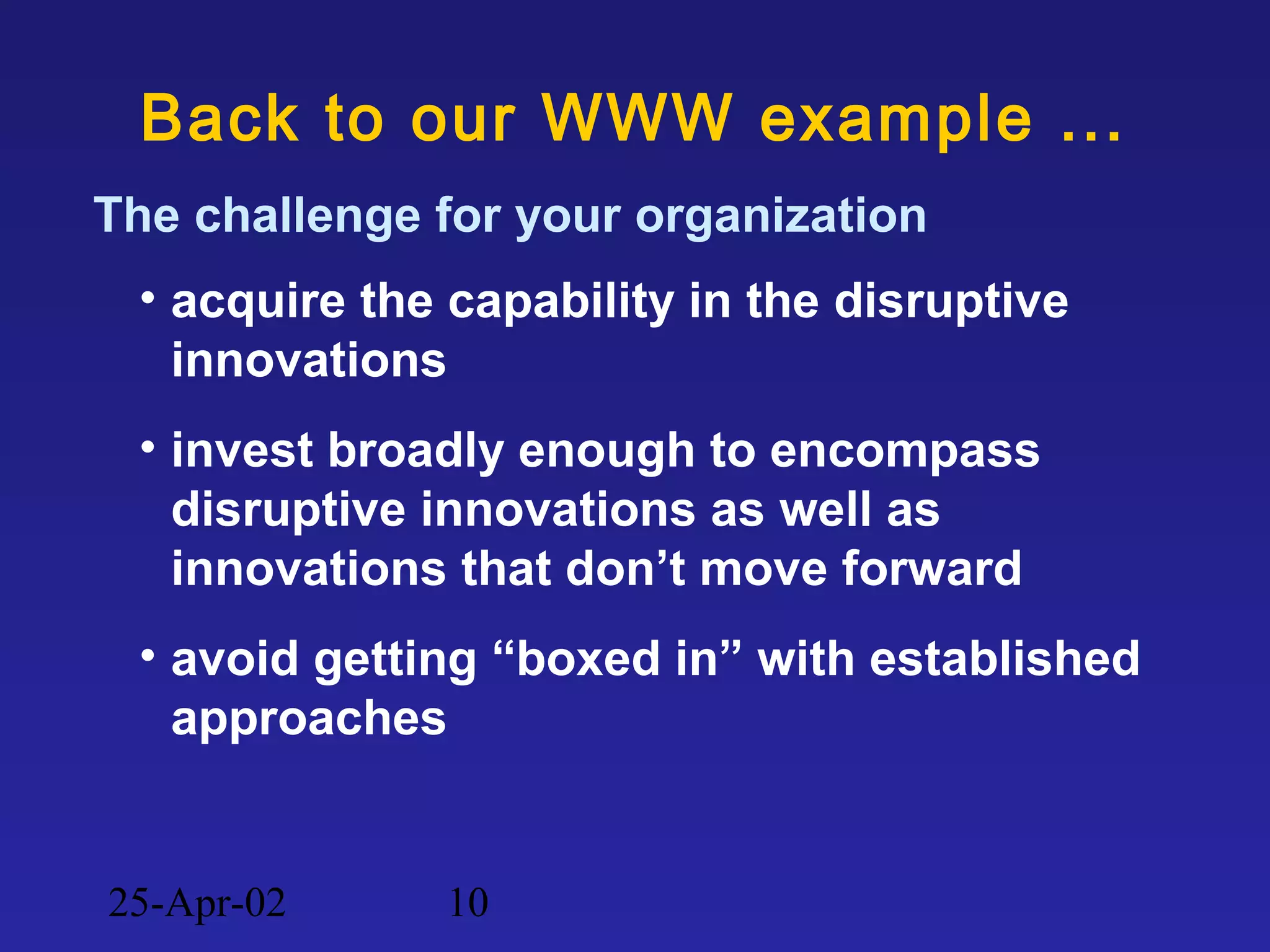
Back to our WWW example ...
The challenge for your organization
• acquire the capability in the disruptive
innovations
• invest broadly enough to encompass
disruptive innovations as well as
innovations that don’t move forward
• avoid getting “boxed in” with established
approaches
25-Apr-02 11
• Building New Capabilities
• Being Pro-active
A plan to boost “Collective IQ”
How to do this?
Understood broadly, goals of “building new capability” and
“being proactive” can address this challenge -- but only if
placed within a structure of planned, facilitated evolution of
your organization or your country’s collective ability.
25-Apr-02 12
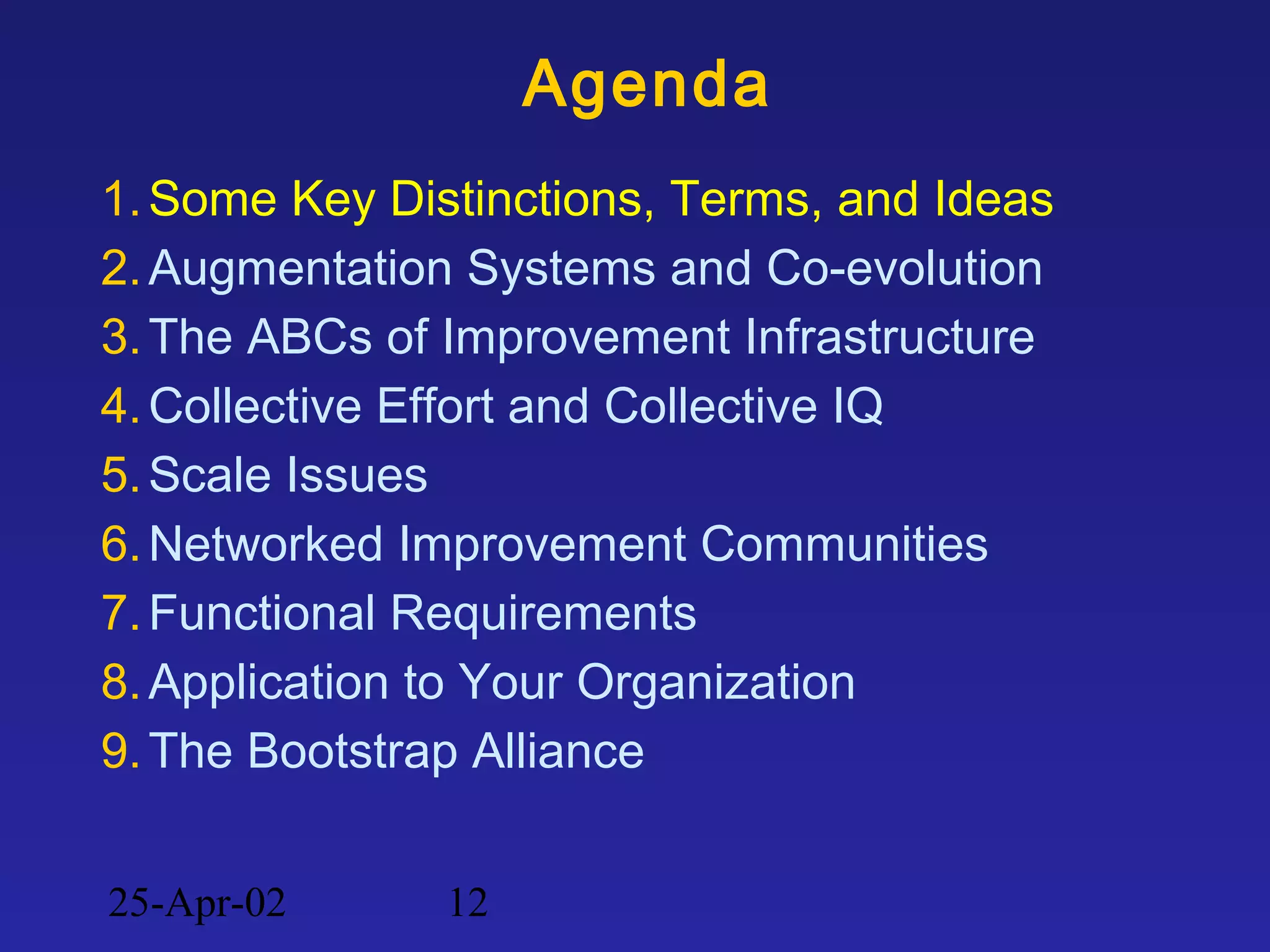
Agenda
1.Some Key Distinctions, Terms, and Ideas
2.Augmentation Systems and Co-evolution
3.The ABCs of Improvement Infrastructure
4.Collective Effort and Collective IQ
5.Scale Issues
6.Networked Improvement Communities
7.Functional Requirements
8.Application to Your Organization
9.The Bootstrap Alliance
25-Apr-02 13
Agenda
• Some Key Distinctions, Terms, and Ideas
– “Augmentation” vs. “Automation”
– “Human” vs. “Mechanistic”
– Growing Knowledge Professionals
– “Capabilities Infrastructure”
– “Human Systems” and “Tool Systems”
– Co-evolution
25-Apr-02 14
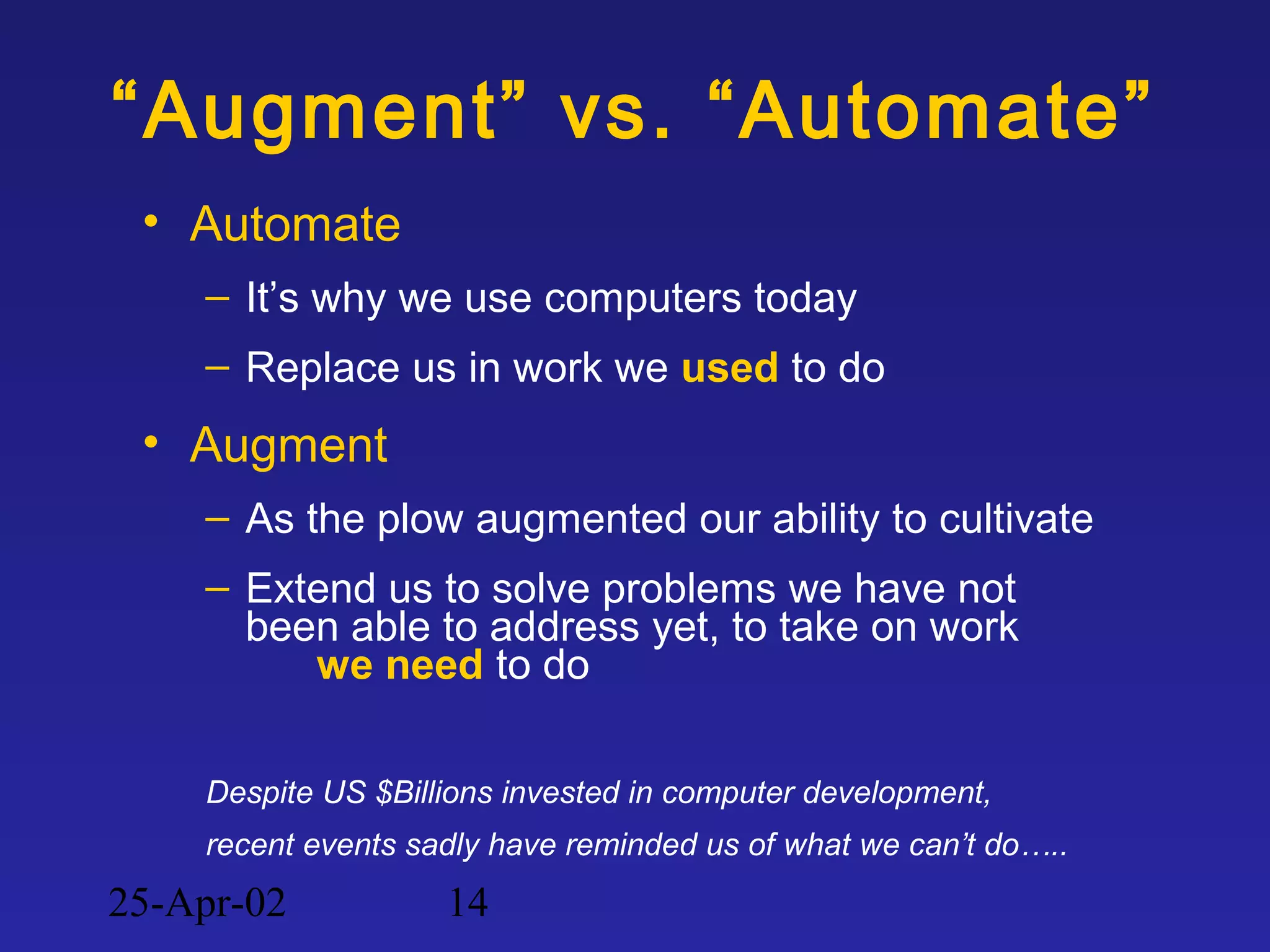
“Augment” vs. “Automate”
• Automate
– It’s why we use computers today
– Replace us in work we used to do
• Augment
– As the plow augmented our ability to cultivate
– Extend us to solve problems we have not
been able to address yet, to take on work
we need to do
Despite US $Billions invested in computer development,
recent events sadly have reminded us of what we can’t do…..
25-Apr-02 15
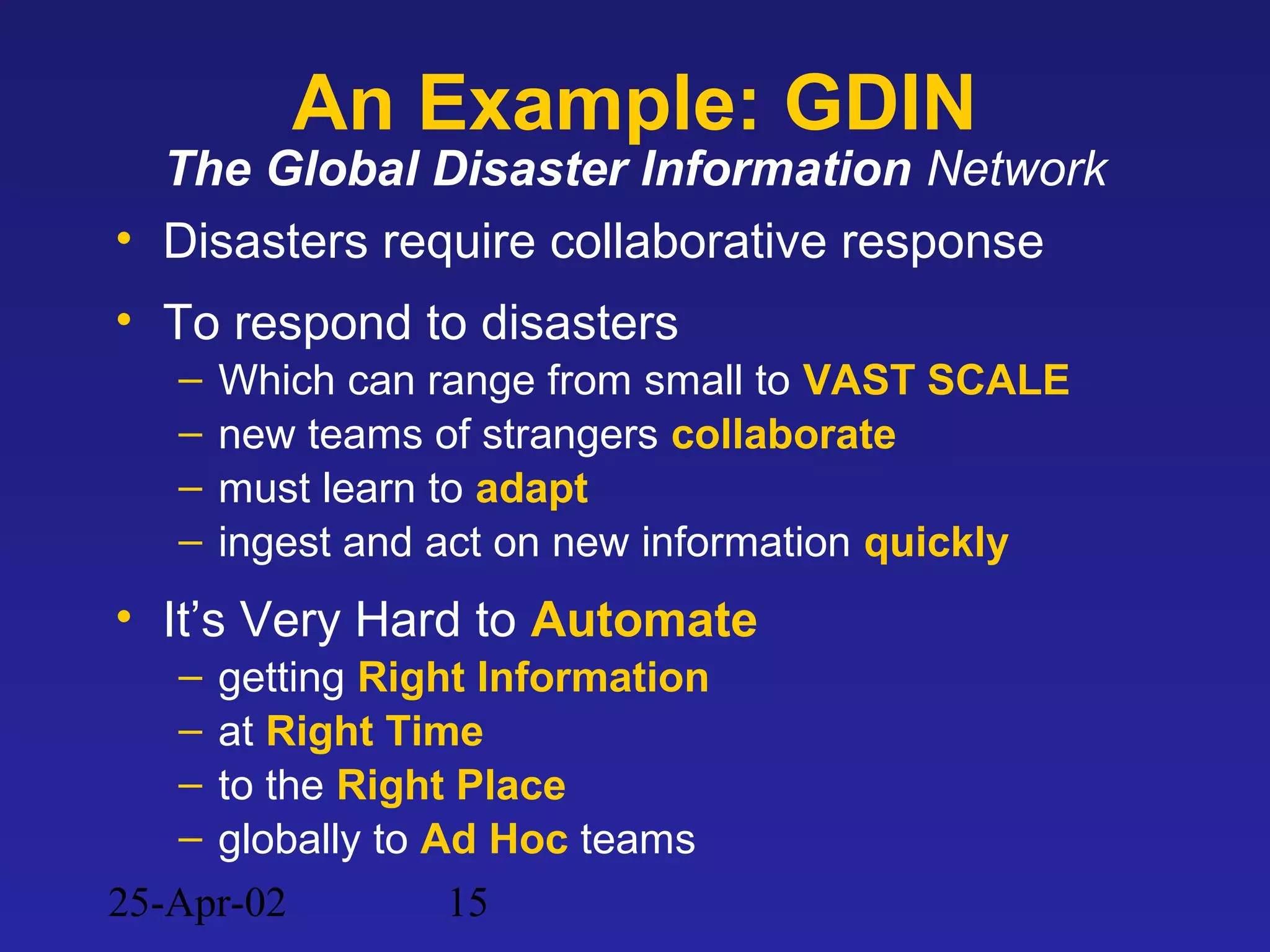
An Example: GDIN
The Global Disaster Information Network
• Disasters require collaborative response
• To respond to disasters
– Which can range from small to VAST SCALE
– new teams of strangers collaborate
– must learn to adapt
– ingest and act on new information quickly
• It’s Very Hard to Automate
– getting Right Information
– at Right Time
– to the Right Place
– globally to Ad Hoc teams
25-Apr-02 16
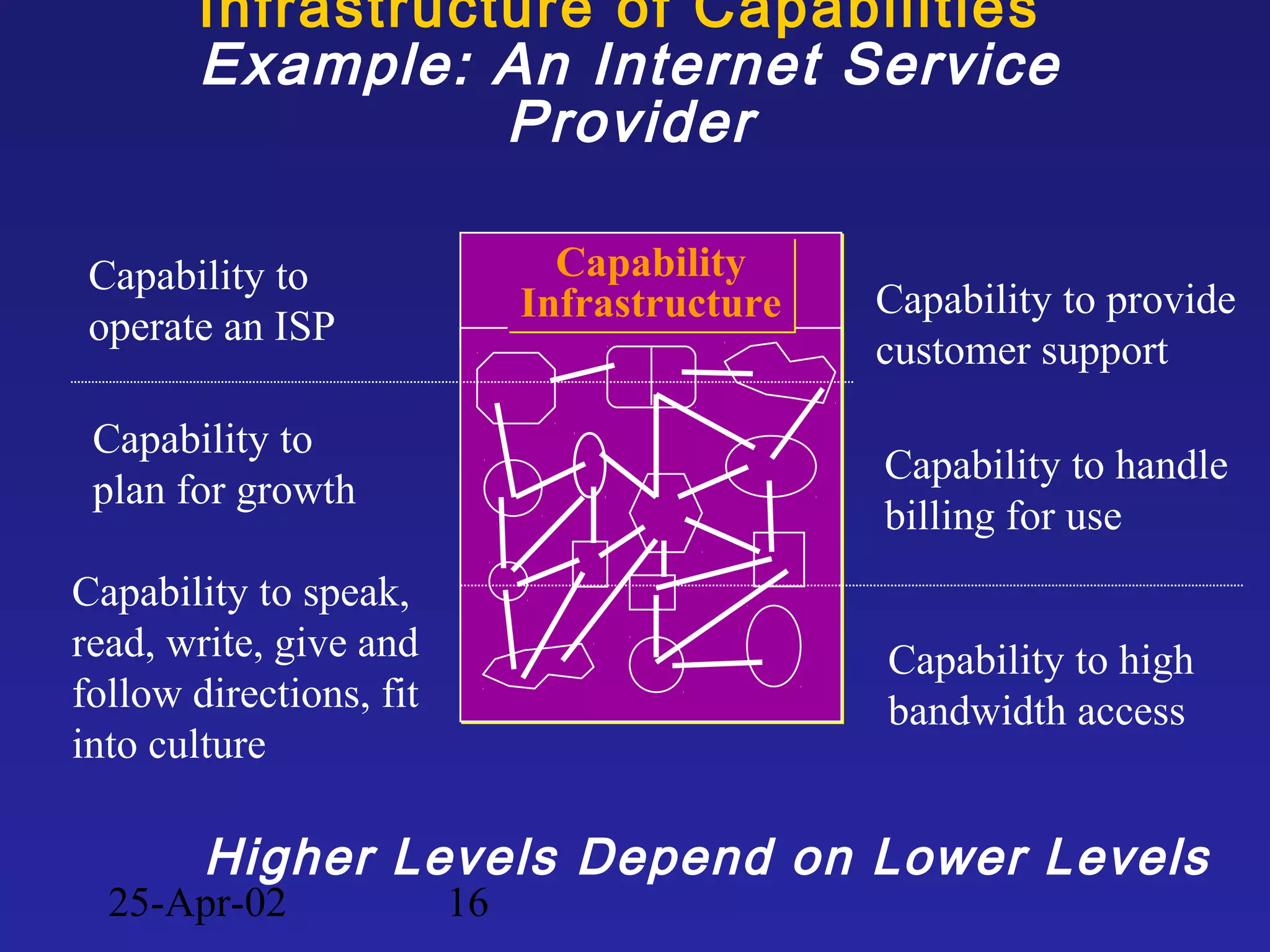
Infrastructure of Capabilities
Example: An Internet Service
Provider
Capability
Infrastructure
Capability
Infrastructure
Capability to
operate an ISP
Capability to high
bandwidth access
Capability to speak,
read, write, give and
follow directions, fit
into culture
Higher Levels Depend on Lower Levels
Capability to provide
customer support
Capability to handle
billing for use
Capability to
plan for growth
25-Apr-02 17
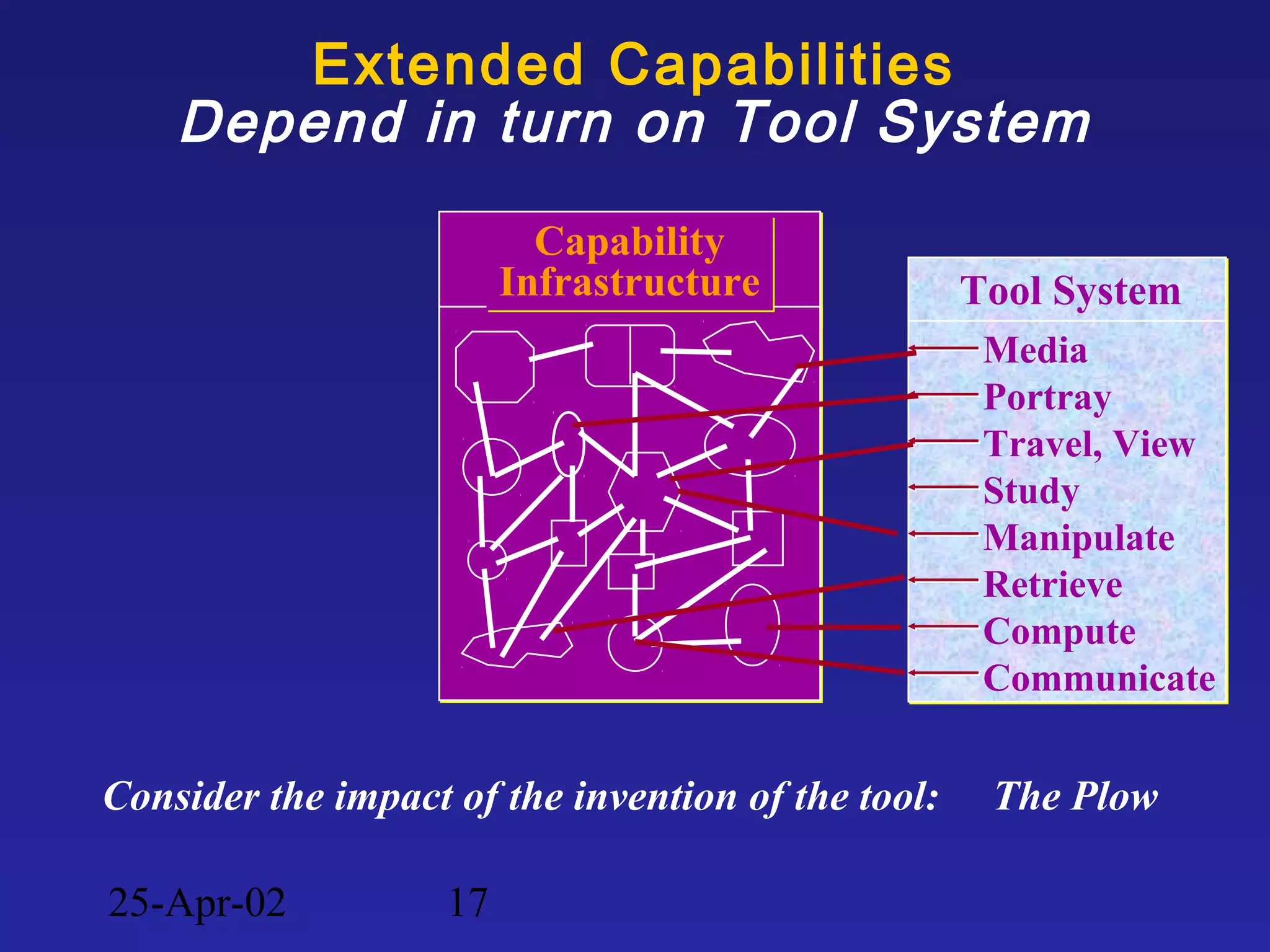
Extended Capabilities
Depend in turn on Tool System
Capability
Infrastructure
Capability
Infrastructure Tool System
Media
Portray
Travel, View
Study
Manipulate
Retrieve
Compute
Communicate
Consider the impact of the invention of the tool: The Plow
25-Apr-02 18
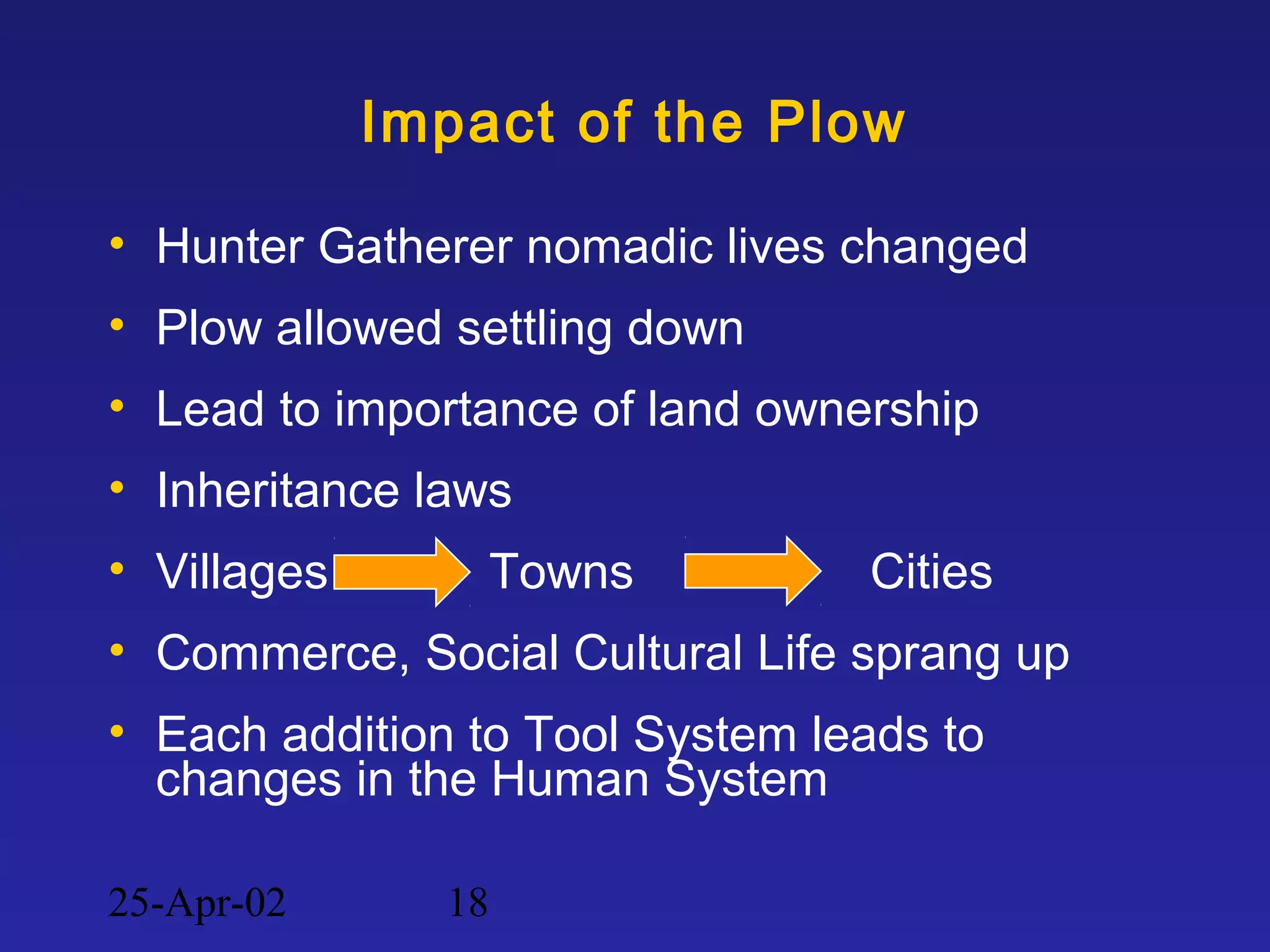
Impact of the Plow
• Hunter Gatherer nomadic lives changed
• Plow allowed settling down
• Lead to importance of land ownership
• Inheritance laws
• Villages Towns Cities
• Commerce, Social Cultural Life sprang up
• Each addition to Tool System leads to
changes in the Human System
25-Apr-02 19
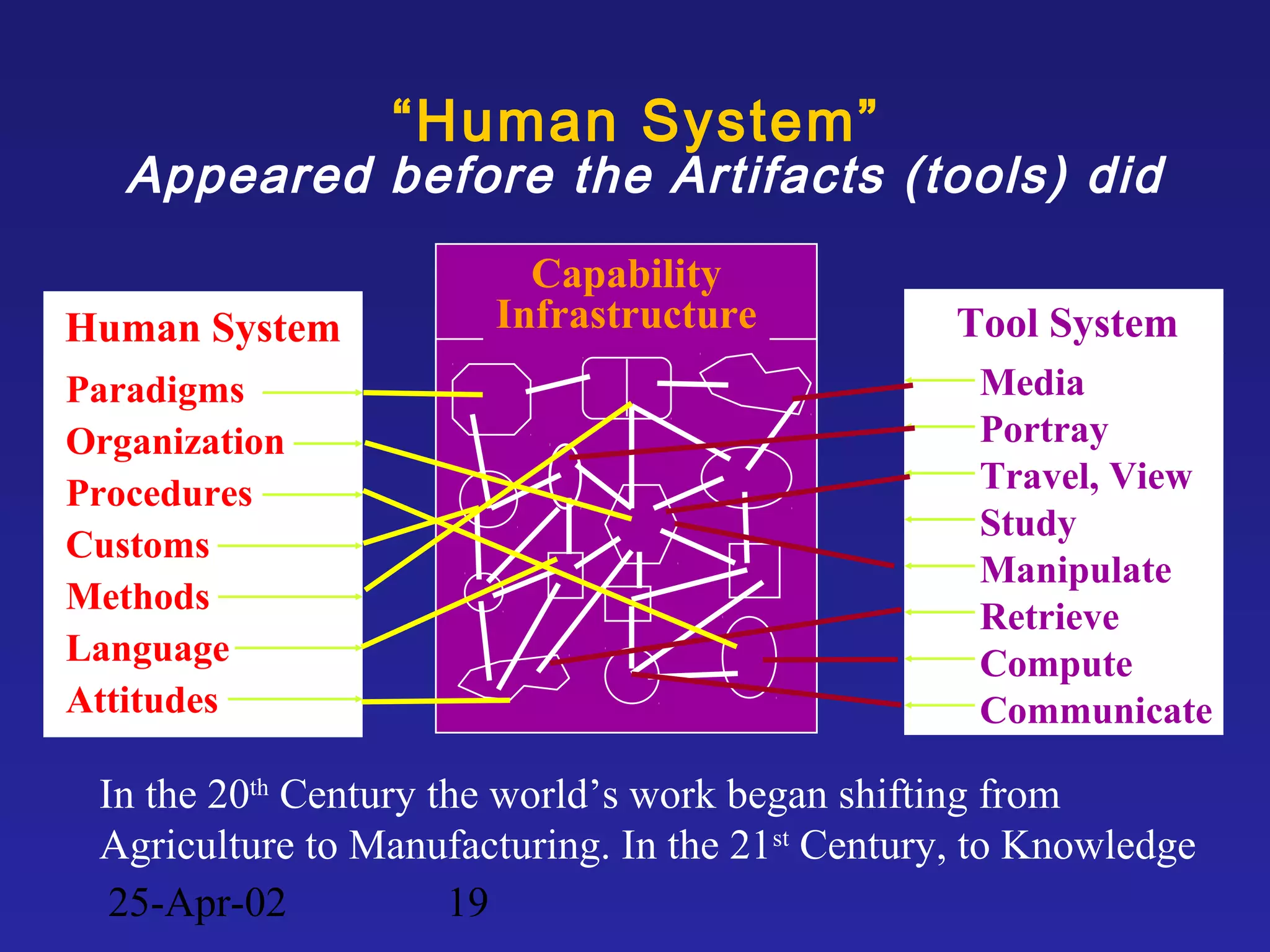
“Human System”
Appeared before the Artifacts (tools) did
Capability
Infrastructure Tool System
Media
Portray
Travel, View
Study
Manipulate
Retrieve
Compute
Communicate
Human System
Paradigms
Organization
Procedures
Customs
Methods
Language
Attitudes
In the 20th
Century the world’s work began shifting from
Agriculture to Manufacturing. In the 21st
Century, to Knowledge
25-Apr-02 20
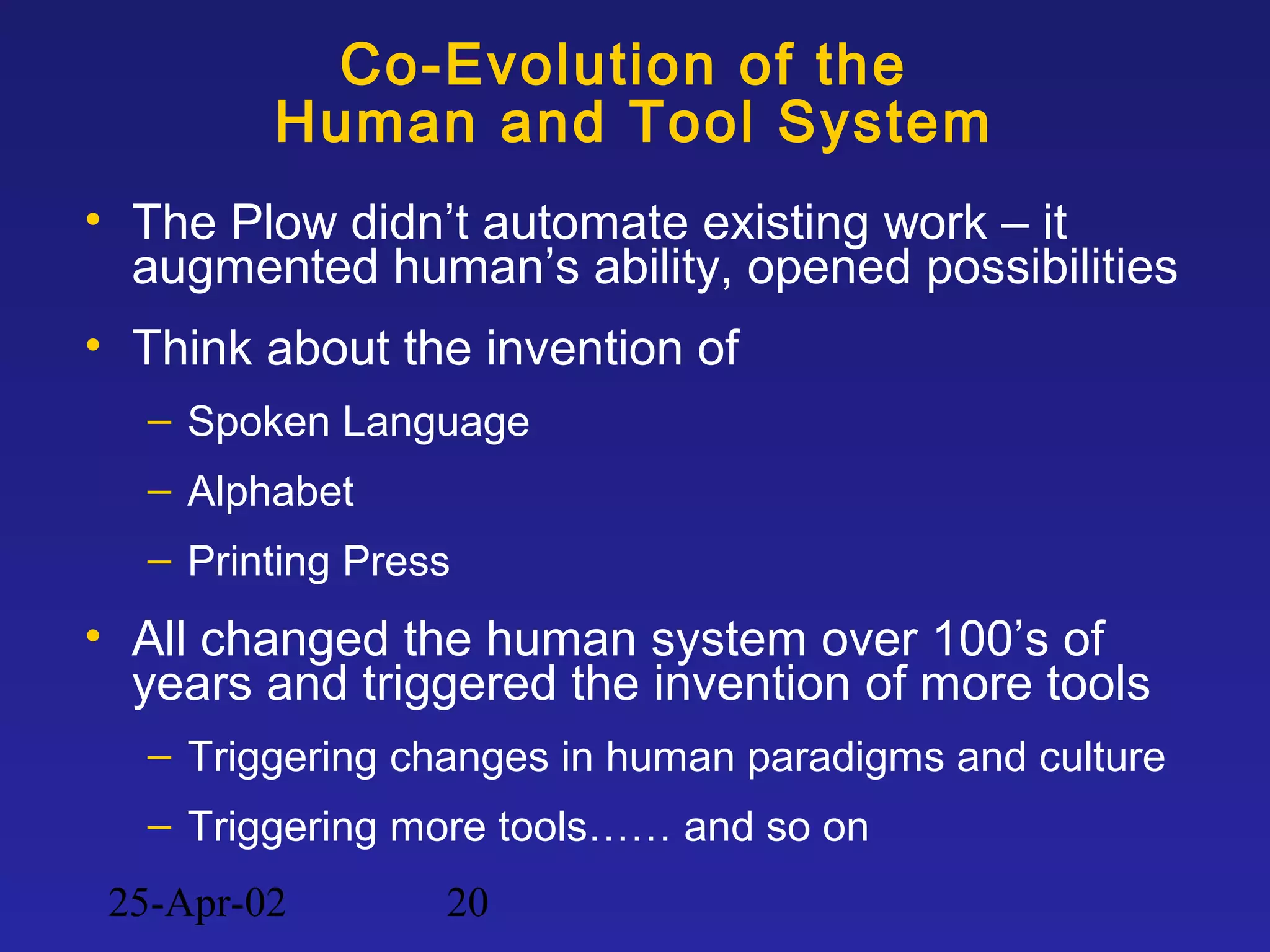
Co-Evolution of the
Human and Tool System
• The Plow didn’t automate existing work – it
augmented human’s ability, opened possibilities
• Think about the invention of
– Spoken Language
– Alphabet
– Printing Press
• All changed the human system over 100’s of
years and triggered the invention of more tools
– Triggering changes in human paradigms and culture
– Triggering more tools…… and so on
25-Apr-02 21
Agenda
• Some Key Distinctions, Terms, and Ideas
• Augmentation Systems and Co-evolution
• The ABCs of Improvement Infrastructure
• Collective Effort and Collective IQ
• Scale Issues
• Networked Improvement Communities
• Functional Requirements
• Application to Your Organization
• The Bootstrap Alliance
25-Apr-02 22
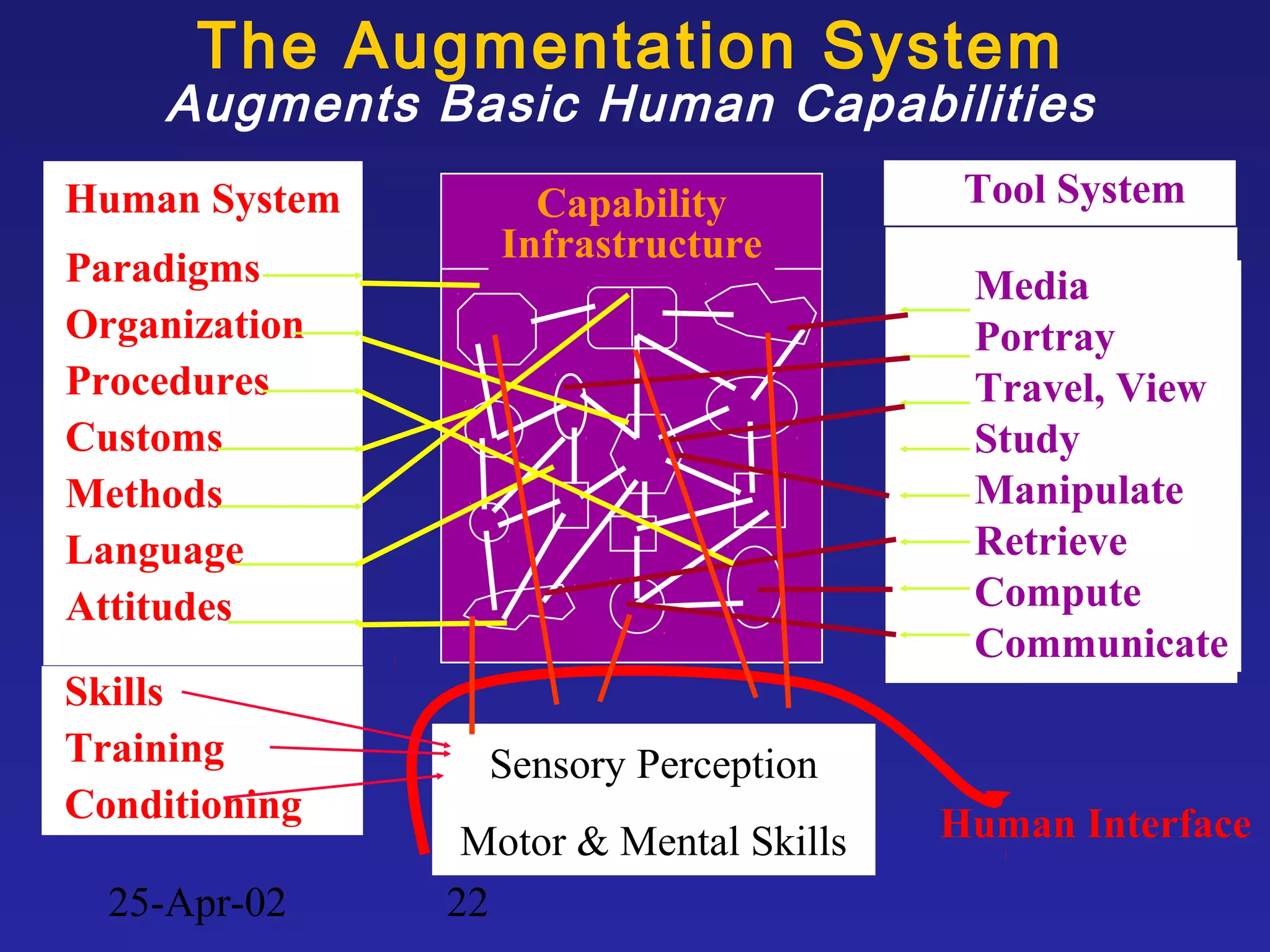
Capability
Infrastructure
The Augmentation System
Augments Basic Human Capabilities
Human Interface
Sensory Perception
Motor & Mental Skills
Skills
Training
Conditioning
Tool System
Media
Portray
Travel, View
Study
Manipulate
Retrieve
Compute
Communicate
Human System
Paradigms
Organization
Procedures
Customs
Methods
Language
Attitudes
25-Apr-02 23
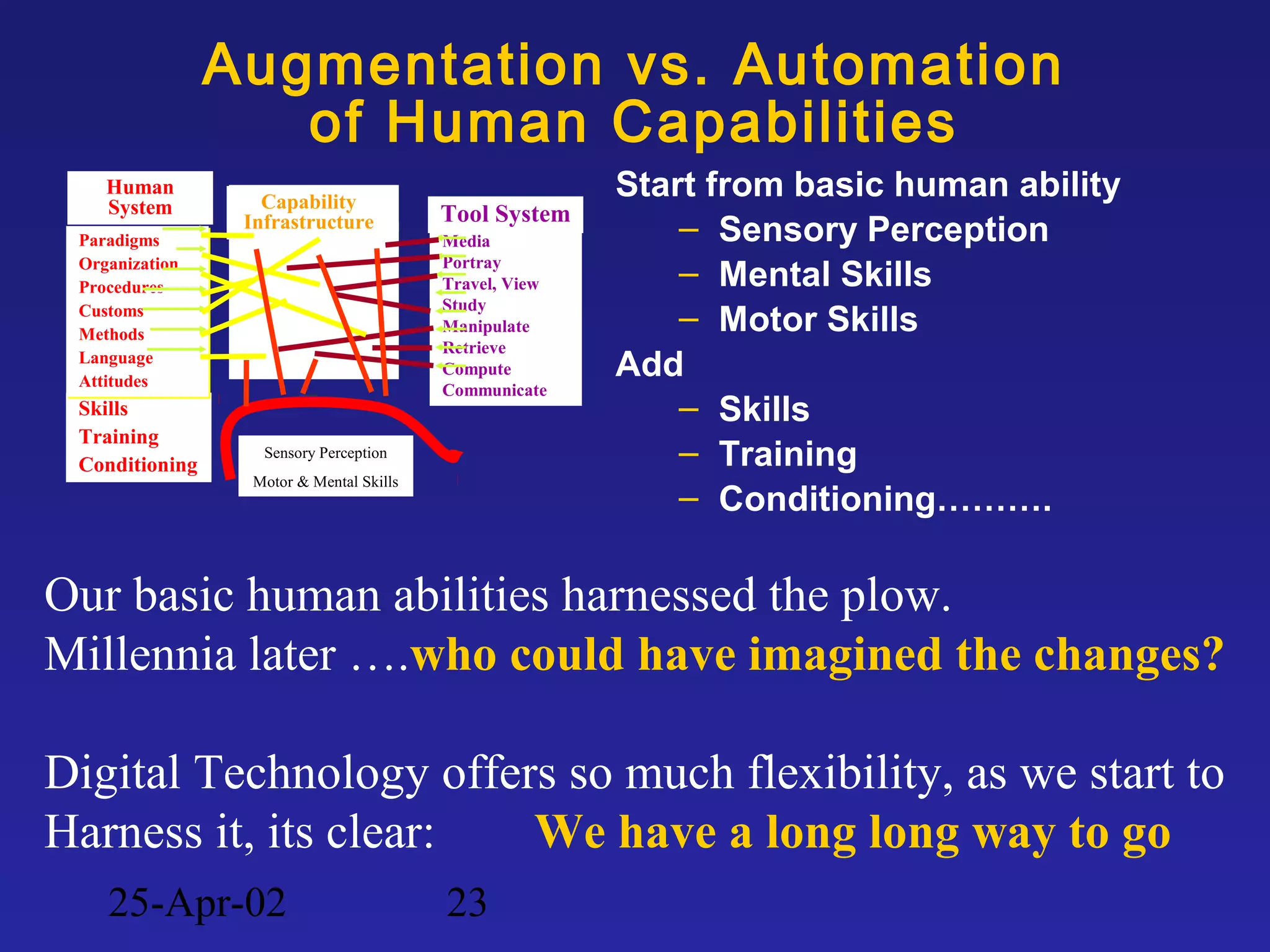
Augmentation vs. Automation
of Human Capabilities
Start from basic human ability
– Sensory Perception
– Mental Skills
– Motor Skills
Add
– Skills
– Training
– Conditioning……….
Skills
Training
Conditioning
Capability
Infrastructure Tool System
Media
Portray
Travel, View
Study
Manipulate
Retrieve
Compute
Communicate
Human
System
Paradigms
Organization
Procedures
Customs
Methods
Language
Attitudes
Paradigms
Organization
Procedures
Customs
Methods
Language
Attitudes
Sensory Perception
Motor & Mental Skills
Our basic human abilities harnessed the plow.
Millennia later ….who could have imagined the changes?
Digital Technology offers so much flexibility, as we start to
Harness it, its clear: We have a long long way to go
25-Apr-02 24
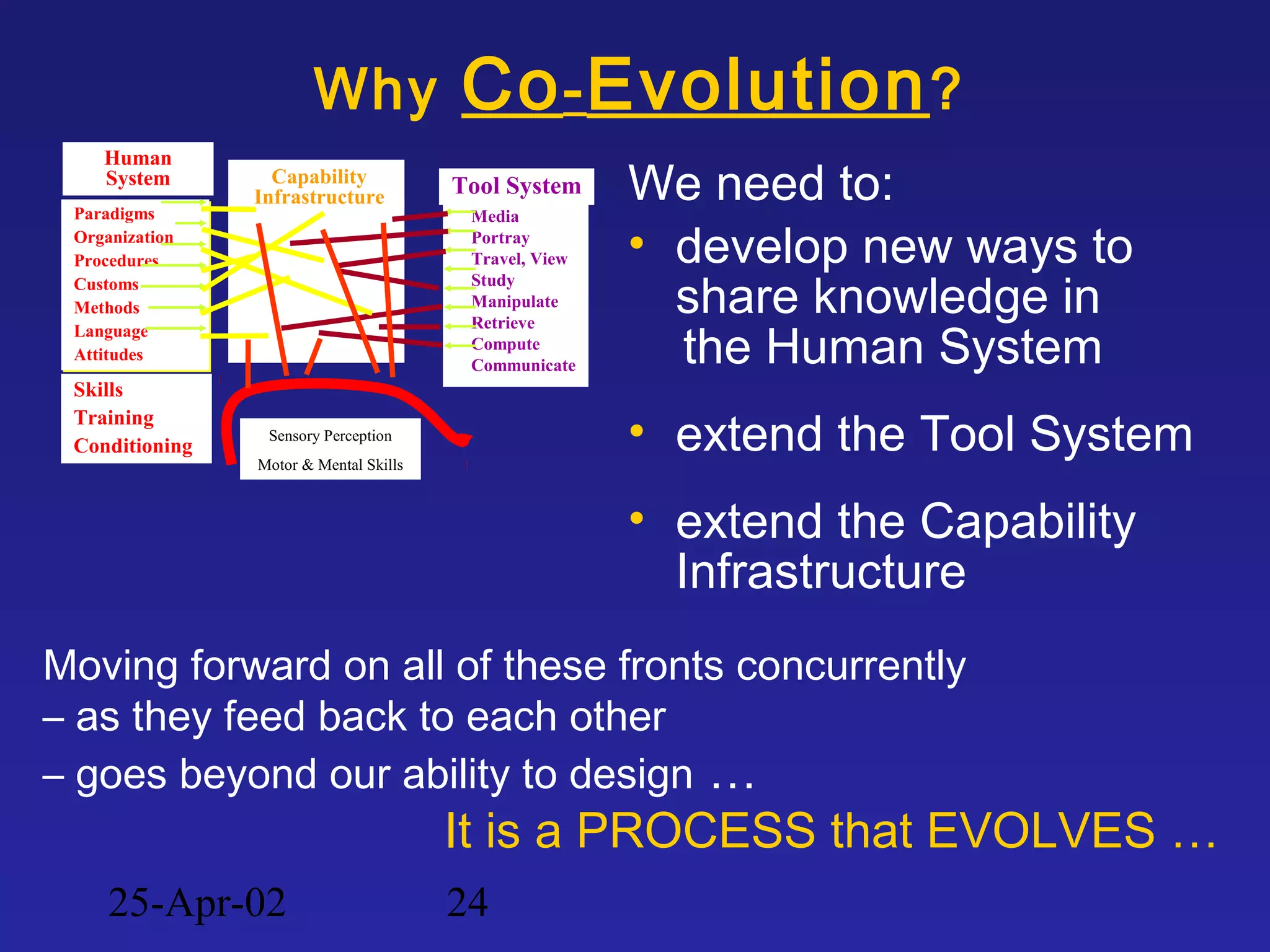
Why Co-Evolution?
We need to:
• develop new ways to
share knowledge in
the Human System
• extend the Tool System
• extend the Capability
Infrastructure
Moving forward on all of these fronts concurrently
– as they feed back to each other
– goes beyond our ability to design …
It is a PROCESS that EVOLVES …
Skills
Training
Conditioning
Capability
Infrastructure Tool System
Media
Portray
Travel, View
Study
Manipulate
Retrieve
Compute
Communicate
Human
System
Paradigms
Organization
Procedures
Customs
Methods
Language
Attitudes
Paradigms
Organization
Procedures
Customs
Methods
Language
Attitudes
Sensory Perception
Motor & Mental Skills
25-Apr-02 25
Improvement Infrastructure
for New, Discontinuous
Innovation
• Requires conscious collective investment
• Requires whole Augmentation system
perspective - human and tool co-evolution
Over 50 years ago,
I saw the frontier differently from those around me
25-Apr-02 26
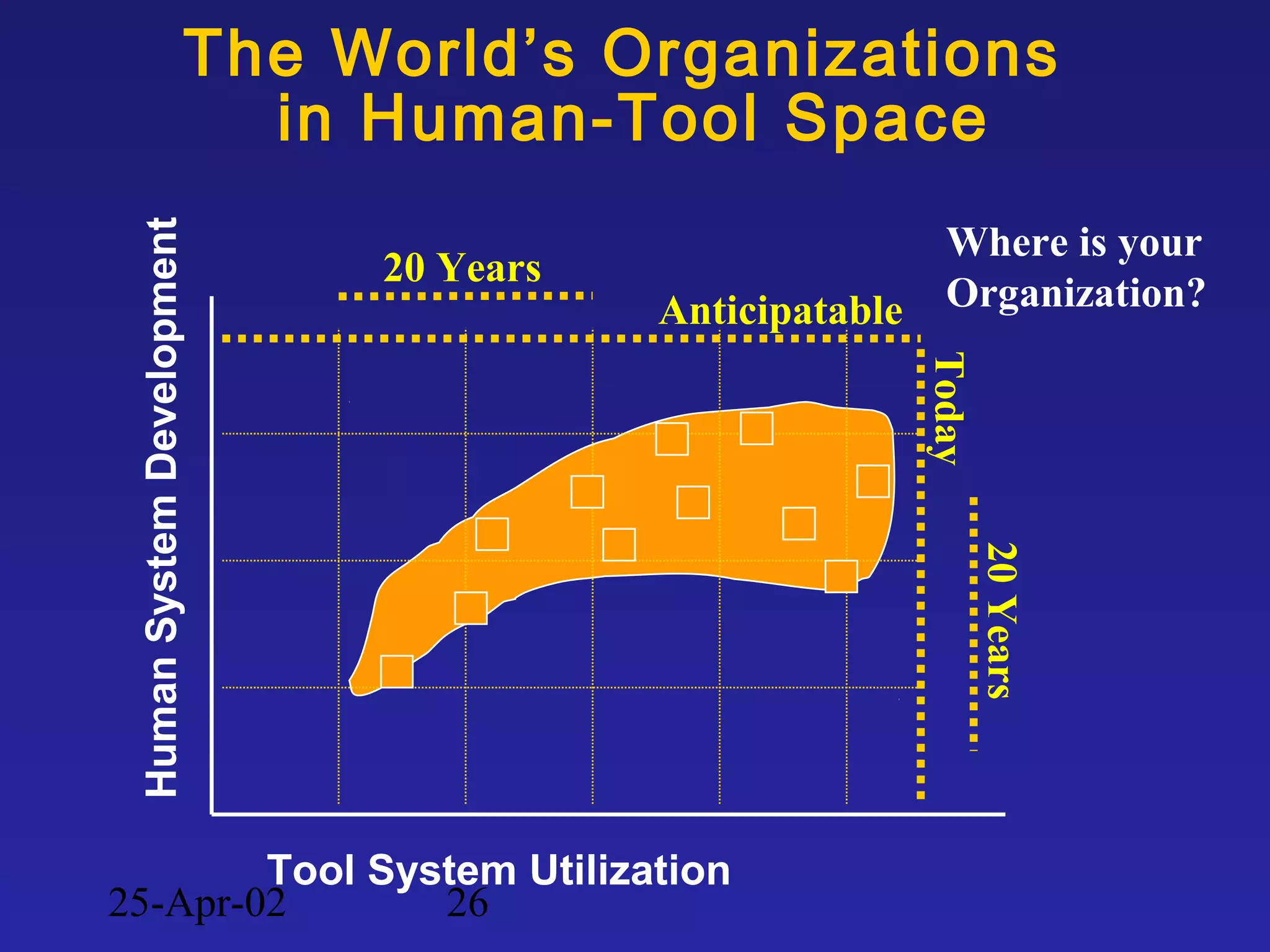
Where is your
Organization?
Tool System Utilization
HumanSystemDevelopment
20 Years
20Years
Anticipatable
Today
The World’s Organizations
in Human-Tool Space
25-Apr-02 27
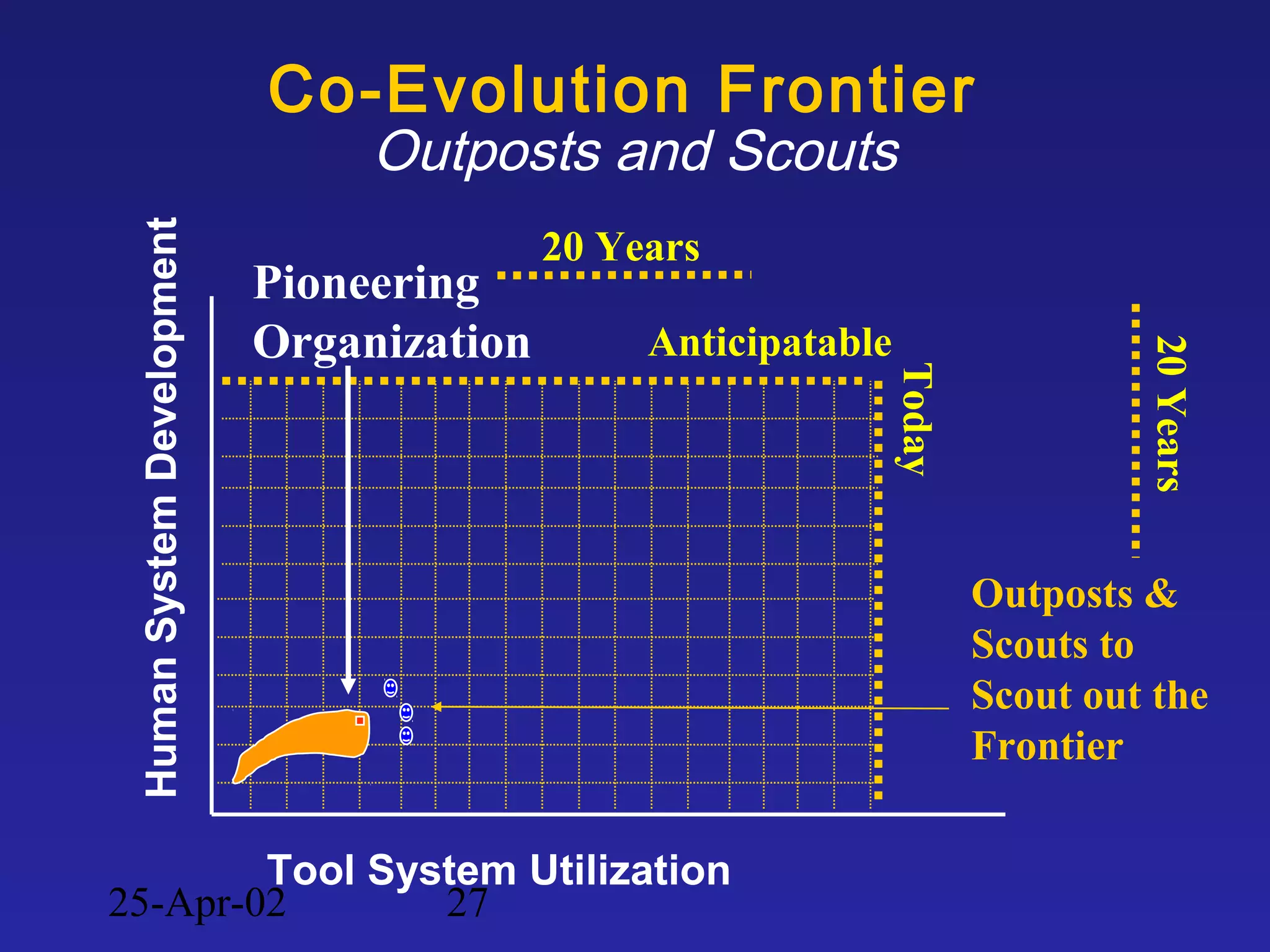
20 Years
20Years
Anticipatable
TodayTool System Utilization
HumanSystemDevelopment
Co-Evolution Frontier
Outposts and Scouts
Outposts &
Scouts to
Scout out the
Frontier
Pioneering
Organization
25-Apr-02 28
Tools and Means for
High Performance Teams
• “Equip” teams to gear up for high performance,
high leverage, group-capability enhancing
work
• “Knowledge Containers” with a high degree of
mobility and knowledge transferability
• “Integration” of historic, current, geographically
dispersed knowledge
• “Contests” for best Knowledge teams
• “Compete” to set up best Knowledge models
25-Apr-02 29
Developing Knowledge Pro’s
a “Learned” skill like reading
• What does it take to “Grow” Novices to Pro’s
– Develop skills till they’re done unconsciously
– Coaching
– Role models
– Purposeful usage
– Real goals that stretch abilities
• Strategic “Frameworks” that ease the learning
– Start from regular work, evolve in smooth stages
– Provide choices: Entry level to Pro level knowledge tools
25-Apr-02 30
Agenda
• Some Key Distinctions, Terms, and Ideas
• Augmentation Systems and Co-evolution
• The ABCs of Improvement Infrastructure
• Collective Effort and Collective IQ
• Scale Issues
• Networked Improvement Communities
• Functional Requirements
• Application to Your Organization
• The Bootstrap Alliance
25-Apr-02 31
• B Activity - improves
product cycle time
and quality
• A Activity - serves
the customer
Customer
Organization
A Core
Business Activity
B Improves
A Capability
ABC’s of
Improvement Infrastructure
“How can we improve our ability to improve?”
25-Apr-02 32
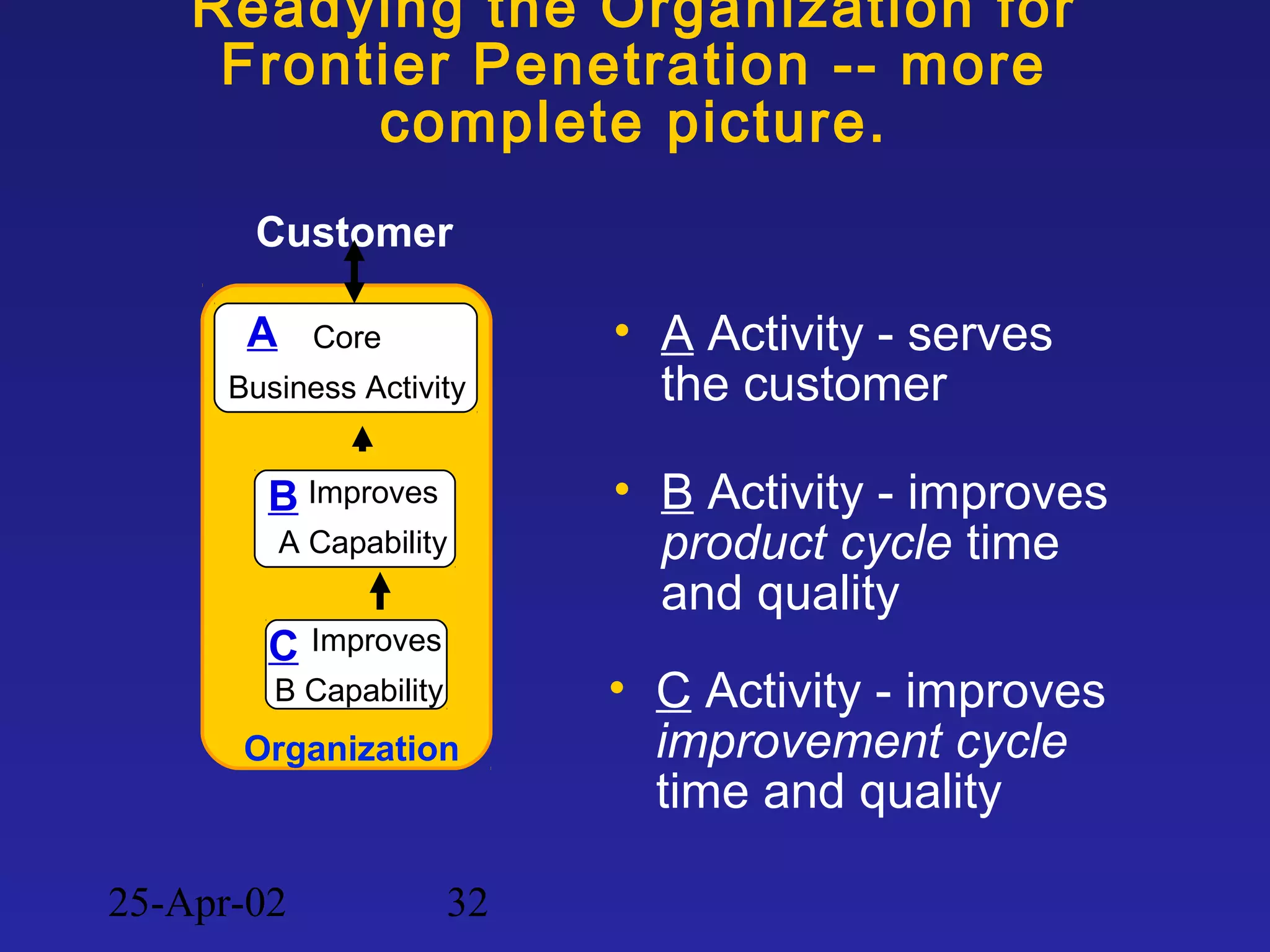
• C Activity - improves
improvement cycle
time and quality
• B Activity - improves
product cycle time
and quality
• A Activity - serves
the customer
Customer
Organization
A Core
Business Activity
B Improves
A Capability
C Improves
B Capability
Readying the Organization for
Frontier Penetration -- more
complete picture.
25-Apr-02 33
Investing in
“A” “B” and “C” Activities
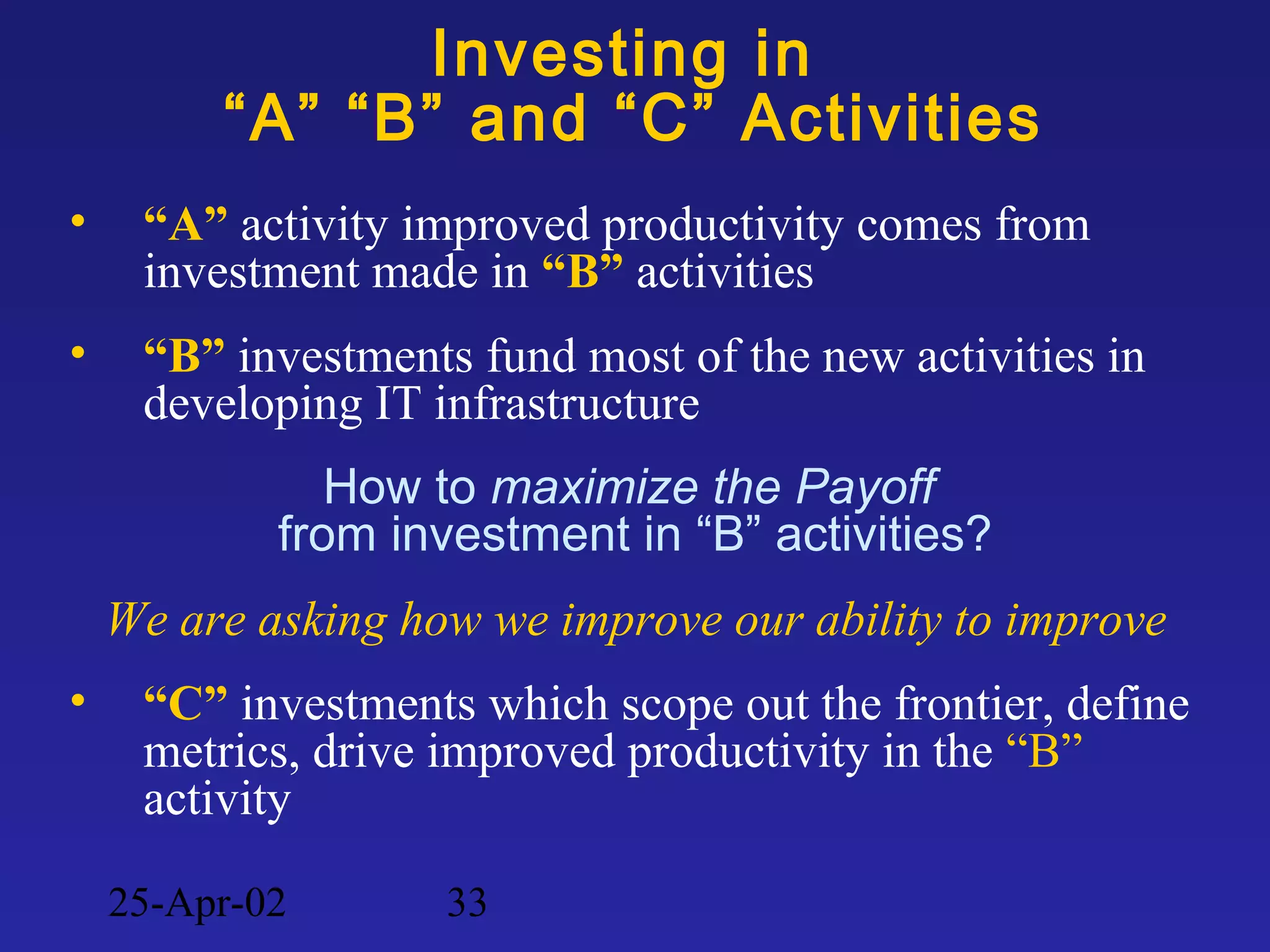
• “A” activity improved productivity comes from
investment made in “B” activities
• “B” investments fund most of the new activities in
developing IT infrastructure
How to maximize the Payoff
from investment in “B” activities?
We are asking how we improve our ability to improve
• “C” investments which scope out the frontier, define
metrics, drive improved productivity in the “B”
activity
25-Apr-02 34
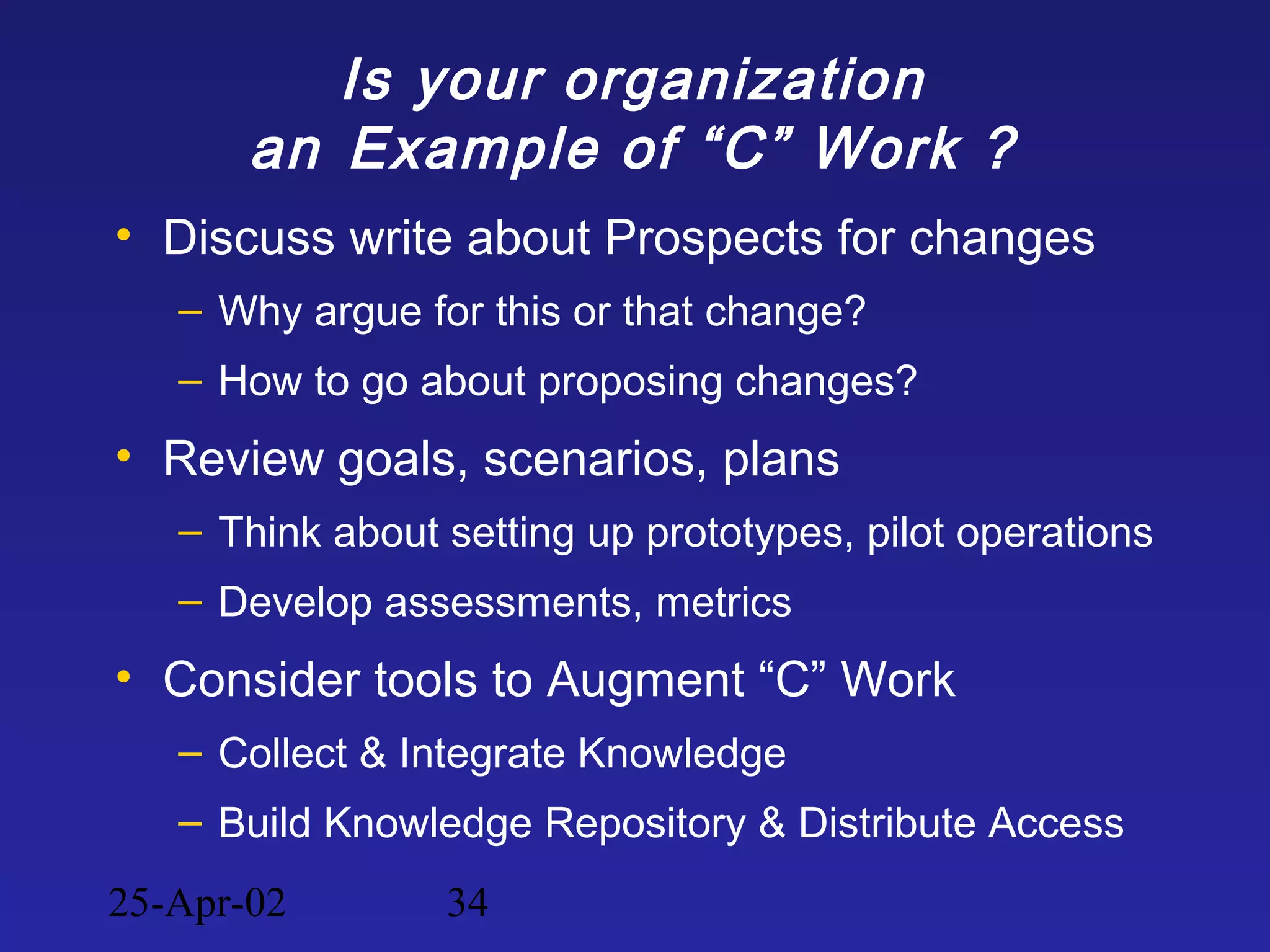
Is your organization
an Example of “C” Work ?
• Discuss write about Prospects for changes
– Why argue for this or that change?
– How to go about proposing changes?
• Review goals, scenarios, plans
– Think about setting up prototypes, pilot operations
– Develop assessments, metrics
• Consider tools to Augment “C” Work
– Collect & Integrate Knowledge
– Build Knowledge Repository & Distribute Access
25-Apr-02 35
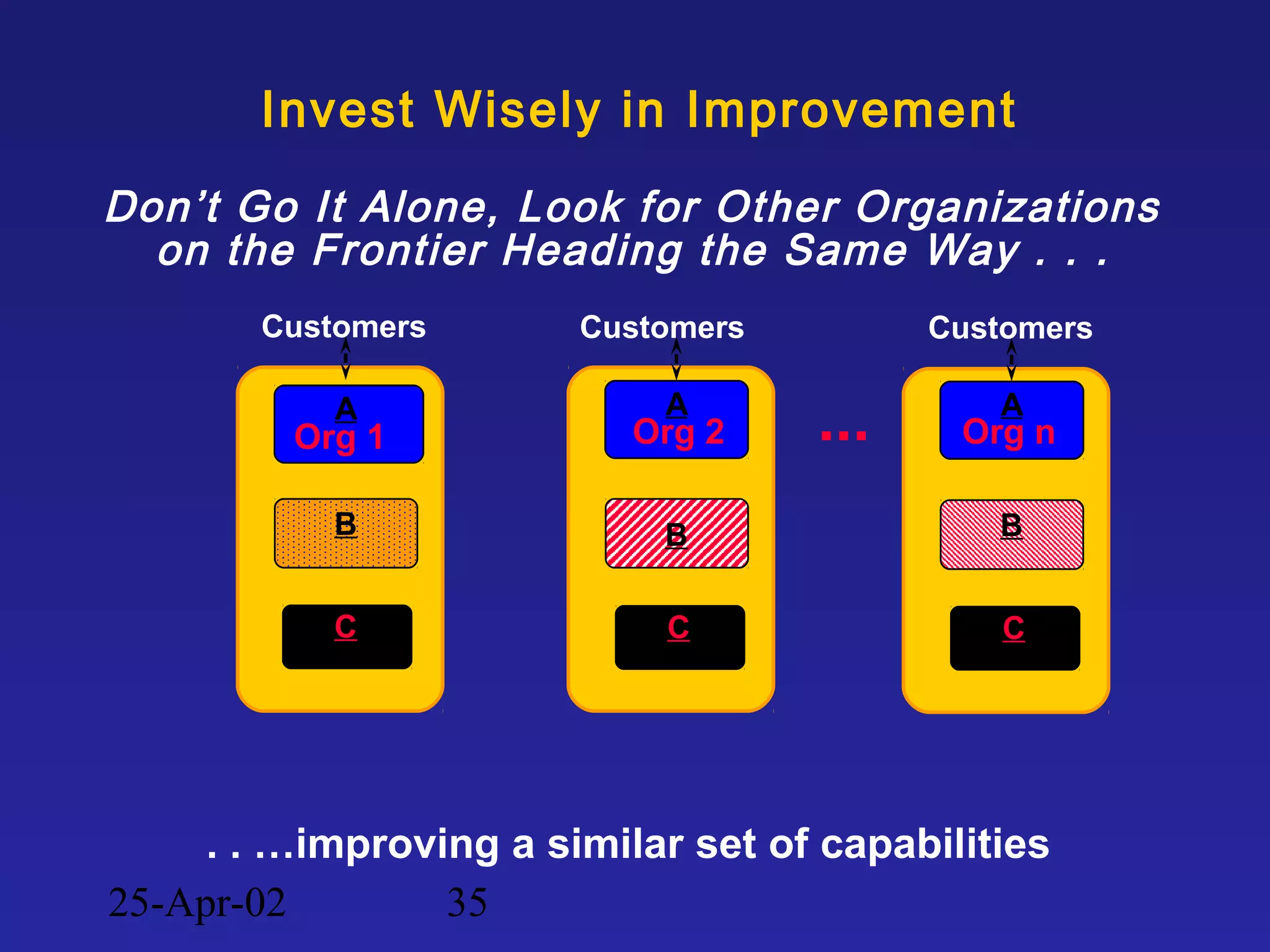
Invest Wisely in Improvement
Don’t Go It Alone, Look for Other Organizations
on the Frontier Heading the Same Way . . .
. . …improving a similar set of capabilities
B
Customers
C
A
Org 1
Customers
C
Customers
C
...A
Org 2
BB
A
Org n
25-Apr-02 36
Agenda
• Some Key Distinctions, Terms, and Ideas
• Augmentation Systems and Co-evolution
• The ABCs of Improvement Infrastructure
• Collective Effort and Collective IQ
• Scale Issues
• Networked Improvement Communities
• Functional Requirements
• Application to Your Organization
• The Bootstrap Alliance
25-Apr-02 37
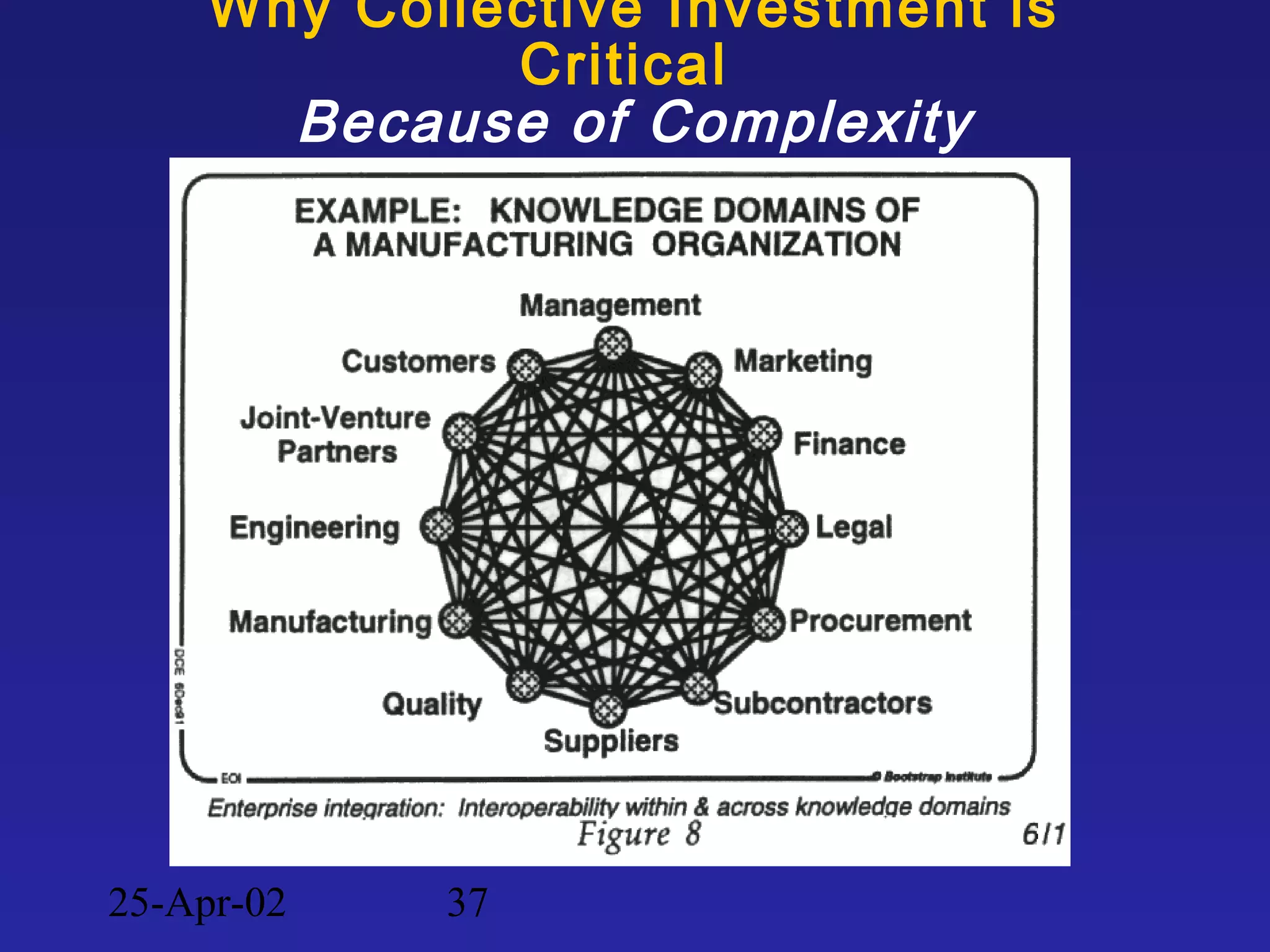
Why Collective Investment is
Critical
Because of Complexity
25-Apr-02 38
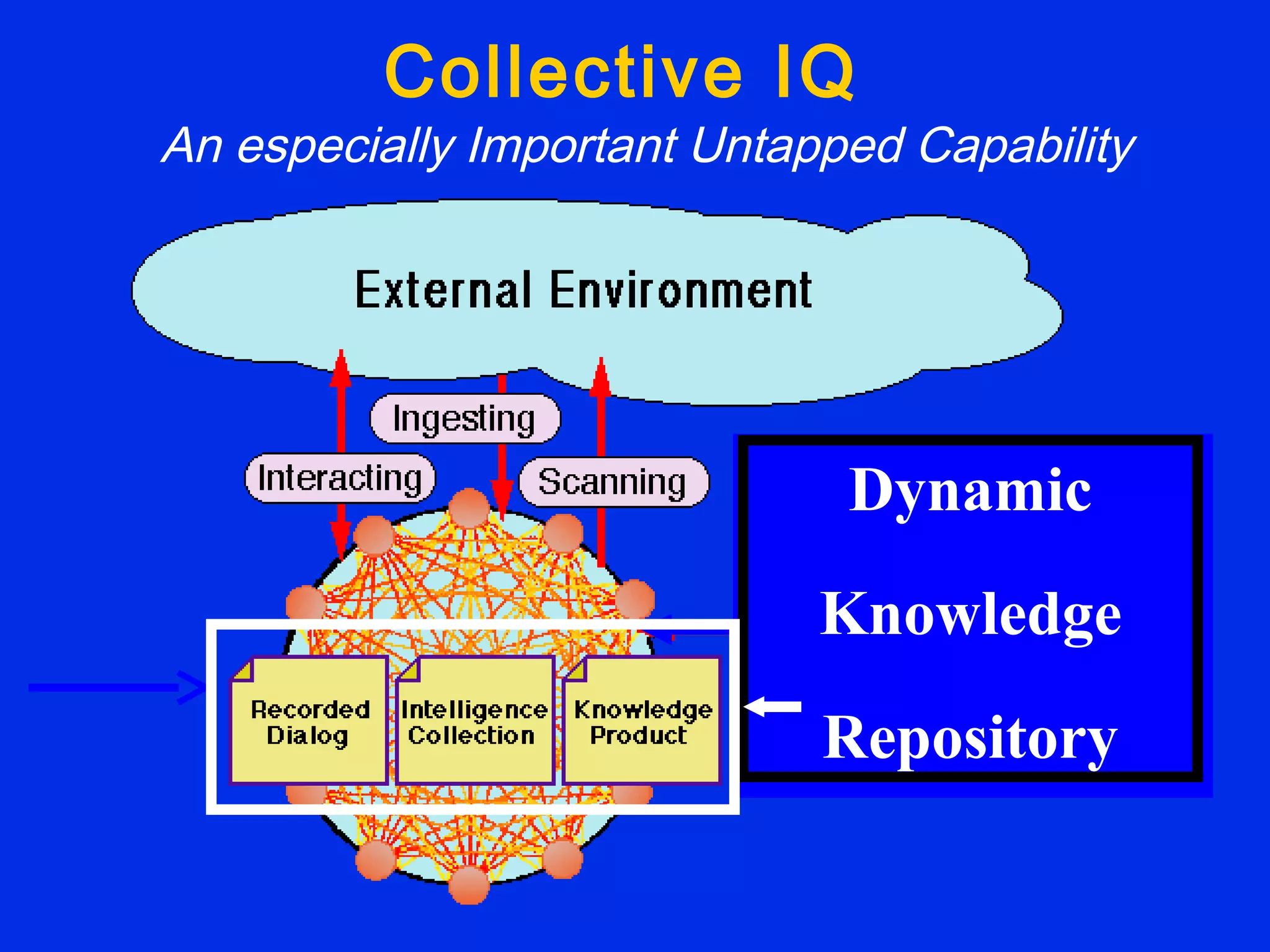
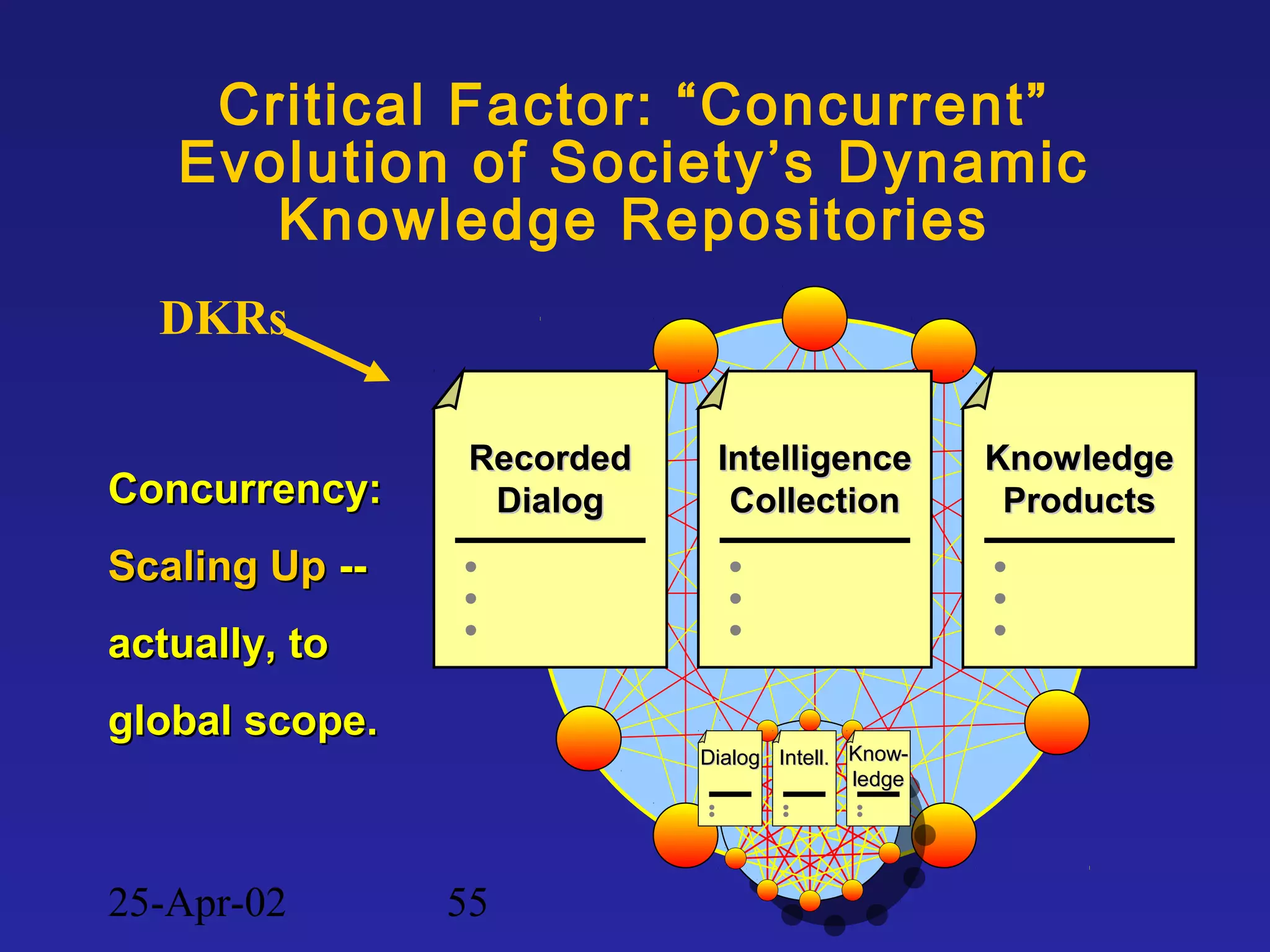
Recorded
Dialog
Intelligence
Collection
Knowledge
Product
Concurrently:
Integrating
Collaborating
Developing
Learning
(Re)using
ScanningInteracting
Ingesting
External Environment
Collective IQ
An especially Important Untapped Capability
Dynamic
Knowledge
Repository
25-Apr-02 39
Agenda
• Some Key Distinctions, Terms, and Ideas
• Augmentation Systems and Co-evolution
• The ABCs of Improvement Infrastructure
• Collective Effort and Collective IQ
• Scale Issues
• Networked Improvement Communities
• Functional Requirements
• Application to Your Organization
• The Bootstrap Alliance
25-Apr-02 40
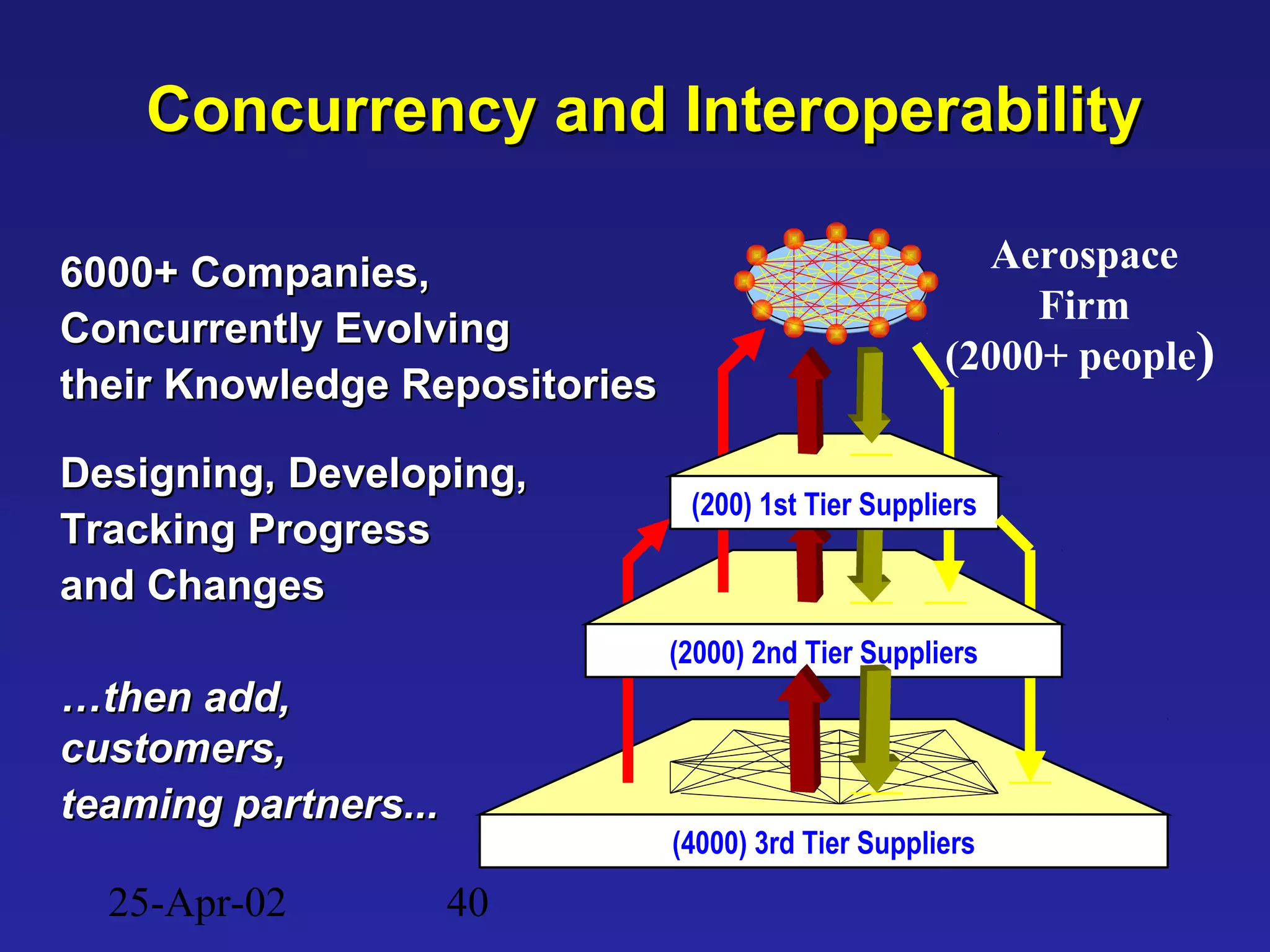
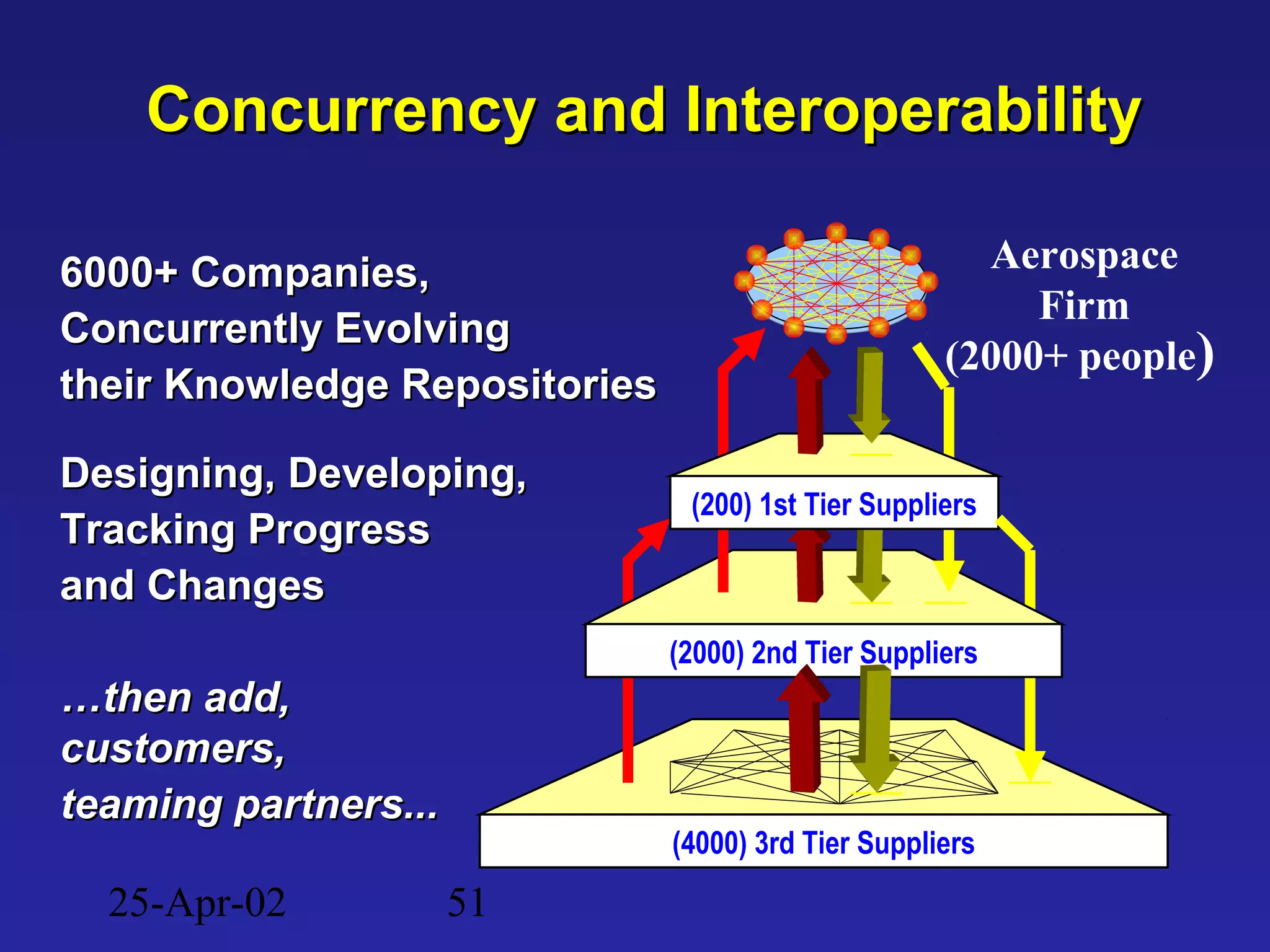
Concurrency and InteroperabilityConcurrency and Interoperability
6000+ Companies,6000+ Companies,
Concurrently EvolvingConcurrently Evolving
their Knowledge Repositoriestheir Knowledge Repositories
Designing, Developing,Designing, Developing,
Tracking ProgressTracking Progress
and Changesand Changes
……then add,then add,
customers,customers,
teaming partners...teaming partners...
(2000+ people)
(4000) 3rd Tier Suppliers
(2000) 2nd Tier Suppliers
Aerospace
Firm
(200) 1st Tier Suppliers
25-Apr-02 41
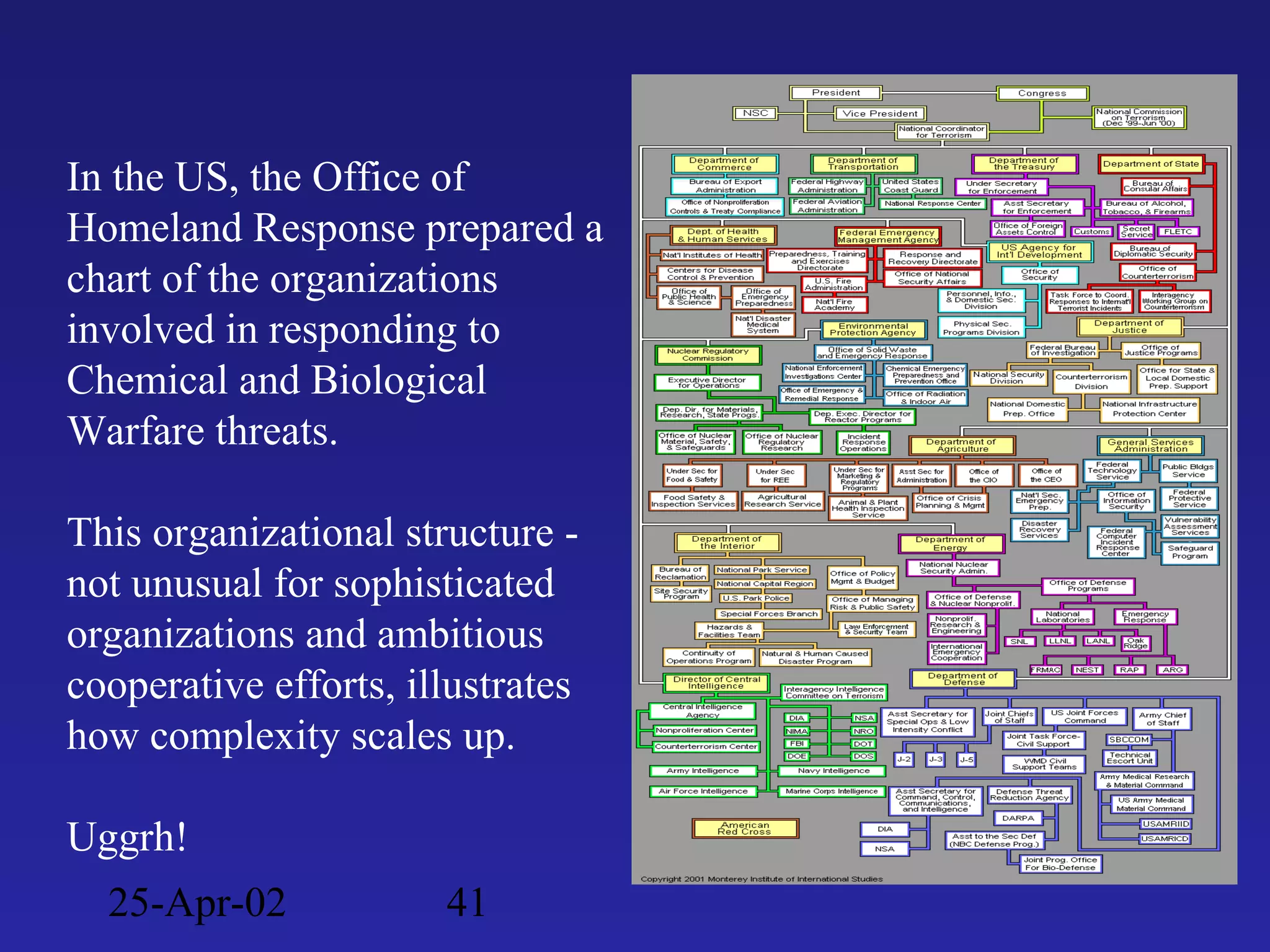
In the US, the Office of
Homeland Response prepared a
chart of the organizations
involved in responding to
Chemical and Biological
Warfare threats.
This organizational structure -
not unusual for sophisticated
organizations and ambitious
cooperative efforts, illustrates
how complexity scales up.
Uggrh!
25-Apr-02 42
Huge strategic factor:
The matter of SCALE!
• The scale of the capability-evolution
challenge transcends what any one
company, any one Explicit Plan, could
formulate and accomplish.
• So, get serious about developing an
appropriate Evolutionary Environment!
• Perhaps even, about evolving an
appropriate Evolutionary Environment?
25-Apr-02 43
Agenda
• Some Key Distinctions, Terms, and Ideas
• Augmentation Systems and Co-evolution
• The ABCs of Improvement Infrastructure
• Collective Effort and Collective IQ
• Scale Issues
• Networked Improvement Communities
• Functional Requirements
• Application to Your Organization
• The Bootstrap Alliance
25-Apr-02 44
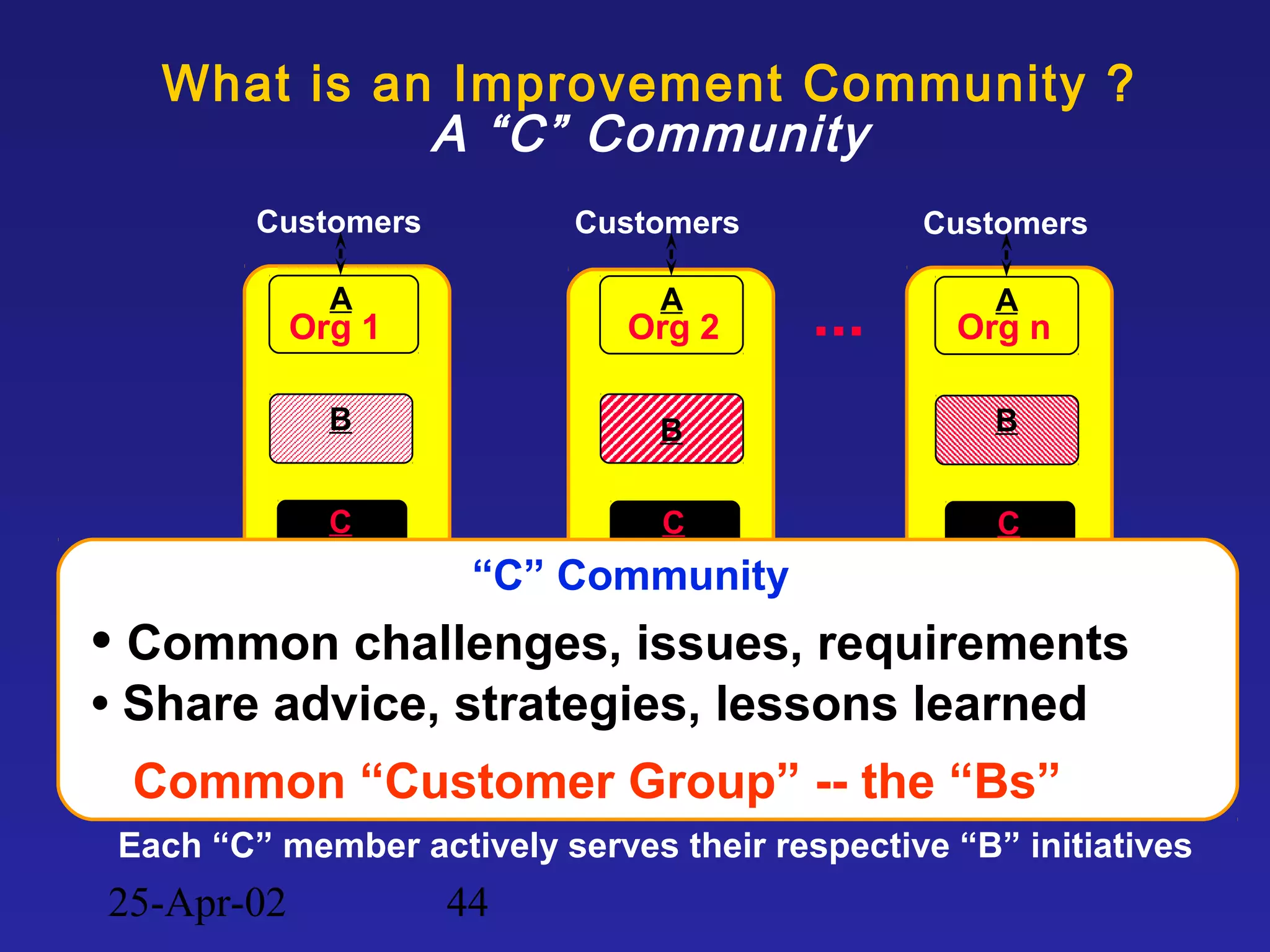
B
Customers
C
A
Org 1
Customers
C
Customers
C
...A
Org 2
BB
A
Org n
What is an Improvement Community ?
A “C” Community
“C” Community
Each “C” member actively serves their respective “B” initiatives
• Common challenges, issues, requirements
• Share advice, strategies, lessons learned
Common “Customer Group” -- the “Bs”
25-Apr-02 45
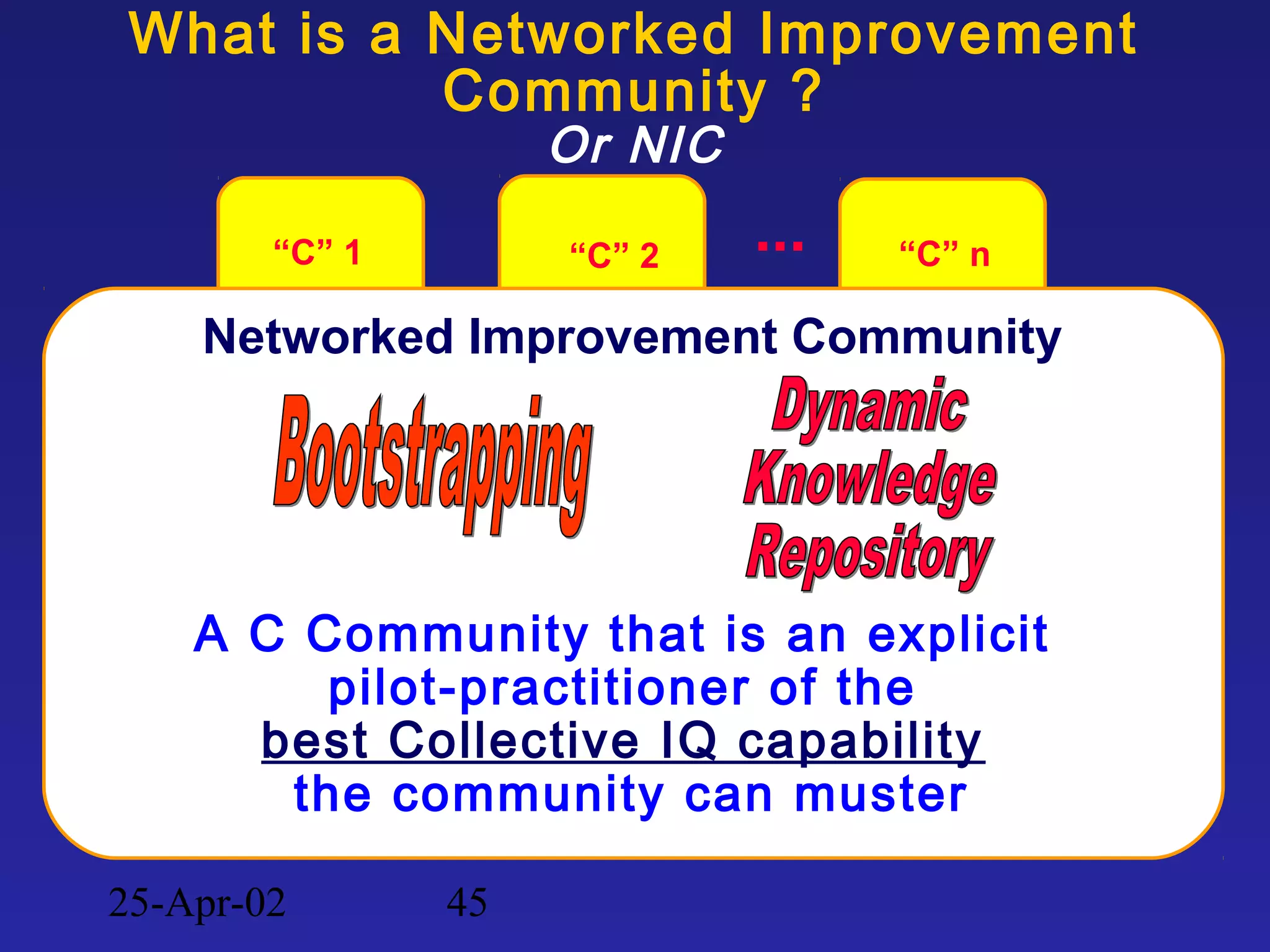
What is a Networked Improvement
Community ?
Or NIC
C
“C” 1
C C
...“C” 2 “C” n
Networked Improvement Community
A C Community that is an explicit
pilot-practitioner of the
best Collective IQ capability
the community can muster
25-Apr-02 46
Agenda
• Some Key Distinctions, Terms, and Ideas
• Augmentation Systems and Co-evolution
• The ABCs of Improvement Infrastructure
• Collective Effort and Collective IQ
• Scale Issues
• Networked Improvement Communities
• Functional Requirements
• Application to Your Organization
• The Bootstrap Alliance
25-Apr-02 47
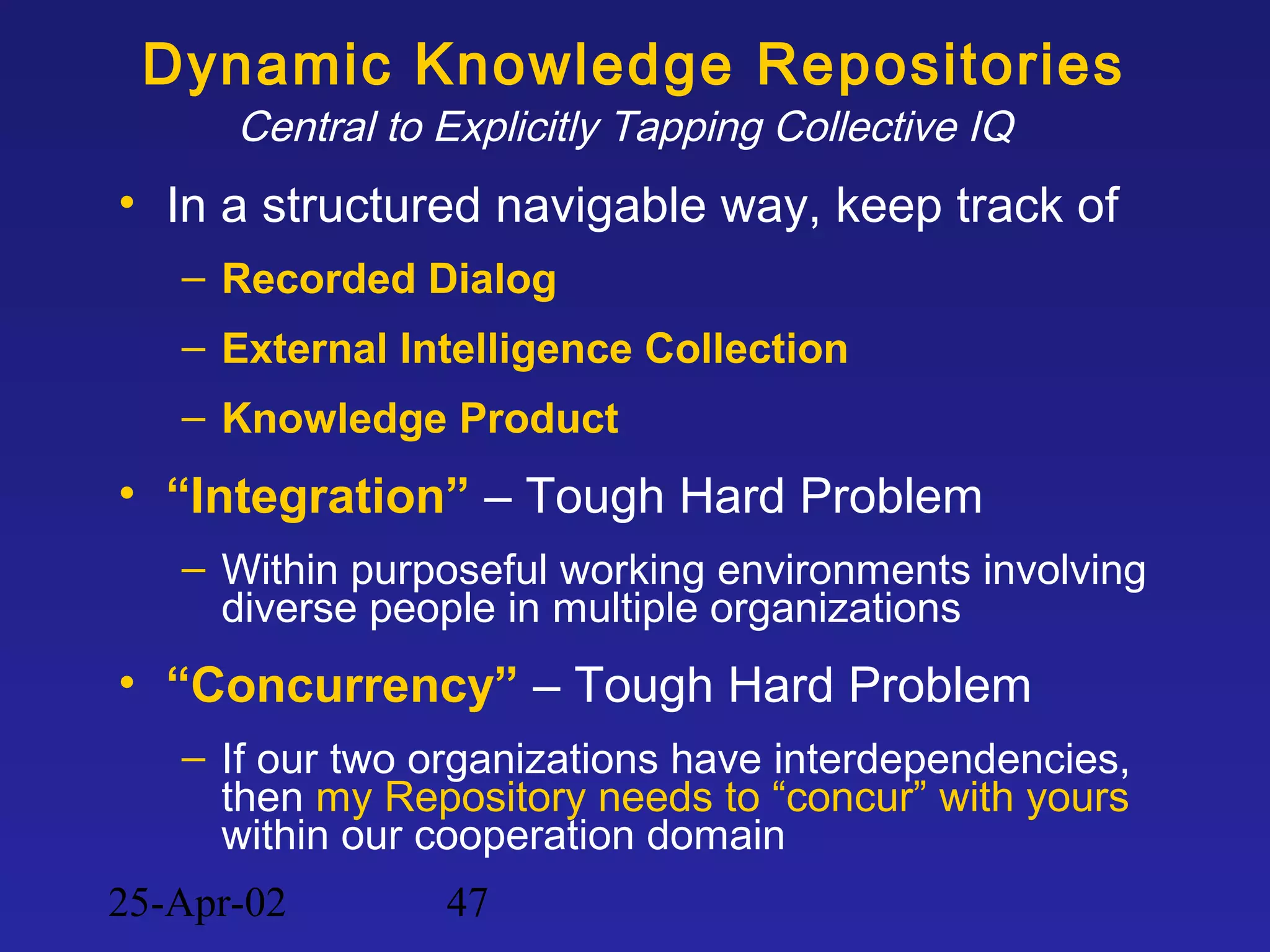
Dynamic Knowledge Repositories
Central to Explicitly Tapping Collective IQ
• In a structured navigable way, keep track of
– Recorded Dialog
– External Intelligence Collection
– Knowledge Product
• “Integration” – Tough Hard Problem
– Within purposeful working environments involving
diverse people in multiple organizations
• “Concurrency” – Tough Hard Problem
– If our two organizations have interdependencies,
then my Repository needs to “concur” with yours
within our cooperation domain
25-Apr-02 48
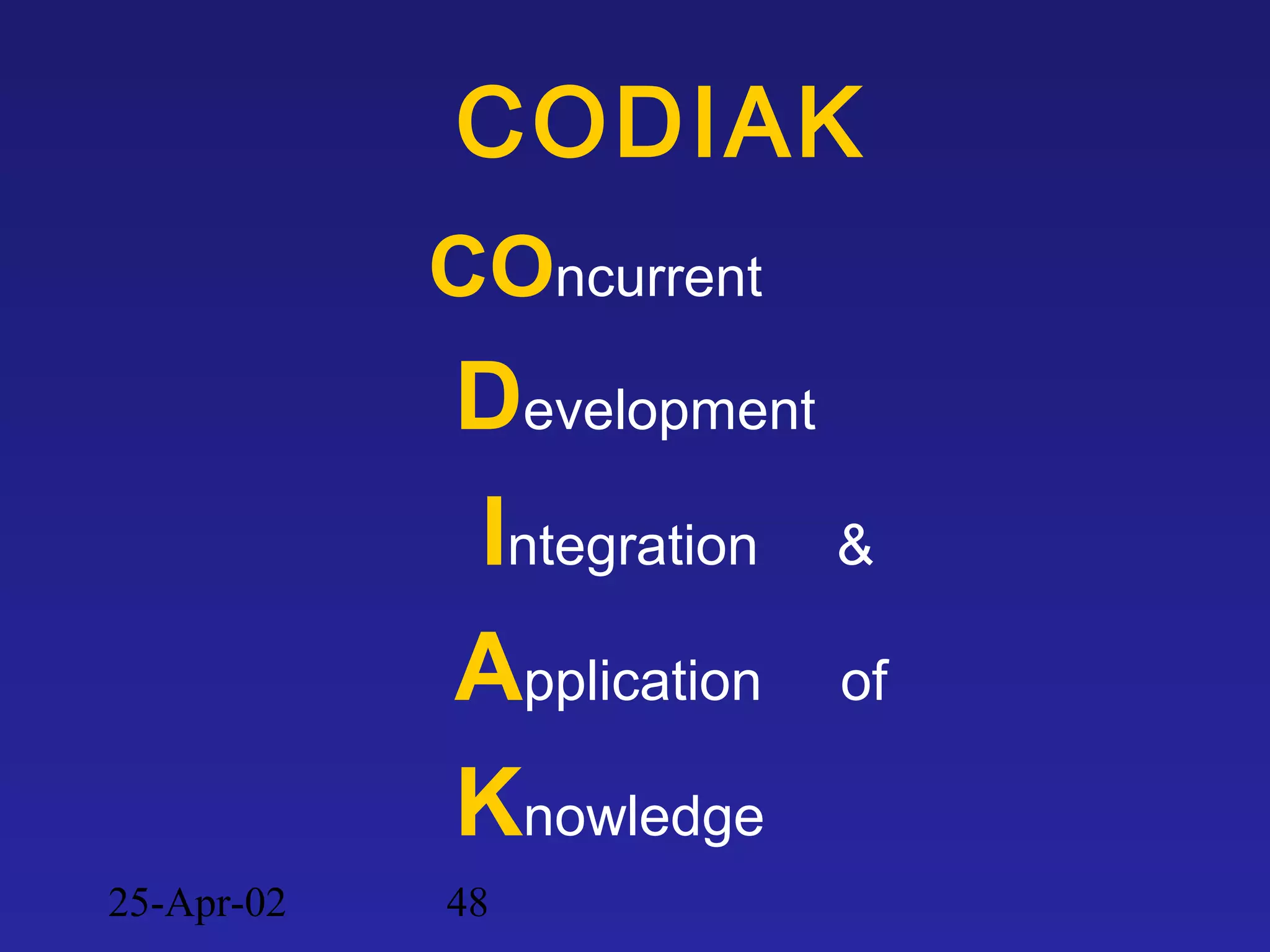
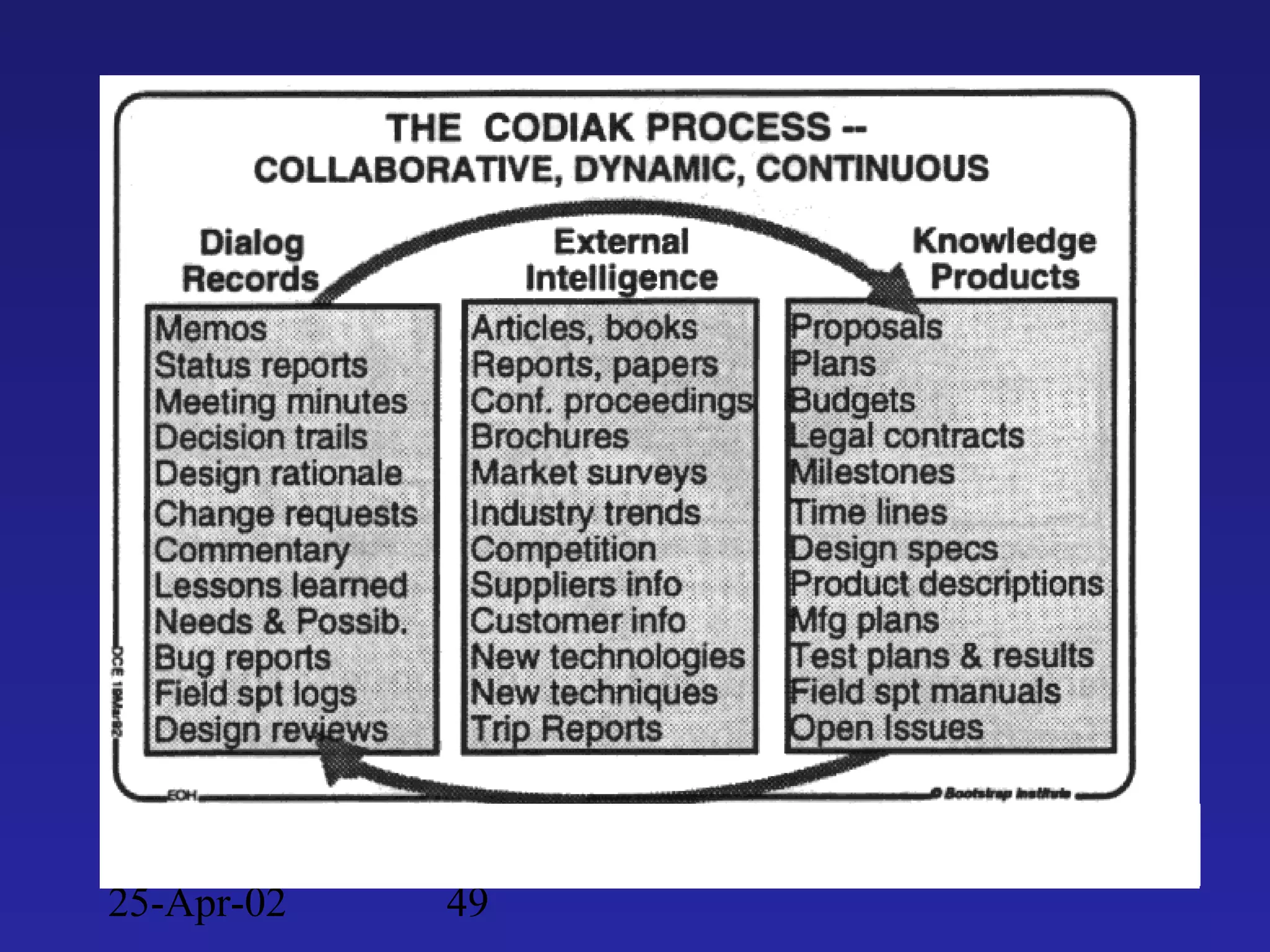
CODIAK
COncurrent
Development
Integration &
Application of
Knowledge
25-Apr-02 49
25-Apr-02 50
The Tool-System Target -- an Open
Hyperdocument System (OHS)
• Critical Requirement: Establishing an initial,
“OHS-Launch Base” upon which to start
serious co-evolution.
• Basic architecture and implementation must
enable smooth transition to very large-scale
evolution of document properties and system
functionality.
• Critical: Must enable smooth transitioning from
legacy systems as shift work dependence onto
OHS.
25-Apr-02 51
Concurrency and InteroperabilityConcurrency and Interoperability
6000+ Companies,6000+ Companies,
Concurrently EvolvingConcurrently Evolving
their Knowledge Repositoriestheir Knowledge Repositories
Designing, Developing,Designing, Developing,
Tracking ProgressTracking Progress
and Changesand Changes
……then add,then add,
customers,customers,
teaming partners...teaming partners...
(2000+ people)
(4000) 3rd Tier Suppliers
(2000) 2nd Tier Suppliers
Aerospace
Firm
(200) 1st Tier Suppliers
25-Apr-02 52
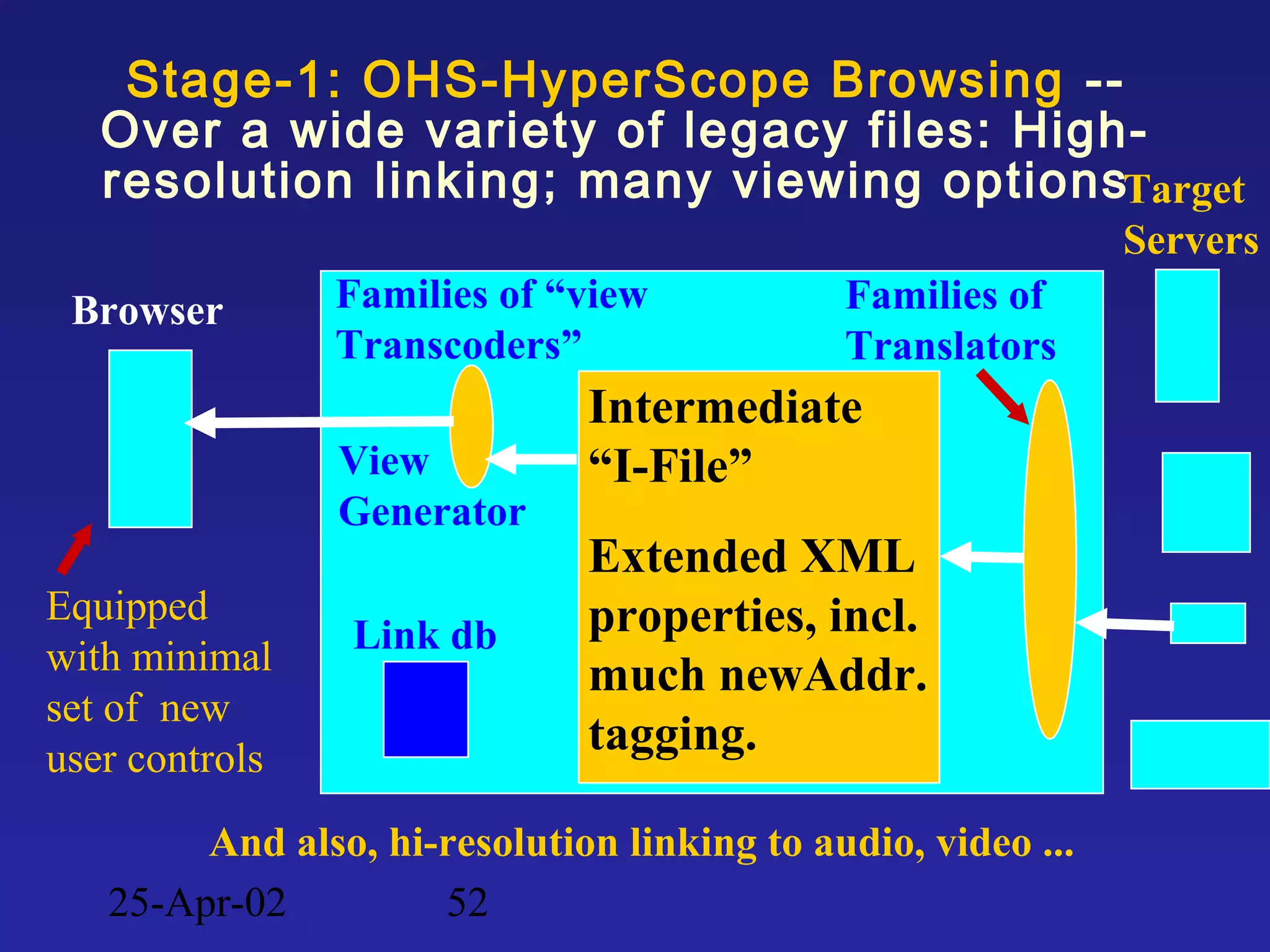
Stage-1: OHS-HyperScope Browsing --
Over a wide variety of legacy files: High-
resolution linking; many viewing options.
Intermediate
“I-File”
Extended XML
properties, incl.
much newAddr.
tagging.
Target
Servers
Families of
Translators
Families of “view
Transcoders”
Link db
Browser
And also, hi-resolution linking to audio, video ...
View
Generator
Equipped
with minimal
set of new
user controls
25-Apr-02 53
Agenda
• Some Key Distinctions, Terms, and Ideas
• Augmentation Systems and Co-evolution
• The ABCs of Improvement Infrastructure
• Collective Effort and Collective IQ
• Scale Issues
• Networked Improvement Communities
• Functional Requirements
• Application to Your Organization
• The Bootstrap Alliance
25-Apr-02 54
The World in the 21st
Century
Creating the Infocomm Future
• Building New Capabilities and Leveraging
Innovation for Key Growth Areas
• Using Infocomm Technologies to Build New
Capability and Capacity
• Being Proactive and Responsive
• Re-inventing Government in the Digital Economy
Proposing our Shared Strategic Objectives
… let’s view these goals in terms of facilitated evolution
25-Apr-02 55
Concurrency:Concurrency:
Scaling UpScaling Up ----
actually, toactually, to
global scope.global scope.
KnowledgeKnowledge
ProductsProducts
IntelligenceIntelligence
CollectionCollection
RecordedRecorded
DialogDialog
Know-Know-
ledgeledge
Intell.Intell.DialogDialog
Critical Factor: “Concurrent”
Evolution of Society’s Dynamic
Knowledge Repositories
DKRs
25-Apr-02 56
Key Ideas for Your
Organization
• Innovation is NOT chaotic -- you can
put in place a plan for facilitation
• Success is collective
• This approach applies not just to IT, but
to shipping, governmental operation,
and collective IQ in general
• An organization or even an economy
that learns to do this well will grow
across all sectors
25-Apr-02 57
Agenda
• Some Key Distinctions, Terms, and Ideas
• Augmentation Systems and Co-evolution
• The ABCs of Improvement Infrastructure
• Collective Effort and Collective IQ
• Scale Issues
• Networked Improvement Communities
• Functional Requirements
• Application to Your Organization
• The Bootstrap Alliance
25-Apr-02 58
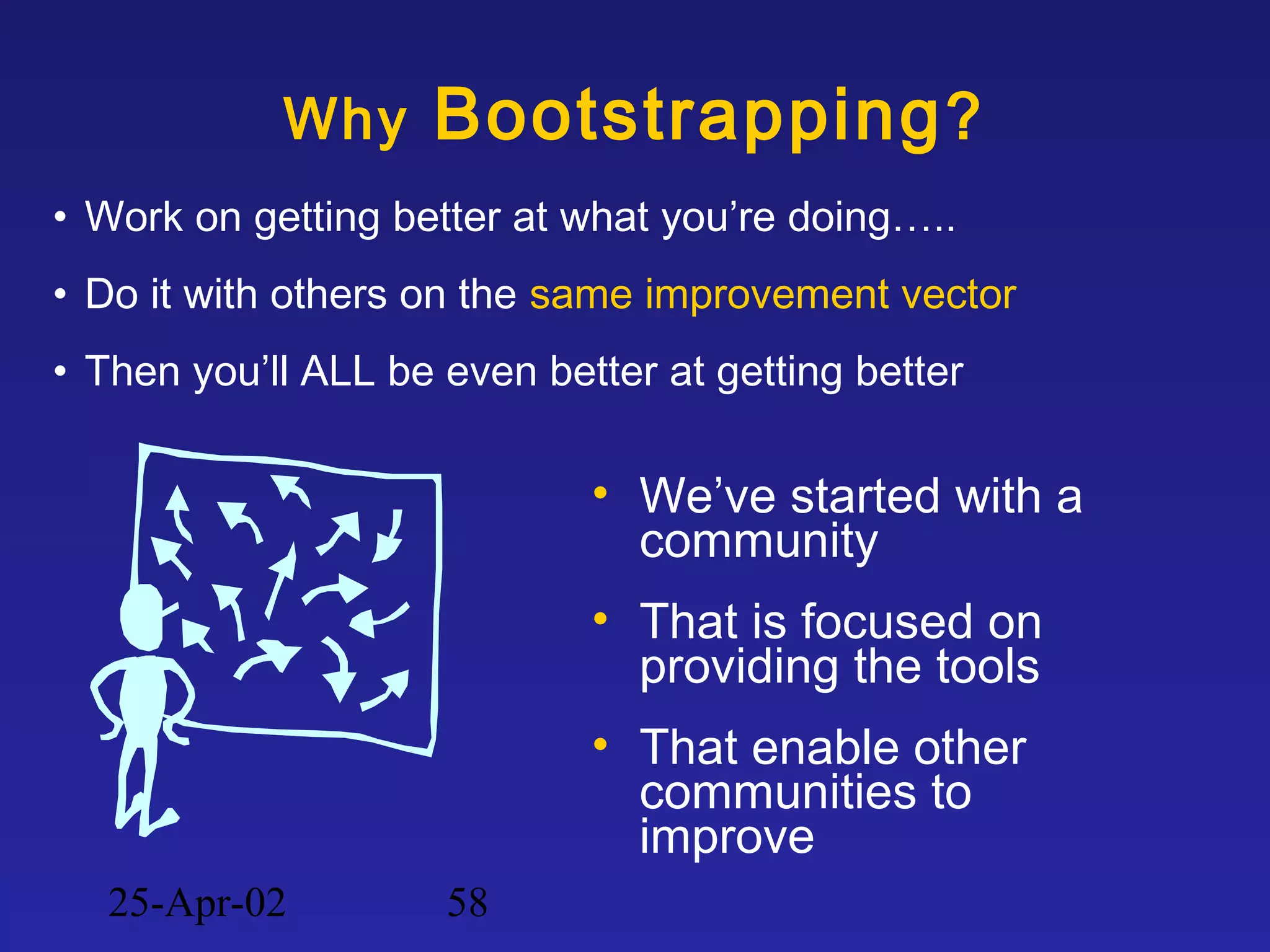
Why Bootstrapping?
• We’ve started with a
community
• That is focused on
providing the tools
• That enable other
communities to
improve
• Work on getting better at what you’re doing…..
• Do it with others on the same improvement vector
• Then you’ll ALL be even better at getting better
25-Apr-02 59
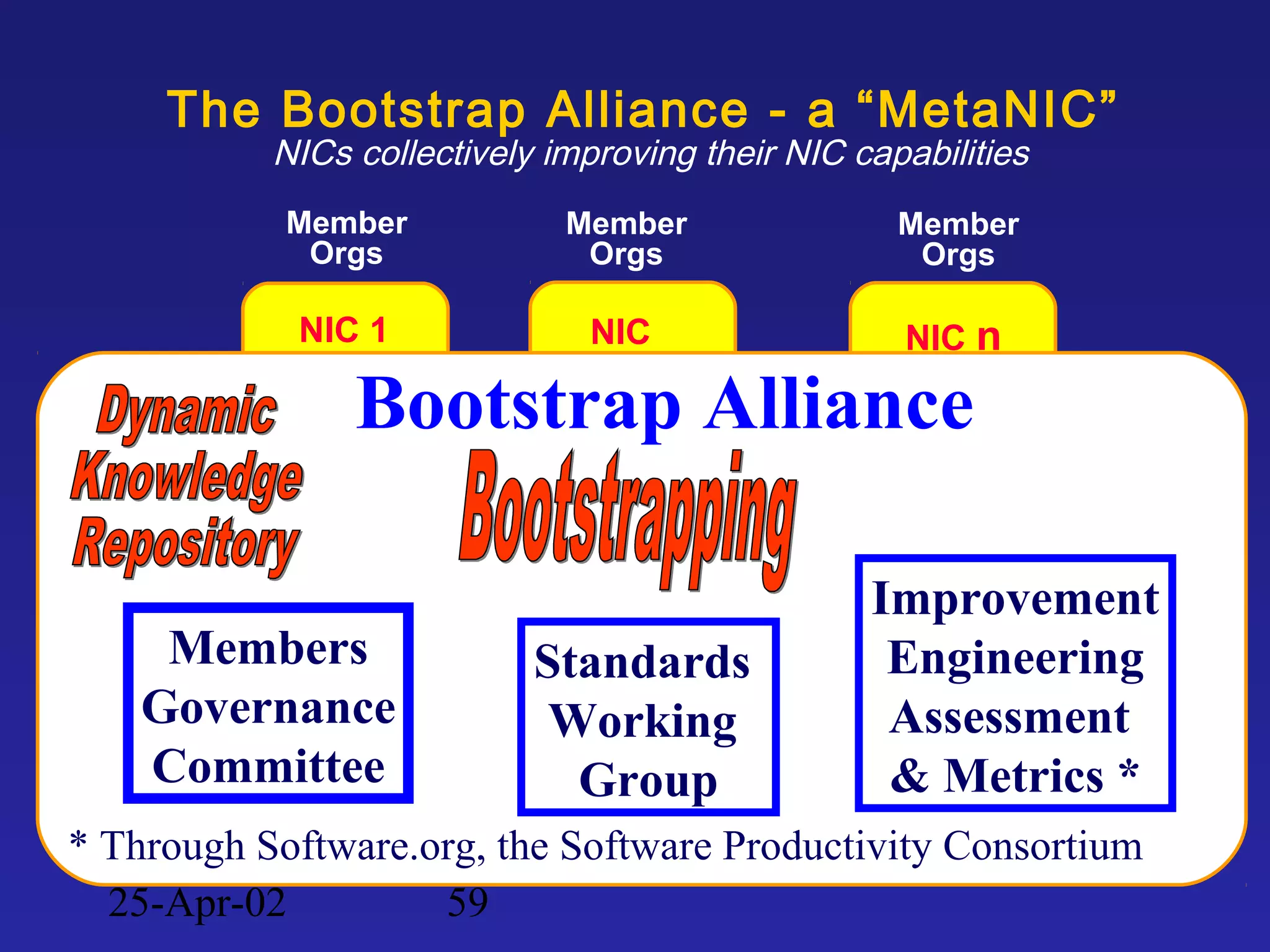
Member
Orgs
B
NIC 1
C
Member
Orgs
Member
Orgs
B B
...NIC
2
C C
NIC n
B
The Bootstrap Alliance - a “MetaNIC”
NICs collectively improving their NIC capabilities
Bootstrap Alliance
Members
Governance
Committee
Standards
Working
Group
Improvement
Engineering
Assessment
& Metrics *
* Through Software.org, the Software Productivity Consortium
25-Apr-02 60
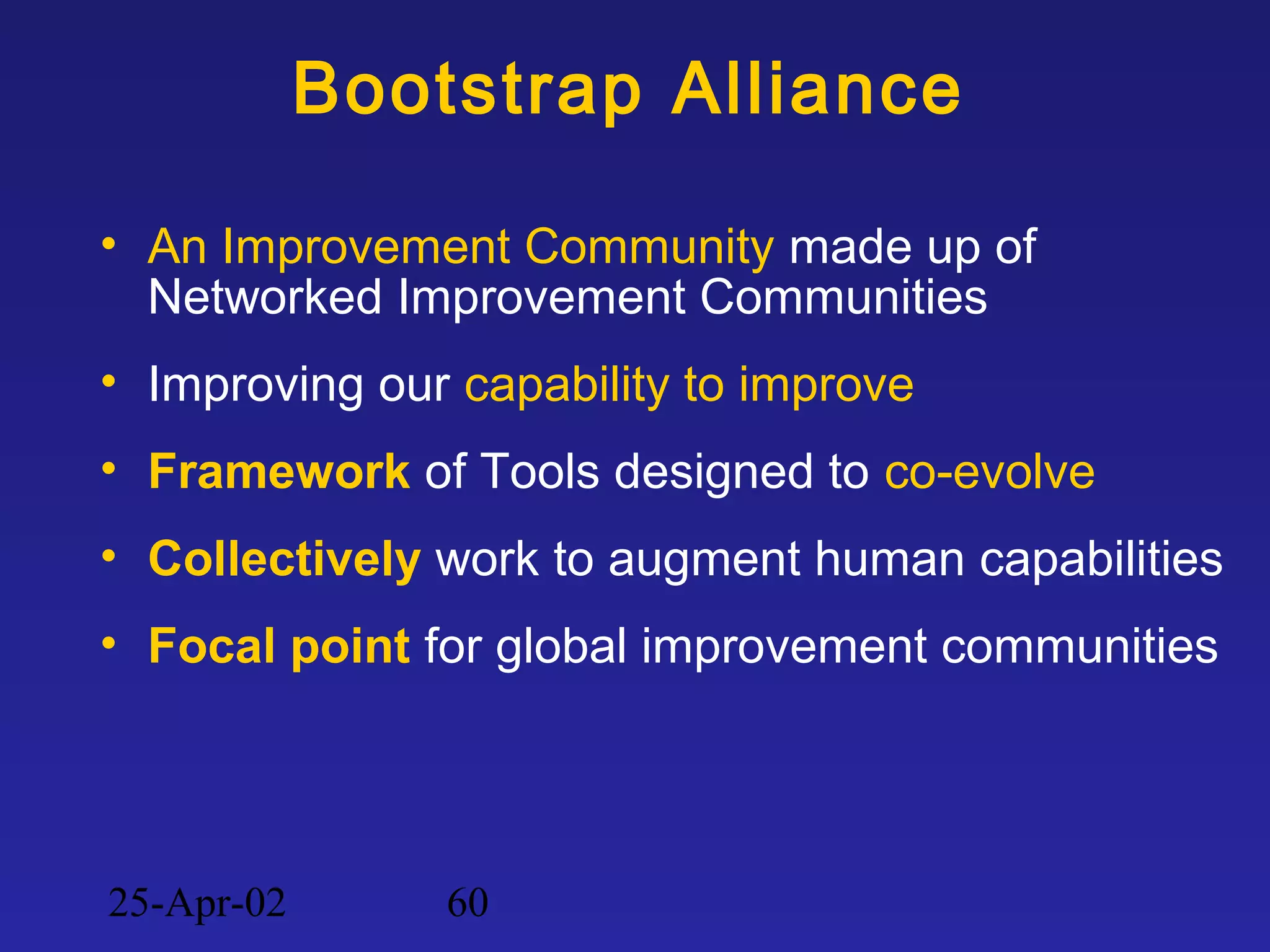
Bootstrap Alliance
• An Improvement Community made up of
Networked Improvement Communities
• Improving our capability to improve
• Framework of Tools designed to co-evolve
• Collectively work to augment human capabilities
• Focal point for global improvement communities
25-Apr-02 61
Dr. Douglas C. Engelbart
Bootstrap Alliance, USA
www.bootstrap.org
Improving Our Ability to Improve:
A Call for Investment in a New Future
Large scale Facilitated Evolution
Of our Improvement Infrastructure

Engelbart Keynote: World Library Summit

  • 1.
    25-Apr-02 1 Dr. DouglasC. Engelbart Bootstrap Alliance, USA www.bootstrap.org Improving Our Ability to Improve: A Call for Investment in a New Future Large scale Facilitated Evolution Of our Improvement Infrastructure
  • 2.
    25-Apr-02 2 The Worldin the 21st Century Creating the Infocomm Future • Building New Capabilities and Leveraging Innovation for Key Growth Areas • Using Infocomm Technologies to Build New Capability and Capacity • Being Proactive and Responsive • Re-inventing Government in the Digital Economy Proposing our Shared Strategic Objectives … these objectives are the focus of my talk
  • 3.
    25-Apr-02 3 My goalthis lecture ... is to help you see these objectives in a new light, understanding them as truly: • long term • deeply strategic • transformative • open ended
  • 4.
    25-Apr-02 4 A “WhatIf” Experiment Imagine that it is the late 1980s • the Internet exists (the basic capability to support the “Web” is already in place) • but the World Wide Web is still in the future • which means that the field is open for Your Organization or Your Country to take a leading position in the technical revolution that is about to happen What would your organization or your country need to be doing to grasp this opportunity?
  • 5.
    25-Apr-02 5 Not anidle question ... The real impact of the Net and Web is just beginning to be felt. Some candidate “next big things …” • the Semantic Web • the shift in the value of content • ubiquitous computing How can your organization learn enough, fast enough, to grasp the next transformative opportunity?
  • 6.
    25-Apr-02 6 Disruptive Innovation ExistingCapability Requirements of Established Market Increased capability always outruns typical requirements as described by Clayton Christensen - “The Innovator’s Dilemma”
  • 7.
    25-Apr-02 7 Disruptive Innovation NewCapability New Requirements in new, emerging market Disruptive innovations start out offering less capability as described by Clayton Christensen - “The Innovator’s Dilemma”
  • 8.
    25-Apr-02 8 Disruptive Innovation But,over time, the new innovation can meet established market requirements, displacing existing market market structure as described by Clayton Christensen - “The Innovator’s Dilemma” Disruption Starts Here
  • 9.
    25-Apr-02 9 Disruptive Innovation Innovationsthat Never find a market Of course, not all emerging innovations work out … as described by Clayton Christensen - “The Innovator’s Dilemma”
  • 10.
    25-Apr-02 10 Back toour WWW example ... The challenge for your organization • acquire the capability in the disruptive innovations • invest broadly enough to encompass disruptive innovations as well as innovations that don’t move forward • avoid getting “boxed in” with established approaches
  • 11.
    25-Apr-02 11 • BuildingNew Capabilities • Being Pro-active A plan to boost “Collective IQ” How to do this? Understood broadly, goals of “building new capability” and “being proactive” can address this challenge -- but only if placed within a structure of planned, facilitated evolution of your organization or your country’s collective ability.
  • 12.
    25-Apr-02 12 Agenda 1.Some KeyDistinctions, Terms, and Ideas 2.Augmentation Systems and Co-evolution 3.The ABCs of Improvement Infrastructure 4.Collective Effort and Collective IQ 5.Scale Issues 6.Networked Improvement Communities 7.Functional Requirements 8.Application to Your Organization 9.The Bootstrap Alliance
  • 13.
    25-Apr-02 13 Agenda • SomeKey Distinctions, Terms, and Ideas – “Augmentation” vs. “Automation” – “Human” vs. “Mechanistic” – Growing Knowledge Professionals – “Capabilities Infrastructure” – “Human Systems” and “Tool Systems” – Co-evolution
  • 14.
    25-Apr-02 14 “Augment” vs.“Automate” • Automate – It’s why we use computers today – Replace us in work we used to do • Augment – As the plow augmented our ability to cultivate – Extend us to solve problems we have not been able to address yet, to take on work we need to do Despite US $Billions invested in computer development, recent events sadly have reminded us of what we can’t do…..
  • 15.
    25-Apr-02 15 An Example:GDIN The Global Disaster Information Network • Disasters require collaborative response • To respond to disasters – Which can range from small to VAST SCALE – new teams of strangers collaborate – must learn to adapt – ingest and act on new information quickly • It’s Very Hard to Automate – getting Right Information – at Right Time – to the Right Place – globally to Ad Hoc teams
  • 16.
    25-Apr-02 16 Infrastructure ofCapabilities Example: An Internet Service Provider Capability Infrastructure Capability Infrastructure Capability to operate an ISP Capability to high bandwidth access Capability to speak, read, write, give and follow directions, fit into culture Higher Levels Depend on Lower Levels Capability to provide customer support Capability to handle billing for use Capability to plan for growth
  • 17.
    25-Apr-02 17 Extended Capabilities Dependin turn on Tool System Capability Infrastructure Capability Infrastructure Tool System Media Portray Travel, View Study Manipulate Retrieve Compute Communicate Consider the impact of the invention of the tool: The Plow
  • 18.
    25-Apr-02 18 Impact ofthe Plow • Hunter Gatherer nomadic lives changed • Plow allowed settling down • Lead to importance of land ownership • Inheritance laws • Villages Towns Cities • Commerce, Social Cultural Life sprang up • Each addition to Tool System leads to changes in the Human System
  • 19.
    25-Apr-02 19 “Human System” Appearedbefore the Artifacts (tools) did Capability Infrastructure Tool System Media Portray Travel, View Study Manipulate Retrieve Compute Communicate Human System Paradigms Organization Procedures Customs Methods Language Attitudes In the 20th Century the world’s work began shifting from Agriculture to Manufacturing. In the 21st Century, to Knowledge
  • 20.
    25-Apr-02 20 Co-Evolution ofthe Human and Tool System • The Plow didn’t automate existing work – it augmented human’s ability, opened possibilities • Think about the invention of – Spoken Language – Alphabet – Printing Press • All changed the human system over 100’s of years and triggered the invention of more tools – Triggering changes in human paradigms and culture – Triggering more tools…… and so on
  • 21.
    25-Apr-02 21 Agenda • SomeKey Distinctions, Terms, and Ideas • Augmentation Systems and Co-evolution • The ABCs of Improvement Infrastructure • Collective Effort and Collective IQ • Scale Issues • Networked Improvement Communities • Functional Requirements • Application to Your Organization • The Bootstrap Alliance
  • 22.
    25-Apr-02 22 Capability Infrastructure The AugmentationSystem Augments Basic Human Capabilities Human Interface Sensory Perception Motor & Mental Skills Skills Training Conditioning Tool System Media Portray Travel, View Study Manipulate Retrieve Compute Communicate Human System Paradigms Organization Procedures Customs Methods Language Attitudes
  • 23.
    25-Apr-02 23 Augmentation vs.Automation of Human Capabilities Start from basic human ability – Sensory Perception – Mental Skills – Motor Skills Add – Skills – Training – Conditioning………. Skills Training Conditioning Capability Infrastructure Tool System Media Portray Travel, View Study Manipulate Retrieve Compute Communicate Human System Paradigms Organization Procedures Customs Methods Language Attitudes Paradigms Organization Procedures Customs Methods Language Attitudes Sensory Perception Motor & Mental Skills Our basic human abilities harnessed the plow. Millennia later ….who could have imagined the changes? Digital Technology offers so much flexibility, as we start to Harness it, its clear: We have a long long way to go
  • 24.
    25-Apr-02 24 Why Co-Evolution? Weneed to: • develop new ways to share knowledge in the Human System • extend the Tool System • extend the Capability Infrastructure Moving forward on all of these fronts concurrently – as they feed back to each other – goes beyond our ability to design … It is a PROCESS that EVOLVES … Skills Training Conditioning Capability Infrastructure Tool System Media Portray Travel, View Study Manipulate Retrieve Compute Communicate Human System Paradigms Organization Procedures Customs Methods Language Attitudes Paradigms Organization Procedures Customs Methods Language Attitudes Sensory Perception Motor & Mental Skills
  • 25.
    25-Apr-02 25 Improvement Infrastructure forNew, Discontinuous Innovation • Requires conscious collective investment • Requires whole Augmentation system perspective - human and tool co-evolution Over 50 years ago, I saw the frontier differently from those around me
  • 26.
    25-Apr-02 26 Where isyour Organization? Tool System Utilization HumanSystemDevelopment 20 Years 20Years Anticipatable Today The World’s Organizations in Human-Tool Space
  • 27.
    25-Apr-02 27 20 Years 20Years Anticipatable TodayToolSystem Utilization HumanSystemDevelopment Co-Evolution Frontier Outposts and Scouts Outposts & Scouts to Scout out the Frontier Pioneering Organization
  • 28.
    25-Apr-02 28 Tools andMeans for High Performance Teams • “Equip” teams to gear up for high performance, high leverage, group-capability enhancing work • “Knowledge Containers” with a high degree of mobility and knowledge transferability • “Integration” of historic, current, geographically dispersed knowledge • “Contests” for best Knowledge teams • “Compete” to set up best Knowledge models
  • 29.
    25-Apr-02 29 Developing KnowledgePro’s a “Learned” skill like reading • What does it take to “Grow” Novices to Pro’s – Develop skills till they’re done unconsciously – Coaching – Role models – Purposeful usage – Real goals that stretch abilities • Strategic “Frameworks” that ease the learning – Start from regular work, evolve in smooth stages – Provide choices: Entry level to Pro level knowledge tools
  • 30.
    25-Apr-02 30 Agenda • SomeKey Distinctions, Terms, and Ideas • Augmentation Systems and Co-evolution • The ABCs of Improvement Infrastructure • Collective Effort and Collective IQ • Scale Issues • Networked Improvement Communities • Functional Requirements • Application to Your Organization • The Bootstrap Alliance
  • 31.
    25-Apr-02 31 • BActivity - improves product cycle time and quality • A Activity - serves the customer Customer Organization A Core Business Activity B Improves A Capability ABC’s of Improvement Infrastructure “How can we improve our ability to improve?”
  • 32.
    25-Apr-02 32 • CActivity - improves improvement cycle time and quality • B Activity - improves product cycle time and quality • A Activity - serves the customer Customer Organization A Core Business Activity B Improves A Capability C Improves B Capability Readying the Organization for Frontier Penetration -- more complete picture.
  • 33.
    25-Apr-02 33 Investing in “A”“B” and “C” Activities • “A” activity improved productivity comes from investment made in “B” activities • “B” investments fund most of the new activities in developing IT infrastructure How to maximize the Payoff from investment in “B” activities? We are asking how we improve our ability to improve • “C” investments which scope out the frontier, define metrics, drive improved productivity in the “B” activity
  • 34.
    25-Apr-02 34 Is yourorganization an Example of “C” Work ? • Discuss write about Prospects for changes – Why argue for this or that change? – How to go about proposing changes? • Review goals, scenarios, plans – Think about setting up prototypes, pilot operations – Develop assessments, metrics • Consider tools to Augment “C” Work – Collect & Integrate Knowledge – Build Knowledge Repository & Distribute Access
  • 35.
    25-Apr-02 35 Invest Wiselyin Improvement Don’t Go It Alone, Look for Other Organizations on the Frontier Heading the Same Way . . . . . …improving a similar set of capabilities B Customers C A Org 1 Customers C Customers C ...A Org 2 BB A Org n
  • 36.
    25-Apr-02 36 Agenda • SomeKey Distinctions, Terms, and Ideas • Augmentation Systems and Co-evolution • The ABCs of Improvement Infrastructure • Collective Effort and Collective IQ • Scale Issues • Networked Improvement Communities • Functional Requirements • Application to Your Organization • The Bootstrap Alliance
  • 37.
    25-Apr-02 37 Why CollectiveInvestment is Critical Because of Complexity
  • 38.
  • 39.
    25-Apr-02 39 Agenda • SomeKey Distinctions, Terms, and Ideas • Augmentation Systems and Co-evolution • The ABCs of Improvement Infrastructure • Collective Effort and Collective IQ • Scale Issues • Networked Improvement Communities • Functional Requirements • Application to Your Organization • The Bootstrap Alliance
  • 40.
    25-Apr-02 40 Concurrency andInteroperabilityConcurrency and Interoperability 6000+ Companies,6000+ Companies, Concurrently EvolvingConcurrently Evolving their Knowledge Repositoriestheir Knowledge Repositories Designing, Developing,Designing, Developing, Tracking ProgressTracking Progress and Changesand Changes ……then add,then add, customers,customers, teaming partners...teaming partners... (2000+ people) (4000) 3rd Tier Suppliers (2000) 2nd Tier Suppliers Aerospace Firm (200) 1st Tier Suppliers
  • 41.
    25-Apr-02 41 In theUS, the Office of Homeland Response prepared a chart of the organizations involved in responding to Chemical and Biological Warfare threats. This organizational structure - not unusual for sophisticated organizations and ambitious cooperative efforts, illustrates how complexity scales up. Uggrh!
  • 42.
    25-Apr-02 42 Huge strategicfactor: The matter of SCALE! • The scale of the capability-evolution challenge transcends what any one company, any one Explicit Plan, could formulate and accomplish. • So, get serious about developing an appropriate Evolutionary Environment! • Perhaps even, about evolving an appropriate Evolutionary Environment?
  • 43.
    25-Apr-02 43 Agenda • SomeKey Distinctions, Terms, and Ideas • Augmentation Systems and Co-evolution • The ABCs of Improvement Infrastructure • Collective Effort and Collective IQ • Scale Issues • Networked Improvement Communities • Functional Requirements • Application to Your Organization • The Bootstrap Alliance
  • 44.
    25-Apr-02 44 B Customers C A Org 1 Customers C Customers C ...A Org2 BB A Org n What is an Improvement Community ? A “C” Community “C” Community Each “C” member actively serves their respective “B” initiatives • Common challenges, issues, requirements • Share advice, strategies, lessons learned Common “Customer Group” -- the “Bs”
  • 45.
    25-Apr-02 45 What isa Networked Improvement Community ? Or NIC C “C” 1 C C ...“C” 2 “C” n Networked Improvement Community A C Community that is an explicit pilot-practitioner of the best Collective IQ capability the community can muster
  • 46.
    25-Apr-02 46 Agenda • SomeKey Distinctions, Terms, and Ideas • Augmentation Systems and Co-evolution • The ABCs of Improvement Infrastructure • Collective Effort and Collective IQ • Scale Issues • Networked Improvement Communities • Functional Requirements • Application to Your Organization • The Bootstrap Alliance
  • 47.
    25-Apr-02 47 Dynamic KnowledgeRepositories Central to Explicitly Tapping Collective IQ • In a structured navigable way, keep track of – Recorded Dialog – External Intelligence Collection – Knowledge Product • “Integration” – Tough Hard Problem – Within purposeful working environments involving diverse people in multiple organizations • “Concurrency” – Tough Hard Problem – If our two organizations have interdependencies, then my Repository needs to “concur” with yours within our cooperation domain
  • 48.
  • 49.
  • 50.
    25-Apr-02 50 The Tool-SystemTarget -- an Open Hyperdocument System (OHS) • Critical Requirement: Establishing an initial, “OHS-Launch Base” upon which to start serious co-evolution. • Basic architecture and implementation must enable smooth transition to very large-scale evolution of document properties and system functionality. • Critical: Must enable smooth transitioning from legacy systems as shift work dependence onto OHS.
  • 51.
    25-Apr-02 51 Concurrency andInteroperabilityConcurrency and Interoperability 6000+ Companies,6000+ Companies, Concurrently EvolvingConcurrently Evolving their Knowledge Repositoriestheir Knowledge Repositories Designing, Developing,Designing, Developing, Tracking ProgressTracking Progress and Changesand Changes ……then add,then add, customers,customers, teaming partners...teaming partners... (2000+ people) (4000) 3rd Tier Suppliers (2000) 2nd Tier Suppliers Aerospace Firm (200) 1st Tier Suppliers
  • 52.
    25-Apr-02 52 Stage-1: OHS-HyperScopeBrowsing -- Over a wide variety of legacy files: High- resolution linking; many viewing options. Intermediate “I-File” Extended XML properties, incl. much newAddr. tagging. Target Servers Families of Translators Families of “view Transcoders” Link db Browser And also, hi-resolution linking to audio, video ... View Generator Equipped with minimal set of new user controls
  • 53.
    25-Apr-02 53 Agenda • SomeKey Distinctions, Terms, and Ideas • Augmentation Systems and Co-evolution • The ABCs of Improvement Infrastructure • Collective Effort and Collective IQ • Scale Issues • Networked Improvement Communities • Functional Requirements • Application to Your Organization • The Bootstrap Alliance
  • 54.
    25-Apr-02 54 The Worldin the 21st Century Creating the Infocomm Future • Building New Capabilities and Leveraging Innovation for Key Growth Areas • Using Infocomm Technologies to Build New Capability and Capacity • Being Proactive and Responsive • Re-inventing Government in the Digital Economy Proposing our Shared Strategic Objectives … let’s view these goals in terms of facilitated evolution
  • 55.
    25-Apr-02 55 Concurrency:Concurrency: Scaling UpScalingUp ---- actually, toactually, to global scope.global scope. KnowledgeKnowledge ProductsProducts IntelligenceIntelligence CollectionCollection RecordedRecorded DialogDialog Know-Know- ledgeledge Intell.Intell.DialogDialog Critical Factor: “Concurrent” Evolution of Society’s Dynamic Knowledge Repositories DKRs
  • 56.
    25-Apr-02 56 Key Ideasfor Your Organization • Innovation is NOT chaotic -- you can put in place a plan for facilitation • Success is collective • This approach applies not just to IT, but to shipping, governmental operation, and collective IQ in general • An organization or even an economy that learns to do this well will grow across all sectors
  • 57.
    25-Apr-02 57 Agenda • SomeKey Distinctions, Terms, and Ideas • Augmentation Systems and Co-evolution • The ABCs of Improvement Infrastructure • Collective Effort and Collective IQ • Scale Issues • Networked Improvement Communities • Functional Requirements • Application to Your Organization • The Bootstrap Alliance
  • 58.
    25-Apr-02 58 Why Bootstrapping? •We’ve started with a community • That is focused on providing the tools • That enable other communities to improve • Work on getting better at what you’re doing….. • Do it with others on the same improvement vector • Then you’ll ALL be even better at getting better
  • 59.
    25-Apr-02 59 Member Orgs B NIC 1 C Member Orgs Member Orgs BB ...NIC 2 C C NIC n B The Bootstrap Alliance - a “MetaNIC” NICs collectively improving their NIC capabilities Bootstrap Alliance Members Governance Committee Standards Working Group Improvement Engineering Assessment & Metrics * * Through Software.org, the Software Productivity Consortium
  • 60.
    25-Apr-02 60 Bootstrap Alliance •An Improvement Community made up of Networked Improvement Communities • Improving our capability to improve • Framework of Tools designed to co-evolve • Collectively work to augment human capabilities • Focal point for global improvement communities
  • 61.
    25-Apr-02 61 Dr. DouglasC. Engelbart Bootstrap Alliance, USA www.bootstrap.org Improving Our Ability to Improve: A Call for Investment in a New Future Large scale Facilitated Evolution Of our Improvement Infrastructure

Editor's Notes

  • #2 Good News and Bad News The development of new computing technologies over the past fifty years – in hardware and software – has provided stunningly important changes in the way we work and in the way we solve problems. I need to get this assertion out in front of you early in this talk, because most of the rest of what I have to say might cause you to think that I have lost track of this progress or that I don’t appreciate it. So, let me get it said … we have made enormous strides since the early 1950s, when I first began thinking seriously about ways to use computers to address important social problems. It has truly been a remarkable fifty years.
  • #15 we are not yet really making good progress toward realizing the really substantial payoff that is possible. That payoff will come when we make better use of computers to bring communities of people together and to augment the very human skills that people bring to bear on difficult problems. In this talk I want to talk to you about that big payoff What is getting in the way of our making better progress Enlist you in an effort to redirect our focus. Let you know what I see as the goal – the way to get the significant payoff from using computers to augment what people can do. This vision of success has not changed much for me over fifty years – it has gotten more precise and detailed – but it is pointed at the same potential that I saw in the early 1950s. It is based on a very simple idea, which is that when problems are really difficult and complex – problems like addressing hunger, containing terrorism, or helping an economy grow more quickly – the solutions come from the insights and capabilities of people working together. So, it is not the computer, working alone, that produces a solution. But is the combination of people, augmented by computers.
  • #16 One organization that we work with is “GDIN” a consortium of regional and local disaster response org. Organizations like this are tremendous examples of organizations that must learn to adapt and use new info. quickly. Responding requires rapid access to weather, geographical, mapping info. Info about local resources, local communications, outside resources & org’s. By many people from many organizations. Need to share all of this information about resources and capabilities, as well as response status, planned next steps, and so on. Computers and the Internet play a key role in the efforts to coordinate such disaster response and to improve the ability to improve over the lifecycle of a disaster response effort.. But what is striking is how difficult it is to harness all the wonderful capability of the systems that we have today in It is simply very difficult to share information Where “sharing” means the ability to find the right information, when it is needed, AND the ability to use it across systems.
  • #17 In the computer, we have a tool that actually can manipulate symbols and, even more important, portray symbols in new ways, so that we can interact with them and learn. We have a tool that radically extends our capabilities in the very area that makes us most human, and most powerful. I will explain how we can overcome such systematic bias and open the doors to the very substantial rewards from continued, productive discontinuous innovation. There is huge opportunity here The good news is that it is possible to build an infrastructure that supports discontinuous innovation. Capability Infrastructure Examples of what the boxes and arrows might be are…….
  • #18 Let’s look at our Tools And how they support our Capability Infrastructure They do things for us……
  • #20 Let’s look at the Human System, the paradigms, organization, culture we bring to bear on the Capability Infrastructure We’ve been designing our IT systems as though they were totally independent of all of this But they are not (Doug, when you click – the connecting lines will spring in) We are NOT done yet!
  • #23 To develop augmentation system: Have to start with basic orientation, culture, training. Keep in mind that people have to fit within the existing Augmentation system. Know about roles, be able to operate existing tools. If sensory equipment is not good enough,…. Augment….. For example glasses to see well enough to operate a car.
  • #24 By here we arrive at an understanding of the entire Augmentation system – as something that must be looked at as a whole system. Innovations on the Right hand side require Left hand side changes. And then LHS change creates new opportunities for RHS changes. Millions of adaptations occur as RHS starts accelerating ni tool production. We are in the situation where the things on the LHS are not yet evolved to adapt. We must find a way to gracefully co-evolve our human systems.
  • #32 ABCs of Improvement Infrastructure The key to developing an effective improvement infrastructure is the realization that, within any organization, there is a division of attention between the part of the organization that is concerned with the organization’s primary activity – I will call this the “A” activity – and the part of the organization concerned with improving the capability to perform this A-Level function. I refer to these improvement efforts as “B” activities. The two different levels of activity are illustrated here
  • #33 We really need to think in terms of yet another level of activity – I call it the “C” activity – that focuses specifically on the matter of accelerating the rate of improvement.
  • #36 Clearly, investment in type C activities is potentially highly leveraged. The right investments here will be multiplied in returns in increased B level productivity – in the ability to improve – which will be multiplied again in returns in productivity in the organization’s primary activity. It is a way of getting a kind of compound return on investment in innovation. The highly leveraged nature of investment in type C activities make this kind of investment in innovation particularly appropriate for governments, public service institutions such as libraries, and broad consortia of different agencies across an entire industry. The reason for this is not only that a small investment here can make a big difference – though that certainly is an important consideration – but also because the investment in C activities is typically pre-competitive. It is investment that can be shared even among competitors in an industry because it is, essentially, investment in creating a better playing field. Recent example of such investment in the U.S. is the relatively small investment that the Department of Defense made in what eventually became the Internet.
  • #41 Teams working at the C-level are working in parallel, sharing information with each other, and also tying what they find to external factors and bigger problems. Put more simply, C-level work requires investment integration – a concerted effort to tie the pieces together. That is, by the way, the reason that the teams that I was leading at SRI were developing ways to connect information with hyperlinks, Hyperlinks were quite literally a critical part of our ability to keep track of what we were doing. Thinking back to our research at SRI leads me to another key feature of development work at the C-level: You have to apply what you discover.That is the way that you reach out and snatch a bit of the future and bring it back to the present: You grab it and use it. At the C level, then, the approach focuses on: ·        Concurrent development ·        Integration across the different concurrent activities though continuous dialog and through constant cross checking with external information ·        Application of the knowledge that is gained, as a way of not only testing it, but also as a way to understand its nature and its ability to support improvement.
  • #48 We need is a place to keep and share the information that we collect – the dialog, the external information, the things that we learn. I call this the “Dynamic Knowledge Repository,” or DKR. It is more than a database, and more than a collection of Internet web sites. It doesn’t have to be all in one place – it can certainly be distributed across the different people and organizations that are collaborating on improving improvement – but it does need to be accessible to everyone – for reading, for writing, and for making new connections. The DKR is a wonderful example of the kind of investment that you can start making at the C level, with modest means, that will pay dividends back as it moves up the line to the B and the A levels. This is exactly what I mean when I talk about “bootstrapping.” The idea is one that we put into practice every time that we “boot up” a computer. A small bit of code in a permanent read only memory knows how to go out to the disk to get more instructions, that in turn know how do to even more things, such as getting even more instructions. Eventually, this process of using successive steps to lead to ever bigger steps, building on each other, get the whole machine up and running. You start small, and keep leveraging what you know at each stage to solve a bigger and bigger problem.
  • #50 As a mnemonic device you can take “Concurrent Development,” “Integration,” and “Application of Knowledge” and put them together in the term “CoDIAK.” For me, this invented word has become my shorthand This diagram illustrates the way that the CoDIAK process builds on continuous, dynamic integration of information so that the members of the team can learn from each other and move forward. So, what else do we need to get started?
  • #52 Teams working at the C-level are working in parallel, sharing information with each other, and also tying what they find to external factors and bigger problems. Put more simply, C-level work requires investment integration – a concerted effort to tie the pieces together. That is, by the way, the reason that the teams that I was leading at SRI were developing ways to connect information with hyperlinks, Hyperlinks were quite literally a critical part of our ability to keep track of what we were doing. Thinking back to our research at SRI leads me to another key feature of development work at the C-level: You have to apply what you discover.That is the way that you reach out and snatch a bit of the future and bring it back to the present: You grab it and use it. At the C level, then, the approach focuses on: ·        Concurrent development ·        Integration across the different concurrent activities though continuous dialog and through constant cross checking with external information ·        Application of the knowledge that is gained, as a way of not only testing it, but also as a way to understand its nature and its ability to support improvement.
  • #60 I come to this seminar representing my own small organization, the Bootstrap Alliance. We don’t sell a product – or anything else. But we do offer an opportunity for you to be actively engaged with other people and other institutions that are interested in understanding how to use this new fire that has been brought down from the heavens. The Bootstrap Alliance is an improvement community that is made up of other improvement communities – we are focused on improving the ability to improve, and on helping other groups that share those interests do a better job of it.
  • #61 We exist to help C-level organizations do a better job of being C-level organizations. Our approach to this, not surprisingly, is based on concurrent development, integration, and application of knowledge across those different pioneering communities. If you are interested in investing in the kind of critically important, highly leveraged mechanisms for change that I talk about here – in using the fire brought down from heaven – please come up and talk to me
  • #62 Good News and Bad News The development of new computing technologies over the past fifty years – in hardware and software – has provided stunningly important changes in the way we work and in the way we solve problems. I need to get this assertion out in front of you early in this talk, because most of the rest of what I have to say might cause you to think that I have lost track of this progress or that I don’t appreciate it. So, let me get it said … we have made enormous strides since the early 1950s, when I first began thinking seriously about ways to use computers to address important social problems. It has truly been a remarkable fifty years.