



Tim HortonsAlways Fresh
About the Company
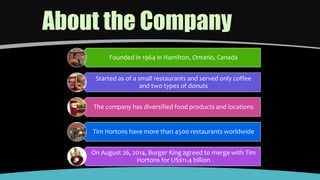
Founded in 1964 in Hamilton, Ontario, Canada
Started as of a small restaurants and served only coffee
and two types of donuts
The company has diversified food products and locations
Tim Hortons have more than 4500 restaurants worldwide
On August 26, 2014, Burger King agreed to merge with Tim
Hortons for US$11.4 billion
Vision Statement
▪ “Our vision is to be the quality
leader in everything we do”
▪ “The main focus is to excel in
the food industry and get
innovative products and to
enhance the existing services.
We constantly strive to be the
best through determination and
passion.”
Mission Statement
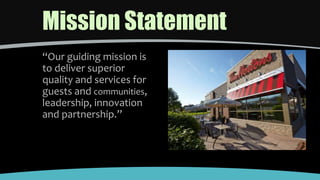
“Our guiding mission is
to deliver superior
quality and services for
guests and communities,
leadership, innovation
and partnership.”
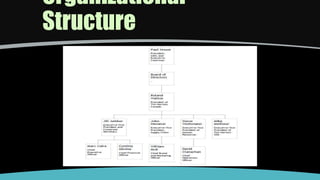
Organizational
Structure
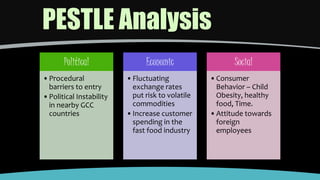
PESTLE Analysis
Political
•Procedural
barriers to entry
•Political Instability
in nearby GCC
countries
Economic
•Fluctuating
exchange rates
put risk to volatile
commodities
•Increase customer
spending in the
fast food industry
Social
•Consumer
Behavior – Child
Obesity, healthy
food, Time.
•Attitude towards
foreign
employees
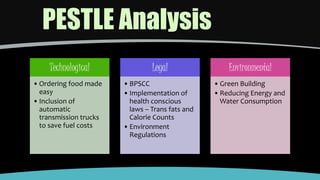
PESTLE Analysis
Technological
• Ordering food made
easy
• Inclusion of
automatic
transmission trucks
to save fuel costs
Legal
• BPSCC
• Implementation of
health conscious
laws – Trans fats and
Calorie Counts
• Environment
Regulations
Environmental
• Green Building
• Reducing Energy and
Water Consumption
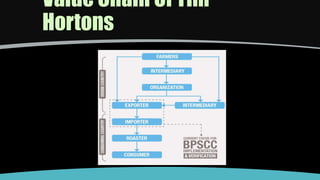
Value Chain Of Tim
Hortons
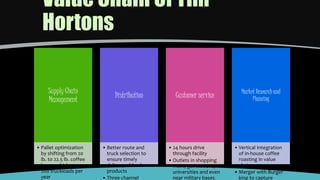
Value Chain Of Tim
Hortons
Supply Chain
Management
• Pallet optimization
by shifting from 20
lb. to 22.5 lb. coffee
boxes which save
200 truckloads per
year
Distribution
• Better route and
truck selection to
ensure timely
delivery of fresh
products
• Three channel
Customer service
• 24 hours drive
through facility
• Outlets in shopping
malls, gas stations,
universities and even
near military bases
Market Research and
Planning
• Vertical Integration
of in-house coffee
roasting in value
chain
• Merger with Burger
king to capture
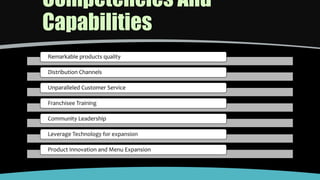
Competencies And
Capabilities
Remarkable products quality
Distribution Channels
Unparalleled Customer Service
Franchisee Training
Community Leadership
Leverage Technology for expansion
Product Innovation and Menu Expansion
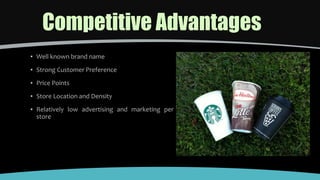
Competitive Advantages
▪ Well known brand name
▪ Strong Customer Preference
▪ Price Points
▪ Store Location and Density
▪ Relatively low advertising and marketing per
store
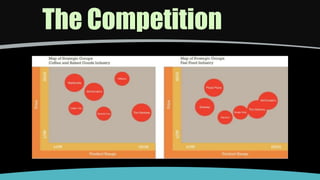
The Competition
Industry Drivers
In Coffee and Fast Food Industry,
taste as well as quality of the
product is the main driving force
Variety in the range of products
offered also an important factor for
this industry
Timely delivery of order to
customers important
Customer loyalty an important
driving force to the company to
grow
Success Factors
▪ Tim Hortons has been famous for its high quality as well as
taste of the coffee that they give to the customers.
▪ Apart from Coffee, from time to time, Tim Hortons offers
various other products to the customers. This included the ice
creams that Tim Hortons sold from the tie up with Cold Stone
Creamery as well the non-coffee beverages that it offered to
customers
▪ As Tim Hortons had started initially keeping office people in
mind, they were famous for their quick delivery of orders.
▪ Being famous for its freshness as well as on time delivery, Tim
Hortons commands high Customer Loyalty.
Growth Strategy
▪ Tim Hortons initially made it self a major player in the
coffee market in Canada were they captured the major
market share with 3500 stores.
▪ For entry into U.S.A, initially they tied up with Wendy’s
starting joints where both brands were present in the
same building.
▪ After this, the signed a contract with Cold Stone
Creamery under which, both companies shall sell the
products of the other company via there outlets.
▪ Merged with Burger King in 2014 which has helped it
enter the markets where Burger King is already
present. Also this has helped with product innovation
that has helped it bring more products for its
customers.
Growth Strategy
▪ Canada: Lead, Defend and Grow
▪ USA: A Must Win Battle
▪ International
– Expansion in Gulf Cooperation Council
– Position of Potential Market Entries
– Validation of International Market Opportunities and
Approach
THANK
YOU
Group 6 – Section B

Tim Hortons - Strategy and Core Competencies

  • 1.
  • 2.
    About the Company Foundedin 1964 in Hamilton, Ontario, Canada Started as of a small restaurants and served only coffee and two types of donuts The company has diversified food products and locations Tim Hortons have more than 4500 restaurants worldwide On August 26, 2014, Burger King agreed to merge with Tim Hortons for US$11.4 billion
  • 3.
    Vision Statement ▪ “Ourvision is to be the quality leader in everything we do” ▪ “The main focus is to excel in the food industry and get innovative products and to enhance the existing services. We constantly strive to be the best through determination and passion.”
  • 4.
    Mission Statement “Our guidingmission is to deliver superior quality and services for guests and communities, leadership, innovation and partnership.”
  • 5.
  • 6.
    PESTLE Analysis Political •Procedural barriers toentry •Political Instability in nearby GCC countries Economic •Fluctuating exchange rates put risk to volatile commodities •Increase customer spending in the fast food industry Social •Consumer Behavior – Child Obesity, healthy food, Time. •Attitude towards foreign employees
  • 7.
    PESTLE Analysis Technological • Orderingfood made easy • Inclusion of automatic transmission trucks to save fuel costs Legal • BPSCC • Implementation of health conscious laws – Trans fats and Calorie Counts • Environment Regulations Environmental • Green Building • Reducing Energy and Water Consumption
  • 8.
    Value Chain OfTim Hortons
  • 9.
    Value Chain OfTim Hortons Supply Chain Management • Pallet optimization by shifting from 20 lb. to 22.5 lb. coffee boxes which save 200 truckloads per year Distribution • Better route and truck selection to ensure timely delivery of fresh products • Three channel Customer service • 24 hours drive through facility • Outlets in shopping malls, gas stations, universities and even near military bases Market Research and Planning • Vertical Integration of in-house coffee roasting in value chain • Merger with Burger king to capture
  • 10.
    Competencies And Capabilities Remarkable productsquality Distribution Channels Unparalleled Customer Service Franchisee Training Community Leadership Leverage Technology for expansion Product Innovation and Menu Expansion
  • 11.
    Competitive Advantages ▪ Wellknown brand name ▪ Strong Customer Preference ▪ Price Points ▪ Store Location and Density ▪ Relatively low advertising and marketing per store
  • 12.
  • 13.
    Industry Drivers In Coffeeand Fast Food Industry, taste as well as quality of the product is the main driving force Variety in the range of products offered also an important factor for this industry Timely delivery of order to customers important Customer loyalty an important driving force to the company to grow
  • 14.
    Success Factors ▪ TimHortons has been famous for its high quality as well as taste of the coffee that they give to the customers. ▪ Apart from Coffee, from time to time, Tim Hortons offers various other products to the customers. This included the ice creams that Tim Hortons sold from the tie up with Cold Stone Creamery as well the non-coffee beverages that it offered to customers ▪ As Tim Hortons had started initially keeping office people in mind, they were famous for their quick delivery of orders. ▪ Being famous for its freshness as well as on time delivery, Tim Hortons commands high Customer Loyalty.
  • 15.
    Growth Strategy ▪ TimHortons initially made it self a major player in the coffee market in Canada were they captured the major market share with 3500 stores. ▪ For entry into U.S.A, initially they tied up with Wendy’s starting joints where both brands were present in the same building. ▪ After this, the signed a contract with Cold Stone Creamery under which, both companies shall sell the products of the other company via there outlets. ▪ Merged with Burger King in 2014 which has helped it enter the markets where Burger King is already present. Also this has helped with product innovation that has helped it bring more products for its customers.
  • 16.
    Growth Strategy ▪ Canada:Lead, Defend and Grow ▪ USA: A Must Win Battle ▪ International – Expansion in Gulf Cooperation Council – Position of Potential Market Entries – Validation of International Market Opportunities and Approach
  • 17.