WELCOME
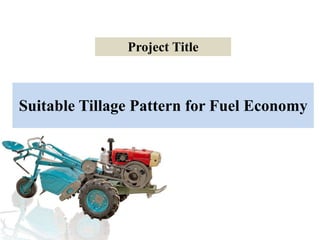
Project Title
Suitable Tillage Pattern for Fuel Economy
Presented by
 Md. Sultan Mahmud
St. id.:1107048
Session: 2010-11
 Shagor Sarkar
St. id.:1107051
Session: 2010-11
 A.B.M. Hasanul Kabir
St. id.:1107052
Session: 2010-11
Supervisor
Prof. Dr. Md. Kamal Uddin Sarker
Dean, Faculty of Engineering
Muhammad Abdul Munnaf
Lecturer, Dept. of Agricultural and Industrial
Engineering
Co-Supervisor
INTRODUCTION
 At present agriculture contributes about 20% of the total
gross domestic product (GDP) of Bangladesh.
 Crop sub sector alone contributes about 11% of the total
GDP of the country and about 75% of the agricultural GDP
(GOB, 2011).
 The status of the economy of Bangladesh in terms of output
and employment still greatly depends on the agricultural
sector.
 Agricultural mechanization embraces the use of tools,
implements and agricultural machinery in an efficient
form, to increase the crop production and improve
quality and reduce costs.
 It includes agricultural land development, harvesting,
preparation for storage, and on-farm processing
(Gatea, 2013).
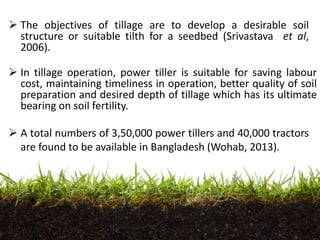
 The objectives of tillage are to develop a desirable soil
structure or suitable tilth for a seedbed (Srivastava et al,
2006).
 A total numbers of 3,50,000 power tillers and 40,000 tractors
are found to be available in Bangladesh (Wohab, 2013).
 In tillage operation, power tiller is suitable for saving labour
cost, maintaining timeliness in operation, better quality of soil
preparation and desired depth of tillage which has its ultimate
bearing on soil fertility.
 Substantive improvements can be made in the field efficiency
by analyzing and changing the model for planning and field
operations that depend on the area and shape of the field
Hunt D. R. (1999).
 As a developing country, Bangladeshi farmers need to apply
appropriate tillage pattern for saving fuel and reducing the
cost of tillage in different soil condition all over the country.
The main objective of the research work was to find a suitable
tillage pattern for fuel economy.
OBJECTIVES
Specific objectives were:
• To select different tillage pattern from existing literature.
• To select suitable land area for tillage operation.
• To plow selected plots in different selected plowing method.
• To measure the fuel consumption and time for individual
tillage operation.
• To measure the soil properties of the selected lands for
plowing.
• To analyse the collected data and prepare report we
recorded.
MATERIALS AND METHODS
The research work was carried out in the experimental field of
Hajee Mohammad Danesh Science and Technology
University, Dinajpur.
List of Materials Required
Power tiller with rotary blade Sedimentation Cylinder
Stop watch Hydrometer
Hand Hoe Electrical Stirrer
Auger Plunger
Hammer Soil texture triangle
Core sampler Tape, Scale etc.
SELECTION OF LAND AND TILLAGE PATTERN
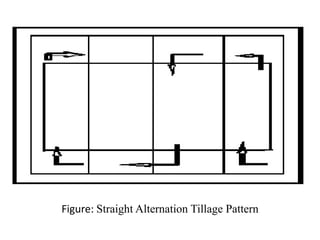
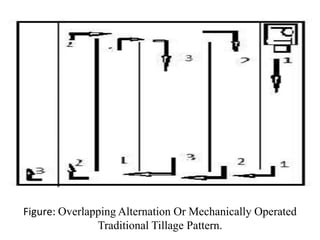
 Three different patterns such as Straight alternation Tillage
pattern, Circuitous tillage pattern and overlapping
alternation or mechanically operated traditional tillage
pattern were chosen to perform the tillage operation.
 Land was selected for application of different tillage pattern
to increase the efficiency of fuel.
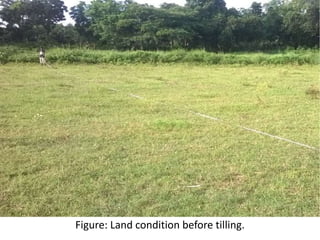
Figure: Land condition before tilling.
TILLAGE PATTERN SELECTION
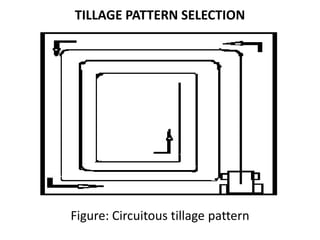
Figure: Circuitous tillage pattern
Figure: Straight Alternation Tillage Pattern
Figure: Overlapping Alternation Or Mechanically Operated
Traditional Tillage Pattern.
LAND CONDITION
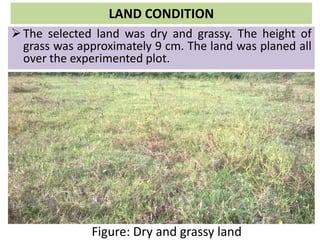
The selected land was dry and grassy. The height of
grass was approximately 9 cm. The land was planed all
over the experimented plot.
Figure: Dry and grassy land
POWER TILLER SPECIFICATION
Model MEGN-12
Type Rotary tiller
Transmission speed change Six speed forward, two speed
reverse
Power transmission Engine to main shaft by V-belt
Main shaft to wheel by gear, to
rotary by chain
Engine horsepower 13 hp (9 kw)
Number of rotary blades 18
Cultivating depth (cm) 7-15
Weight (kg, with engine) 234+150 = 384
Fuel type Diesel
18
13 hp (9 kw)
EXPERIMENTAL DESIGN
 For the operation of tillage an area of (90×15) m2 was
selected from a cultivable land.
 Total area was sub-divided into three plots, (30×15) m2 each.
Figure-6: Design of experiment of land
COLLECTION OF SOIL SAMPLE
Soil sample was collected from three plot of land for
determining soil properties.
Figure: Soil sample collection
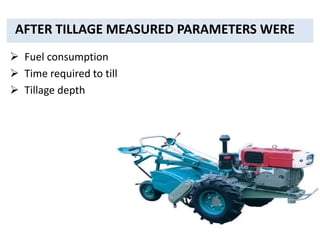
AFTER TILLAGE MEASURED PARAMETERS WERE
 Fuel consumption
 Time required to till
 Tillage depth
Figure: Fuel consumption measuring
SOIL PROPERTIES DETERMINATION
The selected parameters were:
a) Soil moisture content
b) Particle density of soil
c) Bulk density of soil and
d) Soil texture
SOME PICTURES FROM THE LAB EXPERIMENT
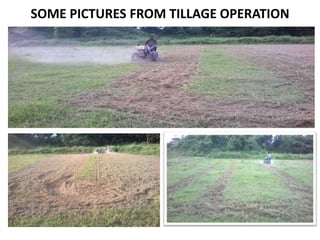
SOME PICTURES FROM TILLAGE OPERATION
RESULTS AND DISCUSSION
Soil Analysis Test on Research Farm:
Soil Properties Plot-1 Plot-2 Plot -3 Average
% Sand 65.6 55.6 55.6 58.93
% Silt 17.6 25.6 25.6 22.93
% Clay 16.8 18.8 18.8 18.13
Soil type Sandy
Loam
Sandy
Loam
Sandy Loam Sandy Loam
Moisture content
(%)
14.95 15.5 15.2 15.22
Particle density
(g/cm3)
2.22 2.24 2.17 2.21
Bulk density
(g/cm3)
1.5 1.58 1.5 1.53
Table: Soil analysis test
Soil type Sandy
Loam
Sandy
Loam
Sandy
Loam
Sandy
Loam
FUEL CONSUMPTION, TILLAGE DEPTH AND TIME
REQUIREMENT ANALYSIS
Properties Circuitous
pattern
Traditional
pattern
Alternation
pattern
Fuel
consumption (L)
0.95 0.8 0.8
Tillage depth
(cm)
8 7 7
Time required
(min)
25 18 22
Table: Data for fuel consumption, tillage depth and time
requirement
0.8
18
CONCLUSION
 The experimental results shown that, for tilling of specific
land (0.045 ha) with overlapping alternation or mechanically
operated traditional pattern required minimum time (18
min) and consume lowest fuel (0.8 L).
 After tillage operation, traditional and alternation pattern
both consume same amount of fuel (0.8 L) and tilling depth
were also same (7 cm). Whereas, the time requirement was
different for those two pattern.
 Study shown that the traditional tillage pattern is most
effective and economic for tillage operation .
 Further study is necessary to confirm the results of
conducting experiments with large area of land and with
same tillage patterns.
THANKS
TO
ALL

Tillage pattern vs fuel consumption

  • 1.
  • 2.
    Project Title Suitable TillagePattern for Fuel Economy
  • 3.
    Presented by  Md.Sultan Mahmud St. id.:1107048 Session: 2010-11  Shagor Sarkar St. id.:1107051 Session: 2010-11  A.B.M. Hasanul Kabir St. id.:1107052 Session: 2010-11
  • 4.
    Supervisor Prof. Dr. Md.Kamal Uddin Sarker Dean, Faculty of Engineering Muhammad Abdul Munnaf Lecturer, Dept. of Agricultural and Industrial Engineering Co-Supervisor
  • 5.
  • 6.
     At presentagriculture contributes about 20% of the total gross domestic product (GDP) of Bangladesh.  Crop sub sector alone contributes about 11% of the total GDP of the country and about 75% of the agricultural GDP (GOB, 2011).  The status of the economy of Bangladesh in terms of output and employment still greatly depends on the agricultural sector.
  • 7.
     Agricultural mechanizationembraces the use of tools, implements and agricultural machinery in an efficient form, to increase the crop production and improve quality and reduce costs.  It includes agricultural land development, harvesting, preparation for storage, and on-farm processing (Gatea, 2013).
  • 8.
     The objectivesof tillage are to develop a desirable soil structure or suitable tilth for a seedbed (Srivastava et al, 2006).  A total numbers of 3,50,000 power tillers and 40,000 tractors are found to be available in Bangladesh (Wohab, 2013).  In tillage operation, power tiller is suitable for saving labour cost, maintaining timeliness in operation, better quality of soil preparation and desired depth of tillage which has its ultimate bearing on soil fertility.
  • 9.
     Substantive improvementscan be made in the field efficiency by analyzing and changing the model for planning and field operations that depend on the area and shape of the field Hunt D. R. (1999).  As a developing country, Bangladeshi farmers need to apply appropriate tillage pattern for saving fuel and reducing the cost of tillage in different soil condition all over the country.
  • 10.
    The main objectiveof the research work was to find a suitable tillage pattern for fuel economy. OBJECTIVES Specific objectives were: • To select different tillage pattern from existing literature. • To select suitable land area for tillage operation. • To plow selected plots in different selected plowing method. • To measure the fuel consumption and time for individual tillage operation. • To measure the soil properties of the selected lands for plowing. • To analyse the collected data and prepare report we recorded.
  • 11.
  • 12.
    The research workwas carried out in the experimental field of Hajee Mohammad Danesh Science and Technology University, Dinajpur. List of Materials Required Power tiller with rotary blade Sedimentation Cylinder Stop watch Hydrometer Hand Hoe Electrical Stirrer Auger Plunger Hammer Soil texture triangle Core sampler Tape, Scale etc.
  • 13.
    SELECTION OF LANDAND TILLAGE PATTERN  Three different patterns such as Straight alternation Tillage pattern, Circuitous tillage pattern and overlapping alternation or mechanically operated traditional tillage pattern were chosen to perform the tillage operation.  Land was selected for application of different tillage pattern to increase the efficiency of fuel.
  • 14.
    Figure: Land conditionbefore tilling.
  • 15.
    TILLAGE PATTERN SELECTION Figure:Circuitous tillage pattern
  • 16.
  • 17.
    Figure: Overlapping AlternationOr Mechanically Operated Traditional Tillage Pattern.
  • 18.
    LAND CONDITION The selectedland was dry and grassy. The height of grass was approximately 9 cm. The land was planed all over the experimented plot. Figure: Dry and grassy land
  • 19.
    POWER TILLER SPECIFICATION ModelMEGN-12 Type Rotary tiller Transmission speed change Six speed forward, two speed reverse Power transmission Engine to main shaft by V-belt Main shaft to wheel by gear, to rotary by chain Engine horsepower 13 hp (9 kw) Number of rotary blades 18 Cultivating depth (cm) 7-15 Weight (kg, with engine) 234+150 = 384 Fuel type Diesel 18 13 hp (9 kw)
  • 20.
    EXPERIMENTAL DESIGN  Forthe operation of tillage an area of (90×15) m2 was selected from a cultivable land.  Total area was sub-divided into three plots, (30×15) m2 each. Figure-6: Design of experiment of land
  • 21.
    COLLECTION OF SOILSAMPLE Soil sample was collected from three plot of land for determining soil properties. Figure: Soil sample collection
  • 22.
    AFTER TILLAGE MEASUREDPARAMETERS WERE  Fuel consumption  Time required to till  Tillage depth
  • 23.
  • 24.
    SOIL PROPERTIES DETERMINATION Theselected parameters were: a) Soil moisture content b) Particle density of soil c) Bulk density of soil and d) Soil texture
  • 25.
    SOME PICTURES FROMTHE LAB EXPERIMENT
  • 26.
    SOME PICTURES FROMTILLAGE OPERATION
  • 27.
  • 28.
    Soil Analysis Teston Research Farm: Soil Properties Plot-1 Plot-2 Plot -3 Average % Sand 65.6 55.6 55.6 58.93 % Silt 17.6 25.6 25.6 22.93 % Clay 16.8 18.8 18.8 18.13 Soil type Sandy Loam Sandy Loam Sandy Loam Sandy Loam Moisture content (%) 14.95 15.5 15.2 15.22 Particle density (g/cm3) 2.22 2.24 2.17 2.21 Bulk density (g/cm3) 1.5 1.58 1.5 1.53 Table: Soil analysis test Soil type Sandy Loam Sandy Loam Sandy Loam Sandy Loam
  • 29.
    FUEL CONSUMPTION, TILLAGEDEPTH AND TIME REQUIREMENT ANALYSIS Properties Circuitous pattern Traditional pattern Alternation pattern Fuel consumption (L) 0.95 0.8 0.8 Tillage depth (cm) 8 7 7 Time required (min) 25 18 22 Table: Data for fuel consumption, tillage depth and time requirement 0.8 18
  • 30.
  • 31.
     The experimentalresults shown that, for tilling of specific land (0.045 ha) with overlapping alternation or mechanically operated traditional pattern required minimum time (18 min) and consume lowest fuel (0.8 L).  After tillage operation, traditional and alternation pattern both consume same amount of fuel (0.8 L) and tilling depth were also same (7 cm). Whereas, the time requirement was different for those two pattern.
  • 32.
     Study shownthat the traditional tillage pattern is most effective and economic for tillage operation .  Further study is necessary to confirm the results of conducting experiments with large area of land and with same tillage patterns.
  • 34.

Editor's Notes

  • #2 Welcome to our presentation
  • #15 Here the photographic view of land condition before tilling
  • #16 this is the operational diagram for Circuitous tillage pattern. This pattern work from the outside of the field and finished at the center of the field.
  • #17 here is the operational diagram for Straight Alternation Tillage Pattern. SATP start from one side of the field, until PT reached at the other side it will make a gap between two width of cut. When the PT return back the gap was tilled and complete the operation.
  • #18 here is the working diagram for Overlapping Alternation Or Mechanically Operated Traditional Tillage Pattern. PT starts tilling from the point 1
  • #20 Engine horse power was 13 hp and number of rotary blades 18 for the selected power tiller.
  • #23 Before starting the tilling operation in the test plot, the fuel tank of the power tiller was filled up to its full. The quantity of fuel required to fill the tank fully after tilling the plot was measured to determine the quantity of fuel consumed for measurement of fuel consumption of the test plot. For each plot tilling time was recorded by the stop watch. A measuring scale made to penetrate tilled soil was used to measure ploughing depths. The depths of tilled soil were measured for thirty (30) times at different points along the ploughed field and then averaged to the soil depth of each tillage operation.
  • #24 Here the picture for measuring fuel consumption
  • #25 Soil moisture content was determined by gravimetric method on wet basis. Particle density of soil was determined by volumetric flask method. Bulk density of soil was determined by core sampler method. Soil texture was determined by the hydrometer method.
  • #27 Traditional pattern. Cicuitous Pattern Straight Alternation Tillage Pattern
  • #29 Soil properties are (% Sand, % Silt, % Clay) these parameters were used for determining the soil type for each plot of land. Another parameters was determined MC, PD, BD for each plot of land. Soil type was found sandy loam for each plot of land.
  • #30 From the above study the lowest fuel consumption was (0.8 L) and lowest time required to till the specific land was (18 min) ) for traditional pattern.