Tight junctions & gene expression
Presented by:Razieh Mohamadian
University of Tehran
IBB
• Introduction of junctions
• Tight junctions( structure and function)
• Adaptor proteins and regulation of gene
expressions
• Conclusions
Tight junctions
• Tight junctions, also known as occluding junctions or zonulae occludentes
• the closely associated areas of two cells whose membranes join together
forming a virtually impermeable barrier to fluid. It is a type of junctional
complex present only in vertebrates .
• Tight junctions are composed of a branching network of sealing strands,
each strand acting independently from the others. Therefore, the
efficiency of the junction in preventing ion passage increases
exponentially with the number of strands. Each strand is formed from a
row of transmembrane proteins .
Function of tight junctions
• They hold cells together
• Barrier function
• Tight Junctions help to maintain the polarity of cells
by preventing the lateral diffusion of integral
membrane proteins between
the apical and lateral/basal surfaces
• Tight Junctions prevent the passage of molecules and
ions through the space between plasma membranes
of adjacent cells.
• Electron microscopy
• Freez fructure
Tight junction electron microscopy
Tight junction freeze-fracture
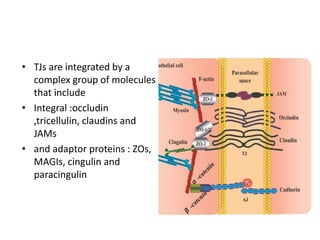
• TJs are integrated by a
complex group of molecules
that include
• Integral :occludin
,tricellulin, claudins and
JAMs
• and adaptor proteins : ZOs,
MAGIs, cingulin and
paracingulin
New role of tight junctions
• Besides the two canonical functions of TJ known as
fence and gate
• new roles for TJ proteins have been revealed
concerning the regulation of cell proliferation and
gene transcription.
• For this purpose, many of the adaptor proteins have
nuclear localization (NLS) and exportation (NES)
signals that allow them to shuttle between the
nucleus and the plasma membrane
•Zo1
•Zo2
Zona occludens 1 (ZO-1)
• Zona occludens 1 (ZO-1) is a 225 kDa protein that
belongs to the MAGUK (membrane associated
guanilase kinase homologue) protein family.
• In silico analysis reveals that cZO-1 has 3 bipartite NLS
and 5 NES
• ZO-1 is present at the nuclei of subconfluent epithelial
cells in culture and in cells that border an inflicted
wound,thus revealing that the nuclear localization of
ZO-1 is favored in proliferating cells
• ZO-1 expression has an inverse relationship with cell
proliferation. Thus in cancerous tissues the expression
of ZO-1 is diminished.
Why in proliferating cells ,ZO1 localize
in nucleus?
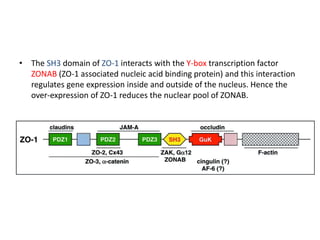
• The SH3 domain of ZO-1 interacts with the Y-box transcription factor
ZONAB (ZO-1 associated nucleic acid binding protein) and this interaction
regulates gene expression inside and outside of the nucleus. Hence the
over-expression of ZO-1 reduces the nuclear pool of ZONAB.
Zona occludens 2 (ZO-2)
• Zona occludens 2 (ZO-2) is a 160 kDa protein with several
functional NLS and NES , some of which are regulated by
phosphorylation and O-N-acetylglucosylation .
• In subconfluent cultures, newly synthesized ZO-2 travels to
the nucleus before reaching the plasma membrane , whereas
in confluent cultures the protein makes no stop over at the
nucleus .
• ZO-2 travels to the nucleus at late G1, and becomes diffusely
distributed throughout the cytoplasm upon mitosis , thus
explaining why in confluent cultures no ZO-2 is present at the
nucleus, while in cells in proliferation ZO-2 concentrates at the
nucleus
Why in proliferating cells ,ZO2 localize in
nucleus?
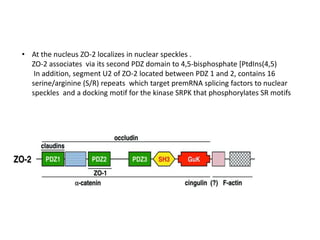
• At the nucleus ZO-2 localizes in nuclear speckles .
ZO-2 associates via its second PDZ domain to 4,5-bisphosphate [PtdIns(4,5)
In addition, segment U2 of ZO-2 located between PDZ 1 and 2, contains 16
serine/arginine (S/R) repeats which target premRNA splicing factors to nuclear
speckles and a docking motif for the kinase SRPK that phosphorylates SR motifs
• ZO-1 expression has an inverse relationship
with cell proliferation. the nuclear localization
of ZO-1 is favored in proliferating cells .
• in confluent cultures no ZO-2 is present at the
nucleus, while in cells in proliferation ZO-2
concentrates at the nucleus .
References
• Lorenza González-Mariscal , Alaide Domínguez-Calderón, Arturo Raya-Sandino, José Mario Ortega-Olvera,
Orlando Vargas-Sierra, Gabriela Martínez-Revollar. Tight junctions and the regulation of gene expression.
Seminars in Cell & Developmental Biology;2014,36:213-223
• Maria S. Balda , Karl Matter. Tight junctions and the regulation of gene expression. Biochimica et
Biophysica Acta (BBA);2009,1788:761-767
• S. Tsukita, Tight Junctions, In Encyclopedia of Biological Chemistry, edited by William J. LennarzM. Daniel
Lane, Academic Press, Waltham, 2013,392-395
Tight junction & gene expression

Tight junction & gene expression

  • 2.
    Tight junctions &gene expression Presented by:Razieh Mohamadian University of Tehran IBB
  • 3.
    • Introduction ofjunctions • Tight junctions( structure and function) • Adaptor proteins and regulation of gene expressions • Conclusions
  • 5.
    Tight junctions • Tightjunctions, also known as occluding junctions or zonulae occludentes • the closely associated areas of two cells whose membranes join together forming a virtually impermeable barrier to fluid. It is a type of junctional complex present only in vertebrates . • Tight junctions are composed of a branching network of sealing strands, each strand acting independently from the others. Therefore, the efficiency of the junction in preventing ion passage increases exponentially with the number of strands. Each strand is formed from a row of transmembrane proteins .
  • 6.
    Function of tightjunctions • They hold cells together • Barrier function • Tight Junctions help to maintain the polarity of cells by preventing the lateral diffusion of integral membrane proteins between the apical and lateral/basal surfaces • Tight Junctions prevent the passage of molecules and ions through the space between plasma membranes of adjacent cells.
  • 7.
  • 8.
  • 9.
  • 10.
    • TJs areintegrated by a complex group of molecules that include • Integral :occludin ,tricellulin, claudins and JAMs • and adaptor proteins : ZOs, MAGIs, cingulin and paracingulin
  • 11.
    New role oftight junctions • Besides the two canonical functions of TJ known as fence and gate • new roles for TJ proteins have been revealed concerning the regulation of cell proliferation and gene transcription. • For this purpose, many of the adaptor proteins have nuclear localization (NLS) and exportation (NES) signals that allow them to shuttle between the nucleus and the plasma membrane
  • 12.
  • 13.
    Zona occludens 1(ZO-1) • Zona occludens 1 (ZO-1) is a 225 kDa protein that belongs to the MAGUK (membrane associated guanilase kinase homologue) protein family. • In silico analysis reveals that cZO-1 has 3 bipartite NLS and 5 NES • ZO-1 is present at the nuclei of subconfluent epithelial cells in culture and in cells that border an inflicted wound,thus revealing that the nuclear localization of ZO-1 is favored in proliferating cells • ZO-1 expression has an inverse relationship with cell proliferation. Thus in cancerous tissues the expression of ZO-1 is diminished.
  • 14.
    Why in proliferatingcells ,ZO1 localize in nucleus?
  • 15.
    • The SH3domain of ZO-1 interacts with the Y-box transcription factor ZONAB (ZO-1 associated nucleic acid binding protein) and this interaction regulates gene expression inside and outside of the nucleus. Hence the over-expression of ZO-1 reduces the nuclear pool of ZONAB.
  • 17.
    Zona occludens 2(ZO-2) • Zona occludens 2 (ZO-2) is a 160 kDa protein with several functional NLS and NES , some of which are regulated by phosphorylation and O-N-acetylglucosylation . • In subconfluent cultures, newly synthesized ZO-2 travels to the nucleus before reaching the plasma membrane , whereas in confluent cultures the protein makes no stop over at the nucleus . • ZO-2 travels to the nucleus at late G1, and becomes diffusely distributed throughout the cytoplasm upon mitosis , thus explaining why in confluent cultures no ZO-2 is present at the nucleus, while in cells in proliferation ZO-2 concentrates at the nucleus
  • 18.
    Why in proliferatingcells ,ZO2 localize in nucleus?
  • 19.
    • At thenucleus ZO-2 localizes in nuclear speckles . ZO-2 associates via its second PDZ domain to 4,5-bisphosphate [PtdIns(4,5) In addition, segment U2 of ZO-2 located between PDZ 1 and 2, contains 16 serine/arginine (S/R) repeats which target premRNA splicing factors to nuclear speckles and a docking motif for the kinase SRPK that phosphorylates SR motifs
  • 21.
    • ZO-1 expressionhas an inverse relationship with cell proliferation. the nuclear localization of ZO-1 is favored in proliferating cells . • in confluent cultures no ZO-2 is present at the nucleus, while in cells in proliferation ZO-2 concentrates at the nucleus .
  • 22.
    References • Lorenza González-Mariscal, Alaide Domínguez-Calderón, Arturo Raya-Sandino, José Mario Ortega-Olvera, Orlando Vargas-Sierra, Gabriela Martínez-Revollar. Tight junctions and the regulation of gene expression. Seminars in Cell & Developmental Biology;2014,36:213-223 • Maria S. Balda , Karl Matter. Tight junctions and the regulation of gene expression. Biochimica et Biophysica Acta (BBA);2009,1788:761-767 • S. Tsukita, Tight Junctions, In Encyclopedia of Biological Chemistry, edited by William J. LennarzM. Daniel Lane, Academic Press, Waltham, 2013,392-395