TALAT Lecture 4201
Arc Welding Processes:
TIG, Plasma Arc, MIG
36 pages, 47 figures
Basic Level
prepared by Ulrich Krüger,
Schweißtechnische Lehr- und Versuchsanstalt Berlin
Objectives:
− to describe the arc welding processes TIG, Plasma, MIG and their modifications in
connection with aluminium
− the choice of welding parameters
− influence on macrostructure
Prerequisites:
− general engineering background
− basic knowledge in electrical engineering
Date of Issue: 1994
© EAA - European Aluminium Association
TALAT 4201 2
4201 Arc Welding Processes: TIG, Plasma Arc, MIG
Table of Contents
4201 Arc Welding Processes: TIG, Plasma Arc, MIG..................................2
4201.01 Introduction: Gas-Shielded Arc Welding of Aluminium...................... 4
4201.02 TIG Welding.............................................................................................. 5
Principle of TIG Welding ........................................................................................5
TIG Welding Equipment..........................................................................................6
Watercooled TIG Welding Torch ............................................................................7
Torch Forms for TIG Welding.................................................................................8
Shielding Gases for Welding and Cutting ...............................................................8
Flow Meters .............................................................................................................9
Flow Meter for Torches ...........................................................................................9
Effect of Current and Inert Gas..............................................................................10
Argon Consumption for TIG Welding...................................................................11
Tungsten Electrodes for TIG Welding...................................................................12
Influence of Current Type on Weld Pool...............................................................13
Arc Burning with Alternating Current...................................................................14
Action of Alternating Current during TIG Welding of Aluminium ......................14
Function of Filter Condenser .................................................................................15
TIG Welding with Pulsating Square-Wave Alternating Current...........................16
TIG Alternating Current Welding Parameters.......................................................16
Current Loading of Tungsten Electrode.................................................................17
Manual and Mechanised TIG Welding..................................................................18
Macrostructure of TIG Welds................................................................................18
4201.03 Plasma Arc Welding ................................................................................ 19
Principle of Plasma Arc Welding ..........................................................................19
Arc Form during TIG and Tungsten Plasma-Arc Welding....................................20
Weld Pool Form and Heat Affected Zone .............................................................20
Varying Arc Stabilities...........................................................................................21
Principle of the Keyhole Plasma Arc Welding......................................................21
Guide Values for the Positive Polarity Plasma Arc Welding ................................22
Principle of the VPPA Welding.............................................................................23
Guide Values for the VPPA Welding....................................................................23
Macrostructure of VPPA Welds ............................................................................24
Advantages of Plasma Arc Welding over to TIG Welding....................................24
Process Steps of the Plasma Arc Cutting...............................................................25
Guide Values for Plasma Arc Cutting ...................................................................26
Characteristics which Determine the Quality of a Plasma Arc Cut.......................26
TALAT 4201 3
4201.04 Metal Inert Gas Welding (MIG)........................................................... 27
Principle of MIG Welding .....................................................................................27
Guide Values for the Manual MIG Welding .........................................................28
MIG Welded Joint Profiles as a Function of Shielding Gas and Welding Parameters
...............................................................................................................................29
Influence of Contact Tube Distance on MIG Welding Current and Penetration...29
Modifications of MIG Welding .............................................................................30
MIG Welding with Pulsed Current........................................................................31
Macrostructure of MIG Welds...............................................................................31
Guide Values for Thick-Wire MIG Welding.........................................................32
Deposit Efficiency of Thick-Wire MIG Welding..................................................33
Principle of the Narrow-Gap MIG Welding ..........................................................33
Principle of the Plasma-Arc MIG Welding............................................................34
Fields of Application for the Shielded Gas Welding of Aluminium .....................34
4201.05 Literature/References............................................................................ 35
4201.06 List of Figures............................................................................................ 35
TALAT 4201 4
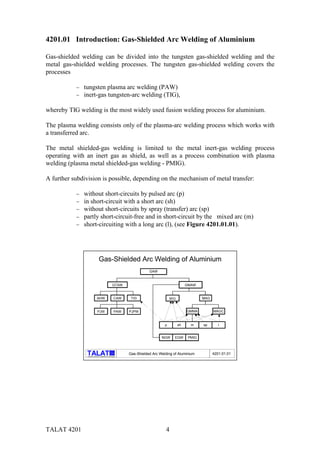
4201.01 Introduction: Gas-Shielded Arc Welding of Aluminium
Gas-shielded welding can be divided into the tungsten gas-shielded welding and the
metal gas-shielded welding processes. The tungsten gas-shielded welding covers the
processes
− tungsten plasma arc welding (PAW)
− inert-gas tungsten-arc welding (TIG),
whereby TIG welding is the most widely used fusion welding process for aluminium.
The plasma welding consists only of the plasma-arc welding process which works with
a transferred arc.
The metal shielded-gas welding is limited to the metal inert-gas welding process
operating with an inert gas as shield, as well as a process combination with plasma
welding (plasma metal shielded-gas welding - PMIG).
A further subdivision is possible, depending on the mechanism of metal transfer:
− without short-circuits by pulsed arc (p)
− in short-circuit with a short arc (sh)
− without short-circuits by spray (transfer) arc (sp)
− partly short-circuit-free and in short-circuit by the mixed arc (m)
− short-circuiting with a long arc (l), (see Figure 4201.01.01).
4201.01.01Gas-Shielded Arc Welding of Aluminiumalu
Training in Aluminium Application Technologies
Gas-Shielded Arc Welding of Aluminium
GAW
GTAW
AHW CAW TIG
PJW PAW PJPW
GMAW
MIG MAG
GMMA MAGC
EGWNGW PMIG
p sh m sp l
TALAT 4201 5
The abbreviations used are:
GAW Gas-shielded arc welding
GTAW Gas-shielded tungsten arc welding
GMAW Gas-shielded metal arc welding
AHW Atomic hydrogen welding
CAW Constricted arc welding
TIG Tungsten inert-gas arc welding
MIG Metal inert-gas arc welding
MAG Metal active-gas arc welding
PJW Plasma jet welding
PAW Plasma arc welding
PJPW Plasma jet plasma arc welding
GMGMMA Gas-mixture shielded metal-arc welding
(MAGM)
MAGC CO2-shielded metal-arc welding
NGW Narrow-gap welding
EGW Electro-gas welding
PMIG Plasma MIG welding
p Pulsed arc
sh Short arc
sp Spray arc
l Long arc
4201.02 TIG Welding
• Principle of TIG Welding
• TIG welding equipment
• Watercooled TIG welding torch
• Torch forms for TIG welding
• Shielding gases for welding and cutting
• Flow meters
• Flow meter for torches
• Effect of current and inert gas
• Argon consumption for TIG welding
• Tungsten electrodes for TIG welding
• Influence of current type on weld pool
• Arc burning with alternating current
• Action of alternating current during TIG welding of aluminium
• Function of filter condenser
• TIG welding with pulsating square-wave alternating current
• TIG alternating current welding parameters
• Current loading of tungsten electrode
• Manual and mechanised TIG welding
• Macrostructure of TIG welds
Principle of TIG Welding
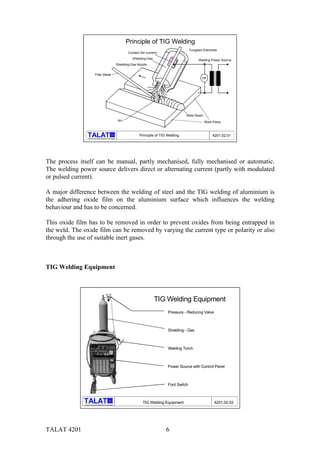
During TIG welding, an arc is maintained between a tungsten electrode and the work-
piece in an inert atmosphere (Ar, He, or Ar-He mixture). Depending on the weld
preparation and the work-piece thickness, it is possible to work with or without a filler.
The filler can be introduced manually or half mechanically without current or only half
mechanically under current (Figure 4201.02.01).
TALAT 4201 6
alu
Training in Aluminium Application Technologies
HF
Tungsten Electrode
Contact (for current)
Shielding-Gas
Shielding-Gas Nozzle
Filler Metal
Principle of TIG Welding
Welding Power Source
Work-Piece
Weld Seam
Arc
4201.02.01Principle of TIG Welding
The process itself can be manual, partly mechanised, fully mechanised or automatic.
The welding power source delivers direct or alternating current (partly with modulated
or pulsed current).
A major difference between the welding of steel and the TIG welding of aluminium is
the adhering oxide film on the aluminium surface which influences the welding
behaviour and has to be concerned.
This oxide film has to be removed in order to prevent oxides from being entrapped in
the weld. The oxide film can be removed by varying the current type or polarity or also
through the use of suitable inert gases.
TIG Welding Equipment
alu
Training in Aluminium Application Technologies
4201.02.02TIG Welding Equipment
TIG Welding Equipment
Pressure - Reducing Valve
Shielding - Gas
Welding Torch
Power Source with Control Panel
Foot Switch
TALAT 4201 7
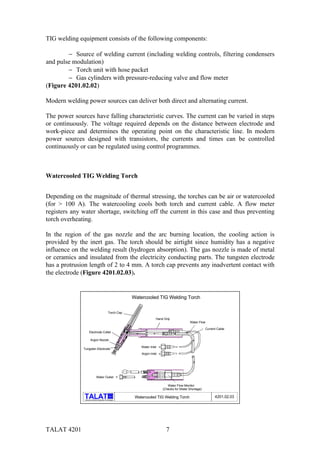
TIG welding equipment consists of the following components:
− Source of welding current (including welding controls, filtering condensers
and pulse modulation)
− Torch unit with hose packet
− Gas cylinders with pressure-reducing valve and flow meter
(Figure 4201.02.02)
Modern welding power sources can deliver both direct and alternating current.
The power sources have falling characteristic curves. The current can be varied in steps
or continuously. The voltage required depends on the distance between electrode and
work-piece and determines the operating point on the characteristic line. In modern
power sources designed with transistors, the currents and times can be controlled
continuously or can be regulated using control programmes.
Watercooled TIG Welding Torch
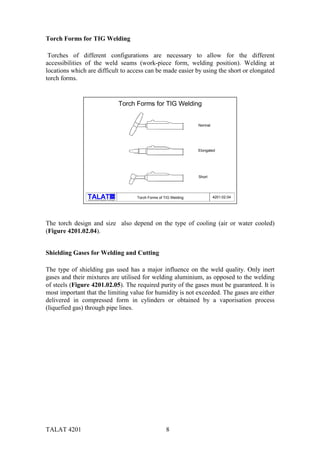
Depending on the magnitude of thermal stressing, the torches can be air or watercooled
(for > 100 A). The watercooling cools both torch and current cable. A flow meter
registers any water shortage, switching off the current in this case and thus preventing
torch overheating.
In the region of the gas nozzle and the arc burning location, the cooling action is
provided by the inert gas. The torch should be airtight since humidity has a negative
influence on the welding result (hydrogen absorption). The gas nozzle is made of metal
or ceramics and insulated from the electricity conducting parts. The tungsten electrode
has a protrusion length of 2 to 4 mm. A torch cap prevents any inadvertent contact with
the electrode (Figure 4201.02.03).
Training in Aluminium Application Technologies
alu
Watercooled TIG Welding Torch
4201.02.03Watercooled TIG Welding Torch
Torch Cap
Water Outlet
Water Flow Monitor
(Checks for Water Shortage)
Argon Inlet
Water Inlet
Current Cable
Water Flow
Hand Grip
Electrode Collet
Argon Nozzle
Tungsten Electrode
TALAT 4201 8
Torch Forms for TIG Welding
Torches of different configurations are necessary to allow for the different
accessibilities of the weld seams (work-piece form, welding position). Welding at
locations which are difficult to access can be made easier by using the short or elongated
torch forms.
alu
Training in Aluminium Application Technologies
Torch Forms for TIG Welding
Normal
Elongated
Short
Torch Forms of TIG Welding 4201.02.04
The torch design and size also depend on the type of cooling (air or water cooled)
(Figure 4201.02.04).
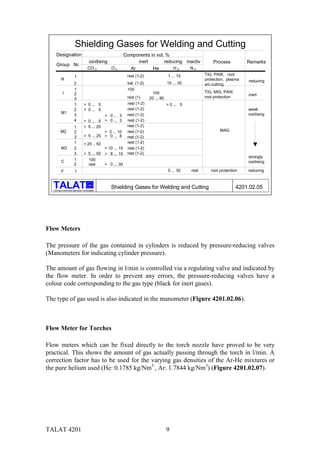
Shielding Gases for Welding and Cutting
The type of shielding gas used has a major influence on the weld quality. Only inert
gases and their mixtures are utilised for welding aluminium, as opposed to the welding
of steels (Figure 4201.02.05). The required purity of the gases must be guaranteed. It is
most important that the limiting value for humidity is not exceeded. The gases are either
delivered in compressed form in cylinders or obtained by a vaporisation process
(liquefied gas) through pipe lines.
TALAT 4201 9
alu
Training in Aluminium Application Technologies
4201.02.05Shielding Gases for Welding and Cutting
Shielding Gases for Welding and Cutting
Designation Components in vol. %
Group Nr.
Process Remarks
root protection
reducing
inert
weak
oxidising
strongly
oxidising
oxidising inert reducing inactiv
CO ² O ² Ar He H ² N ²
R
I
M1
M2
M3
C
F
1
2
1
2
1
2
1
2
1
2
1
2
1
3
3
3
3
4
rest (1-2)
bal. (1-2)
1 ... 15
15 ... 35
100
100
20 ... 80rest (1)
> 0 ... 5
> 0 ... 5
> 0 ... 5 > 0 ... 3
> 0 ... 5
> 0 .. . 3
> 5 ... 25
> 3 ... 10
> 0 ... 8> 5 ... 25
> 25 .. 50
> 5 ... 50
> 10 ... 15
> 8 ... 15
> 0 ... 30
0 ... 30 rest
MAG
100
rest
TIG, PAW, root
protection, plasma
arc cutting
TIG, MIG, PAW
root protection
rest (1-2)
rest (1-2)
rest (1-2)
rest (1-2)
rest (1-2)
rest (1-2)
rest (1-2)
rest (1-2)
rest (1-2)
rest (1-2)
reducing
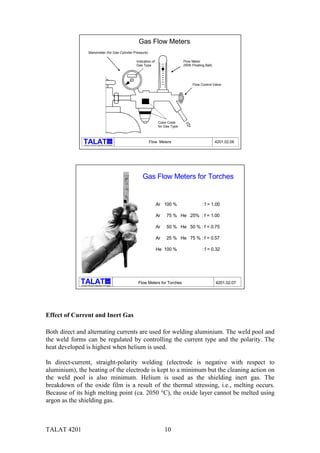
Flow Meters
The pressure of the gas contained in cylinders is reduced by pressure-reducing valves
(Manometers for indicating cylinder pressure).
The amount of gas flowing in l/min is controlled via a regulating valve and indicated by
the flow meter. In order to prevent any errors, the pressure-reducing valves have a
colour code corresponding to the gas type (black for inert gases).
The type of gas used is also indicated in the manometer (Figure 4201.02.06).
Flow Meter for Torches
Flow meters which can be fixed directly to the torch nozzle have proved to be very
practical. This shows the amount of gas actually passing through the torch in l/min. A
correction factor has to be used for the varying gas densities of the Ar-He mixtures or
the pure helium used (He: 0.1785 kg/Nm3
, Ar: 1.7844 kg/Nm3
) (Figure 4201.02.07).
TALAT 4201 10
alu
Training in Aluminium Application Technologies
4201.02.06Flow Meters
Gas Flow Meters
Manometer (for Gas Cylinder Pressure)
Indication of
Gas Type
Flow Meter
(With Floating Ball)
Flow Control Valve
Color Code
for Gas Type
alu
Training in Aluminium Application Technologies
Flow Meters for Torches 4201.02.07
Ar 100 % : f = 1.00
Ar 75 % He 25% : f = 1.00
Ar 50 % He 50 % : f = 0.75
Ar 25 % He 75 % : f = 0.57
He 100 % : f = 0.32
Gas Flow Meters for Torches
Effect of Current and Inert Gas
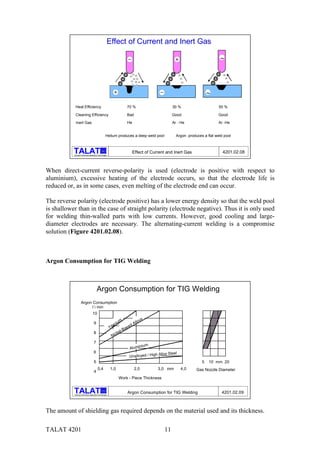
Both direct and alternating currents are used for welding aluminium. The weld pool and
the weld forms can be regulated by controlling the current type and the polarity. The
heat developed is highest when helium is used.
In direct-current, straight-polarity welding (electrode is negative with respect to
aluminium), the heating of the electrode is kept to a minimum but the cleaning action on
the weld pool is also minimum. Helium is used as the shielding inert gas. The
breakdown of the oxide film is a result of the thermal stressing, i.e., melting occurs.
Because of its high melting point (ca. 2050 °C), the oxide layer cannot be melted using
argon as the shielding gas.
TALAT 4201 11
Effect of Current and Inert Gas 4201.02.08
Effect of Current and Inert Gas
Heat Efficiency
Cleaning Efficiency
Inert Gas
70 %
Bad
He
30 %
Good
Ar - He
50 %
Good
Ar -He
Argon produces a flat weld poolHelium produces a deep weld pool
~
~
alu
Training in Aluminium Application Technologies
When direct-current reverse-polarity is used (electrode is positive with respect to
aluminium), excessive heating of the electrode occurs, so that the electrode life is
reduced or, as in some cases, even melting of the electrode end can occur.
The reverse polarity (electrode positive) has a lower energy density so that the weld pool
is shallower than in the case of straight polarity (electrode negative). Thus it is only used
for welding thin-walled parts with low currents. However, good cooling and large-
diameter electrodes are necessary. The alternating-current welding is a compromise
solution (Figure 4201.02.08).
Argon Consumption for TIG Welding
alu
Training in Aluminium Application Technologies
Argon Consumption for TIG Welding 4201.02.09
Argon Consumption for TIG Welding
5 10 mm 20
Gas Nozzle Diameter
Argon Consumption
l  min
10
9
8
7
6
5
4
0,4 1,0 2,0 3,0 mm 4,0
Work - Piece Thickness
Nickel-Based Alloys
Aluminium
Titanium
The amount of shielding gas required depends on the material used and its thickness.
TALAT 4201 12
The gas consumption for titanium is higher than for steel, since a gas absorption by the
former material must be prevented even at lower temperatures.
Thus, trailing nozzles have to be used.
The gas nozzle diameter has to be optimised for the electrode diameter used.
Because of its lower density, the amount of argon required is larger than the helium
amount needed (4201.02.09).
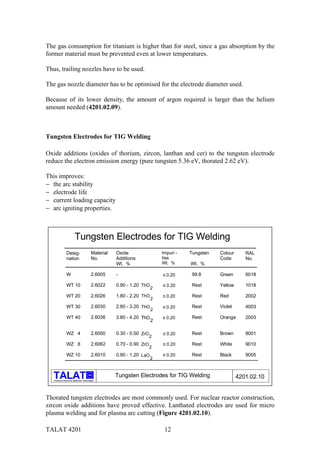
Tungsten Electrodes for TIG Welding
Oxide additions (oxides of thorium, zircon, lanthan and cer) to the tungsten electrode
reduce the electron emission energy (pure tungsten 5.36 eV, thorated 2.62 eV).
This improves:
− the arc stability
− electrode life
− current loading capacity
− arc igniting properties.
alu
Training in Aluminium Application Technologies
Tungsten Electrodes for TIG Welding
Desig-
nation
W
WT 10
WT 20
WT 30
WT 40
WZ 4
WZ 8
WZ 10
Material
No.
2.6005
2.6022
2.6026
2.6030
2.6036
2.6050
2.6062
2.6010
Oxide
Additions
Wt. %
-
0.90 - 1.20
1.80 - 2.20
2.80 - 3.20
3.80 - 4.20
0.30 - 0.50
0.70 - 0.90
0.90 - 1.20
ThO
2
ThO
2
ThO
2
ThO
2
2
ZrO
2
ZrO
LaO
2
<_ 0.20
<_ 0.20
<_ 0.20
<_ 0.20
<_ 0.20
<_ 0.20
<_ 0.20
<_ 0.20
Impuri -
ties
Wt. %
Tungsten
Wt. %
99.8
Rest
Rest
Rest
Rest
Rest
Rest
Rest
Colour
Code
Green
Yellow
Red
Violet
Orange
Brown
White
Black
RAL
No.
6018
1018
2002
4003
2003
8001
9010
9005
4201.02.10Tungsten Electrodes for TIG Welding
Thorated tungsten electrodes are most commonly used. For nuclear reactor construction,
zircon oxide additions have proved effective. Lanthated electrodes are used for micro
plasma welding and for plasma arc cutting (Figure 4201.02.10).
TALAT 4201 13
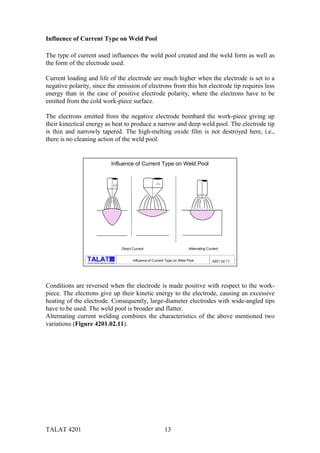
Influence of Current Type on Weld Pool
The type of current used influences the weld pool created and the weld form as well as
the form of the electrode used.
Current loading and life of the electrode are much higher when the electrode is set to a
negative polarity, since the emission of electrons from this hot electrode tip requires less
energy than in the case of positive electrode polarity, where the electrons have to be
emitted from the cold work-piece surface.
The electrons emitted from the negative electrode bombard the work-piece giving up
their kinectical energy as heat to produce a narrow and deep weld pool. The electrode tip
is thin and narrowly tapered. The high-melting oxide film is not destroyed here, i.e.,
there is no cleaning action of the weld pool.
alu
Training in Aluminium Application Technologies
4201.02.11Influence of Current Type on Weld Pool
Influence of Current Type on Weld Pool
Direct Current Alternating Current
(+)
(-)
Conditions are reversed when the electrode is made positive with respect to the work-
piece. The electrons give up their kinetic energy to the electrode, causing an excessive
heating of the electrode. Consequently, large-diameter electrodes with wide-angled tips
have to be used. The weld pool is broader and flatter.
Alternating current welding combines the characteristics of the above mentioned two
variations (Figure 4201.02.11).
TALAT 4201 14
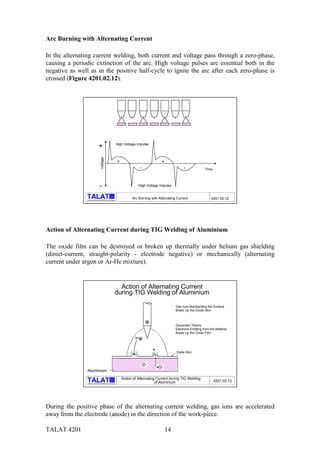
Arc Burning with Alternating Current
In the alternating current welding, both current and voltage pass through a zero-phase,
causing a periodic extinction of the arc. High voltage pulses are essential both in the
negative as well as in the positive half-cycle to ignite the arc after each zero-phase is
crossed (Figure 4201.02.12).
alu
Training in Aluminium Application Technologies
Arc Burning with Alternating Current 4201.02.12
+
-
Voltage
High Voltage Impulse
Time-
+
-
+
Action of Alternating Current during TIG Welding of Aluminium
The oxide film can be destroyed or broken up thermally under helium gas shielding
(direct-current, straight-polarity - electrode negative) or mechanically (alternating
current under argon or Ar-He mixture).
alu
Training in Aluminium Application Technologies
e
Ar
Oxide Skin
Aluminium
Action of Alternating Current
during TIG Welding of Aluminium
Gas Ions Bombarding the Surface
Break Up the Oxide Skin
Discarded Theory:
Electrons Emitting from the Material
Break Up the Oxide Film
Action of Alternating Current during TIG Welding
of Aluminium 4201.02.13
During the positive phase of the alternating current welding, gas ions are accelerated
away from the electrode (anode) in the direction of the work-piece.
TALAT 4201 15
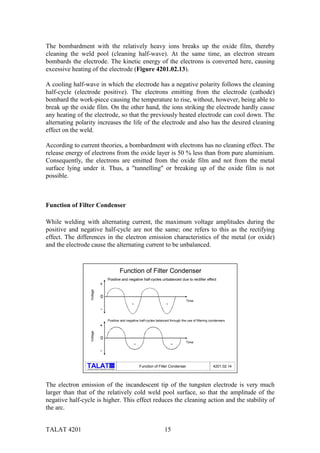
The bombardment with the relatively heavy ions breaks up the oxide film, thereby
cleaning the weld pool (cleaning half-wave). At the same time, an electron stream
bombards the electrode. The kinetic energy of the electrons is converted here, causing
excessive heating of the electrode (Figure 4201.02.13).
A cooling half-wave in which the electrode has a negative polarity follows the cleaning
half-cycle (electrode positive). The electrons emitting from the electrode (cathode)
bombard the work-piece causing the temperature to rise, without, however, being able to
break up the oxide film. On the other hand, the ions striking the electrode hardly cause
any heating of the electrode, so that the previously heated electrode can cool down. The
alternating polarity increases the life of the electrode and also has the desired cleaning
effect on the weld.
According to current theories, a bombardment with electrons has no cleaning effect. The
release energy of electrons from the oxide layer is 50 % less than from pure aluminium.
Consequently, the electrons are emitted from the oxide film and not from the metal
surface lying under it. Thus, a "tunnelling" or breaking up of the oxide film is not
possible.
Function of Filter Condenser
While welding with alternating current, the maximum voltage amplitudes during the
positive and negative half-cycle are not the same; one refers to this as the rectifying
effect. The differences in the electron emission characteristics of the metal (or oxide)
and the electrode cause the alternating current to be unbalanced.
alu
Training in Aluminium Application Technologies
Function of Filter Condenser
Positive and negative half-cycles unbalanced due to rectifier effect
Positive and negative half-cycles balanced through the use of filtering condensers
+
-
-
-
+
-
0
0
- -
Time
Time
VoltageVoltage
Function of Filter Condenser 4201.02.14
The electron emission of the incandescent tip of the tungsten electrode is very much
larger than that of the relatively cold weld pool surface, so that the amplitude of the
negative half-cycle is higher. This effect reduces the cleaning action and the stability of
the arc.
TALAT 4201 16
Filter condensers are used to produce a balanced wave (Figure 4201.02.14).
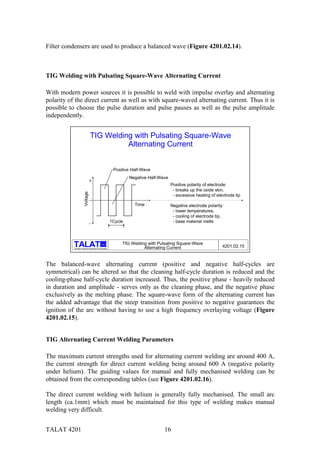
TIG Welding with Pulsating Square-Wave Alternating Current
With modern power sources it is possible to weld with impulse overlay and alternating
polarity of the direct current as well as with square-waved alternating current. Thus it is
possible to choose the pulse duration and pulse pauses as well as the pulse amplitude
independently.
Training in Aluminium Application Technologies
alu TIG Welding with Pulsating Square-Wave
Alternating Current 4201.02.15
TIG Welding with Pulsating Square-Wave
Alternating Current
Positive polarity of electrode:
- breaks up the oxide skin,
- excessive heating of electrode tip
Negative electrode polarity:
- lower temperatures,
- cooling of electrode tip,
- base material melts
Time
1Cycle
Voltage
+
-
Positive Half-Wave
Negative Half-Wave
The balanced-wave alternating current (positive and negative half-cycles are
symmetrical) can be altered so that the cleaning half-cycle duration is reduced and the
cooling-phase half-cycle duration increased. Thus, the positive phase - heavily reduced
in duration and amplitude - serves only as the cleaning phase, and the negative phase
exclusively as the melting phase. The square-wave form of the alternating current has
the added advantage that the steep transition from positive to negative guarantees the
ignition of the arc without having to use a high frequency overlaying voltage (Figure
4201.02.15).
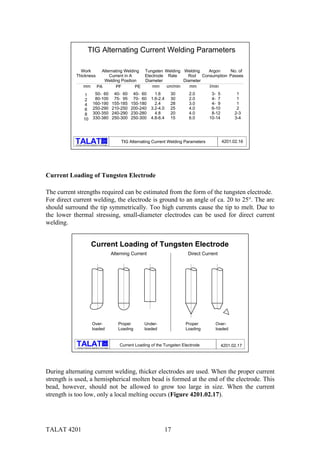
TIG Alternating Current Welding Parameters
The maximum current strengths used for alternating current welding are around 400 A,
the current strength for direct current welding being around 600 A (negative polarity
under helium). The guiding values for manual and fully mechanised welding can be
obtained from the corresponding tables (see Figure 4201.02.16).
The direct current welding with helium is generally fully mechanised. The small arc
length (ca.1mm) which must be maintained for this type of welding makes manual
welding very difficult.
TALAT 4201 17
Training in Aluminium Application Technologies
alu
TIG Alternating Current Welding Parameters 4201.02.16
TIG Alternating Current Welding Parameters
Work
Thickness
1
2
4
6
8
10
Alternating Welding
Current in A
Welding Position
Tungsten
Electrode
Diameter
Welding
Rate
Welding
Rod
Diameter
Argon
Consumption
No. of
Passes
PA PF PEmm mm cm/min mm l/min
50- 60
80-100
160-190
250-290
300-350
330-380
40- 60
75- 95
155-185
210-250
240-290
250-300
40- 60
70- 60
150-180
200-240
230-280
250-300
1.6
1.6-2.4
2.4
3.2-4.0
4.8
4.8-6.4
30
30
28
25
20
15
2.0
2.0
3.0
4.0
4.0
6.0
3- 5
4- 7
4- 9
6-10
8-12
10-14
1
1
1
2
2-3
3-4
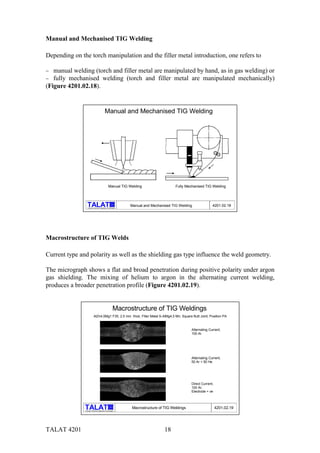
Current Loading of Tungsten Electrode
The current strengths required can be estimated from the form of the tungsten electrode.
For direct current welding, the electrode is ground to an angle of ca. 20 to 25°. The arc
should surround the tip symmetrically. Too high currents cause the tip to melt. Due to
the lower thermal stressing, small-diameter electrodes can be used for direct current
welding.
Training in Aluminium Application Technologies
alu
4201.02.17Current Loading of the Tungsten Electrode
Proper
Loading
Under-
loaded
Over-
loaded
Proper
Loading
Over-
loaded
Alterning Current Direct Current
Current Loading of Tungsten Electrode
During alternating current welding, thicker electrodes are used. When the proper current
strength is used, a hemispherical molten bead is formed at the end of the electrode. This
bead, however, should not be allowed to grow too large in size. When the current
strength is too low, only a local melting occurs (Figure 4201.02.17).
TALAT 4201 18
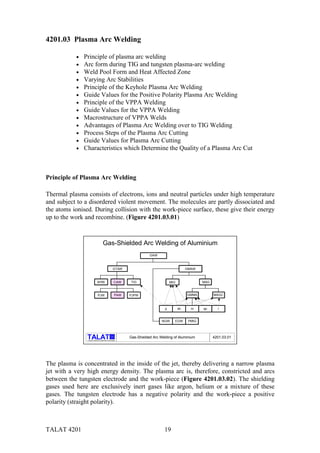
Manual and Mechanised TIG Welding
Depending on the torch manipulation and the filler metal introduction, one refers to
− manual welding (torch and filler metal are manipulated by hand, as in gas welding) or
− fully mechanised welding (torch and filler metal are manipulated mechanically)
(Figure 4201.02.18).
alu
Training in Aluminium Application Technologies
Fully Mechanised TIG WeldingManual TIG Welding
Manual and Mechanised TIG Welding
Manual and Mechanised TIG Welding 4201.02.18
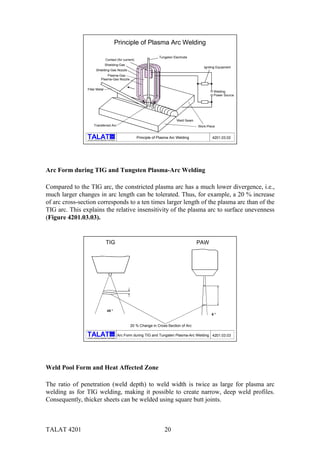
Macrostructure of TIG Welds
Current type and polarity as well as the shielding gas type influence the weld geometry.
The micrograph shows a flat and broad penetration during positive polarity under argon
gas shielding. The mixing of helium to argon in the alternating current welding,
produces a broader penetration profile (Figure 4201.02.19).
alu
Training in Aluminium Application Technologies
Macrostructure of TIG Weldings
Macrostructure of TIG Weldings 4201.02.19
AlZn4,5Mg1 F35; 2.5 mm thick, Filler Metal S-AlMg4,5 Mn; Square Butt Joint; Position PA
Alternating Current;
100 Ar
Direct Current;
100 Ar;
Electrode + ve
Alternating Current;
50 Ar + 50 He
TALAT 4201 19
4201.03 Plasma Arc Welding
• Principle of plasma arc welding
• Arc form during TIG and tungsten plasma-arc welding
• Weld Pool Form and Heat Affected Zone
• Varying Arc Stabilities
• Principle of the Keyhole Plasma Arc Welding
• Guide Values for the Positive Polarity Plasma Arc Welding
• Principle of the VPPA Welding
• Guide Values for the VPPA Welding
• Macrostructure of VPPA Welds
• Advantages of Plasma Arc Welding over to TIG Welding
• Process Steps of the Plasma Arc Cutting
• Guide Values for Plasma Arc Cutting
• Characteristics which Determine the Quality of a Plasma Arc Cut
Principle of Plasma Arc Welding
Thermal plasma consists of electrons, ions and neutral particles under high temperature
and subject to a disordered violent movement. The molecules are partly dissociated and
the atoms ionised. During collision with the work-piece surface, these give their energy
up to the work and recombine. (Figure 4201.03.01)
alu
Training in Aluminium Application Technologies
PAW
Gas-Shielded Arc Welding of Aluminium
GAW
GTAW
AHW TIG
PJW PJPW
GMAW
MIG MAG
GMMA MAGC
EGWNGW PMIG
p sh m sp l
4201.03.01Gas-Shielded Arc Welding of Aluminium
CAW
The plasma is concentrated in the inside of the jet, thereby delivering a narrow plasma
jet with a very high energy density. The plasma arc is, therefore, constricted and arcs
between the tungsten electrode and the work-piece (Figure 4201.03.02). The shielding
gases used here are exclusively inert gases like argon, helium or a mixture of these
gases. The tungsten electrode has a negative polarity and the work-piece a positive
polarity (straight polarity).
TALAT 4201 20
alu
Training in Aluminium Application Technologies
Tungsten Electrode
Contact (for current)
Shielding-Gas
Shielding-Gas Nozzle
Filler Metal
Principle of Plasma Arc Welding
Work-Piece
Weld Seam
Transferred Arc
Principle of Plasma Arc Welding 4201.03.02
Plasma-Gas
Plasma-Gas Nozzle
Welding
Power Source
Igniting Equipment
Arc Form during TIG and Tungsten Plasma-Arc Welding
Compared to the TIG arc, the constricted plasma arc has a much lower divergence, i.e.,
much larger changes in arc length can be tolerated. Thus, for example, a 20 % increase
of arc cross-section corresponds to a ten times larger length of the plasma arc than of the
TIG arc. This explains the relative insensitivity of the plasma arc to surface unevenness
(Figure 4201.03.03).
Training in Aluminium Application Technologies
alu
Arc Form during TIG and Tungsten Plasma-Arc Welding 4201.03.03
45 °
6 °
20 % Change in Cross-Section of Arc
TIG PAW
Weld Pool Form and Heat Affected Zone
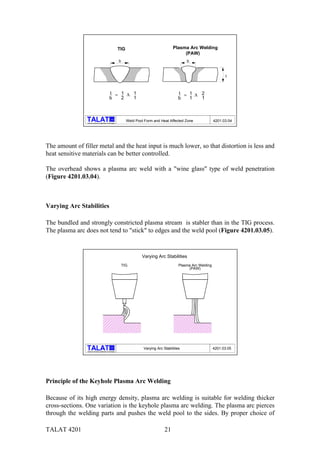
The ratio of penetration (weld depth) to weld width is twice as large for plasma arc
welding as for TIG welding, making it possible to create narrow, deep weld profiles.
Consequently, thicker sheets can be welded using square butt joints.
TALAT 4201 21
Training in Aluminium Application Technologies
alu
Weld Pool Form and Heat Affected Zone 4201.03.04
b b
t
TIG Plasma Arc Welding
(PAW)
t
b
1
2
1
1
= Λ t
b
1
1
2
1
= Λ
The amount of filler metal and the heat input is much lower, so that distortion is less and
heat sensitive materials can be better controlled.
The overhead shows a plasma arc weld with a "wine glass" type of weld penetration
(Figure 4201.03.04).
Varying Arc Stabilities
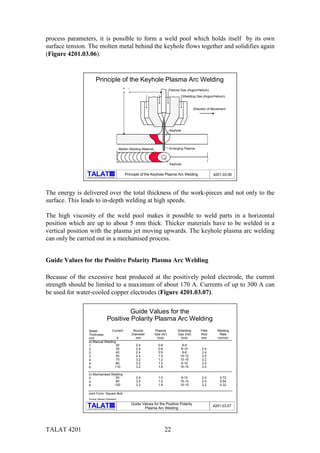
The bundled and strongly constricted plasma stream is stabler than in the TIG process.
The plasma arc does not tend to "stick" to edges and the weld pool (Figure 4201.03.05).
Training in Aluminium Application Technologies
alu
Varying Arc Stabilities
4201.03.05
TIG Plasma Arc Welding
(PAW)
Principle of the Keyhole Plasma Arc Welding
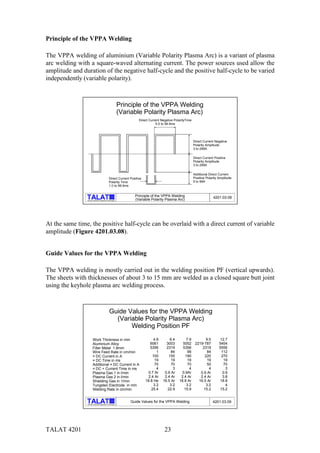
Because of its high energy density, plasma arc welding is suitable for welding thicker
cross-sections. One variation is the keyhole plasma arc welding. The plasma arc pierces
through the welding parts and pushes the weld pool to the sides. By proper choice of
TALAT 4201 22
process parameters, it is possible to form a weld pool which holds itself by its own
surface tension. The molten metal behind the keyhole flows together and solidifies again
(Figure 4201.03.06).
alu
Training in Aluminium Application Technologies
Principle of the Keyhole Plasma Arc Welding
+ - Plasma Gas (Argon/Helium)
Shielding Gas (Argon/Helium)
Direction of Movement
Keyhole
Emerging PlasmaMolten Welding Material
Keyhole
Principle of the Keyhole Plasma Arc Welding 4201.03.06
The energy is delivered over the total thickness of the work-pieces and not only to the
surface. This leads to in-depth welding at high speeds.
The high viscosity of the weld pool makes it possible to weld parts in a horizontal
position which are up to about 5 mm thick. Thicker materials have to be welded in a
vertical position with the plasma jet moving upwards. The keyhole plasma arc welding
can only be carried out in a mechanised process.
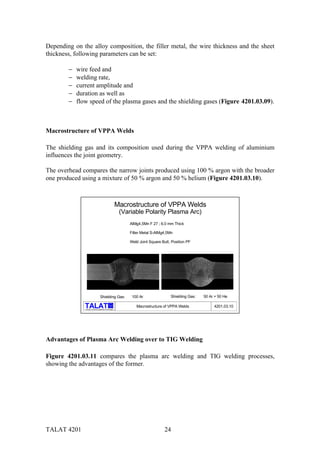
Guide Values for the Positive Polarity Plasma Arc Welding
Because of the excessive heat produced at the positively poled electrode, the current
strength should be limited to a maximum of about 170 A. Currents of up to 300 A can
be used for water-cooled copper electrodes (Figure 4201.03.07).
Training in Aluminium Application Technologies
alu
Guide Values for the
Positive Polarity Plasma Arc Welding
Sheet
Thickness
mm
a) Manual Welding
1
2
2
3
4
4
6
b) Mechanised Welding
2
4
6
Current
A
30
35
40
50
75
80
110
50
80
120
Nozzle
Diameter
mm
2.4
2.4
2.4
2.4
3.2
3.2
3.2
2.4
3.2
3.2
Plasma
Gas (Ar)
l/min
0.8
0.8
0.9
1.0
1.2
1.2
1.6
1.0
1.2
1.8
Shielding
Gas (He)
l/min
6-8
8-10
6-8
10-12
10-15
8-10
10-15
8-10
10-12
10-15
Filler
Rod
mm
-
2.4
2.4
3.2
3.2
3.2
3.2
2.4
2.4
3.2
Welding
Rate
cm/min
0.72
0.54
0.32
Joint Form: Square Butt
Source: Messer Griesheim
Guide Values for the Positive Polarity
Plasma Arc Welding
4201.03.07
TALAT 4201 23
Principle of the VPPA Welding
The VPPA welding of aluminium (Variable Polarity Plasma Arc) is a variant of plasma
arc welding with a square-waved alternating current. The power sources used allow the
amplitude and duration of the negative half-cycle and the positive half-cycle to be varied
independently (variable polarity).
Training in Aluminium Application Technologies
alu
4201.03.08Principle of the VPPA Welding
(Variable Polarity Plasma Arc)
Principle of the VPPA Welding
(Variable Polarity Plasma Arc)
Direct Current Positive
Polarity Time
1.0 to 99.9ms
Direct Current Negative PolarityTime
5.0 to 99.9ms
Direct Current Negative
Polarity Amplitude
3 to 299A
Direct Current Positive
Polarity Amplitude
3 to 299A
Additional Direct Current
Positive Polarity Amplitude
5 to 99A
At the same time, the positive half-cycle can be overlaid with a direct current of variable
amplitude (Figure 4201.03.08).
Guide Values for the VPPA Welding
The VPPA welding is mostly carried out in the welding position PF (vertical upwards).
The sheets with thicknesses of about 3 to 15 mm are welded as a closed square butt joint
using the keyhole plasma arc welding process.
Training in Aluminium Application Technologies
alu
Guide Values for the VPPA Welding
(Variable Polarity Plasma Arc)
Welding Position PF
Work Thickness in mm
Aluminium Alloy
Filler Metal 1.6mm
Wire Feed Rate in cm/min
= DC Current in A
= DC Time in ms
Additional = DC Current in A
= DC + Current Time in ms
Plasma Gas 1 in l/min
Plasma Gas 2 in l/min
Shielding Gas in 1/min
Tungsten Electrode in mm
Welding Rate in cm/min
4.8
6061
5356
1
100
19
70
4
0.7 Ar
2.4 Ar
18.8 He
3.2
25.4
6.4
3003
2319
84
155
19
70
3
0.9 Ar
2.4 Ar
16.5 Ar
3.2
22.9
7.9
5052
5356
99
190
19
70
4
0.9Ar
2.4 Ar
18.8 Ar
3.2
15.9
9.5
2219-T87
2319
84
220
19
50
4
0.9 Ar
2.4 Ar
16.5 Ar
3.2
15.2
12.7
5454
5556
112
270
19
70
3
0.9
3.8
18.8
4
15.2
Guide Values for the VPPA Welding 4201.03.09
TALAT 4201 24
Depending on the alloy composition, the filler metal, the wire thickness and the sheet
thickness, following parameters can be set:
− wire feed and
− welding rate,
− current amplitude and
− duration as well as
− flow speed of the plasma gases and the shielding gases (Figure 4201.03.09).
Macrostructure of VPPA Welds
The shielding gas and its composition used during the VPPA welding of aluminium
influences the joint geometry.
The overhead compares the narrow joints produced using 100 % argon with the broader
one produced using a mixture of 50 % argon and 50 % helium (Figure 4201.03.10).
alu
Training in Aluminium Application Technologies
Macrostructure of VPPA Welds 4201.03.10
AlMg4,5Mn F 27 ; 6.0 mm Thick
Filler Metal S-AlMg4,5Mn
Weld Joint Square Butt, Position PF
Shielding Gas: 100 Ar 50 Ar + 50 HeShielding Gas:
Macrostructure of VPPA Welds
(Variable Polarity Plasma Arc)
Advantages of Plasma Arc Welding over to TIG Welding
Figure 4201.03.11 compares the plasma arc welding and TIG welding processes,
showing the advantages of the former.
TALAT 4201 25
Training in Aluminium Application Technologies
alu
Advantages of Plasma Arc Welding
over TIG Welding
* Reliable arc ignition due to pilot arc
* Stable arc
* Insensitive to changes in torch-to-work distance
* Higher welding speeds
* Less distortion due to narrow HAZ
* One-sided welding possible also for thicker sheets
* Controlled through welding using the keyhole technique
* Less effort required for edge preparation
* Filler metal not required
* Deeper penetration
* Tungsten inclusions avoided
Advantages of Plasma Arc Welding
over TIG Welding
4201.03.11
Process Steps of the Plasma Arc Cutting
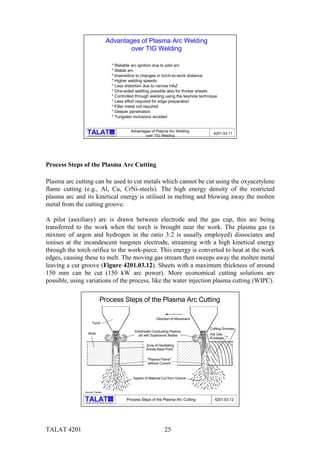
Plasma arc cutting can be used to cut metals which cannot be cut using the oxyacetylene
flame cutting (e.g., Al, Cu, CrNi-steels). The high energy density of the restricted
plasma arc and its kinetical energy is utilised in melting and blowing away the molten
metal from the cutting groove.
A pilot (auxiliary) arc is drawn between electrode and the gas cup, this arc being
transferred to the work when the torch is brought near the work. The plasma gas (a
mixture of argon and hydrogen in the ratio 3:2 is usually employed) dissociates and
ionises at the incandescent tungsten electrode, streaming with a high kinetical energy
through the torch orifice to the work-piece. This energy is converted to heat at the work
edges, causing these to melt. The moving gas stream then sweeps away the molten metal
leaving a cut groove (Figure 4201.03.12). Sheets with a maximum thickness of around
150 mm can be cut (150 kW arc power). More economical cutting solutions are
possible, using variations of the process, like the water injection plasma cutting (WIPC).
Process Steps of the Plasma Arc Cuttingalu
Training in Aluminium Application Technologies
4201.03.12
Direction of Movement
Torch
Work
Process Steps of the Plasma Arc Cutting
Source: Farwer
Electrically Conducting Plasma
Jet with Supersonic Nodes
Zone of Oscillating
Anode Base Point
"Plasma Flame"
without Current
Sparks of Material Cut from Groove
Cutting Grooves
Hot Gas
Envelope
TALAT 4201 26
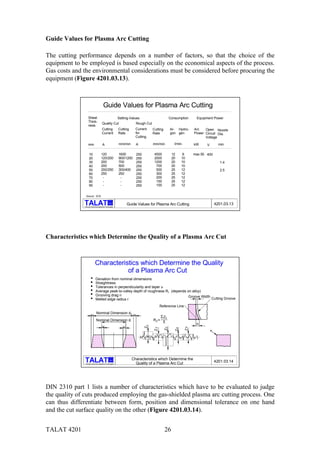
Guide Values for Plasma Arc Cutting
The cutting performance depends on a number of factors, so that the choice of the
equipment to be employed is based especially on the economical aspects of the process.
Gas costs and the environmental considerations must be considered before procuring the
equipment (Figure 4201.03.13).
Guide Values for Plasma Arc Cutting
Amm
Current
for
Cutting
A
Consumption
Ar-
gon
Arc
Power
Equipment Power
Open
Circuit
Voltage
Nozzle
Dia.
mm
10
20
30
40
50
60
70
80
90
1600
900/1200
700
500
300/400
250
-
-
-
250
250
250
250
250
250
250
250
250
12
20
20
20
25
25
25
25
25
max.50 400
1.4
2.5
Source: DVS
Sheet
Thick-
ness
Cutting
Current
Cutting
Rate
Cutting
Rate
4500
2000
1200
700
500
300
200
150
100
Hydro-
gen
8
10
10
10
12
12
12
12
12
120
120/200
200
200
200/250
250
-
-
-
mm/min mm/min
Setting-Values
Quality Cut Rough Cut
l/min. kW V
Guide Values for Plasma Arc Cutting 4201.03.13alu
Training in Aluminium Application Technologies
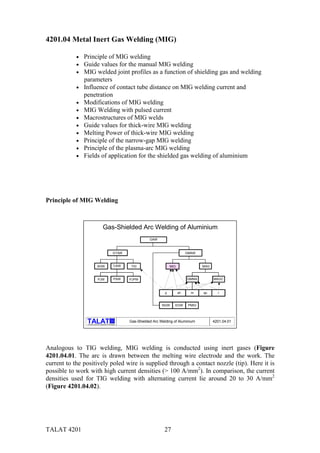
Characteristics which Determine the Quality of a Plasma Arc Cut
r
Cutting Groove
Groove Width
Reference Line
n
Characteristics which Determine the Quality
of a Plasma Arc Cut
Deviation from nominal dimensions
Straightness
Tolerances in perpendicularity and taper u
Average peak-to-valley depth of roughness Rz (depends on alloy)
Grooving drag n
Melted edge radius r
Nominal Dimension di
Nominal Dimension da
u u
u u
Z
Z
Z
Z
Z
1
2
3
4
5
Characteristics which Determine the
Quality of a Plasma Arc Cut 4201.03.14
R =
Z
5
n
Z
Σ
alu
Training in Aluminium Application Technologies
DIN 2310 part 1 lists a number of characteristics which have to be evaluated to judge
the quality of cuts produced employing the gas-shielded plasma arc cutting process. One
can thus differentiate between form, position and dimensional tolerance on one hand
and the cut surface quality on the other (Figure 4201.03.14).
TALAT 4201 27
4201.04 Metal Inert Gas Welding (MIG)
• Principle of MIG welding
• Guide values for the manual MIG welding
• MIG welded joint profiles as a function of shielding gas and welding
parameters
• Influence of contact tube distance on MIG welding current and
penetration
• Modifications of MIG welding
• MIG Welding with pulsed current
• Macrostructures of MIG welds
• Guide values for thick-wire MIG welding
• Melting Power of thick-wire MIG welding
• Principle of the narrow-gap MIG welding
• Principle of the plasma-arc MIG welding
• Fields of application for the shielded gas welding of aluminium
Principle of MIG Welding
alu
Training in Aluminium Application Technologies
Gas-Shielded Arc Welding of Aluminium
GAW
GTAW
AHW TIG
PJW PJPW
GMAW
MAG
GMMA MAGC
EGWNGW PMIG
p sh m sp l
CAW
PAW
4201.04.01Gas-Shielded Arc Welding of Aluminium
MIG
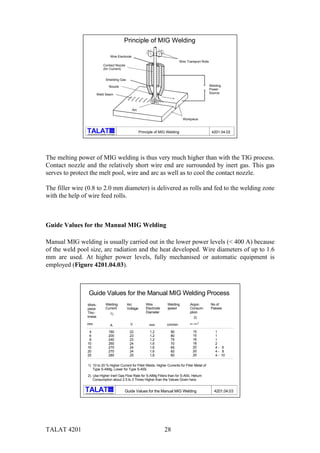
Analogous to TIG welding, MIG welding is conducted using inert gases (Figure
4201.04.01. The arc is drawn between the melting wire electrode and the work. The
current to the positively poled wire is supplied through a contact nozzle (tip). Here it is
possible to work with high current densities (> 100 A/mm2
). In comparison, the current
densities used for TIG welding with alternating current lie around 20 to 30 A/mm2
(Figure 4201.04.02).
TALAT 4201 28
Wire Transport Rolls
Welding
Power
Source
Wire Electrode
Contact Nozzle
(for Current)
Weld Seam
Nozzle
Shielding Gas
Arc
Workpiece
Principle of MIG Welding 4201.04.02
Principle of MIG Welding
alu
Training in Aluminium Application Technologies
The melting power of MIG welding is thus very much higher than with the TIG process.
Contact nozzle and the relatively short wire end are surrounded by inert gas. This gas
serves to protect the melt pool, wire and arc as well as to cool the contact nozzle.
The filler wire (0.8 to 2.0 mm diameter) is delivered as rolls and fed to the welding zone
with the help of wire feed rolls.
Guide Values for the Manual MIG Welding
Manual MIG welding is usually carried out in the lower power levels (< 400 A) because
of the weld pool size, arc radiation and the heat developed. Wire diameters of up to 1.6
mm are used. At higher power levels, fully mechanised or automatic equipment is
employed (Figure 4201.04.03).
Guide Values for the Manual MIG Welding Process
Work-
piece
Thic-
kness
Welding
Current
Arc
Voltage
Wire
Electrode
Diameter
Welding
speed
Argon
Consum-
ption
No of
Passes
4
6
8
10
15
20
25
180
200
240
260
270
270
280
22
23
23
24
24
24
25
1,2
1,2
1,2
1,6
1,6
1,6
1,6
90
80
75
70
65
60
60
15
15
16
18
20
20
20
1
1
1
2
4 - 6
4 - 8
4 - 10
1) 10 to 20 % Higher Current for Fillet Welds. Higher Currents for Filler Metal of
Type S-AlMg, Lower for Type S-AlSi.
2) Use Higher Inert Gas Flow Rate for S-AlMg Fillers than for S-AlSi, Helium
Consumption about 2.5 to 3 Times Higher than the Values Given here.
mm A V mm cm/min
1)
2)
dm /min
3
Guide Values for the Manual MIG Welding 4201.04.03
alu
Training in Aluminium Application Technologies
TALAT 4201 29
MIG Welded Joint Profiles as a Function of Shielding Gas and Welding
Parameters
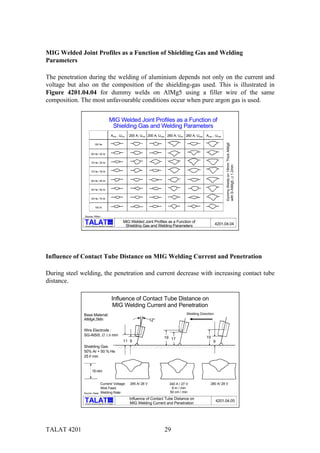
The penetration during the welding of aluminium depends not only on the current and
voltage but also on the composition of the shielding-gas used. This is illustrated in
Figure 4201.04.04 for dummy welds on AlMg5 using a filler wire of the same
composition. The most unfavourable conditions occur when pure argon gas is used.
alu
Training in Aluminium Application Technologies
MIG Welded Joint Profiles as a Function of
Shielding Gas and Welding Parameters 4201.04.04
MIG Welded Joint Profiles as a Function of
Shielding Gas and Welding Parameters
DummyWeldson19mmThickAlMg5
withS-AlMg5,∅1.2mm
120 He
80 He / 20 Ar
75 He / 25 Ar
70 He / 30 Ar
60 He / 40 Ar
50 He / 50 Ar
30 He / 70 Ar
100 Ar
Amin , Umin 200 A, Umin 200 A, Umax 260 A, Umin 260 A, Umax Amax , Umax
Source: Hilton
Influence of Contact Tube Distance on MIG Welding Current and Penetration
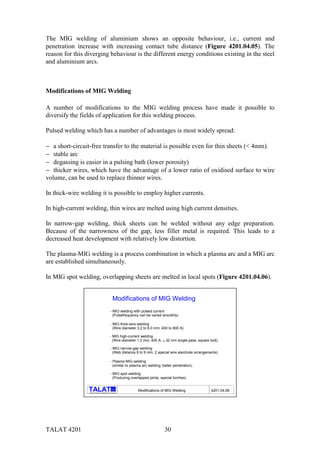
During steel welding, the penetration and current decrease with increasing contact tube
distance.
alu
Training in Aluminium Application Technologies
Influence of Contact Tube Distance on
MIG Welding Current and Penetration
4201.04.05
Influence of Contact Tube Distance on
MIG Welding Current and Penetration
Source: Haas
Shielding Gas:
50% Ar + 50 % He
25 l/ min
Base Material:
AlMg4,5Mn
Wire Electrode :
SG-AlSi5; ∅ 1.6 mm
Current/ Voltage:
Wire Feed:
Welding Rate:
285 A/ 28 V 280 A/ 28 V
15 mm
19
9
Welding Direction
340 A / 27 V
9 m / min
50 cm / min
11 9
12°12°
19 17
TALAT 4201 30
The MIG welding of aluminium shows an opposite behaviour, i.e., current and
penetration increase with increasing contact tube distance (Figure 4201.04.05). The
reason for this diverging behaviour is the different energy conditions existing in the steel
and aluminium arcs.
Modifications of MIG Welding
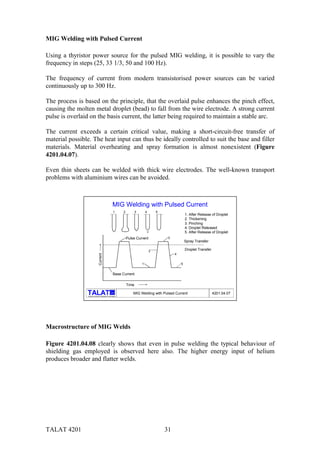
A number of modifications to the MIG welding process have made it possible to
diversify the fields of application for this welding process.
Pulsed welding which has a number of advantages is most widely spread:
− a short-circuit-free transfer to the material is possible even for thin sheets (< 4mm).
− stable arc
− degassing is easier in a pulsing bath (lower porosity)
− thicker wires, which have the advantage of a lower ratio of oxidised surface to wire
volume, can be used to replace thinner wires.
In thick-wire welding it is possible to employ higher currents.
In high-current welding, thin wires are melted using high current densities.
In narrow-gap welding, thick sheets can be welded without any edge preparation.
Because of the narrowness of the gap, less filler metal is required. This leads to a
decreased heat development with relatively low distortion.
The plasma-MIG welding is a process combination in which a plasma arc and a MIG arc
are established simultaneously.
In MIG spot welding, overlapping sheets are melted in local spots (Figure 4201.04.06).
alu
Training in Aluminium Application Technologies
Modifications of MIG Welding 4201.04.06
Modifications of MIG Welding
- MIG welding with pulsed current
(Pulsefrequency can be varied smoothly)
- MIG thick-wire welding
(Wire diameter 3.2 to 6.0 mm; 400 to 800 A)
- MIG narrow-gap welding
(Web distance 6 to 9 mm; 2 special wire electrode arrangements)
- Plasma MIG welding
(similar to plasma arc welding; better penetration)
- MIG spot welding
(Producing overlapped joints; special torches)
- MIG high-current welding
(Wire diameter 1.2 mm; 400 A: ≤ 32 mm single pass; square butt)
TALAT 4201 31
MIG Welding with Pulsed Current
Using a thyristor power source for the pulsed MIG welding, it is possible to vary the
frequency in steps (25, 33 1/3, 50 and 100 Hz).
The frequency of current from modern transistorised power sources can be varied
continuously up to 300 Hz.
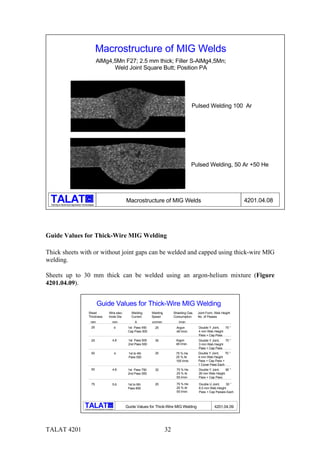
The process is based on the principle, that the overlaid pulse enhances the pinch effect,
causing the molten metal droplet (bead) to fall from the wire electrode. A strong current
pulse is overlaid on the basis current, the latter being required to maintain a stable arc.
The current exceeds a certain critical value, making a short-circuit-free transfer of
material possible. The heat input can thus be ideally controlled to suit the base and filler
materials. Material overheating and spray formation is almost nonexistent (Figure
4201.04.07).
Even thin sheets can be welded with thick wire electrodes. The well-known transport
problems with aluminium wires can be avoided.
Training in Aluminium Application Technologies
alu
4201.04.07MIG Welding with Pulsed Current
MIG Welding with Pulsed Current
Pulse Current
Base Current
1
2
3
4
5
Current
Time
Spray Transfer
1. After Release of Droplet
2. Thickening
3. Pinching
4. Droplet Released
5. After Release of Droplet
1 2 3 4 5
Droplet Transfer
Macrostructure of MIG Welds
Figure 4201.04.08 clearly shows that even in pulse welding the typical behaviour of
shielding gas employed is observed here also. The higher energy input of helium
produces broader and flatter welds.
TALAT 4201 32
alu
Training in Aluminium Application Technologies
4201.04.08Macrostructure of MIG Welds
Macrostructure of MIG Welds
Pulsed Welding 100 Ar
Pulsed Welding, 50 Ar +50 He
AlMg4,5Mn F27; 2.5 mm thick; Filler S-AlMg4,5Mn;
Weld Joint Square Butt; Position PA
Guide Values for Thick-Wire MIG Welding
Thick sheets with or without joint gaps can be welded and capped using thick-wire MIG
welding.
Sheets up to 30 mm thick can be welded using an argon-helium mixture (Figure
4201.04.09).
Guide Values for Thick-Wire MIG Welding
Welding
Current
Welding
Speed
Wire elec-
trode Dia
Joint Form, Web Height
No. of Passes
Shielding Gas
Consumption
Sheet
Thickness
25 4 1st Pass 450
Cap Pass 500
25 Argon
46 l/min
Double Y Joint, 70 °
4 mm Web Height
Pass + Cap Pass
25 4.8 1st Pass 500
2nd Pass 500
30 Argon
46 l/min
Double Y Joint, 70 °
3 mm Web Height
Pass + Cap Pass
50 4 1st to 4th
Pass 550
25 75 % He
25 % Ar
105 l/min
Double Y Joint, 70 °
4 mm Web Height
Pass + Cap Pass +
1 Cover Pass Each
50 4.8 1st Pass 750
2nd Pass 550
32 75 % He
25 % Ar
55 l/min
Double Y Joint, 90 °
26 mm Web Height
Pass + Cap Pass
75 5.6 1st to 6th
Pass 650
25 75 % He
25 % Ar
55 l/min
Double U Joint, 30 °
6.5 mm Web Height
Pass + Cap Passes Each
mm mm A cm/min l/min
Guide Values for Thick-Wire MIG Welding 4201.04.09alu
Training in Aluminium Application Technologies
TALAT 4201 33
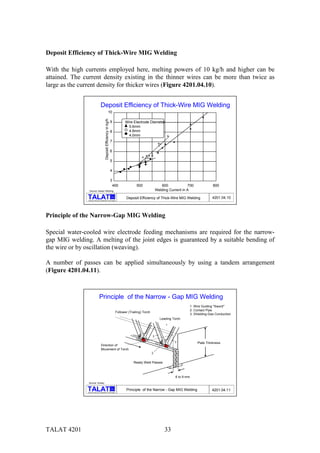
Deposit Efficiency of Thick-Wire MIG Welding
With the high currents employed here, melting powers of 10 kg/h and higher can be
attained. The current density existing in the thinner wires can be more than twice as
large as the current density for thicker wires (Figure 4201.04.10).
Training in Aluminium Application Technologies
alu
4201.04.10Deposit Efficiency of Thick-Wire MIG Welding
Source: Kaiser Welding
Deposit Efficiency of Thick-Wire MIG Welding
3
4
5
6
7
8
9
10
400 500 600 700 800
Welding Current in A
DepositEfficiencyinkg/h
Wire Electrode Diameter
5.6mm
4.8mm
4.0mm
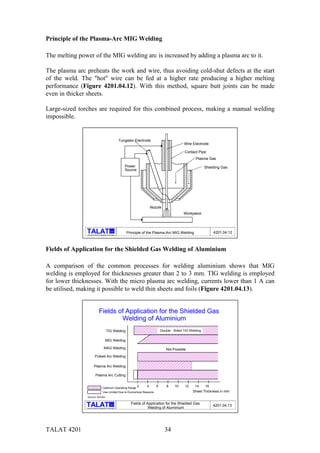
Principle of the Narrow-Gap MIG Welding
Special water-cooled wire electrode feeding mechanisms are required for the narrow-
gap MIG welding. A melting of the joint edges is guaranteed by a suitable bending of
the wire or by oscillation (weaving).
A number of passes can be applied simultaneously by using a tandem arrangement
(Figure 4201.04.11).
Principle of the Narrow - Gap MIG Welding
4201.04.11
Source: Sciaky
Ready Weld Passes
Direction of
Movement of Torch
Plate Thickness
Follower (Trailing) Torch
Leading Torch
1. Wire Guiding "Sword"
2. Contact Pipe
3. Shielding-Gas Conduction
1
3
3
2
6 to 9 mm
alu
Training in Aluminium Application Technologies
TALAT 4201 34
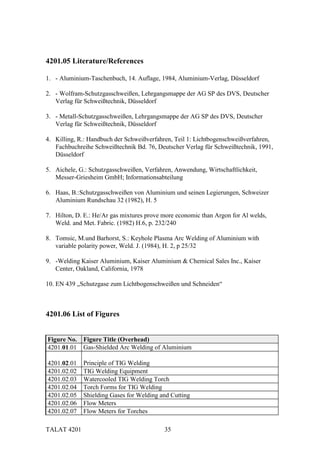
Principle of the Plasma-Arc MIG Welding
The melting power of the MIG welding arc is increased by adding a plasma arc to it.
The plasma arc preheats the work and wire, thus avoiding cold-shut defects at the start
of the weld. The "hot" wire can be fed at a higher rate producing a higher melting
performance (Figure 4201.04.12). With this method, square butt joints can be made
even in thicker sheets.
Large-sized torches are required for this combined process, making a manual welding
impossible.
Power
Source
Nozzle
Tungsten Electrode
Shielding Gas
Plasma Gas
Contact Pipe
Wire Electrode
Workpiece
Principle of the Plasma-Arc MIG Welding 4201.04.12alu
Training in Aluminium Application Technologies
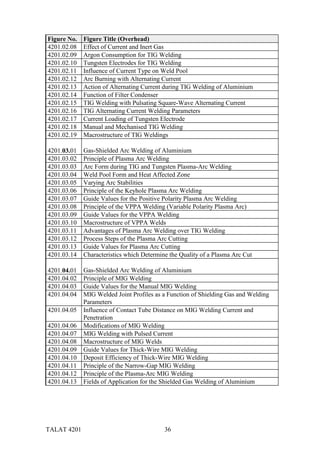
Fields of Application for the Shielded Gas Welding of Aluminium
A comparison of the common processes for welding aluminium shows that MIG
welding is employed for thicknesses greater than 2 to 3 mm. TIG welding is employed
for lower thicknesses. With the micro plasma arc welding, currents lower than 1 A can
be utilised, making it possible to weld thin sheets and foils (Figure 4201.04.13).
alu
Training in Aluminium Application Technologies
Fields of Application for the Shielded Gas
Welding of Aluminium
Fields of Application for the Shielded Gas
Welding of Aluminium
4201.04.13
Use Limited Due to Economical Reasons
Optimum Operating Range
Not Possible
Sheet Thickness in mm
2 4 6 8 10 12 14 16
TIG Welding
MIG Welding
MAG Welding
Pulsed Arc Welding
Plasma Arc Welding
Plasma Arc Cutting
Source: Aichele
Double - Sided TIG Welding
TALAT 4201 35
4201.05 Literature/References
1. - Aluminium-Taschenbuch, 14. Auflage, 1984, Aluminium-Verlag, Düsseldorf
2. - Wolfram-Schutzgasschweißen, Lehrgangsmappe der AG SP des DVS, Deutscher
Verlag für Schweißtechnik, Düsseldorf
3. - Metall-Schutzgasschweißen, Lehrgangsmappe der AG SP des DVS, Deutscher
Verlag für Schweißtechnik, Düsseldorf
4. Killing, R.: Handbuch der Schweißverfahren, Teil 1: Lichtbogenschweißverfahren,
Fachbuchreihe Schweißtechnik Bd. 76, Deutscher Verlag für Schweißtechnik, 1991,
Düsseldorf
5. Aichele, G.: Schutzgasschweißen, Verfahren, Anwendung, Wirtschaftlichkeit,
Messer-Griesheim GmbH; Informationsabteilung
6. Haas, B.:Schutzgasschweißen von Aluminium und seinen Legierungen, Schweizer
Aluminium Rundschau 32 (1982), H. 5
7. Hilton, D. E.: He/Ar gas mixtures prove more economic than Argon for Al welds,
Weld. and Met. Fabric. (1982) H.6, p. 232/240
8. Tomsic, M.und Barhorst, S.: Keyhole Plasma Arc Welding of Aluminium with
variable polarity power, Weld. J. (1984), H. 2, p 25/32
9. -Welding Kaiser Aluminium, Kaiser Aluminium & Chemical Sales Inc., Kaiser
Center, Oakland, California, 1978
10. EN 439 „Schutzgase zum Lichtbogenschweißen und Schneiden“
4201.06 List of Figures
Figure No. Figure Title (Overhead)
4201.01.01 Gas-Shielded Arc Welding of Aluminium
4201.02.01 Principle of TIG Welding
4201.02.02 TIG Welding Equipment
4201.02.03 Watercooled TIG Welding Torch
4201.02.04 Torch Forms for TIG Welding
4201.02.05 Shielding Gases for Welding and Cutting
4201.02.06 Flow Meters
4201.02.07 Flow Meters for Torches
TALAT 4201 36
Figure No. Figure Title (Overhead)
4201.02.08 Effect of Current and Inert Gas
4201.02.09 Argon Consumption for TIG Welding
4201.02.10 Tungsten Electrodes for TIG Welding
4201.02.11 Influence of Current Type on Weld Pool
4201.02.12 Arc Burning with Alternating Current
4201.02.13 Action of Alternating Current during TIG Welding of Aluminium
4201.02.14 Function of Filter Condenser
4201.02.15 TIG Welding with Pulsating Square-Wave Alternating Current
4201.02.16 TIG Alternating Current Welding Parameters
4201.02.17 Current Loading of Tungsten Electrode
4201.02.18 Manual and Mechanised TIG Welding
4201.02.19 Macrostructure of TIG Weldings
4201.03.01 Gas-Shielded Arc Welding of Aluminium
4201.03.02 Principle of Plasma Arc Welding
4201.03.03 Arc Form during TIG and Tungsten Plasma-Arc Welding
4201.03.04 Weld Pool Form and Heat Affected Zone
4201.03.05 Varying Arc Stabilities
4201.03.06 Principle of the Keyhole Plasma Arc Welding
4201.03.07 Guide Values for the Positive Polarity Plasma Arc Welding
4201.03.08 Principle of the VPPA Welding (Variable Polarity Plasma Arc)
4201.03.09 Guide Values for the VPPA Welding
4201.03.10 Macrostructure of VPPA Welds
4201.03.11 Advantages of Plasma Arc Welding over TIG Welding
4201.03.12 Process Steps of the Plasma Arc Cutting
4201.03.13 Guide Values for Plasma Arc Cutting
4201.03.14 Characteristics which Determine the Quality of a Plasma Arc Cut
4201.04.01 Gas-Shielded Arc Welding of Aluminium
4201.04.02 Principle of MIG Welding
4201.04.03 Guide Values for the Manual MIG Welding
4201.04.04 MIG Welded Joint Profiles as a Function of Shielding Gas and Welding
Parameters
4201.04.05 Influence of Contact Tube Distance on MIG Welding Current and
Penetration
4201.04.06 Modifications of MIG Welding
4201.04.07 MIG Welding with Pulsed Current
4201.04.08 Macrostructure of MIG Welds
4201.04.09 Guide Values for Thick-Wire MIG Welding
4201.04.10 Deposit Efficiency of Thick-Wire MIG Welding
4201.04.11 Principle of the Narrow-Gap MIG Welding
4201.04.12 Principle of the Plasma-Arc MIG Welding
4201.04.13 Fields of Application for the Shielded Gas Welding of Aluminium

Tig welding

  • 1.
    TALAT Lecture 4201 ArcWelding Processes: TIG, Plasma Arc, MIG 36 pages, 47 figures Basic Level prepared by Ulrich Krüger, Schweißtechnische Lehr- und Versuchsanstalt Berlin Objectives: − to describe the arc welding processes TIG, Plasma, MIG and their modifications in connection with aluminium − the choice of welding parameters − influence on macrostructure Prerequisites: − general engineering background − basic knowledge in electrical engineering Date of Issue: 1994 © EAA - European Aluminium Association
  • 2.
    TALAT 4201 2 4201Arc Welding Processes: TIG, Plasma Arc, MIG Table of Contents 4201 Arc Welding Processes: TIG, Plasma Arc, MIG..................................2 4201.01 Introduction: Gas-Shielded Arc Welding of Aluminium...................... 4 4201.02 TIG Welding.............................................................................................. 5 Principle of TIG Welding ........................................................................................5 TIG Welding Equipment..........................................................................................6 Watercooled TIG Welding Torch ............................................................................7 Torch Forms for TIG Welding.................................................................................8 Shielding Gases for Welding and Cutting ...............................................................8 Flow Meters .............................................................................................................9 Flow Meter for Torches ...........................................................................................9 Effect of Current and Inert Gas..............................................................................10 Argon Consumption for TIG Welding...................................................................11 Tungsten Electrodes for TIG Welding...................................................................12 Influence of Current Type on Weld Pool...............................................................13 Arc Burning with Alternating Current...................................................................14 Action of Alternating Current during TIG Welding of Aluminium ......................14 Function of Filter Condenser .................................................................................15 TIG Welding with Pulsating Square-Wave Alternating Current...........................16 TIG Alternating Current Welding Parameters.......................................................16 Current Loading of Tungsten Electrode.................................................................17 Manual and Mechanised TIG Welding..................................................................18 Macrostructure of TIG Welds................................................................................18 4201.03 Plasma Arc Welding ................................................................................ 19 Principle of Plasma Arc Welding ..........................................................................19 Arc Form during TIG and Tungsten Plasma-Arc Welding....................................20 Weld Pool Form and Heat Affected Zone .............................................................20 Varying Arc Stabilities...........................................................................................21 Principle of the Keyhole Plasma Arc Welding......................................................21 Guide Values for the Positive Polarity Plasma Arc Welding ................................22 Principle of the VPPA Welding.............................................................................23 Guide Values for the VPPA Welding....................................................................23 Macrostructure of VPPA Welds ............................................................................24 Advantages of Plasma Arc Welding over to TIG Welding....................................24 Process Steps of the Plasma Arc Cutting...............................................................25 Guide Values for Plasma Arc Cutting ...................................................................26 Characteristics which Determine the Quality of a Plasma Arc Cut.......................26
  • 3.
    TALAT 4201 3 4201.04Metal Inert Gas Welding (MIG)........................................................... 27 Principle of MIG Welding .....................................................................................27 Guide Values for the Manual MIG Welding .........................................................28 MIG Welded Joint Profiles as a Function of Shielding Gas and Welding Parameters ...............................................................................................................................29 Influence of Contact Tube Distance on MIG Welding Current and Penetration...29 Modifications of MIG Welding .............................................................................30 MIG Welding with Pulsed Current........................................................................31 Macrostructure of MIG Welds...............................................................................31 Guide Values for Thick-Wire MIG Welding.........................................................32 Deposit Efficiency of Thick-Wire MIG Welding..................................................33 Principle of the Narrow-Gap MIG Welding ..........................................................33 Principle of the Plasma-Arc MIG Welding............................................................34 Fields of Application for the Shielded Gas Welding of Aluminium .....................34 4201.05 Literature/References............................................................................ 35 4201.06 List of Figures............................................................................................ 35
  • 4.
    TALAT 4201 4 4201.01Introduction: Gas-Shielded Arc Welding of Aluminium Gas-shielded welding can be divided into the tungsten gas-shielded welding and the metal gas-shielded welding processes. The tungsten gas-shielded welding covers the processes − tungsten plasma arc welding (PAW) − inert-gas tungsten-arc welding (TIG), whereby TIG welding is the most widely used fusion welding process for aluminium. The plasma welding consists only of the plasma-arc welding process which works with a transferred arc. The metal shielded-gas welding is limited to the metal inert-gas welding process operating with an inert gas as shield, as well as a process combination with plasma welding (plasma metal shielded-gas welding - PMIG). A further subdivision is possible, depending on the mechanism of metal transfer: − without short-circuits by pulsed arc (p) − in short-circuit with a short arc (sh) − without short-circuits by spray (transfer) arc (sp) − partly short-circuit-free and in short-circuit by the mixed arc (m) − short-circuiting with a long arc (l), (see Figure 4201.01.01). 4201.01.01Gas-Shielded Arc Welding of Aluminiumalu Training in Aluminium Application Technologies Gas-Shielded Arc Welding of Aluminium GAW GTAW AHW CAW TIG PJW PAW PJPW GMAW MIG MAG GMMA MAGC EGWNGW PMIG p sh m sp l
  • 5.
    TALAT 4201 5 Theabbreviations used are: GAW Gas-shielded arc welding GTAW Gas-shielded tungsten arc welding GMAW Gas-shielded metal arc welding AHW Atomic hydrogen welding CAW Constricted arc welding TIG Tungsten inert-gas arc welding MIG Metal inert-gas arc welding MAG Metal active-gas arc welding PJW Plasma jet welding PAW Plasma arc welding PJPW Plasma jet plasma arc welding GMGMMA Gas-mixture shielded metal-arc welding (MAGM) MAGC CO2-shielded metal-arc welding NGW Narrow-gap welding EGW Electro-gas welding PMIG Plasma MIG welding p Pulsed arc sh Short arc sp Spray arc l Long arc 4201.02 TIG Welding • Principle of TIG Welding • TIG welding equipment • Watercooled TIG welding torch • Torch forms for TIG welding • Shielding gases for welding and cutting • Flow meters • Flow meter for torches • Effect of current and inert gas • Argon consumption for TIG welding • Tungsten electrodes for TIG welding • Influence of current type on weld pool • Arc burning with alternating current • Action of alternating current during TIG welding of aluminium • Function of filter condenser • TIG welding with pulsating square-wave alternating current • TIG alternating current welding parameters • Current loading of tungsten electrode • Manual and mechanised TIG welding • Macrostructure of TIG welds Principle of TIG Welding During TIG welding, an arc is maintained between a tungsten electrode and the work- piece in an inert atmosphere (Ar, He, or Ar-He mixture). Depending on the weld preparation and the work-piece thickness, it is possible to work with or without a filler. The filler can be introduced manually or half mechanically without current or only half mechanically under current (Figure 4201.02.01).
  • 6.
    TALAT 4201 6 alu Trainingin Aluminium Application Technologies HF Tungsten Electrode Contact (for current) Shielding-Gas Shielding-Gas Nozzle Filler Metal Principle of TIG Welding Welding Power Source Work-Piece Weld Seam Arc 4201.02.01Principle of TIG Welding The process itself can be manual, partly mechanised, fully mechanised or automatic. The welding power source delivers direct or alternating current (partly with modulated or pulsed current). A major difference between the welding of steel and the TIG welding of aluminium is the adhering oxide film on the aluminium surface which influences the welding behaviour and has to be concerned. This oxide film has to be removed in order to prevent oxides from being entrapped in the weld. The oxide film can be removed by varying the current type or polarity or also through the use of suitable inert gases. TIG Welding Equipment alu Training in Aluminium Application Technologies 4201.02.02TIG Welding Equipment TIG Welding Equipment Pressure - Reducing Valve Shielding - Gas Welding Torch Power Source with Control Panel Foot Switch
  • 7.
    TALAT 4201 7 TIGwelding equipment consists of the following components: − Source of welding current (including welding controls, filtering condensers and pulse modulation) − Torch unit with hose packet − Gas cylinders with pressure-reducing valve and flow meter (Figure 4201.02.02) Modern welding power sources can deliver both direct and alternating current. The power sources have falling characteristic curves. The current can be varied in steps or continuously. The voltage required depends on the distance between electrode and work-piece and determines the operating point on the characteristic line. In modern power sources designed with transistors, the currents and times can be controlled continuously or can be regulated using control programmes. Watercooled TIG Welding Torch Depending on the magnitude of thermal stressing, the torches can be air or watercooled (for > 100 A). The watercooling cools both torch and current cable. A flow meter registers any water shortage, switching off the current in this case and thus preventing torch overheating. In the region of the gas nozzle and the arc burning location, the cooling action is provided by the inert gas. The torch should be airtight since humidity has a negative influence on the welding result (hydrogen absorption). The gas nozzle is made of metal or ceramics and insulated from the electricity conducting parts. The tungsten electrode has a protrusion length of 2 to 4 mm. A torch cap prevents any inadvertent contact with the electrode (Figure 4201.02.03). Training in Aluminium Application Technologies alu Watercooled TIG Welding Torch 4201.02.03Watercooled TIG Welding Torch Torch Cap Water Outlet Water Flow Monitor (Checks for Water Shortage) Argon Inlet Water Inlet Current Cable Water Flow Hand Grip Electrode Collet Argon Nozzle Tungsten Electrode
  • 8.
    TALAT 4201 8 TorchForms for TIG Welding Torches of different configurations are necessary to allow for the different accessibilities of the weld seams (work-piece form, welding position). Welding at locations which are difficult to access can be made easier by using the short or elongated torch forms. alu Training in Aluminium Application Technologies Torch Forms for TIG Welding Normal Elongated Short Torch Forms of TIG Welding 4201.02.04 The torch design and size also depend on the type of cooling (air or water cooled) (Figure 4201.02.04). Shielding Gases for Welding and Cutting The type of shielding gas used has a major influence on the weld quality. Only inert gases and their mixtures are utilised for welding aluminium, as opposed to the welding of steels (Figure 4201.02.05). The required purity of the gases must be guaranteed. It is most important that the limiting value for humidity is not exceeded. The gases are either delivered in compressed form in cylinders or obtained by a vaporisation process (liquefied gas) through pipe lines.
  • 9.
    TALAT 4201 9 alu Trainingin Aluminium Application Technologies 4201.02.05Shielding Gases for Welding and Cutting Shielding Gases for Welding and Cutting Designation Components in vol. % Group Nr. Process Remarks root protection reducing inert weak oxidising strongly oxidising oxidising inert reducing inactiv CO ² O ² Ar He H ² N ² R I M1 M2 M3 C F 1 2 1 2 1 2 1 2 1 2 1 2 1 3 3 3 3 4 rest (1-2) bal. (1-2) 1 ... 15 15 ... 35 100 100 20 ... 80rest (1) > 0 ... 5 > 0 ... 5 > 0 ... 5 > 0 ... 3 > 0 ... 5 > 0 .. . 3 > 5 ... 25 > 3 ... 10 > 0 ... 8> 5 ... 25 > 25 .. 50 > 5 ... 50 > 10 ... 15 > 8 ... 15 > 0 ... 30 0 ... 30 rest MAG 100 rest TIG, PAW, root protection, plasma arc cutting TIG, MIG, PAW root protection rest (1-2) rest (1-2) rest (1-2) rest (1-2) rest (1-2) rest (1-2) rest (1-2) rest (1-2) rest (1-2) rest (1-2) reducing Flow Meters The pressure of the gas contained in cylinders is reduced by pressure-reducing valves (Manometers for indicating cylinder pressure). The amount of gas flowing in l/min is controlled via a regulating valve and indicated by the flow meter. In order to prevent any errors, the pressure-reducing valves have a colour code corresponding to the gas type (black for inert gases). The type of gas used is also indicated in the manometer (Figure 4201.02.06). Flow Meter for Torches Flow meters which can be fixed directly to the torch nozzle have proved to be very practical. This shows the amount of gas actually passing through the torch in l/min. A correction factor has to be used for the varying gas densities of the Ar-He mixtures or the pure helium used (He: 0.1785 kg/Nm3 , Ar: 1.7844 kg/Nm3 ) (Figure 4201.02.07).
  • 10.
    TALAT 4201 10 alu Trainingin Aluminium Application Technologies 4201.02.06Flow Meters Gas Flow Meters Manometer (for Gas Cylinder Pressure) Indication of Gas Type Flow Meter (With Floating Ball) Flow Control Valve Color Code for Gas Type alu Training in Aluminium Application Technologies Flow Meters for Torches 4201.02.07 Ar 100 % : f = 1.00 Ar 75 % He 25% : f = 1.00 Ar 50 % He 50 % : f = 0.75 Ar 25 % He 75 % : f = 0.57 He 100 % : f = 0.32 Gas Flow Meters for Torches Effect of Current and Inert Gas Both direct and alternating currents are used for welding aluminium. The weld pool and the weld forms can be regulated by controlling the current type and the polarity. The heat developed is highest when helium is used. In direct-current, straight-polarity welding (electrode is negative with respect to aluminium), the heating of the electrode is kept to a minimum but the cleaning action on the weld pool is also minimum. Helium is used as the shielding inert gas. The breakdown of the oxide film is a result of the thermal stressing, i.e., melting occurs. Because of its high melting point (ca. 2050 °C), the oxide layer cannot be melted using argon as the shielding gas.
  • 11.
    TALAT 4201 11 Effectof Current and Inert Gas 4201.02.08 Effect of Current and Inert Gas Heat Efficiency Cleaning Efficiency Inert Gas 70 % Bad He 30 % Good Ar - He 50 % Good Ar -He Argon produces a flat weld poolHelium produces a deep weld pool ~ ~ alu Training in Aluminium Application Technologies When direct-current reverse-polarity is used (electrode is positive with respect to aluminium), excessive heating of the electrode occurs, so that the electrode life is reduced or, as in some cases, even melting of the electrode end can occur. The reverse polarity (electrode positive) has a lower energy density so that the weld pool is shallower than in the case of straight polarity (electrode negative). Thus it is only used for welding thin-walled parts with low currents. However, good cooling and large- diameter electrodes are necessary. The alternating-current welding is a compromise solution (Figure 4201.02.08). Argon Consumption for TIG Welding alu Training in Aluminium Application Technologies Argon Consumption for TIG Welding 4201.02.09 Argon Consumption for TIG Welding 5 10 mm 20 Gas Nozzle Diameter Argon Consumption l min 10 9 8 7 6 5 4 0,4 1,0 2,0 3,0 mm 4,0 Work - Piece Thickness Nickel-Based Alloys Aluminium Titanium The amount of shielding gas required depends on the material used and its thickness.
  • 12.
    TALAT 4201 12 Thegas consumption for titanium is higher than for steel, since a gas absorption by the former material must be prevented even at lower temperatures. Thus, trailing nozzles have to be used. The gas nozzle diameter has to be optimised for the electrode diameter used. Because of its lower density, the amount of argon required is larger than the helium amount needed (4201.02.09). Tungsten Electrodes for TIG Welding Oxide additions (oxides of thorium, zircon, lanthan and cer) to the tungsten electrode reduce the electron emission energy (pure tungsten 5.36 eV, thorated 2.62 eV). This improves: − the arc stability − electrode life − current loading capacity − arc igniting properties. alu Training in Aluminium Application Technologies Tungsten Electrodes for TIG Welding Desig- nation W WT 10 WT 20 WT 30 WT 40 WZ 4 WZ 8 WZ 10 Material No. 2.6005 2.6022 2.6026 2.6030 2.6036 2.6050 2.6062 2.6010 Oxide Additions Wt. % - 0.90 - 1.20 1.80 - 2.20 2.80 - 3.20 3.80 - 4.20 0.30 - 0.50 0.70 - 0.90 0.90 - 1.20 ThO 2 ThO 2 ThO 2 ThO 2 2 ZrO 2 ZrO LaO 2 <_ 0.20 <_ 0.20 <_ 0.20 <_ 0.20 <_ 0.20 <_ 0.20 <_ 0.20 <_ 0.20 Impuri - ties Wt. % Tungsten Wt. % 99.8 Rest Rest Rest Rest Rest Rest Rest Colour Code Green Yellow Red Violet Orange Brown White Black RAL No. 6018 1018 2002 4003 2003 8001 9010 9005 4201.02.10Tungsten Electrodes for TIG Welding Thorated tungsten electrodes are most commonly used. For nuclear reactor construction, zircon oxide additions have proved effective. Lanthated electrodes are used for micro plasma welding and for plasma arc cutting (Figure 4201.02.10).
  • 13.
    TALAT 4201 13 Influenceof Current Type on Weld Pool The type of current used influences the weld pool created and the weld form as well as the form of the electrode used. Current loading and life of the electrode are much higher when the electrode is set to a negative polarity, since the emission of electrons from this hot electrode tip requires less energy than in the case of positive electrode polarity, where the electrons have to be emitted from the cold work-piece surface. The electrons emitted from the negative electrode bombard the work-piece giving up their kinectical energy as heat to produce a narrow and deep weld pool. The electrode tip is thin and narrowly tapered. The high-melting oxide film is not destroyed here, i.e., there is no cleaning action of the weld pool. alu Training in Aluminium Application Technologies 4201.02.11Influence of Current Type on Weld Pool Influence of Current Type on Weld Pool Direct Current Alternating Current (+) (-) Conditions are reversed when the electrode is made positive with respect to the work- piece. The electrons give up their kinetic energy to the electrode, causing an excessive heating of the electrode. Consequently, large-diameter electrodes with wide-angled tips have to be used. The weld pool is broader and flatter. Alternating current welding combines the characteristics of the above mentioned two variations (Figure 4201.02.11).
  • 14.
    TALAT 4201 14 ArcBurning with Alternating Current In the alternating current welding, both current and voltage pass through a zero-phase, causing a periodic extinction of the arc. High voltage pulses are essential both in the negative as well as in the positive half-cycle to ignite the arc after each zero-phase is crossed (Figure 4201.02.12). alu Training in Aluminium Application Technologies Arc Burning with Alternating Current 4201.02.12 + - Voltage High Voltage Impulse High Voltage Impulse Time- + - + Action of Alternating Current during TIG Welding of Aluminium The oxide film can be destroyed or broken up thermally under helium gas shielding (direct-current, straight-polarity - electrode negative) or mechanically (alternating current under argon or Ar-He mixture). alu Training in Aluminium Application Technologies e Ar Oxide Skin Aluminium Action of Alternating Current during TIG Welding of Aluminium Gas Ions Bombarding the Surface Break Up the Oxide Skin Discarded Theory: Electrons Emitting from the Material Break Up the Oxide Film Action of Alternating Current during TIG Welding of Aluminium 4201.02.13 During the positive phase of the alternating current welding, gas ions are accelerated away from the electrode (anode) in the direction of the work-piece.
  • 15.
    TALAT 4201 15 Thebombardment with the relatively heavy ions breaks up the oxide film, thereby cleaning the weld pool (cleaning half-wave). At the same time, an electron stream bombards the electrode. The kinetic energy of the electrons is converted here, causing excessive heating of the electrode (Figure 4201.02.13). A cooling half-wave in which the electrode has a negative polarity follows the cleaning half-cycle (electrode positive). The electrons emitting from the electrode (cathode) bombard the work-piece causing the temperature to rise, without, however, being able to break up the oxide film. On the other hand, the ions striking the electrode hardly cause any heating of the electrode, so that the previously heated electrode can cool down. The alternating polarity increases the life of the electrode and also has the desired cleaning effect on the weld. According to current theories, a bombardment with electrons has no cleaning effect. The release energy of electrons from the oxide layer is 50 % less than from pure aluminium. Consequently, the electrons are emitted from the oxide film and not from the metal surface lying under it. Thus, a "tunnelling" or breaking up of the oxide film is not possible. Function of Filter Condenser While welding with alternating current, the maximum voltage amplitudes during the positive and negative half-cycle are not the same; one refers to this as the rectifying effect. The differences in the electron emission characteristics of the metal (or oxide) and the electrode cause the alternating current to be unbalanced. alu Training in Aluminium Application Technologies Function of Filter Condenser Positive and negative half-cycles unbalanced due to rectifier effect Positive and negative half-cycles balanced through the use of filtering condensers + - - - + - 0 0 - - Time Time VoltageVoltage Function of Filter Condenser 4201.02.14 The electron emission of the incandescent tip of the tungsten electrode is very much larger than that of the relatively cold weld pool surface, so that the amplitude of the negative half-cycle is higher. This effect reduces the cleaning action and the stability of the arc.
  • 16.
    TALAT 4201 16 Filtercondensers are used to produce a balanced wave (Figure 4201.02.14). TIG Welding with Pulsating Square-Wave Alternating Current With modern power sources it is possible to weld with impulse overlay and alternating polarity of the direct current as well as with square-waved alternating current. Thus it is possible to choose the pulse duration and pulse pauses as well as the pulse amplitude independently. Training in Aluminium Application Technologies alu TIG Welding with Pulsating Square-Wave Alternating Current 4201.02.15 TIG Welding with Pulsating Square-Wave Alternating Current Positive polarity of electrode: - breaks up the oxide skin, - excessive heating of electrode tip Negative electrode polarity: - lower temperatures, - cooling of electrode tip, - base material melts Time 1Cycle Voltage + - Positive Half-Wave Negative Half-Wave The balanced-wave alternating current (positive and negative half-cycles are symmetrical) can be altered so that the cleaning half-cycle duration is reduced and the cooling-phase half-cycle duration increased. Thus, the positive phase - heavily reduced in duration and amplitude - serves only as the cleaning phase, and the negative phase exclusively as the melting phase. The square-wave form of the alternating current has the added advantage that the steep transition from positive to negative guarantees the ignition of the arc without having to use a high frequency overlaying voltage (Figure 4201.02.15). TIG Alternating Current Welding Parameters The maximum current strengths used for alternating current welding are around 400 A, the current strength for direct current welding being around 600 A (negative polarity under helium). The guiding values for manual and fully mechanised welding can be obtained from the corresponding tables (see Figure 4201.02.16). The direct current welding with helium is generally fully mechanised. The small arc length (ca.1mm) which must be maintained for this type of welding makes manual welding very difficult.
  • 17.
    TALAT 4201 17 Trainingin Aluminium Application Technologies alu TIG Alternating Current Welding Parameters 4201.02.16 TIG Alternating Current Welding Parameters Work Thickness 1 2 4 6 8 10 Alternating Welding Current in A Welding Position Tungsten Electrode Diameter Welding Rate Welding Rod Diameter Argon Consumption No. of Passes PA PF PEmm mm cm/min mm l/min 50- 60 80-100 160-190 250-290 300-350 330-380 40- 60 75- 95 155-185 210-250 240-290 250-300 40- 60 70- 60 150-180 200-240 230-280 250-300 1.6 1.6-2.4 2.4 3.2-4.0 4.8 4.8-6.4 30 30 28 25 20 15 2.0 2.0 3.0 4.0 4.0 6.0 3- 5 4- 7 4- 9 6-10 8-12 10-14 1 1 1 2 2-3 3-4 Current Loading of Tungsten Electrode The current strengths required can be estimated from the form of the tungsten electrode. For direct current welding, the electrode is ground to an angle of ca. 20 to 25°. The arc should surround the tip symmetrically. Too high currents cause the tip to melt. Due to the lower thermal stressing, small-diameter electrodes can be used for direct current welding. Training in Aluminium Application Technologies alu 4201.02.17Current Loading of the Tungsten Electrode Proper Loading Under- loaded Over- loaded Proper Loading Over- loaded Alterning Current Direct Current Current Loading of Tungsten Electrode During alternating current welding, thicker electrodes are used. When the proper current strength is used, a hemispherical molten bead is formed at the end of the electrode. This bead, however, should not be allowed to grow too large in size. When the current strength is too low, only a local melting occurs (Figure 4201.02.17).
  • 18.
    TALAT 4201 18 Manualand Mechanised TIG Welding Depending on the torch manipulation and the filler metal introduction, one refers to − manual welding (torch and filler metal are manipulated by hand, as in gas welding) or − fully mechanised welding (torch and filler metal are manipulated mechanically) (Figure 4201.02.18). alu Training in Aluminium Application Technologies Fully Mechanised TIG WeldingManual TIG Welding Manual and Mechanised TIG Welding Manual and Mechanised TIG Welding 4201.02.18 Macrostructure of TIG Welds Current type and polarity as well as the shielding gas type influence the weld geometry. The micrograph shows a flat and broad penetration during positive polarity under argon gas shielding. The mixing of helium to argon in the alternating current welding, produces a broader penetration profile (Figure 4201.02.19). alu Training in Aluminium Application Technologies Macrostructure of TIG Weldings Macrostructure of TIG Weldings 4201.02.19 AlZn4,5Mg1 F35; 2.5 mm thick, Filler Metal S-AlMg4,5 Mn; Square Butt Joint; Position PA Alternating Current; 100 Ar Direct Current; 100 Ar; Electrode + ve Alternating Current; 50 Ar + 50 He
  • 19.
    TALAT 4201 19 4201.03Plasma Arc Welding • Principle of plasma arc welding • Arc form during TIG and tungsten plasma-arc welding • Weld Pool Form and Heat Affected Zone • Varying Arc Stabilities • Principle of the Keyhole Plasma Arc Welding • Guide Values for the Positive Polarity Plasma Arc Welding • Principle of the VPPA Welding • Guide Values for the VPPA Welding • Macrostructure of VPPA Welds • Advantages of Plasma Arc Welding over to TIG Welding • Process Steps of the Plasma Arc Cutting • Guide Values for Plasma Arc Cutting • Characteristics which Determine the Quality of a Plasma Arc Cut Principle of Plasma Arc Welding Thermal plasma consists of electrons, ions and neutral particles under high temperature and subject to a disordered violent movement. The molecules are partly dissociated and the atoms ionised. During collision with the work-piece surface, these give their energy up to the work and recombine. (Figure 4201.03.01) alu Training in Aluminium Application Technologies PAW Gas-Shielded Arc Welding of Aluminium GAW GTAW AHW TIG PJW PJPW GMAW MIG MAG GMMA MAGC EGWNGW PMIG p sh m sp l 4201.03.01Gas-Shielded Arc Welding of Aluminium CAW The plasma is concentrated in the inside of the jet, thereby delivering a narrow plasma jet with a very high energy density. The plasma arc is, therefore, constricted and arcs between the tungsten electrode and the work-piece (Figure 4201.03.02). The shielding gases used here are exclusively inert gases like argon, helium or a mixture of these gases. The tungsten electrode has a negative polarity and the work-piece a positive polarity (straight polarity).
  • 20.
    TALAT 4201 20 alu Trainingin Aluminium Application Technologies Tungsten Electrode Contact (for current) Shielding-Gas Shielding-Gas Nozzle Filler Metal Principle of Plasma Arc Welding Work-Piece Weld Seam Transferred Arc Principle of Plasma Arc Welding 4201.03.02 Plasma-Gas Plasma-Gas Nozzle Welding Power Source Igniting Equipment Arc Form during TIG and Tungsten Plasma-Arc Welding Compared to the TIG arc, the constricted plasma arc has a much lower divergence, i.e., much larger changes in arc length can be tolerated. Thus, for example, a 20 % increase of arc cross-section corresponds to a ten times larger length of the plasma arc than of the TIG arc. This explains the relative insensitivity of the plasma arc to surface unevenness (Figure 4201.03.03). Training in Aluminium Application Technologies alu Arc Form during TIG and Tungsten Plasma-Arc Welding 4201.03.03 45 ° 6 ° 20 % Change in Cross-Section of Arc TIG PAW Weld Pool Form and Heat Affected Zone The ratio of penetration (weld depth) to weld width is twice as large for plasma arc welding as for TIG welding, making it possible to create narrow, deep weld profiles. Consequently, thicker sheets can be welded using square butt joints.
  • 21.
    TALAT 4201 21 Trainingin Aluminium Application Technologies alu Weld Pool Form and Heat Affected Zone 4201.03.04 b b t TIG Plasma Arc Welding (PAW) t b 1 2 1 1 = Λ t b 1 1 2 1 = Λ The amount of filler metal and the heat input is much lower, so that distortion is less and heat sensitive materials can be better controlled. The overhead shows a plasma arc weld with a "wine glass" type of weld penetration (Figure 4201.03.04). Varying Arc Stabilities The bundled and strongly constricted plasma stream is stabler than in the TIG process. The plasma arc does not tend to "stick" to edges and the weld pool (Figure 4201.03.05). Training in Aluminium Application Technologies alu Varying Arc Stabilities Varying Arc Stabilities 4201.03.05 TIG Plasma Arc Welding (PAW) Principle of the Keyhole Plasma Arc Welding Because of its high energy density, plasma arc welding is suitable for welding thicker cross-sections. One variation is the keyhole plasma arc welding. The plasma arc pierces through the welding parts and pushes the weld pool to the sides. By proper choice of
  • 22.
    TALAT 4201 22 processparameters, it is possible to form a weld pool which holds itself by its own surface tension. The molten metal behind the keyhole flows together and solidifies again (Figure 4201.03.06). alu Training in Aluminium Application Technologies Principle of the Keyhole Plasma Arc Welding + - Plasma Gas (Argon/Helium) Shielding Gas (Argon/Helium) Direction of Movement Keyhole Emerging PlasmaMolten Welding Material Keyhole Principle of the Keyhole Plasma Arc Welding 4201.03.06 The energy is delivered over the total thickness of the work-pieces and not only to the surface. This leads to in-depth welding at high speeds. The high viscosity of the weld pool makes it possible to weld parts in a horizontal position which are up to about 5 mm thick. Thicker materials have to be welded in a vertical position with the plasma jet moving upwards. The keyhole plasma arc welding can only be carried out in a mechanised process. Guide Values for the Positive Polarity Plasma Arc Welding Because of the excessive heat produced at the positively poled electrode, the current strength should be limited to a maximum of about 170 A. Currents of up to 300 A can be used for water-cooled copper electrodes (Figure 4201.03.07). Training in Aluminium Application Technologies alu Guide Values for the Positive Polarity Plasma Arc Welding Sheet Thickness mm a) Manual Welding 1 2 2 3 4 4 6 b) Mechanised Welding 2 4 6 Current A 30 35 40 50 75 80 110 50 80 120 Nozzle Diameter mm 2.4 2.4 2.4 2.4 3.2 3.2 3.2 2.4 3.2 3.2 Plasma Gas (Ar) l/min 0.8 0.8 0.9 1.0 1.2 1.2 1.6 1.0 1.2 1.8 Shielding Gas (He) l/min 6-8 8-10 6-8 10-12 10-15 8-10 10-15 8-10 10-12 10-15 Filler Rod mm - 2.4 2.4 3.2 3.2 3.2 3.2 2.4 2.4 3.2 Welding Rate cm/min 0.72 0.54 0.32 Joint Form: Square Butt Source: Messer Griesheim Guide Values for the Positive Polarity Plasma Arc Welding 4201.03.07
  • 23.
    TALAT 4201 23 Principleof the VPPA Welding The VPPA welding of aluminium (Variable Polarity Plasma Arc) is a variant of plasma arc welding with a square-waved alternating current. The power sources used allow the amplitude and duration of the negative half-cycle and the positive half-cycle to be varied independently (variable polarity). Training in Aluminium Application Technologies alu 4201.03.08Principle of the VPPA Welding (Variable Polarity Plasma Arc) Principle of the VPPA Welding (Variable Polarity Plasma Arc) Direct Current Positive Polarity Time 1.0 to 99.9ms Direct Current Negative PolarityTime 5.0 to 99.9ms Direct Current Negative Polarity Amplitude 3 to 299A Direct Current Positive Polarity Amplitude 3 to 299A Additional Direct Current Positive Polarity Amplitude 5 to 99A At the same time, the positive half-cycle can be overlaid with a direct current of variable amplitude (Figure 4201.03.08). Guide Values for the VPPA Welding The VPPA welding is mostly carried out in the welding position PF (vertical upwards). The sheets with thicknesses of about 3 to 15 mm are welded as a closed square butt joint using the keyhole plasma arc welding process. Training in Aluminium Application Technologies alu Guide Values for the VPPA Welding (Variable Polarity Plasma Arc) Welding Position PF Work Thickness in mm Aluminium Alloy Filler Metal 1.6mm Wire Feed Rate in cm/min = DC Current in A = DC Time in ms Additional = DC Current in A = DC + Current Time in ms Plasma Gas 1 in l/min Plasma Gas 2 in l/min Shielding Gas in 1/min Tungsten Electrode in mm Welding Rate in cm/min 4.8 6061 5356 1 100 19 70 4 0.7 Ar 2.4 Ar 18.8 He 3.2 25.4 6.4 3003 2319 84 155 19 70 3 0.9 Ar 2.4 Ar 16.5 Ar 3.2 22.9 7.9 5052 5356 99 190 19 70 4 0.9Ar 2.4 Ar 18.8 Ar 3.2 15.9 9.5 2219-T87 2319 84 220 19 50 4 0.9 Ar 2.4 Ar 16.5 Ar 3.2 15.2 12.7 5454 5556 112 270 19 70 3 0.9 3.8 18.8 4 15.2 Guide Values for the VPPA Welding 4201.03.09
  • 24.
    TALAT 4201 24 Dependingon the alloy composition, the filler metal, the wire thickness and the sheet thickness, following parameters can be set: − wire feed and − welding rate, − current amplitude and − duration as well as − flow speed of the plasma gases and the shielding gases (Figure 4201.03.09). Macrostructure of VPPA Welds The shielding gas and its composition used during the VPPA welding of aluminium influences the joint geometry. The overhead compares the narrow joints produced using 100 % argon with the broader one produced using a mixture of 50 % argon and 50 % helium (Figure 4201.03.10). alu Training in Aluminium Application Technologies Macrostructure of VPPA Welds 4201.03.10 AlMg4,5Mn F 27 ; 6.0 mm Thick Filler Metal S-AlMg4,5Mn Weld Joint Square Butt, Position PF Shielding Gas: 100 Ar 50 Ar + 50 HeShielding Gas: Macrostructure of VPPA Welds (Variable Polarity Plasma Arc) Advantages of Plasma Arc Welding over to TIG Welding Figure 4201.03.11 compares the plasma arc welding and TIG welding processes, showing the advantages of the former.
  • 25.
    TALAT 4201 25 Trainingin Aluminium Application Technologies alu Advantages of Plasma Arc Welding over TIG Welding * Reliable arc ignition due to pilot arc * Stable arc * Insensitive to changes in torch-to-work distance * Higher welding speeds * Less distortion due to narrow HAZ * One-sided welding possible also for thicker sheets * Controlled through welding using the keyhole technique * Less effort required for edge preparation * Filler metal not required * Deeper penetration * Tungsten inclusions avoided Advantages of Plasma Arc Welding over TIG Welding 4201.03.11 Process Steps of the Plasma Arc Cutting Plasma arc cutting can be used to cut metals which cannot be cut using the oxyacetylene flame cutting (e.g., Al, Cu, CrNi-steels). The high energy density of the restricted plasma arc and its kinetical energy is utilised in melting and blowing away the molten metal from the cutting groove. A pilot (auxiliary) arc is drawn between electrode and the gas cup, this arc being transferred to the work when the torch is brought near the work. The plasma gas (a mixture of argon and hydrogen in the ratio 3:2 is usually employed) dissociates and ionises at the incandescent tungsten electrode, streaming with a high kinetical energy through the torch orifice to the work-piece. This energy is converted to heat at the work edges, causing these to melt. The moving gas stream then sweeps away the molten metal leaving a cut groove (Figure 4201.03.12). Sheets with a maximum thickness of around 150 mm can be cut (150 kW arc power). More economical cutting solutions are possible, using variations of the process, like the water injection plasma cutting (WIPC). Process Steps of the Plasma Arc Cuttingalu Training in Aluminium Application Technologies 4201.03.12 Direction of Movement Torch Work Process Steps of the Plasma Arc Cutting Source: Farwer Electrically Conducting Plasma Jet with Supersonic Nodes Zone of Oscillating Anode Base Point "Plasma Flame" without Current Sparks of Material Cut from Groove Cutting Grooves Hot Gas Envelope
  • 26.
    TALAT 4201 26 GuideValues for Plasma Arc Cutting The cutting performance depends on a number of factors, so that the choice of the equipment to be employed is based especially on the economical aspects of the process. Gas costs and the environmental considerations must be considered before procuring the equipment (Figure 4201.03.13). Guide Values for Plasma Arc Cutting Amm Current for Cutting A Consumption Ar- gon Arc Power Equipment Power Open Circuit Voltage Nozzle Dia. mm 10 20 30 40 50 60 70 80 90 1600 900/1200 700 500 300/400 250 - - - 250 250 250 250 250 250 250 250 250 12 20 20 20 25 25 25 25 25 max.50 400 1.4 2.5 Source: DVS Sheet Thick- ness Cutting Current Cutting Rate Cutting Rate 4500 2000 1200 700 500 300 200 150 100 Hydro- gen 8 10 10 10 12 12 12 12 12 120 120/200 200 200 200/250 250 - - - mm/min mm/min Setting-Values Quality Cut Rough Cut l/min. kW V Guide Values for Plasma Arc Cutting 4201.03.13alu Training in Aluminium Application Technologies Characteristics which Determine the Quality of a Plasma Arc Cut r Cutting Groove Groove Width Reference Line n Characteristics which Determine the Quality of a Plasma Arc Cut Deviation from nominal dimensions Straightness Tolerances in perpendicularity and taper u Average peak-to-valley depth of roughness Rz (depends on alloy) Grooving drag n Melted edge radius r Nominal Dimension di Nominal Dimension da u u u u Z Z Z Z Z 1 2 3 4 5 Characteristics which Determine the Quality of a Plasma Arc Cut 4201.03.14 R = Z 5 n Z Σ alu Training in Aluminium Application Technologies DIN 2310 part 1 lists a number of characteristics which have to be evaluated to judge the quality of cuts produced employing the gas-shielded plasma arc cutting process. One can thus differentiate between form, position and dimensional tolerance on one hand and the cut surface quality on the other (Figure 4201.03.14).
  • 27.
    TALAT 4201 27 4201.04Metal Inert Gas Welding (MIG) • Principle of MIG welding • Guide values for the manual MIG welding • MIG welded joint profiles as a function of shielding gas and welding parameters • Influence of contact tube distance on MIG welding current and penetration • Modifications of MIG welding • MIG Welding with pulsed current • Macrostructures of MIG welds • Guide values for thick-wire MIG welding • Melting Power of thick-wire MIG welding • Principle of the narrow-gap MIG welding • Principle of the plasma-arc MIG welding • Fields of application for the shielded gas welding of aluminium Principle of MIG Welding alu Training in Aluminium Application Technologies Gas-Shielded Arc Welding of Aluminium GAW GTAW AHW TIG PJW PJPW GMAW MAG GMMA MAGC EGWNGW PMIG p sh m sp l CAW PAW 4201.04.01Gas-Shielded Arc Welding of Aluminium MIG Analogous to TIG welding, MIG welding is conducted using inert gases (Figure 4201.04.01. The arc is drawn between the melting wire electrode and the work. The current to the positively poled wire is supplied through a contact nozzle (tip). Here it is possible to work with high current densities (> 100 A/mm2 ). In comparison, the current densities used for TIG welding with alternating current lie around 20 to 30 A/mm2 (Figure 4201.04.02).
  • 28.
    TALAT 4201 28 WireTransport Rolls Welding Power Source Wire Electrode Contact Nozzle (for Current) Weld Seam Nozzle Shielding Gas Arc Workpiece Principle of MIG Welding 4201.04.02 Principle of MIG Welding alu Training in Aluminium Application Technologies The melting power of MIG welding is thus very much higher than with the TIG process. Contact nozzle and the relatively short wire end are surrounded by inert gas. This gas serves to protect the melt pool, wire and arc as well as to cool the contact nozzle. The filler wire (0.8 to 2.0 mm diameter) is delivered as rolls and fed to the welding zone with the help of wire feed rolls. Guide Values for the Manual MIG Welding Manual MIG welding is usually carried out in the lower power levels (< 400 A) because of the weld pool size, arc radiation and the heat developed. Wire diameters of up to 1.6 mm are used. At higher power levels, fully mechanised or automatic equipment is employed (Figure 4201.04.03). Guide Values for the Manual MIG Welding Process Work- piece Thic- kness Welding Current Arc Voltage Wire Electrode Diameter Welding speed Argon Consum- ption No of Passes 4 6 8 10 15 20 25 180 200 240 260 270 270 280 22 23 23 24 24 24 25 1,2 1,2 1,2 1,6 1,6 1,6 1,6 90 80 75 70 65 60 60 15 15 16 18 20 20 20 1 1 1 2 4 - 6 4 - 8 4 - 10 1) 10 to 20 % Higher Current for Fillet Welds. Higher Currents for Filler Metal of Type S-AlMg, Lower for Type S-AlSi. 2) Use Higher Inert Gas Flow Rate for S-AlMg Fillers than for S-AlSi, Helium Consumption about 2.5 to 3 Times Higher than the Values Given here. mm A V mm cm/min 1) 2) dm /min 3 Guide Values for the Manual MIG Welding 4201.04.03 alu Training in Aluminium Application Technologies
  • 29.
    TALAT 4201 29 MIGWelded Joint Profiles as a Function of Shielding Gas and Welding Parameters The penetration during the welding of aluminium depends not only on the current and voltage but also on the composition of the shielding-gas used. This is illustrated in Figure 4201.04.04 for dummy welds on AlMg5 using a filler wire of the same composition. The most unfavourable conditions occur when pure argon gas is used. alu Training in Aluminium Application Technologies MIG Welded Joint Profiles as a Function of Shielding Gas and Welding Parameters 4201.04.04 MIG Welded Joint Profiles as a Function of Shielding Gas and Welding Parameters DummyWeldson19mmThickAlMg5 withS-AlMg5,∅1.2mm 120 He 80 He / 20 Ar 75 He / 25 Ar 70 He / 30 Ar 60 He / 40 Ar 50 He / 50 Ar 30 He / 70 Ar 100 Ar Amin , Umin 200 A, Umin 200 A, Umax 260 A, Umin 260 A, Umax Amax , Umax Source: Hilton Influence of Contact Tube Distance on MIG Welding Current and Penetration During steel welding, the penetration and current decrease with increasing contact tube distance. alu Training in Aluminium Application Technologies Influence of Contact Tube Distance on MIG Welding Current and Penetration 4201.04.05 Influence of Contact Tube Distance on MIG Welding Current and Penetration Source: Haas Shielding Gas: 50% Ar + 50 % He 25 l/ min Base Material: AlMg4,5Mn Wire Electrode : SG-AlSi5; ∅ 1.6 mm Current/ Voltage: Wire Feed: Welding Rate: 285 A/ 28 V 280 A/ 28 V 15 mm 19 9 Welding Direction 340 A / 27 V 9 m / min 50 cm / min 11 9 12°12° 19 17
  • 30.
    TALAT 4201 30 TheMIG welding of aluminium shows an opposite behaviour, i.e., current and penetration increase with increasing contact tube distance (Figure 4201.04.05). The reason for this diverging behaviour is the different energy conditions existing in the steel and aluminium arcs. Modifications of MIG Welding A number of modifications to the MIG welding process have made it possible to diversify the fields of application for this welding process. Pulsed welding which has a number of advantages is most widely spread: − a short-circuit-free transfer to the material is possible even for thin sheets (< 4mm). − stable arc − degassing is easier in a pulsing bath (lower porosity) − thicker wires, which have the advantage of a lower ratio of oxidised surface to wire volume, can be used to replace thinner wires. In thick-wire welding it is possible to employ higher currents. In high-current welding, thin wires are melted using high current densities. In narrow-gap welding, thick sheets can be welded without any edge preparation. Because of the narrowness of the gap, less filler metal is required. This leads to a decreased heat development with relatively low distortion. The plasma-MIG welding is a process combination in which a plasma arc and a MIG arc are established simultaneously. In MIG spot welding, overlapping sheets are melted in local spots (Figure 4201.04.06). alu Training in Aluminium Application Technologies Modifications of MIG Welding 4201.04.06 Modifications of MIG Welding - MIG welding with pulsed current (Pulsefrequency can be varied smoothly) - MIG thick-wire welding (Wire diameter 3.2 to 6.0 mm; 400 to 800 A) - MIG narrow-gap welding (Web distance 6 to 9 mm; 2 special wire electrode arrangements) - Plasma MIG welding (similar to plasma arc welding; better penetration) - MIG spot welding (Producing overlapped joints; special torches) - MIG high-current welding (Wire diameter 1.2 mm; 400 A: ≤ 32 mm single pass; square butt)
  • 31.
    TALAT 4201 31 MIGWelding with Pulsed Current Using a thyristor power source for the pulsed MIG welding, it is possible to vary the frequency in steps (25, 33 1/3, 50 and 100 Hz). The frequency of current from modern transistorised power sources can be varied continuously up to 300 Hz. The process is based on the principle, that the overlaid pulse enhances the pinch effect, causing the molten metal droplet (bead) to fall from the wire electrode. A strong current pulse is overlaid on the basis current, the latter being required to maintain a stable arc. The current exceeds a certain critical value, making a short-circuit-free transfer of material possible. The heat input can thus be ideally controlled to suit the base and filler materials. Material overheating and spray formation is almost nonexistent (Figure 4201.04.07). Even thin sheets can be welded with thick wire electrodes. The well-known transport problems with aluminium wires can be avoided. Training in Aluminium Application Technologies alu 4201.04.07MIG Welding with Pulsed Current MIG Welding with Pulsed Current Pulse Current Base Current 1 2 3 4 5 Current Time Spray Transfer 1. After Release of Droplet 2. Thickening 3. Pinching 4. Droplet Released 5. After Release of Droplet 1 2 3 4 5 Droplet Transfer Macrostructure of MIG Welds Figure 4201.04.08 clearly shows that even in pulse welding the typical behaviour of shielding gas employed is observed here also. The higher energy input of helium produces broader and flatter welds.
  • 32.
    TALAT 4201 32 alu Trainingin Aluminium Application Technologies 4201.04.08Macrostructure of MIG Welds Macrostructure of MIG Welds Pulsed Welding 100 Ar Pulsed Welding, 50 Ar +50 He AlMg4,5Mn F27; 2.5 mm thick; Filler S-AlMg4,5Mn; Weld Joint Square Butt; Position PA Guide Values for Thick-Wire MIG Welding Thick sheets with or without joint gaps can be welded and capped using thick-wire MIG welding. Sheets up to 30 mm thick can be welded using an argon-helium mixture (Figure 4201.04.09). Guide Values for Thick-Wire MIG Welding Welding Current Welding Speed Wire elec- trode Dia Joint Form, Web Height No. of Passes Shielding Gas Consumption Sheet Thickness 25 4 1st Pass 450 Cap Pass 500 25 Argon 46 l/min Double Y Joint, 70 ° 4 mm Web Height Pass + Cap Pass 25 4.8 1st Pass 500 2nd Pass 500 30 Argon 46 l/min Double Y Joint, 70 ° 3 mm Web Height Pass + Cap Pass 50 4 1st to 4th Pass 550 25 75 % He 25 % Ar 105 l/min Double Y Joint, 70 ° 4 mm Web Height Pass + Cap Pass + 1 Cover Pass Each 50 4.8 1st Pass 750 2nd Pass 550 32 75 % He 25 % Ar 55 l/min Double Y Joint, 90 ° 26 mm Web Height Pass + Cap Pass 75 5.6 1st to 6th Pass 650 25 75 % He 25 % Ar 55 l/min Double U Joint, 30 ° 6.5 mm Web Height Pass + Cap Passes Each mm mm A cm/min l/min Guide Values for Thick-Wire MIG Welding 4201.04.09alu Training in Aluminium Application Technologies
  • 33.
    TALAT 4201 33 DepositEfficiency of Thick-Wire MIG Welding With the high currents employed here, melting powers of 10 kg/h and higher can be attained. The current density existing in the thinner wires can be more than twice as large as the current density for thicker wires (Figure 4201.04.10). Training in Aluminium Application Technologies alu 4201.04.10Deposit Efficiency of Thick-Wire MIG Welding Source: Kaiser Welding Deposit Efficiency of Thick-Wire MIG Welding 3 4 5 6 7 8 9 10 400 500 600 700 800 Welding Current in A DepositEfficiencyinkg/h Wire Electrode Diameter 5.6mm 4.8mm 4.0mm Principle of the Narrow-Gap MIG Welding Special water-cooled wire electrode feeding mechanisms are required for the narrow- gap MIG welding. A melting of the joint edges is guaranteed by a suitable bending of the wire or by oscillation (weaving). A number of passes can be applied simultaneously by using a tandem arrangement (Figure 4201.04.11). Principle of the Narrow - Gap MIG Welding Principle of the Narrow - Gap MIG Welding 4201.04.11 Source: Sciaky Ready Weld Passes Direction of Movement of Torch Plate Thickness Follower (Trailing) Torch Leading Torch 1. Wire Guiding "Sword" 2. Contact Pipe 3. Shielding-Gas Conduction 1 3 3 2 6 to 9 mm alu Training in Aluminium Application Technologies
  • 34.
    TALAT 4201 34 Principleof the Plasma-Arc MIG Welding The melting power of the MIG welding arc is increased by adding a plasma arc to it. The plasma arc preheats the work and wire, thus avoiding cold-shut defects at the start of the weld. The "hot" wire can be fed at a higher rate producing a higher melting performance (Figure 4201.04.12). With this method, square butt joints can be made even in thicker sheets. Large-sized torches are required for this combined process, making a manual welding impossible. Power Source Nozzle Tungsten Electrode Shielding Gas Plasma Gas Contact Pipe Wire Electrode Workpiece Principle of the Plasma-Arc MIG Welding 4201.04.12alu Training in Aluminium Application Technologies Fields of Application for the Shielded Gas Welding of Aluminium A comparison of the common processes for welding aluminium shows that MIG welding is employed for thicknesses greater than 2 to 3 mm. TIG welding is employed for lower thicknesses. With the micro plasma arc welding, currents lower than 1 A can be utilised, making it possible to weld thin sheets and foils (Figure 4201.04.13). alu Training in Aluminium Application Technologies Fields of Application for the Shielded Gas Welding of Aluminium Fields of Application for the Shielded Gas Welding of Aluminium 4201.04.13 Use Limited Due to Economical Reasons Optimum Operating Range Not Possible Sheet Thickness in mm 2 4 6 8 10 12 14 16 TIG Welding MIG Welding MAG Welding Pulsed Arc Welding Plasma Arc Welding Plasma Arc Cutting Source: Aichele Double - Sided TIG Welding
  • 35.
    TALAT 4201 35 4201.05Literature/References 1. - Aluminium-Taschenbuch, 14. Auflage, 1984, Aluminium-Verlag, Düsseldorf 2. - Wolfram-Schutzgasschweißen, Lehrgangsmappe der AG SP des DVS, Deutscher Verlag für Schweißtechnik, Düsseldorf 3. - Metall-Schutzgasschweißen, Lehrgangsmappe der AG SP des DVS, Deutscher Verlag für Schweißtechnik, Düsseldorf 4. Killing, R.: Handbuch der Schweißverfahren, Teil 1: Lichtbogenschweißverfahren, Fachbuchreihe Schweißtechnik Bd. 76, Deutscher Verlag für Schweißtechnik, 1991, Düsseldorf 5. Aichele, G.: Schutzgasschweißen, Verfahren, Anwendung, Wirtschaftlichkeit, Messer-Griesheim GmbH; Informationsabteilung 6. Haas, B.:Schutzgasschweißen von Aluminium und seinen Legierungen, Schweizer Aluminium Rundschau 32 (1982), H. 5 7. Hilton, D. E.: He/Ar gas mixtures prove more economic than Argon for Al welds, Weld. and Met. Fabric. (1982) H.6, p. 232/240 8. Tomsic, M.und Barhorst, S.: Keyhole Plasma Arc Welding of Aluminium with variable polarity power, Weld. J. (1984), H. 2, p 25/32 9. -Welding Kaiser Aluminium, Kaiser Aluminium & Chemical Sales Inc., Kaiser Center, Oakland, California, 1978 10. EN 439 „Schutzgase zum Lichtbogenschweißen und Schneiden“ 4201.06 List of Figures Figure No. Figure Title (Overhead) 4201.01.01 Gas-Shielded Arc Welding of Aluminium 4201.02.01 Principle of TIG Welding 4201.02.02 TIG Welding Equipment 4201.02.03 Watercooled TIG Welding Torch 4201.02.04 Torch Forms for TIG Welding 4201.02.05 Shielding Gases for Welding and Cutting 4201.02.06 Flow Meters 4201.02.07 Flow Meters for Torches
  • 36.
    TALAT 4201 36 FigureNo. Figure Title (Overhead) 4201.02.08 Effect of Current and Inert Gas 4201.02.09 Argon Consumption for TIG Welding 4201.02.10 Tungsten Electrodes for TIG Welding 4201.02.11 Influence of Current Type on Weld Pool 4201.02.12 Arc Burning with Alternating Current 4201.02.13 Action of Alternating Current during TIG Welding of Aluminium 4201.02.14 Function of Filter Condenser 4201.02.15 TIG Welding with Pulsating Square-Wave Alternating Current 4201.02.16 TIG Alternating Current Welding Parameters 4201.02.17 Current Loading of Tungsten Electrode 4201.02.18 Manual and Mechanised TIG Welding 4201.02.19 Macrostructure of TIG Weldings 4201.03.01 Gas-Shielded Arc Welding of Aluminium 4201.03.02 Principle of Plasma Arc Welding 4201.03.03 Arc Form during TIG and Tungsten Plasma-Arc Welding 4201.03.04 Weld Pool Form and Heat Affected Zone 4201.03.05 Varying Arc Stabilities 4201.03.06 Principle of the Keyhole Plasma Arc Welding 4201.03.07 Guide Values for the Positive Polarity Plasma Arc Welding 4201.03.08 Principle of the VPPA Welding (Variable Polarity Plasma Arc) 4201.03.09 Guide Values for the VPPA Welding 4201.03.10 Macrostructure of VPPA Welds 4201.03.11 Advantages of Plasma Arc Welding over TIG Welding 4201.03.12 Process Steps of the Plasma Arc Cutting 4201.03.13 Guide Values for Plasma Arc Cutting 4201.03.14 Characteristics which Determine the Quality of a Plasma Arc Cut 4201.04.01 Gas-Shielded Arc Welding of Aluminium 4201.04.02 Principle of MIG Welding 4201.04.03 Guide Values for the Manual MIG Welding 4201.04.04 MIG Welded Joint Profiles as a Function of Shielding Gas and Welding Parameters 4201.04.05 Influence of Contact Tube Distance on MIG Welding Current and Penetration 4201.04.06 Modifications of MIG Welding 4201.04.07 MIG Welding with Pulsed Current 4201.04.08 Macrostructure of MIG Welds 4201.04.09 Guide Values for Thick-Wire MIG Welding 4201.04.10 Deposit Efficiency of Thick-Wire MIG Welding 4201.04.11 Principle of the Narrow-Gap MIG Welding 4201.04.12 Principle of the Plasma-Arc MIG Welding 4201.04.13 Fields of Application for the Shielded Gas Welding of Aluminium