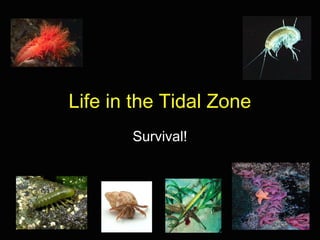
Life in the Tidal Zone
Survival!
Objective: I can identify biotic and
abiotic factors in marine ecosystems
and describe how they interact with
one another.
 Essential Question: How do
adaptations increase the likelihood of a
species’ survival in the intertidal zones?
2 Major ecological concepts
are in effect:
 Competition
 For Space
 For Resources (food, water, space…)
 Adaptations
 To prevent desiccation (drying out)
 To anchor themselves
 To protect themselves
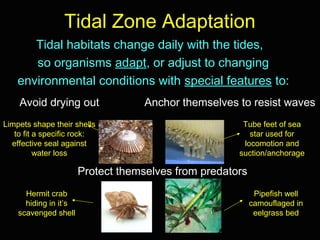
Tidal Zone Adaptation
Tidal habitats change daily with the tides,
so organisms adapt, or adjust to changing
environmental conditions with special features to:
Avoid drying out
Protect themselves from predators
Anchor themselves to resist waves
Limpets shape their shells
to fit a specific rock:
effective seal against
water loss
Tube feet of sea
star used for
locomotion and
suction/anchorage
Hermit crab
hiding in it’s
scavenged shell
Pipefish well
camouflaged in
eelgrass bed
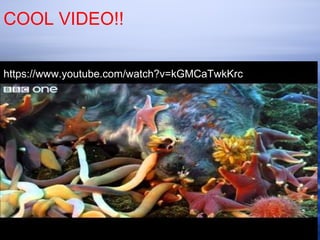
COOL VIDEO!!
https://www.youtube.com/watch?v=kGMCaTwkKrc
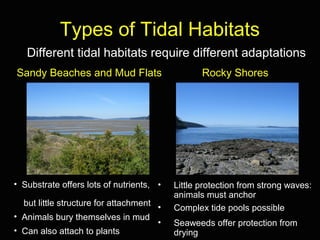
Types of Tidal Habitats
Sandy Beaches and Mud Flats Rocky Shores
Different tidal habitats require different adaptations
• Substrate offers lots of nutrients,
but little structure for attachment
• Animals bury themselves in mud
• Can also attach to plants
• Little protection from strong waves:
animals must anchor
• Complex tide pools possible
• Seaweeds offer protection from
drying
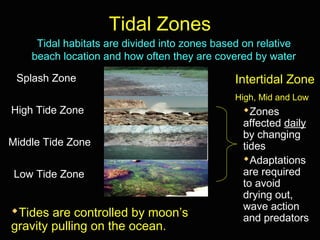
Tidal Zones
Splash Zone
High Tide Zone
Middle Tide Zone
Low Tide Zone
Zones
affected daily
by changing
tides
Adaptations
are required
to avoid
drying out,
wave action
and predators
Intertidal Zone
High, Mid and Low
Tidal habitats are divided into zones based on relative
beach location and how often they are covered by water
Tides are controlled by moon’s
gravity pulling on the ocean.
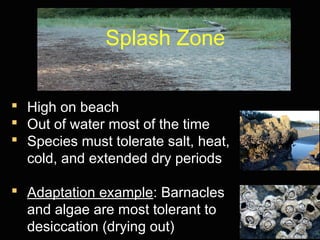
 High on beach
 Out of water most of the time
 Species must tolerate salt, heat,
cold, and extended dry periods
 Adaptation example: Barnacles
and algae are most tolerant to
desiccation (drying out)
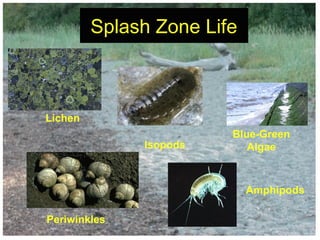
Splash Zone
Splash Zone LifeSplash Zone Life
Amphipods
Periwinkles
Isopods
Blue-Green
Algae
Lichen
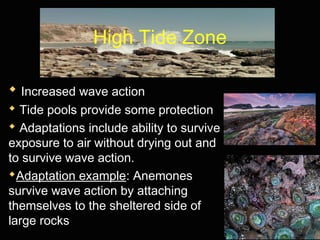
 Increased wave action
 Tide pools provide some protection
 Adaptations include ability to survive
exposure to air without drying out and
to survive wave action.
Adaptation example: Anemones
survive wave action by attaching
themselves to the sheltered side of
large rocks
High Tide Zone
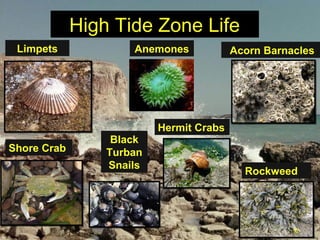
High Tide Zone LifeHigh Tide Zone Life
Acorn BarnaclesLimpets
Shore Crab
Rockweed
Anemones
Hermit Crabs
Black
Turban
Snails
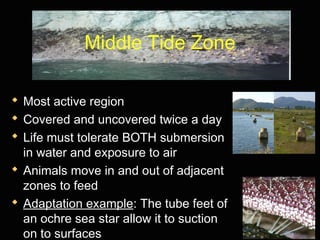
 Most active region
 Covered and uncovered twice a day
 Life must tolerate BOTH submersion
in water and exposure to air
 Animals move in and out of adjacent
zones to feed
 Adaptation example: The tube feet of
an ochre sea star allow it to suction
on to surfaces
Middle Tide Zone
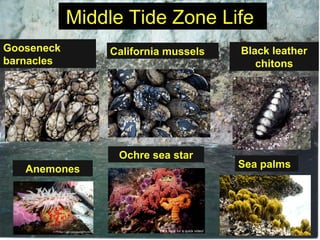
Middle Tide Zone LifeMiddle Tide Zone Life
Gooseneck
barnacles
Ochre sea star
Sea palmsAnemones
California mussels Black leather
chitons
Click here for a quick video!
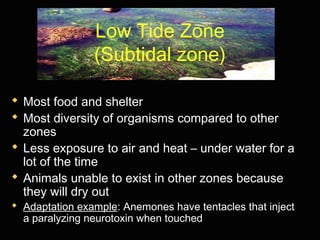
 Most food and shelter
 Most diversity of organisms compared to other
zones
 Less exposure to air and heat – under water for a
lot of the time
 Animals unable to exist in other zones because
they will dry out
 Adaptation example: Anemones have tentacles that inject
a paralyzing neurotoxin when touched
Low Tide Zone
(Subtidal zone)
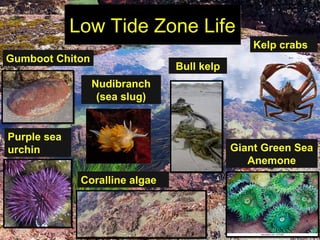
Low Tide Zone LifeLow Tide Zone Life
Nudibranch
(sea slug)
Kelp crabs
Gumboot Chiton
Purple sea
urchin Giant Green Sea
Anemone
Coralline algae
Bull kelp
Summary
Exposure to Water
Most time
Each zone requires unique
adaptations for survival
Splash Zone
High Tide Zone
Middle Tide Zone
Low Tide Zone
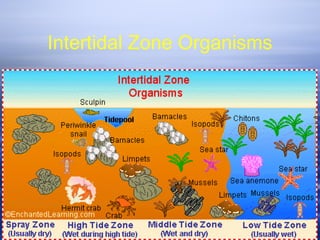
Intertidal Zone Organisms
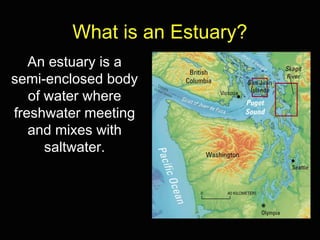
What is an Estuary?
An estuary is a
semi-enclosed body
of water where
freshwater meeting
and mixes with
saltwater.

Tidal zones notes ppt

  • 1.
    Life in theTidal Zone Survival!
  • 2.
    Objective: I canidentify biotic and abiotic factors in marine ecosystems and describe how they interact with one another.  Essential Question: How do adaptations increase the likelihood of a species’ survival in the intertidal zones?
  • 3.
    2 Major ecologicalconcepts are in effect:  Competition  For Space  For Resources (food, water, space…)  Adaptations  To prevent desiccation (drying out)  To anchor themselves  To protect themselves
  • 4.
    Tidal Zone Adaptation Tidalhabitats change daily with the tides, so organisms adapt, or adjust to changing environmental conditions with special features to: Avoid drying out Protect themselves from predators Anchor themselves to resist waves Limpets shape their shells to fit a specific rock: effective seal against water loss Tube feet of sea star used for locomotion and suction/anchorage Hermit crab hiding in it’s scavenged shell Pipefish well camouflaged in eelgrass bed
  • 5.
  • 6.
    Types of TidalHabitats Sandy Beaches and Mud Flats Rocky Shores Different tidal habitats require different adaptations • Substrate offers lots of nutrients, but little structure for attachment • Animals bury themselves in mud • Can also attach to plants • Little protection from strong waves: animals must anchor • Complex tide pools possible • Seaweeds offer protection from drying
  • 7.
    Tidal Zones Splash Zone HighTide Zone Middle Tide Zone Low Tide Zone Zones affected daily by changing tides Adaptations are required to avoid drying out, wave action and predators Intertidal Zone High, Mid and Low Tidal habitats are divided into zones based on relative beach location and how often they are covered by water Tides are controlled by moon’s gravity pulling on the ocean.
  • 8.
     High onbeach  Out of water most of the time  Species must tolerate salt, heat, cold, and extended dry periods  Adaptation example: Barnacles and algae are most tolerant to desiccation (drying out) Splash Zone
  • 9.
    Splash Zone LifeSplashZone Life Amphipods Periwinkles Isopods Blue-Green Algae Lichen
  • 10.
     Increased waveaction  Tide pools provide some protection  Adaptations include ability to survive exposure to air without drying out and to survive wave action. Adaptation example: Anemones survive wave action by attaching themselves to the sheltered side of large rocks High Tide Zone
  • 11.
    High Tide ZoneLifeHigh Tide Zone Life Acorn BarnaclesLimpets Shore Crab Rockweed Anemones Hermit Crabs Black Turban Snails
  • 12.
     Most activeregion  Covered and uncovered twice a day  Life must tolerate BOTH submersion in water and exposure to air  Animals move in and out of adjacent zones to feed  Adaptation example: The tube feet of an ochre sea star allow it to suction on to surfaces Middle Tide Zone
  • 13.
    Middle Tide ZoneLifeMiddle Tide Zone Life Gooseneck barnacles Ochre sea star Sea palmsAnemones California mussels Black leather chitons Click here for a quick video!
  • 14.
     Most foodand shelter  Most diversity of organisms compared to other zones  Less exposure to air and heat – under water for a lot of the time  Animals unable to exist in other zones because they will dry out  Adaptation example: Anemones have tentacles that inject a paralyzing neurotoxin when touched Low Tide Zone (Subtidal zone)
  • 15.
    Low Tide ZoneLifeLow Tide Zone Life Nudibranch (sea slug) Kelp crabs Gumboot Chiton Purple sea urchin Giant Green Sea Anemone Coralline algae Bull kelp
  • 16.
    Summary Exposure to Water Mosttime Each zone requires unique adaptations for survival Splash Zone High Tide Zone Middle Tide Zone Low Tide Zone
  • 17.
  • 18.
    What is anEstuary? An estuary is a semi-enclosed body of water where freshwater meeting and mixes with saltwater.