RECONSTRUCTION OF THE THUMB
DR.HARISH KUMAR KABILAN
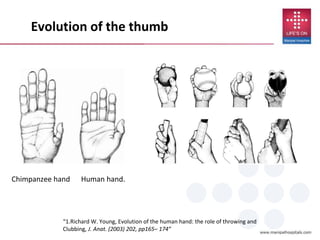
Evolution of the thumb
Chimpanzee hand Human hand.
“1.Richard W. Young, Evolution of the human hand: the role of throwing and
Clubbing, J. Anat. (2003) 202, pp165– 174”
In this presentation
•General considerations
•Classification of thumb
defects
•Choice of method
•Critical points of
reconstruction
General Considerations
• Ideal reconstruction – “Replace like with like”
• Recreate sensation and opposition
• Consider patient’s need
• Non micro-vascular vs. Micro-vascular
Anatomical considerations :
• Uniquely positioned
• Capacity of circumduction
• Greater degree of mobility.
GOALS OF RECONSTRUCTION
•Sensate and non-tender thumb tip
•Stability
•Adequate strength
•Correct posture and positioning
•Mobility
3.Heitmann C and Levin LS, Alternatives to thumb replantation, plastic recon surg 2002 Nov110(6)
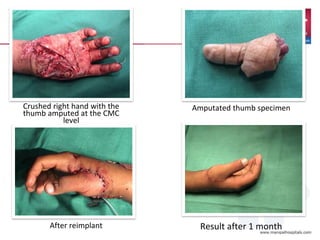
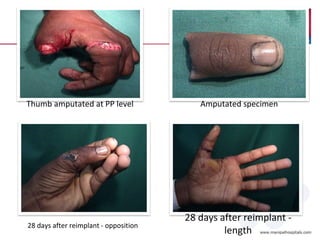
Thumb Reimplantation
Crushed right hand with the
thumb amputed at the CMC
level
Amputated thumb specimen
After reimplant Result after 1 month
Amputated specimenThumb amputated at PP level
28 days after reimplant - opposition
28 days after reimplant -
length
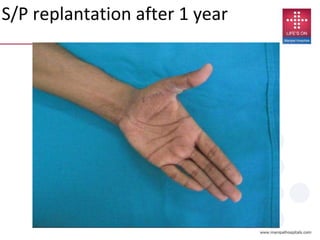
S/P replantation after 1 year
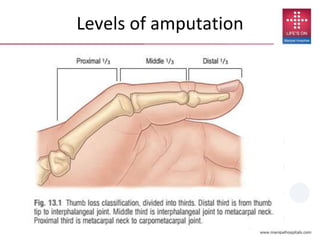
Levels of amputation
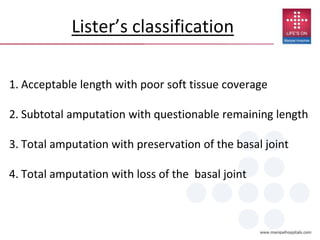
Lister’s classification
1. Acceptable length with poor soft tissue coverage
2. Subtotal amputation with questionable remaining length
3. Total amputation with preservation of the basal joint
4. Total amputation with loss of the basal joint
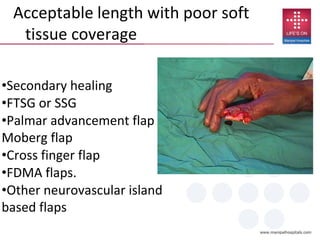
•Secondary healing
•FTSG or SSG
•Palmar advancement flap –
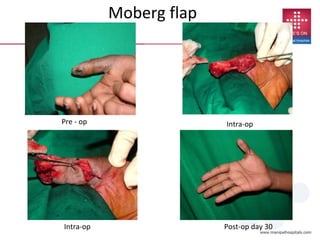
Moberg flap
•Cross finger flap
•FDMA flaps.
•Other neurovascular island
based flaps
Acceptable length with poor soft
tissue coverage
Moberg flap
Pre - op Intra-op
Intra-op Post-op day 30
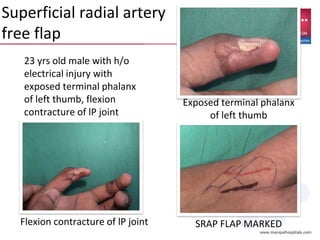
Exposed terminal phalanx
of left thumb
SRAP FLAP MARKEDFlexion contracture of lP joint
23 yrs old male with h/o
electrical injury with
exposed terminal phalanx
of left thumb, flexion
contracture of lP joint
Superficial radial artery
free flap
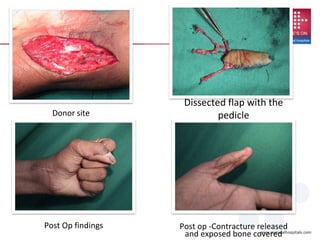
Donor site
Post op -Contracture released
and exposed bone covered
Post Op findings
Dissected flap with the
pedicle
Subtotal amputation with questionable
remaining length
•Phalangisation
i. Small web space deepening – either skin
grafting or Z plasties, Cross arm flap
ii. Large web space deepening– Dorsal hand flap,
RAFF,PIA.
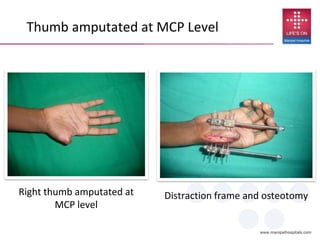
Right thumb amputated at
MCP level
Distraction frame and osteotomy
Thumb amputated at MCP Level
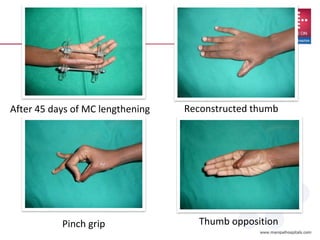
Pinch grip
After 45 days of MC lengthening Reconstructed thumb
Thumb opposition
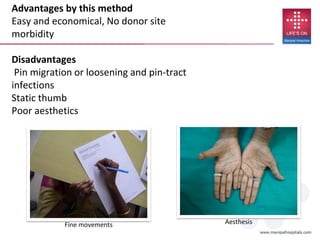
Aesthesis
Advantages by this method
Easy and economical, No donor site
morbidity
Disadvantages
Pin migration or loosening and pin-tract
infections
Static thumb
Poor aesthetics
Fine movements
Total amputation with preservation of
basal joint
•Osteoplastic reconstruction
•Composite Radial forearm flap
•Pollicisation / On-top plasty
•Toe transfer
Osteoplastic Thumb Reconstruction
6. Arshad R. Muzaffar, M.D., James J. Chao, M.D., and Jeffrey B. Freidrich, M.D.Post trauma thumb reconstruction, ,
plastic recon surg , october 2005 ,104(6)
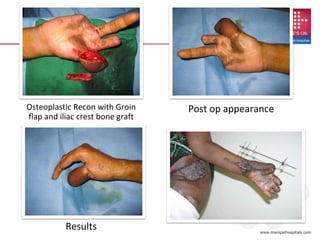
Post op appearance
Results
Osteoplastic Recon with Groin
flap and iliac crest bone graft
ORTHOTROPIC THUMB
RECONSTRUCTION
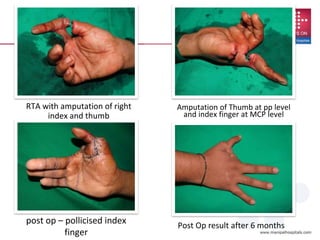
RTA with amputation of right
index and thumb
Amputation of Thumb at pp level
and index finger at MCP level
Post Op result after 6 months
post op – pollicised index
finger
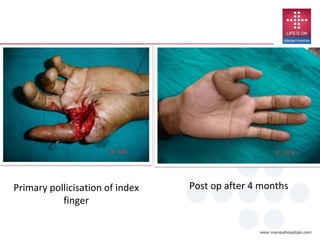
Primary pollicisation of index
finger
Post op after 4 months
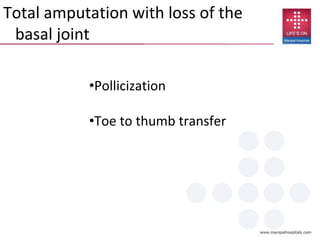
Total amputation with loss of the
basal joint
•Pollicization
•Toe to thumb transfer
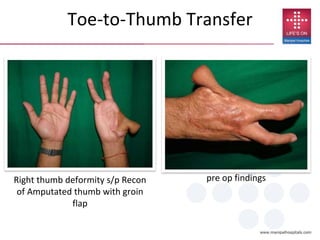
Right thumb deformity s/p Recon
of Amputated thumb with groin
flap
pre op findings
Toe-to-Thumb Transfer
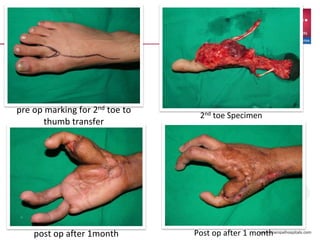
2nd toe Specimen
Post op after 1 monthpost op after 1month
pre op marking for 2nd toe to
thumb transfer
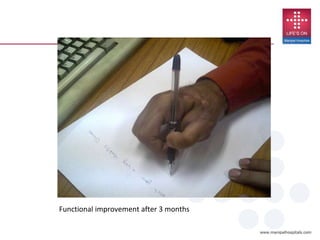
Functional improvement after 3 months
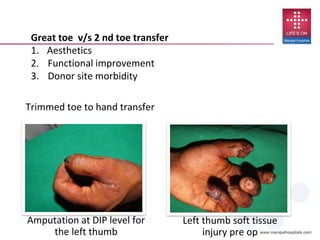
Left thumb soft tissue
injury pre op
Amputation at DIP level for
the left thumb
Trimmed toe to hand transfer
Great toe v/s 2 nd toe transfer
1. Aesthetics
2. Functional improvement
3. Donor site morbidity
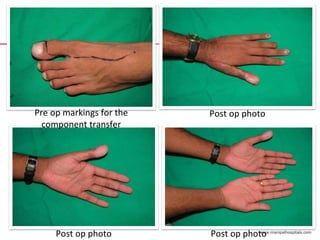
Post op photo Post op photo
Pre op markings for the
component transfer
Post op photo
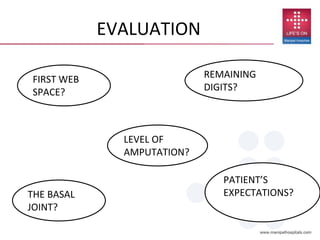
EVALUATION
LEVEL OF
AMPUTATION?
THE BASAL
JOINT?
REMAINING
DIGITS?
PATIENT’S
EXPECTATIONS?
FIRST WEB
SPACE?
•Challenging and rewarding surgical endeavour.
•The best results are obtained with replantation or
revascularization whenever possible.
•Patient’s post-traumatic function and specific reconstructive
needs
CONCLUSION
▪ Improve patient reported outcomes and evidence based
medicine
▪ 3 D printing and computer aided designing for complicated pre
op designing
▪Robotic surgery could be a potential
▪ Durable osteo-integrated prosthetics
▪Perforator flap surgery advent – Princeps pollicis
Future
References
1.Richard W. Young, Evolution of the human hand: the role of throwing and
Clubbing, J. Anat. (2003) 202, pp165– 174
2. Napier, J. R. The prehensile movements of the human hand.
J.Bone Joint Surg. (Br.) 38: 902, 1956.
3.Heitmann C and Levin LS, Alternatives to thumb replantation, plastic recon surg
2002 Nov110(6)
4.Lister G,The choice of procedure following thumb amputation, J Clinical orthop
195.85.1985
5.Greens operative hand surgery 5th edition, chap-thumb reconstruction
6. Arshad R. Muzaffar, M.D., James J. Chao, M.D., and Jeffrey B. Freidrich, M.D.Post
trauma thumb reconstruction, , plastic recon surg , october 2005 ,104(6)

Thumb reconstruction

  • 1.
    RECONSTRUCTION OF THETHUMB DR.HARISH KUMAR KABILAN
  • 2.
    Evolution of thethumb Chimpanzee hand Human hand. “1.Richard W. Young, Evolution of the human hand: the role of throwing and Clubbing, J. Anat. (2003) 202, pp165– 174”
  • 3.
    In this presentation •Generalconsiderations •Classification of thumb defects •Choice of method •Critical points of reconstruction
  • 4.
    General Considerations • Idealreconstruction – “Replace like with like” • Recreate sensation and opposition • Consider patient’s need • Non micro-vascular vs. Micro-vascular Anatomical considerations : • Uniquely positioned • Capacity of circumduction • Greater degree of mobility.
  • 5.
    GOALS OF RECONSTRUCTION •Sensateand non-tender thumb tip •Stability •Adequate strength •Correct posture and positioning •Mobility 3.Heitmann C and Levin LS, Alternatives to thumb replantation, plastic recon surg 2002 Nov110(6)
  • 6.
  • 7.
    Crushed right handwith the thumb amputed at the CMC level Amputated thumb specimen After reimplant Result after 1 month
  • 8.
    Amputated specimenThumb amputatedat PP level 28 days after reimplant - opposition 28 days after reimplant - length
  • 9.
  • 10.
  • 11.
    Lister’s classification 1. Acceptablelength with poor soft tissue coverage 2. Subtotal amputation with questionable remaining length 3. Total amputation with preservation of the basal joint 4. Total amputation with loss of the basal joint
  • 12.
    •Secondary healing •FTSG orSSG •Palmar advancement flap – Moberg flap •Cross finger flap •FDMA flaps. •Other neurovascular island based flaps Acceptable length with poor soft tissue coverage
  • 13.
    Moberg flap Pre -op Intra-op Intra-op Post-op day 30
  • 14.
    Exposed terminal phalanx ofleft thumb SRAP FLAP MARKEDFlexion contracture of lP joint 23 yrs old male with h/o electrical injury with exposed terminal phalanx of left thumb, flexion contracture of lP joint Superficial radial artery free flap
  • 15.
    Donor site Post op-Contracture released and exposed bone covered Post Op findings Dissected flap with the pedicle
  • 16.
    Subtotal amputation withquestionable remaining length •Phalangisation i. Small web space deepening – either skin grafting or Z plasties, Cross arm flap ii. Large web space deepening– Dorsal hand flap, RAFF,PIA.
  • 17.
    Right thumb amputatedat MCP level Distraction frame and osteotomy Thumb amputated at MCP Level
  • 18.
    Pinch grip After 45days of MC lengthening Reconstructed thumb Thumb opposition
  • 20.
    Aesthesis Advantages by thismethod Easy and economical, No donor site morbidity Disadvantages Pin migration or loosening and pin-tract infections Static thumb Poor aesthetics Fine movements
  • 21.
    Total amputation withpreservation of basal joint •Osteoplastic reconstruction •Composite Radial forearm flap •Pollicisation / On-top plasty •Toe transfer
  • 22.
    Osteoplastic Thumb Reconstruction 6.Arshad R. Muzaffar, M.D., James J. Chao, M.D., and Jeffrey B. Freidrich, M.D.Post trauma thumb reconstruction, , plastic recon surg , october 2005 ,104(6)
  • 23.
    Post op appearance Results OsteoplasticRecon with Groin flap and iliac crest bone graft
  • 24.
  • 25.
    RTA with amputationof right index and thumb Amputation of Thumb at pp level and index finger at MCP level Post Op result after 6 months post op – pollicised index finger
  • 26.
    Primary pollicisation ofindex finger Post op after 4 months
  • 27.
    Total amputation withloss of the basal joint •Pollicization •Toe to thumb transfer
  • 28.
    Right thumb deformitys/p Recon of Amputated thumb with groin flap pre op findings Toe-to-Thumb Transfer
  • 29.
    2nd toe Specimen Postop after 1 monthpost op after 1month pre op marking for 2nd toe to thumb transfer
  • 30.
  • 31.
    Left thumb softtissue injury pre op Amputation at DIP level for the left thumb Trimmed toe to hand transfer Great toe v/s 2 nd toe transfer 1. Aesthetics 2. Functional improvement 3. Donor site morbidity
  • 32.
    Post op photoPost op photo Pre op markings for the component transfer Post op photo
  • 33.
  • 34.
    •Challenging and rewardingsurgical endeavour. •The best results are obtained with replantation or revascularization whenever possible. •Patient’s post-traumatic function and specific reconstructive needs CONCLUSION
  • 35.
    ▪ Improve patientreported outcomes and evidence based medicine ▪ 3 D printing and computer aided designing for complicated pre op designing ▪Robotic surgery could be a potential ▪ Durable osteo-integrated prosthetics ▪Perforator flap surgery advent – Princeps pollicis Future
  • 36.
    References 1.Richard W. Young,Evolution of the human hand: the role of throwing and Clubbing, J. Anat. (2003) 202, pp165– 174 2. Napier, J. R. The prehensile movements of the human hand. J.Bone Joint Surg. (Br.) 38: 902, 1956. 3.Heitmann C and Levin LS, Alternatives to thumb replantation, plastic recon surg 2002 Nov110(6) 4.Lister G,The choice of procedure following thumb amputation, J Clinical orthop 195.85.1985 5.Greens operative hand surgery 5th edition, chap-thumb reconstruction 6. Arshad R. Muzaffar, M.D., James J. Chao, M.D., and Jeffrey B. Freidrich, M.D.Post trauma thumb reconstruction, , plastic recon surg , october 2005 ,104(6)

Editor's Notes

  • #3 There is a an old saying – “ The thumb is half the hand” The evolution of the human thumb as we know it today is diferent from the primate’s thumb due to the 3 basic grips – pad to side grip. 3 jawed chuck, 5 jawed cradle chuck, all of which are dependent on a fully functional thumb.
  • #5 Replantation is the best option wherever possible. Opposition necessitates length strength stability and mobility Uniquely positioned at approximately 60 to 80 degrees to the plane of the metacarpal arch. Capacity of circumduction The carpo metacarpal joint provides a greater degree of mobility.
  • #6 As outlined by Heitmann and Levin, consist of the following[3] : Sensate and non-tender thumb tip Stability at IP and MCP joints Adequate strength Correct posture and positioning of the thumb with a wide web space Mobility of the CMC joint with intrinsic muscles to aid prehension
  • #7 Thumb replatation is the best method to achieve maximum function and sensations after traumatic amputation
  • #11 The levels of amputation are as follows This clinical usefuless is better with ……
  • #13  In this case, the Chief priority is soft tissue coverage and – a pain free sensory thumb tip would be the main goal. Compensation amputation zone – because it rarely results in ay significant defects. Following the reconstructive ladder, the first rung would be to allow it to heal secondarily....... Moberg – palmar thumb defects > 1 cm but less than 2 cm Last 2 usualy for dorsal defects
  • #14 This patient had sustained a crush injury to the right thumb, and necrosis of the distal one third. Right handed individual. The only earning member of his family working as a medical scribe and required reconstruction of the tip. Hence the Moberg flap was done. For volar thumb pad defects greater than 1 but less than 2 cm
  • #16 Advantages – Sensate and good mobility Disadvantages – Donor site morbidity. Cost and expertise.
  • #17 (deepening of the first web space) Phalangisation increases the relative length of the thumb.
  • #18  A 23 yrs old female Thumb amputated at the MCP level for which primary wound closure done. Right handed individul from a Lower socio- economic class Meta Carpal distraction was planned do decrease cost and down time Initial osteotomy and distraction frame placement done on day care basis. Quarter turn every 6 hours per day. And 1 mm increase per day Desired length was obtained after around 45 days of distraction. Splinted for 2 months. Physiotherapy. 2 stage procedure Distractrtion frame and then 4 flap z pasty for phalangisation and K wire fixation for immobilisation
  • #19  OPERATIVE TECHNIQUES Linear incision over the dorsum of the first metacarpal. Retract the extensor tendons to expose the bone. Mark the planned osteotomy site. Place the fixation hardware Transverse osteotomy with an oscillating saw. Apply the distraction apparatus. POSTOPERATIVE CARE Distract the metacarpal at 1 to 1.5 mm/day for 25 to 35 days* Post distraction immobilisation splint in the 1:2 ratio*.   
  • #21 2 stage procedure Distractrtion frame and then 4 flap z pasty and K wiring for imobilisation
  • #22 All theses techniques aim at increasing the absolute length of the thumb.
  • #23 Reconstruction using a bone graft which is covered with a pedicled flap
  • #24 Variations Gillies “cocked-hat” flap Biemer and Stock composite flaps based on the pedicled radial forearm flap Moberg and Littler neurovascular island pedicle transfer for improving sensation Draw backs Inability to provide adequate sensory perception Significant resorption of the bone graft inside the pedicle Cosmetically less appealing Multiple operative procedure Donor site morbidity Less mobility after surgery
  • #25  OPERATIVE TECHNIQUES Incise around the palmar base of the index finger near the MCP joint. Extend incision dorsally. Raise the dorsal flaps till MCP level. Identify the radial digital nerve/artery and flexor tendons . Radial digital artery to the long finger, ligate away from the bifurcation of the CDA. Tease apart the digital nerves to the ulnar index and radial long finger into the palm Separate the second intermetacarpal space Expose the 2nd metacarpal subperiosteally and Obliquely osteotomize at its base.Resect if needed Transfer and fix the index stump to the residual thumb metacarpal       Transfer the lateral flap into the new web defect. POSTOPERATIVE CARE Cast/ thumb spica until bony union occurs Web spacer splint Active and passive range-of-motion exercises
  • #26 Indications of pollicisation is where there is – Loss of thumb at or near MP joint level with concomitatnt partial amputation of the index finger. As a result of which the number of cases are infrequent. Nevertheless, the pollicised digit makes for an excellent functional and sensate thumb
  • #28 Loss in proximal third of the thumb are not adaptable and are challenging. Entire thumb ray requires restoration Microsurgical methods are now the standard for losses at this level. Pollicization of the index finger remains in cases with concomitant damaged index fingers. Free toe transfers remain the gold standard at this level.
  • #29  Deformity right thumb s/p groin flap reconstruction for amputated thumb. he was a Right handed, was concerned about the functional improvement. Clerical job. Right hand had only middle and ring fingers left. Patient didn't want to sacrifice great toe (which happens often) and hence 2nd toe was transferred.
  • #33 Advtgs – cosmetically good. Good function and sensation. Disadvantages – Donor site morbidity
  • #34 Before reconstruction, the following questions must be asked. What is The level of amputation? What is the status of the first web space? Are there any remaining viable digits? Is the basal joint intact? And finally, what are the patient’s needs and expectations from the surgery?
  • #36 Physiological tremor suppresion and user friendly ergonomics ad ultra-precise control of instruments. Perforator flap surgery (microsurgery without the microscope) advent – Princeps pollicis