International Research Journal of Engineering and Technology (IRJET) e-ISSN: 2395 -0056
Volume: 04 Issue: 03 | Mar -2017 www.irjet.net p-ISSN: 2395-0072
© 2017, IRJET | Impact Factor value: 5.181 | ISO 9001:2008 Certified Journal | Page 747
Three Phase Induction Motor Protection Scheme
Yogesh Mandekar1,Swapnil Bongale2, Vinayak Savant3, Himen Savsani4,Suraj Salunkhe 5
Mr.Prof. Suraj Pawar6
1,2,3,4,5 UG Student,Dept Of Electrical Engineering, Sanjay Ghodawat Institutes(SGI), Atigre,Maharashtra,India
6 Assistant Professor, Dept Of Electrical Engineering, Sanjay Ghodawat Institutes(SGI), Atigre,Maharashtra,India
---------------------------------------------------------------------***---------------------------------------------------------------------
Abstract - This paper include a protection scheme for
three phase induction motors against single-phasing
faults. A simulation was proposed, which can help to
determine the impact of single-phasing on any three
phase induction motor. Using MATLAB/SIMULINK
software a case study of single-phasing is carried out. A
single-phasing protection by means of contactors was
reviewed before an enhanced single-phasing protection
was designed.. The latter, in additional to protection
against single-phasing, also protects the motor from
under-voltage, over-voltage and voltage unbalance.
In the hardware circuit is completely controlled by the
microcontroller and monitors the voltages of three
phase.If voltage goes beyond the limit then it turn off the
motor by switching. With the help of current transformer
which senses the current and if it exceeds level then
comparator sends signal to microcontroller to stop the
motor. All the conditions are shown by it over the LCD
display. In this paper we are utilizing the 8 bit
microcontroller ATmega328p.It is a 28 pin
microcontroller. Metering unit ADE7758 is used in this
project. It protects the motor from single phasing, over
voltage, dry run, over current.
Key words: Single phasing,Over voltage,over current
protection.
1.INTRODUCTION
Induction motor is one of the most important
motors used in industrial applications. The operating
condition may sometime lead the machine into
different fault situations. The main types of external
faults experienced by these motors are overloading,
single phasing, unbalanced supply voltage, locked
rotor, phase reversal, ground fault, under voltage and
over voltage.
1. Under and over voltage supply conditions:
Under voltage and over voltage supply
conditions are commonly occurring power line
problems. Efficiency of induction motor decreases
when voltage on the induction motor decreases even
though all the three phases is balanced. When the
percentage balancedundervoltageincreasesthespeed
decreases drastically with increase in load. When the
percentage balanced under voltage exceeds 30%, then
the induction motor performance is very poor and
hence to be avoided. Operating the motor from 10% to
30% of balanced under voltage can be permitted with
the compromise of reduced performance. During
balanced over voltage condition, the increase in speed
is not proportional to increase in voltage. But increase
in current is proportional to voltage. Hence Losses in
the motor is more i.e., increase in power delivered by
the motor is less as compared to increase in power
drawn by the motor. Hence efficiency is reduced.
2. Heat dissipation/over temperature
Since the current drawn by the motor is more,
heat dissipation in the stator and rotor is increased
drastically when the percentagebalancedovervoltage
exceeds 25%. Hence it is recommended to operate the
motor within 10% of balance over voltage.
3. Single phasing:
Single phasing condition affects the motor
performance.Thecurrentsareenormouslyhighsothat
the conductors cannot with stand the heavy current
and hence losses are also more. The heat dissipation is
heavy which will damage the stator and rotor
conductors. Also there is heavy pulsationintorqueand
speed. Therefore, in the developed protection scheme
top priority is given for protection of motor during
single phasing condition.
International Research Journal of Engineering and Technology (IRJET) e-ISSN: 2395 -0056
Volume: 04 Issue: 03 | Mar -2017 www.irjet.net p-ISSN: 2395-0072
© 2017, IRJET | Impact Factor value: 5.181 | ISO 9001:2008 Certified Journal | Page 748
2. SIMULATION MODEL
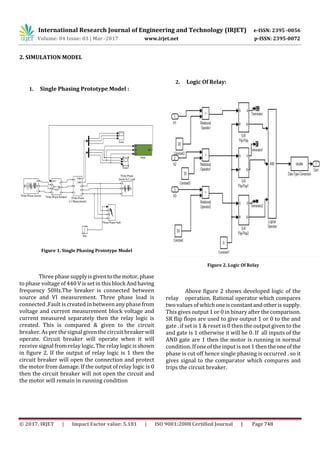
1. Single Phasing Prototype Model :
Figure 1. Single Phasing Prototype Model
Three phasesupplyisgiventothemotor,phase
to phase voltage of 440 V is set in this block Andhaving
frequency 50Hz.The breaker is connected between
source and VI measurement. Three phase load is
connected .Fault is created in between any phase from
voltage and current measurement block voltage and
current measured separately then the relay logic is
created. This is compared & given to the circuit
breaker. As per the signal given the circuit breakerwill
operate. Circuit breaker will operate when it will
receive signal from relay logic. The relaylogicisshown
in figure 2. If the output of relay logic is 1 then the
circuit breaker will open the connection and protect
the motor from damage. If the output of relay logic is 0
then the circuit breaker will not open the circuit and
the motor will remain in running condition
2. Logic Of Relay:
Figure 2. Logic Of Relay
Above figure 2 shows developed logic of the
relay operation. Rational operator which compares
two values of which oneisconstantandotherissupply.
This gives output 1 or 0 in binary after thecomparison.
SR flip flops are used to give output 1 or 0 to the and
gate . if set is 1 & reset is 0 then the output given to the
and gate is 1 otherwise it will be 0. If all inputs of the
AND gate are 1 then the motor is running in normal
condition. If one of the input is not 1 then theoneofthe
phase is cut off hence single phasing is occurred . so it
gives signal to the comparator which compares and
trips the circuit breaker.
International Research Journal of Engineering and Technology (IRJET) e-ISSN: 2395 -0056
Volume: 04 Issue: 03 | Mar -2017 www.irjet.net p-ISSN: 2395-0072
© 2017, IRJET | Impact Factor value: 5.181 | ISO 9001:2008 Certified Journal | Page 749
3. RESULTS AND ANALYSIS
1. Voltage waveform:
Figure 3. Voltage Waveform
From Above fig we studied Voltage Changes
During Fault and After Fault.
In the Fig After 0.1 Sec the single phasing fault is
occur And Breaker Cut the all Three Phases so that
Voltage goes to zero value and induction motor stops.
2. Current Waveform:
Figure 4. Current Waveform
Fig . Shows the current changes in Fault
Here After 0.1 Sec Single Phasing Fault is occur Then
current suddenly increases.
At that time circuit breaker cut the supply so that
current goes to zero value and motor stops.
From the above we studied about the single
phasing of the 3 phase induction motor. Now we
discuss about the some different protection i.
overvoltage, over current, over temperature
protection.
4. CONCLUSION AND FUTURE WORK
Protectionofthreephaseinductionmotorfrom
under voltage, single phasing, over current and phase
reversal provide the smooth running of motor
improves its lifetime and efficiency. Tomakeinduction
motor run efficiently and to protect it from various
faults, sensing circuits have been designed. These
sensing circuit sense the faults occur in an induction
Motor. These faults are monitored by the protection
system and if any fault occurs the motor automatically
turned off.
Hence this prototype model of microcontroller
based protection system is very simple in design,
reliable, highly versatile, and cost effective and gives
quick response.
REFERENCES
[1] D. Kornack and P. Rakic, “Cell Proliferation without
Neurogenesis in Adult Primate Neocortex,” Science, vol.
294, Dec. 2001, pp. 2127-2130,
doi:10.1126/science.1065467.
[2] M. Young, The Technical Writer’s Handbook. Mill Valley,
CA: University Science, 1989.
[3] R. Nicole, “Title of paper with only first word
capitalized,” J. Name Stand. Abbrev., in press.
[4] K. Elissa, “Title of paper if known,” unpublished.

Three Phase Induction Motor Protection Scheme

  • 1.
    International Research Journalof Engineering and Technology (IRJET) e-ISSN: 2395 -0056 Volume: 04 Issue: 03 | Mar -2017 www.irjet.net p-ISSN: 2395-0072 © 2017, IRJET | Impact Factor value: 5.181 | ISO 9001:2008 Certified Journal | Page 747 Three Phase Induction Motor Protection Scheme Yogesh Mandekar1,Swapnil Bongale2, Vinayak Savant3, Himen Savsani4,Suraj Salunkhe 5 Mr.Prof. Suraj Pawar6 1,2,3,4,5 UG Student,Dept Of Electrical Engineering, Sanjay Ghodawat Institutes(SGI), Atigre,Maharashtra,India 6 Assistant Professor, Dept Of Electrical Engineering, Sanjay Ghodawat Institutes(SGI), Atigre,Maharashtra,India ---------------------------------------------------------------------***--------------------------------------------------------------------- Abstract - This paper include a protection scheme for three phase induction motors against single-phasing faults. A simulation was proposed, which can help to determine the impact of single-phasing on any three phase induction motor. Using MATLAB/SIMULINK software a case study of single-phasing is carried out. A single-phasing protection by means of contactors was reviewed before an enhanced single-phasing protection was designed.. The latter, in additional to protection against single-phasing, also protects the motor from under-voltage, over-voltage and voltage unbalance. In the hardware circuit is completely controlled by the microcontroller and monitors the voltages of three phase.If voltage goes beyond the limit then it turn off the motor by switching. With the help of current transformer which senses the current and if it exceeds level then comparator sends signal to microcontroller to stop the motor. All the conditions are shown by it over the LCD display. In this paper we are utilizing the 8 bit microcontroller ATmega328p.It is a 28 pin microcontroller. Metering unit ADE7758 is used in this project. It protects the motor from single phasing, over voltage, dry run, over current. Key words: Single phasing,Over voltage,over current protection. 1.INTRODUCTION Induction motor is one of the most important motors used in industrial applications. The operating condition may sometime lead the machine into different fault situations. The main types of external faults experienced by these motors are overloading, single phasing, unbalanced supply voltage, locked rotor, phase reversal, ground fault, under voltage and over voltage. 1. Under and over voltage supply conditions: Under voltage and over voltage supply conditions are commonly occurring power line problems. Efficiency of induction motor decreases when voltage on the induction motor decreases even though all the three phases is balanced. When the percentage balancedundervoltageincreasesthespeed decreases drastically with increase in load. When the percentage balanced under voltage exceeds 30%, then the induction motor performance is very poor and hence to be avoided. Operating the motor from 10% to 30% of balanced under voltage can be permitted with the compromise of reduced performance. During balanced over voltage condition, the increase in speed is not proportional to increase in voltage. But increase in current is proportional to voltage. Hence Losses in the motor is more i.e., increase in power delivered by the motor is less as compared to increase in power drawn by the motor. Hence efficiency is reduced. 2. Heat dissipation/over temperature Since the current drawn by the motor is more, heat dissipation in the stator and rotor is increased drastically when the percentagebalancedovervoltage exceeds 25%. Hence it is recommended to operate the motor within 10% of balance over voltage. 3. Single phasing: Single phasing condition affects the motor performance.Thecurrentsareenormouslyhighsothat the conductors cannot with stand the heavy current and hence losses are also more. The heat dissipation is heavy which will damage the stator and rotor conductors. Also there is heavy pulsationintorqueand speed. Therefore, in the developed protection scheme top priority is given for protection of motor during single phasing condition.
  • 2.
    International Research Journalof Engineering and Technology (IRJET) e-ISSN: 2395 -0056 Volume: 04 Issue: 03 | Mar -2017 www.irjet.net p-ISSN: 2395-0072 © 2017, IRJET | Impact Factor value: 5.181 | ISO 9001:2008 Certified Journal | Page 748 2. SIMULATION MODEL 1. Single Phasing Prototype Model : Figure 1. Single Phasing Prototype Model Three phasesupplyisgiventothemotor,phase to phase voltage of 440 V is set in this block Andhaving frequency 50Hz.The breaker is connected between source and VI measurement. Three phase load is connected .Fault is created in between any phase from voltage and current measurement block voltage and current measured separately then the relay logic is created. This is compared & given to the circuit breaker. As per the signal given the circuit breakerwill operate. Circuit breaker will operate when it will receive signal from relay logic. The relaylogicisshown in figure 2. If the output of relay logic is 1 then the circuit breaker will open the connection and protect the motor from damage. If the output of relay logic is 0 then the circuit breaker will not open the circuit and the motor will remain in running condition 2. Logic Of Relay: Figure 2. Logic Of Relay Above figure 2 shows developed logic of the relay operation. Rational operator which compares two values of which oneisconstantandotherissupply. This gives output 1 or 0 in binary after thecomparison. SR flip flops are used to give output 1 or 0 to the and gate . if set is 1 & reset is 0 then the output given to the and gate is 1 otherwise it will be 0. If all inputs of the AND gate are 1 then the motor is running in normal condition. If one of the input is not 1 then theoneofthe phase is cut off hence single phasing is occurred . so it gives signal to the comparator which compares and trips the circuit breaker.
  • 3.
    International Research Journalof Engineering and Technology (IRJET) e-ISSN: 2395 -0056 Volume: 04 Issue: 03 | Mar -2017 www.irjet.net p-ISSN: 2395-0072 © 2017, IRJET | Impact Factor value: 5.181 | ISO 9001:2008 Certified Journal | Page 749 3. RESULTS AND ANALYSIS 1. Voltage waveform: Figure 3. Voltage Waveform From Above fig we studied Voltage Changes During Fault and After Fault. In the Fig After 0.1 Sec the single phasing fault is occur And Breaker Cut the all Three Phases so that Voltage goes to zero value and induction motor stops. 2. Current Waveform: Figure 4. Current Waveform Fig . Shows the current changes in Fault Here After 0.1 Sec Single Phasing Fault is occur Then current suddenly increases. At that time circuit breaker cut the supply so that current goes to zero value and motor stops. From the above we studied about the single phasing of the 3 phase induction motor. Now we discuss about the some different protection i. overvoltage, over current, over temperature protection. 4. CONCLUSION AND FUTURE WORK Protectionofthreephaseinductionmotorfrom under voltage, single phasing, over current and phase reversal provide the smooth running of motor improves its lifetime and efficiency. Tomakeinduction motor run efficiently and to protect it from various faults, sensing circuits have been designed. These sensing circuit sense the faults occur in an induction Motor. These faults are monitored by the protection system and if any fault occurs the motor automatically turned off. Hence this prototype model of microcontroller based protection system is very simple in design, reliable, highly versatile, and cost effective and gives quick response. REFERENCES [1] D. Kornack and P. Rakic, “Cell Proliferation without Neurogenesis in Adult Primate Neocortex,” Science, vol. 294, Dec. 2001, pp. 2127-2130, doi:10.1126/science.1065467. [2] M. Young, The Technical Writer’s Handbook. Mill Valley, CA: University Science, 1989. [3] R. Nicole, “Title of paper with only first word capitalized,” J. Name Stand. Abbrev., in press. [4] K. Elissa, “Title of paper if known,” unpublished.