Goal of AI is to outperform the
abilities of human beings.
Necessary to have large, balanced and
labeled datasets.
Unrealistic to expect the perfect
datasets for all the tasks.
It can also involve human efforts and
time to create one.
Learning to Learn.
Meta-Learning intends to train the model with a large
dataset, containing varied classes.
While in the testing phase, the model is tested with
a novel set where the number of classes will not be more
than 5.
The main objective of Meta-Learning is to find the best
hyperparameters and model weights for the model so
that it can generalize more to the novel set.
Few-shot or low-shot and n-shot learning are meta-
learning techniques with a minimalistic dataset and n
can be between 0 to 5.
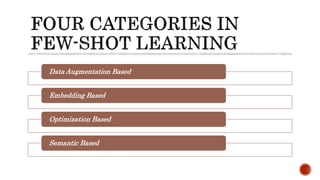
Data Augmentation Based
Embedding Based
Optimization Based
Semantic Based
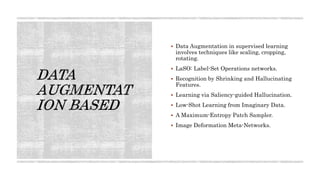
 Data Augmentation in supervised learning
involves techniques like scaling, cropping,
rotating.
 LaSO: Label-Set Operations networks.
 Recognition by Shrinking and Hallucinating
Features.
 Learning via Saliency-guided Hallucination.
 Low-Shot Learning from Imaginary Data.
 A Maximum-Entropy Patch Sampler.
 Image Deformation Meta-Networks.
 Metric-based technique, uses data transformed to lower
dimension representation, clustering, and comparison
based on distance (metric).
 Relation Network.
 Prototypical Network.
 Learning in localization of realistic settings.
 Cross-Validation using Leave-one-Out Approach.
 Learning for Semi-Supervised Classification.
 Transferable Prototypical Networks.
 Task dependent adaptive metric learning.
 Representative-based metric learning.
 Task-Aware Feature Embedding.
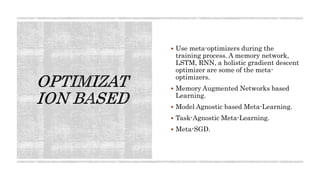
 Use meta-optimizers during the
training process. A memory network,
LSTM, RNN, a holistic gradient descent
optimizer are some of the meta-
optimizers.
 Memory Augmented Networks based
Learning.
 Model Agnostic based Meta-Learning.
 Task-Agnostic Meta-Learning.
 Meta-SGD.
 Popular in zero-shot learning.
 Learning with Multiple Semantics.
 Learning via Aligned Variational
Autoencoders (VAE).
 The paper provides a comparison of different model
performances on the two prominent datasets Omniglot
and MiniImageNet.
 Based on the information given in the paper, on using
both Data Augmentation and embedding learning
techniques the models performed well for the Omniglot
dataset.
 But the same techniques produce lower accuracies
comparatively for the MiniImageNet dataset.
 Interestingly, the performance of the current state-of-the-
art models is very low compared to a toddler’s
performance.
 There is a scope for improvement in the future.
 A hybrid model using the mentioned techniques like data-
augmentation, embedding techniques, using semantic
information, etc., all at once, can be used in the future.
Meta-Learning Presentation

Meta-Learning Presentation

  • 2.
    Goal of AIis to outperform the abilities of human beings. Necessary to have large, balanced and labeled datasets. Unrealistic to expect the perfect datasets for all the tasks. It can also involve human efforts and time to create one.
  • 3.
    Learning to Learn. Meta-Learningintends to train the model with a large dataset, containing varied classes. While in the testing phase, the model is tested with a novel set where the number of classes will not be more than 5. The main objective of Meta-Learning is to find the best hyperparameters and model weights for the model so that it can generalize more to the novel set. Few-shot or low-shot and n-shot learning are meta- learning techniques with a minimalistic dataset and n can be between 0 to 5.
  • 4.
    Data Augmentation Based EmbeddingBased Optimization Based Semantic Based
  • 5.
     Data Augmentationin supervised learning involves techniques like scaling, cropping, rotating.  LaSO: Label-Set Operations networks.  Recognition by Shrinking and Hallucinating Features.  Learning via Saliency-guided Hallucination.  Low-Shot Learning from Imaginary Data.  A Maximum-Entropy Patch Sampler.  Image Deformation Meta-Networks.
  • 6.
     Metric-based technique,uses data transformed to lower dimension representation, clustering, and comparison based on distance (metric).  Relation Network.  Prototypical Network.  Learning in localization of realistic settings.  Cross-Validation using Leave-one-Out Approach.  Learning for Semi-Supervised Classification.  Transferable Prototypical Networks.  Task dependent adaptive metric learning.  Representative-based metric learning.  Task-Aware Feature Embedding.
  • 7.
     Use meta-optimizersduring the training process. A memory network, LSTM, RNN, a holistic gradient descent optimizer are some of the meta- optimizers.  Memory Augmented Networks based Learning.  Model Agnostic based Meta-Learning.  Task-Agnostic Meta-Learning.  Meta-SGD.
  • 8.
     Popular inzero-shot learning.  Learning with Multiple Semantics.  Learning via Aligned Variational Autoencoders (VAE).
  • 9.
     The paperprovides a comparison of different model performances on the two prominent datasets Omniglot and MiniImageNet.  Based on the information given in the paper, on using both Data Augmentation and embedding learning techniques the models performed well for the Omniglot dataset.  But the same techniques produce lower accuracies comparatively for the MiniImageNet dataset.  Interestingly, the performance of the current state-of-the- art models is very low compared to a toddler’s performance.  There is a scope for improvement in the future.  A hybrid model using the mentioned techniques like data- augmentation, embedding techniques, using semantic information, etc., all at once, can be used in the future.