EVALUATION OF THE FUNCTIONAL OUTCOME
OF THORACO-LUMBAR BURST FRACTURES
STABILIZATION BY PEDICLE SCREW & ROD.
DR. K. M. RAFIQUL ISLAM SHETU
MBBS (SSMC), MS (Ortho)
Research Assistant
Department of Orthopaedic Surgery
Bangabandhu Sheikh Mujib Medical University
Dhaka.
ABSTRACT
 This was a prospective study carried out at BSMMU. A total of 15 patients
aged over 15 years were included in the study.
 Among the 15 cases, 12 cases (80%) were male and 3 cases (20%) were
female.
 The age range of patient was from 17-55 years. Most commonly affected
people were labours 5 (33.33%).
 Fall from height was the commonest cause of injury 11 (73.30%).
 Most commonly level of injury was L1- 07 (46.70%).
ABSTRACT: CONT…
 According to Frankel grade preoperatively most common grade was
C- 10 and next common was B- 5. Post operatively most was D-9 and
next was E-4 & C-2.
 According to Denis et al pain scale most commonly 8 (53.34%) cases
complaint no pain & work scale most commonly 6 (40.0%) cases
were completely well and can perform normal work up to latest
follow-up.
ABSTRACT: CONT…
 Mean hospital stay was (13.27±3.54) days. Satisfactory results
(excellent & good) were in 13 (86.66%), fair 1 (6.67%) & 1(6.67%)
unsatisfactory (poor) results.
 The results of the study demonstrates that functional outcome of
Thoraco-Lumbar burst fractures stabilization by pedicle screw & rod
is an effective procedure.
INTRODUCTION
 Fracture and dislocations of the spine are serious injuries that most
commonly occur in young people.Nearly 43% of patients with spinal
cord injuries sustain multiple injuries. (Leventhal, 2003).
 Spinal column injuries represent approximately 3% of all trauma cases
and 10% of spine injuries are accompanied by injury to the spinal
cord.75% of all spinal injuries occur within the thoracolumbar segment.
 Surgical treatment is now offered not only to patients with spinal
injuries accompanied with spinal cord lesion,but also to injuries where
instability and subsequent deformity is expected. (Lukas et al.2006).
INTRODUCTION: CONT…
 The thoracolumbar junction is the most common area of injury to the
axial skeleton. Forces along the long stiff kyphotic thoracic spine switch
abruptly into the mobile lordotic lumbar spine at the thoracolumbar
junction.
 Biomechanically, this transition zone is susceptible to injury and is the
most commonly injured portion of the spine. Primary goals in
thoracolumbar trauma patients are prompt recognition and treatment of
associated injuries and expeditious stabilization of the spine and
protection of the neural elements. (Patel et al. 2002).
INTRODUCTION: CONT…
 A burst fracture is a type of traumatic spinal injury in which a
vertebra breaks from a high energy axial load with pieces of the
vertebra shattering into surrounding tissues and sometimes the
spinal canal & involved all three columns.
 Burst fractures are most often caused by car accident or by falls.
Burst fractures are categorized by the "severity of the deformity,
the severity of (spinal) canal compromise, the degree of loss of
vertebral body height, and the degree of neurologic deficit."
INTRODUCTION: CONT…
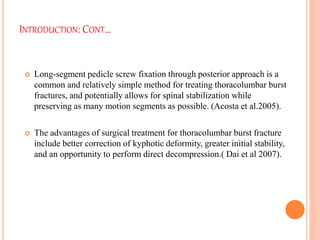
 Long-segment pedicle screw fixation through posterior approach is a
common and relatively simple method for treating thoracolumbar burst
fractures, and potentially allows for spinal stabilization while
preserving as many motion segments as possible. (Acosta et al.2005).
 The advantages of surgical treatment for thoracolumbar burst fracture
include better correction of kyphotic deformity, greater initial stability,
and an opportunity to perform direct decompression.( Dai et al 2007).
INTRODUCTION: CONT…
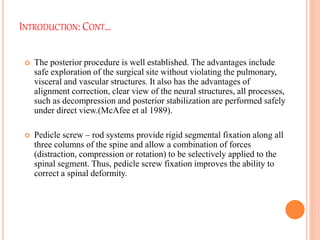
 The posterior procedure is well established. The advantages include
safe exploration of the surgical site without violating the pulmonary,
visceral and vascular structures. It also has the advantages of
alignment correction, clear view of the neural structures, all processes,
such as decompression and posterior stabilization are performed safely
under direct view.(McAfee et al 1989).
 Pedicle screw – rod systems provide rigid segmental fixation along all
three columns of the spine and allow a combination of forces
(distraction, compression or rotation) to be selectively applied to the
spinal segment. Thus, pedicle screw fixation improves the ability to
correct a spinal deformity.
INTRODUCTION: CONT…
 It is critically important to determine if a vertebral fracture is stable
or not.
 Of an unstable fracture' is overlooked, it may cause serious
neurologic deficit, progressive spinal deformity, persistent back pain,
bed rest of long duration and usage of boring orthosis.
 On the other hand, if a stable fracture is misdiagnosed, it may lead to
unnecessary surgical intervention.
JUSTIFICATION /RATIONALE
 In Bangladesh the incidence of spinal injuries are rising but the
management of this remained largely conservative. This has a
negative consequence. Hospital beds remained occupied for long;
patients suffer complications of immobilization and add further
financial strain to family and the state.
 Spinal injuries associated with neurological lesions needs
decompression along with stabilization. Decompression &
stabilization of the spine by pedicle screw & rod through single
posterior approach are not a very well practiced procedure in
Bangladesh. However, the demand, for surgery is increasing & needs
evaluation.
HYPOTHESIS
Thoraco-lumbar burst fractures with incomplete neurological
lesion stabilization by pedicle Screw and Rod is an effective
procedure.
OBJECTIVE
A) General:
The find out a good option in the management of thoracolumbar burst
fractures with incomplete neurological lesion.
B) Specific objectives:
1. To find out the functional outcome of surgery.
2. To asses the level of spine injury.
3. To asses the types of cord lesion and out come after surgery.
4. To asses the complication during treatment.
MATERIALS & METHOD
 Types of study: Experimental study.
 Place of study: Bangabandhu Sheikh Mujib Medical
University, Bangladesh.
 Period of Study: January 2019 to December 2019
 Study population: A total number of fifteen patients with
Thoraco-Lumbar Burst fracture were selected from BSMMU,
Dhaka, Bangladesh.
 Sampling Method: Purposive sampling technique.
MATERIALS & METHOD: CONT…
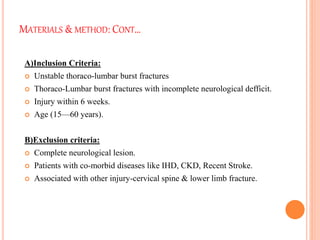
A)Inclusion Criteria:
 Unstable thoraco-lumbar burst fractures
 Thoraco-Lumbar burst fractures with incomplete neurological defficit.
 Injury within 6 weeks.
 Age (15—60 years).
B)Exclusion criteria:
 Complete neurological lesion.
 Patients with co-morbid diseases like IHD, CKD, Recent Stroke.
 Associated with other injury-cervical spine & lower limb fracture.
MATERIALS & METHOD: CONT…
Variables:
The following outcome variables were studied:
(a) Pain
(b) Work
(c) Hospital stay
(d) Functional outcome
(e) Complications
RESULTS
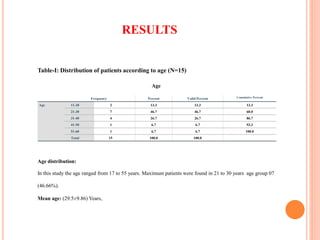
Table-I: Distribution of patients according to age (N=15)
Age
Frequency Percent Valid Percent Cumulative Percent
Age 11-20 2 13.3 13.3 13.3
21-30 7 46.7 46.7 60.0
31-40 4 26.7 26.7 86.7
41-50 1 6.7 6.7 93.3
51-60 1 6.7 6.7 100.0
Total 15 100.0 100.0
Age distribution:
In this study the age ranged from 17 to 55 years. Maximum patients were found in 21 to 30 years age group 07
(46.66%).
Mean age: (29.5±9.86) Years,
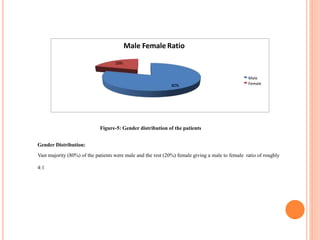
Figure-5: Gender distribution of the patients
Gender Distribution:
Vast majority (80%) of the patients were male and the rest (20%) female giving a male to female ratio of roughly
4:1
80%
20%
Male Female Ratio
Male
Female
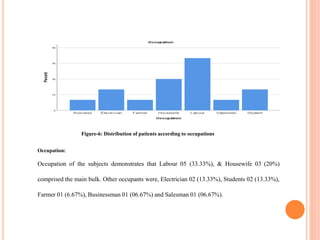
Figure-6: Distribution of patients according to occupations
Occupation:
Occupation of the subjects demonstrates that Labour 05 (33.33%), & Housewife 03 (20%)
comprised the main bulk. Other occupants were, Electrician 02 (13.33%), Students 02 (13.33%),
Farmer 01 (6.67%), Businessman 01 (06.67%) and Salesman 01 (06.67%).
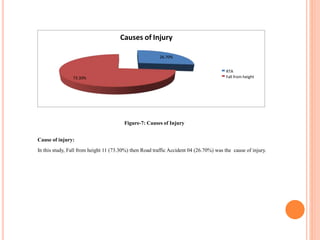
Figure-7: Causes of Injury
Cause of injury:
In this study, Fall from height 11 (73.30%) then Road traffic Accident 04 (26.70%) was the cause of injury.
26.70%
73.30%
Causes of Injury
RTA
Fall from height
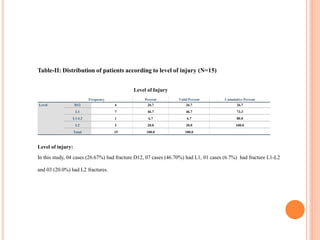
Table-II: Distribution of patients according to level of injury (N=15)
Level of Injury
Frequency Percent Valid Percent Cumulative Percent
Level D12 4 26.7 26.7 26.7
L1 7 46.7 46.7 73.3
L1-L2 1 6.7 6.7 80.0
L2 3 20.0 20.0 100.0
Total 15 100.0 100.0
Level of injury:
In this study, 04 cases (26.67%) had fracture D12, 07 cases (46.70%) had L1, 01 cases (6.7%) had fracture L1-L2
and 03 (20.0%) had L2 fractures.
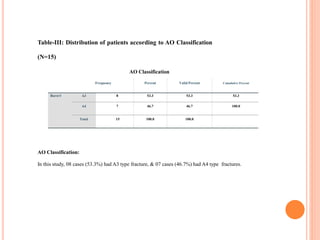
Table-III: Distribution of patients according to AO Classification
(N=15)
AO Classification
Frequency Percent Valid Percent Cumulative Percent
Burst # A3 8 53.3 53.3 53.3
A4 7 46.7 46.7 100.0
Total 15 100.0 100.0
AO Classification:
In this study, 08 cases (53.3%) had A3 type fracture, & 07 cases (46.7%) had A4 type fractures.
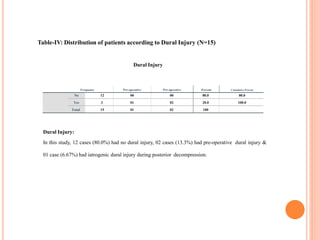
Table-IV: Distribution of patients according to Dural Injury (N=15)
Dural Injury
Frequency Pre-operative Per-operative Percent Cumulative Percent
No 12 00 00 80.0 80.0
Yes 3 01 02 20.0 100.0
Total 15 01 02 100
Dural Injury:
In this study, 12 cases (80.0%) had no dural injury, 02 cases (13.3%) had pre-operative dural injury &
01 case (6.67%) had iatrogenic dural injury during posterior decompression.
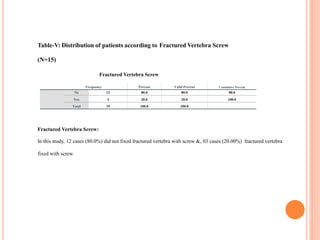
Table-V: Distribution of patients according to Fractured Vertebra Screw
(N=15)
Fractured Vertebra Screw
Frequency Percent Valid Percent Cumulative Percent
No 12 80.0 80.0 80.0
Yes 3 20.0 20.0 100.0
Total 15 100.0 100.0
Fractured Vertebra Screw:
In this study, 12 cases (80.0%) did not fixed fractured vertebra with screw &, 03 cases (20.00%) fractured vertebra
fixed with screw.
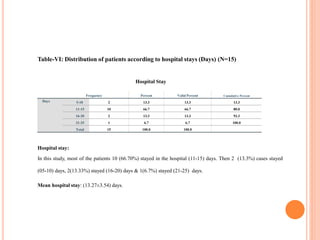
Table-VI: Distribution of patients according to hospital stays (Days) (N=15)
Hospital Stay
Frequency Percent Valid Percent Cumulative Percent
Days 5-10 2 13.3 13.3 13.3
11-15 10 66.7 66.7 80.0
16-20 2 13.3 13.3 93.3
21-25 1 6.7 6.7 100.0
Total 15 100.0 100.0
Hospital stay:
In this study, most of the patients 10 (66.70%) stayed in the hospital (11-15) days. Then 2 (13.3%) cases stayed
(05-10) days, 2(13.33%) stayed (16-20) days & 1(6.7%) stayed (21-25) days.
Mean hospital stay: (13.27±3.54) days.
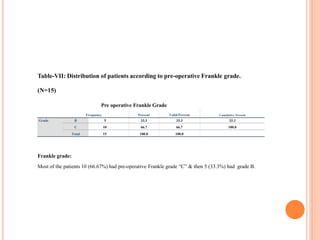
Table-VII: Distribution of patients according to pre-operative Frankle grade.
(N=15)
Pre operative Frankle Grade
Frequency Percent Valid Percent Cumulative Percent
Grade B 5 33.3 33.3 33.3
C 10 66.7 66.7 100.0
Total 15 100.0 100.0
Frankle grade:
Most of the patients 10 (66.67%) had pre-operative Frankle grade “C” & then 5 (33.3%) had grade B.
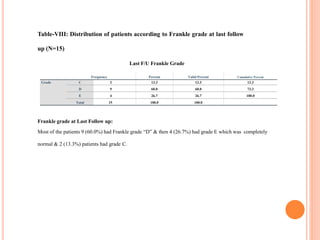
Table-VIII: Distribution of patients according to Frankle grade at last follow
up (N=15)
Last F/U Frankle Grade
Frequency Percent Valid Percent Cumulative Percent
Grade C 2 13.3 13.3 13.3
D 9 60.0 60.0 73.3
E 4 26.7 26.7 100.0
Total 15 100.0 100.0
Frankle grade at Last Follow up:
Most of the patients 9 (60.0%) had Frankle grade “D” & then 4 (26.7%) had grade E which was completely
normal & 2 (13.3%) patients had grade C.
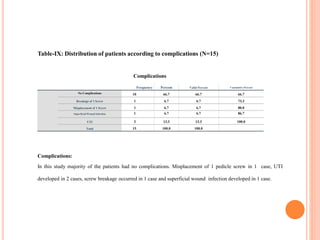
Table-IX: Distribution of patients according to complications (N=15)
Complications
Frequency Percent Valid Percent Cumulative Percent
No Complications 10 66.7 66.7 66.7
Breakage of 1 Screw 1 6.7 6.7 73.3
Misplacement of 1 Screw 1 6.7 6.7 80.0
Superficial Wound Infection 1 6.7 6.7 86.7
UTI 2 13.3 13.3 100.0
Total 15 100.0 100.0
Complications:
In this study majority of the patients had no complications. Misplacement of 1 pedicle screw in 1 case, UTI
developed in 2 cases, screw breakage occurred in 1 case and superficial wound infection developed in 1 case.
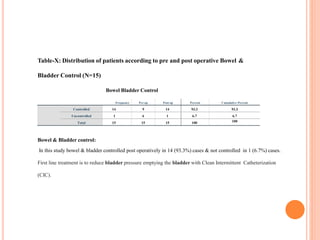
Table-X: Distribution of patients according to pre and post operative Bowel &
Bladder Control (N=15)
Bowel Bladder Control
Frequency Pre-op Post-op Percent Cumulative Percent
Controlled 14 9 14 93.3 93.3
Uncontrolled 1 6 1 6.7 6.7
Total 15 15 15 100 100
Bowel & Bladder control:
In this study bowel & bladder controlled post operatively in 14 (93.3%) cases & not controlled in 1 (6.7%) cases.
First line treatment is to reduce bladder pressure emptying the bladder with Clean Intermittent Catheterization
(CIC).
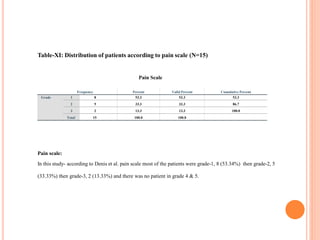
Table-XI: Distribution of patients according to pain scale (N=15)
Pain Scale
Frequency Percent Valid Percent Cumulative Percent
Grade 1 8 53.3 53.3 53.3
2 5 33.3 33.3 86.7
3 2 13.3 13.3 100.0
Total 15 100.0 100.0
Pain scale:
In this study- according to Denis et al. pain scale most of the patients were grade-1, 8 (53.34%) then grade-2, 5
(33.33%) then grade-3, 2 (13.33%) and there was no patient in grade 4 & 5.
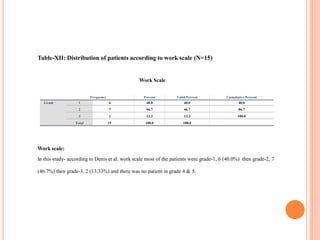
Table-XII: Distribution of patients according to work scale (N=15)
Work Scale
Frequency Percent Valid Percent Cumulative Percent
Grade 1 6 40.0 40.0 40.0
2 7 46.7 46.7 86.7
3 2 13.3 13.3 100.0
Total 15 100.0 100.0
Work scale:
In this study- according to Denis et al. work scale most of the patients were grade-1, 6 (40.0%) then grade-2, 7
(46.7%) then grade-3, 2 (13.33%) and there was no patient in grade 4 & 5.
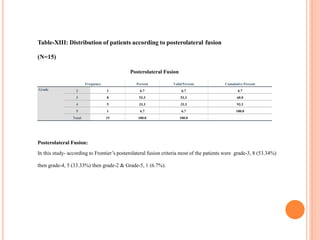
Frequency Percent Valid Percent Cumulative Percent
Grade 2 1 6.7 6.7 6.7
3 8 53.3 53.3 60.0
4 5 33.3 33.3 93.3
5 1 6.7 6.7 100.0
Total 15 100.0 100.0
Table-XIII: Distribution of patients according to posterolateral fusion
(N=15)
Posterolateral Fusion
Posterolateral Fusion:
In this study- according to Frontier’s posterolateral fusion criteria most of the patients were grade-3, 8 (53.34%)
then grade-4, 5 (33.33%) then grade-2 & Grade-5, 1 (6.7%).
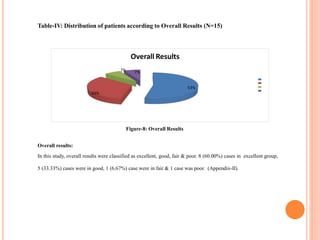
Table-IV: Distribution of patients according to Overall Results (N=15)
53%
33%
7% 7%
Overall Results
Figure-8: Overall Results
Overall results:
In this study, overall results were classified as excellent, good, fair & poor. 8 (60.00%) cases in excellent group,
5 (33.33%) cases were in good, 1 (6.67%) case were in fair & 1 case was poor. (Appendix-II).
DISCUSSION
 In this study, the age range of patients was from 17-55 years, with
mean age of (29.5±9.86) years. Majority of the patients in this series
were in the age group of 21-30 (46.66%), while the next common age
group 31-40 (33.34%).
 Yue et al. 2002 selected mean age 41.3 years (range 21-76 years).
Aebi et al. 1987 stated mean age was 33.8 years (range 18-61 years).
McNamara et al. 1992 found mean age 28.6 years (range 16-50
years).
DISCUSSION: CON….
 In this series, fall from height was the commonest cause of injury. It
comprises fall from tree (26.26%) and fall from roof of building (26.26%).
RTA (33.33%) was another cause of injury.
 Yue et al. 2002 also found that common cause of injury was high energy
trauma such as motor vehicle accidents.
 In this study, most involved level of spine was Ll (40.00%), next common
involved group was D12 (26.67%)
 Aebi et al (1986) & Celebi et al. (2007) showed most common level was
L1 (43.3%) & Ll (37.5%).
 So in all series Ll was the most common involved spine level.
DISCUSSION: CON….
 In this study majority of the patients had no complications.
Misplacement of 1 pedicle screw in 1 case, screw breakage occurred
in 1 case at follow up.
 Yue et al (2002) found that a single deep wound infection & no cases
of hardware failure..
 Shin et al (2007) stated that one screw pullout resulted in kyphotic
angulations and one screw was misplaced.
DISCUSSION: CON…
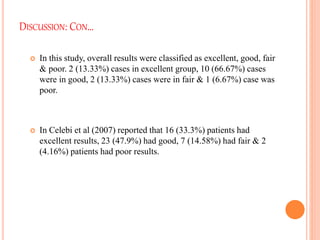
 In this study, overall results were classified as excellent, good, fair
& poor. 2 (13.33%) cases in excellent group, 10 (66.67%) cases
were in good, 2 (13.33%) cases were in fair & 1 (6.67%) case was
poor.
 In Celebi et al (2007) reported that 16 (33.3%) patients had
excellent results, 23 (47.9%) had good, 7 (14.58%) had fair & 2
(4.16%) patients had poor results.
CONCLUSION
 In the surgical treatment of thoraco-lumbar burst fractures,
decompression and posterolateral fusion & stabilization by pedicle
screw & rods is a safe surgical treatment for the neural structures.
 Other advantages of this operative procedure are complete spinal
canal decompression with direct visualization of neural structures.
LIMITATION
 There are some limitations in this study. Some are mentioned
below:
 Smaller sample size
 Non randomized sampling method
 Absence of neuro-monitor in operation theater
 The study and follow up period is short in comparable
to other series.
RECOMMENDATION
 This study demonstrated that early surgical intervention is
essential after unstable spinal injury with incomplete neurological
deficit.
 A regular, well supervised follow up programmed should be
ensured to know the final outcome of the treatment and patient’s
motivation must be established.
BIBLIOGRAPHY
 Acosta FL, Aryan HE, Taylor WR, Ames CP, 2005, ‘kyphoplasty augmented short-segment pedicle screw fixation of traumatic
lumbar burst fractures: Initial clinical experience and literature review', viewed on August 8th 2008, <http://www. medscape.
com/viewartic1e1501678?rss>
 Aebi M, Etter C, Kehl T, Thalgott J, 1987, ‘Stabilization of the lower thoracic and lumbar spine with the internal spinal skeletal
fixation system. Indication, technique and first result of treatment', Spine, vol. 12, No. 6, pp. 544-551.
 Alany A, Aceroglu E, Yazici M, Ozmur A, Surat A, 2001, ‘Short-Segment pedicle instrumentation of thoracolumbar burst
fractures: Does transpedicular intracorporal grafting prevent early failure', Spine, vol. 26, No. 2, pp. 213-217.
 Benzel EC, Halliday AL, Zileli M, Stillerman CB, 2005, ‘Dorsal thoracic and lumbar Screw Fixation and Pedicle Fixation
Techniques,' in Benzel EC (ed), Spine Surgery Techniques, Complication Avoidance and management, Elsevier, Churchill,
Livingstone, 2nd edn, vol. 3,pp. 1518-1549.
 Boerger TO, Limb D, Dickson RA, 2000, ‘Does canal clearance affect neurological outcome after thoracolumbar burst fractures',
J Bone Joint surg (Br) Vol.82-B, No. 5, pp. 629-35.
 Bradford DS, McBride GG, 1987, ‘Surgical management of thoracolumbar spine- fractures with incomplete neurologic deficits,
Clinical orthopaedics and related research', no. 218, pp. 201-216.
 Celebi L, Dogan 0, Murath HH, Yagmurlu MF, Bicimoglu A, 2007, ‘The effectiveness of short-segment posterior instrumentation
of thoracolumbar burst fractures', Acta orthop traumatol turc, vol. 41, no-3, pp. 183-189.
 Dai LY, Jiang SD, Wang XY, Jiang LS, 2007, ‘A review of the management of thoracolumbar burst fractures. Surgical
Neurology. No. 67(3), pp. 221-231.
 Denis F, 1983, 'The three column spine and its significance in the Classification of acute thoracolumbar spine injuries’ Spine,
volume 8, no. 8, pp.817-831.
 Dickson JH, Harrington PR, Erwin VVID, 1978, 'Results of Reduction and stabilization of the severely fractured thoracic and
lumbar spine', J Bon Joint surgery (Am), vol. 60-A, no. 6, pp. 799-805.
 Gaines RW, 2000. 'The use of pedicle-screw internal fixation for the operative treatment of spinal disorders', J Bone Joint Surg
(Am), vol 82-A, pp. 1458-65
BIBLIOGRAPHY
 KeithB, 2011,'Vertebral column', viewed on 15 May 2011,<http://www.spineuniverse. com/anatomy/vertebral column>
 Leferink VJM, 2002, 'Thoracolumbar spinal fractures: aspects of epidemiology, classification, radiological results and functional outcome,' viewed on 8th August
2008, <http://dissertations. ub. rug.nl/faculties lmedicineI20021vj. m. leferinkl'>
 Leventhal MR, 2003, 'Fractures, dislocation and fracture-dislocation of spine', in ST Canale (ed), Campbell's operative orthopaedics, Mosby, S, Louis, London,
11th edn, vol. 2, pp. 1761-1821.
 Lukas R, Suchomel P, Sram J, 2006,'Surgical treatment of thoracolumbar spine fractures, Coluna / columna, vol. 5, no. 2, pp. 84-89.
 McAfee PC, Farey ID, Sutterlin CE, 1986, ‘Device-related osteoporosis with spinal instrumentation’ Spine, no. 14(9), pp. 919-926.
 McNamara MI, Stephnes GC, Spengler DM, 1992, 'Transpedicular short segment fusions for treatment of lumbar burst fractures', Journal of spinal disorders,
vol.5, no. 2, pp. 183-187
 'Moon MS, Choi WT, Moon YW, Kim YS, Moon JL, 2003, 'Stabilization of fractured thoracic and lumbar spine with cotrel-dubousset instruments’, Journal of
orthopaedic surgery, vol.11, no.1, pp. 59-66
 Patel CK, Trumes E, Fischgrund JS, and Harkowitz MN, 2002, 'Evaluation and treatment of thoracolumbar junction trauma', UPOJ, vol. 15, pp. 7-12.
 Pickett J, Blumenkopf B, 1989, ‘Dural lacerations and thoracolumbar fractures. J Spinal Disorders, no. 2(2), pp. 99-103.
 Puttlitz CM, Goel VK, McLain RF, 2001, 'Biomechanics of spinal Instrumentation', in Chapman MW (ed), Chapman's Orthopaedic Surgery, Lippincott, Williams
& Wilkins, Philadelphia, Baltimore, New York, 3rd edn, vol. 4, pp. 3619-3632.
 Rahman MM, 2006, 'Outcome of traumatic thoracolumabr spine stabilization through posterior approach’ MS thesis, University of Dhaka.
 Roy-camille R, Saillant G, Mazel C, 1986, 'Internal fixation of the lumbar spine with pedicle screw plating’, Clinical orthopaedics and related research, no. 203,
pp. 7- 17.
 Sasso RC, Coder HB, 1993, 'Posterior instrumentation and fusion for -unstable fractures and fracture-dislocation of the thoracic and lumbar spine’, Spine, vol.
18, no. 4, pp. 450-460.
 Shin TS, Kim HW, Park KS, Kim JM, Jung CK, 2007, 'Short-segment pedicle instrumentation of thoracolumbar Burst-Compression fractures; short term
follow-up results', J Korean neurosurg soc, vol. 42, pp.265-270.
 Snell RS (ed), 1992, 'The vertebral Colunm", Clinical Anatomy for Medical students, Little, Brown & company, Boston/Toronto/ London, 4 edn, pp.944-978.
 Solomon L, Warwick D, Nayagarn S, 2001, 'Injuries of the spine', Apley's system of Orthopaedics and fractures, 8th edn, Arnold, London, pp. 643-665
 Steeffee AD, Biscup RS, Sitkowski DJ, 1986, 'Segmental spine plates with pedicle screw fixation', Clinical orthopaedics and related research, no. 203, pp.
45-57.
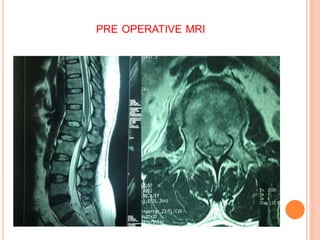
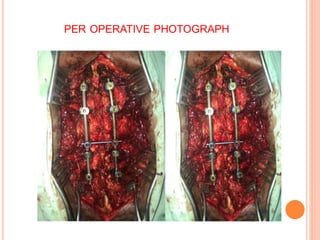
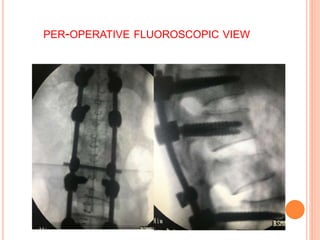
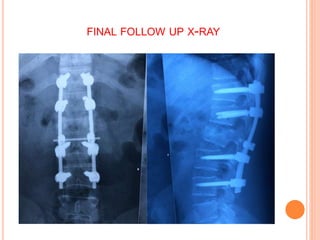
CASE ILLUSTRATION-1
Patient Name: Mr. Masud
Age: 32 years
Profession: Business
Cause of Injury: Fall from height
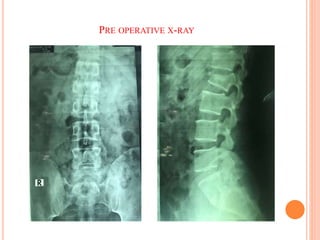
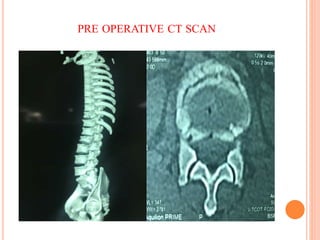
Diagnosis: L1 Burst Fracture
Neurological Status: Frankle Grade “C”
Bowel/Bladder Involvement: No
PRE OPERATIVE X-RAY
PRE OPERATIVE CT SCAN
PRE OPERATIVE MRI
PER OPERATIVE PHOTOGRAPH
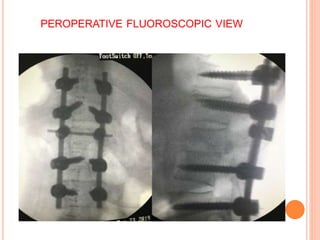
PER-OPERATIVE FLUOROSCOPIC VIEW
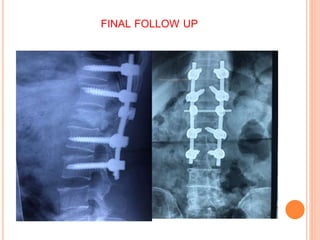
FINAL FOLLOW UP X-RAY
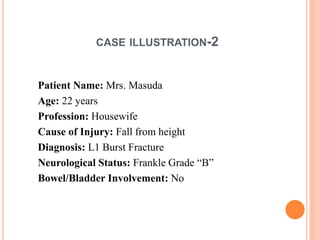
CASE ILLUSTRATION-2
Patient Name: Mrs. Masuda
Age: 22 years
Profession: Housewife
Cause of Injury: Fall from height
Diagnosis: L1 Burst Fracture
Neurological Status: Frankle Grade “B”
Bowel/Bladder Involvement: No
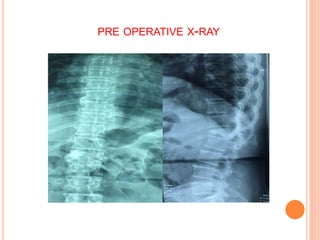
PRE OPERATIVE X-RAY
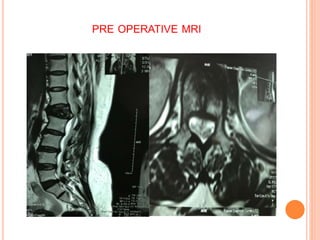
PRE OPERATIVE MRI
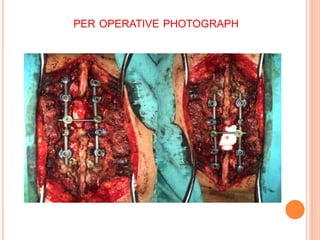
PER OPERATIVE PHOTOGRAPH
PEROPERATIVE FLUOROSCOPIC VIEW
FINAL FOLLOW UP
THANK YOU

Thoracolumbar Burst Fractures

  • 1.
    EVALUATION OF THEFUNCTIONAL OUTCOME OF THORACO-LUMBAR BURST FRACTURES STABILIZATION BY PEDICLE SCREW & ROD. DR. K. M. RAFIQUL ISLAM SHETU MBBS (SSMC), MS (Ortho) Research Assistant Department of Orthopaedic Surgery Bangabandhu Sheikh Mujib Medical University Dhaka.
  • 2.
    ABSTRACT  This wasa prospective study carried out at BSMMU. A total of 15 patients aged over 15 years were included in the study.  Among the 15 cases, 12 cases (80%) were male and 3 cases (20%) were female.  The age range of patient was from 17-55 years. Most commonly affected people were labours 5 (33.33%).  Fall from height was the commonest cause of injury 11 (73.30%).  Most commonly level of injury was L1- 07 (46.70%).
  • 3.
    ABSTRACT: CONT…  Accordingto Frankel grade preoperatively most common grade was C- 10 and next common was B- 5. Post operatively most was D-9 and next was E-4 & C-2.  According to Denis et al pain scale most commonly 8 (53.34%) cases complaint no pain & work scale most commonly 6 (40.0%) cases were completely well and can perform normal work up to latest follow-up.
  • 4.
    ABSTRACT: CONT…  Meanhospital stay was (13.27±3.54) days. Satisfactory results (excellent & good) were in 13 (86.66%), fair 1 (6.67%) & 1(6.67%) unsatisfactory (poor) results.  The results of the study demonstrates that functional outcome of Thoraco-Lumbar burst fractures stabilization by pedicle screw & rod is an effective procedure.
  • 5.
    INTRODUCTION  Fracture anddislocations of the spine are serious injuries that most commonly occur in young people.Nearly 43% of patients with spinal cord injuries sustain multiple injuries. (Leventhal, 2003).  Spinal column injuries represent approximately 3% of all trauma cases and 10% of spine injuries are accompanied by injury to the spinal cord.75% of all spinal injuries occur within the thoracolumbar segment.  Surgical treatment is now offered not only to patients with spinal injuries accompanied with spinal cord lesion,but also to injuries where instability and subsequent deformity is expected. (Lukas et al.2006).
  • 6.
    INTRODUCTION: CONT…  Thethoracolumbar junction is the most common area of injury to the axial skeleton. Forces along the long stiff kyphotic thoracic spine switch abruptly into the mobile lordotic lumbar spine at the thoracolumbar junction.  Biomechanically, this transition zone is susceptible to injury and is the most commonly injured portion of the spine. Primary goals in thoracolumbar trauma patients are prompt recognition and treatment of associated injuries and expeditious stabilization of the spine and protection of the neural elements. (Patel et al. 2002).
  • 7.
    INTRODUCTION: CONT…  Aburst fracture is a type of traumatic spinal injury in which a vertebra breaks from a high energy axial load with pieces of the vertebra shattering into surrounding tissues and sometimes the spinal canal & involved all three columns.  Burst fractures are most often caused by car accident or by falls. Burst fractures are categorized by the "severity of the deformity, the severity of (spinal) canal compromise, the degree of loss of vertebral body height, and the degree of neurologic deficit."
  • 8.
    INTRODUCTION: CONT…  Long-segmentpedicle screw fixation through posterior approach is a common and relatively simple method for treating thoracolumbar burst fractures, and potentially allows for spinal stabilization while preserving as many motion segments as possible. (Acosta et al.2005).  The advantages of surgical treatment for thoracolumbar burst fracture include better correction of kyphotic deformity, greater initial stability, and an opportunity to perform direct decompression.( Dai et al 2007).
  • 9.
    INTRODUCTION: CONT…  Theposterior procedure is well established. The advantages include safe exploration of the surgical site without violating the pulmonary, visceral and vascular structures. It also has the advantages of alignment correction, clear view of the neural structures, all processes, such as decompression and posterior stabilization are performed safely under direct view.(McAfee et al 1989).  Pedicle screw – rod systems provide rigid segmental fixation along all three columns of the spine and allow a combination of forces (distraction, compression or rotation) to be selectively applied to the spinal segment. Thus, pedicle screw fixation improves the ability to correct a spinal deformity.
  • 10.
    INTRODUCTION: CONT…  Itis critically important to determine if a vertebral fracture is stable or not.  Of an unstable fracture' is overlooked, it may cause serious neurologic deficit, progressive spinal deformity, persistent back pain, bed rest of long duration and usage of boring orthosis.  On the other hand, if a stable fracture is misdiagnosed, it may lead to unnecessary surgical intervention.
  • 11.
    JUSTIFICATION /RATIONALE  InBangladesh the incidence of spinal injuries are rising but the management of this remained largely conservative. This has a negative consequence. Hospital beds remained occupied for long; patients suffer complications of immobilization and add further financial strain to family and the state.  Spinal injuries associated with neurological lesions needs decompression along with stabilization. Decompression & stabilization of the spine by pedicle screw & rod through single posterior approach are not a very well practiced procedure in Bangladesh. However, the demand, for surgery is increasing & needs evaluation.
  • 12.
    HYPOTHESIS Thoraco-lumbar burst fractureswith incomplete neurological lesion stabilization by pedicle Screw and Rod is an effective procedure.
  • 13.
    OBJECTIVE A) General: The findout a good option in the management of thoracolumbar burst fractures with incomplete neurological lesion. B) Specific objectives: 1. To find out the functional outcome of surgery. 2. To asses the level of spine injury. 3. To asses the types of cord lesion and out come after surgery. 4. To asses the complication during treatment.
  • 14.
    MATERIALS & METHOD Types of study: Experimental study.  Place of study: Bangabandhu Sheikh Mujib Medical University, Bangladesh.  Period of Study: January 2019 to December 2019  Study population: A total number of fifteen patients with Thoraco-Lumbar Burst fracture were selected from BSMMU, Dhaka, Bangladesh.  Sampling Method: Purposive sampling technique.
  • 15.
    MATERIALS & METHOD:CONT… A)Inclusion Criteria:  Unstable thoraco-lumbar burst fractures  Thoraco-Lumbar burst fractures with incomplete neurological defficit.  Injury within 6 weeks.  Age (15—60 years). B)Exclusion criteria:  Complete neurological lesion.  Patients with co-morbid diseases like IHD, CKD, Recent Stroke.  Associated with other injury-cervical spine & lower limb fracture.
  • 16.
    MATERIALS & METHOD:CONT… Variables: The following outcome variables were studied: (a) Pain (b) Work (c) Hospital stay (d) Functional outcome (e) Complications
  • 17.
    RESULTS Table-I: Distribution ofpatients according to age (N=15) Age Frequency Percent Valid Percent Cumulative Percent Age 11-20 2 13.3 13.3 13.3 21-30 7 46.7 46.7 60.0 31-40 4 26.7 26.7 86.7 41-50 1 6.7 6.7 93.3 51-60 1 6.7 6.7 100.0 Total 15 100.0 100.0 Age distribution: In this study the age ranged from 17 to 55 years. Maximum patients were found in 21 to 30 years age group 07 (46.66%). Mean age: (29.5±9.86) Years,
  • 18.
    Figure-5: Gender distributionof the patients Gender Distribution: Vast majority (80%) of the patients were male and the rest (20%) female giving a male to female ratio of roughly 4:1 80% 20% Male Female Ratio Male Female
  • 19.
    Figure-6: Distribution ofpatients according to occupations Occupation: Occupation of the subjects demonstrates that Labour 05 (33.33%), & Housewife 03 (20%) comprised the main bulk. Other occupants were, Electrician 02 (13.33%), Students 02 (13.33%), Farmer 01 (6.67%), Businessman 01 (06.67%) and Salesman 01 (06.67%).
  • 20.
    Figure-7: Causes ofInjury Cause of injury: In this study, Fall from height 11 (73.30%) then Road traffic Accident 04 (26.70%) was the cause of injury. 26.70% 73.30% Causes of Injury RTA Fall from height
  • 21.
    Table-II: Distribution ofpatients according to level of injury (N=15) Level of Injury Frequency Percent Valid Percent Cumulative Percent Level D12 4 26.7 26.7 26.7 L1 7 46.7 46.7 73.3 L1-L2 1 6.7 6.7 80.0 L2 3 20.0 20.0 100.0 Total 15 100.0 100.0 Level of injury: In this study, 04 cases (26.67%) had fracture D12, 07 cases (46.70%) had L1, 01 cases (6.7%) had fracture L1-L2 and 03 (20.0%) had L2 fractures.
  • 22.
    Table-III: Distribution ofpatients according to AO Classification (N=15) AO Classification Frequency Percent Valid Percent Cumulative Percent Burst # A3 8 53.3 53.3 53.3 A4 7 46.7 46.7 100.0 Total 15 100.0 100.0 AO Classification: In this study, 08 cases (53.3%) had A3 type fracture, & 07 cases (46.7%) had A4 type fractures.
  • 23.
    Table-IV: Distribution ofpatients according to Dural Injury (N=15) Dural Injury Frequency Pre-operative Per-operative Percent Cumulative Percent No 12 00 00 80.0 80.0 Yes 3 01 02 20.0 100.0 Total 15 01 02 100 Dural Injury: In this study, 12 cases (80.0%) had no dural injury, 02 cases (13.3%) had pre-operative dural injury & 01 case (6.67%) had iatrogenic dural injury during posterior decompression.
  • 24.
    Table-V: Distribution ofpatients according to Fractured Vertebra Screw (N=15) Fractured Vertebra Screw Frequency Percent Valid Percent Cumulative Percent No 12 80.0 80.0 80.0 Yes 3 20.0 20.0 100.0 Total 15 100.0 100.0 Fractured Vertebra Screw: In this study, 12 cases (80.0%) did not fixed fractured vertebra with screw &, 03 cases (20.00%) fractured vertebra fixed with screw.
  • 25.
    Table-VI: Distribution ofpatients according to hospital stays (Days) (N=15) Hospital Stay Frequency Percent Valid Percent Cumulative Percent Days 5-10 2 13.3 13.3 13.3 11-15 10 66.7 66.7 80.0 16-20 2 13.3 13.3 93.3 21-25 1 6.7 6.7 100.0 Total 15 100.0 100.0 Hospital stay: In this study, most of the patients 10 (66.70%) stayed in the hospital (11-15) days. Then 2 (13.3%) cases stayed (05-10) days, 2(13.33%) stayed (16-20) days & 1(6.7%) stayed (21-25) days. Mean hospital stay: (13.27±3.54) days.
  • 26.
    Table-VII: Distribution ofpatients according to pre-operative Frankle grade. (N=15) Pre operative Frankle Grade Frequency Percent Valid Percent Cumulative Percent Grade B 5 33.3 33.3 33.3 C 10 66.7 66.7 100.0 Total 15 100.0 100.0 Frankle grade: Most of the patients 10 (66.67%) had pre-operative Frankle grade “C” & then 5 (33.3%) had grade B.
  • 27.
    Table-VIII: Distribution ofpatients according to Frankle grade at last follow up (N=15) Last F/U Frankle Grade Frequency Percent Valid Percent Cumulative Percent Grade C 2 13.3 13.3 13.3 D 9 60.0 60.0 73.3 E 4 26.7 26.7 100.0 Total 15 100.0 100.0 Frankle grade at Last Follow up: Most of the patients 9 (60.0%) had Frankle grade “D” & then 4 (26.7%) had grade E which was completely normal & 2 (13.3%) patients had grade C.
  • 28.
    Table-IX: Distribution ofpatients according to complications (N=15) Complications Frequency Percent Valid Percent Cumulative Percent No Complications 10 66.7 66.7 66.7 Breakage of 1 Screw 1 6.7 6.7 73.3 Misplacement of 1 Screw 1 6.7 6.7 80.0 Superficial Wound Infection 1 6.7 6.7 86.7 UTI 2 13.3 13.3 100.0 Total 15 100.0 100.0 Complications: In this study majority of the patients had no complications. Misplacement of 1 pedicle screw in 1 case, UTI developed in 2 cases, screw breakage occurred in 1 case and superficial wound infection developed in 1 case.
  • 29.
    Table-X: Distribution ofpatients according to pre and post operative Bowel & Bladder Control (N=15) Bowel Bladder Control Frequency Pre-op Post-op Percent Cumulative Percent Controlled 14 9 14 93.3 93.3 Uncontrolled 1 6 1 6.7 6.7 Total 15 15 15 100 100 Bowel & Bladder control: In this study bowel & bladder controlled post operatively in 14 (93.3%) cases & not controlled in 1 (6.7%) cases. First line treatment is to reduce bladder pressure emptying the bladder with Clean Intermittent Catheterization (CIC).
  • 30.
    Table-XI: Distribution ofpatients according to pain scale (N=15) Pain Scale Frequency Percent Valid Percent Cumulative Percent Grade 1 8 53.3 53.3 53.3 2 5 33.3 33.3 86.7 3 2 13.3 13.3 100.0 Total 15 100.0 100.0 Pain scale: In this study- according to Denis et al. pain scale most of the patients were grade-1, 8 (53.34%) then grade-2, 5 (33.33%) then grade-3, 2 (13.33%) and there was no patient in grade 4 & 5.
  • 31.
    Table-XII: Distribution ofpatients according to work scale (N=15) Work Scale Frequency Percent Valid Percent Cumulative Percent Grade 1 6 40.0 40.0 40.0 2 7 46.7 46.7 86.7 3 2 13.3 13.3 100.0 Total 15 100.0 100.0 Work scale: In this study- according to Denis et al. work scale most of the patients were grade-1, 6 (40.0%) then grade-2, 7 (46.7%) then grade-3, 2 (13.33%) and there was no patient in grade 4 & 5.
  • 32.
    Frequency Percent ValidPercent Cumulative Percent Grade 2 1 6.7 6.7 6.7 3 8 53.3 53.3 60.0 4 5 33.3 33.3 93.3 5 1 6.7 6.7 100.0 Total 15 100.0 100.0 Table-XIII: Distribution of patients according to posterolateral fusion (N=15) Posterolateral Fusion Posterolateral Fusion: In this study- according to Frontier’s posterolateral fusion criteria most of the patients were grade-3, 8 (53.34%) then grade-4, 5 (33.33%) then grade-2 & Grade-5, 1 (6.7%).
  • 33.
    Table-IV: Distribution ofpatients according to Overall Results (N=15) 53% 33% 7% 7% Overall Results Figure-8: Overall Results Overall results: In this study, overall results were classified as excellent, good, fair & poor. 8 (60.00%) cases in excellent group, 5 (33.33%) cases were in good, 1 (6.67%) case were in fair & 1 case was poor. (Appendix-II).
  • 34.
    DISCUSSION  In thisstudy, the age range of patients was from 17-55 years, with mean age of (29.5±9.86) years. Majority of the patients in this series were in the age group of 21-30 (46.66%), while the next common age group 31-40 (33.34%).  Yue et al. 2002 selected mean age 41.3 years (range 21-76 years). Aebi et al. 1987 stated mean age was 33.8 years (range 18-61 years). McNamara et al. 1992 found mean age 28.6 years (range 16-50 years).
  • 35.
    DISCUSSION: CON….  Inthis series, fall from height was the commonest cause of injury. It comprises fall from tree (26.26%) and fall from roof of building (26.26%). RTA (33.33%) was another cause of injury.  Yue et al. 2002 also found that common cause of injury was high energy trauma such as motor vehicle accidents.  In this study, most involved level of spine was Ll (40.00%), next common involved group was D12 (26.67%)  Aebi et al (1986) & Celebi et al. (2007) showed most common level was L1 (43.3%) & Ll (37.5%).  So in all series Ll was the most common involved spine level.
  • 36.
    DISCUSSION: CON….  Inthis study majority of the patients had no complications. Misplacement of 1 pedicle screw in 1 case, screw breakage occurred in 1 case at follow up.  Yue et al (2002) found that a single deep wound infection & no cases of hardware failure..  Shin et al (2007) stated that one screw pullout resulted in kyphotic angulations and one screw was misplaced.
  • 37.
    DISCUSSION: CON…  Inthis study, overall results were classified as excellent, good, fair & poor. 2 (13.33%) cases in excellent group, 10 (66.67%) cases were in good, 2 (13.33%) cases were in fair & 1 (6.67%) case was poor.  In Celebi et al (2007) reported that 16 (33.3%) patients had excellent results, 23 (47.9%) had good, 7 (14.58%) had fair & 2 (4.16%) patients had poor results.
  • 38.
    CONCLUSION  In thesurgical treatment of thoraco-lumbar burst fractures, decompression and posterolateral fusion & stabilization by pedicle screw & rods is a safe surgical treatment for the neural structures.  Other advantages of this operative procedure are complete spinal canal decompression with direct visualization of neural structures.
  • 39.
    LIMITATION  There aresome limitations in this study. Some are mentioned below:  Smaller sample size  Non randomized sampling method  Absence of neuro-monitor in operation theater  The study and follow up period is short in comparable to other series.
  • 40.
    RECOMMENDATION  This studydemonstrated that early surgical intervention is essential after unstable spinal injury with incomplete neurological deficit.  A regular, well supervised follow up programmed should be ensured to know the final outcome of the treatment and patient’s motivation must be established.
  • 41.
    BIBLIOGRAPHY  Acosta FL,Aryan HE, Taylor WR, Ames CP, 2005, ‘kyphoplasty augmented short-segment pedicle screw fixation of traumatic lumbar burst fractures: Initial clinical experience and literature review', viewed on August 8th 2008, <http://www. medscape. com/viewartic1e1501678?rss>  Aebi M, Etter C, Kehl T, Thalgott J, 1987, ‘Stabilization of the lower thoracic and lumbar spine with the internal spinal skeletal fixation system. Indication, technique and first result of treatment', Spine, vol. 12, No. 6, pp. 544-551.  Alany A, Aceroglu E, Yazici M, Ozmur A, Surat A, 2001, ‘Short-Segment pedicle instrumentation of thoracolumbar burst fractures: Does transpedicular intracorporal grafting prevent early failure', Spine, vol. 26, No. 2, pp. 213-217.  Benzel EC, Halliday AL, Zileli M, Stillerman CB, 2005, ‘Dorsal thoracic and lumbar Screw Fixation and Pedicle Fixation Techniques,' in Benzel EC (ed), Spine Surgery Techniques, Complication Avoidance and management, Elsevier, Churchill, Livingstone, 2nd edn, vol. 3,pp. 1518-1549.  Boerger TO, Limb D, Dickson RA, 2000, ‘Does canal clearance affect neurological outcome after thoracolumbar burst fractures', J Bone Joint surg (Br) Vol.82-B, No. 5, pp. 629-35.  Bradford DS, McBride GG, 1987, ‘Surgical management of thoracolumbar spine- fractures with incomplete neurologic deficits, Clinical orthopaedics and related research', no. 218, pp. 201-216.  Celebi L, Dogan 0, Murath HH, Yagmurlu MF, Bicimoglu A, 2007, ‘The effectiveness of short-segment posterior instrumentation of thoracolumbar burst fractures', Acta orthop traumatol turc, vol. 41, no-3, pp. 183-189.  Dai LY, Jiang SD, Wang XY, Jiang LS, 2007, ‘A review of the management of thoracolumbar burst fractures. Surgical Neurology. No. 67(3), pp. 221-231.  Denis F, 1983, 'The three column spine and its significance in the Classification of acute thoracolumbar spine injuries’ Spine, volume 8, no. 8, pp.817-831.  Dickson JH, Harrington PR, Erwin VVID, 1978, 'Results of Reduction and stabilization of the severely fractured thoracic and lumbar spine', J Bon Joint surgery (Am), vol. 60-A, no. 6, pp. 799-805.  Gaines RW, 2000. 'The use of pedicle-screw internal fixation for the operative treatment of spinal disorders', J Bone Joint Surg (Am), vol 82-A, pp. 1458-65
  • 42.
    BIBLIOGRAPHY  KeithB, 2011,'Vertebralcolumn', viewed on 15 May 2011,<http://www.spineuniverse. com/anatomy/vertebral column>  Leferink VJM, 2002, 'Thoracolumbar spinal fractures: aspects of epidemiology, classification, radiological results and functional outcome,' viewed on 8th August 2008, <http://dissertations. ub. rug.nl/faculties lmedicineI20021vj. m. leferinkl'>  Leventhal MR, 2003, 'Fractures, dislocation and fracture-dislocation of spine', in ST Canale (ed), Campbell's operative orthopaedics, Mosby, S, Louis, London, 11th edn, vol. 2, pp. 1761-1821.  Lukas R, Suchomel P, Sram J, 2006,'Surgical treatment of thoracolumbar spine fractures, Coluna / columna, vol. 5, no. 2, pp. 84-89.  McAfee PC, Farey ID, Sutterlin CE, 1986, ‘Device-related osteoporosis with spinal instrumentation’ Spine, no. 14(9), pp. 919-926.  McNamara MI, Stephnes GC, Spengler DM, 1992, 'Transpedicular short segment fusions for treatment of lumbar burst fractures', Journal of spinal disorders, vol.5, no. 2, pp. 183-187  'Moon MS, Choi WT, Moon YW, Kim YS, Moon JL, 2003, 'Stabilization of fractured thoracic and lumbar spine with cotrel-dubousset instruments’, Journal of orthopaedic surgery, vol.11, no.1, pp. 59-66  Patel CK, Trumes E, Fischgrund JS, and Harkowitz MN, 2002, 'Evaluation and treatment of thoracolumbar junction trauma', UPOJ, vol. 15, pp. 7-12.  Pickett J, Blumenkopf B, 1989, ‘Dural lacerations and thoracolumbar fractures. J Spinal Disorders, no. 2(2), pp. 99-103.  Puttlitz CM, Goel VK, McLain RF, 2001, 'Biomechanics of spinal Instrumentation', in Chapman MW (ed), Chapman's Orthopaedic Surgery, Lippincott, Williams & Wilkins, Philadelphia, Baltimore, New York, 3rd edn, vol. 4, pp. 3619-3632.  Rahman MM, 2006, 'Outcome of traumatic thoracolumabr spine stabilization through posterior approach’ MS thesis, University of Dhaka.  Roy-camille R, Saillant G, Mazel C, 1986, 'Internal fixation of the lumbar spine with pedicle screw plating’, Clinical orthopaedics and related research, no. 203, pp. 7- 17.  Sasso RC, Coder HB, 1993, 'Posterior instrumentation and fusion for -unstable fractures and fracture-dislocation of the thoracic and lumbar spine’, Spine, vol. 18, no. 4, pp. 450-460.  Shin TS, Kim HW, Park KS, Kim JM, Jung CK, 2007, 'Short-segment pedicle instrumentation of thoracolumbar Burst-Compression fractures; short term follow-up results', J Korean neurosurg soc, vol. 42, pp.265-270.  Snell RS (ed), 1992, 'The vertebral Colunm", Clinical Anatomy for Medical students, Little, Brown & company, Boston/Toronto/ London, 4 edn, pp.944-978.  Solomon L, Warwick D, Nayagarn S, 2001, 'Injuries of the spine', Apley's system of Orthopaedics and fractures, 8th edn, Arnold, London, pp. 643-665  Steeffee AD, Biscup RS, Sitkowski DJ, 1986, 'Segmental spine plates with pedicle screw fixation', Clinical orthopaedics and related research, no. 203, pp. 45-57.
  • 43.
    CASE ILLUSTRATION-1 Patient Name:Mr. Masud Age: 32 years Profession: Business Cause of Injury: Fall from height Diagnosis: L1 Burst Fracture Neurological Status: Frankle Grade “C” Bowel/Bladder Involvement: No
  • 44.
  • 45.
  • 46.
  • 47.
  • 48.
  • 49.
  • 50.
    CASE ILLUSTRATION-2 Patient Name:Mrs. Masuda Age: 22 years Profession: Housewife Cause of Injury: Fall from height Diagnosis: L1 Burst Fracture Neurological Status: Frankle Grade “B” Bowel/Bladder Involvement: No
  • 51.
  • 52.
  • 53.
  • 54.
  • 55.
  • 56.