Demonstrative pronouns
is used with singular nouns. The object is near the speaker. THIS ONE is used to show a specific object among several. Notice you use IS with this pronoun.
is used with plural nouns. The objects are near the speaker. THESE ONES is used to show  specific objects among  several. Notice you use ARE with this pronoun.
is used with singular nouns. The object is far from the speaker. THAT ONE is used to show a specific object among  several. Notice you use IS with this pronoun.
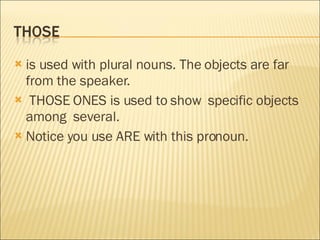
is used with plural nouns. The objects are far from the speaker. THOSE ONES is used to show  specific objects among  several. Notice you use ARE with this pronoun.
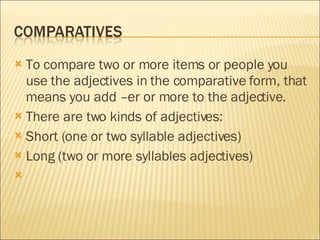
To compare two or more items or people you use the adjectives in the comparative form, that means you add –er or more to the adjective. There are two kinds of adjectives: Short (one or two syllable adjectives)  Long (two or more syllables adjectives)
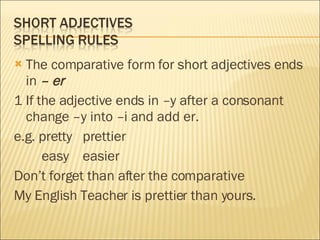
The comparative form for short adjectives ends in  – er  1 If the adjective ends in –y after a consonant change –y into –i and add er. e.g. pretty  prettier easy  easier Don’t forget than after the comparative My English Teacher is prettier than yours.
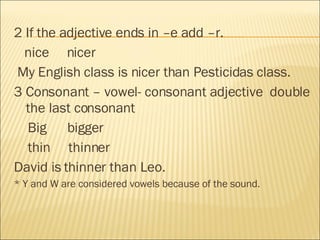
2 If the adjective ends in –e add –r. nice  nicer My English class is nicer than Pesticidas class. 3 Consonant – vowel- consonant adjective  double the last consonant Big  bigger thin  thinner David is thinner than Leo. * Y and W are considered vowels because of the sound.
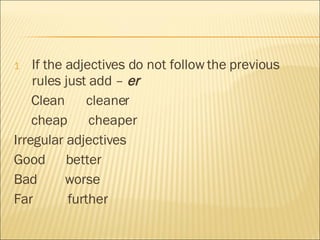
If the adjectives do not follow the previous rules just add –  er Clean  cleaner cheap  cheaper Irregular adjectives Good  better Bad  worse Far  further
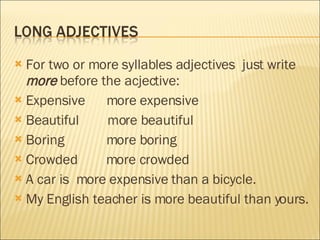
For two or more syllables adjectives  just write  more  before the acjective: Expensive  more expensive Beautiful  more beautiful Boring  more boring Crowded  more crowded A car is  more expensive than a bicycle. My English teacher is more beautiful than yours.
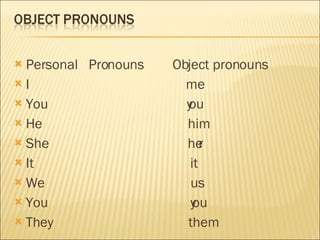
Personal  Pronouns  Object pronouns I  me You  you He  him She  her It  it We  us You  you They  them
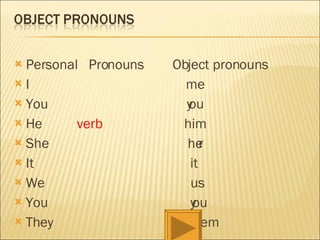
Personal  Pronouns  Object pronouns I  me You  you He  verb   him  She  her It  it We  us You  you They  them

This These

  • 1.
  • 2.
    is used withsingular nouns. The object is near the speaker. THIS ONE is used to show a specific object among several. Notice you use IS with this pronoun.
  • 3.
    is used withplural nouns. The objects are near the speaker. THESE ONES is used to show specific objects among several. Notice you use ARE with this pronoun.
  • 4.
    is used withsingular nouns. The object is far from the speaker. THAT ONE is used to show a specific object among several. Notice you use IS with this pronoun.
  • 5.
    is used withplural nouns. The objects are far from the speaker. THOSE ONES is used to show specific objects among several. Notice you use ARE with this pronoun.
  • 6.
    To compare twoor more items or people you use the adjectives in the comparative form, that means you add –er or more to the adjective. There are two kinds of adjectives: Short (one or two syllable adjectives) Long (two or more syllables adjectives)
  • 7.
    The comparative formfor short adjectives ends in – er 1 If the adjective ends in –y after a consonant change –y into –i and add er. e.g. pretty prettier easy easier Don’t forget than after the comparative My English Teacher is prettier than yours.
  • 8.
    2 If theadjective ends in –e add –r. nice nicer My English class is nicer than Pesticidas class. 3 Consonant – vowel- consonant adjective double the last consonant Big bigger thin thinner David is thinner than Leo. * Y and W are considered vowels because of the sound.
  • 9.
    If the adjectivesdo not follow the previous rules just add – er Clean cleaner cheap cheaper Irregular adjectives Good better Bad worse Far further
  • 10.
    For two ormore syllables adjectives just write more before the acjective: Expensive more expensive Beautiful more beautiful Boring more boring Crowded more crowded A car is more expensive than a bicycle. My English teacher is more beautiful than yours.
  • 11.
    Personal Pronouns Object pronouns I me You you He him She her It it We us You you They them
  • 12.
    Personal Pronouns Object pronouns I me You you He verb him She her It it We us You you They them