Introduction to dosage form
By
Rupa Devi
Assistant Professor
Department of pharmaceutics
Global Research Institute of Pharmacy,
Nachraun, Radaur, Yamunanagar
Contents
 Introduction
 Classification of dosage forms
Solid dosage forms
Semisolid dosage forms
Liquid dosage forms
Dosage form
• A dosage form can be defined as the physical form of a
dose of a chemical compound used as a drug or
medication intended for administration or consumption.
OR
• Pharmaceutical dosage form can be defined as a physical
form of a drug such as a solid, liquid or gas by which it
can be delivered in proper form to particular sites within
the body.
Importance of Dosage Forms
 To provide a safe and convenient delivery of accurate dosage.
 To protect the drug substance from oxidation, hydrolysis and
reduction.
 To protect the drugs from the destructive effect of gastric
juice(Hydrochloric acid) of the stomach after oral
administration e.g. enteric coated tablets.
 To conceal the bitter, salty or obnoxious taste or odour of a
drug substance e.g. capsules, coated tablets.
 To provide for the optimum drug action through inhalation
therapy e.g. inhalation aerosols and inhalants.
Ideal properties of a dosage form
 Its handling , usage, and storage should be easy.
 It should not affect the lifestyle of a patient.
 It should be aesthetically, organoleptically and
therapeutically acceptable.
 It should be able to endure the mechanical shock during
transportation.
 It should maintain its stability during the shelf-life
(storage) and use.
 It should provide protection to the drug and mask the
unpleasant taste or odour.
 It should have a pleasant appearance.
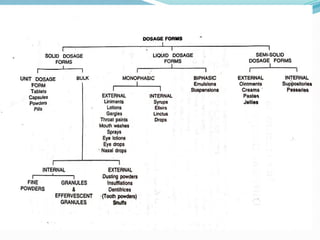
Classification of Dosage Forms
 Dosage forms may be classified on the basis of physiacl
form of the final product which are :
Solid dosage form
Liquid dosage form
Semi-solid dosage form
Solid dosage forms
The solid dosage forms are available mostly in unit dosage
forms (consisting of doses which are taken by numbers)
such as tablets, capsules, pills, cachets or powders.
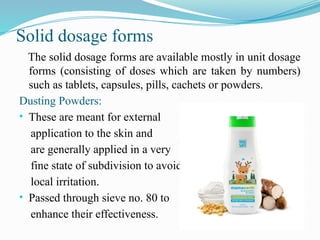
Dusting Powders:
• These are meant for external
application to the skin and
are generally applied in a very
fine state of subdivision to avoid
local irritation.
• Passed through sieve no. 80 to
enhance their effectiveness.
Types of Dusting Powders
 Dusting powders are of two types:
Medical
Surgical
Medical dusting powders: are used mainly for superficial
skin conditions.
Surgical dusting powders: are used in body cavities and also
on major wounds as a result of burns and umbilical cords
of infants.
Insufflations
• These are medicated dusting powders meant for introduction
into the body cavities such as nose, throat, ears and vagina
with the help of an apparatus known as “Insufflator”.
• Sprays the powder into a stream of finely divided particles
all over the site of application.
• The following difficulties are generally faced while using
the insufflators:
• Uniform dose of the drug is not measured.
• It gets blocked when it is slightly wet or the powder used is
wet.
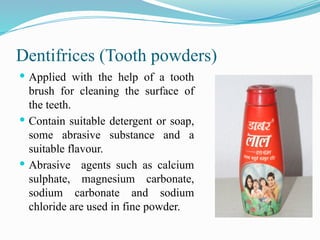
Dentifrices (Tooth powders)
 Applied with the help of a tooth
brush for cleaning the surface of
the teeth.
 Contain suitable detergent or soap,
some abrasive substance and a
suitable flavour.
 Abrasive agents such as calcium
sulphate, magnesium carbonate,
sodium carbonate and sodium
chloride are used in fine powder.
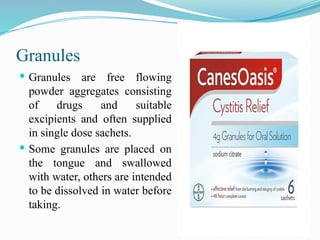
Granules
 Granules are free flowing
powder aggregates consisting
of drugs and suitable
excipients and often supplied
in single dose sachets.
 Some granules are placed on
the tongue and swallowed
with water, others are intended
to be dissolved in water before
taking.
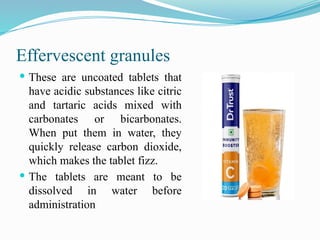
Effervescent granules
 These are uncoated tablets that
have acidic substances like citric
and tartaric acids mixed with
carbonates or bicarbonates.
When put them in water, they
quickly release carbon dioxide,
which makes the tablet fizz.
 The tablets are meant to be
dissolved in water before
administration
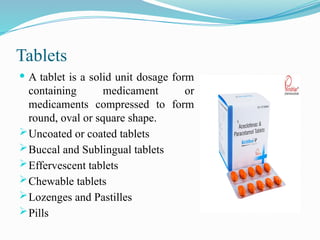
Tablets
 A tablet is a solid unit dosage form
containing medicament or
medicaments compressed to form
round, oval or square shape.
Uncoated or coated tablets
Buccal and Sublingual tablets
Effervescent tablets
Chewable tablets
Lozenges and Pastilles
Pills
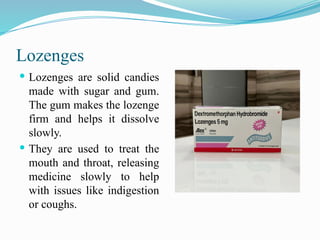
Lozenges
 Lozenges are solid candies
made with sugar and gum.
The gum makes the lozenge
firm and helps it dissolve
slowly.
 They are used to treat the
mouth and throat, releasing
medicine slowly to help
with issues like indigestion
or coughs.
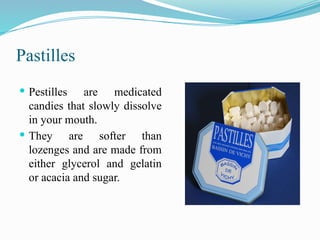
Pastilles
 Pestilles are medicated
candies that slowly dissolve
in your mouth.
 They are softer than
lozenges and are made from
either glycerol and gelatin
or acacia and sugar.
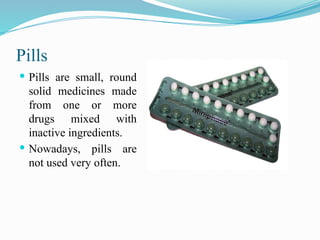
Pills
 Pills are small, round
solid medicines made
from one or more
drugs mixed with
inactive ingredients.
 Nowadays, pills are
not used very often.
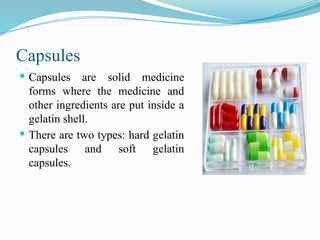
Capsules
 Capsules are solid medicine
forms where the medicine and
other ingredients are put inside a
gelatin shell.
 There are two types: hard gelatin
capsules and soft gelatin
capsules.
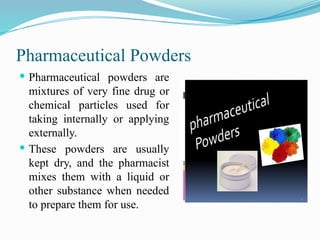
Pharmaceutical Powders
 Pharmaceutical powders are
mixtures of very fine drug or
chemical particles used for
taking internally or applying
externally.
 These powders are usually
kept dry, and the pharmacist
mixes them with a liquid or
other substance when needed
to prepare them for use.
Semi-Solid Dosage Forms
 Semi-solid dosage forms are medications that have a
consistency between solids and liquids. They can be
spread easily and are typically used for applying to the
skin. Common examples include :-
Ointments
Cream
Paste
Jellies
Suppositories
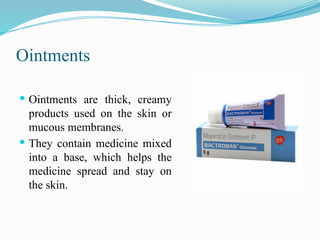
Ointments
 Ointments are thick, creamy
products used on the skin or
mucous membranes.
 They contain medicine mixed
into a base, which helps the
medicine spread and stay on
the skin.
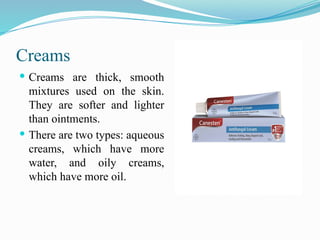
Creams
 Creams are thick, smooth
mixtures used on the skin.
They are softer and lighter
than ointments.
 There are two types: aqueous
creams, which have more
water, and oily creams,
which have more oil.
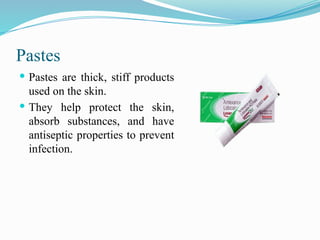
Pastes
 Pastes are thick, stiff products
used on the skin.
 They help protect the skin,
absorb substances, and have
antiseptic properties to prevent
infection.
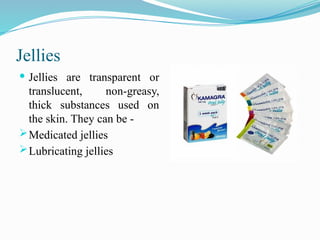
Jellies
 Jellies are transparent or
translucent, non-greasy,
thick substances used on
the skin. They can be -
Medicated jellies
Lubricating jellies
Suppositories
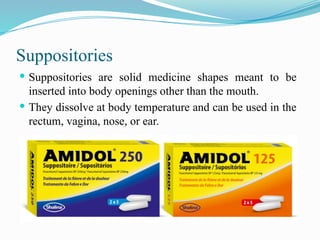
 Suppositories are solid medicine shapes meant to be
inserted into body openings other than the mouth.
 They dissolve at body temperature and can be used in the
rectum, vagina, nose, or ear.
Liquid Dosage Forms
 Liquid dosage forms are medicines in a liquid state that
can be taken by mouth, applied to the skin, or used in
other ways.
 They include solutions, suspensions and syrups. These
forms are often used for their ease of use and quick
absorption.
 Liquid dosage forms are of two types:-
Monophasic liquid dosage forms
Biphasic liquid dosage forms
Monophasic Liquid Dosage Forms
 A monophasic dosage form is a type of liquid medicine
where two or more ingredients are mixed together in a
single, uniform phase.
 An example of this is a true solution, where the
ingredients are fully dissolved in the liquid.
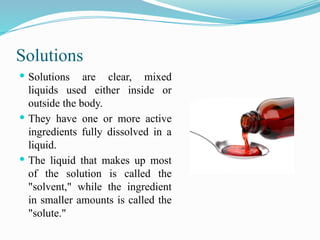
Solutions
 Solutions are clear, mixed
liquids used either inside or
outside the body.
 They have one or more active
ingredients fully dissolved in a
liquid.
 The liquid that makes up most
of the solution is called the
"solvent," while the ingredient
in smaller amounts is called the
"solute."
Syrups
 Syrups are thick, sweet liquids that contain
60% to 85% sugar, and they may also have
flavors and medicine in them.
 For example, there are syrups with
medicines like chlorpheniramine maleate or
chloral hydrate.
 They can be either flavored or have added
medication.
Mixture
 This is a liquid medicine taken by mouth, where the
medicine is mixed into a liquid.
 It’s usually not used for a long time and is prescribed for
short-term issues like cough, indigestion, diarrhea, or
constipation.
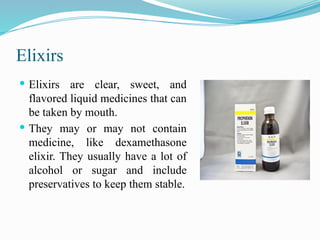
Elixirs
 Elixirs are clear, sweet, and
flavored liquid medicines that can
be taken by mouth.
 They may or may not contain
medicine, like dexamethasone
elixir. They usually have a lot of
alcohol or sugar and include
preservatives to keep them stable.
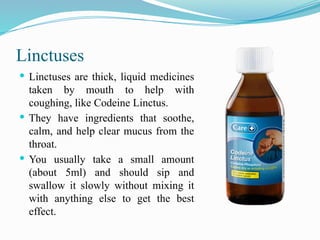
Linctuses
 Linctuses are thick, liquid medicines
taken by mouth to help with
coughing, like Codeine Linctus.
 They have ingredients that soothe,
calm, and help clear mucus from the
throat.
 You usually take a small amount
(about 5ml) and should sip and
swallow it slowly without mixing it
with anything else to get the best
effect.
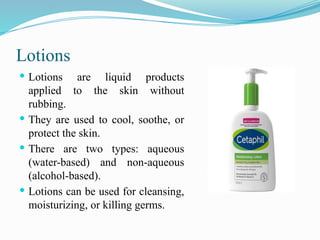
Lotions
 Lotions are liquid products
applied to the skin without
rubbing.
 They are used to cool, soothe, or
protect the skin.
 There are two types: aqueous
(water-based) and non-aqueous
(alcohol-based).
 Lotions can be used for cleansing,
moisturizing, or killing germs.
Liniments
 Liniments are liquid medicines
applied to the skin with rubbing.
 They come in alcohol-based or
oily forms and can also be
emulsions.
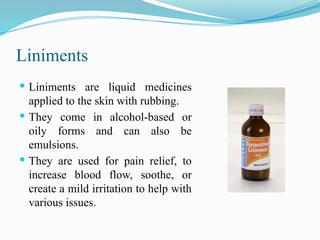
 They are used for pain relief, to
increase blood flow, soothe, or
create a mild irritation to help with
various issues.
Gargles
 Gargles are liquid solutions
used to help prevent or treat
throat infections.
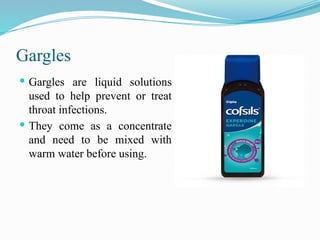
 They come as a concentrate
and need to be mixed with
warm water before using.
Mouth washes
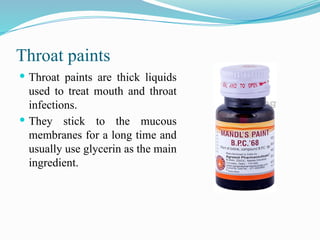
 These are liquid solutions
with a nice taste and smell,
used to clean and freshen
up the mouth.
 They often contain
antibacterial agents,
alcohol, glycerin,
sweeteners, flavors, and
colors.
Throat paints
 Throat paints are thick liquids
used to treat mouth and throat
infections.
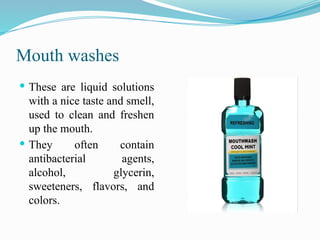
 They stick to the mucous
membranes for a long time and
usually use glycerin as the main
ingredient.
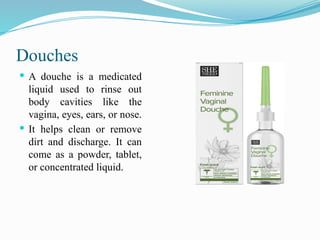
Douches
 A douche is a medicated
liquid used to rinse out
body cavities like the
vagina, eyes, ears, or nose.
 It helps clean or remove
dirt and discharge. It can
come as a powder, tablet,
or concentrated liquid.
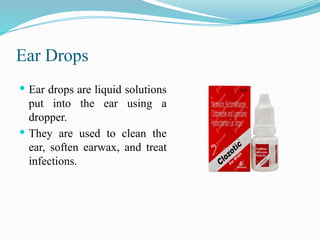
Ear Drops
 Ear drops are liquid solutions
put into the ear using a
dropper.
 They are used to clean the
ear, soften earwax, and treat
infections.
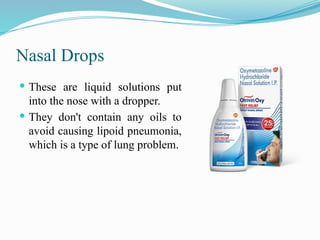
Nasal Drops
 These are liquid solutions put
into the nose with a dropper.
 They don't contain any oils to
avoid causing lipoid pneumonia,
which is a type of lung problem.
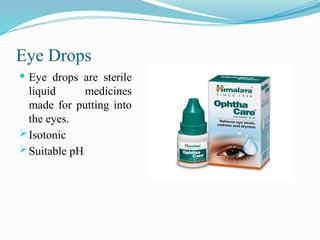
Eye Drops
 Eye drops are sterile
liquid medicines
made for putting into
the eyes.
Isotonic
Suitable pH
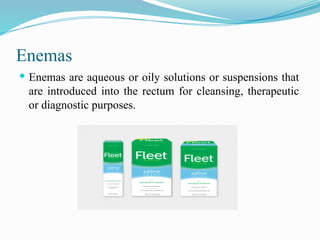
Enemas
 Enemas are aqueous or oily solutions or suspensions that
are introduced into the rectum for cleansing, therapeutic
or diagnostic purposes.
Biphasic Liquid Dosage Forms
 A biphasic liquid dosage form is a medicine that has two
separate layers or phases when mixed.
 One layer is usually a liquid, and the other can be a
suspension or an emulsion.
 You need to shake or mix it before use to combine the two
phases.
Emulsions
 Biphasic liquid dosage form for oral containing medicaments
in which fine oil globules dispersed in continuous phase.
 There are two types:
 O/W (Oil-in-Water) Emulsions: Oil drops are mixed in water.
 W/O (Water-in-Oil) Emulsions: Water drops are mixed in oil.
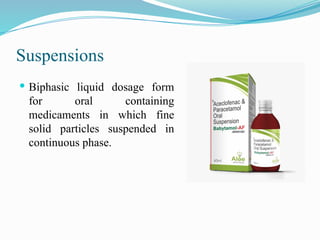
Suspensions
 Biphasic liquid dosage form
for oral containing
medicaments in which fine
solid particles suspended in
continuous phase.
Thank
You

Introduction to dosage forms (Solid, Semi-solid, Liquid)

  • 1.
    Introduction to dosageform By Rupa Devi Assistant Professor Department of pharmaceutics Global Research Institute of Pharmacy, Nachraun, Radaur, Yamunanagar
  • 2.
    Contents  Introduction  Classificationof dosage forms Solid dosage forms Semisolid dosage forms Liquid dosage forms
  • 3.
    Dosage form • Adosage form can be defined as the physical form of a dose of a chemical compound used as a drug or medication intended for administration or consumption. OR • Pharmaceutical dosage form can be defined as a physical form of a drug such as a solid, liquid or gas by which it can be delivered in proper form to particular sites within the body.
  • 4.
    Importance of DosageForms  To provide a safe and convenient delivery of accurate dosage.  To protect the drug substance from oxidation, hydrolysis and reduction.  To protect the drugs from the destructive effect of gastric juice(Hydrochloric acid) of the stomach after oral administration e.g. enteric coated tablets.  To conceal the bitter, salty or obnoxious taste or odour of a drug substance e.g. capsules, coated tablets.  To provide for the optimum drug action through inhalation therapy e.g. inhalation aerosols and inhalants.
  • 5.
    Ideal properties ofa dosage form  Its handling , usage, and storage should be easy.  It should not affect the lifestyle of a patient.  It should be aesthetically, organoleptically and therapeutically acceptable.  It should be able to endure the mechanical shock during transportation.  It should maintain its stability during the shelf-life (storage) and use.  It should provide protection to the drug and mask the unpleasant taste or odour.  It should have a pleasant appearance.
  • 6.
    Classification of DosageForms  Dosage forms may be classified on the basis of physiacl form of the final product which are : Solid dosage form Liquid dosage form Semi-solid dosage form
  • 8.
    Solid dosage forms Thesolid dosage forms are available mostly in unit dosage forms (consisting of doses which are taken by numbers) such as tablets, capsules, pills, cachets or powders. Dusting Powders: • These are meant for external application to the skin and are generally applied in a very fine state of subdivision to avoid local irritation. • Passed through sieve no. 80 to enhance their effectiveness.
  • 9.
    Types of DustingPowders  Dusting powders are of two types: Medical Surgical Medical dusting powders: are used mainly for superficial skin conditions. Surgical dusting powders: are used in body cavities and also on major wounds as a result of burns and umbilical cords of infants.
  • 10.
    Insufflations • These aremedicated dusting powders meant for introduction into the body cavities such as nose, throat, ears and vagina with the help of an apparatus known as “Insufflator”. • Sprays the powder into a stream of finely divided particles all over the site of application. • The following difficulties are generally faced while using the insufflators: • Uniform dose of the drug is not measured. • It gets blocked when it is slightly wet or the powder used is wet.
  • 11.
    Dentifrices (Tooth powders) Applied with the help of a tooth brush for cleaning the surface of the teeth.  Contain suitable detergent or soap, some abrasive substance and a suitable flavour.  Abrasive agents such as calcium sulphate, magnesium carbonate, sodium carbonate and sodium chloride are used in fine powder.
  • 12.
    Granules  Granules arefree flowing powder aggregates consisting of drugs and suitable excipients and often supplied in single dose sachets.  Some granules are placed on the tongue and swallowed with water, others are intended to be dissolved in water before taking.
  • 13.
    Effervescent granules  Theseare uncoated tablets that have acidic substances like citric and tartaric acids mixed with carbonates or bicarbonates. When put them in water, they quickly release carbon dioxide, which makes the tablet fizz.  The tablets are meant to be dissolved in water before administration
  • 14.
    Tablets  A tabletis a solid unit dosage form containing medicament or medicaments compressed to form round, oval or square shape. Uncoated or coated tablets Buccal and Sublingual tablets Effervescent tablets Chewable tablets Lozenges and Pastilles Pills
  • 15.
    Lozenges  Lozenges aresolid candies made with sugar and gum. The gum makes the lozenge firm and helps it dissolve slowly.  They are used to treat the mouth and throat, releasing medicine slowly to help with issues like indigestion or coughs.
  • 16.
    Pastilles  Pestilles aremedicated candies that slowly dissolve in your mouth.  They are softer than lozenges and are made from either glycerol and gelatin or acacia and sugar.
  • 17.
    Pills  Pills aresmall, round solid medicines made from one or more drugs mixed with inactive ingredients.  Nowadays, pills are not used very often.
  • 18.
    Capsules  Capsules aresolid medicine forms where the medicine and other ingredients are put inside a gelatin shell.  There are two types: hard gelatin capsules and soft gelatin capsules.
  • 19.
    Pharmaceutical Powders  Pharmaceuticalpowders are mixtures of very fine drug or chemical particles used for taking internally or applying externally.  These powders are usually kept dry, and the pharmacist mixes them with a liquid or other substance when needed to prepare them for use.
  • 20.
    Semi-Solid Dosage Forms Semi-solid dosage forms are medications that have a consistency between solids and liquids. They can be spread easily and are typically used for applying to the skin. Common examples include :- Ointments Cream Paste Jellies Suppositories
  • 21.
    Ointments  Ointments arethick, creamy products used on the skin or mucous membranes.  They contain medicine mixed into a base, which helps the medicine spread and stay on the skin.
  • 22.
    Creams  Creams arethick, smooth mixtures used on the skin. They are softer and lighter than ointments.  There are two types: aqueous creams, which have more water, and oily creams, which have more oil.
  • 23.
    Pastes  Pastes arethick, stiff products used on the skin.  They help protect the skin, absorb substances, and have antiseptic properties to prevent infection.
  • 24.
    Jellies  Jellies aretransparent or translucent, non-greasy, thick substances used on the skin. They can be - Medicated jellies Lubricating jellies
  • 25.
    Suppositories  Suppositories aresolid medicine shapes meant to be inserted into body openings other than the mouth.  They dissolve at body temperature and can be used in the rectum, vagina, nose, or ear.
  • 26.
    Liquid Dosage Forms Liquid dosage forms are medicines in a liquid state that can be taken by mouth, applied to the skin, or used in other ways.  They include solutions, suspensions and syrups. These forms are often used for their ease of use and quick absorption.  Liquid dosage forms are of two types:- Monophasic liquid dosage forms Biphasic liquid dosage forms
  • 27.
    Monophasic Liquid DosageForms  A monophasic dosage form is a type of liquid medicine where two or more ingredients are mixed together in a single, uniform phase.  An example of this is a true solution, where the ingredients are fully dissolved in the liquid.
  • 28.
    Solutions  Solutions areclear, mixed liquids used either inside or outside the body.  They have one or more active ingredients fully dissolved in a liquid.  The liquid that makes up most of the solution is called the "solvent," while the ingredient in smaller amounts is called the "solute."
  • 29.
    Syrups  Syrups arethick, sweet liquids that contain 60% to 85% sugar, and they may also have flavors and medicine in them.  For example, there are syrups with medicines like chlorpheniramine maleate or chloral hydrate.  They can be either flavored or have added medication.
  • 30.
    Mixture  This isa liquid medicine taken by mouth, where the medicine is mixed into a liquid.  It’s usually not used for a long time and is prescribed for short-term issues like cough, indigestion, diarrhea, or constipation.
  • 31.
    Elixirs  Elixirs areclear, sweet, and flavored liquid medicines that can be taken by mouth.  They may or may not contain medicine, like dexamethasone elixir. They usually have a lot of alcohol or sugar and include preservatives to keep them stable.
  • 32.
    Linctuses  Linctuses arethick, liquid medicines taken by mouth to help with coughing, like Codeine Linctus.  They have ingredients that soothe, calm, and help clear mucus from the throat.  You usually take a small amount (about 5ml) and should sip and swallow it slowly without mixing it with anything else to get the best effect.
  • 33.
    Lotions  Lotions areliquid products applied to the skin without rubbing.  They are used to cool, soothe, or protect the skin.  There are two types: aqueous (water-based) and non-aqueous (alcohol-based).  Lotions can be used for cleansing, moisturizing, or killing germs.
  • 34.
    Liniments  Liniments areliquid medicines applied to the skin with rubbing.  They come in alcohol-based or oily forms and can also be emulsions.  They are used for pain relief, to increase blood flow, soothe, or create a mild irritation to help with various issues.
  • 35.
    Gargles  Gargles areliquid solutions used to help prevent or treat throat infections.  They come as a concentrate and need to be mixed with warm water before using.
  • 36.
    Mouth washes  Theseare liquid solutions with a nice taste and smell, used to clean and freshen up the mouth.  They often contain antibacterial agents, alcohol, glycerin, sweeteners, flavors, and colors.
  • 37.
    Throat paints  Throatpaints are thick liquids used to treat mouth and throat infections.  They stick to the mucous membranes for a long time and usually use glycerin as the main ingredient.
  • 38.
    Douches  A doucheis a medicated liquid used to rinse out body cavities like the vagina, eyes, ears, or nose.  It helps clean or remove dirt and discharge. It can come as a powder, tablet, or concentrated liquid.
  • 39.
    Ear Drops  Eardrops are liquid solutions put into the ear using a dropper.  They are used to clean the ear, soften earwax, and treat infections.
  • 40.
    Nasal Drops  Theseare liquid solutions put into the nose with a dropper.  They don't contain any oils to avoid causing lipoid pneumonia, which is a type of lung problem.
  • 41.
    Eye Drops  Eyedrops are sterile liquid medicines made for putting into the eyes. Isotonic Suitable pH
  • 42.
    Enemas  Enemas areaqueous or oily solutions or suspensions that are introduced into the rectum for cleansing, therapeutic or diagnostic purposes.
  • 43.
    Biphasic Liquid DosageForms  A biphasic liquid dosage form is a medicine that has two separate layers or phases when mixed.  One layer is usually a liquid, and the other can be a suspension or an emulsion.  You need to shake or mix it before use to combine the two phases.
  • 44.
    Emulsions  Biphasic liquiddosage form for oral containing medicaments in which fine oil globules dispersed in continuous phase.  There are two types:  O/W (Oil-in-Water) Emulsions: Oil drops are mixed in water.  W/O (Water-in-Oil) Emulsions: Water drops are mixed in oil.
  • 45.
    Suspensions  Biphasic liquiddosage form for oral containing medicaments in which fine solid particles suspended in continuous phase.
  • 46.