CHAPTER 1
THE PROBLEM AND
ITS BACKGROUND
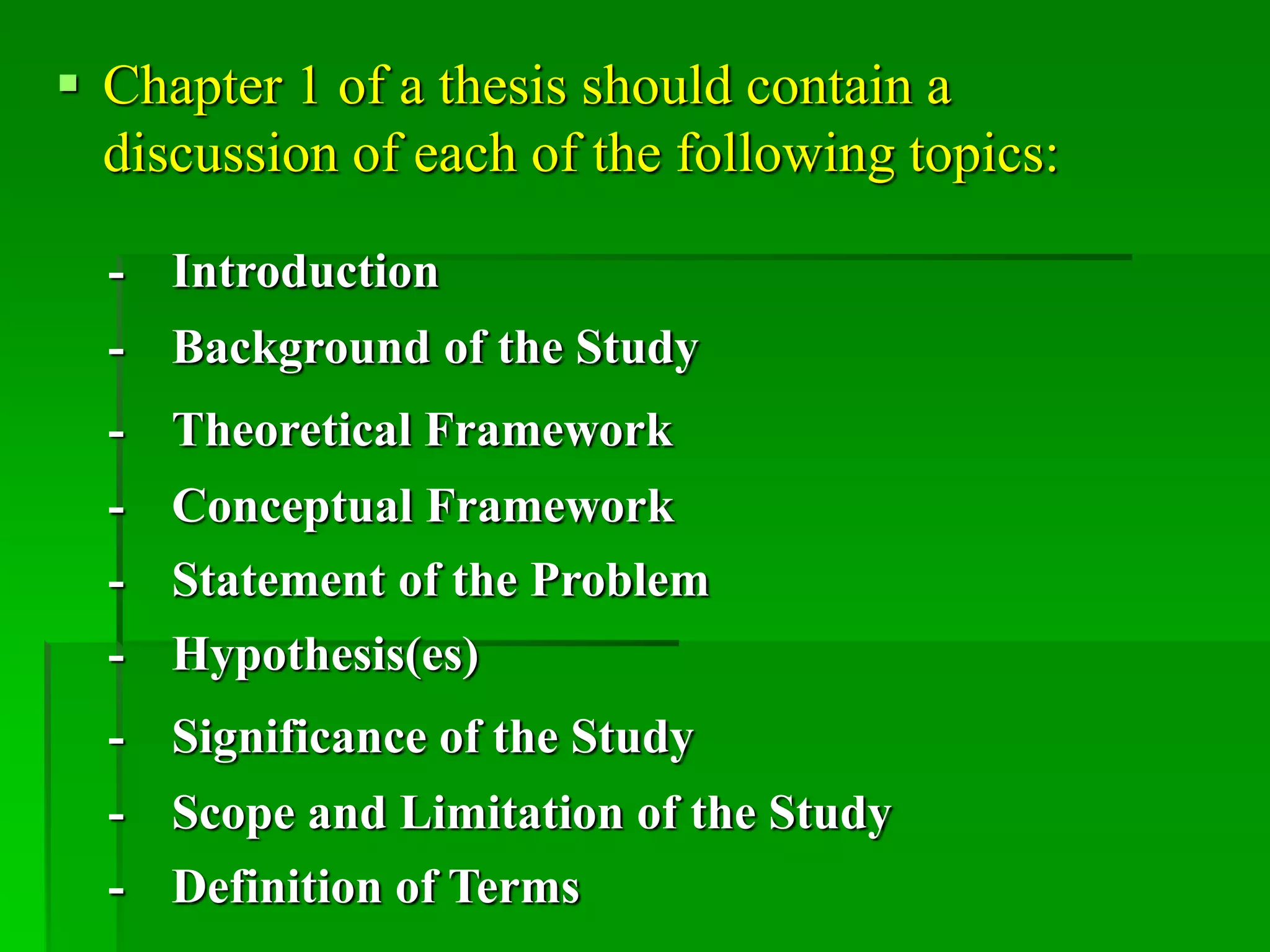
 Chapter 1 of a thesis should contain a
discussion of each of the following topics:
- Introduction
- Background of the Study
- Theoretical Framework
- Conceptual Framework
- Statement of the Problem
- Hypothesis(es)
- Significance of the Study
- Scope and Limitation of the Study
- Definition of Terms
Introduction
 The introduction should give information
as to what the study is all about.
 It should show the existence of an
unsatisfactory condition, a felt problem
that needs a solution. That is, the reason
or reasons why it is necessary to conduct
the study must be discussed.
 The introduction should be linked to the
statement of the problem.
Background of the Study
 This section should discuss the historical
background of the problem.
 It must explain the students’ earnest desire
to have a deeper and clearer understanding
of a situation so they will be in a better
position to initiate remedial measures or to
find a better way to improve the situation.
 The geographical conditions of the study
locale may also be discussed in this
section.
Theoretical Framework
 This section should present the different
theories, models, paradigms, perspectives
related to the variables, problem statement
and hypothesis of the present study.
 The students should test, confirm, validate,
or verify the cited theories in other
situations or attempt to formulate a new
theory which will be their contribution to
their field of specialization.
Conceptual Framework
 The conceptual framework should be
anchored on the theoretical framework.
That is, the conceptual and theoretical
frameworks should be consistent and
related.
 It should present in detail the variables to
be observed in the current study, the
concepts defined, the operationalization of
the variable-concepts, and the scheme of
measuring the variables.
 A paradigm of the study showing a
diagrammatic representation of the
conceptual framework should be included
in this section. It should depict in a more
vivid way what the conceptual framework
wants to convey.
Statement of the Problem
 The problem should be stated both in
general and in specific terms. The general
statement of the problem is usually a
reiteration of the title of the study.
 The problem should be stated in the
infinitive to such as examine, analyze,
determine, measure, assess, evaluate, or
find out.
 Specific questions should be stated using
the guide question words: “How,” “Will,”
“What,” “Is there,” etc.
Hypothesis(es)
 Hypotheses should be stated in the null
form.
 They should be formulated from the
specific questions upon which they are
based.
Significance of the Study
 The candidate should explain or discuss
in this section the rationale, timeliness
and/or relevance of the study to existing
conditions.
 This section must show who are the
individuals, groups, or communities who
may benefit on account of the study.
 The candidate should point out the
possible contribution(s) of the study to
the fund of knowledge.
 It should discuss the implications,
including the possible causes of the
problems discovered, the positive effects
of the problems, and the remedial
measures to solve the problem.
Scope and Limitation
 The students should identify the
boundaries or coverage of their study in
terms of the subjects, the study area, the
research instrument, the time frame, the
population or universe, and the issues to
which the study is focused.
 The students should also define the
constraints or weaknesses which are not
within their control and hence are not
covered by the study.
Definition of Terms
 This section should include important or
key terms that should be substantially
and clearly defined according to how they
are used in the study in order to facilitate
understanding of the problem and avoid
ambiguous meaning to terms which can
be otherwise interpreted in different
ways.
 The researcher should defined only what is
absolutely necessary. Only terms, word, or
phrases which have special or unique
meanings in the study should be defined.
 Terms may be defined operationally, that is,
based on observable characteristics and how
they are used in the study; or, conceptually,
that is, based on definitions taken from
encyclopedias, books, magazines and
newspaper articles, dictionaries, and other
publications. Definitions taken from
publications should be acknowledged.
 The terms defined should be arranged in
alphabetical order and acronyms should
always be spelled out fully, especially if it
is not commonly known or if used for the
first time.

Thesis Writing Chapter 1

  • 1.
    CHAPTER 1 THE PROBLEMAND ITS BACKGROUND
  • 2.
     Chapter 1of a thesis should contain a discussion of each of the following topics: - Introduction - Background of the Study - Theoretical Framework - Conceptual Framework - Statement of the Problem - Hypothesis(es) - Significance of the Study - Scope and Limitation of the Study - Definition of Terms
  • 3.
    Introduction  The introductionshould give information as to what the study is all about.  It should show the existence of an unsatisfactory condition, a felt problem that needs a solution. That is, the reason or reasons why it is necessary to conduct the study must be discussed.  The introduction should be linked to the statement of the problem.
  • 4.
    Background of theStudy  This section should discuss the historical background of the problem.  It must explain the students’ earnest desire to have a deeper and clearer understanding of a situation so they will be in a better position to initiate remedial measures or to find a better way to improve the situation.  The geographical conditions of the study locale may also be discussed in this section.
  • 5.
    Theoretical Framework  Thissection should present the different theories, models, paradigms, perspectives related to the variables, problem statement and hypothesis of the present study.  The students should test, confirm, validate, or verify the cited theories in other situations or attempt to formulate a new theory which will be their contribution to their field of specialization.
  • 6.
    Conceptual Framework  Theconceptual framework should be anchored on the theoretical framework. That is, the conceptual and theoretical frameworks should be consistent and related.  It should present in detail the variables to be observed in the current study, the concepts defined, the operationalization of the variable-concepts, and the scheme of measuring the variables.
  • 7.
     A paradigmof the study showing a diagrammatic representation of the conceptual framework should be included in this section. It should depict in a more vivid way what the conceptual framework wants to convey.
  • 8.
    Statement of theProblem  The problem should be stated both in general and in specific terms. The general statement of the problem is usually a reiteration of the title of the study.  The problem should be stated in the infinitive to such as examine, analyze, determine, measure, assess, evaluate, or find out.  Specific questions should be stated using the guide question words: “How,” “Will,” “What,” “Is there,” etc.
  • 9.
    Hypothesis(es)  Hypotheses shouldbe stated in the null form.  They should be formulated from the specific questions upon which they are based.
  • 10.
    Significance of theStudy  The candidate should explain or discuss in this section the rationale, timeliness and/or relevance of the study to existing conditions.  This section must show who are the individuals, groups, or communities who may benefit on account of the study.
  • 11.
     The candidateshould point out the possible contribution(s) of the study to the fund of knowledge.  It should discuss the implications, including the possible causes of the problems discovered, the positive effects of the problems, and the remedial measures to solve the problem.
  • 12.
    Scope and Limitation The students should identify the boundaries or coverage of their study in terms of the subjects, the study area, the research instrument, the time frame, the population or universe, and the issues to which the study is focused.  The students should also define the constraints or weaknesses which are not within their control and hence are not covered by the study.
  • 13.
    Definition of Terms This section should include important or key terms that should be substantially and clearly defined according to how they are used in the study in order to facilitate understanding of the problem and avoid ambiguous meaning to terms which can be otherwise interpreted in different ways.
  • 14.
     The researchershould defined only what is absolutely necessary. Only terms, word, or phrases which have special or unique meanings in the study should be defined.  Terms may be defined operationally, that is, based on observable characteristics and how they are used in the study; or, conceptually, that is, based on definitions taken from encyclopedias, books, magazines and newspaper articles, dictionaries, and other publications. Definitions taken from publications should be acknowledged.
  • 15.
     The termsdefined should be arranged in alphabetical order and acronyms should always be spelled out fully, especially if it is not commonly known or if used for the first time.