Components of Chapter I
Week 3
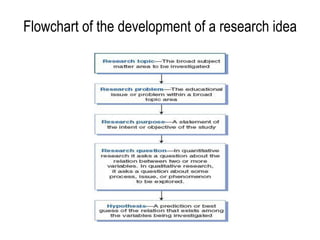
Flowchart of the development of a research idea
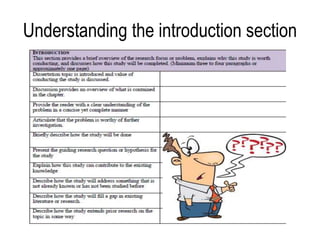
Understanding the introduction section
Background, context, and theoretical
framework
• The background, context, and theoretical framework of
the study should tell the reader what has happened in
the past to create the problem or need today.
• A brief historical overview that answers these
questions:
– What do we know?
– What created the problem?
– When did the problem begin, and for whom is it a problem?
– What research has been done?
What information you need?
• Provides necessary information to allow the reader to understand the
background of the problem and context in which the problem occurs.
• The primary objectives in writing this section are:
a) to provide a brief overview of research related to the problem;
b) to identify and describe the key components, elements, aspects, concepts
of the problem;
c) to provide the reader with an understanding of how the problem arose and
the specific context within which the problem is occurring; and
d) to briefly introduce the reader to the theoretical framework and how that
framework either supports the proposed study or provides a theoretical
context for developing the research problem.
• Background sections are five to eight paragraphs but can be longer for more
complex problems or for problems that have an extensive history of
investigation.
• The context for the study refers to the
physical setting of the research and the
natural or artificial (simulated) properties of
that setting.
• Sometimes it is referred to “experimental
conditions” or “study environment.”
• This component should introduce the theory
that will provide support and justification for
your study.
• It will be used to briefly introduce the primary
theoretical topics that will be developed in
detail in Chapter 2.
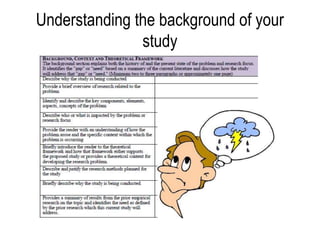
Understanding the background of your
study
Purpose of the theoretic framework
• To tie the dissertation together
• As the researcher, you should approach the proposed research from a theory or
set of theories that provide the backdrop for the work (researchers use
established theory to embed their work).
• This component describes how your study relates to existing theories and
discuss how the methodology being used in the study links to those theories.
– Is the theoretical foundation strong?
– Are the theoretical sources apparent?
– Are they appropriate for the topic?
– Do they need further explanation?
• The theoretical framework describes a context to locate the intended study and
suggests why doing such a study is worthwhile.
• The theoretical framework justifies the methods you plan to use for conducting
the study and presents how this research will contribute to the body of
knowledge and/or practice.
Problem Statement
• This component must clearly states the problem or
research focus, the population affected and how the
study will contribute to solving the problem.
• A well-written problem statement begins with the big
picture of the issue (macro) and works to the small,
narrower, and more specific problem (micro).
• It must clearly communicates the significance,
magnitude, and importance of the problem and
transitions into the Purpose of the Study with a
declarative statement.
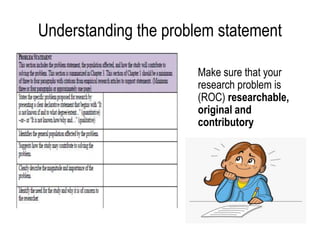
Understanding the problem statement
Make sure that your
research problem is
(ROC) researchable,
original and
contributory
Rationale for the Study
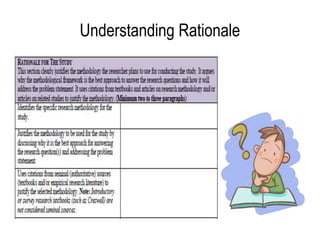
• The Rationale for the Study section of Chapter 1 clearly justifies
the methodology the researcher plans to use for conducting the
study.
• It argues how the methodological framework is the best
approach to answer the research questions and address the
problem statement.
• It contains citations from textbooks and articles on research
methodology and/or articles on related studies.
• For qualitative designs, this section states the research
question(s) the study will answer and describes the
phenomenon to be studied.
• For quantitative designs, this section describes the research
questions the study will answer, identifies the variables, and
states the hypotheses (predictive statements) using the
format appropriate for the specific design.
• Finally, this section includes a discussion of the research
questions, relating them to the problem statement.
• This section should illustrate how the methodological
framework is aligned with the problem statement and purpose
of the study, providing additional context for the study.
• Rationalizes the specific research design to answer
the research questions and why this approach was
selected.
• Why the selected design is the best design to
address the problem statement and research
questions as compared to other designs.
Understanding Rationale
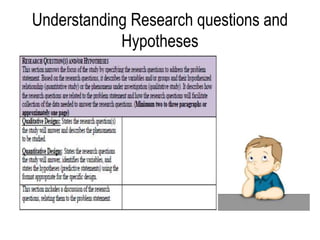
Research Question(s) and Hypotheses
• This section narrows the focus of the study and specifies the
research questions to address the problem statement.
• Based on the research questions, it describes the variables or
groups and their hypothesized relationship for a quantitative
study or the phenomena under investigation for a qualitative
study.
• The research questions and hypotheses should be derived
from, and are directly aligned with, the problem and purpose
statements, research methods, and data analyses.
• The Research Questions or Hypotheses section of Chapter 1
will be presented again in Chapter 3 to provide clear continuity
for the reader and to help frame your data analysis in Chapter 4.
• If your study is qualitative, state the research question(s) the
study will answer, and describe the phenomenon to be studied.
• Qualitative studies will typically have one overarching research
question with three or more sub-questions.
• If your study is quantitative, state the research questions the
study will answer, identify the variables, and state the
hypotheses (predictive statements) using the format appropriate
for the specific design.
• Quantitative studies will typically have three or four research
questions and associated hypotheses; mixed method studies
can use both depending on the design.
• Provide a paragraph prior to listing the research
questions or hypotheses, include a discussion of
the research questions, relating them to the
problem statement.
• Include a leading phrase to introduce the questions
such as: The following research questions guide
this qualitative study:
Understanding Research questions and
Hypotheses
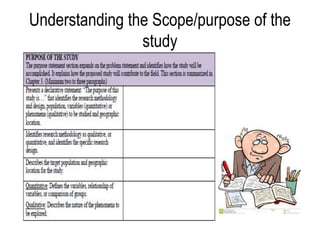
Scope of the Study
• This section provides a reflection of the problem statement and identifies
how the study will be accomplished.
• It explains how the proposed study will contribute to the field.
• The section begins with a declarative statement, “The purpose of this
study is…. .” Included in this statement are the research design,
population, variables (quantitative) or phenomena (qualitative) to be
studied, and the geographic location.
• Clearly defines the dependent and independent variables, relationship of
variables, or comparison of groups for quantitative studies.
• For qualitative studies, this section describes the nature of the
phenomena to be explored.
• Keep in mind that the purpose of the study is restated in other chapters
of the dissertation and should be worded exactly as presented in this
section of Chapter 1.
Understanding the Scope/purpose of the
study
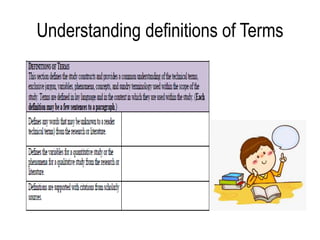
Definition of Terms
• The Definition of Terms defines the study constructs and
provides a common understanding of the technical terms,
exclusive jargon, variables, phenomena, concepts, and
technical terminology used within the scope of the study.
• Terms are defined in lay terms and in the context in which
they are used within the study.
• Each definition may be a few sentences to a paragraph in
length.
• This section includes any words that may be unknown to a
reader(words with unusual or ambiguous meanings or
technical terms).
• Starts with a paragraph introducing this section prior to
listing the definition of terms.
• Definitions must be supported with citations from
scholarly sources.
• Do not use Wikipedia to define terms.
• Do not use dictionaries to define terms. However, a
lead-in phrase is needed to introduce the terms such
as: “The following terms were used operationally in this
study.”
• This is a section that "operationally defines” unique
phrases specific to this research.
Understanding definitions of Terms
Significance of the Study
• This component identifies and describes the
importance of the study.
• It also discusses the implications of the potential results
based on the research questions and problem
statement, hypotheses, or the investigated phenomena.
• It describes how the research fits within and will
contribute to the current literature or body of research.
• It explains the potential practical applications from the
research.
• This section is of importance because it justifies the
need for, and the relevance of, the research.
Summary and Organization of the Study
• Summarizes the key points of Chapter 1 and provides
supporting citations for those key points.
• Provides a transition discussion to Chapter 2 followed by a
description of the remaining chapters.
• For example, Chapter 2 will present a review of current
research on the centrality of the dissertation literature review in
research preparation.
• Chapter 3 will describe the methodology, research design, and
procedures for this investigation.
• Chapter 4 details how the data was analyzed and provides
both a written and graphic summary of the results.
• Chapter 5 is an interpretation and discussion of the
results, as it relates to the existing body of research
related to the dissertation topic.
• For the proposal, this section should provide a
timeline for completing the research and writing up
the dissertation.
• When the dissertation is complete, this section
should be revised to eliminate the timeline
information
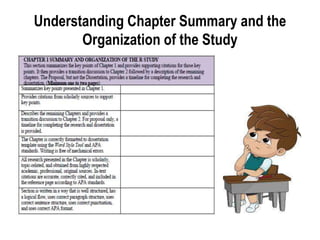
Understanding Chapter Summary and the
Organization of the Study
Further Reading
• Johnson & Christensen (2014). Educational Research:
Quantitative, qualitative and mixed-approaches (5th ed.).
Routledge, Chapter 4 &5

EG5000_Wk. 3.ppt

  • 1.
  • 2.
    Flowchart of thedevelopment of a research idea
  • 3.
  • 4.
    Background, context, andtheoretical framework • The background, context, and theoretical framework of the study should tell the reader what has happened in the past to create the problem or need today. • A brief historical overview that answers these questions: – What do we know? – What created the problem? – When did the problem begin, and for whom is it a problem? – What research has been done?
  • 5.
    What information youneed? • Provides necessary information to allow the reader to understand the background of the problem and context in which the problem occurs. • The primary objectives in writing this section are: a) to provide a brief overview of research related to the problem; b) to identify and describe the key components, elements, aspects, concepts of the problem; c) to provide the reader with an understanding of how the problem arose and the specific context within which the problem is occurring; and d) to briefly introduce the reader to the theoretical framework and how that framework either supports the proposed study or provides a theoretical context for developing the research problem. • Background sections are five to eight paragraphs but can be longer for more complex problems or for problems that have an extensive history of investigation.
  • 6.
    • The contextfor the study refers to the physical setting of the research and the natural or artificial (simulated) properties of that setting. • Sometimes it is referred to “experimental conditions” or “study environment.” • This component should introduce the theory that will provide support and justification for your study. • It will be used to briefly introduce the primary theoretical topics that will be developed in detail in Chapter 2.
  • 7.
  • 8.
    Purpose of thetheoretic framework • To tie the dissertation together • As the researcher, you should approach the proposed research from a theory or set of theories that provide the backdrop for the work (researchers use established theory to embed their work). • This component describes how your study relates to existing theories and discuss how the methodology being used in the study links to those theories. – Is the theoretical foundation strong? – Are the theoretical sources apparent? – Are they appropriate for the topic? – Do they need further explanation? • The theoretical framework describes a context to locate the intended study and suggests why doing such a study is worthwhile. • The theoretical framework justifies the methods you plan to use for conducting the study and presents how this research will contribute to the body of knowledge and/or practice.
  • 9.
    Problem Statement • Thiscomponent must clearly states the problem or research focus, the population affected and how the study will contribute to solving the problem. • A well-written problem statement begins with the big picture of the issue (macro) and works to the small, narrower, and more specific problem (micro). • It must clearly communicates the significance, magnitude, and importance of the problem and transitions into the Purpose of the Study with a declarative statement.
  • 10.
    Understanding the problemstatement Make sure that your research problem is (ROC) researchable, original and contributory
  • 11.
    Rationale for theStudy • The Rationale for the Study section of Chapter 1 clearly justifies the methodology the researcher plans to use for conducting the study. • It argues how the methodological framework is the best approach to answer the research questions and address the problem statement. • It contains citations from textbooks and articles on research methodology and/or articles on related studies.
  • 12.
    • For qualitativedesigns, this section states the research question(s) the study will answer and describes the phenomenon to be studied. • For quantitative designs, this section describes the research questions the study will answer, identifies the variables, and states the hypotheses (predictive statements) using the format appropriate for the specific design. • Finally, this section includes a discussion of the research questions, relating them to the problem statement. • This section should illustrate how the methodological framework is aligned with the problem statement and purpose of the study, providing additional context for the study.
  • 13.
    • Rationalizes thespecific research design to answer the research questions and why this approach was selected. • Why the selected design is the best design to address the problem statement and research questions as compared to other designs.
  • 14.
  • 15.
    Research Question(s) andHypotheses • This section narrows the focus of the study and specifies the research questions to address the problem statement. • Based on the research questions, it describes the variables or groups and their hypothesized relationship for a quantitative study or the phenomena under investigation for a qualitative study. • The research questions and hypotheses should be derived from, and are directly aligned with, the problem and purpose statements, research methods, and data analyses. • The Research Questions or Hypotheses section of Chapter 1 will be presented again in Chapter 3 to provide clear continuity for the reader and to help frame your data analysis in Chapter 4.
  • 16.
    • If yourstudy is qualitative, state the research question(s) the study will answer, and describe the phenomenon to be studied. • Qualitative studies will typically have one overarching research question with three or more sub-questions. • If your study is quantitative, state the research questions the study will answer, identify the variables, and state the hypotheses (predictive statements) using the format appropriate for the specific design. • Quantitative studies will typically have three or four research questions and associated hypotheses; mixed method studies can use both depending on the design.
  • 17.
    • Provide aparagraph prior to listing the research questions or hypotheses, include a discussion of the research questions, relating them to the problem statement. • Include a leading phrase to introduce the questions such as: The following research questions guide this qualitative study:
  • 18.
  • 19.
    Scope of theStudy • This section provides a reflection of the problem statement and identifies how the study will be accomplished. • It explains how the proposed study will contribute to the field. • The section begins with a declarative statement, “The purpose of this study is…. .” Included in this statement are the research design, population, variables (quantitative) or phenomena (qualitative) to be studied, and the geographic location. • Clearly defines the dependent and independent variables, relationship of variables, or comparison of groups for quantitative studies. • For qualitative studies, this section describes the nature of the phenomena to be explored. • Keep in mind that the purpose of the study is restated in other chapters of the dissertation and should be worded exactly as presented in this section of Chapter 1.
  • 20.
  • 21.
    Definition of Terms •The Definition of Terms defines the study constructs and provides a common understanding of the technical terms, exclusive jargon, variables, phenomena, concepts, and technical terminology used within the scope of the study. • Terms are defined in lay terms and in the context in which they are used within the study. • Each definition may be a few sentences to a paragraph in length. • This section includes any words that may be unknown to a reader(words with unusual or ambiguous meanings or technical terms).
  • 22.
    • Starts witha paragraph introducing this section prior to listing the definition of terms. • Definitions must be supported with citations from scholarly sources. • Do not use Wikipedia to define terms. • Do not use dictionaries to define terms. However, a lead-in phrase is needed to introduce the terms such as: “The following terms were used operationally in this study.” • This is a section that "operationally defines” unique phrases specific to this research.
  • 23.
  • 24.
    Significance of theStudy • This component identifies and describes the importance of the study. • It also discusses the implications of the potential results based on the research questions and problem statement, hypotheses, or the investigated phenomena. • It describes how the research fits within and will contribute to the current literature or body of research. • It explains the potential practical applications from the research. • This section is of importance because it justifies the need for, and the relevance of, the research.
  • 25.
    Summary and Organizationof the Study • Summarizes the key points of Chapter 1 and provides supporting citations for those key points. • Provides a transition discussion to Chapter 2 followed by a description of the remaining chapters. • For example, Chapter 2 will present a review of current research on the centrality of the dissertation literature review in research preparation. • Chapter 3 will describe the methodology, research design, and procedures for this investigation. • Chapter 4 details how the data was analyzed and provides both a written and graphic summary of the results.
  • 26.
    • Chapter 5is an interpretation and discussion of the results, as it relates to the existing body of research related to the dissertation topic. • For the proposal, this section should provide a timeline for completing the research and writing up the dissertation. • When the dissertation is complete, this section should be revised to eliminate the timeline information
  • 27.
    Understanding Chapter Summaryand the Organization of the Study
  • 28.
    Further Reading • Johnson& Christensen (2014). Educational Research: Quantitative, qualitative and mixed-approaches (5th ed.). Routledge, Chapter 4 &5