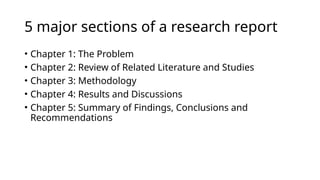
5 major sectionsof a research report
• Chapter 1: The Problem
• Chapter 2: Review of Related Literature and Studies
• Chapter 3: Methodology
• Chapter 4: Results and Discussions
• Chapter 5: Summary of Findings, Conclusions and
Recommendations
3.
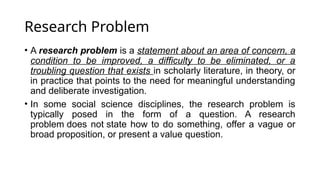
Research Problem
• Aresearch problem is a statement about an area of concern, a
condition to be improved, a difficulty to be eliminated, or a
troubling question that exists in scholarly literature, in theory, or
in practice that points to the need for meaningful understanding
and deliberate investigation.
• In some social science disciplines, the research problem is
typically posed in the form of a question. A research
problem does not state how to do something, offer a vague or
broad proposition, or present a value question.
4.
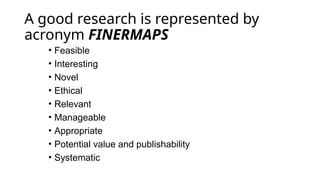
A good researchis represented by
acronym FINERMAPS
• Feasible
• Interesting
• Novel
• Ethical
• Relevant
• Manageable
• Appropriate
• Potential value and publishability
• Systematic
7.
Research Questions
• Aresearch question is a question that a study or research
project, through its thesis statement, aims to answer.
• This question often addresses an issue or a problem, which,
through analysis and interpretation of data, is answered in the
study’s conclusion.
• In most studies, the research question is written so that it
outlines various aspects of the study, including the population
and variables to be studied and the problem the study
addresses.
8.
Purpose Statement
• Athesis statement is a sentence that makes an assertion about
a topic and predicts how the topic will be developed. It does not
simply announce a topic: it says something about the topic.
• A thesis statement makes a promise to the reader about the
scope, purpose, and direction of the paper. It summarizes the
conclusions that the writer has reached about the topic.
• A purpose statement announces the purpose, scope, and
direction of the paper. It tells the reader what to expect in a
paper and what the specific focus will be.
9.
Purpose Statement
• Apurpose statement makes a promise to the reader about the
development of the argument but does not preview the
particular conclusions that the writer has drawn.
• A purpose statement is specific enough to satisfy the
requirements of the assignment. Purpose statements are
common in research papers.
10.
Purpose Statement
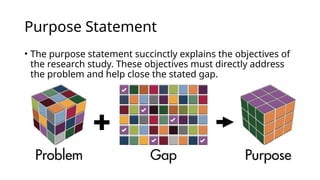
• Thepurpose statement succinctly explains the objectives of
the research study. These objectives must directly address
the problem and help close the stated gap.
11.
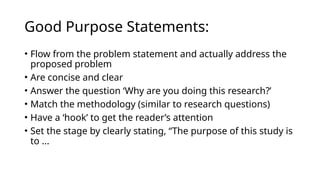
Good Purpose Statements:
•Flow from the problem statement and actually address the
proposed problem
• Are concise and clear
• Answer the question ‘Why are you doing this research?’
• Match the methodology (similar to research questions)
• Have a ‘hook’ to get the reader’s attention
• Set the stage by clearly stating, “The purpose of this study is
to ...
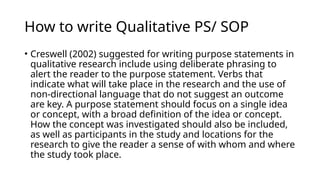
13.
How to writeQualitative PS/ SOP
• Creswell (2002) suggested for writing purpose statements in
qualitative research include using deliberate phrasing to
alert the reader to the purpose statement. Verbs that
indicate what will take place in the research and the use of
non-directional language that do not suggest an outcome
are key. A purpose statement should focus on a single idea
or concept, with a broad definition of the idea or concept.
How the concept was investigated should also be included,
as well as participants in the study and locations for the
research to give the reader a sense of with whom and where
the study took place.
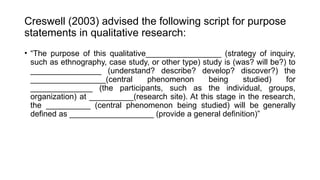
14.
Creswell (2003) advisedthe following script for purpose
statements in qualitative research:
• “The purpose of this qualitative_________________ (strategy of inquiry,
such as ethnography, case study, or other type) study is (was? will be?) to
________________ (understand? describe? develop? discover?) the
_________________(central phenomenon being studied) for
______________ (the participants, such as the individual, groups,
organization) at __________(research site). At this stage in the research,
the __________ (central phenomenon being studied) will be generally
defined as ___________________ (provide a general definition)”
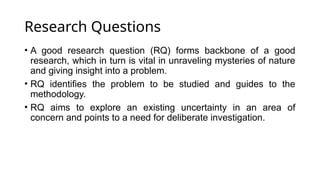
Research Questions
• Agood research question (RQ) forms backbone of a good
research, which in turn is vital in unraveling mysteries of nature
and giving insight into a problem.
• RQ identifies the problem to be studied and guides to the
methodology.
• RQ aims to explore an existing uncertainty in an area of
concern and points to a need for deliberate investigation.
17.
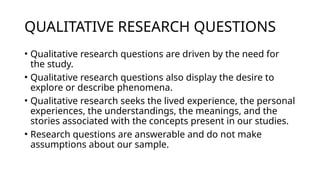
QUALITATIVE RESEARCH QUESTIONS
•Qualitative research questions are driven by the need for
the study.
• Qualitative research questions also display the desire to
explore or describe phenomena.
• Qualitative research seeks the lived experience, the personal
experiences, the understandings, the meanings, and the
stories associated with the concepts present in our studies.
• Research questions are answerable and do not make
assumptions about our sample.
18.
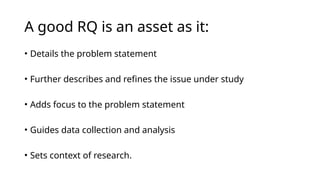
A good RQis an asset as it:
• Details the problem statement
• Further describes and refines the issue under study
• Adds focus to the problem statement
• Guides data collection and analysis
• Sets context of research.
19.
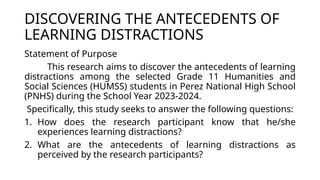
DISCOVERING THE ANTECEDENTSOF
LEARNING DISTRACTIONS
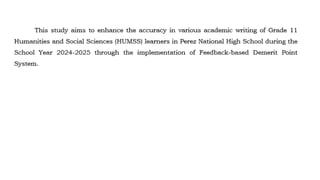
Statement of Purpose
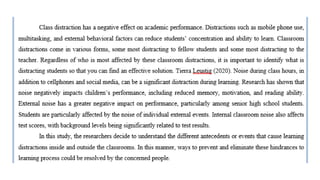
This research aims to discover the antecedents of learning
distractions among the selected Grade 11 Humanities and
Social Sciences (HUMSS) students in Perez National High School
(PNHS) during the School Year 2023-2024.
Specifically, this study seeks to answer the following questions:
1. How does the research participant know that he/she
experiences learning distractions?
2. What are the antecedents of learning distractions as
perceived by the research participants?
Theoretical Framework
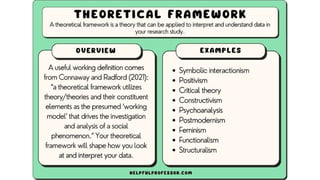
• Atheoretical framework (also sometimes referred to as a
foundation of theory) is essentially a set of concepts,
definitions, and propositions that together form a
structured, comprehensive view of a specific phenomenon.
• In other words, a theoretical framework is a collection of
existing theories, models and frameworks that provides a
foundation of core knowledge – a “lay of the land”, so to
speak, from which you can build a research study.
22.
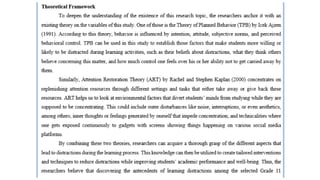
• First Paragraph:everything about the theory (the
proponent, the key take away or main belief of the theory,
elements and other important or related concepts which
you think are necessary to discuss) 5-7 sentences.
• Second paragraph: How does the theory guide the present
study? In terms of concepts and data analysis. 5-7
• Third paragraph: Synthesis, generalization of the connection
of the variables in the present study to the theory or model.
3-5
23.
Theoretical Framework
• Thetheoretical framework may revolve around just one major
theory, or it could comprise a collection of different interrelated
theories and models.
• The theoretical framework is the core foundation of theory
that you’ll build your research upon. It is a critical ingredient
in any study.
24.
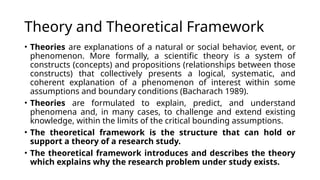
Theory and TheoreticalFramework
• Theories are explanations of a natural or social behavior, event, or
phenomenon. More formally, a scientific theory is a system of
constructs (concepts) and propositions (relationships between those
constructs) that collectively presents a logical, systematic, and
coherent explanation of a phenomenon of interest within some
assumptions and boundary conditions (Bacharach 1989).
• Theories are formulated to explain, predict, and understand
phenomena and, in many cases, to challenge and extend existing
knowledge, within the limits of the critical bounding assumptions.
• The theoretical framework is the structure that can hold or
support a theory of a research study.
• The theoretical framework introduces and describes the theory
which explains why the research problem under study exists.
26.
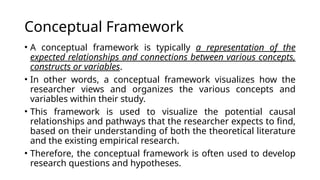
Conceptual Framework
• Aconceptual framework is typically a representation of the
expected relationships and connections between various concepts,
constructs or variables.
• In other words, a conceptual framework visualizes how the
researcher views and organizes the various concepts and
variables within their study.
• This framework is used to visualize the potential causal
relationships and pathways that the researcher expects to find,
based on their understanding of both the theoretical literature
and the existing empirical research.
• Therefore, the conceptual framework is often used to develop
research questions and hypotheses.
27.
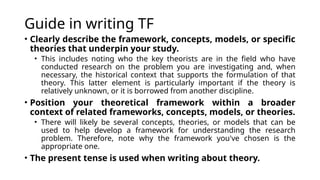
Guide in writingTF
• Clearly describe the framework, concepts, models, or specific
theories that underpin your study.
• This includes noting who the key theorists are in the field who have
conducted research on the problem you are investigating and, when
necessary, the historical context that supports the formulation of that
theory. This latter element is particularly important if the theory is
relatively unknown, or it is borrowed from another discipline.
• Position your theoretical framework within a broader
context of related frameworks, concepts, models, or theories.
• There will likely be several concepts, theories, or models that can be
used to help develop a framework for understanding the research
problem. Therefore, note why the framework you've chosen is the
appropriate one.
• The present tense is used when writing about theory.
28.
Guide in writingTF
• You should make your theoretical assumptions as
explicit as possible.
• Always note the limitations of the theoretical
framework you've chosen [i.e., what parts of the research
problem require further investigation because the theory
does not explain a certain phenomena].
30.
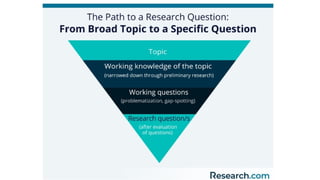
Techniques for narrowingdown a topic
into research questions
• Examine the literature
• Talk over ideas with others
• Relate the topic to a specific context
• Define the aim or desired outcome of the study


![Guide in writing TF
• You should make your theoretical assumptions as
explicit as possible.
• Always note the limitations of the theoretical
framework you've chosen [i.e., what parts of the research
problem require further investigation because the theory
does not explain a certain phenomena].](https://image.slidesharecdn.com/formulatingresearchproblemandquestions-250220195339-be6a6424/85/Formulating-Research-Problem-and-Questions-pptx-28-320.jpg)