
UV SPECTROSCOPY EMBEDDED CLOUD
SYSTEM FOR ANN-COD ANALYSIS
Kaushik Patra (kpatra@gmail.com)
For CMPE-299 under the supervision of
Dr. Hua Harry Li (hualili@yahoo.com )
Department of Computer Engineering
San Jose State University
Date: 19th March, 2013
© 2012 - SJSU
Confidential
Problem Statement
• Lack of affordable water quality analysis instrument using
spectrometry analysis with UV/Vis light spectrum (200nm –
800nm).
• Very time consuming and not adaptable to analysis
environment variability.
• Non-generic system geared towards a specific set of testing.
• Environment non-friendly process due to heavy use of
chemical re-agents.
© 2012 - SJSU
Confidential
Objectives of Study
• To conduct survey on state of the art technique for COD
content measurement in water.
• To design and implement ANN based self learning and
sustainable and adaptive computing system for better
decision making in COD analysis using spectrometry.
• To integrate ANN based COD measurement system into
the existing embedded system.
• To test and verify overall system using real water
samples from water treatment facilities.
© 2012 - SJSU
Confidential
Artificial Neural Network (ANN)
• Artificial Neural Network (ANN) is mathematical model of
problem solving based on a very simplified model of working
mechanism of neuron.
▫ Invention of Associative Network by John Joseph Hopfield in
1982 accelerated the usage of ANN in industrial application.
▫ The conception of ANN is proposed in 1943 by Warren
McCulloch, a neuropsychologist, and Walter Pitts, a logician,
from University of Chicago.
• It is an adaptive mathematical model for solving problem
where relation between input parameters and output(s) of a
function is very complex or unknown.
▫ Adaptability and machine learning are two essential
characteristics for ANN based tools.
© 2012 - SJSU
Confidential
ANN in COD analysis
• ANN has its application in very complex problem solving.
▫ Analog VLSI , Vision Chips
▫ Stock market prediction
▫ Autopilot mechanism for aircrafts
• Spectrometry based measurement of Chemical Oxygen
Demand (COD) metric is a complex problem.
▫ Mathematical relation between spectral analysis data and COD
content is complex and not completely known.
▫ ANN with three feed-forward perception layer is a good candidate
to be used to implement an adaptable and supervised
machine learning mechanism to be used for COD
determination using spectral analysis with UV/Vis light (200nm
– 800nm).
© 2012 - SJSU
Confidential
Spectroscopy in COD analysis
• Three phenomenon occurs when EM radiation falls into
water sample containing impurities.
▫ Deflection
▫ Absorption
▫ Scattering
• Different type of organic compound absorbs UV / VIS
EM radiation of different wave length.
▫ Hence COD measurement should be studied over entire spectrum
(200nm – 850nm)
© 2012 - SJSU
Confidential
Related Researches (1/3)
• Glucose concentration determination using ANN on infra-red
absorption pattern in sample solution.
▫ ‘Neural Network Based Real-Time Detection of Glucose using a Non-
chemical Optical Sensor Approach’ by Fedric M. Ham et. al. [1990]
• COD determination using UV/VIS spectrometry.
▫ ‘On-line and in-situ measurement of turbidity and COD in wastewater using
UV/VIS spectrometry’ by N. Flesichmann et. al.
▫ ‘Binary encoded 2nd-differential spectrometry using UV-Vis spectral data
and neural networks in the estimation of species type and concentration’ by
N. Benjathapanun et. al. (1997).
• Hybrid approach of water quality measurement using spectrometry and
physico-chemical sensor.
▫ Water quality monitoring using a smart sensing system by A. Charef et. al.
[2000]
© 2012 - SJSU
Confidential
Related Researches (2/3)
• A case study on pepper mill wastewater shows that analysis needs to be
done on entire spectrum of UV/VIS.
▫ ‘Monitoring of paper mill wastewater treatment plant using UV/VIS spectroscopy’
by G. Langergraber et. al. [2004]
• Fingerprinting of different bio media substances using spectroscopy on
entire range of EM wave.
▫ ‘Spectral analysis and finger printing for biomedia characterization’ by M. Pons et.
al. [2004]
• Using wireless network for water quality monitoring.
▫ ‘Water Quality Monitoring System Using Zigbee Based Wireless Sensor Network’
by Z. Rasin and Md. R. Abdullah [2006]
© 2012 - SJSU
Confidential
Related Researches (3/3)
• Statistical feature extraction to reduce ANN input to a manageable amount
for spectroscopy analysis for COD.
▫ ‘Estimation of chemical oxygen demand by ultraviolate spectroscopic profiling
and artificial neural network’ by S. Fogelman et. al. [2006]
• Remote monitoring of water quality using GPRS.
▫ ‘The Design on Multi-Parameter Online Monitoring System of Water Quality
Based on GPRS’ by Q. Tie-Zhu and S. Le [2010]
• Using ANN and GA for COD measurement.
▫ ‘Hybrid artificial neural network genetic algorithm technique for modeling
chemical oxygen demand removal in anoxic / oxic process’ by Y. Ma et. al. [2011]
© 2012 - SJSU
Confidential
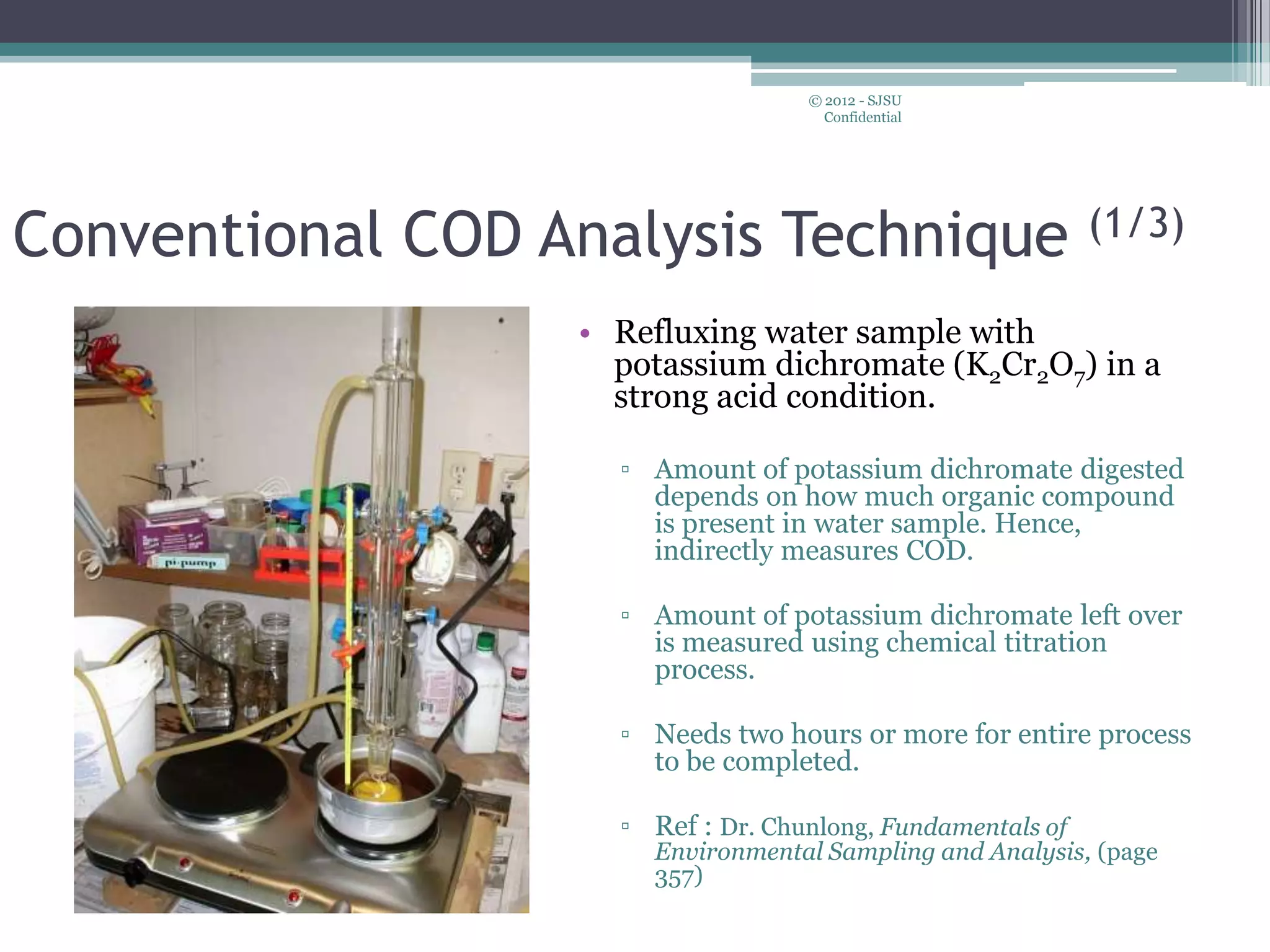
Conventional COD Analysis Technique (1/3)
• Refluxing water sample with
potassium dichromate (K2Cr2O7) in a
strong acid condition.
▫ Amount of potassium dichromate digested
depends on how much organic compound
is present in water sample. Hence,
indirectly measures COD.
▫ Amount of potassium dichromate left over
is measured using chemical titration
process.
▫ Needs two hours or more for entire process
to be completed.
▫ Ref : Dr. Chunlong, Fundamentals of
Environmental Sampling and Analysis, (page
357)
© 2012 - SJSU
Confidential
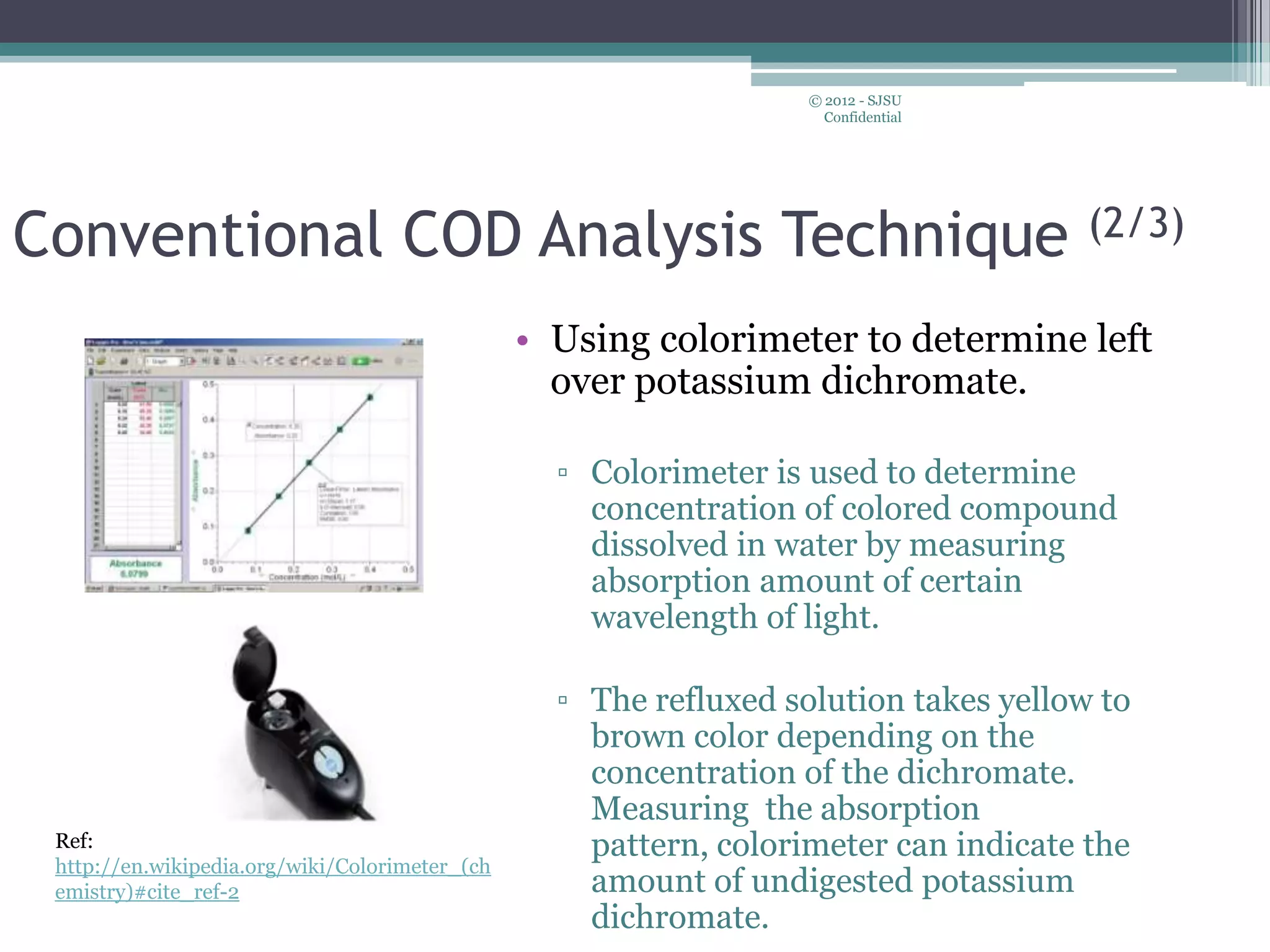
• Using colorimeter to determine left
over potassium dichromate.
▫ Colorimeter is used to determine
concentration of colored compound
dissolved in water by measuring
absorption amount of certain
wavelength of light.
▫ The refluxed solution takes yellow to
brown color depending on the
concentration of the dichromate.
Measuring the absorption
pattern, colorimeter can indicate the
amount of undigested potassium
dichromate.
© 2012 - SJSU
Confidential
Conventional COD Analysis Technique (2/3)
Ref:
http://en.wikipedia.org/wiki/Colorimeter_(ch
emistry)#cite_ref-2
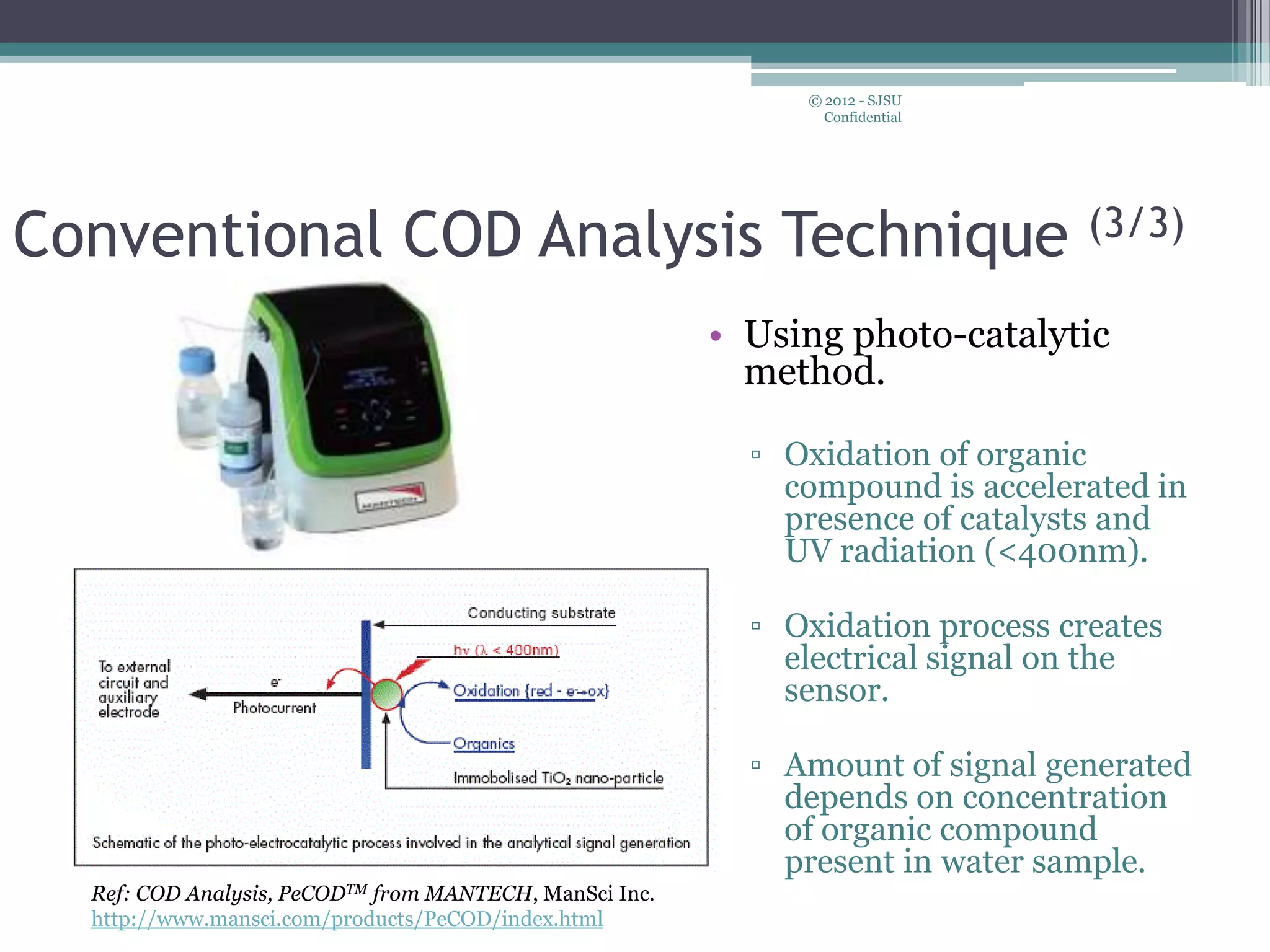
• Using photo-catalytic
method.
▫ Oxidation of organic
compound is accelerated in
presence of catalysts and
UV radiation (<400nm).
▫ Oxidation process creates
electrical signal on the
sensor.
▫ Amount of signal generated
depends on concentration
of organic compound
present in water sample.
© 2012 - SJSU
Confidential
Conventional COD Analysis Technique (3/3)
Ref: COD Analysis, PeCODTM from MANTECH, ManSci Inc.
http://www.mansci.com/products/PeCOD/index.html
Uniqueness of this Research
1. An unique methodology of COD identification in water
sample using ANN photometry data analysis technique.
2. A mobile embedded hardware system integrated with
portable photometer and connected to cloud
infrastructure.
3. A software application system to utilize implemented
cloud enabled mobile hardware system
1) System to both train and utilize ANN for COD analysis.
2) In-situ upgrade of ANN by incremental training.
© 2012 - SJSU
Confidential
Overall System Architecture
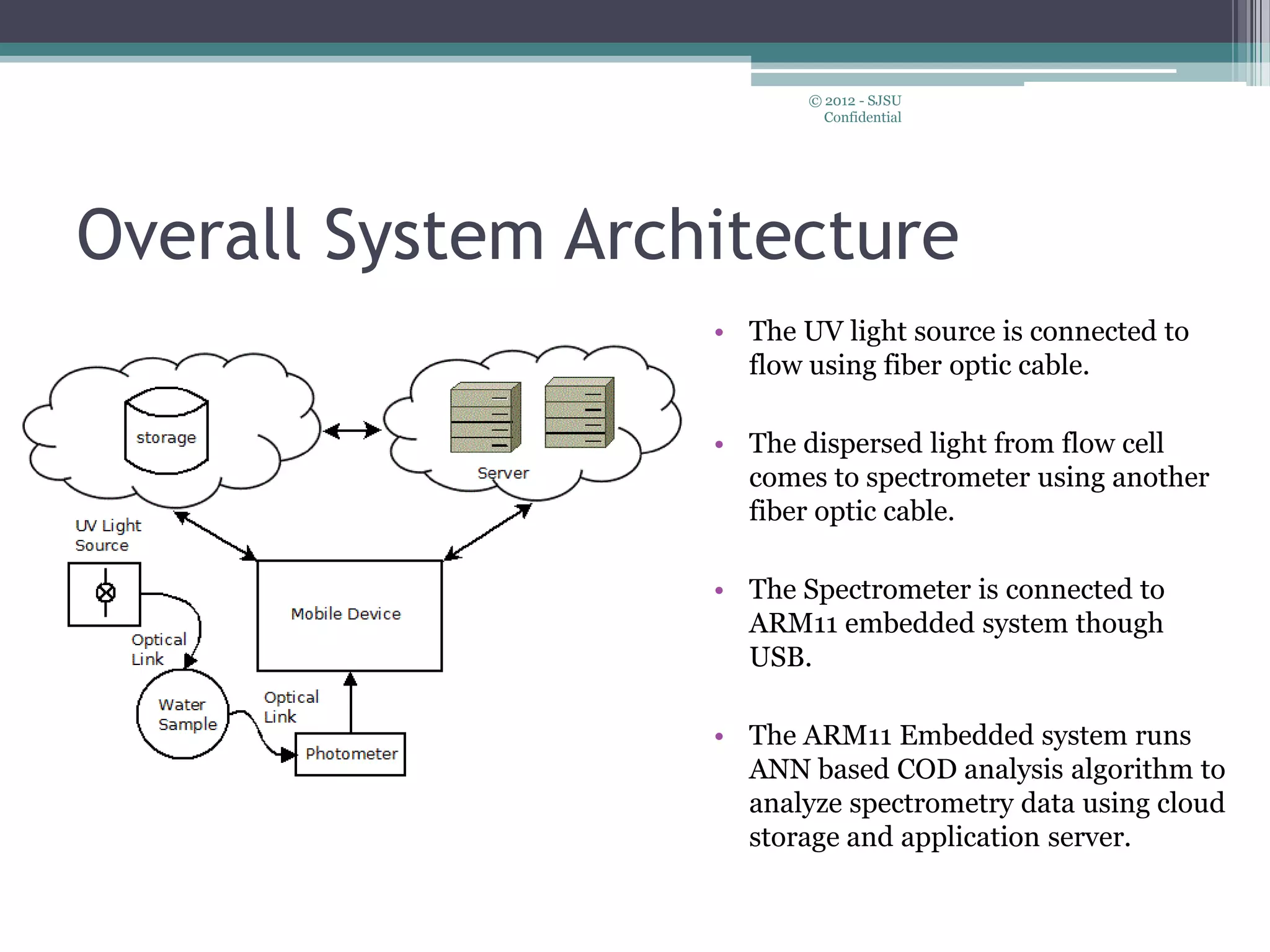
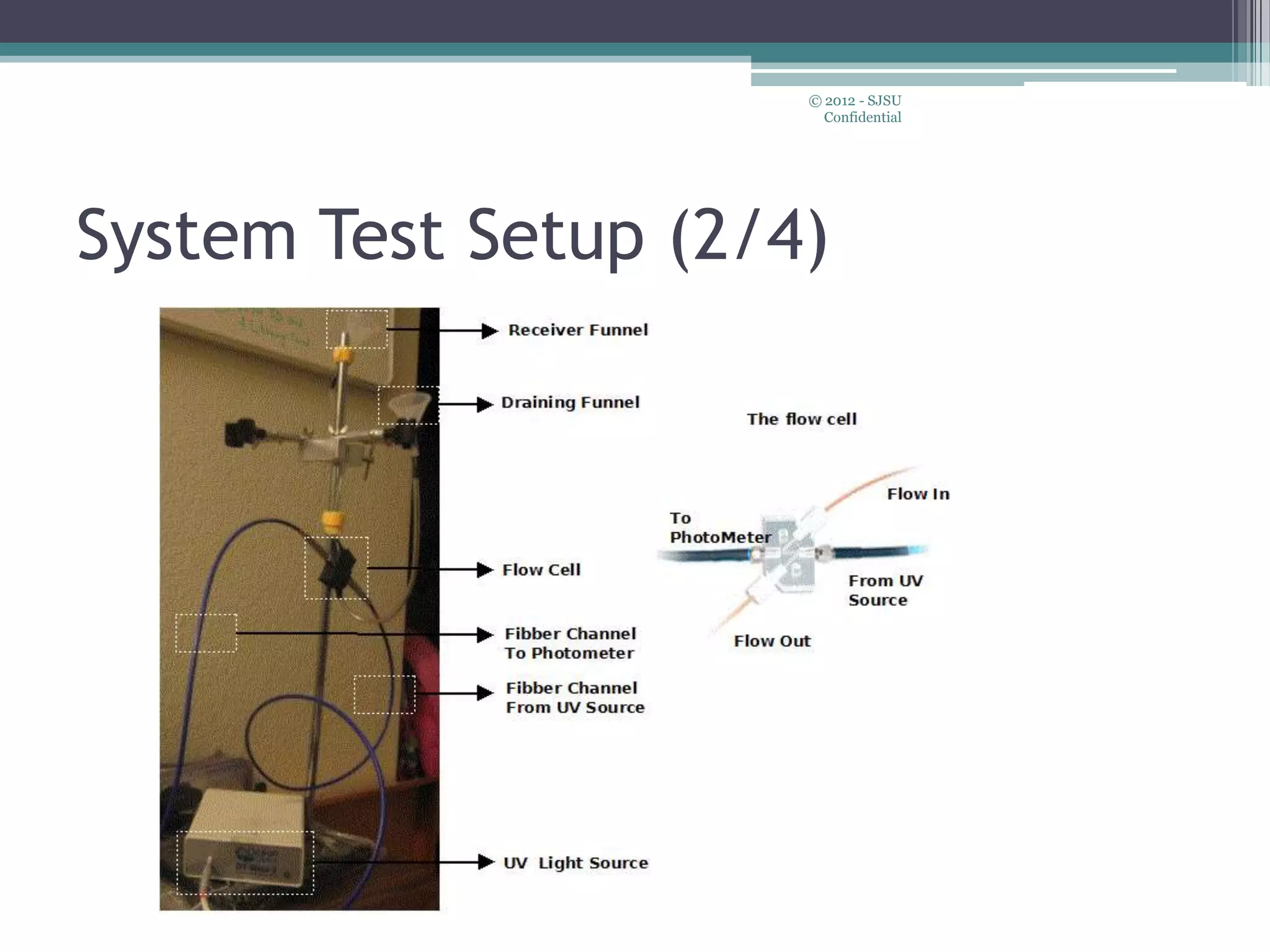
• The UV light source is connected to
flow using fiber optic cable.
• The dispersed light from flow cell
comes to spectrometer using another
fiber optic cable.
• The Spectrometer is connected to
ARM11 embedded system though
USB.
• The ARM11 Embedded system runs
ANN based COD analysis algorithm to
analyze spectrometry data using cloud
storage and application server.
© 2012 - SJSU
Confidential
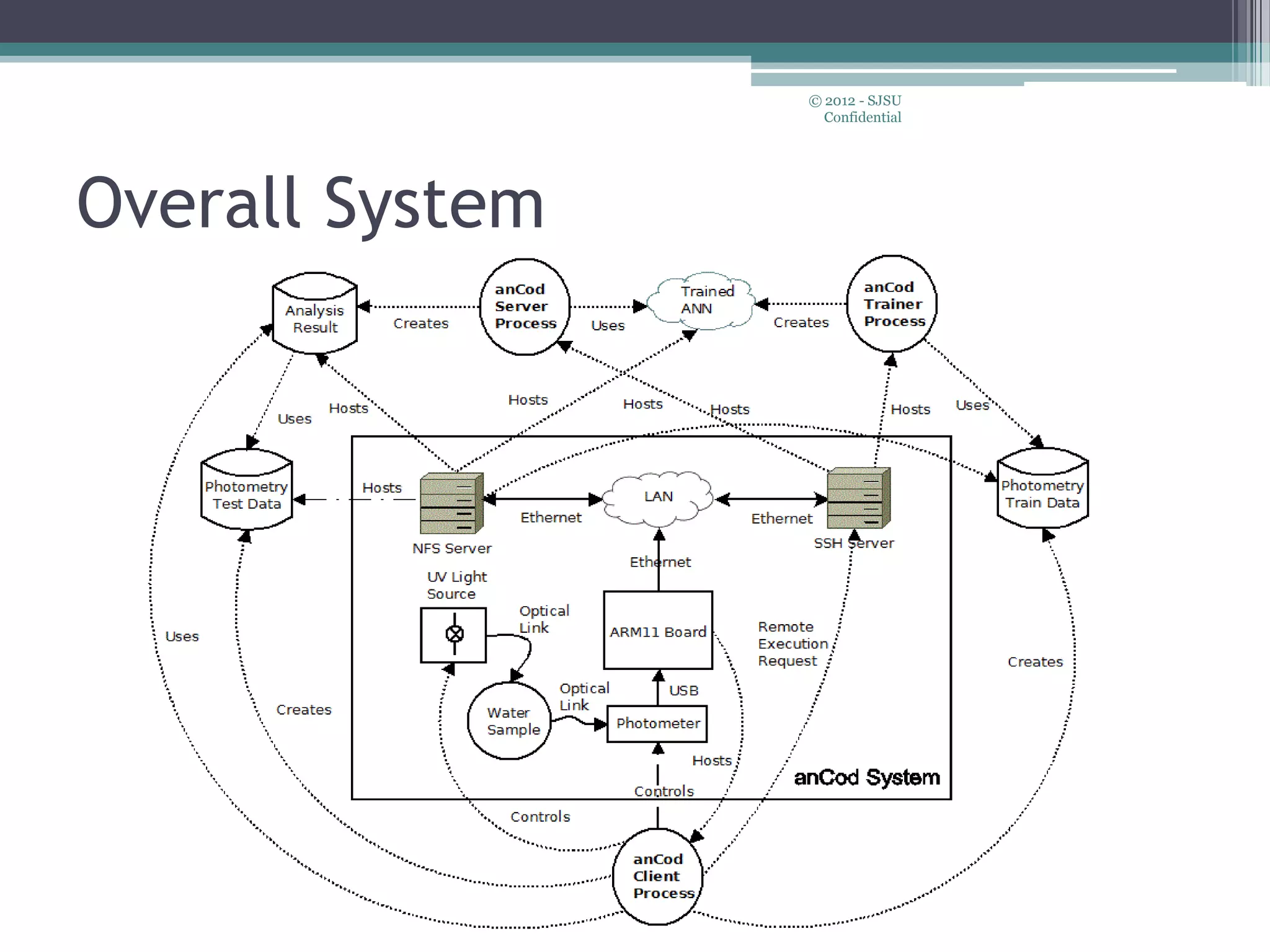
Overall System
© 2012 - SJSU
Confidential
Design of COD Detection Technique
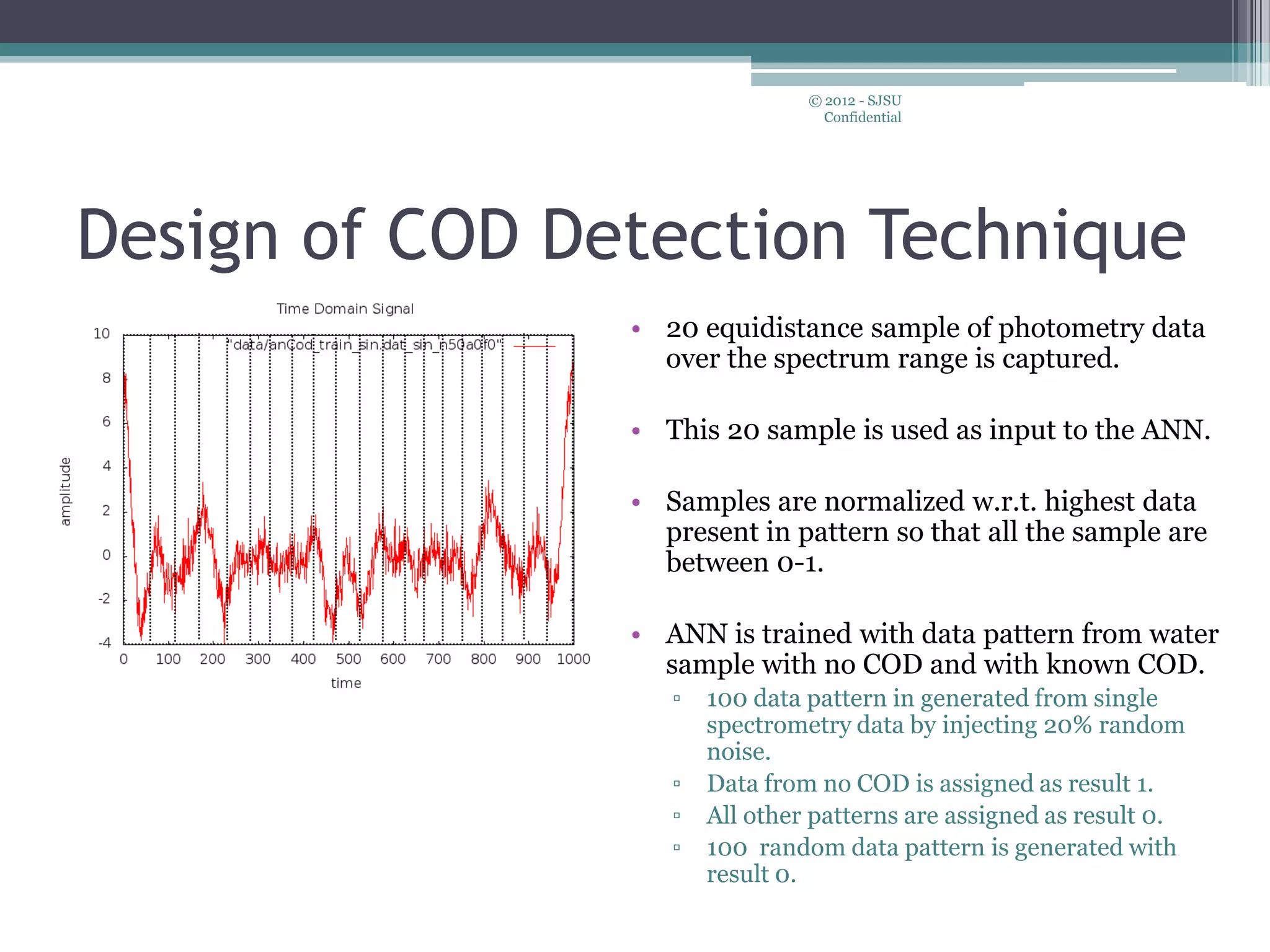
• 20 equidistance sample of photometry data
over the spectrum range is captured.
• This 20 sample is used as input to the ANN.
• Samples are normalized w.r.t. highest data
present in pattern so that all the sample are
between 0-1.
• ANN is trained with data pattern from water
sample with no COD and with known COD.
▫ 100 data pattern in generated from single
spectrometry data by injecting 20% random
noise.
▫ Data from no COD is assigned as result 1.
▫ All other patterns are assigned as result 0.
▫ 100 random data pattern is generated with
result 0.
© 2012 - SJSU
Confidential
ANN Architecture
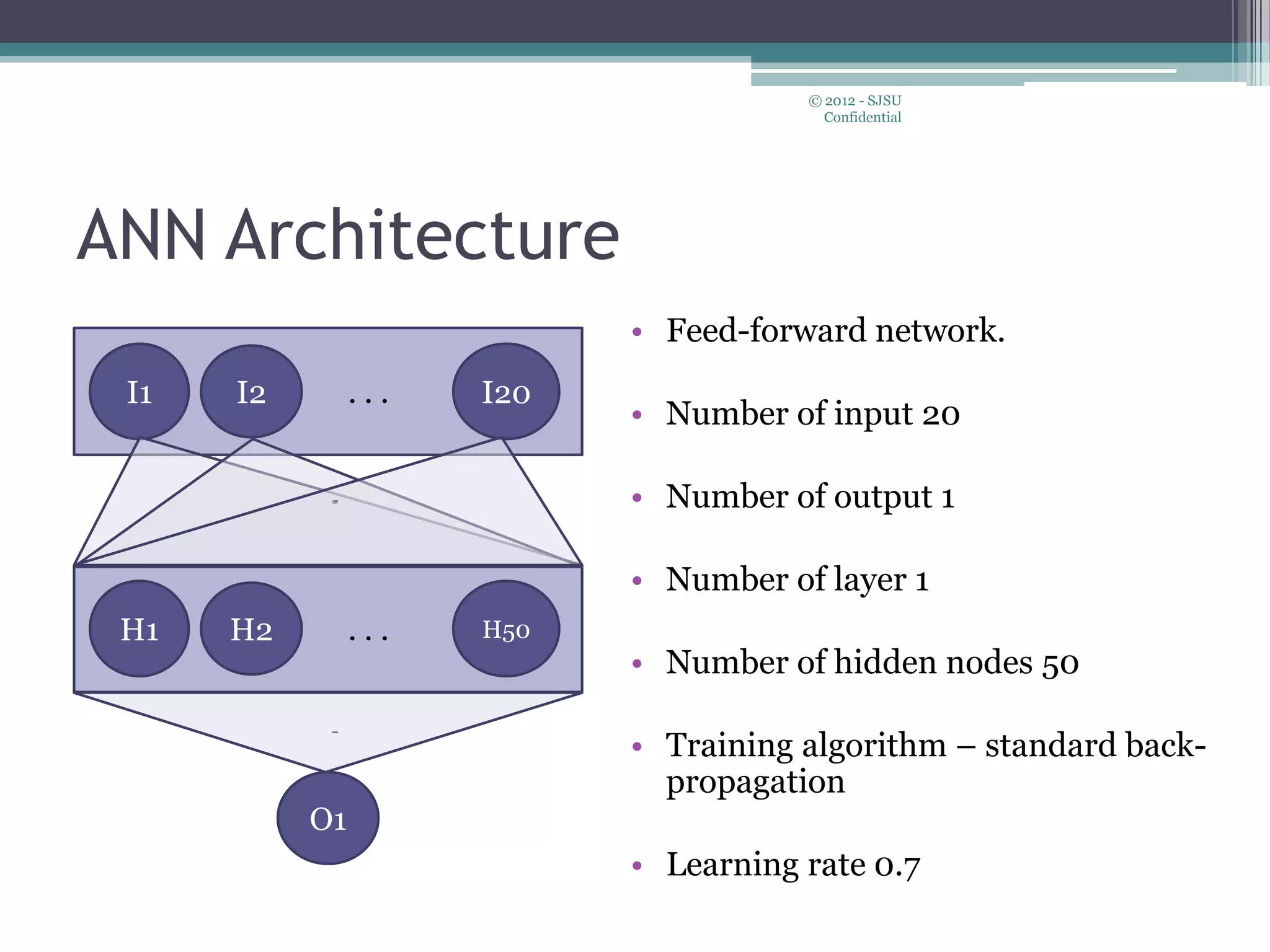
• Feed-forward network.
• Number of input 20
• Number of output 1
• Number of layer 1
• Number of hidden nodes 50
• Training algorithm – standard back-
propagation
• Learning rate 0.7
© 2012 - SJSU
Confidential
I1 I2 I20. . .
H1 H2 H50. . .
O1
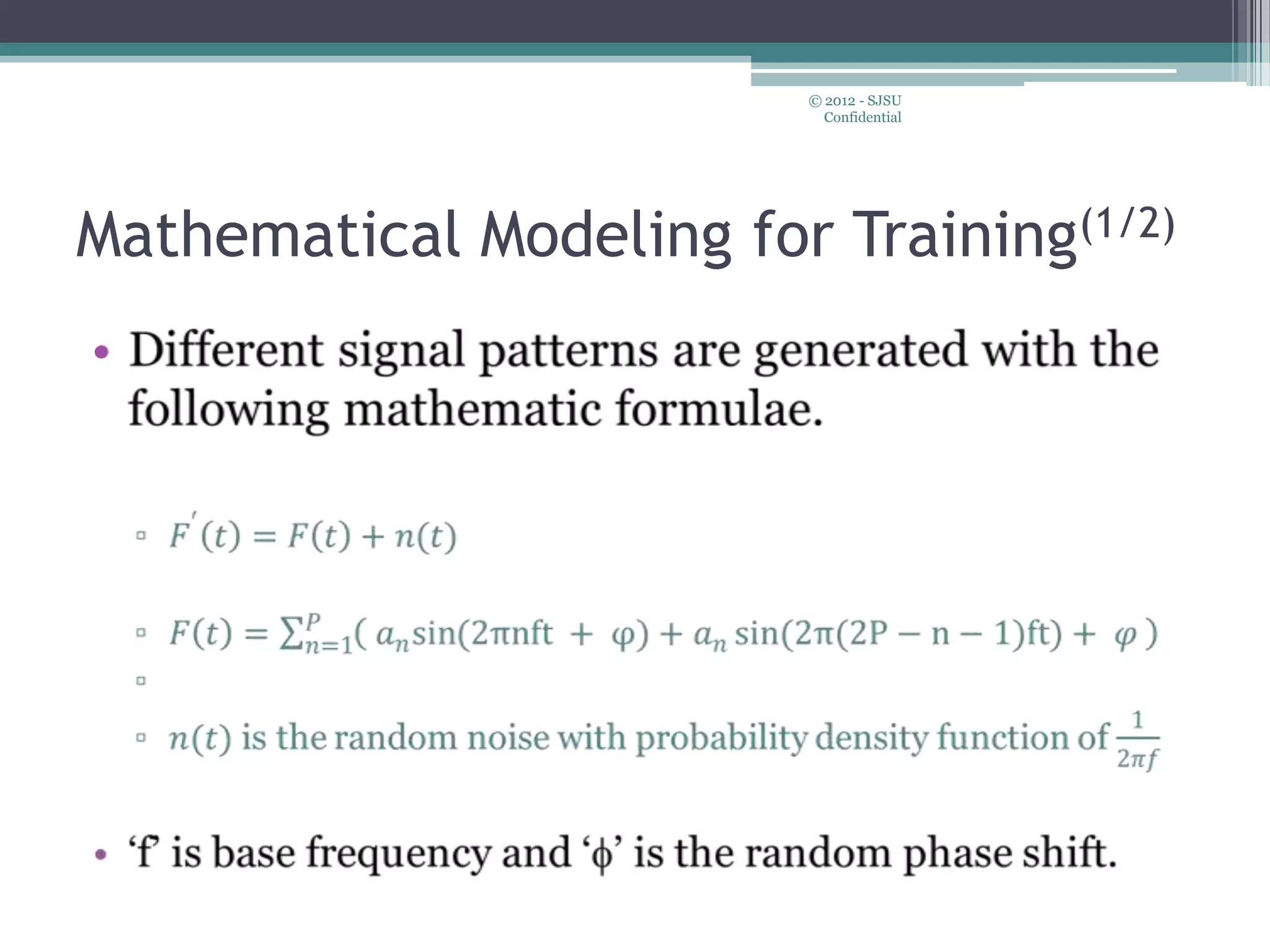
Mathematical Modeling for Training(1/2)
•
© 2012 - SJSU
Confidential
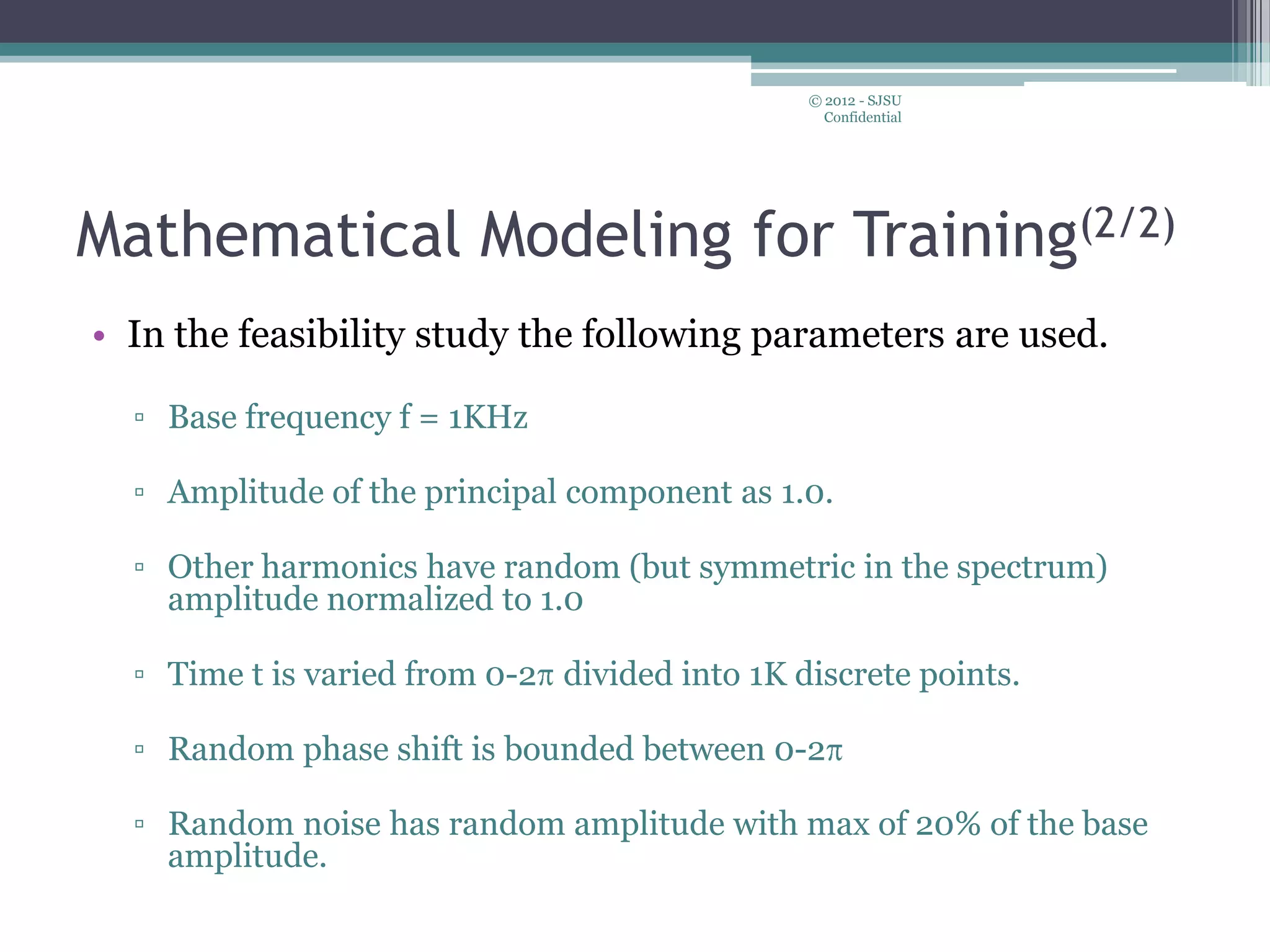
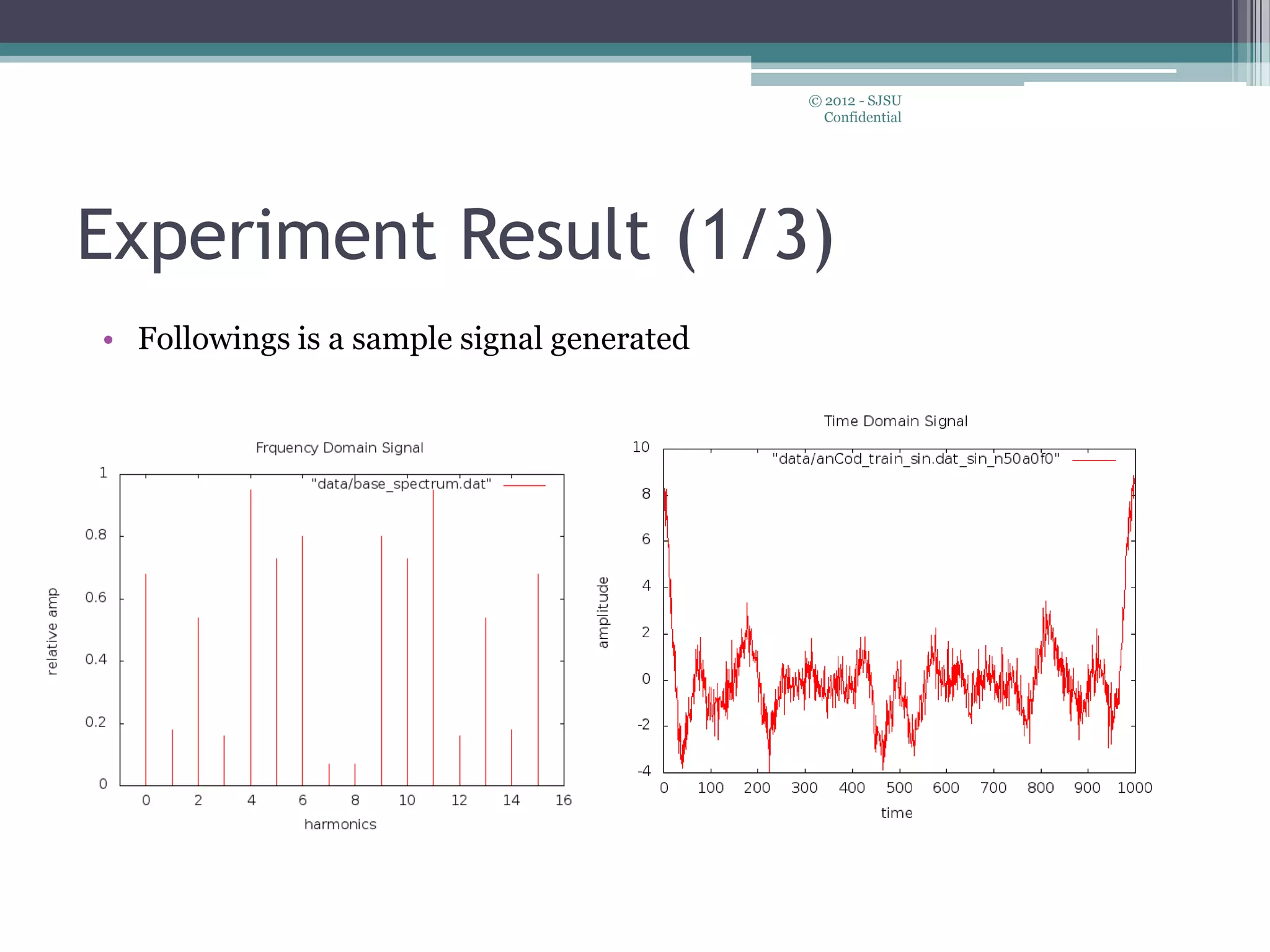
• In the feasibility study the following parameters are used.
▫ Base frequency f = 1KHz
▫ Amplitude of the principal component as 1.0.
▫ Other harmonics have random (but symmetric in the spectrum)
amplitude normalized to 1.0
▫ Time t is varied from 0-2 divided into 1K discrete points.
▫ Random phase shift is bounded between 0-2
▫ Random noise has random amplitude with max of 20% of the base
amplitude.
© 2012 - SJSU
Confidential
Mathematical Modeling for Training(2/2)
Experiment Design (1/2)
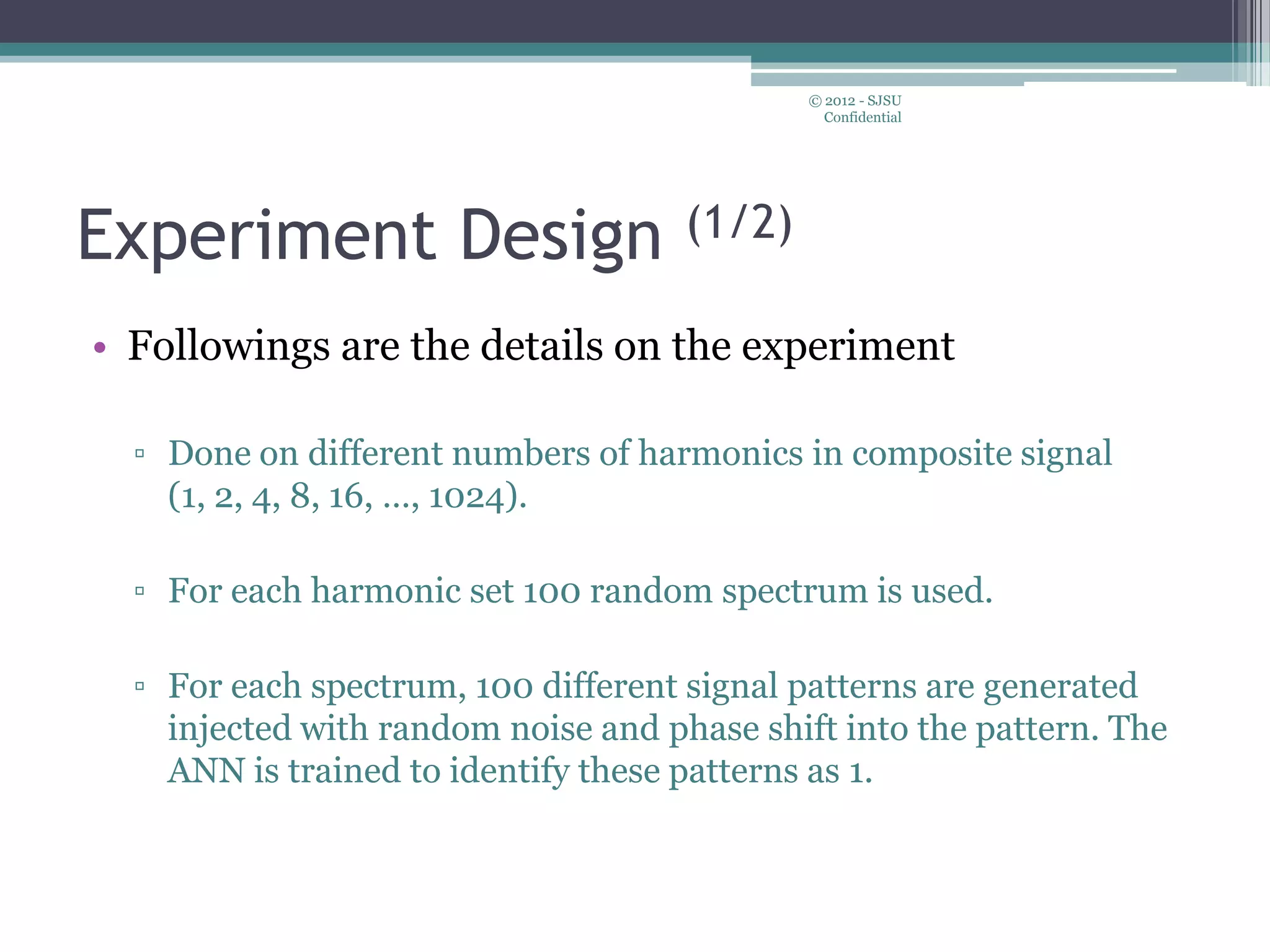
• Followings are the details on the experiment
▫ Done on different numbers of harmonics in composite signal
(1, 2, 4, 8, 16, …, 1024).
▫ For each harmonic set 100 random spectrum is used.
▫ For each spectrum, 100 different signal patterns are generated
injected with random noise and phase shift into the pattern. The
ANN is trained to identify these patterns as 1.
© 2012 - SJSU
Confidential
Experiment Design (2/2)
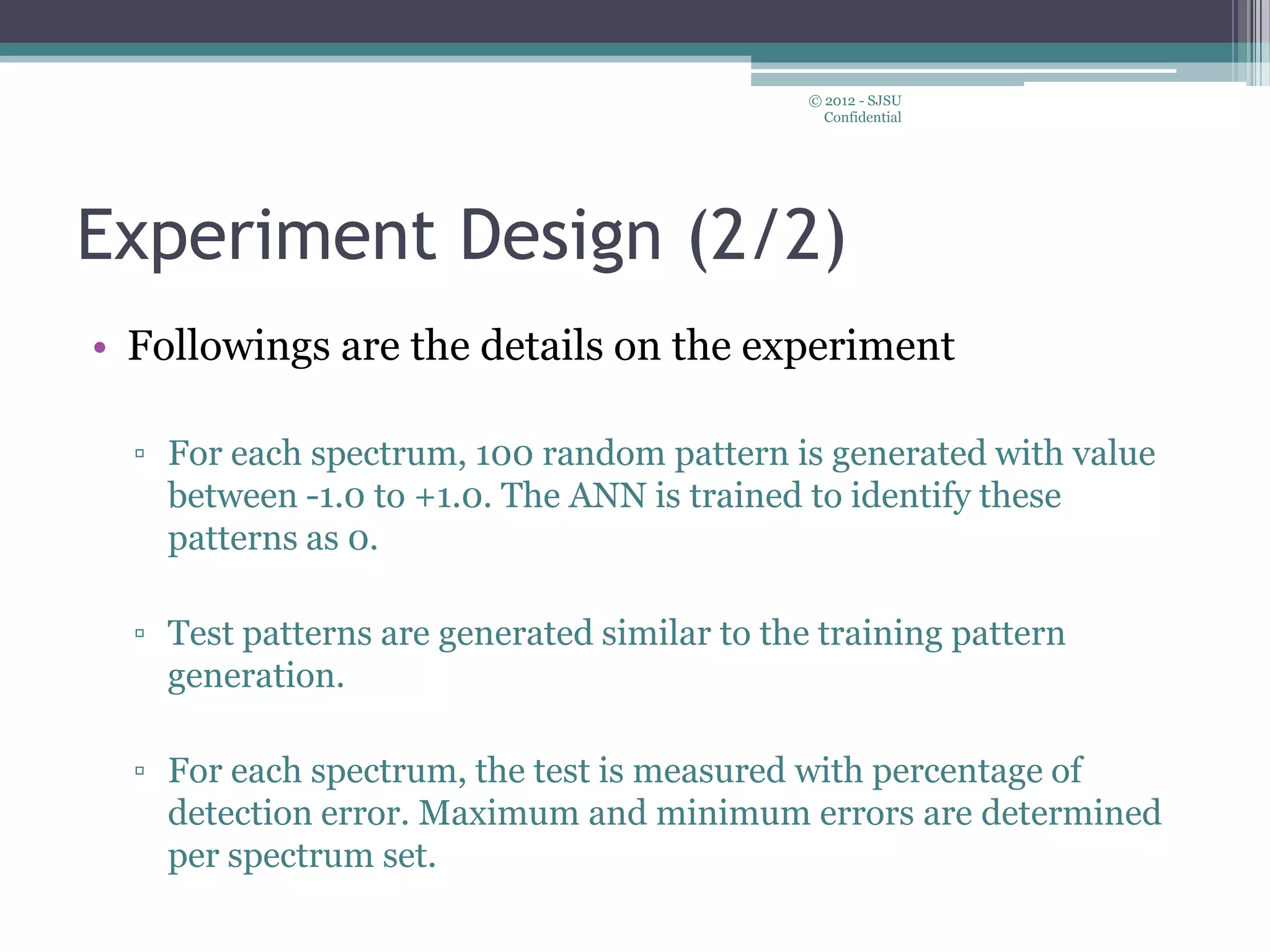
• Followings are the details on the experiment
▫ For each spectrum, 100 random pattern is generated with value
between -1.0 to +1.0. The ANN is trained to identify these
patterns as 0.
▫ Test patterns are generated similar to the training pattern
generation.
▫ For each spectrum, the test is measured with percentage of
detection error. Maximum and minimum errors are determined
per spectrum set.
© 2012 - SJSU
Confidential
Experiment Result (1/3)
• Followings is a sample signal generated
© 2012 - SJSU
Confidential
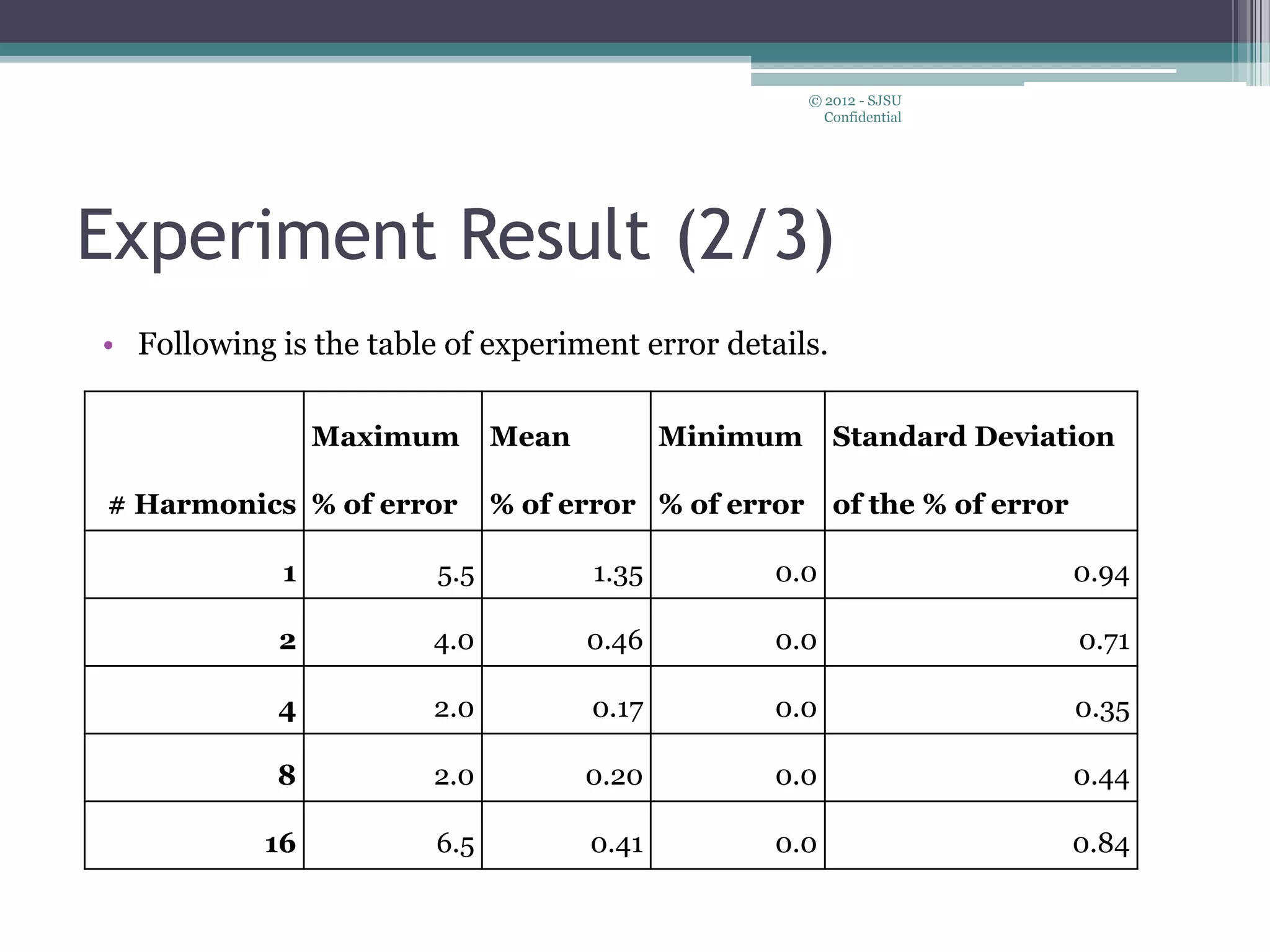
Experiment Result (2/3)
• Following is the table of experiment error details.
© 2012 - SJSU
Confidential
# Harmonics
Maximum
% of error
Mean
% of error
Minimum
% of error
Standard Deviation
of the % of error
1 5.5 1.35 0.0 0.94
2 4.0 0.46 0.0 0.71
4 2.0 0.17 0.0 0.35
8 2.0 0.20 0.0 0.44
16 6.5 0.41 0.0 0.84
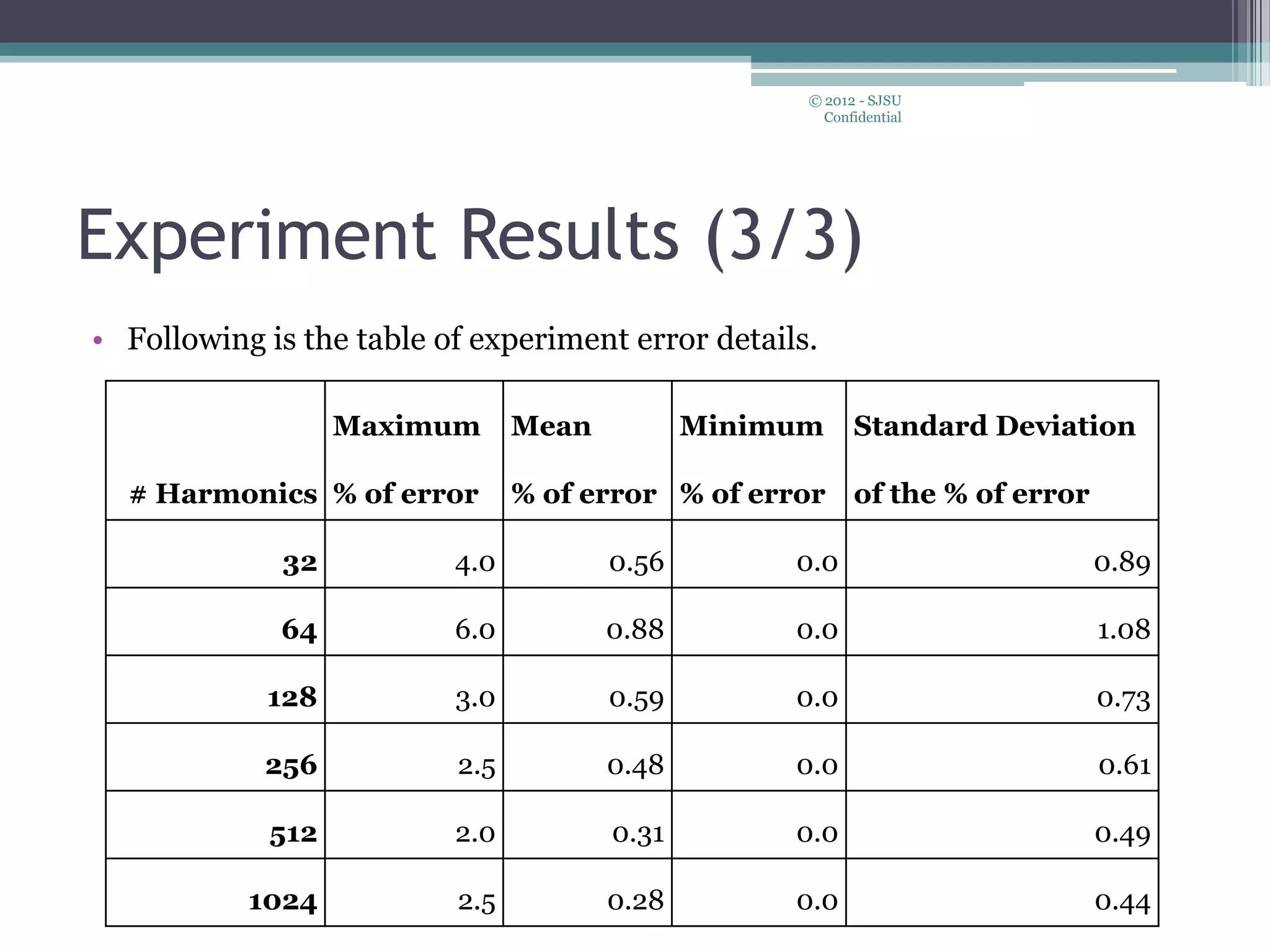
Experiment Results (3/3)
• Following is the table of experiment error details.
© 2012 - SJSU
Confidential
# Harmonics
Maximum
% of error
Mean
% of error
Minimum
% of error
Standard Deviation
of the % of error
32 4.0 0.56 0.0 0.89
64 6.0 0.88 0.0 1.08
128 3.0 0.59 0.0 0.73
256 2.5 0.48 0.0 0.61
512 2.0 0.31 0.0 0.49
1024 2.5 0.28 0.0 0.44
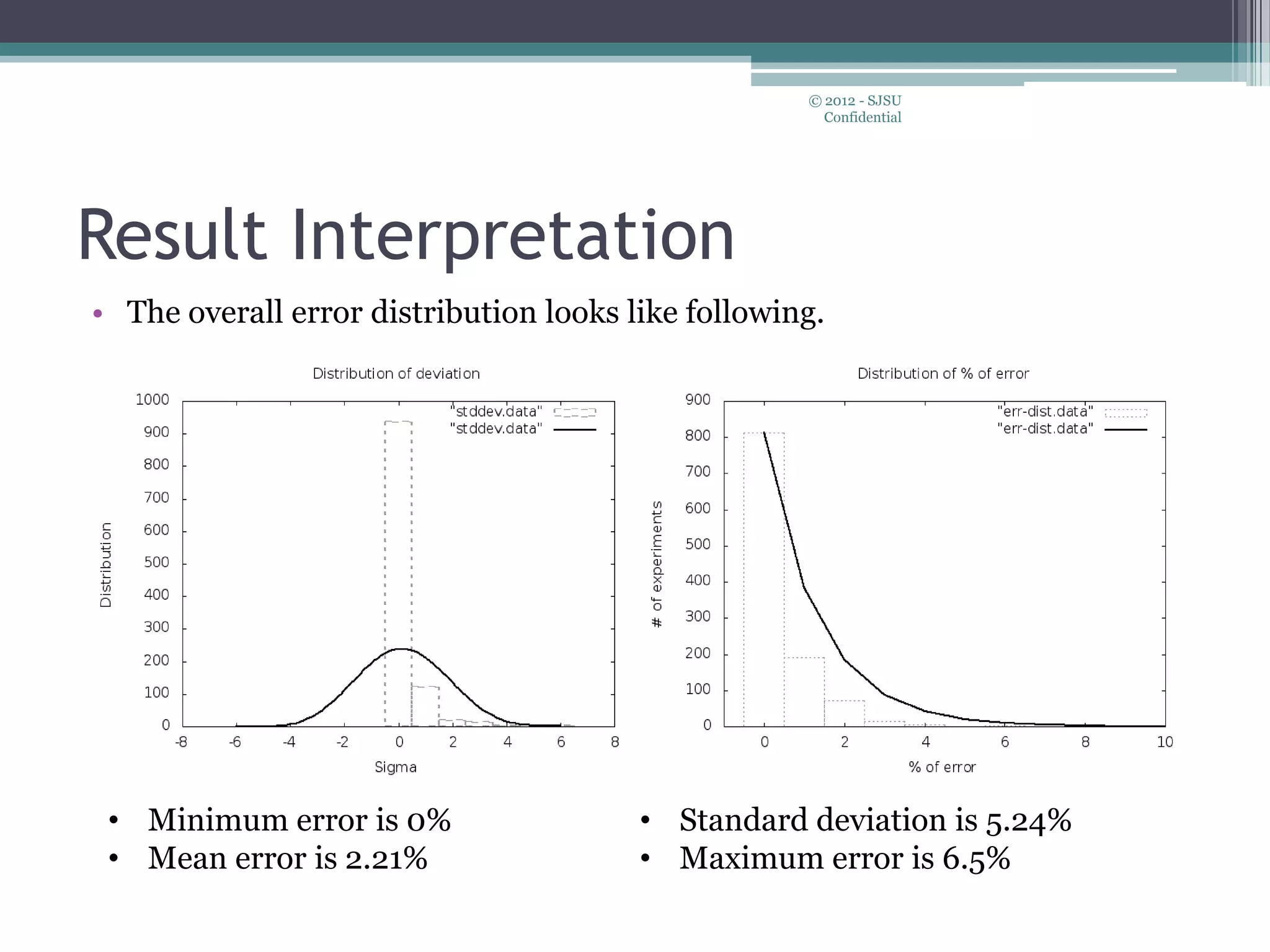
Result Interpretation
• The overall error distribution looks like following.
© 2012 - SJSU
Confidential
• Minimum error is 0%
• Mean error is 2.21%
• Standard deviation is 5.24%
• Maximum error is 6.5%
System Testing (1/2)
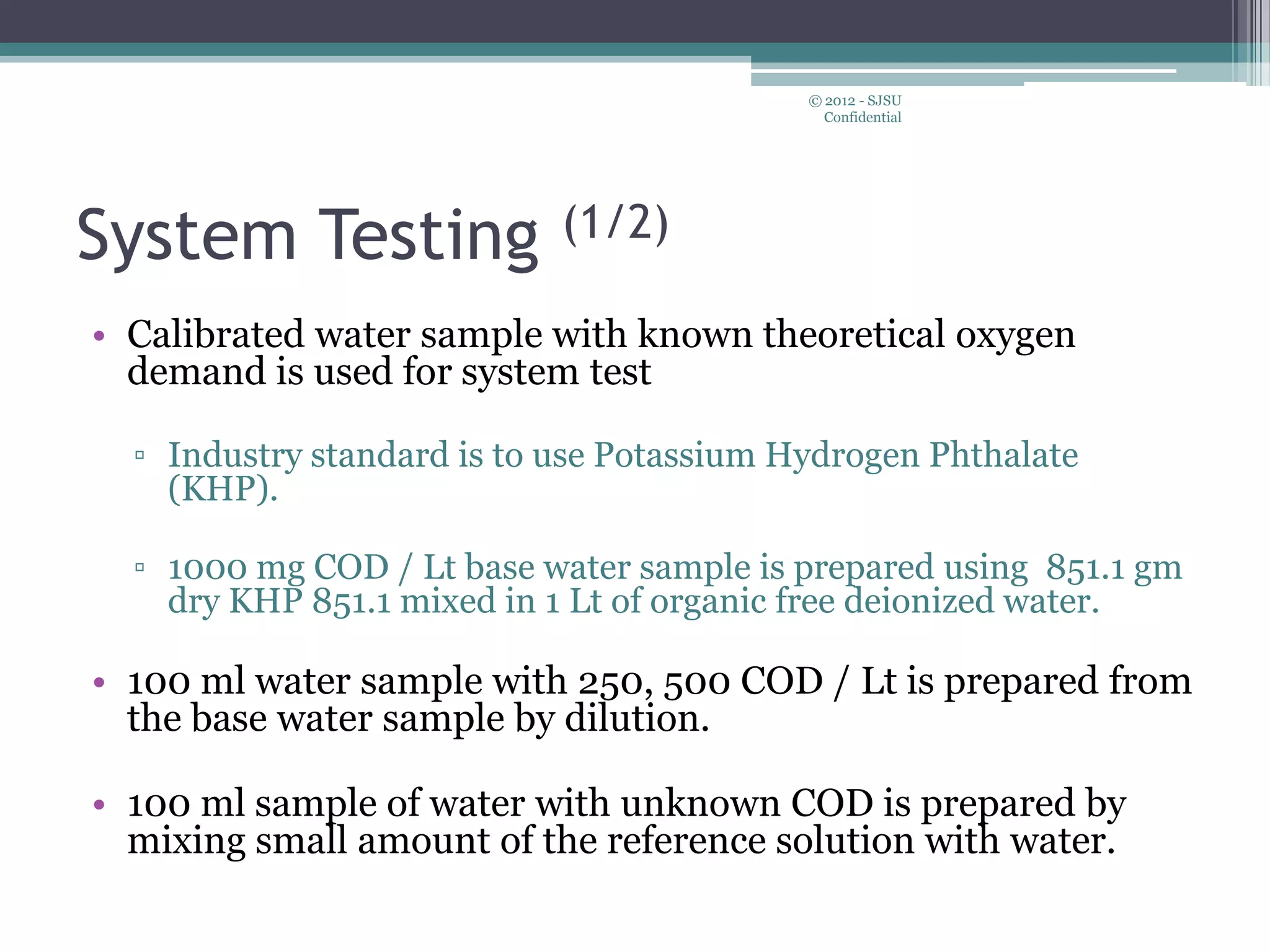
• Calibrated water sample with known theoretical oxygen
demand is used for system test
▫ Industry standard is to use Potassium Hydrogen Phthalate
(KHP).
▫ 1000 mg COD / Lt base water sample is prepared using 851.1 gm
dry KHP 851.1 mixed in 1 Lt of organic free deionized water.
• 100 ml water sample with 250, 500 COD / Lt is prepared from
the base water sample by dilution.
• 100 ml sample of water with unknown COD is prepared by
mixing small amount of the reference solution with water.
© 2012 - SJSU
Confidential
System Testing (2/2)
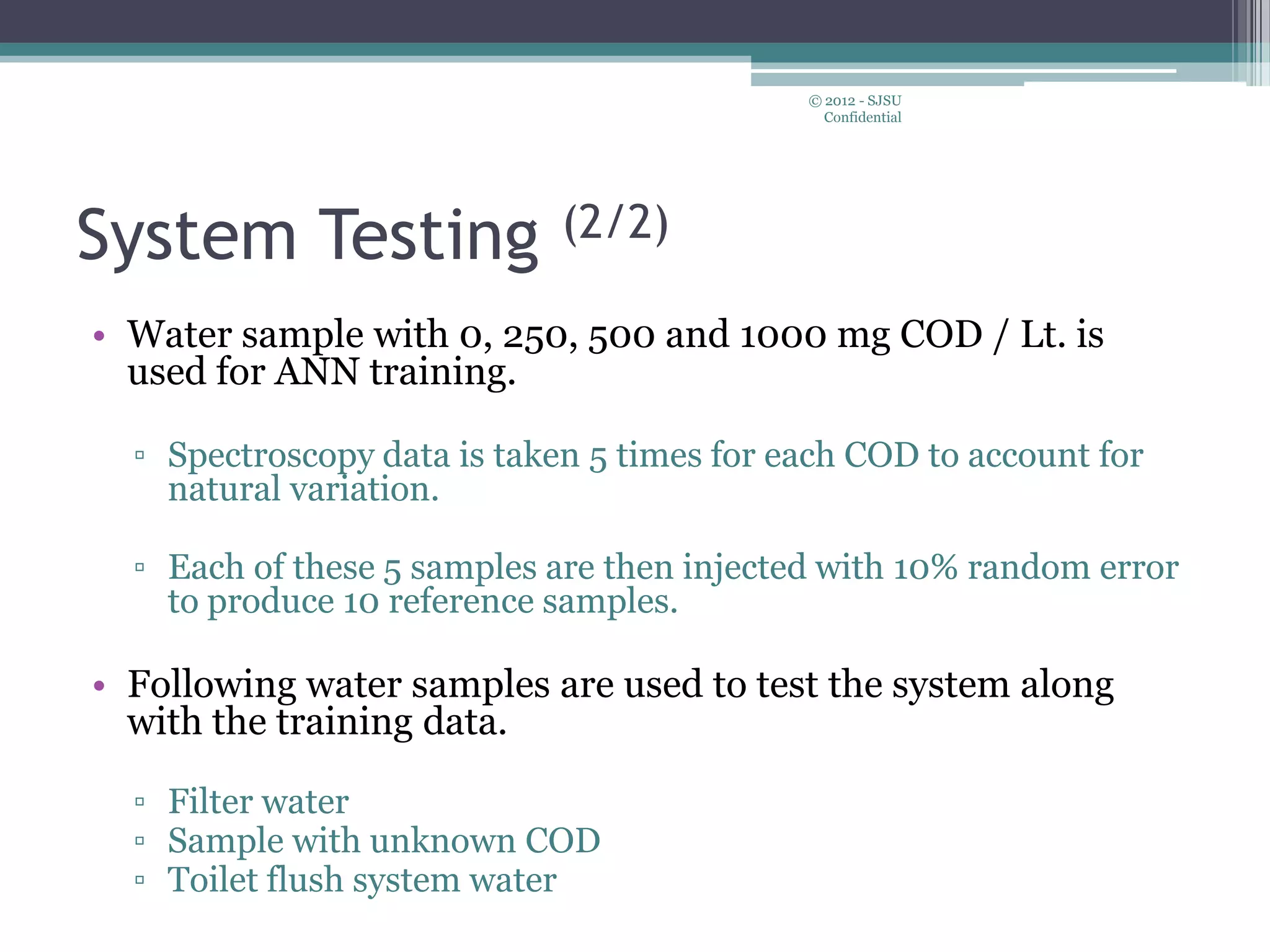
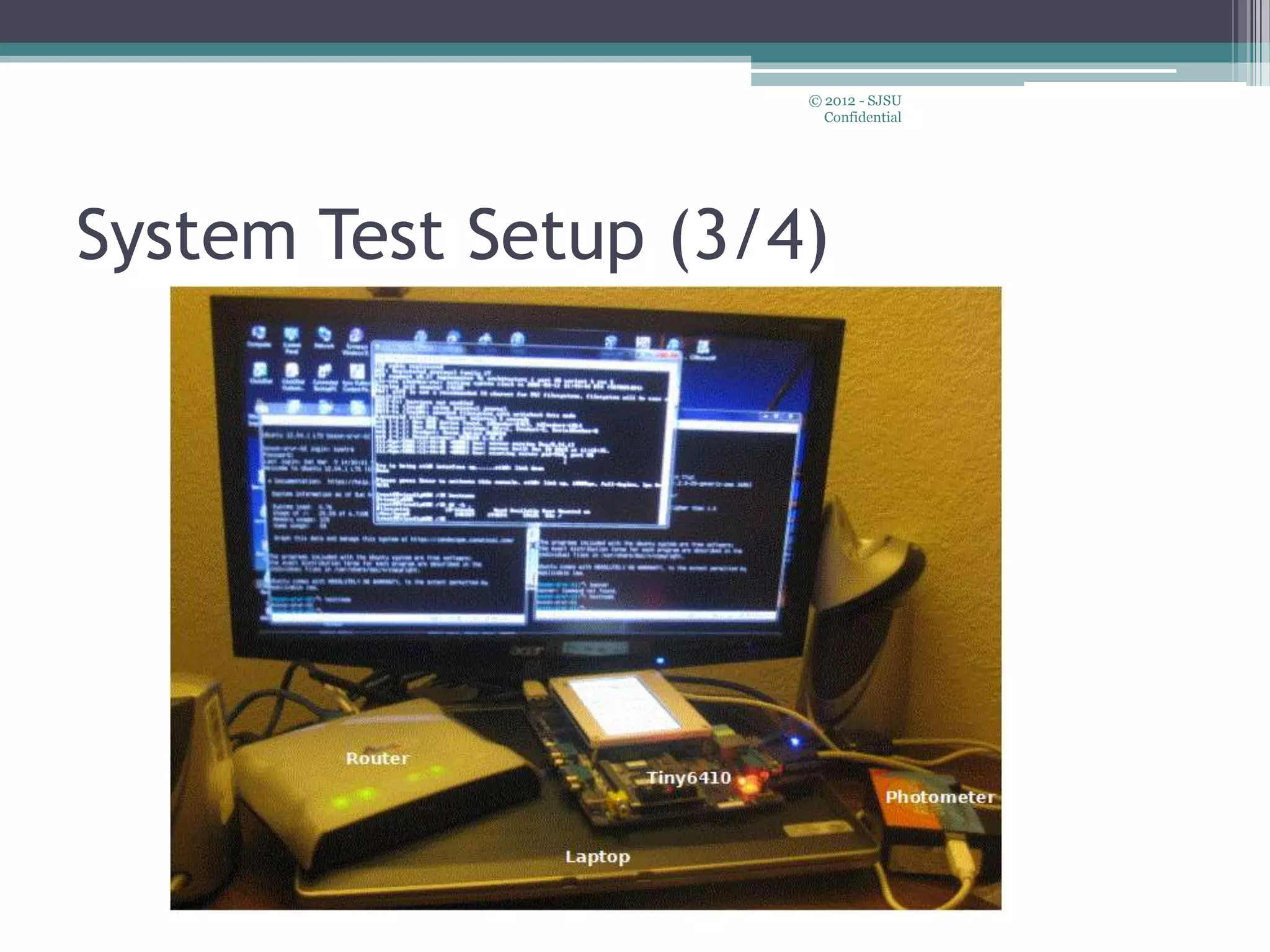
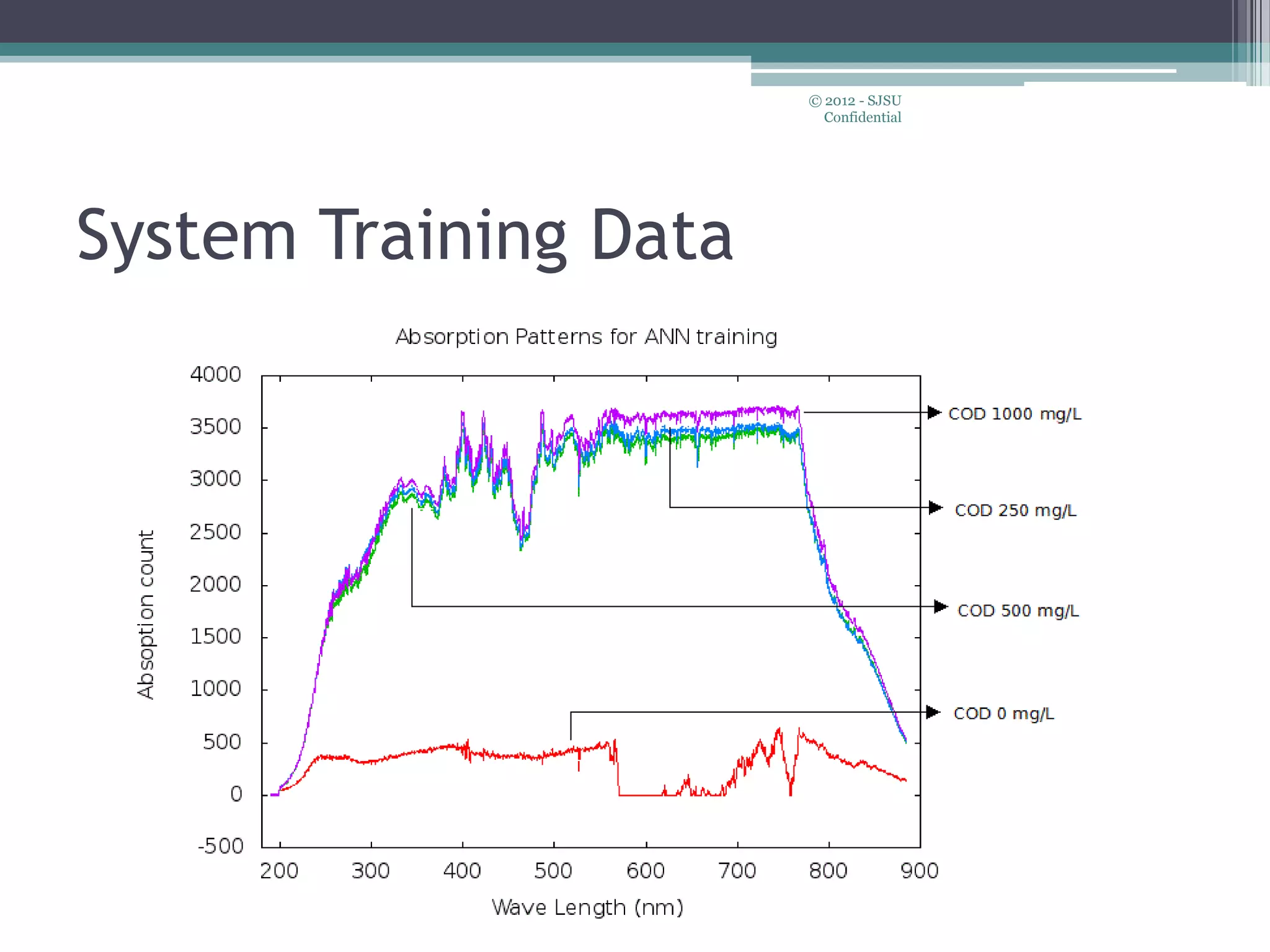
• Water sample with 0, 250, 500 and 1000 mg COD / Lt. is
used for ANN training.
▫ Spectroscopy data is taken 5 times for each COD to account for
natural variation.
▫ Each of these 5 samples are then injected with 10% random error
to produce 10 reference samples.
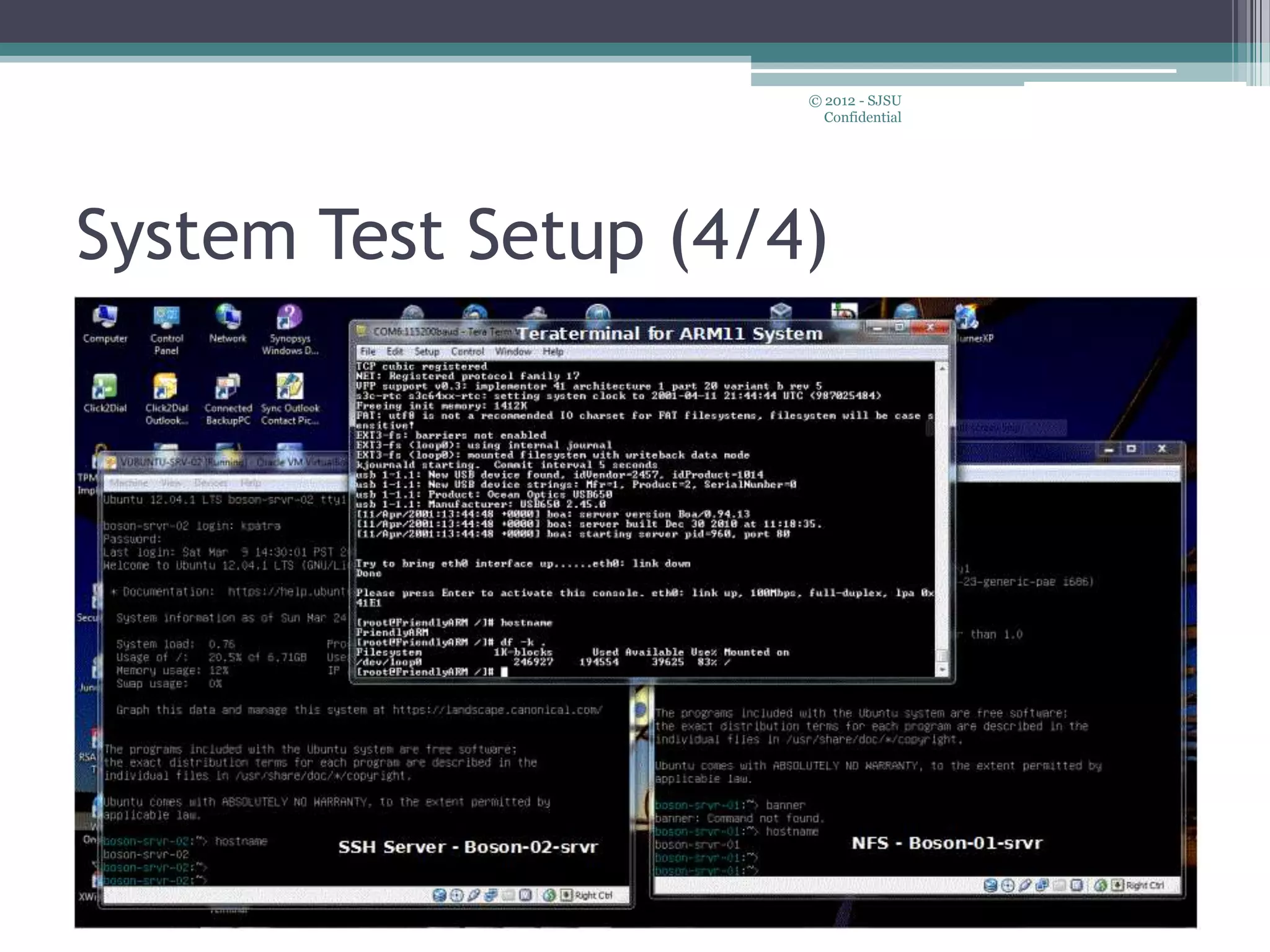
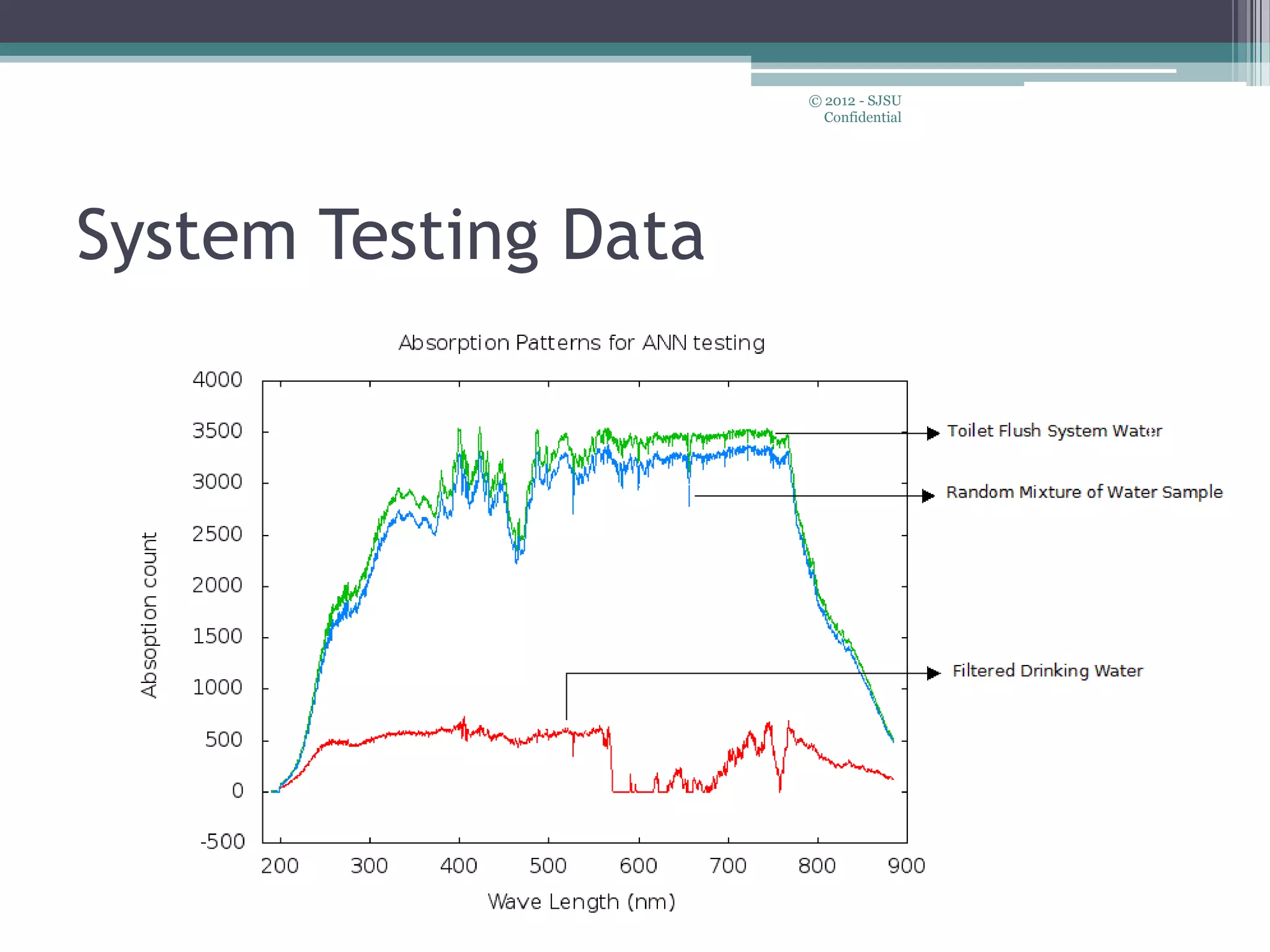
• Following water samples are used to test the system along
with the training data.
▫ Filter water
▫ Sample with unknown COD
▫ Toilet flush system water
© 2012 - SJSU
Confidential
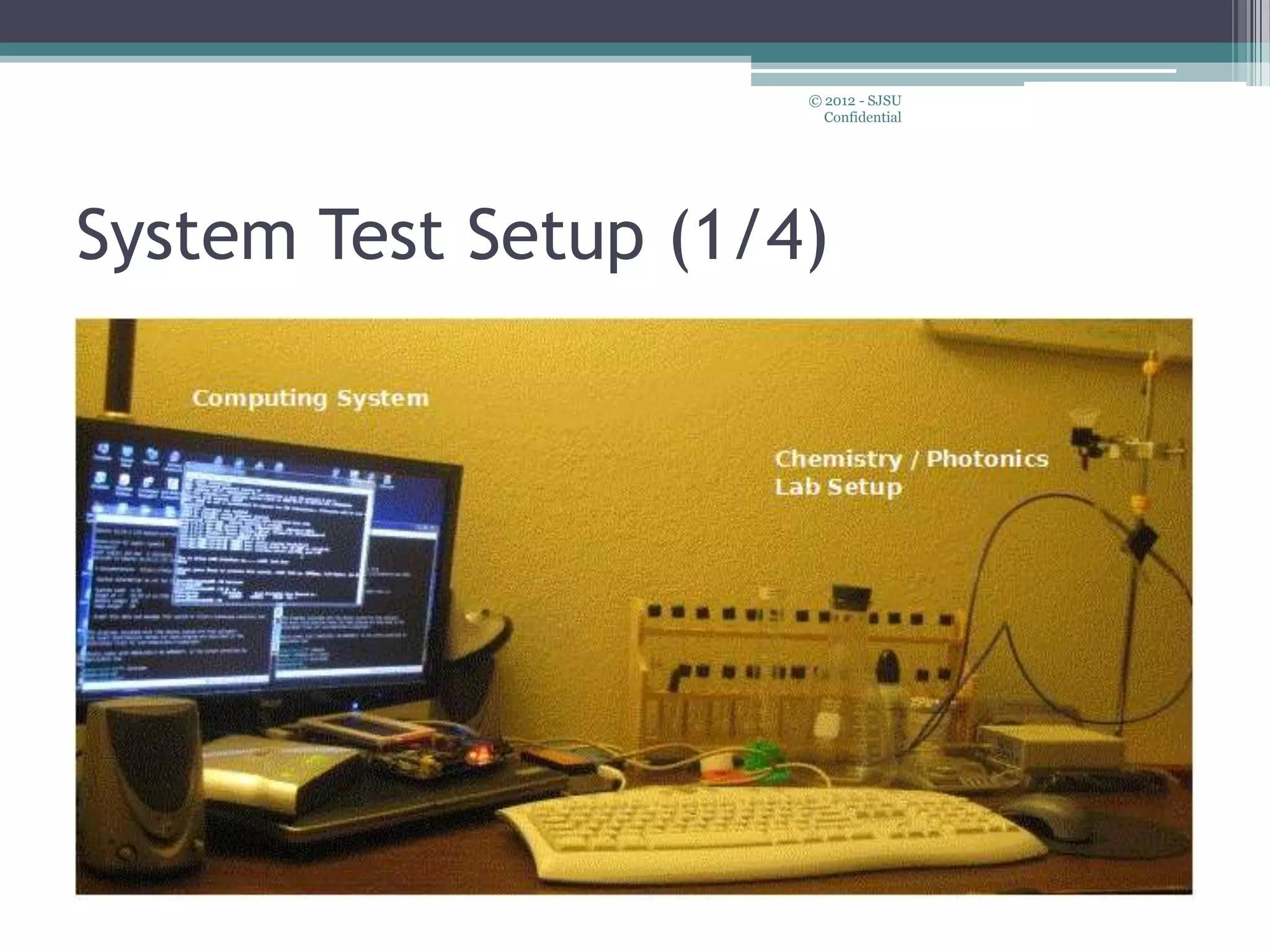
System Test Setup (1/4)
© 2012 - SJSU
Confidential
System Test Setup (2/4)
© 2012 - SJSU
Confidential
System Test Setup (3/4)
© 2012 - SJSU
Confidential
System Test Setup (4/4)
© 2012 - SJSU
Confidential
System Training Data
© 2012 - SJSU
Confidential
System Testing Data
© 2012 - SJSU
Confidential
System Test Result
• All test patterns are successfully classified as
having COD or no COD.
▫ Link to the sample preparation video.
▫ Link to the test demonstration video.
© 2012 - SJSU
Confidential
Conclusion
• COD detection is possible, without using any
chemical, based on pure photometry data analysis using
artificial neural network.
• Affordable COD detection system can be built using
generic mobile embedded system extended with
attachable spectrometer through USB or other standard
connection.
• COD detection system can be built on top of cloud based
infrastructure.
© 2012 - SJSU
Confidential
Future Work
• Development of photometry data analysis based
algorithm to determine COD concentration level.
• Integration of real private / public cloud into this
system.
• Implementation of an evolving COD analysis system
with feedback from laboratory COD results.
• Implementation of more robust experiment setup using
controlled pump and flush system.
© 2012 - SJSU
Confidential
Acknowledgment
• Dr. Hary Hua Li, Department of Computer Engineering, San Jose
State University for his continuous support, encouragement and
guidance throughout this thesis work.
• The thesis committee members, Dr. Donald Hung, Department of
Computer Engineering, and Dr. Robert H. Morelos-
Zaragoza, Department of Electrical Engineering, San Jose State
University for being generously agreed to be part of the thesis
committee and their encouragement and valuable feedback on this
work.
• Arch Shaw, Alumni, Computer Engineering Department, San Jose
State University for his pioneer work on integration of photometer
into embedded system.
• My wife and daughter for being continuously supportive to complete
this thesis work in time.
© 2012 - SJSU
Confidential
UV SPECTROSCOPY EMBEDDED CLOUD
SYSTEM FOR ANN-COD ANALYSIS
Kaushik Patra (kpatra@gmail.com)
For CMPE-299 under the supervision of
Dr. Hua Harry Li (hualili@yahoo.com )
Department of Computer Engineering
San Jose State University
Date: 19th March, 2013
© 2012 - SJSU
Confidential

COD-UV-SPECTROSCOPY-ANN-ANALYSIS

  • 1.
    UV SPECTROSCOPY EMBEDDEDCLOUD SYSTEM FOR ANN-COD ANALYSIS Kaushik Patra (kpatra@gmail.com) For CMPE-299 under the supervision of Dr. Hua Harry Li (hualili@yahoo.com ) Department of Computer Engineering San Jose State University Date: 19th March, 2013 © 2012 - SJSU Confidential
  • 2.
    Problem Statement • Lackof affordable water quality analysis instrument using spectrometry analysis with UV/Vis light spectrum (200nm – 800nm). • Very time consuming and not adaptable to analysis environment variability. • Non-generic system geared towards a specific set of testing. • Environment non-friendly process due to heavy use of chemical re-agents. © 2012 - SJSU Confidential
  • 3.
    Objectives of Study •To conduct survey on state of the art technique for COD content measurement in water. • To design and implement ANN based self learning and sustainable and adaptive computing system for better decision making in COD analysis using spectrometry. • To integrate ANN based COD measurement system into the existing embedded system. • To test and verify overall system using real water samples from water treatment facilities. © 2012 - SJSU Confidential
  • 4.
    Artificial Neural Network(ANN) • Artificial Neural Network (ANN) is mathematical model of problem solving based on a very simplified model of working mechanism of neuron. ▫ Invention of Associative Network by John Joseph Hopfield in 1982 accelerated the usage of ANN in industrial application. ▫ The conception of ANN is proposed in 1943 by Warren McCulloch, a neuropsychologist, and Walter Pitts, a logician, from University of Chicago. • It is an adaptive mathematical model for solving problem where relation between input parameters and output(s) of a function is very complex or unknown. ▫ Adaptability and machine learning are two essential characteristics for ANN based tools. © 2012 - SJSU Confidential
  • 5.
    ANN in CODanalysis • ANN has its application in very complex problem solving. ▫ Analog VLSI , Vision Chips ▫ Stock market prediction ▫ Autopilot mechanism for aircrafts • Spectrometry based measurement of Chemical Oxygen Demand (COD) metric is a complex problem. ▫ Mathematical relation between spectral analysis data and COD content is complex and not completely known. ▫ ANN with three feed-forward perception layer is a good candidate to be used to implement an adaptable and supervised machine learning mechanism to be used for COD determination using spectral analysis with UV/Vis light (200nm – 800nm). © 2012 - SJSU Confidential
  • 6.
    Spectroscopy in CODanalysis • Three phenomenon occurs when EM radiation falls into water sample containing impurities. ▫ Deflection ▫ Absorption ▫ Scattering • Different type of organic compound absorbs UV / VIS EM radiation of different wave length. ▫ Hence COD measurement should be studied over entire spectrum (200nm – 850nm) © 2012 - SJSU Confidential
  • 7.
    Related Researches (1/3) •Glucose concentration determination using ANN on infra-red absorption pattern in sample solution. ▫ ‘Neural Network Based Real-Time Detection of Glucose using a Non- chemical Optical Sensor Approach’ by Fedric M. Ham et. al. [1990] • COD determination using UV/VIS spectrometry. ▫ ‘On-line and in-situ measurement of turbidity and COD in wastewater using UV/VIS spectrometry’ by N. Flesichmann et. al. ▫ ‘Binary encoded 2nd-differential spectrometry using UV-Vis spectral data and neural networks in the estimation of species type and concentration’ by N. Benjathapanun et. al. (1997). • Hybrid approach of water quality measurement using spectrometry and physico-chemical sensor. ▫ Water quality monitoring using a smart sensing system by A. Charef et. al. [2000] © 2012 - SJSU Confidential
  • 8.
    Related Researches (2/3) •A case study on pepper mill wastewater shows that analysis needs to be done on entire spectrum of UV/VIS. ▫ ‘Monitoring of paper mill wastewater treatment plant using UV/VIS spectroscopy’ by G. Langergraber et. al. [2004] • Fingerprinting of different bio media substances using spectroscopy on entire range of EM wave. ▫ ‘Spectral analysis and finger printing for biomedia characterization’ by M. Pons et. al. [2004] • Using wireless network for water quality monitoring. ▫ ‘Water Quality Monitoring System Using Zigbee Based Wireless Sensor Network’ by Z. Rasin and Md. R. Abdullah [2006] © 2012 - SJSU Confidential
  • 9.
    Related Researches (3/3) •Statistical feature extraction to reduce ANN input to a manageable amount for spectroscopy analysis for COD. ▫ ‘Estimation of chemical oxygen demand by ultraviolate spectroscopic profiling and artificial neural network’ by S. Fogelman et. al. [2006] • Remote monitoring of water quality using GPRS. ▫ ‘The Design on Multi-Parameter Online Monitoring System of Water Quality Based on GPRS’ by Q. Tie-Zhu and S. Le [2010] • Using ANN and GA for COD measurement. ▫ ‘Hybrid artificial neural network genetic algorithm technique for modeling chemical oxygen demand removal in anoxic / oxic process’ by Y. Ma et. al. [2011] © 2012 - SJSU Confidential
  • 10.
    Conventional COD AnalysisTechnique (1/3) • Refluxing water sample with potassium dichromate (K2Cr2O7) in a strong acid condition. ▫ Amount of potassium dichromate digested depends on how much organic compound is present in water sample. Hence, indirectly measures COD. ▫ Amount of potassium dichromate left over is measured using chemical titration process. ▫ Needs two hours or more for entire process to be completed. ▫ Ref : Dr. Chunlong, Fundamentals of Environmental Sampling and Analysis, (page 357) © 2012 - SJSU Confidential
  • 11.
    • Using colorimeterto determine left over potassium dichromate. ▫ Colorimeter is used to determine concentration of colored compound dissolved in water by measuring absorption amount of certain wavelength of light. ▫ The refluxed solution takes yellow to brown color depending on the concentration of the dichromate. Measuring the absorption pattern, colorimeter can indicate the amount of undigested potassium dichromate. © 2012 - SJSU Confidential Conventional COD Analysis Technique (2/3) Ref: http://en.wikipedia.org/wiki/Colorimeter_(ch emistry)#cite_ref-2
  • 12.
    • Using photo-catalytic method. ▫Oxidation of organic compound is accelerated in presence of catalysts and UV radiation (<400nm). ▫ Oxidation process creates electrical signal on the sensor. ▫ Amount of signal generated depends on concentration of organic compound present in water sample. © 2012 - SJSU Confidential Conventional COD Analysis Technique (3/3) Ref: COD Analysis, PeCODTM from MANTECH, ManSci Inc. http://www.mansci.com/products/PeCOD/index.html
  • 13.
    Uniqueness of thisResearch 1. An unique methodology of COD identification in water sample using ANN photometry data analysis technique. 2. A mobile embedded hardware system integrated with portable photometer and connected to cloud infrastructure. 3. A software application system to utilize implemented cloud enabled mobile hardware system 1) System to both train and utilize ANN for COD analysis. 2) In-situ upgrade of ANN by incremental training. © 2012 - SJSU Confidential
  • 14.
    Overall System Architecture •The UV light source is connected to flow using fiber optic cable. • The dispersed light from flow cell comes to spectrometer using another fiber optic cable. • The Spectrometer is connected to ARM11 embedded system though USB. • The ARM11 Embedded system runs ANN based COD analysis algorithm to analyze spectrometry data using cloud storage and application server. © 2012 - SJSU Confidential
  • 15.
    Overall System © 2012- SJSU Confidential
  • 16.
    Design of CODDetection Technique • 20 equidistance sample of photometry data over the spectrum range is captured. • This 20 sample is used as input to the ANN. • Samples are normalized w.r.t. highest data present in pattern so that all the sample are between 0-1. • ANN is trained with data pattern from water sample with no COD and with known COD. ▫ 100 data pattern in generated from single spectrometry data by injecting 20% random noise. ▫ Data from no COD is assigned as result 1. ▫ All other patterns are assigned as result 0. ▫ 100 random data pattern is generated with result 0. © 2012 - SJSU Confidential
  • 17.
    ANN Architecture • Feed-forwardnetwork. • Number of input 20 • Number of output 1 • Number of layer 1 • Number of hidden nodes 50 • Training algorithm – standard back- propagation • Learning rate 0.7 © 2012 - SJSU Confidential I1 I2 I20. . . H1 H2 H50. . . O1
  • 18.
    Mathematical Modeling forTraining(1/2) • © 2012 - SJSU Confidential
  • 19.
    • In thefeasibility study the following parameters are used. ▫ Base frequency f = 1KHz ▫ Amplitude of the principal component as 1.0. ▫ Other harmonics have random (but symmetric in the spectrum) amplitude normalized to 1.0 ▫ Time t is varied from 0-2 divided into 1K discrete points. ▫ Random phase shift is bounded between 0-2 ▫ Random noise has random amplitude with max of 20% of the base amplitude. © 2012 - SJSU Confidential Mathematical Modeling for Training(2/2)
  • 20.
    Experiment Design (1/2) •Followings are the details on the experiment ▫ Done on different numbers of harmonics in composite signal (1, 2, 4, 8, 16, …, 1024). ▫ For each harmonic set 100 random spectrum is used. ▫ For each spectrum, 100 different signal patterns are generated injected with random noise and phase shift into the pattern. The ANN is trained to identify these patterns as 1. © 2012 - SJSU Confidential
  • 21.
    Experiment Design (2/2) •Followings are the details on the experiment ▫ For each spectrum, 100 random pattern is generated with value between -1.0 to +1.0. The ANN is trained to identify these patterns as 0. ▫ Test patterns are generated similar to the training pattern generation. ▫ For each spectrum, the test is measured with percentage of detection error. Maximum and minimum errors are determined per spectrum set. © 2012 - SJSU Confidential
  • 22.
    Experiment Result (1/3) •Followings is a sample signal generated © 2012 - SJSU Confidential
  • 23.
    Experiment Result (2/3) •Following is the table of experiment error details. © 2012 - SJSU Confidential # Harmonics Maximum % of error Mean % of error Minimum % of error Standard Deviation of the % of error 1 5.5 1.35 0.0 0.94 2 4.0 0.46 0.0 0.71 4 2.0 0.17 0.0 0.35 8 2.0 0.20 0.0 0.44 16 6.5 0.41 0.0 0.84
  • 24.
    Experiment Results (3/3) •Following is the table of experiment error details. © 2012 - SJSU Confidential # Harmonics Maximum % of error Mean % of error Minimum % of error Standard Deviation of the % of error 32 4.0 0.56 0.0 0.89 64 6.0 0.88 0.0 1.08 128 3.0 0.59 0.0 0.73 256 2.5 0.48 0.0 0.61 512 2.0 0.31 0.0 0.49 1024 2.5 0.28 0.0 0.44
  • 25.
    Result Interpretation • Theoverall error distribution looks like following. © 2012 - SJSU Confidential • Minimum error is 0% • Mean error is 2.21% • Standard deviation is 5.24% • Maximum error is 6.5%
  • 26.
    System Testing (1/2) •Calibrated water sample with known theoretical oxygen demand is used for system test ▫ Industry standard is to use Potassium Hydrogen Phthalate (KHP). ▫ 1000 mg COD / Lt base water sample is prepared using 851.1 gm dry KHP 851.1 mixed in 1 Lt of organic free deionized water. • 100 ml water sample with 250, 500 COD / Lt is prepared from the base water sample by dilution. • 100 ml sample of water with unknown COD is prepared by mixing small amount of the reference solution with water. © 2012 - SJSU Confidential
  • 27.
    System Testing (2/2) •Water sample with 0, 250, 500 and 1000 mg COD / Lt. is used for ANN training. ▫ Spectroscopy data is taken 5 times for each COD to account for natural variation. ▫ Each of these 5 samples are then injected with 10% random error to produce 10 reference samples. • Following water samples are used to test the system along with the training data. ▫ Filter water ▫ Sample with unknown COD ▫ Toilet flush system water © 2012 - SJSU Confidential
  • 28.
    System Test Setup(1/4) © 2012 - SJSU Confidential
  • 29.
    System Test Setup(2/4) © 2012 - SJSU Confidential
  • 30.
    System Test Setup(3/4) © 2012 - SJSU Confidential
  • 31.
    System Test Setup(4/4) © 2012 - SJSU Confidential
  • 32.
    System Training Data ©2012 - SJSU Confidential
  • 33.
    System Testing Data ©2012 - SJSU Confidential
  • 34.
    System Test Result •All test patterns are successfully classified as having COD or no COD. ▫ Link to the sample preparation video. ▫ Link to the test demonstration video. © 2012 - SJSU Confidential
  • 35.
    Conclusion • COD detectionis possible, without using any chemical, based on pure photometry data analysis using artificial neural network. • Affordable COD detection system can be built using generic mobile embedded system extended with attachable spectrometer through USB or other standard connection. • COD detection system can be built on top of cloud based infrastructure. © 2012 - SJSU Confidential
  • 36.
    Future Work • Developmentof photometry data analysis based algorithm to determine COD concentration level. • Integration of real private / public cloud into this system. • Implementation of an evolving COD analysis system with feedback from laboratory COD results. • Implementation of more robust experiment setup using controlled pump and flush system. © 2012 - SJSU Confidential
  • 37.
    Acknowledgment • Dr. HaryHua Li, Department of Computer Engineering, San Jose State University for his continuous support, encouragement and guidance throughout this thesis work. • The thesis committee members, Dr. Donald Hung, Department of Computer Engineering, and Dr. Robert H. Morelos- Zaragoza, Department of Electrical Engineering, San Jose State University for being generously agreed to be part of the thesis committee and their encouragement and valuable feedback on this work. • Arch Shaw, Alumni, Computer Engineering Department, San Jose State University for his pioneer work on integration of photometer into embedded system. • My wife and daughter for being continuously supportive to complete this thesis work in time. © 2012 - SJSU Confidential
  • 38.
    UV SPECTROSCOPY EMBEDDEDCLOUD SYSTEM FOR ANN-COD ANALYSIS Kaushik Patra (kpatra@gmail.com) For CMPE-299 under the supervision of Dr. Hua Harry Li (hualili@yahoo.com ) Department of Computer Engineering San Jose State University Date: 19th March, 2013 © 2012 - SJSU Confidential