RADIOACTIVITY
Atomic theory
In chemistryand physics, the atomic theoryexplainshow our
understanding ofthe atom has changed over time. Atomswere once
thought tobe the smallest piecesof matter.
The first idea of the atom camefrom the Greek philosopher Democritus. A
lot of the ideasin the moderntheory camefrom John Dalton, a British
chemist and physicist.
Democritus' atomictheory
Democritus(Greekphilosopher, 460 BC)thought that ifyou cut something
in half againand again, you would at last have to stop. He said that thislast
pieceof matter could not be cut any smaller. Democrituscalled these small
piecesof matter atoms, which means"indivisible". He thought that atoms
would last forever, never changeand could not be destroyed. Democritus
thought that therewasnothing between the atomsand that everything
around us could be explained if we could understand how atomsworked.
Sir Joseph John Thomson (1856–1940), English physicianwhodiscovered
the electronand determined itsnegativecharge. He got the Nobel Prizein
Physicsfor 1906.
Dalton's atomic theory
In 1803, the English scientist JohnDalton(1766–1844) , reworked
Democritus' theory, as follows:
1. All matter isformed of atoms.
2. That atomsareindivisibleand invisibleparticles.
3. That atomsof the same element are of thesame type and mass.
4. The atomsthat makecompoundsarepresent in set proportions.
5. Chemicalchangescorrespond to a reorganisationofthe atomstaking
part in the chemicalreaction.
Dalton defined the atom as the basic unit of an element that cantake part
in a chemicalcombination.
In 1850, Sir William Crookes constructed a 'dischargetube', that isa glass
tubewith the air removed and metallic electrodesat itsends, connected toa
high voltage source. When creating a vacuum inthe tube, a light discharge
canbe seen that goes from the cathode(negatively-chargedelectrode) to
the anode (positively-chargedelectrode). Crookes named the emission
'cathoderays'.
Thomson'satomic model
After the cathoderayexperiments, Sir Joseph John Thomson established
that the emitted raywasformed by negativecharges, becausetheywere
attracted bythe positivepole. Thomson knew that the atomswere
electricallyneutral, but he established that, for thisto occur, an atom
should have the same quantityofnegativeand positivecharges. The
negativechargeswerenamed electrons (e-).
According totheassumptionsestablished about theatomsneutralcharge,
Thomson proposed the first atomic model, that was described asa
positively-charged sphereinwhich the electrons wereinlaid (with negative
charges). It is known as the plum pudding model.
In 1906, Robert Millikart determinedthat theelectronshad a Coulomb (C)
chargeof -1.6 × 101 9, something thatallowed calculationofits mass,
infinitelysmall, equal to 9.109 ×1031 kg.
In the same time, experimentsbyEugene Goldsteinin 1886 with cathode
dischargetubesallowed him to establish that the positivechargeshad a
mass of 1.6726 ×1027 kg and an electricalchargeof+1.6 × 10 1 9 C. Lord
Ernest Rutherford later named these positively charged particlesprotons.
Lord Rutherford atomic model
Atomic experiment ofLord Ernest Rutherford
In 1910, the New Zealand physicist Ernest Rutherford suggested that the
positivechargesof the atom were found mostly in its center, in the nucleus,
and the electrons(e-) around it.
Rutherford showed this when he used an alpha radiationsource(from
helium) to hit the very thin gold sheets, surrounded by a Zinc sulphide
lampshadethat produced visiblelight when hit by alpha emissions. This
experiment wascalled the Geiger–Marsdenexperimentor the Gold Foil
Experiment.
By thisstagethe mainelements of theatom were clear, plus the discovery
that atomsof an element may occur in isotopes. Isotopes vary in the
number of neutronspresent in thenucleus. Although this model waswell
understood, modern physicshas developed further, and present-dayideas
cannot be madeeasy to understand.
Modern physics
Atomsare not elementaryparticles, becausetheyaremadeof subatomic
particleslikeprotons and neutrons. Protonsand neutrons arealso not
elementaryparticlesbecausetheyare madeup of even smaller particles
called quarksjoined together by other particlescalled gluons (becausethey
"glue" thequarkstogether in the atom). Quarksareelementary because
quarkscannot be broken down any further.
Radioactivityisthespontaneous disintegration( breakdown ) of a certain
atomic nuclei accompanied with emissionofalpha particle( Helium nuclei
) beta particle( electron) or gamma rays( electromagneticwaveto short
wave length ) The atomic nuclei that canundergospontaneous
disintegrationarecalled Radioactivenuclide.
Radioactive decay
Radioactivedecayisthe spontaneousdisintegrationofunstablenuclideto
form stablenuclide.
TYPESOF RADIOACTIVE DECAY
There aretwo types of radioactivedecay:
1. Naturalradioactivedecay
2. Artificialradioactivedecay
NATURAL RADIOACTIVITY
Thisis thedisintegrationofmaterialwhich occursinhuge unstablenuclide
materialwhich emitsa particlespontaneous.
The huge unstablenuclidesthat canundergonaturalradioactivedecayare:
-Uranium (Ra)
-Radon (Rh)
-Polonium (Po)
-Bismuth (Bi)
-Thulium (Th)
-Actinium (Ac)
The unstablenuclidesthat can undergospontaneousdecayare those with
high mass number. Thisis becausethe bond of their nuclideare weakened
by the largenumber of protonforming repulsion force.
EMISSION OF PARTICLE
Radioactivenuclidecanundergospontaneousdecayin the form of
radiation.Theseparticleare:
 Alpha particle(α – particle)
 Beta particle (β – particle)
 Gamma rays(ϒ – rays )
1. EMISSION OF ALPHA PARTICLE
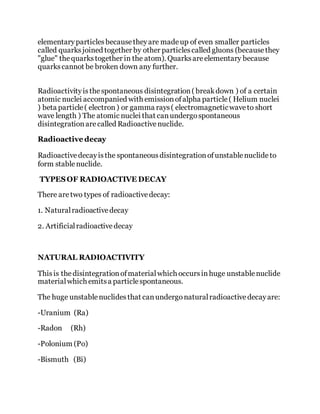
Definition: Alpha particlesarehelium nuclei emitted bylarge nucleus
during alpha decay. When the nucleus of an atom emit alpha particleit
loses 4 unit in its massnumber and 2 in itsatomic number.
The number left behind will takea different from which canbe stableor
unstable. If it is unstableit will be also disintegrateuntilthestablenucleus
is obtained.
NOTE: A stream of alpha particlesiscalled alpha rays.
PROPERTIESOF ALPHA PARTICLE
1. They are massiveparticle.
2. The carrypositivecharge.
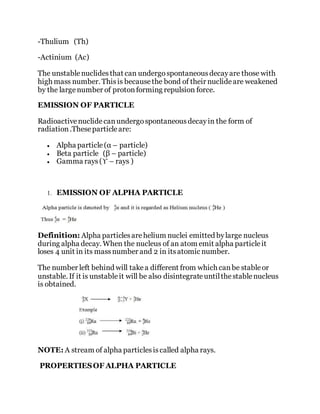
3. They can slightlybe detected by magnetic field and electric field.
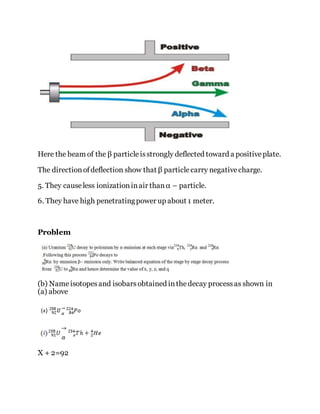
Here α – particleareslightly deflected toward South Pole.
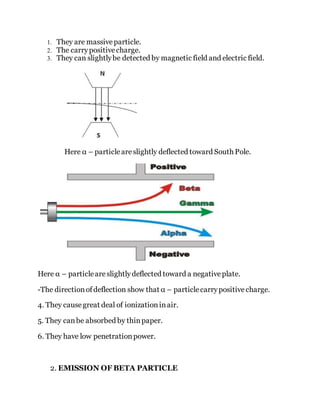
Here α – particleareslightlydeflected toward a negativeplate.
-The directionofdeflection show that α – particlecarrypositivecharge.
4. They causegreat deal of ionizationinair.
5. They canbe absorbed by thinpaper.
6. They have low penetrationpower.
2. EMISSION OF BETA PARTICLE
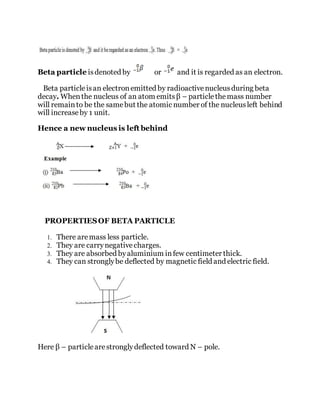
Beta particle isdenoted by or and it is regarded as an electron.
Beta particleisan electronemitted by radioactivenucleusduring beta
decay. Whenthe nucleus of an atom emitsβ – particlethemass number
will remainto be the samebut the atomic number of the nucleusleft behind
will increaseby 1 unit.
Hence a new nucleus is left behind
PROPERTIESOF BETA PARTICLE
1. There aremass less particle.
2. They are carrynegativecharges.
3. They are absorbed byaluminium infew centimeter thick.
4. They can stronglybe deflected by magnetic field and electric field.
Here β – particlearestronglydeflected toward N – pole.
Here the beam of the β particleisstrongly deflected toward a positiveplate.
The directionofdeflection show that β particlecarry negativecharge.
5. They causeless ionizationinair thanα – particle.
6. They have high penetratingpower up about 1 meter.
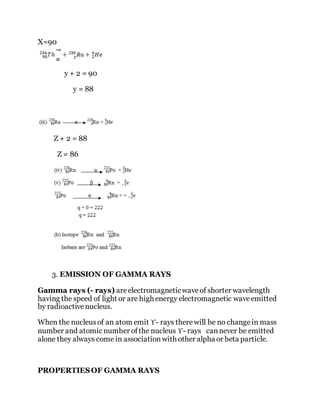
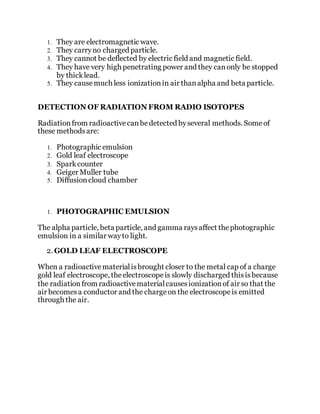
Problem
(b) Nameisotopesand isobarsobtained inthedecay processas shown in
(a) above
X + 2=92
X=90
y + 2 = 90
y = 88
Z + 2 = 88
Z = 86
3. EMISSION OF GAMMA RAYS
Gamma rays (- rays) areelectromagneticwaveof shorter wavelength
having the speed of light or are high energy electromagnetic waveemitted
by radioactivenucleus.
When the nucleusof an atom emit ϒ- rays therewill be no changein mass
number and atomic number ofthe nucleus ϒ- rays cannever be emitted
alone they always come in associationwith other alpha or beta particle.
PROPERTIESOF GAMMA RAYS
1. They are electromagnetic wave.
2. They carryno charged particle.
3. They cannot be deflected by electric field and magnetic field.
4. They have very high penetrating power and they canonly be stopped
by thicklead.
5. They causemuch less ionizationin air thanalpha and beta particle.
DETECTION OF RADIATION FROM RADIO ISOTOPES
Radiationfrom radioactivecanbedetected byseveral methods. Someof
these methodsare:
1. Photographic emulsion
2. Gold leaf electroscope
3. Sparkcounter
4. Geiger Muller tube
5. Diffusioncloud chamber
1. PHOTOGRAPHIC EMULSION
The alpha particle, beta particle, and gamma raysaffect thephotographic
emulsion in a similar wayto light.
2. GOLD LEAF ELECTROSCOPE
When a radioactivematerialisbrought closer to the metal cap of a charge
gold leaf electroscope, theelectroscopeis slowly discharged thisisbecause
the radiationfrom radioactivematerialcausesionizationof air so that the
air becomesa conductor and the chargeon the electroscopeis emitted
through the air.
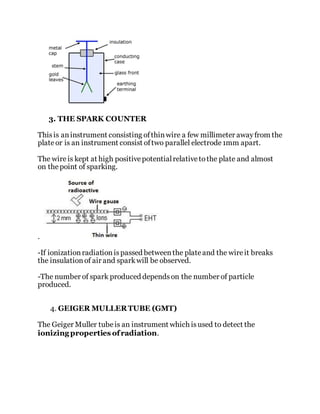
3. THE SPARK COUNTER
Thisis aninstrument consisting ofthinwire a few millimeter awayfrom the
plateor is an instrument consist oftwo parallel electrode1mm apart.
The wireis kept at high positivepotentialrelativetothe plate and almost
on thepoint of sparking.
.
-If ionizationradiationispassed betweenthe plateand the wireit breaks
the insulationof air and sparkwill be observed.
-The number of spark produced dependson the number of particle
produced.
4. GEIGER MULLER TUBE (GMT)
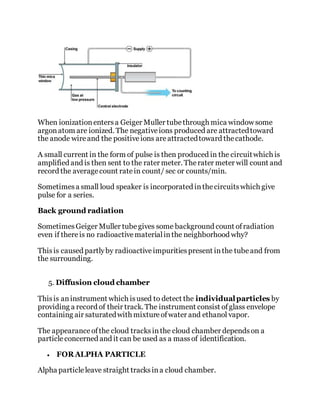
The Geiger Muller tubeis an instrument which isused to detect the
ionizing properties ofradiation.
When ionizationentersa Geiger Muller tubethrough mica window some
argonatom are ionized. The negativeions produced are attractedtoward
the anode wireand the positiveions areattractedtoward thecathode.
A small current in the form of pulse is then produced in the circuitwhich is
amplified and is then sent to the rater meter. Therater meter will count and
record the averagecount ratein count/ sec or counts/min.
Sometimesa small loud speaker is incorporated inthecircuitswhich give
pulse for a series.
Back ground radiation
SometimesGeiger Muller tubegives some background count ofradiation
even if thereis no radioactivematerialinthe neighborhood why?
Thisis caused partlyby radioactiveimpuritiespresent inthe tubeand from
the surrounding.
5. Diffusion cloud chamber
Thisis aninstrument which isused to detect the individualparticles by
providing a record of their track. The instrument consist ofglass envelope
containing air saturatedwith mixtureofwater and ethanol vapor.
The appearanceofthe cloud tracksinthe cloud chamber dependson a
particleconcerned and it can be used as a massof identification.
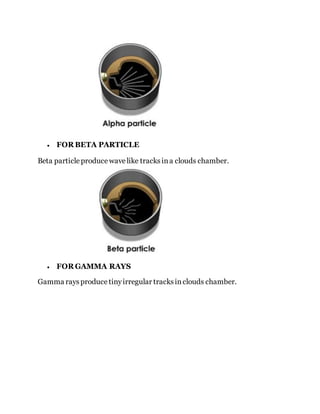
 FOR ALPHA PARTICLE
Alpha particleleave straight tracksina cloud chamber.
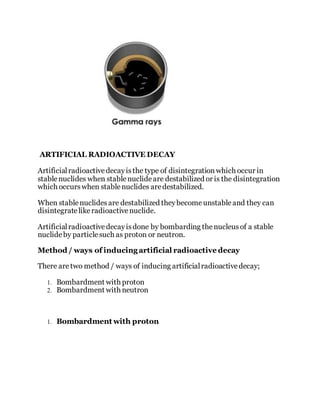
 FOR BETA PARTICLE
Beta particleproducewavelike tracksina clouds chamber.
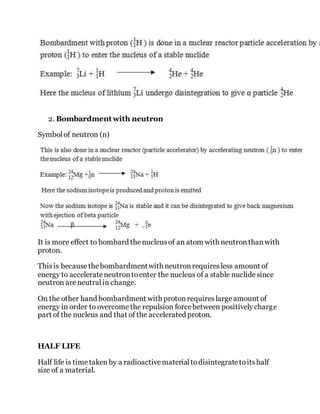
 FOR GAMMA RAYS
Gamma raysproducetinyirregular tracksinclouds chamber.
ARTIFICIAL RADIOACTIVE DECAY
Artificialradioactivedecayisthe type of disintegrationwhich occur in
stablenuclides when stablenuclideare destabilized or is the disintegration
which occurswhen stablenuclides aredestabilized.
When stablenuclidesare destabilized theybecomeunstableand they can
disintegratelikeradioactivenuclide.
Artificialradioactivedecayisdone by bombarding thenucleusof a stable
nuclideby particlesuch as proton or neutron.
Method / ways of inducing artificial radioactive decay
There aretwo method / ways of inducing artificialradioactivedecay;
1. Bombardment with proton
2. Bombardment with neutron
1. Bombardment with proton
2. Bombardment with neutron
Symbolof neutron (n)
It is more effect to bombard thenucleusof an atom with neutronthanwith
proton.
Thisis becausethebombardmentwith neutronrequiresless amount of
energy to accelerateneutrontoenter the nucleus of a stable nuclidesince
neutron areneutralin change.
On the other hand bombardment with protonrequireslargeamount of
energy in order to overcomethe repulsion forcebetween positivelycharge
part of the nucleus and that of the accelerated proton.
HALF LIFE
Half life is timetakenby a radioactivematerialtodisintegratetoitshalf
size of a material.
HALF LIFE PERIOD
Thehalf life period of a radioactivesampleisthat timetakenfor half the
atomsin any given sampleof the materialtodecay.
Each materialhasits own half life period. Example: The half life of radium
is 1600 years while that of bismuth is10min.
THE HALF LIFE EQUATION
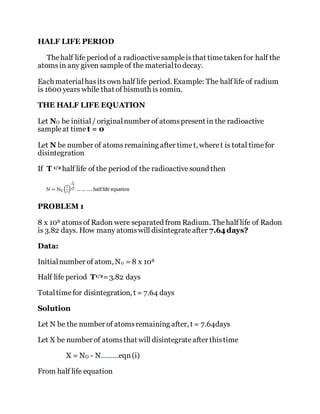
Let NO be initial/ originalnumber of atomspresent in the radioactive
sampleat time t = 0
Let N be number of atomsremaining after timet, wheret is total timefor
disintegration
If T 1/2 half life of the period of the radioactivesound then
PROBLEM 1
8 x 10⁸ atomsof Radon were separated from Radium. Thehalf life of Radon
is 3.82 days. How many atomswill disintegrateafter 7.64days?
Data:
Initialnumber of atom, N0 = 8 x 10⁸
Half life period T1/2=3.82 days
Totaltimefor disintegration, t = 7.64 days
Solution
Let N be the number of atomsremaining after, t = 7.64days
Let X be number of atomsthat will disintegrateafter thistime
X = NO - N.........eqn(i)
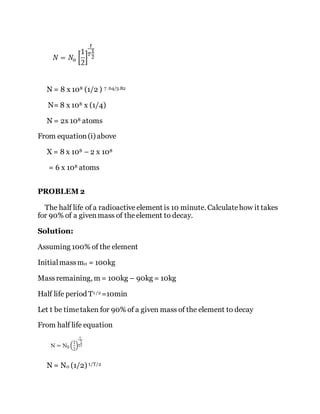
From half life equation
N = 8 x 10⁸ (1/2 ) 7 .64/3.82
N= 8 x 108 x (1/4)
N = 2x 10⁸ atoms
From equation(i) above
X = 8 x 10⁸ – 2 x 108
= 6 x 10⁸ atoms
PROBLEM 2
The half life of a radioactiveelement is 10 minute. Calculatehow it takes
for 90% of a givenmass of theelement to decay.
Solution:
Assuming 100% of the element
Initialmassm0 = 100kg
Massremaining, m = 100kg – 90kg = 10kg
Half life period T1 /2 =10min
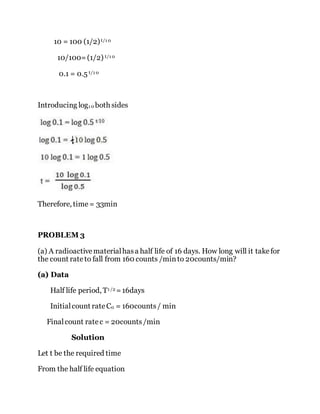
Let t be timetaken for 90% of a given mass of the element to decay
From half life equation
N = N0 (1/2) t/T/2
10 = 100 (1/2)t/1 0
10/100=(1/2) t/1 0
0.1 = 0.5 t/1 0
Introducing log1 0 both sides
Therefore, time= 33min
PROBLEM 3
(a) A radioactivematerialhasa half life of 16 days. How long will it takefor
the count rateto fall from 160 counts /minto 20counts/min?
(a) Data
Half life period, T1 /2 =16days
Initialcount rateC0 = 160counts/ min
Finalcount ratec = 20counts/min
Solution
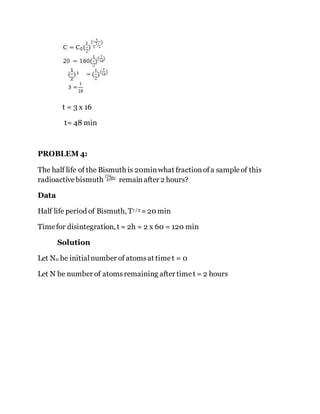
Let t be the required time
From the half life equation
t = 3 x 16
t= 48 min
PROBLEM 4:
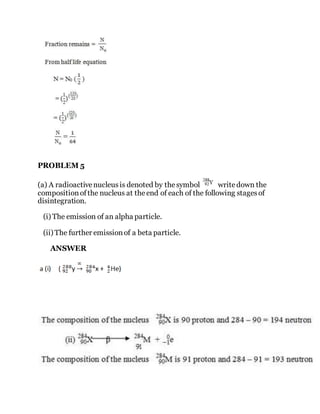
The half life of the Bismuth is 20minwhat fractionofa sampleof this
radioactivebismuth remainafter 2 hours?
Data
Half life period of Bismuth, T1 /2 =20 min
Timefor disintegration, t = 2h = 2 x 60 = 120 min
Solution
Let N0 be initialnumber of atomsat timet = 0
Let N be number of atomsremaining after timet = 2 hours
PROBLEM 5
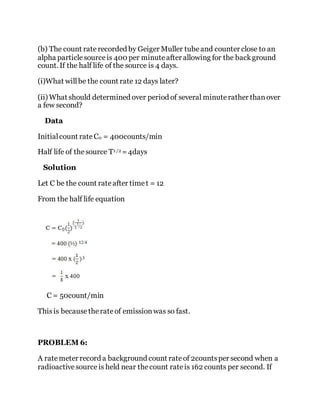
(a) A radioactivenucleusis denoted by thesymbol writedown the
compositionofthe nucleus at theend of each of the following stagesof
disintegration.
(i) The emission of an alpha particle.
(ii) The further emissionof a beta particle.
ANSWER
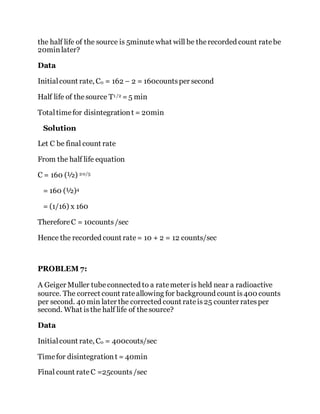
(b) The count rate recorded by Geiger Muller tubeand counter close to an
alpha particlesourceis 400 per minuteafter allowing for the background
count. If the half life of the source is 4 days.
(i)What willbe the count rate 12 days later?
(ii) What should determined over period of several minuterather thanover
a few second?
Data
Initialcount rateC0 = 400counts/min
Half life of thesource T1 /2 =4days
Solution
Let C be the count rateafter timet = 12
From the half life equation
C = 50count/min
Thisis becausetherateof emissionwas so fast.
PROBLEM 6:
A ratemeter record a background count rateof 2countsper second when a
radioactivesourceis held near thecount rateis 162 counts per second. If
the half life of the source is 5minute what will be therecorded count ratebe
20minlater?
Data
Initialcount rate, C0 = 162 – 2 = 160countsper second
Half life of thesource T1 /2 =5 min
Totaltimefor disintegrationt = 20min
Solution
Let C be final count rate
From the half life equation
C = 160 (½) 20/5
= 160 (½)4
= (1/16) x 160
ThereforeC = 10counts/sec
Hence the recorded count rate= 10 + 2 = 12 counts/sec
PROBLEM 7:
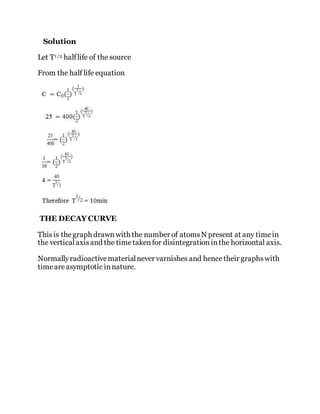
A Geiger Muller tubeconnected to a ratemeter is held near a radioactive
source. The correct count rateallowing for background count is400 counts
per second. 40 min later the corrected count rateis25 counter ratesper
second. What isthe half life of thesource?
Data
Initialcount rate, C0 = 400couts/sec
Timefor disintegrationt = 40min
Final count rateC =25counts/sec
Solution
Let T1 /2 halflife of the source
From the half life equation
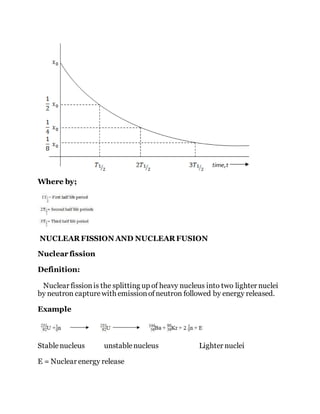
THE DECAY CURVE
Thisis thegraph drawnwith the number of atomsN present at any timein
the verticalaxisand the timetakenfor disintegrationinthe horizontal axis.
Normallyradioactivematerialnever varnishes and hencetheir graphswith
timeareasymptotic innature.
Where by;
NUCLEAR FISSION AND NUCLEAR FUSION
Nuclear fission
Definition:
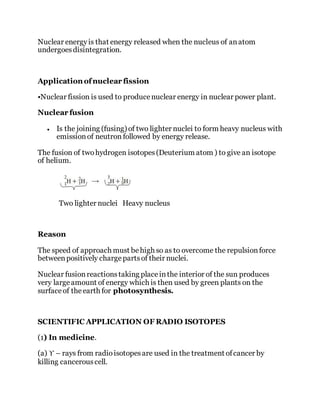
Nuclear fissionis the splitting up of heavy nucleus into two lighter nuclei
by neutron capturewith emissionofneutron followed by energy released.
Example
Stablenucleus unstablenucleus Lighter nuclei
E = Nuclear energy release
Nuclear energyis that energy released when the nucleus of anatom
undergoesdisintegration.
Application ofnuclear fission
•Nuclear fission is used to producenuclear energy in nuclear power plant.
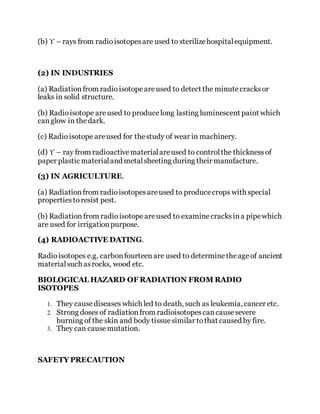
Nuclear fusion
 Is the joining (fusing) of two lighter nuclei to form heavy nucleus with
emissionof neutron followed by energy release.
The fusion of twohydrogen isotopes(Deuterium atom ) to give an isotope
of helium.
Two lighter nuclei Heavy nucleus
Reason
The speed of approach must behigh so as to overcome the repulsionforce
betweenpositively chargepartsof their nuclei.
Nuclear fusionreactionstaking placeinthe interior of the sun produces
very largeamount of energy which is then used by green plants on the
surfaceof theearth for photosynthesis.
SCIENTIFIC APPLICATION OF RADIO ISOTOPES
(1) In medicine.
(a) ϒ – rays from radioisotopesare used in the treatment ofcancer by
killing cancerouscell.
(b) ϒ – rays from radioisotopesare used to sterilizehospitalequipment.
(2) IN INDUSTRIES
(a) Radiationfrom radio isotopeareused to detect the minutecracksor
leaks in solid structure.
(b) Radioisotope areused to producelong lasting luminescent paint which
canglow in thedark.
(c) Radioisotope areused for thestudy of wear in machinery.
(d) ϒ – ray from radioactivematerialareused to controlthe thicknessof
paper plastic materialand metalsheeting during their manufacture.
(3) IN AGRICULTURE.
(a) Radiationfrom radioisotopesareused to producecrops with special
propertiestoresist pest.
(b) Radiation from radioisotopeareused to examinecracksina pipewhich
are used for irrigationpurpose.
(4) RADIOACTIVE DATING.
Radioisotopes e.g. carbonfourteen are used to determinetheageof ancient
materialsuch asrocks, wood etc.
BIOLOGICAL HAZARD OF RADIATION FROM RADIO
ISOTOPES
1. They causediseases which led to death, such as leukemia, cancer etc.
2. Strong doses of radiationfrom radioisotopescancausesevere
burning of the skin and body tissue similar tothat caused by fire.
3. They can causemutation.
SAFETY PRECAUTION
1. Radioactivematerialarehandled by mechanicaltongsoperated by
remotecontrol / equipment with theoperator beam being a thickwall
of lead or concretewhich shields him from the radiation.
2. Radioactivematerialarestored in thickwall lead container.

Radioactivity

  • 1.
    RADIOACTIVITY Atomic theory In chemistryandphysics, the atomic theoryexplainshow our understanding ofthe atom has changed over time. Atomswere once thought tobe the smallest piecesof matter. The first idea of the atom camefrom the Greek philosopher Democritus. A lot of the ideasin the moderntheory camefrom John Dalton, a British chemist and physicist. Democritus' atomictheory Democritus(Greekphilosopher, 460 BC)thought that ifyou cut something in half againand again, you would at last have to stop. He said that thislast pieceof matter could not be cut any smaller. Democrituscalled these small piecesof matter atoms, which means"indivisible". He thought that atoms would last forever, never changeand could not be destroyed. Democritus thought that therewasnothing between the atomsand that everything around us could be explained if we could understand how atomsworked. Sir Joseph John Thomson (1856–1940), English physicianwhodiscovered the electronand determined itsnegativecharge. He got the Nobel Prizein Physicsfor 1906. Dalton's atomic theory In 1803, the English scientist JohnDalton(1766–1844) , reworked Democritus' theory, as follows: 1. All matter isformed of atoms. 2. That atomsareindivisibleand invisibleparticles. 3. That atomsof the same element are of thesame type and mass. 4. The atomsthat makecompoundsarepresent in set proportions.
  • 2.
    5. Chemicalchangescorrespond toa reorganisationofthe atomstaking part in the chemicalreaction. Dalton defined the atom as the basic unit of an element that cantake part in a chemicalcombination. In 1850, Sir William Crookes constructed a 'dischargetube', that isa glass tubewith the air removed and metallic electrodesat itsends, connected toa high voltage source. When creating a vacuum inthe tube, a light discharge canbe seen that goes from the cathode(negatively-chargedelectrode) to the anode (positively-chargedelectrode). Crookes named the emission 'cathoderays'. Thomson'satomic model After the cathoderayexperiments, Sir Joseph John Thomson established that the emitted raywasformed by negativecharges, becausetheywere attracted bythe positivepole. Thomson knew that the atomswere electricallyneutral, but he established that, for thisto occur, an atom should have the same quantityofnegativeand positivecharges. The negativechargeswerenamed electrons (e-). According totheassumptionsestablished about theatomsneutralcharge, Thomson proposed the first atomic model, that was described asa positively-charged sphereinwhich the electrons wereinlaid (with negative charges). It is known as the plum pudding model. In 1906, Robert Millikart determinedthat theelectronshad a Coulomb (C) chargeof -1.6 × 101 9, something thatallowed calculationofits mass, infinitelysmall, equal to 9.109 ×1031 kg.
  • 3.
    In the sametime, experimentsbyEugene Goldsteinin 1886 with cathode dischargetubesallowed him to establish that the positivechargeshad a mass of 1.6726 ×1027 kg and an electricalchargeof+1.6 × 10 1 9 C. Lord Ernest Rutherford later named these positively charged particlesprotons. Lord Rutherford atomic model Atomic experiment ofLord Ernest Rutherford In 1910, the New Zealand physicist Ernest Rutherford suggested that the positivechargesof the atom were found mostly in its center, in the nucleus, and the electrons(e-) around it. Rutherford showed this when he used an alpha radiationsource(from helium) to hit the very thin gold sheets, surrounded by a Zinc sulphide lampshadethat produced visiblelight when hit by alpha emissions. This experiment wascalled the Geiger–Marsdenexperimentor the Gold Foil Experiment. By thisstagethe mainelements of theatom were clear, plus the discovery that atomsof an element may occur in isotopes. Isotopes vary in the number of neutronspresent in thenucleus. Although this model waswell understood, modern physicshas developed further, and present-dayideas cannot be madeeasy to understand. Modern physics Atomsare not elementaryparticles, becausetheyaremadeof subatomic particleslikeprotons and neutrons. Protonsand neutrons arealso not
  • 4.
    elementaryparticlesbecausetheyare madeup ofeven smaller particles called quarksjoined together by other particlescalled gluons (becausethey "glue" thequarkstogether in the atom). Quarksareelementary because quarkscannot be broken down any further. Radioactivityisthespontaneous disintegration( breakdown ) of a certain atomic nuclei accompanied with emissionofalpha particle( Helium nuclei ) beta particle( electron) or gamma rays( electromagneticwaveto short wave length ) The atomic nuclei that canundergospontaneous disintegrationarecalled Radioactivenuclide. Radioactive decay Radioactivedecayisthe spontaneousdisintegrationofunstablenuclideto form stablenuclide. TYPESOF RADIOACTIVE DECAY There aretwo types of radioactivedecay: 1. Naturalradioactivedecay 2. Artificialradioactivedecay NATURAL RADIOACTIVITY Thisis thedisintegrationofmaterialwhich occursinhuge unstablenuclide materialwhich emitsa particlespontaneous. The huge unstablenuclidesthat canundergonaturalradioactivedecayare: -Uranium (Ra) -Radon (Rh) -Polonium (Po) -Bismuth (Bi)
  • 5.
    -Thulium (Th) -Actinium (Ac) Theunstablenuclidesthat can undergospontaneousdecayare those with high mass number. Thisis becausethe bond of their nuclideare weakened by the largenumber of protonforming repulsion force. EMISSION OF PARTICLE Radioactivenuclidecanundergospontaneousdecayin the form of radiation.Theseparticleare:  Alpha particle(α – particle)  Beta particle (β – particle)  Gamma rays(ϒ – rays ) 1. EMISSION OF ALPHA PARTICLE Definition: Alpha particlesarehelium nuclei emitted bylarge nucleus during alpha decay. When the nucleus of an atom emit alpha particleit loses 4 unit in its massnumber and 2 in itsatomic number. The number left behind will takea different from which canbe stableor unstable. If it is unstableit will be also disintegrateuntilthestablenucleus is obtained. NOTE: A stream of alpha particlesiscalled alpha rays. PROPERTIESOF ALPHA PARTICLE
  • 6.
    1. They aremassiveparticle. 2. The carrypositivecharge. 3. They can slightlybe detected by magnetic field and electric field. Here α – particleareslightly deflected toward South Pole. Here α – particleareslightlydeflected toward a negativeplate. -The directionofdeflection show that α – particlecarrypositivecharge. 4. They causegreat deal of ionizationinair. 5. They canbe absorbed by thinpaper. 6. They have low penetrationpower. 2. EMISSION OF BETA PARTICLE
  • 7.
    Beta particle isdenotedby or and it is regarded as an electron. Beta particleisan electronemitted by radioactivenucleusduring beta decay. Whenthe nucleus of an atom emitsβ – particlethemass number will remainto be the samebut the atomic number of the nucleusleft behind will increaseby 1 unit. Hence a new nucleus is left behind PROPERTIESOF BETA PARTICLE 1. There aremass less particle. 2. They are carrynegativecharges. 3. They are absorbed byaluminium infew centimeter thick. 4. They can stronglybe deflected by magnetic field and electric field. Here β – particlearestronglydeflected toward N – pole.
  • 8.
    Here the beamof the β particleisstrongly deflected toward a positiveplate. The directionofdeflection show that β particlecarry negativecharge. 5. They causeless ionizationinair thanα – particle. 6. They have high penetratingpower up about 1 meter. Problem (b) Nameisotopesand isobarsobtained inthedecay processas shown in (a) above X + 2=92
  • 9.
    X=90 y + 2= 90 y = 88 Z + 2 = 88 Z = 86 3. EMISSION OF GAMMA RAYS Gamma rays (- rays) areelectromagneticwaveof shorter wavelength having the speed of light or are high energy electromagnetic waveemitted by radioactivenucleus. When the nucleusof an atom emit ϒ- rays therewill be no changein mass number and atomic number ofthe nucleus ϒ- rays cannever be emitted alone they always come in associationwith other alpha or beta particle. PROPERTIESOF GAMMA RAYS
  • 10.
    1. They areelectromagnetic wave. 2. They carryno charged particle. 3. They cannot be deflected by electric field and magnetic field. 4. They have very high penetrating power and they canonly be stopped by thicklead. 5. They causemuch less ionizationin air thanalpha and beta particle. DETECTION OF RADIATION FROM RADIO ISOTOPES Radiationfrom radioactivecanbedetected byseveral methods. Someof these methodsare: 1. Photographic emulsion 2. Gold leaf electroscope 3. Sparkcounter 4. Geiger Muller tube 5. Diffusioncloud chamber 1. PHOTOGRAPHIC EMULSION The alpha particle, beta particle, and gamma raysaffect thephotographic emulsion in a similar wayto light. 2. GOLD LEAF ELECTROSCOPE When a radioactivematerialisbrought closer to the metal cap of a charge gold leaf electroscope, theelectroscopeis slowly discharged thisisbecause the radiationfrom radioactivematerialcausesionizationof air so that the air becomesa conductor and the chargeon the electroscopeis emitted through the air.
  • 11.
    3. THE SPARKCOUNTER Thisis aninstrument consisting ofthinwire a few millimeter awayfrom the plateor is an instrument consist oftwo parallel electrode1mm apart. The wireis kept at high positivepotentialrelativetothe plate and almost on thepoint of sparking. . -If ionizationradiationispassed betweenthe plateand the wireit breaks the insulationof air and sparkwill be observed. -The number of spark produced dependson the number of particle produced. 4. GEIGER MULLER TUBE (GMT) The Geiger Muller tubeis an instrument which isused to detect the ionizing properties ofradiation.
  • 12.
    When ionizationentersa GeigerMuller tubethrough mica window some argonatom are ionized. The negativeions produced are attractedtoward the anode wireand the positiveions areattractedtoward thecathode. A small current in the form of pulse is then produced in the circuitwhich is amplified and is then sent to the rater meter. Therater meter will count and record the averagecount ratein count/ sec or counts/min. Sometimesa small loud speaker is incorporated inthecircuitswhich give pulse for a series. Back ground radiation SometimesGeiger Muller tubegives some background count ofradiation even if thereis no radioactivematerialinthe neighborhood why? Thisis caused partlyby radioactiveimpuritiespresent inthe tubeand from the surrounding. 5. Diffusion cloud chamber Thisis aninstrument which isused to detect the individualparticles by providing a record of their track. The instrument consist ofglass envelope containing air saturatedwith mixtureofwater and ethanol vapor. The appearanceofthe cloud tracksinthe cloud chamber dependson a particleconcerned and it can be used as a massof identification.  FOR ALPHA PARTICLE Alpha particleleave straight tracksina cloud chamber.
  • 13.
     FOR BETAPARTICLE Beta particleproducewavelike tracksina clouds chamber.  FOR GAMMA RAYS Gamma raysproducetinyirregular tracksinclouds chamber.
  • 14.
    ARTIFICIAL RADIOACTIVE DECAY Artificialradioactivedecayisthetype of disintegrationwhich occur in stablenuclides when stablenuclideare destabilized or is the disintegration which occurswhen stablenuclides aredestabilized. When stablenuclidesare destabilized theybecomeunstableand they can disintegratelikeradioactivenuclide. Artificialradioactivedecayisdone by bombarding thenucleusof a stable nuclideby particlesuch as proton or neutron. Method / ways of inducing artificial radioactive decay There aretwo method / ways of inducing artificialradioactivedecay; 1. Bombardment with proton 2. Bombardment with neutron 1. Bombardment with proton
  • 15.
    2. Bombardment withneutron Symbolof neutron (n) It is more effect to bombard thenucleusof an atom with neutronthanwith proton. Thisis becausethebombardmentwith neutronrequiresless amount of energy to accelerateneutrontoenter the nucleus of a stable nuclidesince neutron areneutralin change. On the other hand bombardment with protonrequireslargeamount of energy in order to overcomethe repulsion forcebetween positivelycharge part of the nucleus and that of the accelerated proton. HALF LIFE Half life is timetakenby a radioactivematerialtodisintegratetoitshalf size of a material.
  • 16.
    HALF LIFE PERIOD Thehalflife period of a radioactivesampleisthat timetakenfor half the atomsin any given sampleof the materialtodecay. Each materialhasits own half life period. Example: The half life of radium is 1600 years while that of bismuth is10min. THE HALF LIFE EQUATION Let NO be initial/ originalnumber of atomspresent in the radioactive sampleat time t = 0 Let N be number of atomsremaining after timet, wheret is total timefor disintegration If T 1/2 half life of the period of the radioactivesound then PROBLEM 1 8 x 10⁸ atomsof Radon were separated from Radium. Thehalf life of Radon is 3.82 days. How many atomswill disintegrateafter 7.64days? Data: Initialnumber of atom, N0 = 8 x 10⁸ Half life period T1/2=3.82 days Totaltimefor disintegration, t = 7.64 days Solution Let N be the number of atomsremaining after, t = 7.64days Let X be number of atomsthat will disintegrateafter thistime X = NO - N.........eqn(i) From half life equation
  • 17.
    N = 8x 10⁸ (1/2 ) 7 .64/3.82 N= 8 x 108 x (1/4) N = 2x 10⁸ atoms From equation(i) above X = 8 x 10⁸ – 2 x 108 = 6 x 10⁸ atoms PROBLEM 2 The half life of a radioactiveelement is 10 minute. Calculatehow it takes for 90% of a givenmass of theelement to decay. Solution: Assuming 100% of the element Initialmassm0 = 100kg Massremaining, m = 100kg – 90kg = 10kg Half life period T1 /2 =10min Let t be timetaken for 90% of a given mass of the element to decay From half life equation N = N0 (1/2) t/T/2
  • 18.
    10 = 100(1/2)t/1 0 10/100=(1/2) t/1 0 0.1 = 0.5 t/1 0 Introducing log1 0 both sides Therefore, time= 33min PROBLEM 3 (a) A radioactivematerialhasa half life of 16 days. How long will it takefor the count rateto fall from 160 counts /minto 20counts/min? (a) Data Half life period, T1 /2 =16days Initialcount rateC0 = 160counts/ min Finalcount ratec = 20counts/min Solution Let t be the required time From the half life equation
  • 19.
    t = 3x 16 t= 48 min PROBLEM 4: The half life of the Bismuth is 20minwhat fractionofa sampleof this radioactivebismuth remainafter 2 hours? Data Half life period of Bismuth, T1 /2 =20 min Timefor disintegration, t = 2h = 2 x 60 = 120 min Solution Let N0 be initialnumber of atomsat timet = 0 Let N be number of atomsremaining after timet = 2 hours
  • 20.
    PROBLEM 5 (a) Aradioactivenucleusis denoted by thesymbol writedown the compositionofthe nucleus at theend of each of the following stagesof disintegration. (i) The emission of an alpha particle. (ii) The further emissionof a beta particle. ANSWER
  • 21.
    (b) The countrate recorded by Geiger Muller tubeand counter close to an alpha particlesourceis 400 per minuteafter allowing for the background count. If the half life of the source is 4 days. (i)What willbe the count rate 12 days later? (ii) What should determined over period of several minuterather thanover a few second? Data Initialcount rateC0 = 400counts/min Half life of thesource T1 /2 =4days Solution Let C be the count rateafter timet = 12 From the half life equation C = 50count/min Thisis becausetherateof emissionwas so fast. PROBLEM 6: A ratemeter record a background count rateof 2countsper second when a radioactivesourceis held near thecount rateis 162 counts per second. If
  • 22.
    the half lifeof the source is 5minute what will be therecorded count ratebe 20minlater? Data Initialcount rate, C0 = 162 – 2 = 160countsper second Half life of thesource T1 /2 =5 min Totaltimefor disintegrationt = 20min Solution Let C be final count rate From the half life equation C = 160 (½) 20/5 = 160 (½)4 = (1/16) x 160 ThereforeC = 10counts/sec Hence the recorded count rate= 10 + 2 = 12 counts/sec PROBLEM 7: A Geiger Muller tubeconnected to a ratemeter is held near a radioactive source. The correct count rateallowing for background count is400 counts per second. 40 min later the corrected count rateis25 counter ratesper second. What isthe half life of thesource? Data Initialcount rate, C0 = 400couts/sec Timefor disintegrationt = 40min Final count rateC =25counts/sec
  • 23.
    Solution Let T1 /2halflife of the source From the half life equation THE DECAY CURVE Thisis thegraph drawnwith the number of atomsN present at any timein the verticalaxisand the timetakenfor disintegrationinthe horizontal axis. Normallyradioactivematerialnever varnishes and hencetheir graphswith timeareasymptotic innature.
  • 24.
    Where by; NUCLEAR FISSIONAND NUCLEAR FUSION Nuclear fission Definition: Nuclear fissionis the splitting up of heavy nucleus into two lighter nuclei by neutron capturewith emissionofneutron followed by energy released. Example Stablenucleus unstablenucleus Lighter nuclei E = Nuclear energy release
  • 25.
    Nuclear energyis thatenergy released when the nucleus of anatom undergoesdisintegration. Application ofnuclear fission •Nuclear fission is used to producenuclear energy in nuclear power plant. Nuclear fusion  Is the joining (fusing) of two lighter nuclei to form heavy nucleus with emissionof neutron followed by energy release. The fusion of twohydrogen isotopes(Deuterium atom ) to give an isotope of helium. Two lighter nuclei Heavy nucleus Reason The speed of approach must behigh so as to overcome the repulsionforce betweenpositively chargepartsof their nuclei. Nuclear fusionreactionstaking placeinthe interior of the sun produces very largeamount of energy which is then used by green plants on the surfaceof theearth for photosynthesis. SCIENTIFIC APPLICATION OF RADIO ISOTOPES (1) In medicine. (a) ϒ – rays from radioisotopesare used in the treatment ofcancer by killing cancerouscell.
  • 26.
    (b) ϒ –rays from radioisotopesare used to sterilizehospitalequipment. (2) IN INDUSTRIES (a) Radiationfrom radio isotopeareused to detect the minutecracksor leaks in solid structure. (b) Radioisotope areused to producelong lasting luminescent paint which canglow in thedark. (c) Radioisotope areused for thestudy of wear in machinery. (d) ϒ – ray from radioactivematerialareused to controlthe thicknessof paper plastic materialand metalsheeting during their manufacture. (3) IN AGRICULTURE. (a) Radiationfrom radioisotopesareused to producecrops with special propertiestoresist pest. (b) Radiation from radioisotopeareused to examinecracksina pipewhich are used for irrigationpurpose. (4) RADIOACTIVE DATING. Radioisotopes e.g. carbonfourteen are used to determinetheageof ancient materialsuch asrocks, wood etc. BIOLOGICAL HAZARD OF RADIATION FROM RADIO ISOTOPES 1. They causediseases which led to death, such as leukemia, cancer etc. 2. Strong doses of radiationfrom radioisotopescancausesevere burning of the skin and body tissue similar tothat caused by fire. 3. They can causemutation. SAFETY PRECAUTION
  • 27.
    1. Radioactivematerialarehandled bymechanicaltongsoperated by remotecontrol / equipment with theoperator beam being a thickwall of lead or concretewhich shields him from the radiation. 2. Radioactivematerialarestored in thickwall lead container.