


Therapeutic Fasting
Seoul National University Dental Hospital
Craniomaxillofacial Cosmetic Surgery
Mohammed Bakri ( MDS candidate )
17/06/2017
Contintes
 Definition
 Forms of Fasting
 A Short History of Fasting
 Physiological Reactions to Fasting
 Safely Fasting
 Efficiency of Fa sting
 Breaking the Fast
Definition
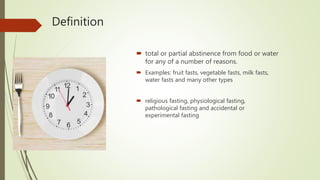
 total or partial abstinence from food or water
for any of a number of reasons.
 Examples: fruit fasts, vegetable fasts, milk fasts,
water fasts and many other types
 religious fasting, physiological fasting,
pathological fasting and accidental or
experimental fasting
Therapeutic fasting
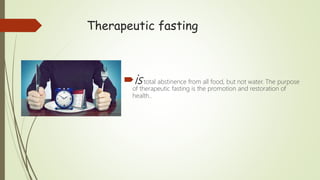
istotal abstinence from all food, but not water. The purpose
of therapeutic fasting is the promotion and restoration of
health..
 The first records of human fasting for the remedy of disease
go back to the ancient civilizations of Greece .
 Socrates said ( fast 10 days at a time will "attain mental and
physical efficiency."
 Pythagoras fasted for 40 days before taking his examination at
the University of Alexandria
 The ancient Egyptians used to treat syphilis with fasting cures.
 The great Greek physician, Hippocrates, prescribed fasting
during the critical periods of disease.
 The Arab physician, Aicenna, prescribed fasting for three to
five weeks at a time.
Plutarch said: "Instead of using medicine better fast a day.
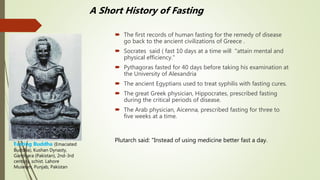
Fasting Buddha (Emaciated
Buddha), Kushan Dynasty,
Gandhara (Pakistan), 2nd-3rd
century, schist. Lahore
Museum, Punjab, Pakistan
A Short History of Fasting
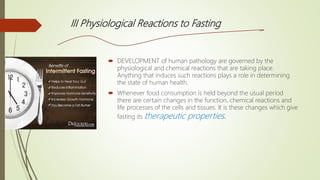
IlI Physiological Reactions to Fasting
 DEVELOPMENT of human pathology are governed by the
physiological and chemical reactions that are taking place.
Anything that induces such reactions plays a role in determining
the state of human health.
 Whenever food consumption is held beyond the usual period
there are certain changes in the function, chemical reactions and
life processes of the cells and tissues. It is these changes which give
fasting its therapeutic properties.
By considering the
physiological
reactions to fasting
we can gain an
understanding of the
reasons which
determine its
therapeutic value.
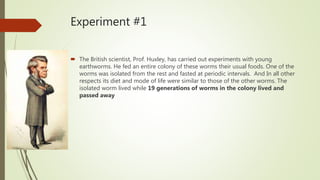
Experiment #1
 The British scientist, Prof. Huxley, has carried out experiments with young
earthworms. He fed an entire colony of these worms their usual foods. One of the
worms was isolated from the rest and fasted at periodic intervals. And In all other
respects its diet and mode of life were similar to those of the other worms. The
isolated worm lived while 19 generations of worms in the colony lived and
passed away
Experiment #2
 Prof. Child, of the University of Chicago, likewise has used worms to determine
 the effects of fasting. He took a group of small flat worms which had grown old
then and fasted them for months, until they had been reduced to a minimum size.
Then he started feeding them again, and as they were growing back to their
normal size, they were just as young, from a physiological standpoint, as they ever
were.
Prof. Child remarks: "Partial starvation inhibits aging
Experiment #3
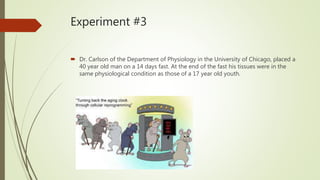
 Dr. Carlson of the Department of Physiology in the University of Chicago, placed a
40 year old man on a 14 days fast. At the end of the fast his tissues were in the
same physiological condition as those of a 17 year old youth.
Experiment #4
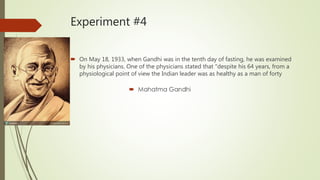
 On May 18, 1933, when Gandhi was in the tenth day of fasting, he was examined
by his physicians. One of the physicians stated that "despite his 64 years, from a
physiological point of view the Indian leader was as healthy as a man of forty
Some of Experiments’ Findings
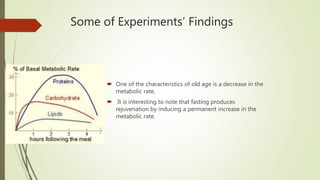
 One of the characteristics of old age is a decrease in the
metabolic rate.
 It is interesting to note that fasting produces
rejuvenation by inducing a permanent increase in the
metabolic rate.
Some of Experiments’ Findings
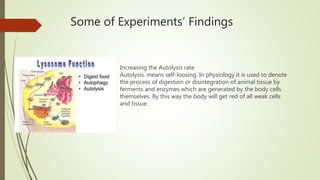
Increasing the Autolysis rate
Autolysis, means self-loosing. In physiology it is used to denote
the process of digestion or disintegration of animal tissue by
ferments and enzymes which are generated by the body cells
themselves. By this way the body will get red of all weak cells
and tissue.
Some of Experiments’ Findings
 During the fast, the body has the opportunity to redistribute its nutritive supplies
 So super-supplies will consumed and utilized first. The absorption of normal
muscles and tissues on a fast is observable,
Some of Experiments’ Findings
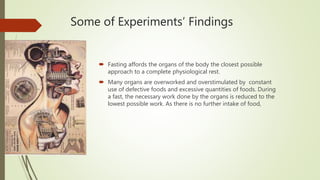
 Fasting affords the organs of the body the closest possible
approach to a complete physiological rest.
 Many organs are overworked and overstimulated by constant
use of defective foods and excessive quantities of foods. During
a fast, the necessary work done by the organs is reduced to the
lowest possible work. As there is no further intake of food,
Some of Experiments’ Findings
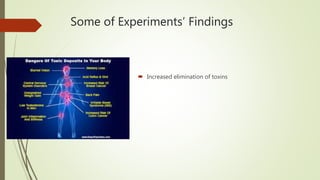
 Increased elimination of toxins
Some of Experiments’ Findings
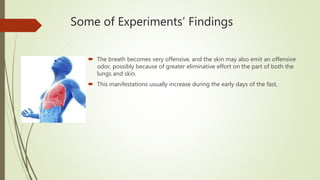
 The breath becomes very offensive, and the skin may also emit an offensive
odor, possibly because of greater eliminative effort on the part of both the
lungs and skin.
 This manifestations usually increase during the early days of the fast,
Fasting for therapeutic purposes has been very extensive.
There are a number of prominent physicians who can be
referred to, each of whom has had experience in
conducting thousands of fasts. Among these is Dr.
Herbert M. Shelton, who has conducted over 30,000 fasts
at his institute ranging in length from a few days to as
many months. This record involves more experience with
fasting than any other living physician.
THE DURATION OF THE FAST
 duration of the complete fast is a matter that can neither be
foretold nor prescribed in any individual case, for the treatment
has its beginning in disease and its end in the hunger that marks
the return of digestive power. Until the latter makes itself
apparent, and it cannot be mistaken, the fast should continue.
Then, and not till then, is the system in condition again to receive
and transform food into tissue structure.
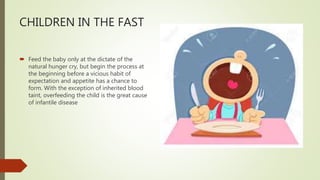
CHILDREN IN THE FAST
 Feed the baby only at the dictate of the
natural hunger cry, but begin the process at
the beginning before a vicious habit of
expectation and appetite has a chance to
form. With the exception of inherited blood
taint, overfeeding the child is the great cause
of infantile disease
Safely of the Fast
 Generally speaking, initial consideration of fasting is associated with fear both of
death and the possibility of doing serious harm to the body.
 During a fast, when the body's energy is not used in the work of digestion, the
need for minerals is lowered. The reserves of these elements in the body are
sufficient to meet all needs
 Man can live much longer on water alone than he can on a diet of white flour
and water simply because use of the flour increases the need for other elements
to enable the body to digest
Safely of the Fast
 hunger is normal throughout the fast, whereas the fact is that it only exists for the first few
days, and when acute disease is present, it often does not exist at all
 , the contrast between deficiency diets and fasting is pointed out by Prof. Morgulis, who
states that "our observation that the chronically underfed dog became debilitated in a
measure not commonly noted in animals which undergo a straight fast
 It is important to distinguishing between the periods of fasting and starvation
 Roger and Jause found that fasting produces an increased tolerance toward bacilli coli in
rabbits. Three to eleven days after the animals had fasted for five to seven days so the
immunity will be more resistance to disease.
 During the first day of the fast, a marked desire for food is usually present by
afternoon or evening. On the second day the desire is often greatly increased, with
the degree of hunger reaching its maximum. On the third day the hunger usually in
some cases it entirely disappears. In nearly all cases the disappearance of hunger is
complete by the fourth or fifth day.
 Nausea and vomiting can even occur at the sight and smell of food. This state
continues until natural hunger returns weeks or months later, or until the fast is
broken, when appetite rapidly returns. Dr. Weger reported that about one in each
forty of his patients failed to lose their hunger on the fast. Other physicians also
reported similar experiences.
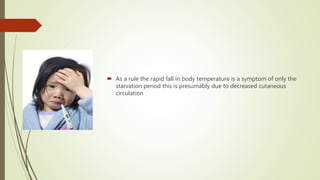
 As a rule the rapid fall in body temperature is a symptom of only the
starvation period this is presumably due to decreased cutaneous
circulation
DEATH IN THE FAST
 Death from starvation is impossible in a fast properly applied
 Death in the fast never has occurred when merely FUNCTIONAL disease was
present, and never has resulted from abstinence from food, but was the inevitable
consequence of obstruction by ORGANIC imperfection of the avenues through
which the energy of the body is expressed.
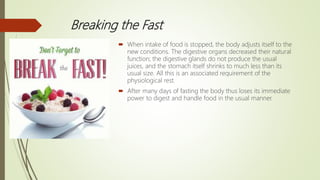
Breaking the Fast
 When intake of food is stopped, the body adjusts itself to the
new conditions. The digestive organs decreased their natural
function; the digestive glands do not produce the usual
juices, and the stomach itself shrinks to much less than its
usual size. All this is an associated requirement of the
physiological rest.
 After many days of fasting the body thus loses its immediate
power to digest and handle food in the usual manner.
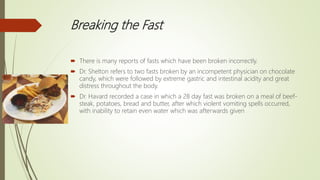
Breaking the Fast
 There is many reports of fasts which have been broken incorrectly.
 Dr. Shelton refers to two fasts broken by an incompetent physician on chocolate
candy, which were followed by extreme gastric and intestinal acidity and great
distress throughout the body.
 Dr. Havard recorded a case in which a 28 day fast was broken on a meal of beef-
steak, potatoes, bread and butter, after which violent vomiting spells occurred,
with inability to retain even water which was afterwards given
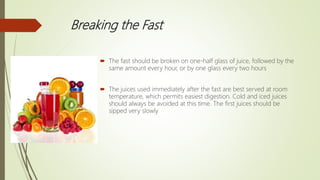
Breaking the Fast
 The fast should be broken on one-half glass of juice, followed by the
same amount every hour, or by one glass every two hours
 The juices used immediately after the fast are best served at room
temperature, which permits easiest digestion. Cold and iced juices
should always be avoided at this time. The first juices should be
sipped very slowly
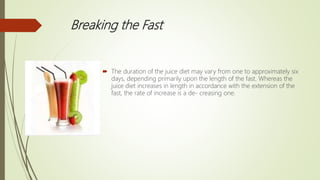
Breaking the Fast
 The duration of the juice diet may vary from one to approximately six
days, depending primarily upon the length of the fast. Whereas the
juice diet increases in length in accordance with the extension of the
fast, the rate of increase is a de- creasing one.
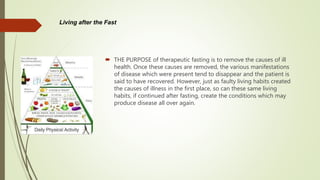
 THE PURPOSE of therapeutic fasting is to remove the causes of ill
health. Once these causes are removed, the various manifestations
of disease which were present tend to disappear and the patient is
said to have recovered. However, just as faulty living habits created
the causes of illness in the first place, so can these same living
habits, if continued after fasting, create the conditions which may
produce disease all over again.
Living after the Fast
However
 ON THE BASIS of our knowledge regarding the physiological effects of fasting, we
are justified in assuming that, theoretically at least, fasting should be a very
efficient therapeutic agent. However, important as this is, it is not enough. A
measure may be theoretically correct, and have a logical and reasonable basis in all
respects, and yet in the treatment of disease it does not fulfill expectations.
Bibliography
 ALLEN., F N., Control of experimental diabetes by fasting and total dietary restriction. J. by. Med.,
31, 575-86, 1920
 2. ALSAKER., R., The master key to health. East Aurora., N. Y, Sun-Diet Health Foundation, 1933
 ASH, J. E., The blood in inanition. Arch, inter. Med.., 14: 8-32, July, 1914
 BASSLER, A., The fasting cure answered. Month. Cycle & Med. Bull. 4:332-
 334
5. BEAN, C. H., Starvation and mental development. Psychol. Clin., 3, 78-
 85,1908
6. BENEDICT, F G., The influence of inanition on metabolism. Publica-
 tions, Carnegie Institution, Washington, 1907
7. BENEDICT, F G., A Study of prolonged fasting. Publications, Carnegie Institu-
 tion, Washington, 1915
 CARLSON, A.
Theraputic fasting

Theraputic fasting

  • 1.
    Therapeutic Fasting Seoul NationalUniversity Dental Hospital Craniomaxillofacial Cosmetic Surgery Mohammed Bakri ( MDS candidate ) 17/06/2017
  • 2.
    Contintes  Definition  Formsof Fasting  A Short History of Fasting  Physiological Reactions to Fasting  Safely Fasting  Efficiency of Fa sting  Breaking the Fast
  • 3.
    Definition  total orpartial abstinence from food or water for any of a number of reasons.  Examples: fruit fasts, vegetable fasts, milk fasts, water fasts and many other types  religious fasting, physiological fasting, pathological fasting and accidental or experimental fasting
  • 4.
    Therapeutic fasting istotal abstinencefrom all food, but not water. The purpose of therapeutic fasting is the promotion and restoration of health..
  • 5.
     The firstrecords of human fasting for the remedy of disease go back to the ancient civilizations of Greece .  Socrates said ( fast 10 days at a time will "attain mental and physical efficiency."  Pythagoras fasted for 40 days before taking his examination at the University of Alexandria  The ancient Egyptians used to treat syphilis with fasting cures.  The great Greek physician, Hippocrates, prescribed fasting during the critical periods of disease.  The Arab physician, Aicenna, prescribed fasting for three to five weeks at a time. Plutarch said: "Instead of using medicine better fast a day. Fasting Buddha (Emaciated Buddha), Kushan Dynasty, Gandhara (Pakistan), 2nd-3rd century, schist. Lahore Museum, Punjab, Pakistan A Short History of Fasting
  • 6.
    IlI Physiological Reactionsto Fasting  DEVELOPMENT of human pathology are governed by the physiological and chemical reactions that are taking place. Anything that induces such reactions plays a role in determining the state of human health.  Whenever food consumption is held beyond the usual period there are certain changes in the function, chemical reactions and life processes of the cells and tissues. It is these changes which give fasting its therapeutic properties.
  • 7.
    By considering the physiological reactionsto fasting we can gain an understanding of the reasons which determine its therapeutic value.
  • 8.
    Experiment #1  TheBritish scientist, Prof. Huxley, has carried out experiments with young earthworms. He fed an entire colony of these worms their usual foods. One of the worms was isolated from the rest and fasted at periodic intervals. And In all other respects its diet and mode of life were similar to those of the other worms. The isolated worm lived while 19 generations of worms in the colony lived and passed away
  • 9.
    Experiment #2  Prof.Child, of the University of Chicago, likewise has used worms to determine  the effects of fasting. He took a group of small flat worms which had grown old then and fasted them for months, until they had been reduced to a minimum size. Then he started feeding them again, and as they were growing back to their normal size, they were just as young, from a physiological standpoint, as they ever were. Prof. Child remarks: "Partial starvation inhibits aging
  • 10.
    Experiment #3  Dr.Carlson of the Department of Physiology in the University of Chicago, placed a 40 year old man on a 14 days fast. At the end of the fast his tissues were in the same physiological condition as those of a 17 year old youth.
  • 11.
    Experiment #4  OnMay 18, 1933, when Gandhi was in the tenth day of fasting, he was examined by his physicians. One of the physicians stated that "despite his 64 years, from a physiological point of view the Indian leader was as healthy as a man of forty
  • 12.
    Some of Experiments’Findings  One of the characteristics of old age is a decrease in the metabolic rate.  It is interesting to note that fasting produces rejuvenation by inducing a permanent increase in the metabolic rate.
  • 13.
    Some of Experiments’Findings Increasing the Autolysis rate Autolysis, means self-loosing. In physiology it is used to denote the process of digestion or disintegration of animal tissue by ferments and enzymes which are generated by the body cells themselves. By this way the body will get red of all weak cells and tissue.
  • 14.
    Some of Experiments’Findings  During the fast, the body has the opportunity to redistribute its nutritive supplies  So super-supplies will consumed and utilized first. The absorption of normal muscles and tissues on a fast is observable,
  • 15.
    Some of Experiments’Findings  Fasting affords the organs of the body the closest possible approach to a complete physiological rest.  Many organs are overworked and overstimulated by constant use of defective foods and excessive quantities of foods. During a fast, the necessary work done by the organs is reduced to the lowest possible work. As there is no further intake of food,
  • 16.
    Some of Experiments’Findings  Increased elimination of toxins
  • 17.
    Some of Experiments’Findings  The breath becomes very offensive, and the skin may also emit an offensive odor, possibly because of greater eliminative effort on the part of both the lungs and skin.  This manifestations usually increase during the early days of the fast,
  • 18.
    Fasting for therapeuticpurposes has been very extensive. There are a number of prominent physicians who can be referred to, each of whom has had experience in conducting thousands of fasts. Among these is Dr. Herbert M. Shelton, who has conducted over 30,000 fasts at his institute ranging in length from a few days to as many months. This record involves more experience with fasting than any other living physician.
  • 19.
    THE DURATION OFTHE FAST  duration of the complete fast is a matter that can neither be foretold nor prescribed in any individual case, for the treatment has its beginning in disease and its end in the hunger that marks the return of digestive power. Until the latter makes itself apparent, and it cannot be mistaken, the fast should continue. Then, and not till then, is the system in condition again to receive and transform food into tissue structure.
  • 20.
    CHILDREN IN THEFAST  Feed the baby only at the dictate of the natural hunger cry, but begin the process at the beginning before a vicious habit of expectation and appetite has a chance to form. With the exception of inherited blood taint, overfeeding the child is the great cause of infantile disease
  • 21.
    Safely of theFast  Generally speaking, initial consideration of fasting is associated with fear both of death and the possibility of doing serious harm to the body.  During a fast, when the body's energy is not used in the work of digestion, the need for minerals is lowered. The reserves of these elements in the body are sufficient to meet all needs  Man can live much longer on water alone than he can on a diet of white flour and water simply because use of the flour increases the need for other elements to enable the body to digest
  • 22.
    Safely of theFast  hunger is normal throughout the fast, whereas the fact is that it only exists for the first few days, and when acute disease is present, it often does not exist at all  , the contrast between deficiency diets and fasting is pointed out by Prof. Morgulis, who states that "our observation that the chronically underfed dog became debilitated in a measure not commonly noted in animals which undergo a straight fast  It is important to distinguishing between the periods of fasting and starvation  Roger and Jause found that fasting produces an increased tolerance toward bacilli coli in rabbits. Three to eleven days after the animals had fasted for five to seven days so the immunity will be more resistance to disease.
  • 23.
     During thefirst day of the fast, a marked desire for food is usually present by afternoon or evening. On the second day the desire is often greatly increased, with the degree of hunger reaching its maximum. On the third day the hunger usually in some cases it entirely disappears. In nearly all cases the disappearance of hunger is complete by the fourth or fifth day.  Nausea and vomiting can even occur at the sight and smell of food. This state continues until natural hunger returns weeks or months later, or until the fast is broken, when appetite rapidly returns. Dr. Weger reported that about one in each forty of his patients failed to lose their hunger on the fast. Other physicians also reported similar experiences.
  • 24.
     As arule the rapid fall in body temperature is a symptom of only the starvation period this is presumably due to decreased cutaneous circulation
  • 25.
    DEATH IN THEFAST  Death from starvation is impossible in a fast properly applied  Death in the fast never has occurred when merely FUNCTIONAL disease was present, and never has resulted from abstinence from food, but was the inevitable consequence of obstruction by ORGANIC imperfection of the avenues through which the energy of the body is expressed.
  • 26.
    Breaking the Fast When intake of food is stopped, the body adjusts itself to the new conditions. The digestive organs decreased their natural function; the digestive glands do not produce the usual juices, and the stomach itself shrinks to much less than its usual size. All this is an associated requirement of the physiological rest.  After many days of fasting the body thus loses its immediate power to digest and handle food in the usual manner.
  • 27.
    Breaking the Fast There is many reports of fasts which have been broken incorrectly.  Dr. Shelton refers to two fasts broken by an incompetent physician on chocolate candy, which were followed by extreme gastric and intestinal acidity and great distress throughout the body.  Dr. Havard recorded a case in which a 28 day fast was broken on a meal of beef- steak, potatoes, bread and butter, after which violent vomiting spells occurred, with inability to retain even water which was afterwards given
  • 28.
    Breaking the Fast The fast should be broken on one-half glass of juice, followed by the same amount every hour, or by one glass every two hours  The juices used immediately after the fast are best served at room temperature, which permits easiest digestion. Cold and iced juices should always be avoided at this time. The first juices should be sipped very slowly
  • 29.
    Breaking the Fast The duration of the juice diet may vary from one to approximately six days, depending primarily upon the length of the fast. Whereas the juice diet increases in length in accordance with the extension of the fast, the rate of increase is a de- creasing one.
  • 30.
     THE PURPOSEof therapeutic fasting is to remove the causes of ill health. Once these causes are removed, the various manifestations of disease which were present tend to disappear and the patient is said to have recovered. However, just as faulty living habits created the causes of illness in the first place, so can these same living habits, if continued after fasting, create the conditions which may produce disease all over again. Living after the Fast
  • 31.
    However  ON THEBASIS of our knowledge regarding the physiological effects of fasting, we are justified in assuming that, theoretically at least, fasting should be a very efficient therapeutic agent. However, important as this is, it is not enough. A measure may be theoretically correct, and have a logical and reasonable basis in all respects, and yet in the treatment of disease it does not fulfill expectations.
  • 32.
    Bibliography  ALLEN., FN., Control of experimental diabetes by fasting and total dietary restriction. J. by. Med., 31, 575-86, 1920  2. ALSAKER., R., The master key to health. East Aurora., N. Y, Sun-Diet Health Foundation, 1933  ASH, J. E., The blood in inanition. Arch, inter. Med.., 14: 8-32, July, 1914  BASSLER, A., The fasting cure answered. Month. Cycle & Med. Bull. 4:332-  334 5. BEAN, C. H., Starvation and mental development. Psychol. Clin., 3, 78-  85,1908 6. BENEDICT, F G., The influence of inanition on metabolism. Publica-  tions, Carnegie Institution, Washington, 1907 7. BENEDICT, F G., A Study of prolonged fasting. Publications, Carnegie Institu-  tion, Washington, 1915  CARLSON, A.