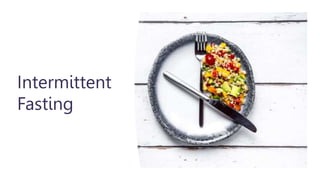
Intermittent
Fasting
Intermittent Fasting
 What is it?
 What does it have to do with keto diet?
 How can it help me?
 How to do it?
 Pitfalls
True or False?
 The body can be trained to fast
 We must eat 3 large meals and 2 snacks for optimum nutrition
 The record for the longest human fast from food was 382 days
 Metabolism creeps to a halt during a fast
 Starvation is the same as fasting
 What we are really feeding is our gut microbes
Contraindications to
Intermittent Fasting
 All of the following people should NOT
routinely intermittently fast:
 1. Pregnant or nursing mothers
 2. Diabetic patients (unless supervised by
a physician)
 3. Infants and Children
 4. Those people who have suffered from
eating disorders such as anorexia or
bulemia
Intermittent Fasting: what it is NOT
 IF is not CALORIE RESTRICTION
 IF is not STARVATION
 Starvation = involuntary lack of nutrition
 Extreme calorie restriction leading to bodily stress & protein breakdown
Intermittent Fasting is…
 A form of fasting
 Fasting = the voluntary & complete withholding of eating food, while maintaining
fluid status
 Most commonly is a prolonged overnight fast
 But can be done over the course of days
 A few days/month or a few days/year as a “detox”
 A time of body healing and rejuvenation
 i.e. “autophagy”
 An enhancement of ketogenic diet
Fasting: a
normal body
process
 We were designed to NOT EAT for prolonged
periods of time
 Religious fasting has been observed for centuries
without harm to millions of people
 Everybody fasts overnight and between meals
 The body maintains energy production by a
combination of glycogen burn, gluconeogenesis
and ketosis
 The body maintains blood sugar
 Through breaking down stored glycogen first
 By gluconeogenesis in the liver
Fasting vs. calorie restriction
 FASTING
 Body turns on ketosis
 Ketosis causes fat loss
 No refeeding syndrome to cause later
weight gain
 No stress response by body if not done in
extreme
 Metabolic rate only decreases about
29kcal/day
 CALORIE RESTRICTION
 Body never fully turns on ketosis
 Fat is lost, but refeeding syndrome occurs
and fat is rapidly regained
 Body is stressed and cortisol is high
 In its extreme leads to starvation
 Metabolic rate drops by 76 kcal/day
Fasting + ketosis = enhanced ketosis + autophagy
LET’S BREAK THIS DOWN…
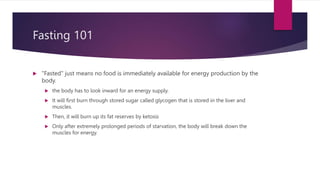
Fasting 101
 "Fasted" just means no food is immediately available for energy production by the
body.
 the body has to look inward for an energy supply.
 It will first burn through stored sugar called glycogen that is stored in the liver and
muscles.
 Then, it will burn up its fat reserves by ketosis
 Only after extremely prolonged periods of starvation, the body will break down the
muscles for energy.
You KNOW about ketosis!
 If you've been doing keto for more than 3 days, you've already accomplished
burning through glycogen and now you're down to fat.
 Congratulations, you’re in KETOSIS!
“Enhanced
ketosis”
 Takes you “deeper” into
ketosis by increasing the
amount of ketone bodies
 This means you’re
burning MORE OF YOUR
OWN FAT!
 Your pee stick turns
deeper purple
Source: Annette Bosworth, M.D.
Internal fat
burn zone!
Fat burned
from diet
Review of the medical literature…
 Review article by Patterson, et al in the Journal of the Academy of Nutrition and Dietetics published
2016
 Most were small studies
 Some mice, some human, a few cross-over
 Multiple types of “intermittent fasting” routines
 Complete Alternate Day Fasting
 Modified Fasting (based off 5:2 diet)
 Time-restricted Feeding (like 16:8 fasting)
 Religious Fasting (Ramadan, Seventh Day Adventists, Latter Day Saints)
Source https://www.ncbi.nlm.nih.gov/pmc/articles/PMC4516560/
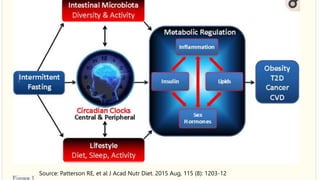
Some general similarities
 Decrease in insulin and blood sugar
 Decrease in markers of inflammation (hsCRP, TNF-alpha, etc.)
 Decrease in triglycerides, increase in HDL
 WEIGHT LOSS! (improvement in hormones associated with obesity: adipolectin and lectin)
 Mood stable through the fasts
 Sensation of hunger was not severe
 = NO HARM to test subjects
Source: https://www.ncbi.nlm.nih.gov/pmc/articles/PMC4516560/
Source: Patterson RE, et al J Acad Nutr Diet. 2015 Aug, 115 (8): 1203-12
Effects on gut biome feeding
 We are feeding a whopping trillions of microbes in our gut alone made up of
bacteria, archeae, viruses, phages, yeast and fungi!!
 These exist in a fluid volume of almost 1.5 L from mouth to anus in the human gut
that stretches 30 feet!
 There is a natural rhythm to feeding (Circadian) and rest from feeding
 There is also a seasonality with feeding and fasting built in to us and our microbes
 365 days of feeding is actually abnormal and NOT how ¾ of the world lives even
today!
What you feed your gut matters!
 Good stuff AKA “pre-biotics”; BAD stuff = “junk food”
 These are preferred foodstuffs for “good” gut microbes
 Impacts their reproduction
 Impacts the mucus layer of the gut
 Impacts cell-cell signaling
 Impacts inflammation via the immune system
 Ultimately impacts your own MORTALITY AND MORBIDITY!!
When you feed your gut biome matters
too!
 The gut microbiome, like our organ systems needs “down time” to self-regulate
 Feeding the gut microbiome is cyclical, following
 Circadian rhythm
 Food sources and their seasonal availability
 Times of fasting associated with food scarcity
Victoza,
Bydureon
Source: Cani,PD. Gut 2018;67:1716-1725
Good gut biome
Thick, protective mucus layer
Beneficial bacterial by-products (butyrate and
propionate)
Anti-microbial signals that all is well or not
Intact tight junctions between gut lining cells
Robust, normal human immune system
function
Normal cell signaling for metabolism and
immunity
Source: Cani,PD. Gut 2018;67:1716-1725
Bad gut biome
Reversal of homeostasis
Thin mucus layer
Bacterial overgrowth
Breach of tight junctions & low
grade inflammation
Derangement of:
Immune regulation
Food metabolism
Cell-cell signaling
Source: Cani,PD. Gut 2018;67:1716-1725
Gut Microbiome and Human Health
 Nearly 80% of all basic biologic science papers written since 1977 have focused on the
gut biome and its relationship to host health and disease!
 This has been mostly ignored by the medical community
 20 years behind “bench” research that is of clinical relevance
 numerous studies have reported changes in the gut microbiota during
 obesity
 diabetes
 liver diseases
 cancer
 neurodegenerative diseases
 Autoimmune diseases
What if…
Instead of “Eat to Beat Diabetes”
We “Don’t Eat to Beat Diabetes?”
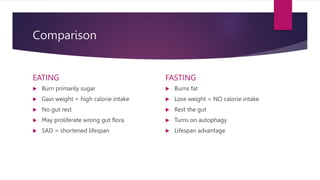
Comparison
EATING
 Burn primarily sugar
 Gain weight = high calorie intake
 No gut rest
 May proliferate wrong gut flora
 SAD = shortened lifespan
FASTING
 Burns fat
 Lose weight = NO calorie intake
 Rest the gut
 Turns on autophagy
 Lifespan advantage
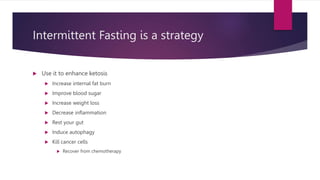
Intermittent Fasting is a strategy
 Use it to enhance ketosis
 Increase internal fat burn
 Improve blood sugar
 Increase weight loss
 Decrease inflammation
 Rest your gut
 Induce autophagy
 Kill cancer cells
 Recover from chemotherapy
A simple way to start
 Start with extending your overnight fast by 2 hours, 3 days/week (14:10)
 Once you’re comfortable, extend it out to 16:8
 If you’re tolerating 16:8 three days/week, increase to 5 days/week
 Ultimate goal would be 16:8 every day of the week
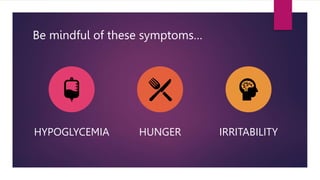
Be mindful of these symptoms…
HYPOGLYCEMIA HUNGER IRRITABILITY
It’s not simple math…
 It’s a biochemical shift
 Again, exactly like ketogenic diet to turn on fat burn
 But, with the added benefit of gut rest and AUTOPHAGY
Autophagy
Autophagy continued…
 Autophagy is when strong cells do internal clean up and weak cells are induced to
die.
 When cells don't have adequate time to clean up or die off, chronic diseases can
occur. The most commonly researched ones are Alzheimer's dementia and Type 2
Diabetes.
 Autophagy is also protective against infection and cancer.
Conclusion
 It is to your benefit to NOT EAT
 Intermittent fasting by extending the overnight fast is easy and effective without
adverse effects
 IF enhances ketosis
 IF helps you enjoy the benefits of autophagy as a cellular mechanism of
rejuvenation
 Fasting is linked to longevity
Questions?
Clinic Info
Works like a gym membership with no
contract
First month is discounted at $50
Business memberships available for
$60/mo/member
Works well with high deductible
insurance or catastrophic coverage only
Call 405-376-1381 for more
information or check out our
website at:
www.vibrantlifedc.com

intermittent fasting.pptx

  • 1.
  • 2.
    Intermittent Fasting  Whatis it?  What does it have to do with keto diet?  How can it help me?  How to do it?  Pitfalls
  • 3.
    True or False? The body can be trained to fast  We must eat 3 large meals and 2 snacks for optimum nutrition  The record for the longest human fast from food was 382 days  Metabolism creeps to a halt during a fast  Starvation is the same as fasting  What we are really feeding is our gut microbes
  • 4.
    Contraindications to Intermittent Fasting All of the following people should NOT routinely intermittently fast:  1. Pregnant or nursing mothers  2. Diabetic patients (unless supervised by a physician)  3. Infants and Children  4. Those people who have suffered from eating disorders such as anorexia or bulemia
  • 5.
    Intermittent Fasting: whatit is NOT  IF is not CALORIE RESTRICTION  IF is not STARVATION  Starvation = involuntary lack of nutrition  Extreme calorie restriction leading to bodily stress & protein breakdown
  • 6.
    Intermittent Fasting is… A form of fasting  Fasting = the voluntary & complete withholding of eating food, while maintaining fluid status  Most commonly is a prolonged overnight fast  But can be done over the course of days  A few days/month or a few days/year as a “detox”  A time of body healing and rejuvenation  i.e. “autophagy”  An enhancement of ketogenic diet
  • 7.
    Fasting: a normal body process We were designed to NOT EAT for prolonged periods of time  Religious fasting has been observed for centuries without harm to millions of people  Everybody fasts overnight and between meals  The body maintains energy production by a combination of glycogen burn, gluconeogenesis and ketosis  The body maintains blood sugar  Through breaking down stored glycogen first  By gluconeogenesis in the liver
  • 8.
    Fasting vs. calorierestriction  FASTING  Body turns on ketosis  Ketosis causes fat loss  No refeeding syndrome to cause later weight gain  No stress response by body if not done in extreme  Metabolic rate only decreases about 29kcal/day  CALORIE RESTRICTION  Body never fully turns on ketosis  Fat is lost, but refeeding syndrome occurs and fat is rapidly regained  Body is stressed and cortisol is high  In its extreme leads to starvation  Metabolic rate drops by 76 kcal/day
  • 9.
    Fasting + ketosis= enhanced ketosis + autophagy LET’S BREAK THIS DOWN…
  • 10.
    Fasting 101  "Fasted"just means no food is immediately available for energy production by the body.  the body has to look inward for an energy supply.  It will first burn through stored sugar called glycogen that is stored in the liver and muscles.  Then, it will burn up its fat reserves by ketosis  Only after extremely prolonged periods of starvation, the body will break down the muscles for energy.
  • 11.
    You KNOW aboutketosis!  If you've been doing keto for more than 3 days, you've already accomplished burning through glycogen and now you're down to fat.  Congratulations, you’re in KETOSIS!
  • 12.
    “Enhanced ketosis”  Takes you“deeper” into ketosis by increasing the amount of ketone bodies  This means you’re burning MORE OF YOUR OWN FAT!  Your pee stick turns deeper purple Source: Annette Bosworth, M.D. Internal fat burn zone! Fat burned from diet
  • 13.
    Review of themedical literature…  Review article by Patterson, et al in the Journal of the Academy of Nutrition and Dietetics published 2016  Most were small studies  Some mice, some human, a few cross-over  Multiple types of “intermittent fasting” routines  Complete Alternate Day Fasting  Modified Fasting (based off 5:2 diet)  Time-restricted Feeding (like 16:8 fasting)  Religious Fasting (Ramadan, Seventh Day Adventists, Latter Day Saints) Source https://www.ncbi.nlm.nih.gov/pmc/articles/PMC4516560/
  • 14.
    Some general similarities Decrease in insulin and blood sugar  Decrease in markers of inflammation (hsCRP, TNF-alpha, etc.)  Decrease in triglycerides, increase in HDL  WEIGHT LOSS! (improvement in hormones associated with obesity: adipolectin and lectin)  Mood stable through the fasts  Sensation of hunger was not severe  = NO HARM to test subjects Source: https://www.ncbi.nlm.nih.gov/pmc/articles/PMC4516560/
  • 15.
    Source: Patterson RE,et al J Acad Nutr Diet. 2015 Aug, 115 (8): 1203-12
  • 16.
    Source: Patterson RE,et al J Acad Nutr Diet. 2015 Aug, 115 (8): 1203-12
  • 17.
    Effects on gutbiome feeding  We are feeding a whopping trillions of microbes in our gut alone made up of bacteria, archeae, viruses, phages, yeast and fungi!!  These exist in a fluid volume of almost 1.5 L from mouth to anus in the human gut that stretches 30 feet!  There is a natural rhythm to feeding (Circadian) and rest from feeding  There is also a seasonality with feeding and fasting built in to us and our microbes  365 days of feeding is actually abnormal and NOT how ¾ of the world lives even today!
  • 18.
    What you feedyour gut matters!  Good stuff AKA “pre-biotics”; BAD stuff = “junk food”  These are preferred foodstuffs for “good” gut microbes  Impacts their reproduction  Impacts the mucus layer of the gut  Impacts cell-cell signaling  Impacts inflammation via the immune system  Ultimately impacts your own MORTALITY AND MORBIDITY!!
  • 19.
    When you feedyour gut biome matters too!  The gut microbiome, like our organ systems needs “down time” to self-regulate  Feeding the gut microbiome is cyclical, following  Circadian rhythm  Food sources and their seasonal availability  Times of fasting associated with food scarcity
  • 20.
  • 21.
    Good gut biome Thick,protective mucus layer Beneficial bacterial by-products (butyrate and propionate) Anti-microbial signals that all is well or not Intact tight junctions between gut lining cells Robust, normal human immune system function Normal cell signaling for metabolism and immunity Source: Cani,PD. Gut 2018;67:1716-1725
  • 22.
    Bad gut biome Reversalof homeostasis Thin mucus layer Bacterial overgrowth Breach of tight junctions & low grade inflammation Derangement of: Immune regulation Food metabolism Cell-cell signaling Source: Cani,PD. Gut 2018;67:1716-1725
  • 23.
    Gut Microbiome andHuman Health  Nearly 80% of all basic biologic science papers written since 1977 have focused on the gut biome and its relationship to host health and disease!  This has been mostly ignored by the medical community  20 years behind “bench” research that is of clinical relevance  numerous studies have reported changes in the gut microbiota during  obesity  diabetes  liver diseases  cancer  neurodegenerative diseases  Autoimmune diseases
  • 24.
    What if… Instead of“Eat to Beat Diabetes” We “Don’t Eat to Beat Diabetes?”
  • 25.
    Comparison EATING  Burn primarilysugar  Gain weight = high calorie intake  No gut rest  May proliferate wrong gut flora  SAD = shortened lifespan FASTING  Burns fat  Lose weight = NO calorie intake  Rest the gut  Turns on autophagy  Lifespan advantage
  • 26.
    Intermittent Fasting isa strategy  Use it to enhance ketosis  Increase internal fat burn  Improve blood sugar  Increase weight loss  Decrease inflammation  Rest your gut  Induce autophagy  Kill cancer cells  Recover from chemotherapy
  • 27.
    A simple wayto start  Start with extending your overnight fast by 2 hours, 3 days/week (14:10)  Once you’re comfortable, extend it out to 16:8  If you’re tolerating 16:8 three days/week, increase to 5 days/week  Ultimate goal would be 16:8 every day of the week
  • 28.
    Be mindful ofthese symptoms… HYPOGLYCEMIA HUNGER IRRITABILITY
  • 29.
    It’s not simplemath…  It’s a biochemical shift  Again, exactly like ketogenic diet to turn on fat burn  But, with the added benefit of gut rest and AUTOPHAGY
  • 30.
  • 31.
    Autophagy continued…  Autophagyis when strong cells do internal clean up and weak cells are induced to die.  When cells don't have adequate time to clean up or die off, chronic diseases can occur. The most commonly researched ones are Alzheimer's dementia and Type 2 Diabetes.  Autophagy is also protective against infection and cancer.
  • 32.
    Conclusion  It isto your benefit to NOT EAT  Intermittent fasting by extending the overnight fast is easy and effective without adverse effects  IF enhances ketosis  IF helps you enjoy the benefits of autophagy as a cellular mechanism of rejuvenation  Fasting is linked to longevity
  • 33.
  • 34.
    Clinic Info Works likea gym membership with no contract First month is discounted at $50 Business memberships available for $60/mo/member Works well with high deductible insurance or catastrophic coverage only Call 405-376-1381 for more information or check out our website at: www.vibrantlifedc.com