Ramadan Fasting
Health Issues
Bahar Bastani MDBahar Bastani MD
Professor of Medicine – NephrologyProfessor of Medicine – Nephrology
Saint Louis UniversitySaint Louis University
FastingFasting
• Act of willingly abstaining from some or all food and / or drinks, for aAct of willingly abstaining from some or all food and / or drinks, for a
period of time.period of time.
• Medicinal fasting:Medicinal fasting:
- Purification / detoxification – HippocratesPurification / detoxification – Hippocrates
- To rest the digestive systemTo rest the digestive system
- A break from combating toxins that enter body with food- A break from combating toxins that enter body with food
- Save energy to heal, repair and recoverSave energy to heal, repair and recover
- To rest the immune system from fighting bacteria and toxinsTo rest the immune system from fighting bacteria and toxins
- Detoxification, disposal of diseased and dead tissueDetoxification, disposal of diseased and dead tissue
- More efficient protein and hormone synthesisMore efficient protein and hormone synthesis
- Longer lifeLonger life
• There is no scientific evidence for any of the above claims.There is no scientific evidence for any of the above claims.
Demographics of the Muslim Population
• Islam is the second largest religion in the world with 1.6 billion adherents
• 23% of world population.
• %6 of Europe (44 mil), 4.6% of UK (2.9 mil), and 2% of US (6-8 mil)
• Ramadan Fasting = Sawm = “to refrain”
• One of the 5 pillars of Islam
• The 9th
month in the Islamic lunar calendar
• Duration of fasting varies, 11-18 hours/day, depending on the geographic
location and season
• in Britain, 19 hours in summer, 10 hours in winter
• Most Muslims eat 2 meals in Ramadan Month
• Before sunrise “Sahur”
• After sunset “Iftar”
• Fasting is obligatory upon all Muslims, except for:
• Children under the age of puberty
• Pregnant, lactating or menstruating women
• The old and frail
• The ill
• The insane
• The travelling --> 50 miles in a single journey
Effects of Fasting on Glucose Metabolism
• Glucose is the primary fuel source in body and is essential for brain function.
• Metabolic changes toward the fasting state starts 8-16 hours after a meal
“post-absorptive state”.
• Eating stimulates insulin secretion --> storage of glucose as glycogen in liver
and muscle.
• In the post absorptive state body turns to liver glycogen stores that last for up to
6 hours, then muscle glycogen, and then fat catabolism as a source of energy.
• When body fat storage is severely depleted (<7% of body weight in males, and
<10% of body weight in females) protein catabolism starts = “STARVATION”
Effects of Fasting on Glucose Metabolism
• Fasting reduces insulin secretion and increases counter regulatory
hormones (glucagon & catecholamines) --> glycogenolysis &
gluconeogenesis that increase glucose release, and later increase fatty acid
release and their oxidation to ketones in liver to be used as sources for
energy.
• Liver storage of Glycogen (5% of its weight = 1200 calories) can provide
glucose for only 5-6 hours
• First couple of days lose up to 2 Ibs per day (predominantly water loss),
then ½ Ib per day.
Physiologic Adaptation to Fasting:
- Initial weight loss slows down
- Reduced metabolic rate
- Efficient utilization of the body fat reserves
- More sedentary life style
Starvation:
- Depleted carbohydrate and fat stores --> protein break down.
Poor Dietary Habits in Ramadan:
- Inappropriate diet
- Over eating at Iftar
- Insufficient sleep
- Carbohydrates: Bread/cereals/rice/fruits/sugar
- Protein: fish/poultry/meat/ milk & dairy products/beans
- Lipids: Polyunsaturated fats
- Fibers: Vegetables/fruits
Sahur:
- Complex carbohydrates – slow digesting (8 hrs): Grains,
barley, whole wheat, oats, beans, lentils, whole wheat
flour, unpolished rice
- Protein, lipids, fibers
Iftar:
- Refined carbohydrates – fast digesting (3-4 hrs):
Dates (sugar, fiber, potassium, magnesium)
- Protein, lipids, fibers
Major Food Groups
Effects of Fasting on Body
• Body Weight:
• 137 Jordanian adults – 3 groups based on baseline body weight (over weight,
normal, under weight). All 3 groups had substantial weight loss during Ramadan
fasting. The greatest weight loss was in the over weight group.
• Four out of 7 other studies confirm this observation.
• Have not followed to see if the weight loss was sustained after Ramadan.
• Blood Cholesterol and Triglycerides
• Eight studies, very conflicting results.
• Blood Uric Acid
• Four studies show increased levels.
• Blood Glucose
• 81 Tehran University students: Glucose level was reduced significantly with weight,
without change in total cholesterol and triglycerides
• Other Tests
• No significant change in blood cortisol and thyroid hormones, total protein,
calcium, sodium, potassium, or urea levels.
Fazel. Journal of Royal Society of Medicine. 91:260, 1998
Karamat et al. J R Soc Med. 103:139, 2010
Effects of Fasting on Cholesterol and Uric Acid
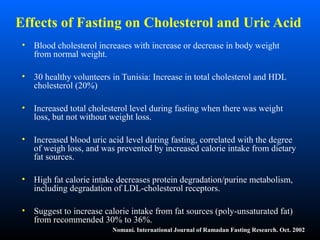
• Blood cholesterol increases with increase or decrease in body weight
from normal weight.
• 30 healthy volunteers in Tunisia: Increase in total cholesterol and HDL
cholesterol (20%)
• Increased total cholesterol level during fasting when there was weight
loss, but not without weight loss.
• Increased blood uric acid level during fasting, correlated with the degree
of weigh loss, and was prevented by increased calorie intake from dietary
fat sources.
• High fat calorie intake decreases protein degradation/purine metabolism,
including degradation of LDL-cholesterol receptors.
• Suggest to increase calorie intake from fat sources (poly-unsaturated fat)
from recommended 30% to 36%.
Nomani. International Journal of Ramadan Fasting Research. Oct. 2002
Fasting and Diabetes
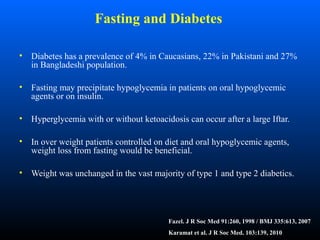
• Diabetes has a prevalence of 4% in Caucasians, 22% in Pakistani and 27%
in Bangladeshi population.
• Fasting may precipitate hypoglycemia in patients on oral hypoglycemic
agents or on insulin.
• Hyperglycemia with or without ketoacidosis can occur after a large Iftar.
• In over weight patients controlled on diet and oral hypoglycemic agents,
weight loss from fasting would be beneficial.
• Weight was unchanged in the vast majority of type 1 and type 2 diabetics.
Fazel. J R Soc Med 91:260, 1998 / BMJ 335:613, 2007
Karamat et al. J R Soc Med. 103:139, 2010
The Epidemiology of Diabetes and Ramadan
EPIDIAR Study
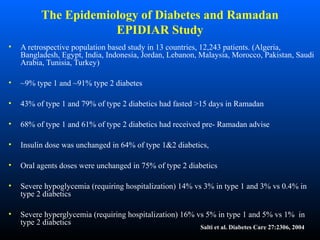
• A retrospective population based study in 13 countries, 12,243 patients. (Algeria,
Bangladesh, Egypt, India, Indonesia, Jordan, Lebanon, Malaysia, Morocco, Pakistan, Saudi
Arabia, Tunisia, Turkey)
• ~9% type 1 and ~91% type 2 diabetes
• 43% of type 1 and 79% of type 2 diabetics had fasted >15 days in Ramadan
• 68% of type 1 and 61% of type 2 diabetics had received pre- Ramadan advise
• Insulin dose was unchanged in 64% of type 1&2 diabetics,
• Oral agents doses were unchanged in 75% of type 2 diabetics
• Severe hypoglycemia (requiring hospitalization) 14% vs 3% in type 1 and 3% vs 0.4% in
type 2 diabetics
• Severe hyperglycemia (requiring hospitalization) 16% vs 5% in type 1 and 5% vs 1% in
type 2 diabetics
Salti et al. Diabetes Care 27:2306, 2004
Fasting and Diabetes
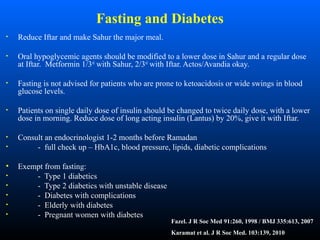
• Reduce Iftar and make Sahur the major meal.
• Oral hypoglycemic agents should be modified to a lower dose in Sahur and a regular dose
at Iftar. Metformin 1/3rd
with Sahur, 2/3rd
with Iftar. Actos/Avandia okay.
• Fasting is not advised for patients who are prone to ketoacidosis or wide swings in blood
glucose levels.
• Patients on single daily dose of insulin should be changed to twice daily dose, with a lower
dose in morning. Reduce dose of long acting insulin (Lantus) by 20%, give it with Iftar.
• Consult an endocrinologist 1-2 months before Ramadan
• - full check up – HbA1c, blood pressure, lipids, diabetic complications
• Exempt from fasting:
• - Type 1 diabetics
• - Type 2 diabetics with unstable disease
• - Diabetes with complications
• - Elderly with diabetes
• - Pregnant women with diabetes
Fazel. J R Soc Med 91:260, 1998 / BMJ 335:613, 2007
Karamat et al. J R Soc Med. 103:139, 2010
Fasting and Cardiovascular Health
• 465 outpatients with stable heart disease had no increase in
hospitalization in Ramadan.
• Hospitalization for heart failure, stroke, acute coronary events
did not increase in Ramadan.
• Increased incidence of cerebral venous sinus thrombosis.
• A change in circadian variation of cardiac events:
• Less at 5 – 8 am, 11% vs 19%
• More at 5 – 6 pm, 11% vs 6%
• More at 3 – 4 am, 11% vs 7%
• More strokes between noon - 6 pm vs 6 am to noon.
Ozkan et al. J Int Med Res. 37:1988, 2009
Chong VH. Singapore Med J. 50:619, 2009
Fasting and Headaches
• “The First of Ramadan Headache”
• A Saudi Hospital Staff:
• Headache occurred in 41% of those who fasted versus in 8% who did not fast
• More frequent in longer fasting days and towards the end of the day’s fast
• Headaches were of “Tension Headache” type in 78%
• Those with migraine headaches had 9.4 days of headache in Ramadan versus 3.7 days
in next month
• More frequent in: Coffee/Tea drinkers (X4-5), previous headaches (X13)
• Causes:
• Caffeine withdrawal
• Lack of sleep
• Dehydration
• Hypoglycemia
•
• Remedies:
• Gradual decrease in caffeine intake weeks before Ramadan
• A cup of strong coffee with the Sahur
• Increased fluid intake
• Adequate sleep
Awada and Jumah. Headache. 39:490, 1999
Abu-Salameh et al. J Headache Pain. July 2010
Fasting and Stomach Problems
• In a university hospital in Turkey: More cases of acute upper
gastrointestial bleed in Ramadan than a control month (43
versus 28 cases), and more of them had history of previous
bleeding (72% versus 43%).
• More duodenal ulcers with or without bleeding in Ramadan
and the month after.
• A significant increase in peptic ulcer disease and its
complications – Upper gastrointestinal bleeding or peptic ulcer
perforation.
Ozkan et al. J Int Med Res. 37:1988, 2009
Chong VH. Singapore Med J. 50:619, 2009
Fasting and Pregnancy
• 3 out of 4 pregnancies will coincide with Ramadan fasting.
• Many Muslim women fast during preconception, pregnancy and nursing the baby.
• Prenatal exposure to Ramadan in Arab women living in Michigan resulted in
lower birth weights.
• 20% more adult disabilities, specially learning disabilities, if Ramadan coincided
with early pregnancy in Uganda and Iraq.
• 1.5 time more low birth weights in mothers who fasted in first trimester.
• A higher percentage of gestational diabetes and C-Section in women who fasted
during pregnancy.
• Pregnant and nursing mothers are exempt from fasting in Ramadan.
Alkandari JR et al. Journal of Sport Sciences 30 (S1): S6-S19, 2012.
Medications in Ramadan
• Many patients may change their medications during fasting.
• In a survey of 325 patients, over 60% changed the way they
took their medications.
• Toxic effects were seen particularly in the elderly who took
their medication once in a day, rather than the prescribed
intervals.
• Drugs with longer half -life may be used. This change should
be started at least 2 weeks before Ramadan to reach a steady
state.
Fazel. Journal of Royal Society of Medicine. 91:260, 1998
Fasting and Other Medical Issues
• “Ramadan Syndrome”, massive stomach dilatation.
• Small bowel volvulus.
• 750 Turkish Muslims surveyed: 84% felt tired or fatigued through out the day, 63% felt
sleepy and irritated most of the daytime, 50% developed severe headaches.
• Reduced cognitive function in afternoon.
• Road traffic accidents increased in Saudi Arabia during Ramadan. In Morocco and Jordan
road accidents and alcohol related aggression and trauma incidents decreased in Ramadan.
• Increased rate of accidents in factory workers, especially in the afternoons.
• Increased emergency department admissions for hypertension (10%) and headaches (14%),
but no change in diabetes related conditions, stroke, heart attacks, or unstable angina.
• Increased incidence of retinal vein occlusion in Saudi Arabia - dehydration
Fazel. Journal of Royal Society of Medicine. 91:260, 1998
Topacoglu et al. Int J Clin Pract. 59:900, 2005
Temizhan et al. Internat J Cardiol. 70:149, 1999

Fasting and health issues

  • 1.
    Ramadan Fasting Health Issues BaharBastani MDBahar Bastani MD Professor of Medicine – NephrologyProfessor of Medicine – Nephrology Saint Louis UniversitySaint Louis University
  • 2.
    FastingFasting • Act ofwillingly abstaining from some or all food and / or drinks, for aAct of willingly abstaining from some or all food and / or drinks, for a period of time.period of time. • Medicinal fasting:Medicinal fasting: - Purification / detoxification – HippocratesPurification / detoxification – Hippocrates - To rest the digestive systemTo rest the digestive system - A break from combating toxins that enter body with food- A break from combating toxins that enter body with food - Save energy to heal, repair and recoverSave energy to heal, repair and recover - To rest the immune system from fighting bacteria and toxinsTo rest the immune system from fighting bacteria and toxins - Detoxification, disposal of diseased and dead tissueDetoxification, disposal of diseased and dead tissue - More efficient protein and hormone synthesisMore efficient protein and hormone synthesis - Longer lifeLonger life • There is no scientific evidence for any of the above claims.There is no scientific evidence for any of the above claims.
  • 4.
    Demographics of theMuslim Population • Islam is the second largest religion in the world with 1.6 billion adherents • 23% of world population. • %6 of Europe (44 mil), 4.6% of UK (2.9 mil), and 2% of US (6-8 mil) • Ramadan Fasting = Sawm = “to refrain” • One of the 5 pillars of Islam • The 9th month in the Islamic lunar calendar • Duration of fasting varies, 11-18 hours/day, depending on the geographic location and season • in Britain, 19 hours in summer, 10 hours in winter • Most Muslims eat 2 meals in Ramadan Month • Before sunrise “Sahur” • After sunset “Iftar” • Fasting is obligatory upon all Muslims, except for: • Children under the age of puberty • Pregnant, lactating or menstruating women • The old and frail • The ill • The insane • The travelling --> 50 miles in a single journey
  • 5.
    Effects of Fastingon Glucose Metabolism • Glucose is the primary fuel source in body and is essential for brain function. • Metabolic changes toward the fasting state starts 8-16 hours after a meal “post-absorptive state”. • Eating stimulates insulin secretion --> storage of glucose as glycogen in liver and muscle. • In the post absorptive state body turns to liver glycogen stores that last for up to 6 hours, then muscle glycogen, and then fat catabolism as a source of energy. • When body fat storage is severely depleted (<7% of body weight in males, and <10% of body weight in females) protein catabolism starts = “STARVATION”
  • 6.
    Effects of Fastingon Glucose Metabolism • Fasting reduces insulin secretion and increases counter regulatory hormones (glucagon & catecholamines) --> glycogenolysis & gluconeogenesis that increase glucose release, and later increase fatty acid release and their oxidation to ketones in liver to be used as sources for energy. • Liver storage of Glycogen (5% of its weight = 1200 calories) can provide glucose for only 5-6 hours • First couple of days lose up to 2 Ibs per day (predominantly water loss), then ½ Ib per day.
  • 7.
    Physiologic Adaptation toFasting: - Initial weight loss slows down - Reduced metabolic rate - Efficient utilization of the body fat reserves - More sedentary life style Starvation: - Depleted carbohydrate and fat stores --> protein break down. Poor Dietary Habits in Ramadan: - Inappropriate diet - Over eating at Iftar - Insufficient sleep
  • 8.
    - Carbohydrates: Bread/cereals/rice/fruits/sugar -Protein: fish/poultry/meat/ milk & dairy products/beans - Lipids: Polyunsaturated fats - Fibers: Vegetables/fruits Sahur: - Complex carbohydrates – slow digesting (8 hrs): Grains, barley, whole wheat, oats, beans, lentils, whole wheat flour, unpolished rice - Protein, lipids, fibers Iftar: - Refined carbohydrates – fast digesting (3-4 hrs): Dates (sugar, fiber, potassium, magnesium) - Protein, lipids, fibers Major Food Groups
  • 9.
    Effects of Fastingon Body • Body Weight: • 137 Jordanian adults – 3 groups based on baseline body weight (over weight, normal, under weight). All 3 groups had substantial weight loss during Ramadan fasting. The greatest weight loss was in the over weight group. • Four out of 7 other studies confirm this observation. • Have not followed to see if the weight loss was sustained after Ramadan. • Blood Cholesterol and Triglycerides • Eight studies, very conflicting results. • Blood Uric Acid • Four studies show increased levels. • Blood Glucose • 81 Tehran University students: Glucose level was reduced significantly with weight, without change in total cholesterol and triglycerides • Other Tests • No significant change in blood cortisol and thyroid hormones, total protein, calcium, sodium, potassium, or urea levels. Fazel. Journal of Royal Society of Medicine. 91:260, 1998 Karamat et al. J R Soc Med. 103:139, 2010
  • 10.
    Effects of Fastingon Cholesterol and Uric Acid • Blood cholesterol increases with increase or decrease in body weight from normal weight. • 30 healthy volunteers in Tunisia: Increase in total cholesterol and HDL cholesterol (20%) • Increased total cholesterol level during fasting when there was weight loss, but not without weight loss. • Increased blood uric acid level during fasting, correlated with the degree of weigh loss, and was prevented by increased calorie intake from dietary fat sources. • High fat calorie intake decreases protein degradation/purine metabolism, including degradation of LDL-cholesterol receptors. • Suggest to increase calorie intake from fat sources (poly-unsaturated fat) from recommended 30% to 36%. Nomani. International Journal of Ramadan Fasting Research. Oct. 2002
  • 11.
    Fasting and Diabetes •Diabetes has a prevalence of 4% in Caucasians, 22% in Pakistani and 27% in Bangladeshi population. • Fasting may precipitate hypoglycemia in patients on oral hypoglycemic agents or on insulin. • Hyperglycemia with or without ketoacidosis can occur after a large Iftar. • In over weight patients controlled on diet and oral hypoglycemic agents, weight loss from fasting would be beneficial. • Weight was unchanged in the vast majority of type 1 and type 2 diabetics. Fazel. J R Soc Med 91:260, 1998 / BMJ 335:613, 2007 Karamat et al. J R Soc Med. 103:139, 2010
  • 12.
    The Epidemiology ofDiabetes and Ramadan EPIDIAR Study • A retrospective population based study in 13 countries, 12,243 patients. (Algeria, Bangladesh, Egypt, India, Indonesia, Jordan, Lebanon, Malaysia, Morocco, Pakistan, Saudi Arabia, Tunisia, Turkey) • ~9% type 1 and ~91% type 2 diabetes • 43% of type 1 and 79% of type 2 diabetics had fasted >15 days in Ramadan • 68% of type 1 and 61% of type 2 diabetics had received pre- Ramadan advise • Insulin dose was unchanged in 64% of type 1&2 diabetics, • Oral agents doses were unchanged in 75% of type 2 diabetics • Severe hypoglycemia (requiring hospitalization) 14% vs 3% in type 1 and 3% vs 0.4% in type 2 diabetics • Severe hyperglycemia (requiring hospitalization) 16% vs 5% in type 1 and 5% vs 1% in type 2 diabetics Salti et al. Diabetes Care 27:2306, 2004
  • 13.
    Fasting and Diabetes •Reduce Iftar and make Sahur the major meal. • Oral hypoglycemic agents should be modified to a lower dose in Sahur and a regular dose at Iftar. Metformin 1/3rd with Sahur, 2/3rd with Iftar. Actos/Avandia okay. • Fasting is not advised for patients who are prone to ketoacidosis or wide swings in blood glucose levels. • Patients on single daily dose of insulin should be changed to twice daily dose, with a lower dose in morning. Reduce dose of long acting insulin (Lantus) by 20%, give it with Iftar. • Consult an endocrinologist 1-2 months before Ramadan • - full check up – HbA1c, blood pressure, lipids, diabetic complications • Exempt from fasting: • - Type 1 diabetics • - Type 2 diabetics with unstable disease • - Diabetes with complications • - Elderly with diabetes • - Pregnant women with diabetes Fazel. J R Soc Med 91:260, 1998 / BMJ 335:613, 2007 Karamat et al. J R Soc Med. 103:139, 2010
  • 14.
    Fasting and CardiovascularHealth • 465 outpatients with stable heart disease had no increase in hospitalization in Ramadan. • Hospitalization for heart failure, stroke, acute coronary events did not increase in Ramadan. • Increased incidence of cerebral venous sinus thrombosis. • A change in circadian variation of cardiac events: • Less at 5 – 8 am, 11% vs 19% • More at 5 – 6 pm, 11% vs 6% • More at 3 – 4 am, 11% vs 7% • More strokes between noon - 6 pm vs 6 am to noon. Ozkan et al. J Int Med Res. 37:1988, 2009 Chong VH. Singapore Med J. 50:619, 2009
  • 15.
    Fasting and Headaches •“The First of Ramadan Headache” • A Saudi Hospital Staff: • Headache occurred in 41% of those who fasted versus in 8% who did not fast • More frequent in longer fasting days and towards the end of the day’s fast • Headaches were of “Tension Headache” type in 78% • Those with migraine headaches had 9.4 days of headache in Ramadan versus 3.7 days in next month • More frequent in: Coffee/Tea drinkers (X4-5), previous headaches (X13) • Causes: • Caffeine withdrawal • Lack of sleep • Dehydration • Hypoglycemia • • Remedies: • Gradual decrease in caffeine intake weeks before Ramadan • A cup of strong coffee with the Sahur • Increased fluid intake • Adequate sleep Awada and Jumah. Headache. 39:490, 1999 Abu-Salameh et al. J Headache Pain. July 2010
  • 16.
    Fasting and StomachProblems • In a university hospital in Turkey: More cases of acute upper gastrointestial bleed in Ramadan than a control month (43 versus 28 cases), and more of them had history of previous bleeding (72% versus 43%). • More duodenal ulcers with or without bleeding in Ramadan and the month after. • A significant increase in peptic ulcer disease and its complications – Upper gastrointestinal bleeding or peptic ulcer perforation. Ozkan et al. J Int Med Res. 37:1988, 2009 Chong VH. Singapore Med J. 50:619, 2009
  • 17.
    Fasting and Pregnancy •3 out of 4 pregnancies will coincide with Ramadan fasting. • Many Muslim women fast during preconception, pregnancy and nursing the baby. • Prenatal exposure to Ramadan in Arab women living in Michigan resulted in lower birth weights. • 20% more adult disabilities, specially learning disabilities, if Ramadan coincided with early pregnancy in Uganda and Iraq. • 1.5 time more low birth weights in mothers who fasted in first trimester. • A higher percentage of gestational diabetes and C-Section in women who fasted during pregnancy. • Pregnant and nursing mothers are exempt from fasting in Ramadan. Alkandari JR et al. Journal of Sport Sciences 30 (S1): S6-S19, 2012.
  • 18.
    Medications in Ramadan •Many patients may change their medications during fasting. • In a survey of 325 patients, over 60% changed the way they took their medications. • Toxic effects were seen particularly in the elderly who took their medication once in a day, rather than the prescribed intervals. • Drugs with longer half -life may be used. This change should be started at least 2 weeks before Ramadan to reach a steady state. Fazel. Journal of Royal Society of Medicine. 91:260, 1998
  • 19.
    Fasting and OtherMedical Issues • “Ramadan Syndrome”, massive stomach dilatation. • Small bowel volvulus. • 750 Turkish Muslims surveyed: 84% felt tired or fatigued through out the day, 63% felt sleepy and irritated most of the daytime, 50% developed severe headaches. • Reduced cognitive function in afternoon. • Road traffic accidents increased in Saudi Arabia during Ramadan. In Morocco and Jordan road accidents and alcohol related aggression and trauma incidents decreased in Ramadan. • Increased rate of accidents in factory workers, especially in the afternoons. • Increased emergency department admissions for hypertension (10%) and headaches (14%), but no change in diabetes related conditions, stroke, heart attacks, or unstable angina. • Increased incidence of retinal vein occlusion in Saudi Arabia - dehydration Fazel. Journal of Royal Society of Medicine. 91:260, 1998 Topacoglu et al. Int J Clin Pract. 59:900, 2005 Temizhan et al. Internat J Cardiol. 70:149, 1999

Editor's Notes

  • #4 Sawm = abstinence from food, water, sex, vulgar talk  Tagwa (Self restrain, piety)
  • #14 International consensus meeting in Morocco, 1995
  • #16 Tension HA was the most common HA in Yom Kippur HA Drinking tea/coffee relieved HA in &gt;50%; a cup of tea 50 mg vs coffee ~100 mg caffeine Caffeine withdrawal HA starts 12-24 hr and peaks 20-48 hr after cessation of caffeine. More in high caffeine intakers &gt;600 mg/day Migrain HA in 12% normal adults (9 million of 1.57 billion Muslims)