Healing Through Fasting
Presented By Roxana Feenster
 “ Food should be our medicine and medicine should
be our food, but to eat when you are sick is to feed
your illness.” - Hippocrates
What is Fasting?
 Fasting is defined as abstinence from all food and
drink except water for a specific period of time and
purpose.
Juice Fasts and Restricted Diets
 Alternative versions where juices or even certain
foods are allowed, such as juice fasts and the mono-
diet, are not real fasts but rather restricted diets.
 Fasting advocates believe that it would take a much
longer period to witness benefits from these
restricted diets as compared to a strict water fast.
 In some cases, it may be necessary for the patient to
continue taking certain medication like insulin,
thyroid hormone and prednisone. Violent and
possible fatal results may occur if the patient stops
taking them. (Chaitow 1996, Salloum 1999)
Fasting vs. Starvation
 Fasting is NOT the same as starvation.
 In most people, even without eating, there is
sufficient reserve food stored to last for many days
and even weeks.
 Fasting spares essential tissues like the vital organs
while utilizing non-essential tissues like adipose
tissue for fuel.
 Additionally, a range of beneficial detoxification and
repair processes usually accompanies it.
 In contrast, during starvation, most fat stores have
been depleted, and the body starts to use essential
tissues from vital organs for fuel. (Chaitow 1996,
Salloum 1999)
Fasting & Healing
 Fasting intensifies healing as deep tissue and tired
organs are repaired rapidly.
 To heal illness the body must pull all of its resources
toward cleansing and repairing by removing appetite and
reducing or stopping digestion.
 Wounded animals will fast, emerging to eat only after
their injury or broken bones have healed. There are
testimonies of people’s old wounds aching during a fast
for the first time in years; unnecessary scare tissue is
being broken down as fuel.
 This is the reason why there is little desire to eat food
when sick—the body wants to focus all of its resources
on healing.
Therapeutic Purposes of Fasting
 Fasting has been employed for thousands of years by
religions and cultures to enhance spiritual awareness and
observe religious traditions. Fasting for health purposes
also dates back to prehistory.
 There are records that reveal that even Hippocrates used
fasts as part of his healing regime for his patients.
 As its popularity grew, researchers began conducting
scientific studies into it.
 For instance, in 1880, the British Medical Journal
reported the findings on a 40-day fast accomplished by a
Dr Tanner.
 Since then, medical journals have continued to report
positive results of the use of fasting in the treatment of
various conditions.
These Include:
 - diabetes
 - mental disease
 - epilepsy
 - skin disease
 - obesity
 - cardiovascular disease
 - pancreatitis
 - chemical poisoning
 - autoimmune disease
 - arthritis
 - food allergies
Other conditions in which research
indicates that fasting has led to
improvement include:
 psychosomatic diseases, neurogenic bladder,
psoriasis, eczema, thrombophlebitis, varicose ulcers,
 IBS, bronchial asthma, lumbago, depression,
neurosis, schizophrenia, parasites, duodenal ulcers
and
 uterine fibroids. (Chaitow 1996, Salloum 1999)
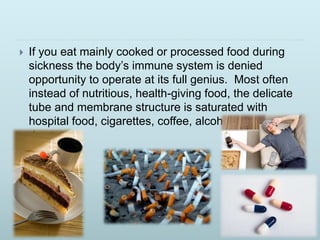
 If you eat mainly cooked or processed food during
sickness the body’s immune system is denied
opportunity to operate at its full genius. Most often
instead of nutritious, health-giving food, the delicate
tube and membrane structure is saturated with
hospital food, cigarettes, coffee, alcohol, and
drugs.
Why does fasting have such a powerful
effect on healing the body?
 In the fasting state, the body scours for dead cells,
damaged tissues, fatty deposits, tumors and abscesses,
all of which are burned for fuel or expelled as waste.
 Diseased cells are dissolved in a systematic manner,
leaving healthy tissue. The result is a thorough cleansing
of the tubes, membranes and cellular
structures. Ingestion of mucus-forming foods clogs the
body's microscopic tubes and membranes, all of which
are the highways used by the immune system.
 Fasting dissolves this internal mucus. During a fast it is
common for the nose, throat and ears to pass sticky
mucus, clogging the sinuses. Strands of mucus may be
found in the stool after the first bowel movement. There
is a remarkable redistribution of nutrients in the fasting
body. It hangs on to precious minerals and vitamins
while catabolizing on old tissue, toxins and inferior
materials.
 Like many natural healing methods, fasting employs
the ability of the body to heal itself.
 It is essentially a process which encourages
homeostasis by allowing the body the time and
space to normalize and recover, regardless of
whatever imbalance is present.
Burn the rubbish!
 Our body will first decompose and burn those cells
and tissues, which are diseased, damaged, aged or
dead. In fasting your body feeds itself on the most
impure and inferior materials, such as dead cells and
morbid accumulations, tumors, abscesses, fat
deposits, etc…
 Dr. Otto Buchinger, M.D., fasting authority, says
“fasting is a refuse disposal, a burning of rubbish”.
 The essential tissues and vital organs, the glands,
the nervous system and the brain are not damaged
or digested in fasting.

The Benefits of Fasting:
 - decreased weight
 - clearer skin
 - increased elimination
 - tissue repair
 - decreased pain and inflammation
 - decreased weight
 - clearer skin
 - increased elimination
 - tissue repair
 - decreased pain and inflammation
 - increased concentration
 - relaxation
 - spare time and savings in the cost of food
 - satisfaction that you are taking charge of your own health
(Salloum 1999) Trevor Salloum, a naturopathic practitioner.
 Fasting is not only excellent for the body; it is
breath to the spirit. - Isaiah 58:6-11
Helpful Resources
 The Fasting Path by Syephen Harrod Buhner
 The Complete Idiot’s Guide to Fasting by Eve
Adamson, Linda Horning, Alison Shore Gaines
 Fast Your Way to Health by Lee Bueno-Aguer, Lee
Bueno
 The 3-Day Energy Fast by Donna Karan, Pamela
Serure
 http://www.freedomyou.com
 http://www.healthandyoga.com/html/fasting.html
 http://nutritionist.tripod.com/fasting.html
Work Cited
 Fast Your Way to Health by Lee Bueno-Aguer, Lee Bueno
 “Recommendations for Fasting” By Valerie Saxion, N.D.,
Ph.D.
 http://www.123people.com -Guidelines for Healthy Eating

Healing through fasting

  • 1.
  • 2.
     “ Foodshould be our medicine and medicine should be our food, but to eat when you are sick is to feed your illness.” - Hippocrates
  • 3.
    What is Fasting? Fasting is defined as abstinence from all food and drink except water for a specific period of time and purpose.
  • 4.
    Juice Fasts andRestricted Diets  Alternative versions where juices or even certain foods are allowed, such as juice fasts and the mono- diet, are not real fasts but rather restricted diets.  Fasting advocates believe that it would take a much longer period to witness benefits from these restricted diets as compared to a strict water fast.  In some cases, it may be necessary for the patient to continue taking certain medication like insulin, thyroid hormone and prednisone. Violent and possible fatal results may occur if the patient stops taking them. (Chaitow 1996, Salloum 1999)
  • 5.
    Fasting vs. Starvation Fasting is NOT the same as starvation.  In most people, even without eating, there is sufficient reserve food stored to last for many days and even weeks.  Fasting spares essential tissues like the vital organs while utilizing non-essential tissues like adipose tissue for fuel.  Additionally, a range of beneficial detoxification and repair processes usually accompanies it.  In contrast, during starvation, most fat stores have been depleted, and the body starts to use essential tissues from vital organs for fuel. (Chaitow 1996, Salloum 1999)
  • 6.
    Fasting & Healing Fasting intensifies healing as deep tissue and tired organs are repaired rapidly.  To heal illness the body must pull all of its resources toward cleansing and repairing by removing appetite and reducing or stopping digestion.  Wounded animals will fast, emerging to eat only after their injury or broken bones have healed. There are testimonies of people’s old wounds aching during a fast for the first time in years; unnecessary scare tissue is being broken down as fuel.  This is the reason why there is little desire to eat food when sick—the body wants to focus all of its resources on healing.
  • 7.
    Therapeutic Purposes ofFasting  Fasting has been employed for thousands of years by religions and cultures to enhance spiritual awareness and observe religious traditions. Fasting for health purposes also dates back to prehistory.  There are records that reveal that even Hippocrates used fasts as part of his healing regime for his patients.  As its popularity grew, researchers began conducting scientific studies into it.  For instance, in 1880, the British Medical Journal reported the findings on a 40-day fast accomplished by a Dr Tanner.  Since then, medical journals have continued to report positive results of the use of fasting in the treatment of various conditions.
  • 8.
    These Include:  -diabetes  - mental disease  - epilepsy  - skin disease  - obesity  - cardiovascular disease  - pancreatitis  - chemical poisoning  - autoimmune disease  - arthritis  - food allergies
  • 9.
    Other conditions inwhich research indicates that fasting has led to improvement include:  psychosomatic diseases, neurogenic bladder, psoriasis, eczema, thrombophlebitis, varicose ulcers,  IBS, bronchial asthma, lumbago, depression, neurosis, schizophrenia, parasites, duodenal ulcers and  uterine fibroids. (Chaitow 1996, Salloum 1999)
  • 10.
     If youeat mainly cooked or processed food during sickness the body’s immune system is denied opportunity to operate at its full genius. Most often instead of nutritious, health-giving food, the delicate tube and membrane structure is saturated with hospital food, cigarettes, coffee, alcohol, and drugs.
  • 11.
    Why does fastinghave such a powerful effect on healing the body?  In the fasting state, the body scours for dead cells, damaged tissues, fatty deposits, tumors and abscesses, all of which are burned for fuel or expelled as waste.  Diseased cells are dissolved in a systematic manner, leaving healthy tissue. The result is a thorough cleansing of the tubes, membranes and cellular structures. Ingestion of mucus-forming foods clogs the body's microscopic tubes and membranes, all of which are the highways used by the immune system.  Fasting dissolves this internal mucus. During a fast it is common for the nose, throat and ears to pass sticky mucus, clogging the sinuses. Strands of mucus may be found in the stool after the first bowel movement. There is a remarkable redistribution of nutrients in the fasting body. It hangs on to precious minerals and vitamins while catabolizing on old tissue, toxins and inferior materials.
  • 12.
     Like manynatural healing methods, fasting employs the ability of the body to heal itself.  It is essentially a process which encourages homeostasis by allowing the body the time and space to normalize and recover, regardless of whatever imbalance is present.
  • 13.
    Burn the rubbish! Our body will first decompose and burn those cells and tissues, which are diseased, damaged, aged or dead. In fasting your body feeds itself on the most impure and inferior materials, such as dead cells and morbid accumulations, tumors, abscesses, fat deposits, etc…  Dr. Otto Buchinger, M.D., fasting authority, says “fasting is a refuse disposal, a burning of rubbish”.  The essential tissues and vital organs, the glands, the nervous system and the brain are not damaged or digested in fasting. 
  • 14.
    The Benefits ofFasting:  - decreased weight  - clearer skin  - increased elimination  - tissue repair  - decreased pain and inflammation  - decreased weight  - clearer skin  - increased elimination  - tissue repair  - decreased pain and inflammation  - increased concentration  - relaxation  - spare time and savings in the cost of food  - satisfaction that you are taking charge of your own health (Salloum 1999) Trevor Salloum, a naturopathic practitioner.
  • 15.
     Fasting isnot only excellent for the body; it is breath to the spirit. - Isaiah 58:6-11
  • 16.
    Helpful Resources  TheFasting Path by Syephen Harrod Buhner  The Complete Idiot’s Guide to Fasting by Eve Adamson, Linda Horning, Alison Shore Gaines  Fast Your Way to Health by Lee Bueno-Aguer, Lee Bueno  The 3-Day Energy Fast by Donna Karan, Pamela Serure  http://www.freedomyou.com  http://www.healthandyoga.com/html/fasting.html  http://nutritionist.tripod.com/fasting.html
  • 17.
    Work Cited  FastYour Way to Health by Lee Bueno-Aguer, Lee Bueno  “Recommendations for Fasting” By Valerie Saxion, N.D., Ph.D.  http://www.123people.com -Guidelines for Healthy Eating