MODERN WORLD ARCHITECTURE
ARN - 210
Submitted By -
Mohit Gupta (18110013)
Anand Kasaudhan (18110003)
Schroder-House
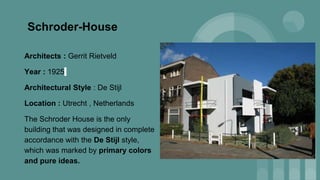
Architects : Gerrit Rietveld
Year : 1925
Architectural Style : De Stijl
Location : Utrecht , Netherlands
The Schroder House is the only
building that was designed in complete
accordance with the De Stijl style,
which was marked by primary colors
and pure ideas.
Schroder-House
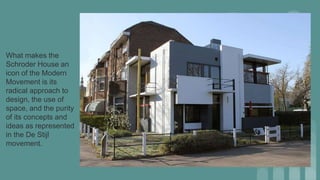
What makes the
Schroder House an
icon of the Modern
Movement is its
radical approach to
design, the use of
space, and the purity
of its concepts and
ideas as represented
in the De Stijl
movement.
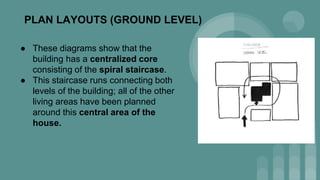
PLAN LAYOUTS (GROUND LEVEL)
● These diagrams show that the
building has a centralized core
consisting of the spiral staircase.
● This staircase runs connecting both
levels of the building; all of the other
living areas have been planned
around this central area of the
house.
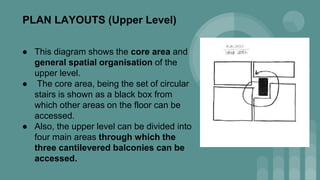
PLAN LAYOUTS (Upper Level)
● This diagram shows the core area and
general spatial organisation of the
upper level.
● The core area, being the set of circular
stairs is shown as a black box from
which other areas on the floor can be
accessed.
● Also, the upper level can be divided into
four main areas through which the
three cantilevered balconies can be
accessed.
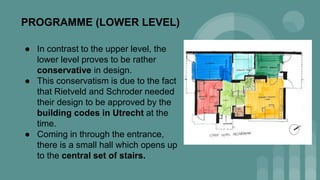
PROGRAMME (LOWER LEVEL)
● In contrast to the upper level, the
lower level proves to be rather
conservative in design.
● This conservatism is due to the fact
that Rietveld and Schroder needed
their design to be approved by the
building codes in Utrecht at the
time.
● Coming in through the entrance,
there is a small hall which opens up
to the central set of stairs.
PROGRAMME (LOWER LEVEL)
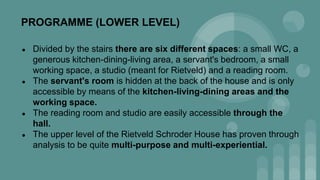
● Divided by the stairs there are six different spaces: a small WC, a
generous kitchen-dining-living area, a servant's bedroom, a small
working space, a studio (meant for Rietveld) and a reading room.
● The servant's room is hidden at the back of the house and is only
accessible by means of the kitchen-living-dining areas and the
working space.
● The reading room and studio are easily accessible through the
hall.
● The upper level of the Rietveld Schroder House has proven through
analysis to be quite multi-purpose and multi-experiential.
PROGRAMME (UPPER LEVEL)
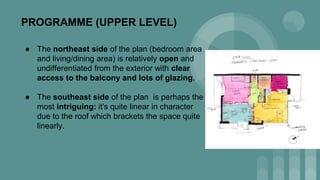
● The northeast side of the plan (bedroom area
and living/dining area) is relatively open and
undifferentiated from the exterior with clear
access to the balcony and lots of glazing.
● The southeast side of the plan is perhaps the
most intriguing: it's quite linear in character
due to the roof which brackets the space quite
linearly.
PROGRAMME
● The linearity of the southeast side allows this part of the building to
merge seamlessly with the landscape (i.e. disappearing corner
windows).
● The openness of the southeast and northeast sections are in clear
contrast to the southwest side of plan which is shut off by opaque
walls with only a little patch of glazing that opens the building out to a
single balcony.
● The privacy of the bathroom is still maintained as the it has been
fixed into the wall.
PROGRAMME
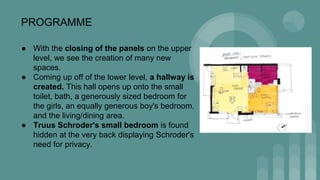
● With the closing of the panels on the upper
level, we see the creation of many new
spaces.
● Coming up off of the lower level, a hallway is
created. This hall opens up onto the small
toilet, bath, a generously sized bedroom for
the girls, an equally generous boy's bedroom,
and the living/dining area.
● Truus Schroder's small bedroom is found
hidden at the very back displaying Schroder's
need for privacy.
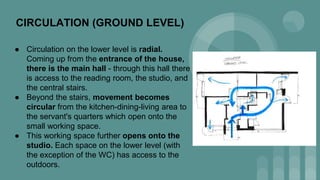
CIRCULATION (GROUND LEVEL)
● Circulation on the lower level is radial.
Coming up from the entrance of the house,
there is the main hall - through this hall there
is access to the reading room, the studio, and
the central stairs.
● Beyond the stairs, movement becomes
circular from the kitchen-dining-living area to
the servant's quarters which open onto the
small working space.
● This working space further opens onto the
studio. Each space on the lower level (with
the exception of the WC) has access to the
outdoors.
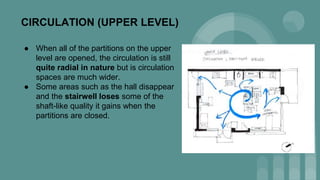
CIRCULATION (UPPER LEVEL)
● When all of the partitions on the upper
level are opened, the circulation is still
quite radial in nature but is circulation
spaces are much wider.
● Some areas such as the hall disappear
and the stairwell loses some of the
shaft-like quality it gains when the
partitions are closed.
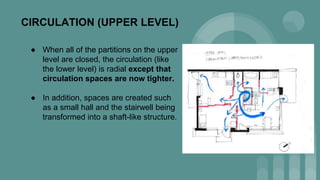
CIRCULATION (UPPER LEVEL)
● When all of the partitions on the upper
level are closed, the circulation (like
the lower level) is radial except that
circulation spaces are now tighter.
● In addition, spaces are created such
as a small hall and the stairwell being
transformed into a shaft-like structure.
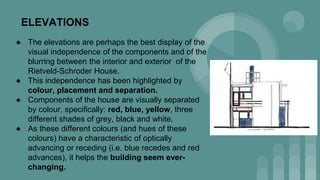
ELEVATIONS
● The elevations are perhaps the best display of the
visual independence of the components and of the
blurring between the interior and exterior of the
Rietveld-Schroder House.
● This independence has been highlighted by
colour, placement and separation.
● Components of the house are visually separated
by colour, specifically: red, blue, yellow, three
different shades of grey, black and white.
● As these different colours (and hues of these
colours) have a characteristic of optically
advancing or receding (i.e. blue recedes and red
advances), it helps the building seem ever-
changing.
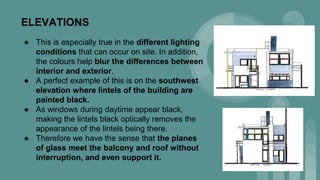
ELEVATIONS
● This is especially true in the different lighting
conditions that can occur on site. In addition,
the colours help blur the differences between
interior and exterior.
● A perfect example of this is on the southwest
elevation where lintels of the building are
painted black.
● As windows during daytime appear black,
making the lintels black optically removes the
appearance of the lintels being there.
● Therefore we have the sense that the planes
of glass meet the balcony and roof without
interruption, and even support it.
STRUCTURE & CONSTRUCTION
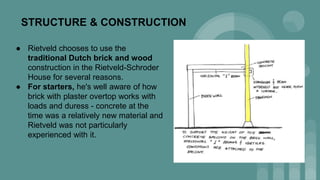
● Rietveld chooses to use the
traditional Dutch brick and wood
construction in the Rietveld-Schroder
House for several reasons.
● For starters, he's well aware of how
brick with plaster overtop works with
loads and duress - concrete at the
time was a relatively new material and
Rietveld was not particularly
experienced with it.
STRUCTURE & CONSTRUCTION
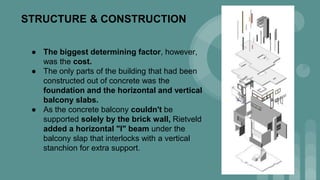
● The biggest determining factor, however,
was the cost.
● The only parts of the building that had been
constructed out of concrete was the
foundation and the horizontal and vertical
balcony slabs.
● As the concrete balcony couldn't be
supported solely by the brick wall, Rietveld
added a horizontal "I" beam under the
balcony slap that interlocks with a vertical
stanchion for extra support.
PHOTOGRAPHS
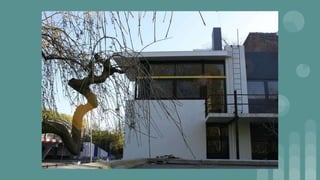
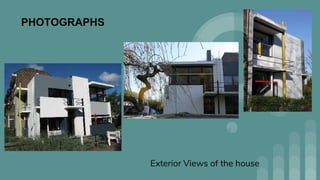
Exterior Views of the house
PHOTOGRAPHS
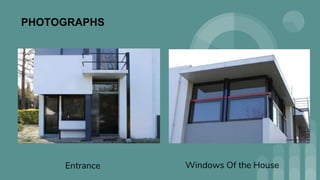
Entrance Windows Of the House
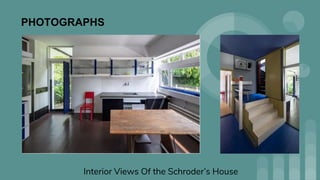
PHOTOGRAPHS
Interior Views Of the Schroder’s House
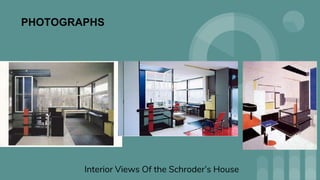
PHOTOGRAPHS
Interior Views Of the Schroder’s House
REFERENCES
● https://www.rietveldschroderhuis.nl/en/rietveld-schroder-house
● https://www.archdaily.com/99698/ad-classics-rietveld-schroder-
house-gerrit-rietveld
● https://www.idesign.wiki/schroder-house-1925/
THANK YOU

Schroder house

  • 1.
    MODERN WORLD ARCHITECTURE ARN- 210 Submitted By - Mohit Gupta (18110013) Anand Kasaudhan (18110003) Schroder-House
  • 2.
    Architects : GerritRietveld Year : 1925 Architectural Style : De Stijl Location : Utrecht , Netherlands The Schroder House is the only building that was designed in complete accordance with the De Stijl style, which was marked by primary colors and pure ideas. Schroder-House
  • 3.
    What makes the SchroderHouse an icon of the Modern Movement is its radical approach to design, the use of space, and the purity of its concepts and ideas as represented in the De Stijl movement.
  • 4.
    PLAN LAYOUTS (GROUNDLEVEL) ● These diagrams show that the building has a centralized core consisting of the spiral staircase. ● This staircase runs connecting both levels of the building; all of the other living areas have been planned around this central area of the house.
  • 5.
    PLAN LAYOUTS (UpperLevel) ● This diagram shows the core area and general spatial organisation of the upper level. ● The core area, being the set of circular stairs is shown as a black box from which other areas on the floor can be accessed. ● Also, the upper level can be divided into four main areas through which the three cantilevered balconies can be accessed.
  • 6.
    PROGRAMME (LOWER LEVEL) ●In contrast to the upper level, the lower level proves to be rather conservative in design. ● This conservatism is due to the fact that Rietveld and Schroder needed their design to be approved by the building codes in Utrecht at the time. ● Coming in through the entrance, there is a small hall which opens up to the central set of stairs.
  • 7.
    PROGRAMME (LOWER LEVEL) ●Divided by the stairs there are six different spaces: a small WC, a generous kitchen-dining-living area, a servant's bedroom, a small working space, a studio (meant for Rietveld) and a reading room. ● The servant's room is hidden at the back of the house and is only accessible by means of the kitchen-living-dining areas and the working space. ● The reading room and studio are easily accessible through the hall. ● The upper level of the Rietveld Schroder House has proven through analysis to be quite multi-purpose and multi-experiential.
  • 8.
    PROGRAMME (UPPER LEVEL) ●The northeast side of the plan (bedroom area and living/dining area) is relatively open and undifferentiated from the exterior with clear access to the balcony and lots of glazing. ● The southeast side of the plan is perhaps the most intriguing: it's quite linear in character due to the roof which brackets the space quite linearly.
  • 9.
    PROGRAMME ● The linearityof the southeast side allows this part of the building to merge seamlessly with the landscape (i.e. disappearing corner windows). ● The openness of the southeast and northeast sections are in clear contrast to the southwest side of plan which is shut off by opaque walls with only a little patch of glazing that opens the building out to a single balcony. ● The privacy of the bathroom is still maintained as the it has been fixed into the wall.
  • 10.
    PROGRAMME ● With theclosing of the panels on the upper level, we see the creation of many new spaces. ● Coming up off of the lower level, a hallway is created. This hall opens up onto the small toilet, bath, a generously sized bedroom for the girls, an equally generous boy's bedroom, and the living/dining area. ● Truus Schroder's small bedroom is found hidden at the very back displaying Schroder's need for privacy.
  • 12.
    CIRCULATION (GROUND LEVEL) ●Circulation on the lower level is radial. Coming up from the entrance of the house, there is the main hall - through this hall there is access to the reading room, the studio, and the central stairs. ● Beyond the stairs, movement becomes circular from the kitchen-dining-living area to the servant's quarters which open onto the small working space. ● This working space further opens onto the studio. Each space on the lower level (with the exception of the WC) has access to the outdoors.
  • 13.
    CIRCULATION (UPPER LEVEL) ●When all of the partitions on the upper level are opened, the circulation is still quite radial in nature but is circulation spaces are much wider. ● Some areas such as the hall disappear and the stairwell loses some of the shaft-like quality it gains when the partitions are closed.
  • 14.
    CIRCULATION (UPPER LEVEL) ●When all of the partitions on the upper level are closed, the circulation (like the lower level) is radial except that circulation spaces are now tighter. ● In addition, spaces are created such as a small hall and the stairwell being transformed into a shaft-like structure.
  • 15.
    ELEVATIONS ● The elevationsare perhaps the best display of the visual independence of the components and of the blurring between the interior and exterior of the Rietveld-Schroder House. ● This independence has been highlighted by colour, placement and separation. ● Components of the house are visually separated by colour, specifically: red, blue, yellow, three different shades of grey, black and white. ● As these different colours (and hues of these colours) have a characteristic of optically advancing or receding (i.e. blue recedes and red advances), it helps the building seem ever- changing.
  • 16.
    ELEVATIONS ● This isespecially true in the different lighting conditions that can occur on site. In addition, the colours help blur the differences between interior and exterior. ● A perfect example of this is on the southwest elevation where lintels of the building are painted black. ● As windows during daytime appear black, making the lintels black optically removes the appearance of the lintels being there. ● Therefore we have the sense that the planes of glass meet the balcony and roof without interruption, and even support it.
  • 17.
    STRUCTURE & CONSTRUCTION ●Rietveld chooses to use the traditional Dutch brick and wood construction in the Rietveld-Schroder House for several reasons. ● For starters, he's well aware of how brick with plaster overtop works with loads and duress - concrete at the time was a relatively new material and Rietveld was not particularly experienced with it.
  • 18.
    STRUCTURE & CONSTRUCTION ●The biggest determining factor, however, was the cost. ● The only parts of the building that had been constructed out of concrete was the foundation and the horizontal and vertical balcony slabs. ● As the concrete balcony couldn't be supported solely by the brick wall, Rietveld added a horizontal "I" beam under the balcony slap that interlocks with a vertical stanchion for extra support.
  • 19.
  • 20.
  • 21.
    PHOTOGRAPHS Interior Views Ofthe Schroder’s House
  • 22.
    PHOTOGRAPHS Interior Views Ofthe Schroder’s House
  • 23.
  • 24.