by-
V.A.THEJASREE
 Introduction
 Steps of catalytic reaction
 Catalyst characterization
 Chemical and surface properties
 Catalyst activity testing
 Recent trends.
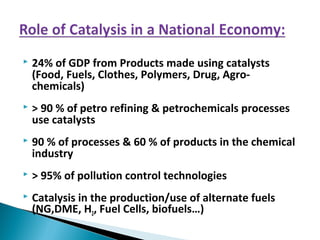
 24% of GDP from Products made using catalysts
(Food, Fuels, Clothes, Polymers, Drug, Agro-
chemicals)
 > 90 % of petro refining & petrochemicals processes
use catalysts
 90 % of processes & 60 % of products in the chemical
industry
 > 95% of pollution control technologies
 Catalysis in the production/use of alternate fuels
(NG,DME, H2, Fuel Cells, biofuels…)
 For discovery/use of alternate sources of
energy/fuels/raw material for chemical industry
 For Pollution control
 For preparation of new materials
(organic & inorganic-eg: Carbon Nanotubes)
Industrial catalysis-from 2000+ :-
 Solid catalysts for biodiesel
- solid acids, Hydroisom catalysts
 Catalysts for carbon nanotubes
- Fe (Ni)-Mo-SiO2
Fordeveloped-mainly improvementinperformancebynewsynthesismethods&useof
promoters
 Green Chemistry is Catalysis due to:-
Pollution control (air and waste streams;
stationary and mobile)
Clean oxidation/halogenation processes
using O2,H2O2 (C2H4O, C3H6O)
Avoiding toxic chemicals in industry
(HF,COCl2 etc)
Fuel cells (H2 generation)
 Catalysis in the Chemical Industry:
 Hydrogen Industry(coal,NH3,methanol, FT,
hydrogenations/ HDT, fuel cell)
 Natural gas processing (SR,ATR,WGS,POX)
 Petroleum refining (FCC, HDW, HDT, HCr, REF)
 Petrochemicals ( monomers, bulk chemicals)
 Fine Chem. ( pharma, agrochemical, fragrance,
textile, coating, surfactants, laundry etc)
 Environmental Catalysis ( auto exhaust, deNOx, DOC)
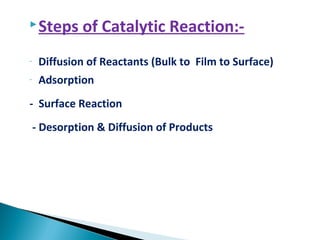
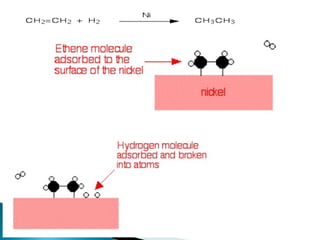
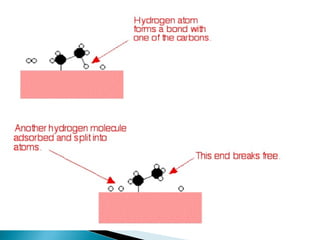
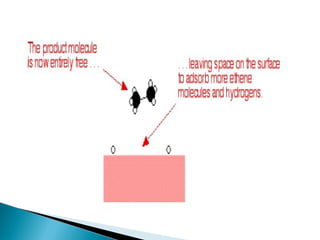
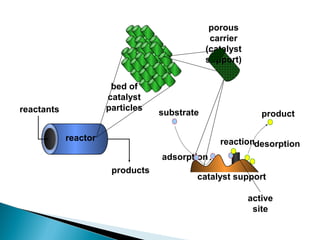
Steps of Catalytic Reaction:-
- Diffusion of Reactants (Bulk to Film to Surface)
- Adsorption
- Surface Reaction
- Desorption & Diffusion of Products
reactants
products
reactor
catalyst support
active
site
substrate
adsorption
reactiondesorption
bed of
catalyst
particles
porous
carrier
(catalyst
support)
product
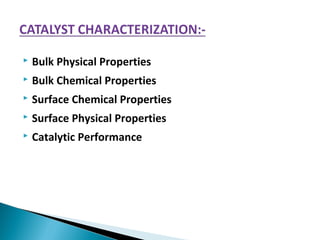
 Bulk Physical Properties
 Bulk Chemical Properties
 Surface Chemical Properties
 Surface Physical Properties
 Catalytic Performance
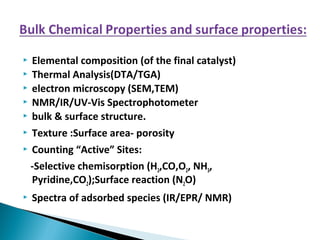
 Elemental composition (of the final catalyst)
 Thermal Analysis(DTA/TGA)
 electron microscopy (SEM,TEM)
 NMR/IR/UV-Vis Spectrophotometer
 bulk & surface structure.
 Texture :Surface area- porosity
 Counting “Active” Sites:
-Selective chemisorption (H2,CO,O2, NH3,
Pyridine,CO2);Surface reaction (N2O)
 Spectra of adsorbed species (IR/EPR/ NMR)
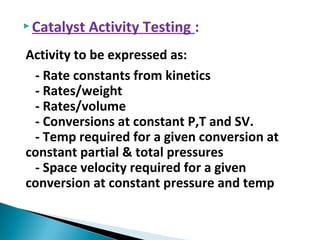
 Catalyst Activity Testing :
Activity to be expressed as:
- Rate constants from kinetics
- Rates/weight
- Rates/volume
- Conversions at constant P,T and SV.
- Temp required for a given conversion at
constant partial & total pressures
- Space velocity required for a given
conversion at constant pressure and temp
 Alternative feedstock's, reagents, solvents, products
 Enhanced process control
 New catalysts
 Greater integration of catalysis and reactor engineering:
membrane reactors, micro reactors, monolith technology,
phenomena integration
 Increased use of natural gas and biomass as feedstock
 Photodecomposition of water into hydrogen and oxygen
 Catalysts for depolymerizing polymers for recycle of the
monomers
 Improvements in fuel cell electrodes and their operation
THANKS FOR PROVIDING THIS
OPPURTUNITY AND SPECIAL THANKS
TO MY BROTHER V.A.CHAITANYA.
Thank
you

Thejasree

  • 1.
  • 2.
     Introduction  Stepsof catalytic reaction  Catalyst characterization  Chemical and surface properties  Catalyst activity testing  Recent trends.
  • 3.
     24% ofGDP from Products made using catalysts (Food, Fuels, Clothes, Polymers, Drug, Agro- chemicals)  > 90 % of petro refining & petrochemicals processes use catalysts  90 % of processes & 60 % of products in the chemical industry  > 95% of pollution control technologies  Catalysis in the production/use of alternate fuels (NG,DME, H2, Fuel Cells, biofuels…)
  • 4.
     For discovery/useof alternate sources of energy/fuels/raw material for chemical industry  For Pollution control  For preparation of new materials (organic & inorganic-eg: Carbon Nanotubes)
  • 5.
    Industrial catalysis-from 2000+:-  Solid catalysts for biodiesel - solid acids, Hydroisom catalysts  Catalysts for carbon nanotubes - Fe (Ni)-Mo-SiO2 Fordeveloped-mainly improvementinperformancebynewsynthesismethods&useof promoters
  • 6.
     Green Chemistryis Catalysis due to:- Pollution control (air and waste streams; stationary and mobile) Clean oxidation/halogenation processes using O2,H2O2 (C2H4O, C3H6O) Avoiding toxic chemicals in industry (HF,COCl2 etc) Fuel cells (H2 generation)
  • 7.
     Catalysis inthe Chemical Industry:  Hydrogen Industry(coal,NH3,methanol, FT, hydrogenations/ HDT, fuel cell)  Natural gas processing (SR,ATR,WGS,POX)  Petroleum refining (FCC, HDW, HDT, HCr, REF)  Petrochemicals ( monomers, bulk chemicals)  Fine Chem. ( pharma, agrochemical, fragrance, textile, coating, surfactants, laundry etc)  Environmental Catalysis ( auto exhaust, deNOx, DOC)
  • 8.
    Steps of CatalyticReaction:- - Diffusion of Reactants (Bulk to Film to Surface) - Adsorption - Surface Reaction - Desorption & Diffusion of Products
  • 12.
  • 13.
     Bulk PhysicalProperties  Bulk Chemical Properties  Surface Chemical Properties  Surface Physical Properties  Catalytic Performance
  • 14.
     Elemental composition(of the final catalyst)  Thermal Analysis(DTA/TGA)  electron microscopy (SEM,TEM)  NMR/IR/UV-Vis Spectrophotometer  bulk & surface structure.  Texture :Surface area- porosity  Counting “Active” Sites: -Selective chemisorption (H2,CO,O2, NH3, Pyridine,CO2);Surface reaction (N2O)  Spectra of adsorbed species (IR/EPR/ NMR)
  • 15.
     Catalyst ActivityTesting : Activity to be expressed as: - Rate constants from kinetics - Rates/weight - Rates/volume - Conversions at constant P,T and SV. - Temp required for a given conversion at constant partial & total pressures - Space velocity required for a given conversion at constant pressure and temp
  • 16.
     Alternative feedstock's,reagents, solvents, products  Enhanced process control  New catalysts  Greater integration of catalysis and reactor engineering: membrane reactors, micro reactors, monolith technology, phenomena integration  Increased use of natural gas and biomass as feedstock  Photodecomposition of water into hydrogen and oxygen  Catalysts for depolymerizing polymers for recycle of the monomers  Improvements in fuel cell electrodes and their operation
  • 17.
    THANKS FOR PROVIDINGTHIS OPPURTUNITY AND SPECIAL THANKS TO MY BROTHER V.A.CHAITANYA.
  • 18.