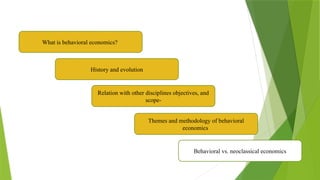
What is behavioraleconomics?
History and evolution
Relation with other disciplines objectives, and
scope-
Themes and methodology of behavioral
economics
Behavioral vs. neoclassical economics
3.
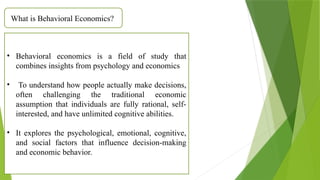
What is BehavioralEconomics?
• Behavioral economics is a field of study that
combines insights from psychology and economics
• To understand how people actually make decisions,
often challenging the traditional economic
assumption that individuals are fully rational, self-
interested, and have unlimited cognitive abilities.
• It explores the psychological, emotional, cognitive,
and social factors that influence decision-making
and economic behavior.
4.
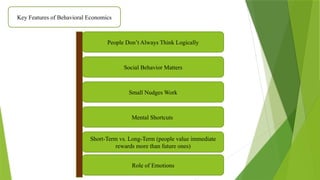
Key Features ofBehavioral Economics
People Don’t Always Think Logically
Social Behavior Matters
Small Nudges Work
Mental Shortcuts
Short-Term vs. Long-Term (people value immediate
rewards more than future ones)
Role of Emotions
Behavioral economics isa field of study that combines insights from economics
and psychology to understand how people actually make decisions, considering
that they often deviate from rational, self-interested behavior due to “cognitive
biases, emotions, social influences, and limited information”.
It examines the psychological, emotional, and cultural factors influencing economic
choices and seeks to design models, policies, and interventions that better reflect
real-world human behavior.
Behavioural economics isa subfield of economics that integrates insights from psychology
and other social sciences to understand how individuals make economic decisions. It
deviates from the traditional economic assumption that individuals always make rational
decisions based on self-interest and complete information. Instead, behavioural economics
recognizes that people often deviate from purely rational behaviour due to cognitive biases,
emotional factors, and social influences.
9.
History and evolution
EarlyFoundations: Challenges to
Rationality (18th-19th Century)
In The Theory of Moral Sentiments, Smith emphasized the role of emotions,
fairness, and social preferences in decision-making, laying the groundwork for
behavioral insights.
Jeremy Bentham (1789):Introduced the concept of utility but acknowledged the
influence of emotions and psychological factors on human behavior.
Foundations (1970s-1980s): The roots of behavioral economics can be traced
back to the works of psychologists such as Daniel Kahneman and Amos
Tversky. Their research challenged the traditional economic assumption that
individuals are perfectly rational decision-makers.
Prospect Theory (1979): Kahneman and Tversky's groundbreaking work on
prospect theory provided a new framework for understanding how people evaluate
and choose between different options under uncertainty.
Nudge Theory (2008): Richard Thaler and Cass Sunstein's book "Nudge"
popularized the idea of using subtle interventions, or "nudges," to influence
people's choices in a predictable way without restricting their freedom.
10.
History and evolution
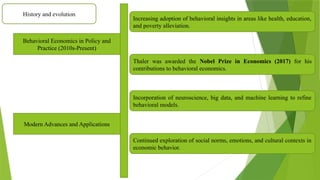
BehavioralEconomics in Policy and
Practice (2010s-Present)
Increasing adoption of behavioral insights in areas like health, education,
and poverty alleviation.
Thaler was awarded the Nobel Prize in Economics (2017) for his
contributions to behavioral economics.
Modern Advances and Applications
Incorporation of neuroscience, big data, and machine learning to refine
behavioral models.
Continued exploration of social norms, emotions, and cultural contexts in
economic behavior.
11.
Behavioral economics hascome a long way since its
inception, gaining acceptance and influence in both academia
and practical applications. The future holds the promise of
deeper insights into the complexities of human behavior and
more effective strategies for shaping choices in various
domains.
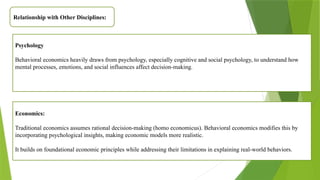
Relationship with OtherDisciplines:
Psychology
Behavioral economics heavily draws from psychology, especially cognitive and social psychology, to understand how
mental processes, emotions, and social influences affect decision-making.
Economics:
Traditional economics assumes rational decision-making (homo economicus). Behavioral economics modifies this by
incorporating psychological insights, making economic models more realistic.
It builds on foundational economic principles while addressing their limitations in explaining real-world behaviors.
14.
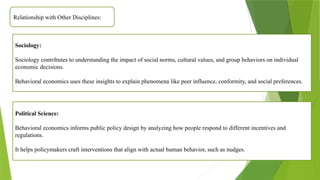
Relationship with OtherDisciplines:
Sociology:
Sociology contributes to understanding the impact of social norms, cultural values, and group behaviors on individual
economic decisions.
Behavioral economics uses these insights to explain phenomena like peer influence, conformity, and social preferences.
Political Science:
Behavioral economics informs public policy design by analyzing how people respond to different incentives and
regulations.
It helps policymakers craft interventions that align with actual human behavior, such as nudges.
15.
Relationship with OtherDisciplines:
Marketing and Business:
In marketing, behavioral economics helps understand consumer behavior, brand loyalty, and purchasing decisions.
Businesses use these insights to design better products, pricing strategies, and customer experiences.
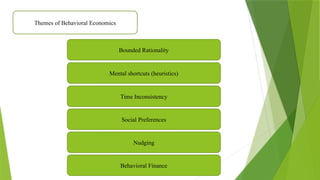
Themes of BehavioralEconomics
Bounded Rationality
Behavioral Finance
Mental shortcuts (heuristics)
Time Inconsistency
Social Preferences
Nudging
19.
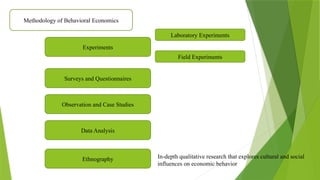
Methodology of BehavioralEconomics
Experiments
Laboratory Experiments
Field Experiments
Surveys and Questionnaires
Observation and Case Studies
Data Analysis
Ethnography In-depth qualitative research that explores cultural and social
influences on economic behavior
21.
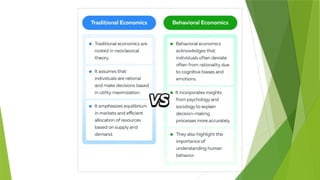
Neo-Classical Behavioural
Assumptions aboutHuman Behaviour
Assumes that individuals are
rational actors who make decisions
to maximize their utility. It relies
on the concept of Homo
Economicus, portraying individuals
as consistently making choices that
are in their best self-interest.
Challenges the assumption of
perfect rationality, suggesting
that individuals have bounded
rationality. It acknowledges that
cognitive limitations, emotions,
and social factors influence
decision-making.
Model of Decision-Making
Decision-making is based on a
well-defined set of preferences
and information, leading to
rational choices that maximize
utility.
Recognizes the presence of
biases, heuristics, and
cognitive shortcuts in decision-
making. Individuals might
deviate from strict rationality
due to psychological factors.
Market Efficiency
Believes in the efficient market
hypothesis, where prices in
financial markets reflect all
available information, and
market participants act rationally.
Highlights instances of market
anomalies, such as bubbles
and crashes, that cannot be
fully explained by rational
expectations. Behavioural
economists argue that markets
are not always perfectly
efficient due to irrational
Behaviour.
22.
Role of Government
Advocatesfor limited
government intervention. It
assumes that free markets will
naturally reach equilibrium and
allocate resources efficiently.
Recognizes the potential role
of government intervention to
correct market failures and
protect individuals from
making suboptimal decisions.
Policies may include nudges,
defaults, or regulations to
guide Behaviour.
Policy Implications
Generally leans towards laissez-
faire policies, with minimal
government intervention, trusting
in the self-regulating nature of
markets
Suggests that policymakers
should consider the
psychological aspects of
decision-making when
designing interventions.
Nudges and Behavioural
policies may be employed to
guide individuals toward
better choices