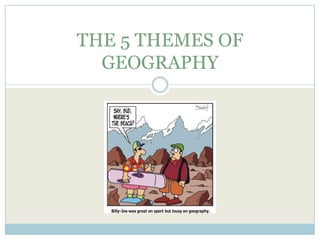
THE 5 THEMES OF
GEOGRAPHY
ge·og·ra·phy
1 : a science that deals with the
description, distribution, and interaction of
the diverse physical, biological, and cultural
features of the earth's surface
Source-Merriam Webster Collegiate Dictionary
IN PLAIN ENGLISH:
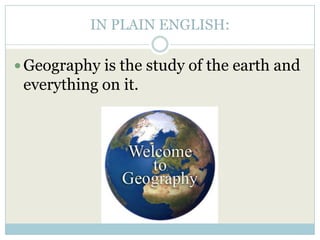
 Geography is the study of the earth and
everything on it.
THE FIVE THEMES OF GEOGRAPHY
1. Location
2. Place
3. Human-Environment Interaction
4. Movement
5. Regions
1. LOCATION:
Where is it? Why is it located there?
 Absolute
Location
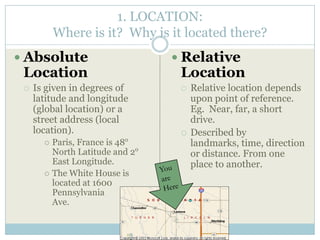
 Is given in degrees of
latitude and longitude
(global location) or a
street address (local
location).
 Paris, France is 48o
North Latitude and 2o
East Longitude.
 The White House is
located at 1600
Pennsylvania
Ave.
 Relative
Location
 Relative location depends
upon point of reference.
Eg. Near, far, a short
drive.
 Described by
landmarks, time, direction
or distance. From one
place to another.
2. PLACE: What is it like?
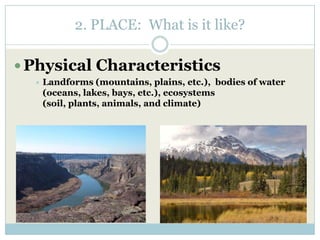
 Physical Characteristics
 Landforms (mountains, plains, etc.), bodies of water
(oceans, lakes, bays, etc.), ecosystems
(soil, plants, animals, and climate)
2. PLACE: What is it like?
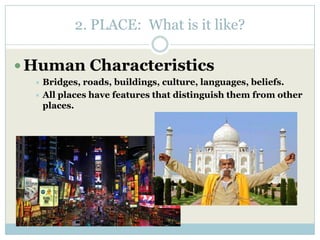
 Human Characteristics
 Bridges, roads, buildings, culture, languages, beliefs.
 All places have features that distinguish them from other
places.
3. HUMAN-ENVIRONMENT INTERACTION
 How do people interact with and change their
environment?
 We depend on the environment.
 Ex. People depend on rivers for water and
transportation.
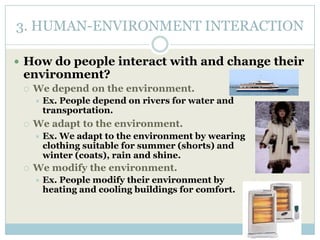
 We adapt to the environment.
 Ex. We adapt to the environment by wearing
clothing suitable for summer (shorts) and
winter (coats), rain and shine.
 We modify the environment.
 Ex. People modify their environment by
heating and cooling buildings for comfort.
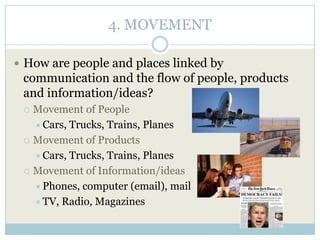
4. MOVEMENT
 How are people and places linked by
communication and the flow of people, products
and information/ideas?
 Movement of People
Cars, Trucks, Trains, Planes
 Movement of Products
Cars, Trucks, Trains, Planes
 Movement of Information/ideas
Phones, computer (email), mail
TV, Radio, Magazines
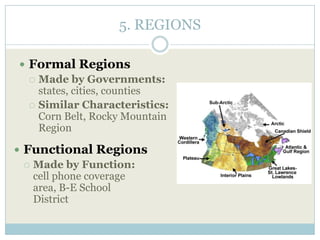
5. REGIONS
 Formal Regions
 Made by Governments:
states, cities, counties
 Similar Characteristics:
Corn Belt, Rocky Mountain
Region
 Functional Regions
 Made by Function:
cell phone coverage
area, B-E School
District
REMEMBERING THE 5 THEMES
If you can’t remember what they are
just ask MR. HELP!!!
M – Movement
R – Regions
HE – Human Environment interaction
L – Location
P - Place
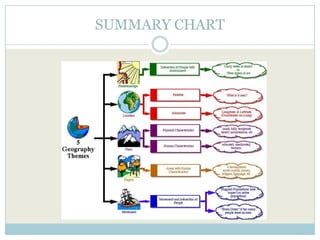
SUMMARY CHART
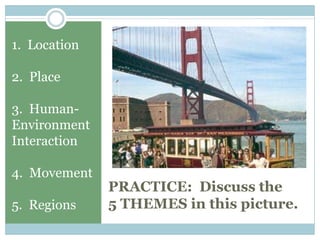
PRACTICE: Discuss the
5 THEMES in this picture.
1. Location
2. Place
3. Human-
Environment
Interaction
4. Movement
5. Regions
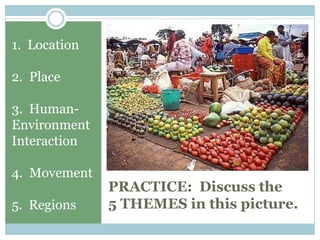
PRACTICE: Discuss the
5 THEMES in this picture.
1. Location
2. Place
3. Human-
Environment
Interaction
4. Movement
5. Regions
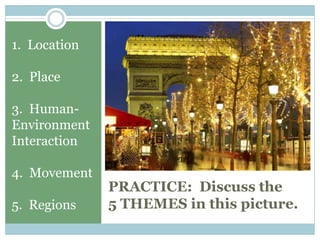
PRACTICE: Discuss the
5 THEMES in this picture.
1. Location
2. Place
3. Human-
Environment
Interaction
4. Movement
5. Regions

The 5 themes of geography (slightly revised)

  • 1.
    THE 5 THEMESOF GEOGRAPHY
  • 2.
    ge·og·ra·phy 1 : ascience that deals with the description, distribution, and interaction of the diverse physical, biological, and cultural features of the earth's surface Source-Merriam Webster Collegiate Dictionary
  • 3.
    IN PLAIN ENGLISH: Geography is the study of the earth and everything on it.
  • 4.
    THE FIVE THEMESOF GEOGRAPHY 1. Location 2. Place 3. Human-Environment Interaction 4. Movement 5. Regions
  • 5.
    1. LOCATION: Where isit? Why is it located there?  Absolute Location  Is given in degrees of latitude and longitude (global location) or a street address (local location).  Paris, France is 48o North Latitude and 2o East Longitude.  The White House is located at 1600 Pennsylvania Ave.  Relative Location  Relative location depends upon point of reference. Eg. Near, far, a short drive.  Described by landmarks, time, direction or distance. From one place to another.
  • 6.
    2. PLACE: Whatis it like?  Physical Characteristics  Landforms (mountains, plains, etc.), bodies of water (oceans, lakes, bays, etc.), ecosystems (soil, plants, animals, and climate)
  • 7.
    2. PLACE: Whatis it like?  Human Characteristics  Bridges, roads, buildings, culture, languages, beliefs.  All places have features that distinguish them from other places.
  • 8.
    3. HUMAN-ENVIRONMENT INTERACTION How do people interact with and change their environment?  We depend on the environment.  Ex. People depend on rivers for water and transportation.  We adapt to the environment.  Ex. We adapt to the environment by wearing clothing suitable for summer (shorts) and winter (coats), rain and shine.  We modify the environment.  Ex. People modify their environment by heating and cooling buildings for comfort.
  • 9.
    4. MOVEMENT  Howare people and places linked by communication and the flow of people, products and information/ideas?  Movement of People Cars, Trucks, Trains, Planes  Movement of Products Cars, Trucks, Trains, Planes  Movement of Information/ideas Phones, computer (email), mail TV, Radio, Magazines
  • 10.
    5. REGIONS  FormalRegions  Made by Governments: states, cities, counties  Similar Characteristics: Corn Belt, Rocky Mountain Region  Functional Regions  Made by Function: cell phone coverage area, B-E School District
  • 11.
    REMEMBERING THE 5THEMES If you can’t remember what they are just ask MR. HELP!!! M – Movement R – Regions HE – Human Environment interaction L – Location P - Place
  • 12.
  • 13.
    PRACTICE: Discuss the 5THEMES in this picture. 1. Location 2. Place 3. Human- Environment Interaction 4. Movement 5. Regions
  • 14.
    PRACTICE: Discuss the 5THEMES in this picture. 1. Location 2. Place 3. Human- Environment Interaction 4. Movement 5. Regions
  • 15.
    PRACTICE: Discuss the 5THEMES in this picture. 1. Location 2. Place 3. Human- Environment Interaction 4. Movement 5. Regions