THE WRITING
 STRATEGIES
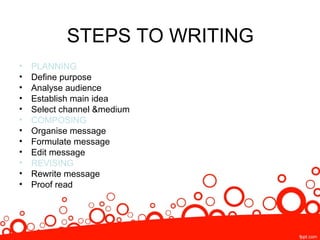
STEPS TO WRITING
•   PLANNING
•   Define purpose
•   Analyse audience
•   Establish main idea
•   Select channel &medium
•   COMPOSING
•   Organise message
•   Formulate message
•   Edit message
•   REVISING
•   Rewrite message
•   Proof read
Essentials to
            Business Writing
Apart from grammar and punctuation we need to
  know
• Formatting business documents
• Strategic approaches to dealing with different
  situations.
• Use a conversational style that eliminates the old
  language of business.
• Use the you viewpoint to build goodwill.
• Employ positive language to achieve desired effect.
Organize your thoughts
• Clarity of purpose encourages brevity & accuracy,
  facilitates emphasis & de-emphasis.

• Know your audience so that you can address to
  their major needs & concerns.

• Scope of the letter (what do I convey)

• What action do I want? (A favour, an order, a job)
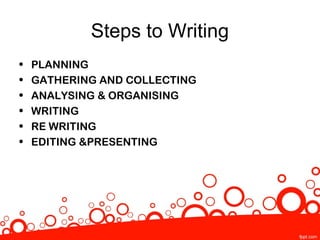
Steps to Writing
•   PLANNING
•   GATHERING AND COLLECTING
•   ANALYSING & ORGANISING
•   WRITING
•   RE WRITING
•   EDITING &PRESENTING
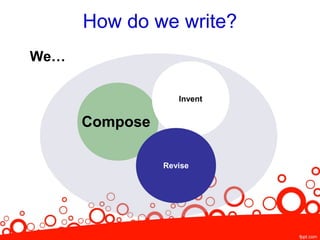
How do we write?
We…

                   Invent


      Compose

                Revise
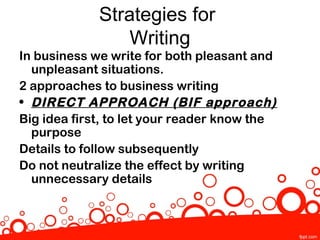
Strategies for
                 Writing
In business we write for both pleasant and
  unpleasant situations.
2 approaches to business writing
• DIRECT APPROACH (BIF approach)
Big idea first, to let your reader know the
  purpose
Details to follow subsequently
Do not neutralize the effect by writing
  unnecessary details
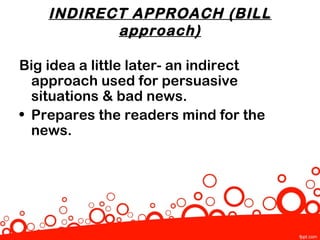
INDIRECT APPROACH (BILL
           approach)

Big idea a little later- an indirect
  approach used for persuasive
  situations & bad news.
• Prepares the readers mind for the
  news.
Writing about the pleasant(Deductive
                Method)
Letters that convey pleasant messages are called
  routine letters. They are not likely to generate any
  emotional reaction.
The first sentence attracts attention, making the
  reader receptive & hence reducing the reading
  time, as it is direct & to the point.
This style applies to:
Routine claims, letters about orders, credit, requests,
  favorable responses.
Writing about the unpleasant
            (Inductive Method)
People who are refused need valid explanation for the
  reason WHY?
Similarly a bad news in the first sentence always
  generates a negative response.
• In such cases begin with a neutral idea that leads
  to reason of refusal.
• Submit facts, reasons for the refusal.
• Finally in the third paragraph, state the statement.
• Close the letter on positive note, de emphasizing
  the negative message.
Generally no letters like NO to a credit request, back
  orders, no to a favor, rejected adjustment request.
Writing for Persuasion
Persuasive writing must include the AIDA plan.
1.Getting the readers ATTENTION (A)
2.ArousingS INTEREST through writing (I)
3.Convincing &generating DESIRE (D)
4.Encouraging ACTION (A)

Clarity of objective & generating desire for action
  form the very basis to such writing.
(What to achieve & how? )
Audience Reaction & Writing
              Strategy
•  AUDIENCE REACTION:
1. Eager or interested
   Write direct request or main idea
   Provide necessary details
   Close cordially &state specific action desired.
2. Pleased or neutral
   Write routine goodwill news & goodwill messages.
   Begin with main idea providing necessary details
   Close on a cordial note or a look toward the
   future.
3. Displeased
    You are about to write bad news or message
   Begin with a neutral sentence that later carries to
   the reasons for bad news
   Give reasons to justify a negative answer
   Close cordially.
4. Uninterested &unwilling
   Write persuasively
   Begin with a catchy sentence (attention getter)
   Arouse interest & build desire
   Close with a request for action.
The writing strategy session 3

The writing strategy session 3

  • 1.
  • 2.
    STEPS TO WRITING • PLANNING • Define purpose • Analyse audience • Establish main idea • Select channel &medium • COMPOSING • Organise message • Formulate message • Edit message • REVISING • Rewrite message • Proof read
  • 3.
    Essentials to Business Writing Apart from grammar and punctuation we need to know • Formatting business documents • Strategic approaches to dealing with different situations. • Use a conversational style that eliminates the old language of business. • Use the you viewpoint to build goodwill. • Employ positive language to achieve desired effect.
  • 4.
    Organize your thoughts •Clarity of purpose encourages brevity & accuracy, facilitates emphasis & de-emphasis. • Know your audience so that you can address to their major needs & concerns. • Scope of the letter (what do I convey) • What action do I want? (A favour, an order, a job)
  • 5.
    Steps to Writing • PLANNING • GATHERING AND COLLECTING • ANALYSING & ORGANISING • WRITING • RE WRITING • EDITING &PRESENTING
  • 6.
    How do wewrite? We… Invent Compose Revise
  • 7.
    Strategies for Writing In business we write for both pleasant and unpleasant situations. 2 approaches to business writing • DIRECT APPROACH (BIF approach) Big idea first, to let your reader know the purpose Details to follow subsequently Do not neutralize the effect by writing unnecessary details
  • 8.
    INDIRECT APPROACH (BILL approach) Big idea a little later- an indirect approach used for persuasive situations & bad news. • Prepares the readers mind for the news.
  • 9.
    Writing about thepleasant(Deductive Method) Letters that convey pleasant messages are called routine letters. They are not likely to generate any emotional reaction. The first sentence attracts attention, making the reader receptive & hence reducing the reading time, as it is direct & to the point. This style applies to: Routine claims, letters about orders, credit, requests, favorable responses.
  • 10.
    Writing about theunpleasant (Inductive Method) People who are refused need valid explanation for the reason WHY? Similarly a bad news in the first sentence always generates a negative response. • In such cases begin with a neutral idea that leads to reason of refusal. • Submit facts, reasons for the refusal. • Finally in the third paragraph, state the statement. • Close the letter on positive note, de emphasizing the negative message. Generally no letters like NO to a credit request, back orders, no to a favor, rejected adjustment request.
  • 11.
    Writing for Persuasion Persuasivewriting must include the AIDA plan. 1.Getting the readers ATTENTION (A) 2.ArousingS INTEREST through writing (I) 3.Convincing &generating DESIRE (D) 4.Encouraging ACTION (A) Clarity of objective & generating desire for action form the very basis to such writing. (What to achieve & how? )
  • 12.
    Audience Reaction &Writing Strategy • AUDIENCE REACTION: 1. Eager or interested Write direct request or main idea Provide necessary details Close cordially &state specific action desired. 2. Pleased or neutral Write routine goodwill news & goodwill messages. Begin with main idea providing necessary details Close on a cordial note or a look toward the future.
  • 13.
    3. Displeased You are about to write bad news or message Begin with a neutral sentence that later carries to the reasons for bad news Give reasons to justify a negative answer Close cordially. 4. Uninterested &unwilling Write persuasively Begin with a catchy sentence (attention getter) Arouse interest & build desire Close with a request for action.