
First Informers in a Facebook World How Social Media Is Changing  Emergency Management and PIOs Greg Licamele / GW EMSE / Dec. 14, 2009
Me in Three Seconds Professional Current: Public Information Officer/Online Communications Director for Fairfax County Government Previous: Web Communications for GW University Relations and Emergency Management Office Academic Master’s, Homeland Security & Emergency Management Master’s, Media and Public Affairs BA, Journalism
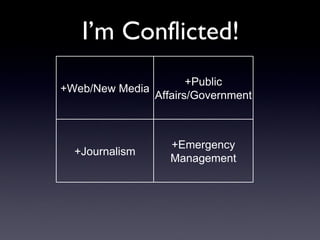
I’m Conflicted! +Web/New Media +Public Affairs/Government +Journalism +Emergency Management
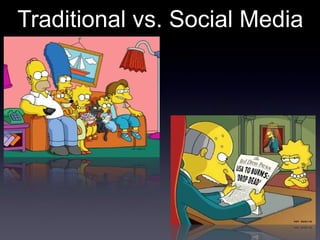
Traditional vs. Social Media
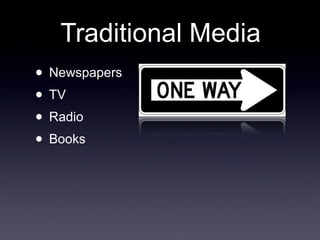
Traditional Media Newspapers TV Radio Books
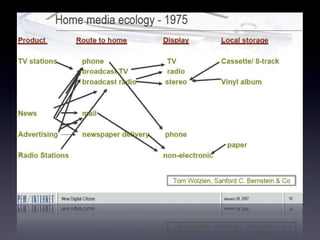
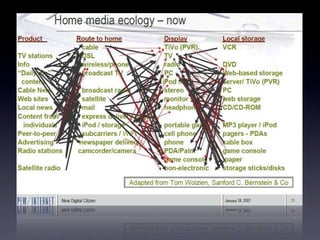
Today’s Media World Traditional media on the decline with layoffs, budget cuts, fewer printed pages and minutes of coverage. Who fills the void? How do messages and information spread? How does a traditional first informer (government, business, organization) tell people what’s going on?
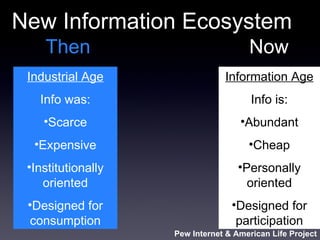
New Information Ecosystem   Then   Now Industrial Age Info was: Scarce Expensive Institutionally oriented Designed for consumption Information Age Info is: Abundant Cheap Personally oriented Designed for participation Pew Internet & American Life Project
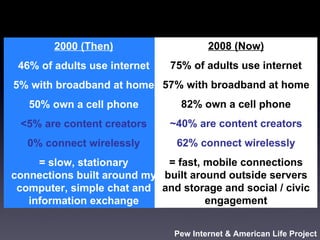
2000 (Then) 46% of adults use internet 5% with broadband at home 50% own a cell phone <5% are content creators 0% connect wirelessly = slow, stationary connections built around my computer, simple chat and information exchange 2008 (Now) 75% of adults use internet 57% with broadband at home 82% own a cell phone ~40% are content creators 62% connect wirelessly = fast, mobile connections built around outside servers and storage and social / civic engagement Pew Internet & American Life Project
 
 
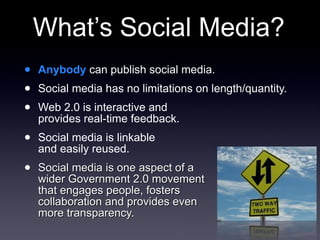
What’s Social Media? Anybody  can publish social media. Social media has no limitations on length/quantity. Web 2.0 is interactive and  provides real-time feedback. Social media is linkable  and easily reused. Social media is one aspect of a  wider Government 2.0 movement  that engages people, fosters  collaboration and provides even  more transparency.
 
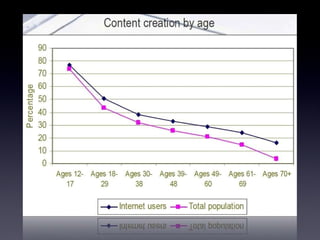
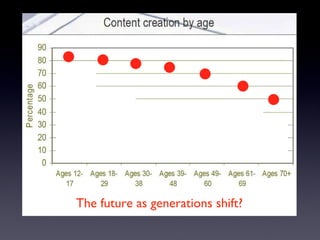
The future as generations shift?
 
Social Media and Emergencies National Response Framework: “ The local senior elected or appointed official (the mayor, city manager, or county manager) is responsible for ensuring the public safety and welfare of residents.”  ESF 15/PIOs communicate this info; need to use  today’s tools to be a first informer .
Q: Who’s a  First Informer?
Answer Before 2004: Government, Media Answer Today:  Everyone
“ ... the old, linear model for information dissemination of authorities- to -public relations- to -media is outmoded...” “ ... the public is able to take not only a more active part in seeking information, but also in providing information to each other...” - Palen and Liu, 2007
Social Media Use •  We, the government, are viewed as simply one content provider and everyone else has just as much power (though not necessarily the same credibility) to provide public information. •  Help others become our information ambassadors.
Social Media Use The public uses today’s tools: Virginia Tech Shooting/Facebook California Wildfires/Twitter & Flickr China Earthquakes/Twitter The public often reports information more rapidly and sometimes more accurately than officials and media. Our voice needs to be part of the conversation.
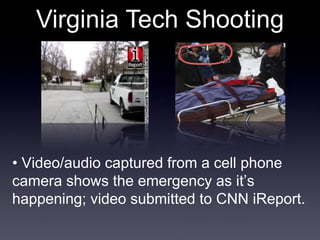
Virginia Tech Shooting •  Video/audio captured from a cell phone camera shows the emergency as it’s happening; video submitted to CNN iReport.
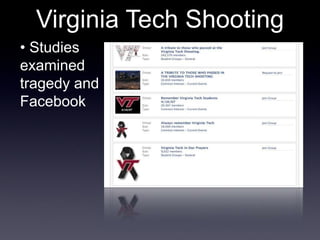
Virginia Tech Shooting •  Studies examined tragedy and Facebook
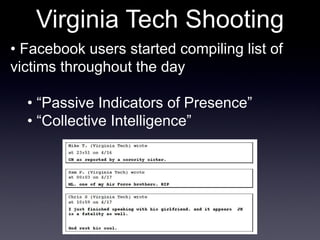
Virginia Tech Shooting •  Facebook users started compiling list of victims throughout the day • “ Passive Indicators of Presence” • “ Collective Intelligence”
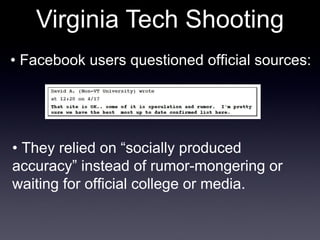
Virginia Tech Shooting •  Facebook users questioned official sources: •  They relied on “socially produced accuracy” instead of rumor-mongering or waiting for official college or media.
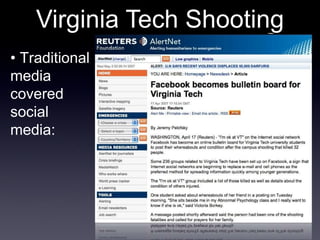
Virginia Tech Shooting •  Traditional media covered social media:
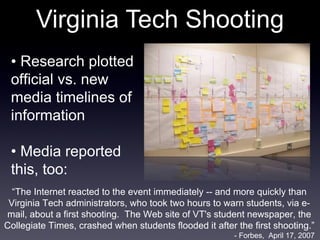
Virginia Tech Shooting •  Research plotted official vs. new media timelines of information •  Media reported this, too: “ The Internet reacted to the event immediately -- and more quickly than Virginia Tech administrators, who took two hours to warn students, via e-mail, about a first shooting.  The Web site of VT's student newspaper, the Collegiate Times, crashed when students flooded it after the first shooting.” - Forbes,  April 17, 2007
Virginia Tech Shooting •  Facebook also had downsides, too: •  VT student with picture of gun collection was originally identified as a potential suspect by some Facebook users. •  Traditional media reported it. •  Student received death threats.
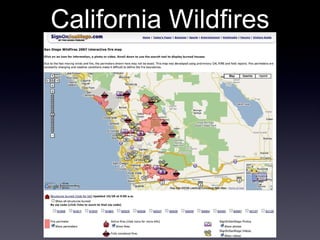
California Wildfires •  Challenging story for traditional media to cover because wide and sometimes remote areas. •  People want real-time information in case they need to evacuate or if they already have evacuated (is their property OK?) •  Local media and government (traditional first informers) started to use social media platforms to keep up with information dissemination during wildfires in 2007.
California Wildfires •  In May 2007, LAFD asked people near fires to send Twitter updates -- “helped the department tailor its fire-fighting strategy.”
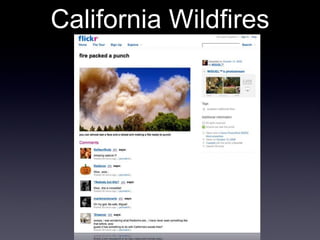
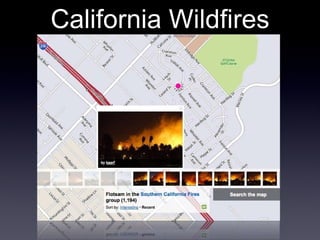
California Wildfires •  During wildfires and other emergencies, Yahoo! News and local media outlets used Flickr photos as eyewitness accounts -- this legitimizes Flickr (photos and members) as an authoritative source.
California Wildfires
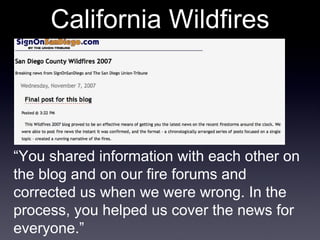
California Wildfires “ You shared information with each other on the blog and on our fire forums and corrected us when we were wrong. In the process, you helped us cover the news for everyone.”
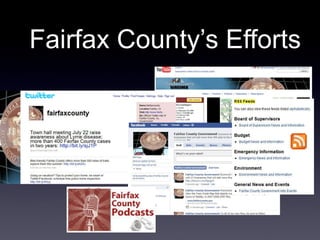
Fairfax County’s Efforts
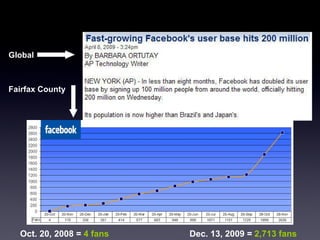
Global Fairfax County Oct. 20, 2008 =  4 fans   Dec. 13, 2009 =  2,713 fans
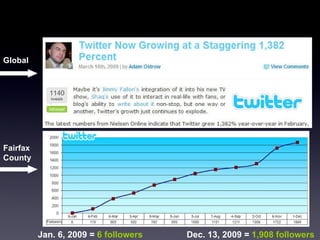
Global Fairfax County Jan. 6, 2009 =  6 followers   Dec. 13, 2009 =  1,908 followers
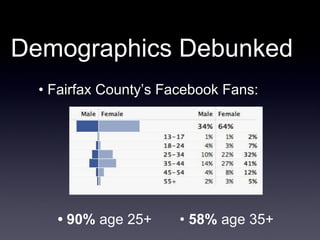
Demographics Debunked •  Fairfax County’s Facebook Fans: •  90%  age 25+  •  58%  age 35+
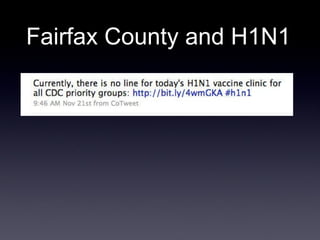
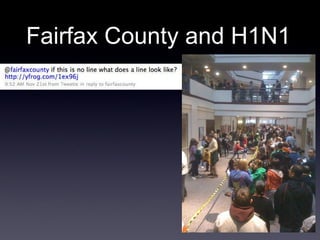
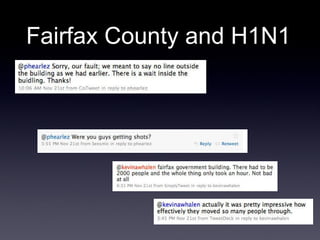
Fairfax County and H1N1 H1N1 Vaccine Clinics: We relied on our .gov site, Facebook and Twitter to provide real-time updates about mass H1N1 vaccination clinic; updated from EOC/JIC Read Our Social Media and H1N1 Case Study
Fairfax County and H1N1
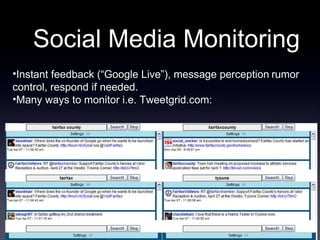
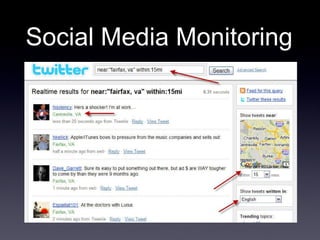
Social Media Monitoring Instant feedback (“Google Live”), message perception   rumor control, respond if needed. Many ways to monitor i.e. Tweetgrid.com:
Social Media Monitoring
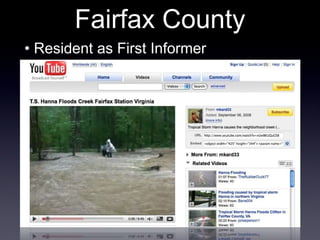
Fairfax County •  Resident as First Informer
Emerging Platforms
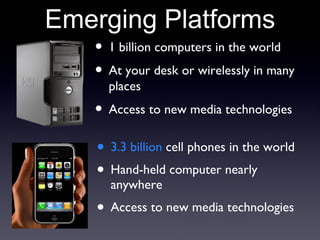
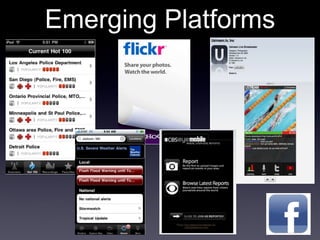
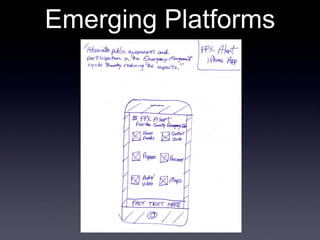
Emerging Platforms 3.3 billion  cell phones in the world Hand-held computer nearly anywhere Access to new media technologies 1 billion computers in the world  At your desk or wirelessly in many places Access to new media technologies
Emerging Platforms
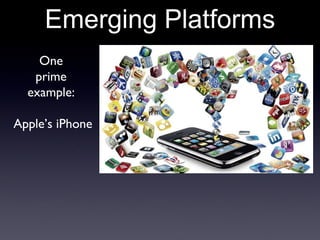
Emerging Platforms One  prime  example:  Apple’s iPhone
Emerging Platforms
Emerging Platforms
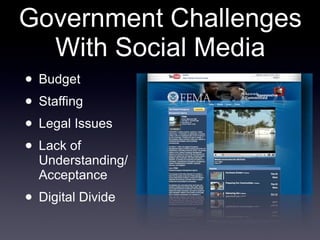
Government Challenges With Social Media Budget Staffing Legal Issues Lack of  Understanding/ Acceptance Digital Divide
Discussion Questions: Impacts on Emergency Management
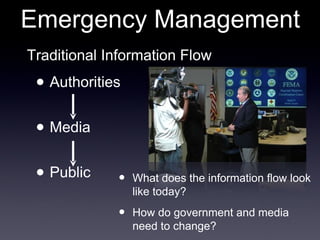
Emergency Management Authorities Media Public Traditional Information Flow What does the information flow look like today? How do government and media need to change?
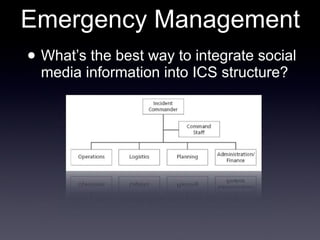
Emergency Management What’s the best way to integrate social media information into ICS structure?
Emergency Management How should a Joint Information Center handle large-scale, complex incidents that have very little information to share in the initial hour(s)? Remember, first informers likely will be on the scene reporting/speculating with text, audio, video and more
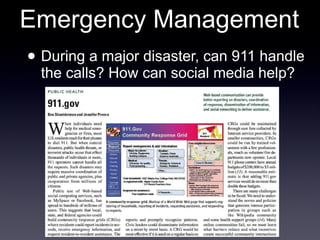
Emergency Management During a major disaster, can 911 handle the calls? How can social media help?
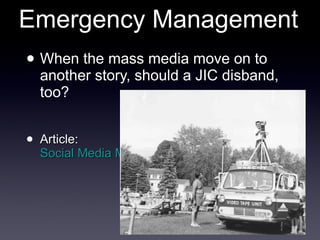
Emergency Management When the mass media move on to another story, should a JIC disband, too? Article:  Social Media Makes a Crisis Last Much Longer
Emergency Management What are the budgetary impacts for governments? Is it possible, realistic and/or expected that these traditional first informers engage  heavily  in social media (especially in tight budget times for state/local governments)?
First Informers in a Facebook World What have you experienced or noticed? Questions, concerns and ideas?
Closing Thought 1 “ We can no longer afford to work at the speed of government. We must remain relevant to the people we serve.”  -- Los Angeles Fire Department PIO about using Twitter (and other social media tools)
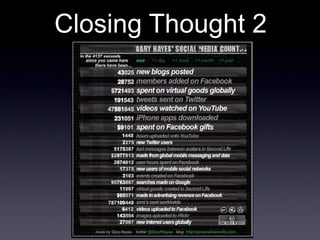
Closing Thought 2

First Informers in a Facebook World

  • 1.
    First Informers ina Facebook World How Social Media Is Changing Emergency Management and PIOs Greg Licamele / GW EMSE / Dec. 14, 2009
  • 2.
    Me in ThreeSeconds Professional Current: Public Information Officer/Online Communications Director for Fairfax County Government Previous: Web Communications for GW University Relations and Emergency Management Office Academic Master’s, Homeland Security & Emergency Management Master’s, Media and Public Affairs BA, Journalism
  • 3.
    I’m Conflicted! +Web/NewMedia +Public Affairs/Government +Journalism +Emergency Management
  • 4.
  • 5.
  • 6.
    Today’s Media WorldTraditional media on the decline with layoffs, budget cuts, fewer printed pages and minutes of coverage. Who fills the void? How do messages and information spread? How does a traditional first informer (government, business, organization) tell people what’s going on?
  • 7.
    New Information Ecosystem Then Now Industrial Age Info was: Scarce Expensive Institutionally oriented Designed for consumption Information Age Info is: Abundant Cheap Personally oriented Designed for participation Pew Internet & American Life Project
  • 8.
    2000 (Then) 46%of adults use internet 5% with broadband at home 50% own a cell phone <5% are content creators 0% connect wirelessly = slow, stationary connections built around my computer, simple chat and information exchange 2008 (Now) 75% of adults use internet 57% with broadband at home 82% own a cell phone ~40% are content creators 62% connect wirelessly = fast, mobile connections built around outside servers and storage and social / civic engagement Pew Internet & American Life Project
  • 9.
  • 10.
  • 11.
    What’s Social Media?Anybody can publish social media. Social media has no limitations on length/quantity. Web 2.0 is interactive and provides real-time feedback. Social media is linkable and easily reused. Social media is one aspect of a wider Government 2.0 movement that engages people, fosters collaboration and provides even more transparency.
  • 12.
  • 13.
    The future asgenerations shift?
  • 14.
  • 15.
    Social Media andEmergencies National Response Framework: “ The local senior elected or appointed official (the mayor, city manager, or county manager) is responsible for ensuring the public safety and welfare of residents.” ESF 15/PIOs communicate this info; need to use today’s tools to be a first informer .
  • 16.
    Q: Who’s a First Informer?
  • 17.
    Answer Before 2004:Government, Media Answer Today: Everyone
  • 18.
    “ ... theold, linear model for information dissemination of authorities- to -public relations- to -media is outmoded...” “ ... the public is able to take not only a more active part in seeking information, but also in providing information to each other...” - Palen and Liu, 2007
  • 19.
    Social Media Use• We, the government, are viewed as simply one content provider and everyone else has just as much power (though not necessarily the same credibility) to provide public information. • Help others become our information ambassadors.
  • 20.
    Social Media UseThe public uses today’s tools: Virginia Tech Shooting/Facebook California Wildfires/Twitter & Flickr China Earthquakes/Twitter The public often reports information more rapidly and sometimes more accurately than officials and media. Our voice needs to be part of the conversation.
  • 21.
    Virginia Tech Shooting• Video/audio captured from a cell phone camera shows the emergency as it’s happening; video submitted to CNN iReport.
  • 22.
    Virginia Tech Shooting• Studies examined tragedy and Facebook
  • 23.
    Virginia Tech Shooting• Facebook users started compiling list of victims throughout the day • “ Passive Indicators of Presence” • “ Collective Intelligence”
  • 24.
    Virginia Tech Shooting• Facebook users questioned official sources: • They relied on “socially produced accuracy” instead of rumor-mongering or waiting for official college or media.
  • 25.
    Virginia Tech Shooting• Traditional media covered social media:
  • 26.
    Virginia Tech Shooting• Research plotted official vs. new media timelines of information • Media reported this, too: “ The Internet reacted to the event immediately -- and more quickly than Virginia Tech administrators, who took two hours to warn students, via e-mail, about a first shooting. The Web site of VT's student newspaper, the Collegiate Times, crashed when students flooded it after the first shooting.” - Forbes, April 17, 2007
  • 27.
    Virginia Tech Shooting• Facebook also had downsides, too: • VT student with picture of gun collection was originally identified as a potential suspect by some Facebook users. • Traditional media reported it. • Student received death threats.
  • 28.
    California Wildfires • Challenging story for traditional media to cover because wide and sometimes remote areas. • People want real-time information in case they need to evacuate or if they already have evacuated (is their property OK?) • Local media and government (traditional first informers) started to use social media platforms to keep up with information dissemination during wildfires in 2007.
  • 29.
    California Wildfires • In May 2007, LAFD asked people near fires to send Twitter updates -- “helped the department tailor its fire-fighting strategy.”
  • 30.
    California Wildfires • During wildfires and other emergencies, Yahoo! News and local media outlets used Flickr photos as eyewitness accounts -- this legitimizes Flickr (photos and members) as an authoritative source.
  • 31.
  • 32.
  • 33.
  • 34.
    California Wildfires “You shared information with each other on the blog and on our fire forums and corrected us when we were wrong. In the process, you helped us cover the news for everyone.”
  • 35.
  • 36.
    Global Fairfax CountyOct. 20, 2008 = 4 fans Dec. 13, 2009 = 2,713 fans
  • 37.
    Global Fairfax CountyJan. 6, 2009 = 6 followers Dec. 13, 2009 = 1,908 followers
  • 38.
    Demographics Debunked • Fairfax County’s Facebook Fans: • 90% age 25+ • 58% age 35+
  • 39.
    Fairfax County andH1N1 H1N1 Vaccine Clinics: We relied on our .gov site, Facebook and Twitter to provide real-time updates about mass H1N1 vaccination clinic; updated from EOC/JIC Read Our Social Media and H1N1 Case Study
  • 40.
  • 41.
  • 42.
  • 43.
    Social Media MonitoringInstant feedback (“Google Live”), message perception rumor control, respond if needed. Many ways to monitor i.e. Tweetgrid.com:
  • 44.
  • 45.
    Fairfax County • Resident as First Informer
  • 46.
  • 47.
    Emerging Platforms 3.3billion cell phones in the world Hand-held computer nearly anywhere Access to new media technologies 1 billion computers in the world At your desk or wirelessly in many places Access to new media technologies
  • 48.
  • 49.
    Emerging Platforms One prime example: Apple’s iPhone
  • 50.
  • 51.
  • 52.
    Government Challenges WithSocial Media Budget Staffing Legal Issues Lack of Understanding/ Acceptance Digital Divide
  • 53.
    Discussion Questions: Impactson Emergency Management
  • 54.
    Emergency Management AuthoritiesMedia Public Traditional Information Flow What does the information flow look like today? How do government and media need to change?
  • 55.
    Emergency Management What’sthe best way to integrate social media information into ICS structure?
  • 56.
    Emergency Management Howshould a Joint Information Center handle large-scale, complex incidents that have very little information to share in the initial hour(s)? Remember, first informers likely will be on the scene reporting/speculating with text, audio, video and more
  • 57.
    Emergency Management Duringa major disaster, can 911 handle the calls? How can social media help?
  • 58.
    Emergency Management Whenthe mass media move on to another story, should a JIC disband, too? Article: Social Media Makes a Crisis Last Much Longer
  • 59.
    Emergency Management Whatare the budgetary impacts for governments? Is it possible, realistic and/or expected that these traditional first informers engage heavily in social media (especially in tight budget times for state/local governments)?
  • 60.
    First Informers ina Facebook World What have you experienced or noticed? Questions, concerns and ideas?
  • 61.
    Closing Thought 1“ We can no longer afford to work at the speed of government. We must remain relevant to the people we serve.” -- Los Angeles Fire Department PIO about using Twitter (and other social media tools)
  • 62.

Editor's Notes

  • #36 Small example of the viral nature of social media and how it empowers people to share our information – especially important during an emergency.
  • #38 One key to our growth: adding clear links and icons on our home page.
  • #39 Putting to bed the myth that only high school or college kids use these tools
  • #44 Just like traditional media monitoring, it’s important to know what’s being said – here are two ways among many to follow on Twitter