SHARE Panel:  The Vermont Experience November 5, 2009 Ronald Deprez, Ph.D., MPH The Center for Health Policy, Planning and Research University of New England
Overview In this talk we will cover: Overview of UNE’s Evaluation of Vermont’s Health Reforms Primary Goals of Vermont’s 2006 HCAA Objectives, Methods and Data Sources  Affordability – Findings and Barriers Sustainability – Findings and Barriers Implications for Federal Health Reform Debate
 
Overview of Evaluation Our evaluation of health care reform in VT is  based on the 2006 Health Care Affordability Acts (HCAA) and will cover: Health insurance affordability Sustainability of the reforms, esp. the public insurance option Access to Care Funded by the Robert Wood Johnson Foundation
VT 2006 HCAA Primary Goals Increase access to affordable health insurance Goal: 96% of Vermont’s population insured by 2010   2. Improve quality of care across the lifespan Prevention and care management of chronic health conditions   3. Contain health care costs. Shift population eligible for public coverage to private sector Provide a comprehensive but affordable public option Use Blueprint for Health to accomplish long term sustainability and reduce rising health care costs  (chronic disease management through a medical home) Blueprint not part of current evaluation
VT access to affordable health insurance   New Public/Private Hybrid Plan – Catamount CHAP with premium publicly subsidized up to 300% FPL  Enrollee premium = $60-$185 per month Catamount Health Above 300% FPL can purchase insurance at full cost Enrollee premium = $393 per month Expand Employer-Based Coverage by subsidizing employee premiums (has to be comprehensive coverage & cost effective for State)  ESIA – Employer-sponsored insurance for those otherwise eligible for Catamount Health VHAP ESI – Employer-sponsored insurance for those otherwise eligible for VHAP (existing VT Medicaid program for childless adults) Employer mandate (Pay or Play) Employers must pay $365 per FTE assessment if do not offer health insurance to workers (or if workers refuse coverage) Marketing and Outreach strategy to simplify and increase enrollment into existing and new public programs
Today’s Presentation Affordability Analysis Examine enrollment as an indicator of affordability for  all four new programs Examine demographics of enrollees by age and income level  Discuss perceived affordability based on qualitative data from stakeholders Sustainability Analysis  Examine expenditures and revenues from Catamount Fund to date
Methods and Data Sources Interviews with key informants to:  Clarify the historical context, policies, and practices involved with implementation  Gain insight around lessons learned Quantitative data from: Office of Vermont Health Access (OVHA) Enrollment, Revenues and Expenditures The 2005 and 2008 VHHIS (pop surveys) The Current Population Survey (CPS)
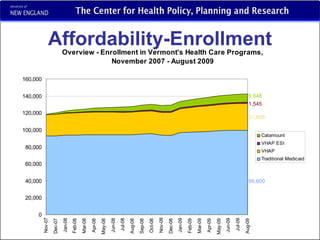
Affordability-Enrollment 9,648 1,545 31,605 99,600
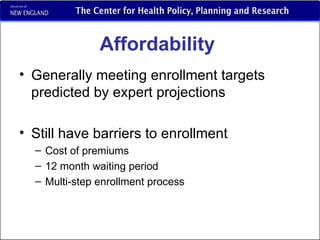
Affordability  Generally meeting enrollment targets predicted by expert projections Still have barriers to enrollment Cost of premiums 12 month waiting period Multi-step enrollment process
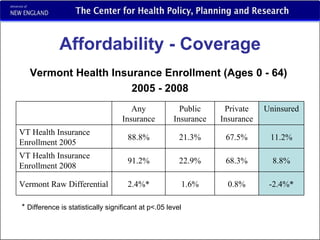
Affordability - Coverage Vermont Health Insurance Enrollment (Ages 0 - 64)  2005 - 2008 *  Difference is statistically significant at p<.05 level   Any Insurance Public Insurance Private Insurance Uninsured VT Health Insurance Enrollment 2005 88.8% 21.3% 67.5% 11.2% VT Health Insurance Enrollment 2008 91.2% 22.9% 68.3% 8.8% Vermont Raw Differential 2.4%* 1.6% 0.8% -2.4%*
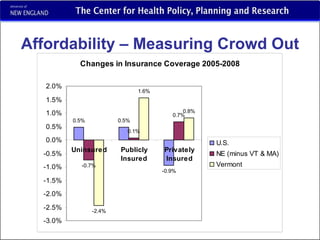
Affordability – Measuring Crowd Out
Affordability – Measuring Crowd Out   ACCOUNTING DECOMPOSITION 2005 2008 Change Public Health Insurance % with public insurance % with public insurance Always Eligible  for Public Coverage (05 & 08) 53.3% 59.9% 6.6% Newly Eligible for Public Coverage  (08 only) 11.7%   12.4% .7% Never eligible for public coverage   3.5% 3.4% -.1% Private Health Insurance %  with private insurance %  with private insurance Always Eligible  for Public Coverage (05 & 08) 30.4% 26.8% -3.6% Newly Eligible for Public Coverage  (08 only) 68.9% 71.8% 2.9% Never eligible for public coverage 91.5% 92.7% 1.2%
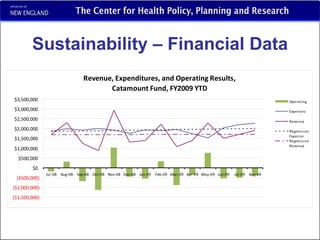
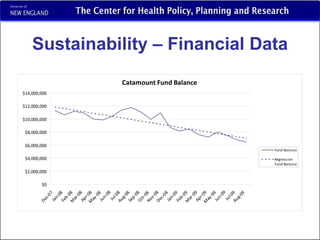
Sustainability – Financial Data
Sustainability - Barriers Barriers to Long Term Sustainability The decision by CMS not to permit the use of matching funds for 200-300% of federal poverty Reliance on a tobacco taxes—thought to be declining revenue source—for a significant portion of program funding (46% of state’s revenue in FY 2009) Broader economic forces Possible negative impact on enrollment Reduced, then eliminated supplemental contribution to offset the loss of anticipated federal funds Blueprint for Health impact on costs not yet available
Summary of Findings Insurance coverage in Vermont has increased significantly.  Enrollment in Catamount Health increased sharply and steadily during the initial months and is growing incrementally now.  Outreach campaigns appear to have been effective.  Some barriers to enrollment exist, but modifications have been made to address these barriers.  Take-up rates in Catamount were higher among older age groups Increases in public insurance appear independent of regional/national trends. Crowd-out from private coverage apparently not an issue. The program, as currently funded, does not appear to be fiscally sustainable.  Despite challenges, stakeholders are optimistic about continuation of health reform in Vermont.
Implications for  Federal Reform Debate Individual Mandate If less than 96% of Vermont’s population is insured by 2010, the legislature will re-evaluate whether a health insurance mandate on individuals is needed to achieve universal coverage. Crowd-out Does not appear to be occurring in Vermont Both private and public insurance coverage increased in VT, despite national trends toward less private coverage Residents newly eligible for Catamount experienced a greater increase in private than public coverage since Catamount’s inception (2.9% vs. 0.7%) Public Option Vermont’s approach to the “public option,” using a public/private hybrid, might be an alternative for Federal Reform given the partisan debate over this issue
Acknowledgments Staff and consultants at the UNE Center for Health Policy, Planning and Research (CHPPR) engaged in this study: Ronald Deprez, PhD, MPH+ Sherry Glied, PhD^ Steven Kappel, MPA* Kira Rodriguez, MHS+ Mary Louie+ Bill Perry, MS+ Brian Robertson, PhD~ Nina Schwabe+ Nicholas Tilipman^ + Center for Health Policy, Planning and Research ^  Columbia University Mailman School of Public Health ~  Market Decisions, Inc. *  Policy Integrity, LLC Special thanks to Susan Besio, Ph.D. and James Hester Ph.D. for their guidance and input.

The Vermont Experience

  • 1.
    SHARE Panel: The Vermont Experience November 5, 2009 Ronald Deprez, Ph.D., MPH The Center for Health Policy, Planning and Research University of New England
  • 2.
    Overview In thistalk we will cover: Overview of UNE’s Evaluation of Vermont’s Health Reforms Primary Goals of Vermont’s 2006 HCAA Objectives, Methods and Data Sources Affordability – Findings and Barriers Sustainability – Findings and Barriers Implications for Federal Health Reform Debate
  • 3.
  • 4.
    Overview of EvaluationOur evaluation of health care reform in VT is based on the 2006 Health Care Affordability Acts (HCAA) and will cover: Health insurance affordability Sustainability of the reforms, esp. the public insurance option Access to Care Funded by the Robert Wood Johnson Foundation
  • 5.
    VT 2006 HCAAPrimary Goals Increase access to affordable health insurance Goal: 96% of Vermont’s population insured by 2010 2. Improve quality of care across the lifespan Prevention and care management of chronic health conditions 3. Contain health care costs. Shift population eligible for public coverage to private sector Provide a comprehensive but affordable public option Use Blueprint for Health to accomplish long term sustainability and reduce rising health care costs (chronic disease management through a medical home) Blueprint not part of current evaluation
  • 6.
    VT access toaffordable health insurance New Public/Private Hybrid Plan – Catamount CHAP with premium publicly subsidized up to 300% FPL Enrollee premium = $60-$185 per month Catamount Health Above 300% FPL can purchase insurance at full cost Enrollee premium = $393 per month Expand Employer-Based Coverage by subsidizing employee premiums (has to be comprehensive coverage & cost effective for State) ESIA – Employer-sponsored insurance for those otherwise eligible for Catamount Health VHAP ESI – Employer-sponsored insurance for those otherwise eligible for VHAP (existing VT Medicaid program for childless adults) Employer mandate (Pay or Play) Employers must pay $365 per FTE assessment if do not offer health insurance to workers (or if workers refuse coverage) Marketing and Outreach strategy to simplify and increase enrollment into existing and new public programs
  • 7.
    Today’s Presentation AffordabilityAnalysis Examine enrollment as an indicator of affordability for all four new programs Examine demographics of enrollees by age and income level Discuss perceived affordability based on qualitative data from stakeholders Sustainability Analysis Examine expenditures and revenues from Catamount Fund to date
  • 8.
    Methods and DataSources Interviews with key informants to: Clarify the historical context, policies, and practices involved with implementation Gain insight around lessons learned Quantitative data from: Office of Vermont Health Access (OVHA) Enrollment, Revenues and Expenditures The 2005 and 2008 VHHIS (pop surveys) The Current Population Survey (CPS)
  • 9.
  • 10.
    Affordability Generallymeeting enrollment targets predicted by expert projections Still have barriers to enrollment Cost of premiums 12 month waiting period Multi-step enrollment process
  • 11.
    Affordability - CoverageVermont Health Insurance Enrollment (Ages 0 - 64) 2005 - 2008 * Difference is statistically significant at p<.05 level   Any Insurance Public Insurance Private Insurance Uninsured VT Health Insurance Enrollment 2005 88.8% 21.3% 67.5% 11.2% VT Health Insurance Enrollment 2008 91.2% 22.9% 68.3% 8.8% Vermont Raw Differential 2.4%* 1.6% 0.8% -2.4%*
  • 12.
  • 13.
    Affordability – MeasuringCrowd Out   ACCOUNTING DECOMPOSITION 2005 2008 Change Public Health Insurance % with public insurance % with public insurance Always Eligible for Public Coverage (05 & 08) 53.3% 59.9% 6.6% Newly Eligible for Public Coverage (08 only) 11.7%   12.4% .7% Never eligible for public coverage   3.5% 3.4% -.1% Private Health Insurance % with private insurance % with private insurance Always Eligible for Public Coverage (05 & 08) 30.4% 26.8% -3.6% Newly Eligible for Public Coverage (08 only) 68.9% 71.8% 2.9% Never eligible for public coverage 91.5% 92.7% 1.2%
  • 14.
  • 15.
  • 16.
    Sustainability - BarriersBarriers to Long Term Sustainability The decision by CMS not to permit the use of matching funds for 200-300% of federal poverty Reliance on a tobacco taxes—thought to be declining revenue source—for a significant portion of program funding (46% of state’s revenue in FY 2009) Broader economic forces Possible negative impact on enrollment Reduced, then eliminated supplemental contribution to offset the loss of anticipated federal funds Blueprint for Health impact on costs not yet available
  • 17.
    Summary of FindingsInsurance coverage in Vermont has increased significantly. Enrollment in Catamount Health increased sharply and steadily during the initial months and is growing incrementally now. Outreach campaigns appear to have been effective. Some barriers to enrollment exist, but modifications have been made to address these barriers. Take-up rates in Catamount were higher among older age groups Increases in public insurance appear independent of regional/national trends. Crowd-out from private coverage apparently not an issue. The program, as currently funded, does not appear to be fiscally sustainable. Despite challenges, stakeholders are optimistic about continuation of health reform in Vermont.
  • 18.
    Implications for Federal Reform Debate Individual Mandate If less than 96% of Vermont’s population is insured by 2010, the legislature will re-evaluate whether a health insurance mandate on individuals is needed to achieve universal coverage. Crowd-out Does not appear to be occurring in Vermont Both private and public insurance coverage increased in VT, despite national trends toward less private coverage Residents newly eligible for Catamount experienced a greater increase in private than public coverage since Catamount’s inception (2.9% vs. 0.7%) Public Option Vermont’s approach to the “public option,” using a public/private hybrid, might be an alternative for Federal Reform given the partisan debate over this issue
  • 19.
    Acknowledgments Staff andconsultants at the UNE Center for Health Policy, Planning and Research (CHPPR) engaged in this study: Ronald Deprez, PhD, MPH+ Sherry Glied, PhD^ Steven Kappel, MPA* Kira Rodriguez, MHS+ Mary Louie+ Bill Perry, MS+ Brian Robertson, PhD~ Nina Schwabe+ Nicholas Tilipman^ + Center for Health Policy, Planning and Research ^ Columbia University Mailman School of Public Health ~ Market Decisions, Inc. * Policy Integrity, LLC Special thanks to Susan Besio, Ph.D. and James Hester Ph.D. for their guidance and input.

Editor's Notes

  • #7 Vermont (Catamount Health) For those not eligible for other state/federal programs and without access to ESI PPO plan with comprehensive benefits Preventive care and chronic care covered 100% Premium assistance for individuals below 300% FPL Without premium assistance - $393 per month to enroll Offered by MVP Health Care, Blue Cross/Blue Shield Funded by state revenues, employer tax, Medicaid, premiums ESI Promotes employer coverage by providing premium assistance to individuals under 300% FPL to help pay for employer plan (only if more cost effective than enrolling in state/federal programs) Employer plan must meet requirements (must be comprehensive) Individuals pay no more than they would to enroll in state/federal programs (sliding scale)
  • #10 The ability for those in need to purchase the plan Defined by the costs of coverage Measured by plan participation conditioned on estimated uptake/need Need measured by population who go without health care due to cost Need is also defined by proportion uninsured How has implementation compared to what was expected? Outreach has been successful in identifying newly eligible and previously eligible populations Enrollment into new programs (Catamount &amp; ESIA), while less than projected, has shown a steady increase since inception By April 2009, 8,758 people enrolled in Catamount Health More than half of Catamount enrollees have family incomes between 150 and 200% FPL 13.1% of enrollees (1,220 people) have family incomes above 300% FPL and do not receive premium assistance. Catamount has been relatively successful in attracting a younger pop; take-up has been substantially higher than expected among those 35 and over. Enrollment in traditional Medicaid and especially VHAP increased since Catamount program began
  • #12 All remaining analyses only include population aged 0 – 64 since they are focus of health reform efforts. Public insurance = All Medicaid, VHAP, Catamount and Medicare (any state or federally subsidized program)
  • #13 Trends in health insurance coverage for Vermonters between 2005 and 2008 compared to the region (New England) and national trends No Evidence of crowd-out (migration to public insurance from the privately insured ) Health insurance enrollment increased significantly in Vermont between 2005 and 2008. Public coverage increased due to a combination of newly eligible enrollees (i.e. newly eligible for Catamount) and increased enrollment among previously eligible populations (i.e. previously eligible for other Medicaid programs) Public insurance coverage increased as a result of both increased propensity to get public coverage across all groups and demographic shifts toward eligibility. Private insurance coverage increased as a result of an increased propensity for private coverage, despite demographic shifts that offset this. Crowd-out does not appear to be an issue for Vermont. Similar trends were not observed in New England or U.S. so results may be attributable to HCAA reforms.
  • #15 Sustainability = The viability of state insurance reforms to develop secure funding over the long term Biggest single threat to health insurance reforms in states: more insured exacerbate rising health costs When Catamount Health was created, the state chose to create a separate fund to finance it, rather than mixing revenues and expenses into existing funds. Catamount Fund Revenues come from five sources: Incremental revenue from an increase in the state’s cigarette and tobacco taxes Federal Medicaid funds (matching $$ up to 200%FPL) An assessment on employers who either do not offer insurance to some or all of their employees or who have employees who are eligible for coverage but are uninsured. Beneficiary premiums Interest on the fund balance To evaluate the fiscal sustainability of the Catamount Health Insurance program, we evaluate the fund balance over time and net operating results, both monthly and cumulatively.
  • #16 Summary of Findings The fiscal sustainability of the program, as currently funded, does not appear to be sound. If fiscal sustainability is to be achieved, a rebalancing of revenue and expenses will be necessary. Additional data are needed before we can reach a conclusion—especially given proposed changes at the federal level.
  • #17 Medicaid and SCHIP Waivers (Section 1115 of Social Security Act) Federal requirements can be waived for purpose of pilot, experimental projects Expand eligibility to new groups Change benefit package design, higher cost sharing, premium assistance