• Structured interviews with 33 individuals
• Current and former state agency staff, health plan staff
Key Program Provisions Examined
• Exchange plan premium assistance
• Enrollee contribution requirements
• Health savings accounts
• Healthy behavior incentives
• Graduated copayments for non-emergency use of the
emergency department (ED)
Policy Questions
• What administrative elements were needed?
• What challenges arose, and how did states respond?
• What are important considerations for CMS and other states?
Implementation Experiences of Arkansas, Indiana, Iowa, & Michigan
Emily Zylla, MPH; Elizabeth Lukanen, MPH; Colin Planalp, MPA; Caroline Au-Yeung, MPH
Study Background
Administrative Capacity Needs
• Staff time needed for program implementation was
considerable, even when some responsibilities were
delegated to contractors.
• Necessary coordination and communication across different
entities that have implementation responsibilities, and with
beneficiaries, was significant and ongoing.
• Systems, processes, and IT infrastructure workloads were
variable depending on existing capacity.
• Very little information is available on total costs for program
administration.
Exchange Plan Premium Assistance (AR & IA)
Challenges
• Health plans were unwilling to offer products for Medicaid
beneficiaries in Iowa.
• Health plans in both Iowa and Arkansas did not have
previous experience serving low-income adults, so pricing
the population was difficult.
• In Arkansas, coordinating between Medicaid, the
Department of Insurance, and exchange plans was difficult
and time-consuming.
Discussion Themes
Discussion Themes
Study Approach
1115 Waivers in Study States
Conclusions
Results
Results
Enrollee Contributions (IA & MI)
Challenges
• Educating beneficiaries about insurance-related concepts was
difficult.
• Calculating, collecting, and processing beneficiary
contributions was time-intensive and administratively
burdensome.
• Setting up systems and coordination needed to collect unpaid
contributions required more administrative work than
originally anticipated, and in some cases it is not yet
occurring.
Health Savings Accounts (AR & IN)
Challenges
• Educating and engaging beneficiaries about their HSAs was
difficult.
• Calculating contribution requirements was burdensome
because premiums had to be recalculated monthly to account
for monthly income fluctuations.
• In Indiana, it was difficult to reconcile information (about
things like account balance amount and member enrollment
status) across plans, the state, and the fiscal agent at the end
of the benefit period.
Healthy Behavior Incentives (IN, IA, & MI)
Challenges
• Engaging beneficiaries on healthy behavior incentives was
difficult.
• Michigan experienced processing delays in its paper-based
health risk assessment screeners.
• In Indiana and Iowa, it was difficult reconciling claims systems
with the payment system used for crediting beneficiaries.
Graduated Copayments for Non-Emergency Use
of the ED (IN)
Challenges
• Neither the state nor health plans in Indiana reported
significant challenges.
• Design of the model placed administrative responsibility for
collecting the copayments on ED providers, and some
interviewees expressed doubt about whether providers were
collecting the payments.
• Waiver programs were more administratively complex than
traditional Medicaid, but the effort was worthwhile in order
to expand access to coverage.
• The value in waiver-based Medicaid expansions is in testing
approaches to incentivize behavior change, not necessarily in
saving the state money.
• Involving operational staff in waiver design process as early
as possible may help to ensure policy goals are achievable.
Arkansas
Arkansas Health Care Independence Program
(aka Private Option)
• Exchange plan premium assistance
• Health independence accounts
(partially implemented, then discontinued in 2016)
• MyIndy Cards
• Tiered based on income, with copayment exemption for
making payments
• 50–100% FPL — $5 per month
• 101–115% FPL — $10 per month
• 116–129% FPL — $17.50 per month
• 130–138% FPL — $25 per month
Indiana
Healthy Indiana Plan (HIP 2.0)
• Personal Wellness and Responsibility (POWER)
Accounts
• 0–5% FPL — $1 per month
• 6–138% FPL — 2% of income
• Healthy Behavior Incentives
Copayments for non-emergency use of ED
• $8 copay for first non-emergency visit, $25 copay for subsequent
non-emergency visits
Iowa
Health and Wellness Plan
• Beneficiaries with incomes 0–100% FPL enrolled (initially)
• Premiums tiered based on income
• 0–49% FPL — none
• 50–100% FPL — $5 per month
• 101–138% FPL — $10 per month
• Healthy Behavior Incentives
Marketplace Choice Plan
• Beneficiaries with incomes 101–138% FPL enrolled
• Premium of $10/month
• Dis-enrolled for non-payment of premiums
• Discontinued in 2016, sole remaining plan exited the market
Section 1115 Waivers
• Eight states are currently using Section 1115 waiver authority
to expand Medicaid to the new adult group
• Arizona, Arkansas, Indiana, Iowa, Kentucky, Michigan,
Montana, and New Hampshire
• Goals of Expansion Waivers include
• Policy changes to mirror commercial benefit and enrollment
design
• Create incentives for enrollees to use resources more
efficiently
Study Purpose
The Medicaid and CHIP Payment and Access Commission
(MACPAC) was interested in understanding how the states of
Arkansas, Indiana, Iowa, and Michigan have approached the
development, implementation, and management of innovate
Section 1115 waiver policies that expand Medicaid.
Michigan
MI Health Accounts
• 101–138% FPL — 2% of income
• Monthly billing through savings account for
copayments incurred for use of services
during prior 6 months
Healthy Behavior Incentives
• 0–100% FPL may receive $50 gift card and 50% reduction in
copayments
• 101–138% FPL may have monthly contributions cut from 2% to
1% of income
• Despite a need for substantial communication and
negotiation with states, health plans generally felt equipped
to take on additional implementation responsibilities.
• Implementation involved major administrative efforts,
requiring significant coordination among multiple
stakeholders, sophisticated IT systems, and ongoing education
of beneficiaries.
• The total costs of the program implementation and
administration were unclear.
• Interviewees felt that the overall value in the waiver approach
was in carrying out policy differently, not necessarily in saving
the state money.
• Waiver programs were ultimately worthwhile because they
led to increased health care coverage for a population that
would not otherwise have been covered.
Section 1115 Medicaid Expansion Waivers:
If there’s any way that you could have the opportunity and luxury of
developing the operational protocol first, and then develop the policy,
you’re better off. If you develop your policy first and try to wrap your
operations around it, that’s when you get in trouble.
”
”
• Considerable IT system redesign was required to develop
and maintain programs.
• The complexity of policy provisions being tested meant that
targeted and ongoing member outreach was essential, but
also an ongoing challenge.
• Building off of existing capacity and infrastructure made
implementation manageable under short timelines, but it
was not necessarily efficient.
• Significant administrative resources were needed to
implement and support ongoing operations of these new
programs.
It’s building the plane as we were flying it… we had to have
something workable, out the door, so that we could send the first bill
out within six months of starting.
”
”
We've worked on this system for two years and we've still got little
things left to do to it. There is still is overhead constantly with the
system. Not to mention the size of the database that is just growing,
the images of the statements that we have to retain for however long.
And the strain on our mailroom and the print room. I think we
mentioned this before and I stick to this, and that's I don't think
you want to look at this as a way to offset costs of the program.
”
”
We definitely had plenty of education and collateral materials
which were distributed and communicated often. There was a user
guide that was created. It seemed like a pretty good educational tool.
I think you just have to wonder if this type of program really is that
enticing to this income population.
”
”
If any state is looking at collecting premiums to offset the cost of
a program, don't do it. If the state is looking to utilize premiums in
a different way, or they have a different purpose for it, just as an
educational method or opportunity for members to have a little
bit of skin in the game and understand how insurance works,
then there's value in that.
”
”
1115 Waivers in Study States

Poster, section 1115 waivers

  • 1.
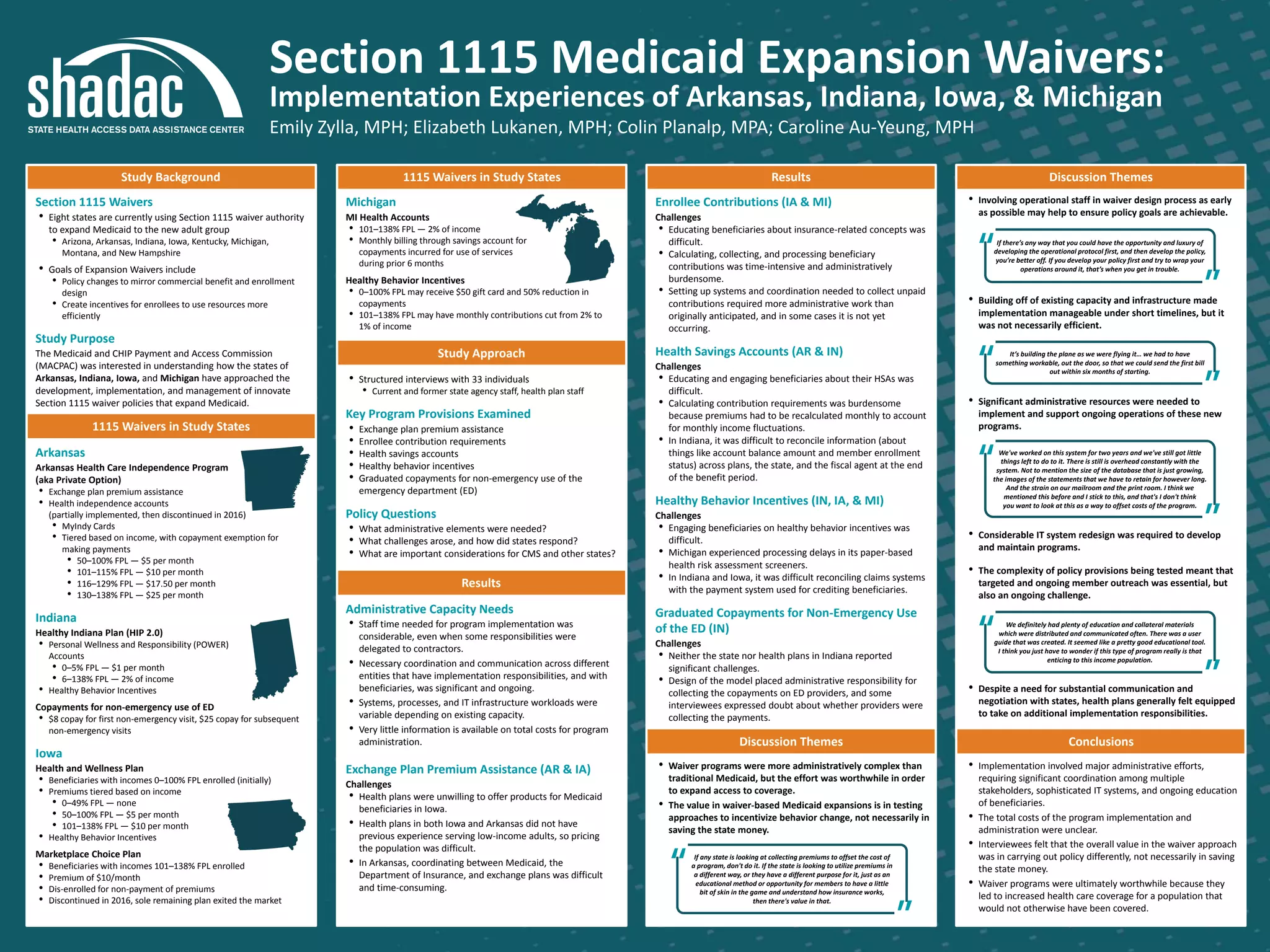
    • Structured interviewswith 33 individuals • Current and former state agency staff, health plan staff Key Program Provisions Examined • Exchange plan premium assistance • Enrollee contribution requirements • Health savings accounts • Healthy behavior incentives • Graduated copayments for non-emergency use of the emergency department (ED) Policy Questions • What administrative elements were needed? • What challenges arose, and how did states respond? • What are important considerations for CMS and other states? Implementation Experiences of Arkansas, Indiana, Iowa, & Michigan Emily Zylla, MPH; Elizabeth Lukanen, MPH; Colin Planalp, MPA; Caroline Au-Yeung, MPH Study Background Administrative Capacity Needs • Staff time needed for program implementation was considerable, even when some responsibilities were delegated to contractors. • Necessary coordination and communication across different entities that have implementation responsibilities, and with beneficiaries, was significant and ongoing. • Systems, processes, and IT infrastructure workloads were variable depending on existing capacity. • Very little information is available on total costs for program administration. Exchange Plan Premium Assistance (AR & IA) Challenges • Health plans were unwilling to offer products for Medicaid beneficiaries in Iowa. • Health plans in both Iowa and Arkansas did not have previous experience serving low-income adults, so pricing the population was difficult. • In Arkansas, coordinating between Medicaid, the Department of Insurance, and exchange plans was difficult and time-consuming. Discussion Themes Discussion Themes Study Approach 1115 Waivers in Study States Conclusions Results Results Enrollee Contributions (IA & MI) Challenges • Educating beneficiaries about insurance-related concepts was difficult. • Calculating, collecting, and processing beneficiary contributions was time-intensive and administratively burdensome. • Setting up systems and coordination needed to collect unpaid contributions required more administrative work than originally anticipated, and in some cases it is not yet occurring. Health Savings Accounts (AR & IN) Challenges • Educating and engaging beneficiaries about their HSAs was difficult. • Calculating contribution requirements was burdensome because premiums had to be recalculated monthly to account for monthly income fluctuations. • In Indiana, it was difficult to reconcile information (about things like account balance amount and member enrollment status) across plans, the state, and the fiscal agent at the end of the benefit period. Healthy Behavior Incentives (IN, IA, & MI) Challenges • Engaging beneficiaries on healthy behavior incentives was difficult. • Michigan experienced processing delays in its paper-based health risk assessment screeners. • In Indiana and Iowa, it was difficult reconciling claims systems with the payment system used for crediting beneficiaries. Graduated Copayments for Non-Emergency Use of the ED (IN) Challenges • Neither the state nor health plans in Indiana reported significant challenges. • Design of the model placed administrative responsibility for collecting the copayments on ED providers, and some interviewees expressed doubt about whether providers were collecting the payments. • Waiver programs were more administratively complex than traditional Medicaid, but the effort was worthwhile in order to expand access to coverage. • The value in waiver-based Medicaid expansions is in testing approaches to incentivize behavior change, not necessarily in saving the state money. • Involving operational staff in waiver design process as early as possible may help to ensure policy goals are achievable. Arkansas Arkansas Health Care Independence Program (aka Private Option) • Exchange plan premium assistance • Health independence accounts (partially implemented, then discontinued in 2016) • MyIndy Cards • Tiered based on income, with copayment exemption for making payments • 50–100% FPL — $5 per month • 101–115% FPL — $10 per month • 116–129% FPL — $17.50 per month • 130–138% FPL — $25 per month Indiana Healthy Indiana Plan (HIP 2.0) • Personal Wellness and Responsibility (POWER) Accounts • 0–5% FPL — $1 per month • 6–138% FPL — 2% of income • Healthy Behavior Incentives Copayments for non-emergency use of ED • $8 copay for first non-emergency visit, $25 copay for subsequent non-emergency visits Iowa Health and Wellness Plan • Beneficiaries with incomes 0–100% FPL enrolled (initially) • Premiums tiered based on income • 0–49% FPL — none • 50–100% FPL — $5 per month • 101–138% FPL — $10 per month • Healthy Behavior Incentives Marketplace Choice Plan • Beneficiaries with incomes 101–138% FPL enrolled • Premium of $10/month • Dis-enrolled for non-payment of premiums • Discontinued in 2016, sole remaining plan exited the market Section 1115 Waivers • Eight states are currently using Section 1115 waiver authority to expand Medicaid to the new adult group • Arizona, Arkansas, Indiana, Iowa, Kentucky, Michigan, Montana, and New Hampshire • Goals of Expansion Waivers include • Policy changes to mirror commercial benefit and enrollment design • Create incentives for enrollees to use resources more efficiently Study Purpose The Medicaid and CHIP Payment and Access Commission (MACPAC) was interested in understanding how the states of Arkansas, Indiana, Iowa, and Michigan have approached the development, implementation, and management of innovate Section 1115 waiver policies that expand Medicaid. Michigan MI Health Accounts • 101–138% FPL — 2% of income • Monthly billing through savings account for copayments incurred for use of services during prior 6 months Healthy Behavior Incentives • 0–100% FPL may receive $50 gift card and 50% reduction in copayments • 101–138% FPL may have monthly contributions cut from 2% to 1% of income • Despite a need for substantial communication and negotiation with states, health plans generally felt equipped to take on additional implementation responsibilities. • Implementation involved major administrative efforts, requiring significant coordination among multiple stakeholders, sophisticated IT systems, and ongoing education of beneficiaries. • The total costs of the program implementation and administration were unclear. • Interviewees felt that the overall value in the waiver approach was in carrying out policy differently, not necessarily in saving the state money. • Waiver programs were ultimately worthwhile because they led to increased health care coverage for a population that would not otherwise have been covered. Section 1115 Medicaid Expansion Waivers: If there’s any way that you could have the opportunity and luxury of developing the operational protocol first, and then develop the policy, you’re better off. If you develop your policy first and try to wrap your operations around it, that’s when you get in trouble. ” ” • Considerable IT system redesign was required to develop and maintain programs. • The complexity of policy provisions being tested meant that targeted and ongoing member outreach was essential, but also an ongoing challenge. • Building off of existing capacity and infrastructure made implementation manageable under short timelines, but it was not necessarily efficient. • Significant administrative resources were needed to implement and support ongoing operations of these new programs. It’s building the plane as we were flying it… we had to have something workable, out the door, so that we could send the first bill out within six months of starting. ” ” We've worked on this system for two years and we've still got little things left to do to it. There is still is overhead constantly with the system. Not to mention the size of the database that is just growing, the images of the statements that we have to retain for however long. And the strain on our mailroom and the print room. I think we mentioned this before and I stick to this, and that's I don't think you want to look at this as a way to offset costs of the program. ” ” We definitely had plenty of education and collateral materials which were distributed and communicated often. There was a user guide that was created. It seemed like a pretty good educational tool. I think you just have to wonder if this type of program really is that enticing to this income population. ” ” If any state is looking at collecting premiums to offset the cost of a program, don't do it. If the state is looking to utilize premiums in a different way, or they have a different purpose for it, just as an educational method or opportunity for members to have a little bit of skin in the game and understand how insurance works, then there's value in that. ” ” 1115 Waivers in Study States

Editor's Notes

  • #2 PLEASE PLACE THIS AT THE BOTTOM OF APPROPRIATE POSTERS: Support for this work was provided by a grant from the Robert Wood Johnson Foundation’s State Health Reform Assistance Network Program.