Leveraging Public Health Capacity to Increase Health System EfficiencySharon MoffattAssociation of State and Territorial Health OfficialsOctober 5, 2010
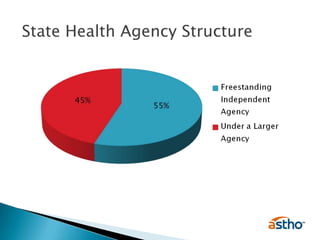
State Health Agency Structure
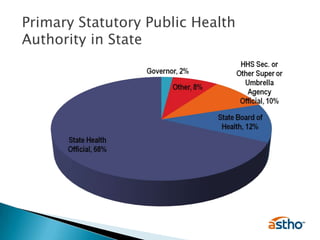
Primary Statutory Public Health Authority in State
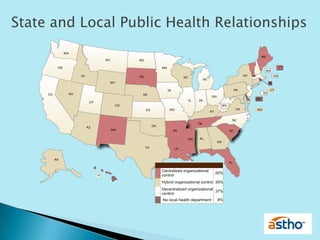
State and Local Public Health Relationships
State Health Agency Roles in Health ReformPrevious Roles and New Roles in Response to Affordable Care Act
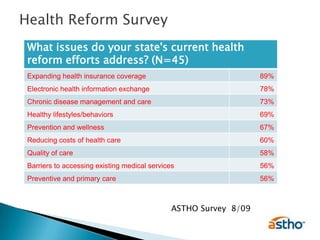
Health Reform SurveyASTHO Survey  8/09
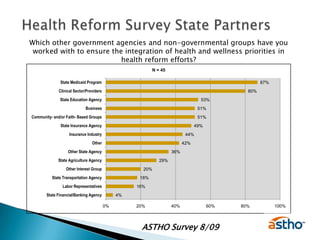
Health Reform Survey State PartnersWhich other government agencies and non-governmental groups have you worked with to ensure the integration of health and wellness priorities in           health reform efforts?ASTHO Survey 8/09
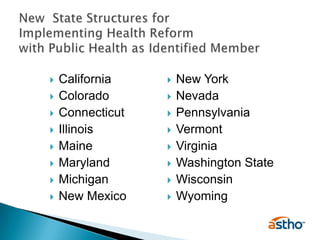
New  State Structures for Implementing Health Reform with Public Health as Identified MemberCaliforniaColoradoConnecticutIllinoisMaineMarylandMichiganNew MexicoNew YorkNevadaPennsylvaniaVermontVirginiaWashington StateWisconsinWyoming
Public Health and Medicaid
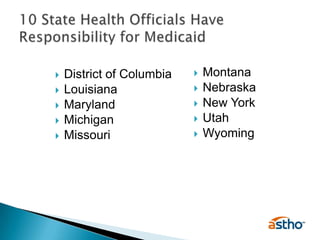
District of ColumbiaLouisianaMarylandMichiganMissouriMontanaNebraskaNew YorkUtahWyoming10 State Health Officials Have Responsibility for Medicaid
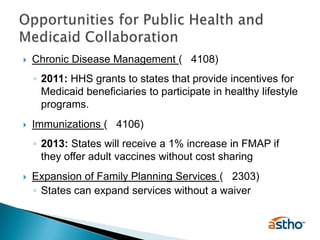
Chronic Disease Management (§ 4108)2011: HHS grants to states that provide incentives for Medicaid beneficiaries to participate in healthy lifestyle programs.Immunizations (§ 4106)2013: States will receive a 1% increase in FMAP if they offer adult vaccines without cost sharingExpansion of Family Planning Services (§ 2303)States can expand services without a waiverOpportunities for Public Health and Medicaid Collaboration
	By October 1, 2010 states are required to cover comprehensive tobacco cessation services for pregnant women in Medicaid (§ 4107)	State health departments have experience developing and promoting comprehensive tobacco use prevention and cessation strategies Public Health and Medicaid Collaboration: Smoking Cessation
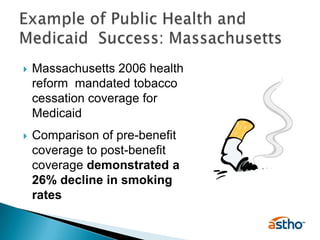
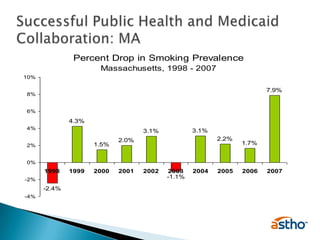
Massachusetts 2006 health reform  mandated tobacco cessation coverage for MedicaidComparison of pre-benefit coverage to post-benefit coverage demonstrated a 26% decline in smoking ratesExample of Public Health and Medicaid  Success: Massachusetts
Successful Public Health and Medicaid Collaboration: MA14Data Source: Massachusetts Behavioral Risk Factor Surveillance System
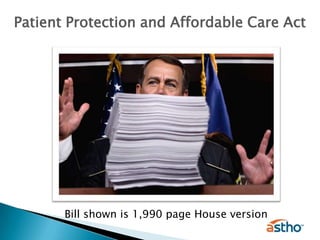
Patient Protection and Affordable Care ActBill shown is 1,990 page House version
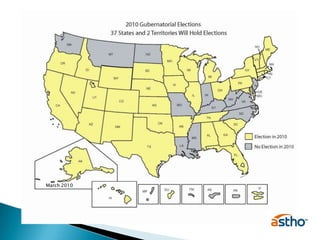
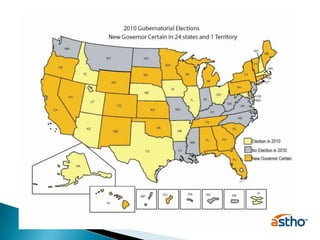
CHALLENGESKeeping focus on public health and prevention State Budget CutsHuge volume of work for statesTimelines for decisions are short2010 Election
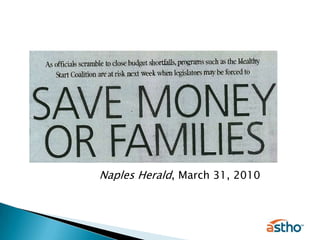
Naples Herald, March 31, 2010
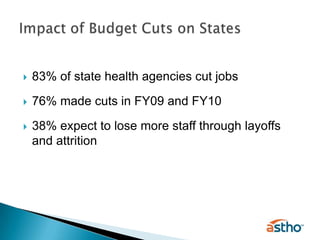
83% of state health agencies cut jobs76% made cuts in FY09 and FY1038% expect to lose more staff through layoffs and attritionImpact of Budget Cuts on States
Asthma programs cutImmunization outreach reducedEligibility for maternal child health programs reduced and waiting lists createdTeen pregnancy programs eliminatedExamples of State Program Budget Cuts
March 2010
OPPORTUNITIES“This is an historic, once in a lifetime investment in public health.”  			-Paul Halverson, DrPH, ASTHO President$15B investment in public health over the next 10 years!Home visiting fundingSection 317 immunization program reauthorizedPrograms to address several critical health care and public health workforce shortages authorizedSchool based Health Centers: 50MCMS Innovation grants
Setting priorities within the state health agencyCommunication of need to Executive and Legislative Branch of governmentIdentification of lead for grant applicationsAssuring quality and alignment of grant applications given short submission periodsState Health Official Role Funding Opportunities and Challenges
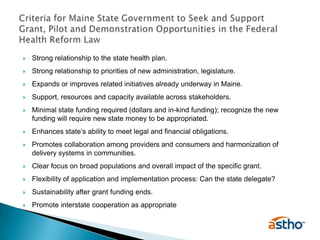
Strong relationship to the state health plan.Strong relationship to priorities of new administration, legislature.Expands or improves related initiatives already underway in Maine.Support, resources and capacity available across stakeholders.Minimal state funding required (dollars and in-kind funding); recognize the new funding will require new state money to be appropriated. Enhances state’s ability to meet legal and financial obligations. Promotes collaboration among providers and consumers and harmonization of delivery systems in communities.Clear focus on broad populations and overall impact of the specific grant.Flexibility of application and implementation process: Can the state delegate?Sustainability after grant funding ends.Promote interstate cooperation as appropriateCriteria for Maine State Government to Seek and SupportGrant, Pilot and Demonstration Opportunities in the Federal Health Reform Law
Patient Protection and Affordable Care Act, March 2010.Congressional Research Service (CRS)Healthreform.govReferences and Resources
Sharon Moffatt Chief of Health Promotion and Disease Prevention 	Association of State and Territorial Health Officials2231 Crystal Drive, Suite 450Arlington, VA 20112202-371-9090smoffatt@astho.orgwww.astho.org

Leveraging Public Health Capacity to Increase Health System Efficiency

  • 1.
    Leveraging Public HealthCapacity to Increase Health System EfficiencySharon MoffattAssociation of State and Territorial Health OfficialsOctober 5, 2010
  • 2.
  • 3.
    Primary Statutory PublicHealth Authority in State
  • 4.
    State and LocalPublic Health Relationships
  • 5.
    State Health AgencyRoles in Health ReformPrevious Roles and New Roles in Response to Affordable Care Act
  • 6.
  • 7.
    Health Reform SurveyState PartnersWhich other government agencies and non-governmental groups have you worked with to ensure the integration of health and wellness priorities in health reform efforts?ASTHO Survey 8/09
  • 8.
    New StateStructures for Implementing Health Reform with Public Health as Identified MemberCaliforniaColoradoConnecticutIllinoisMaineMarylandMichiganNew MexicoNew YorkNevadaPennsylvaniaVermontVirginiaWashington StateWisconsinWyoming
  • 9.
  • 10.
    District of ColumbiaLouisianaMarylandMichiganMissouriMontanaNebraskaNewYorkUtahWyoming10 State Health Officials Have Responsibility for Medicaid
  • 11.
    Chronic Disease Management(§ 4108)2011: HHS grants to states that provide incentives for Medicaid beneficiaries to participate in healthy lifestyle programs.Immunizations (§ 4106)2013: States will receive a 1% increase in FMAP if they offer adult vaccines without cost sharingExpansion of Family Planning Services (§ 2303)States can expand services without a waiverOpportunities for Public Health and Medicaid Collaboration
  • 12.
    By October 1,2010 states are required to cover comprehensive tobacco cessation services for pregnant women in Medicaid (§ 4107) State health departments have experience developing and promoting comprehensive tobacco use prevention and cessation strategies Public Health and Medicaid Collaboration: Smoking Cessation
  • 13.
    Massachusetts 2006 healthreform mandated tobacco cessation coverage for MedicaidComparison of pre-benefit coverage to post-benefit coverage demonstrated a 26% decline in smoking ratesExample of Public Health and Medicaid Success: Massachusetts
  • 14.
    Successful Public Healthand Medicaid Collaboration: MA14Data Source: Massachusetts Behavioral Risk Factor Surveillance System
  • 15.
    Patient Protection andAffordable Care ActBill shown is 1,990 page House version
  • 16.
    CHALLENGESKeeping focus onpublic health and prevention State Budget CutsHuge volume of work for statesTimelines for decisions are short2010 Election
  • 17.
  • 18.
    83% of statehealth agencies cut jobs76% made cuts in FY09 and FY1038% expect to lose more staff through layoffs and attritionImpact of Budget Cuts on States
  • 19.
    Asthma programs cutImmunizationoutreach reducedEligibility for maternal child health programs reduced and waiting lists createdTeen pregnancy programs eliminatedExamples of State Program Budget Cuts
  • 20.
  • 22.
    OPPORTUNITIES“This is anhistoric, once in a lifetime investment in public health.” -Paul Halverson, DrPH, ASTHO President$15B investment in public health over the next 10 years!Home visiting fundingSection 317 immunization program reauthorizedPrograms to address several critical health care and public health workforce shortages authorizedSchool based Health Centers: 50MCMS Innovation grants
  • 23.
    Setting priorities withinthe state health agencyCommunication of need to Executive and Legislative Branch of governmentIdentification of lead for grant applicationsAssuring quality and alignment of grant applications given short submission periodsState Health Official Role Funding Opportunities and Challenges
  • 24.
    Strong relationship tothe state health plan.Strong relationship to priorities of new administration, legislature.Expands or improves related initiatives already underway in Maine.Support, resources and capacity available across stakeholders.Minimal state funding required (dollars and in-kind funding); recognize the new funding will require new state money to be appropriated. Enhances state’s ability to meet legal and financial obligations. Promotes collaboration among providers and consumers and harmonization of delivery systems in communities.Clear focus on broad populations and overall impact of the specific grant.Flexibility of application and implementation process: Can the state delegate?Sustainability after grant funding ends.Promote interstate cooperation as appropriateCriteria for Maine State Government to Seek and SupportGrant, Pilot and Demonstration Opportunities in the Federal Health Reform Law
  • 25.
    Patient Protection andAffordable Care Act, March 2010.Congressional Research Service (CRS)Healthreform.govReferences and Resources
  • 26.
    Sharon Moffatt Chiefof Health Promotion and Disease Prevention Association of State and Territorial Health Officials2231 Crystal Drive, Suite 450Arlington, VA 20112202-371-9090smoffatt@astho.orgwww.astho.org

Editor's Notes

  • #3 The majority of state public health agencies (55%) are structured as free-standing agencies, while the remaining agencies (45%) are located within an umbrella agency structure in state government.In 13 states and the District of Columbia (28%), local health services are provided by the state public health agency (centralized or no local health departments). In 19 states (37%), local health services are provided by independent local health departments (decentralized states). The remaining 18 states (35%) function with some combination of the above arrangements (hybrid states). The majority of state public health agencies (55%) are structured as free-standing agencies, while the remaining agencies (45%) are located within an umbrella agency structure in state government.In 13 states and the District of Columbia (28%), local health services are provided by the state public health agency (centralized or no local health departments). In 19 states (37%), local health services are provided by independent local health departments (decentralized states). The remaining 18 states (35%) function with some combination of the above arrangements (hybrid states). 
  • #11 By 2014, state Medicaid programs will cover “childless adults” under age 65 at 133% of poverty, increasing insurance coverage. Overall, expanded Medicaid and CHIP programs will potentially cover 16 million more Americans. As states prepare for the coming expansions, state public health officials can collaborate with the Medicaid program to address population health and improve health status.
  • #12 State and local public health departments are experienced in conducting outreach to eligible populations, developing programs, and convening multiple stakeholders to address population health issues and improve health outcomes. Implementation of health reform requires collaboration among multiple parties including public health, public and private insurers and other state agencies. Outreach to eligible populations: MA during their reform efforts cross trained community outreach workers to determine eligibility and increase enrollment of their newly eligible population, thereby increasing utilization of preventive services and decreasing costs. Beginning in 2011, HHS will award grants to states that provide incentives to Medicaid beneficiaries who participate in healthy lifestyle programs and demonstrate changes in health risks and outcomes. State officials can partner with Medicaid to identify evidence based prevention strategies that reduce or control the development of chronic disease. Beginning in 2013, states will receive an 1% increase in FMAP if they offer adult vaccines without cost sharing. Section 2303 will allow states to adopt family planning expansions—expanding access for women and sometimes men to reproductive health services—without a waiver. Currently 27 states use Medicaid family planning waivers. (Guttmacher)
  • #13 Source: Section 4107 of PPACA and ASTHO section summaryTalking Points: Next slide highlights how MA collaborated with their Medicaid program, after their 2006 health reform law, to increase smoking cessation
  • #14 Source: Medicaid Coverage for Tobacco Dependence Treatments in Massachusetts and Associated Decreases in Smoking Prevalence http://www.plosone.org/article/info:doi/10.1371/journal.pone.0009770
  • #15 State Successes: MAMassachusetts 2006 health reform law mandated tobacco cessation coverage for the Medicaid population.Comparison of pre-benefit coverage to post-benefit coverage demonstrated a 26 percent decline in smoking rates. Smoking rates sharply decreased at a rate not seen in many years (11% of Medicaid adults used the cessation service)**Does this chart make sense? I combined my Medicaid slide with his but putting my text in as talking points, let me know what you think**
  • #16 Competitive v. Allocated Mandatory v. Discretionary States v. Communities Authorized v. Appropriated (“Such Sums” v. $$$) Reauthorized v. New Programs Fiscal YearsMandates Direct Indirect Program Impact Direct Indirect Required Match or Maintenance of Effort
  • #21 In November 2010, 37 states and 2 territories will have gubernatorial elections.DC will also host a mayoral election.These jurisdictions are highlighted here in yellow
  • #22 In these 40 jurisdictions, 24 of the incumbents are either term limited or have announced they will not seek reelection.The orange states and territories on this map WILL have a new governor following the November elections.Yellow states are those in which the incumbent is running for reelection.