Deirdre Farrell, Zohal Ghiaszada, Erin Greco, Shevaun Harris, and Nina Hicks Quinnipiac University HM 600
Illustrates the growing issue facing the U.S. in terms of inadequate access to quality affordable health care for the uninsured and underinsured  Highlights the impact on the overall health care delivery system Identifies potential health care models of success Reviews solutions offered through the Patient Protection and Affordable Care Act
49.9 million Americans lacked health insurance  Approximately 25 million individuals between the ages of 19 – 64 are underinsured There is a strong correlation between access to health insurance coverage and better health outcomes
Inadequate health care coverage disproportionately affects minorities: 20.8% of Among African Americans  30.7% of Hispanics 11.7% of Caucasians 9.8% of children  Individuals with lower incomes  are at a higher risk
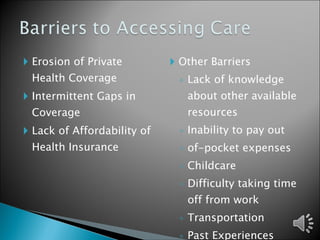
Erosion of Private Health Coverage Intermittent Gaps in Coverage Lack of Affordability of Health Insurance Other Barriers Lack of knowledge about other available resources Inability  to pay out of-pocket expenses Childcare Difficulty taking time off from work Transportation Past Experiences
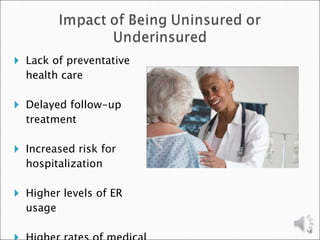
Lack of preventative health care Delayed follow-up treatment Increased risk for hospitalization Higher levels of ER usage Higher rates of medical morbidity
Medicaid is an entitlement program for the poor and disabled Categorical eligibility requirements Income eligibility requirements Residency requirements Citizenship status requirements State Children’s Health Insurance Program (SCHIP) Covers children who are ineligible for Medicaid
48.6 million individuals are covered by Medicaid Over $300 billion spent on the Medicaid program Limited coverage for non-disabled adults under the age of 65 without dependent children States can impose more restrictive eligibility requirements and benefit coverage
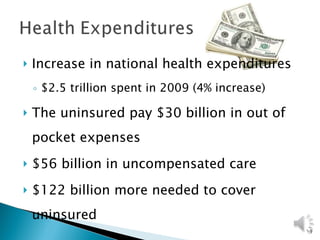
Increase in national health expenditures $2.5 trillion spent in 2009 (4% increase) The uninsured pay $30 billion in out of pocket expenses $56 billion in uncompensated care $122 billion more needed to cover uninsured
Solutions and Challenges
“ It is vital that health reform reduces costs to make health care affordable; protects a patient's choice of doctors, hospitals, and insurance plans; invests in prevention and wellness; and assures quality, affordable health care for all Americans.”   (Halle, Lewis, & Seshamani, 2009)
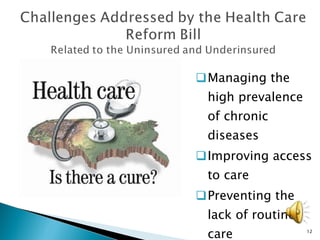
Managing the high prevalence of chronic diseases Improving access to care Preventing the lack of routine care
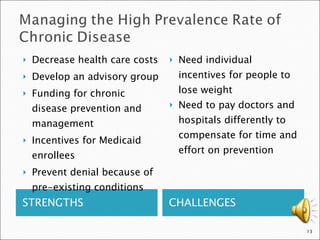
STRENGTHS CHALLENGES Decrease health care costs Develop an advisory group Funding for chronic disease prevention and management Incentives for Medicaid enrollees Prevent denial because of pre-existing conditions Need individual incentives for people to lose weight Need to pay doctors and hospitals differently to compensate for time and effort on prevention
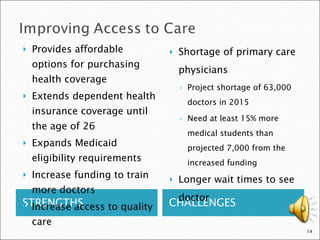
STRENGTHS CHALLENGES Provides affordable options for purchasing health coverage Extends dependent health insurance coverage until the age of 26 Expands Medicaid eligibility requirements Increase funding to train more doctors Increase access to quality care Shortage of primary care physicians  Project shortage of 63,000 doctors in 2015 Need at least 15% more medical students than projected 7,000 from the increased funding Longer wait times to see doctor
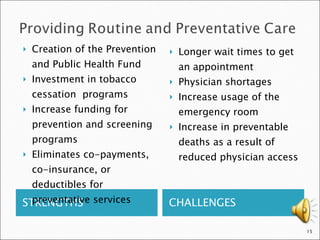
STRENGTHS CHALLENGES Creation of the Prevention and Public Health Fund Investment in tobacco cessation  programs Increase funding for prevention and screening programs Eliminates co-payments, co-insurance, or deductibles for preventative services Longer wait times to get an appointment  Physician shortages Increase usage of the emergency room  Increase in preventable deaths as a result of reduced physician access
Veterans Health Administration
Model for low-cost and high-quality healthcare since the mid-1990s Nation’s largest integrated health care system 1,400 sites  152 medical centers
Provides a full array of preventative services 53,000 independent licensed health care practitioners  83 million veterans served each year Priority group enrollment Co-payment exemptions Purple Heart Recipient Prisoner of War Service-Connect Injury
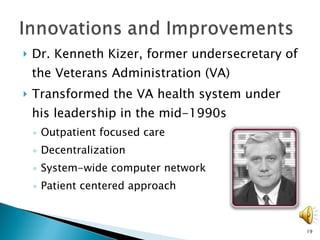
Dr. Kenneth Kizer, former undersecretary of the Veterans Administration (VA)  Transformed the VA health system under his leadership in the mid-1990s Outpatient focused care Decentralization System-wide computer network  Patient centered approach
As a government entity, the VHA cannot be sued for malpractice  Focus on preventative medicine Electronic records system Lower overhead and administrative costs Higher customer satisfaction index than private institutions
France and Italy
First major study of the world’s healthcare systems in 2000 Evaluated on 5 criteria: Overall level of the population’s health  Health inequalities within the population  Overall level of the health system’s responsiveness  Distribution of responsiveness within the population  Distribution of financing the systems between economic classes in each population
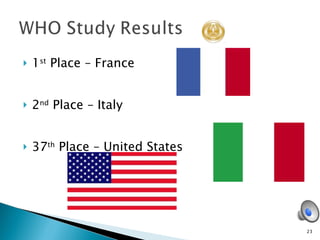
1 st  Place – France 2 nd  Place – Italy  37 th  Place – United States
Hybrid of socialized and competitive systems Universal coverage– no uninsured The sicker you are, the less you pay Full reimbursement for treatment, drugs, surgeries, and procedures for chronic illnesses.  10-11% of Gross Domestic Product 21% of income is paid to the national healthcare system Employers pay between 11-13% Supplemental coverage
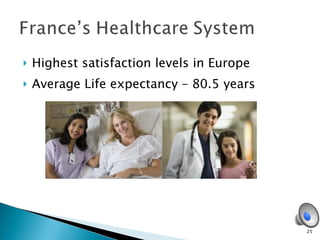
Highest satisfaction levels in Europe Average Life expectancy – 80.5 years
“ There are no uninsured in France. That's completely unheard of. There is no case of anybody going broke over their health costs. In fact, the system is so designed that for the 3 or 4 or 5 percent of the patients who are the very sickest, those patients are exempt from their co-payments to begin with. There are no deductibles.”  --  Victor Rodwin
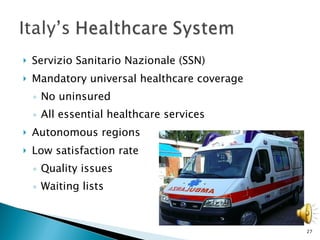
Servizio Sanitario Nazionale (SSN)  Mandatory universal healthcare coverage No uninsured All essential healthcare services Autonomous regions Low satisfaction rate Quality issues Waiting lists
Can potentially decrease quality Competition between public and private
eReferral and eConsult
Demand >> Supply Onerous and unreliable referral system Lack of equitable triage Poor communication between specialists and primary care providers (PCP)
Patients Experiencing Problems Obtaining Specialty Care:  Uninsured – 80% - 90% Medicaid and Medicare- 40% - 50% Private Insurances – 5 – 10%
Handwrite/fax the referral form Loss of referral documentations No centralized method to track the referrals Reason for consultation (include pertinent history, physical laboratory findings, medications)
Proven model in safety-net facilities serving the uninsured  Enhance efficiency and improve communication between specialists and PCPs Improve triage of referrals Goals Reduce demand Increase efficiency Improve quality Enhance timely access
BENEFITS NEXT STEPS Health Reduces mortality and morbidity Economical Cuts down healthcare expenses Social Reduced inequities and disparities Spread to other departments Radiology (MRI, CT, U/S) Build relationship and trust Other specialists
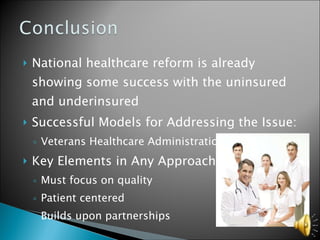
National healthcare reform is already showing some success with the uninsured and underinsured Successful Models for Addressing the Issue: Veterans Healthcare Administration Key Elements in Any Approach Must focus on quality Patient centered Builds upon partnerships
Group D Team Presentation

Group D Team Presentation

  • 1.
    Deirdre Farrell, ZohalGhiaszada, Erin Greco, Shevaun Harris, and Nina Hicks Quinnipiac University HM 600
  • 2.
    Illustrates the growingissue facing the U.S. in terms of inadequate access to quality affordable health care for the uninsured and underinsured Highlights the impact on the overall health care delivery system Identifies potential health care models of success Reviews solutions offered through the Patient Protection and Affordable Care Act
  • 3.
    49.9 million Americanslacked health insurance Approximately 25 million individuals between the ages of 19 – 64 are underinsured There is a strong correlation between access to health insurance coverage and better health outcomes
  • 4.
    Inadequate health carecoverage disproportionately affects minorities: 20.8% of Among African Americans 30.7% of Hispanics 11.7% of Caucasians 9.8% of children Individuals with lower incomes are at a higher risk
  • 5.
    Erosion of PrivateHealth Coverage Intermittent Gaps in Coverage Lack of Affordability of Health Insurance Other Barriers Lack of knowledge about other available resources Inability to pay out of-pocket expenses Childcare Difficulty taking time off from work Transportation Past Experiences
  • 6.
    Lack of preventativehealth care Delayed follow-up treatment Increased risk for hospitalization Higher levels of ER usage Higher rates of medical morbidity
  • 7.
    Medicaid is anentitlement program for the poor and disabled Categorical eligibility requirements Income eligibility requirements Residency requirements Citizenship status requirements State Children’s Health Insurance Program (SCHIP) Covers children who are ineligible for Medicaid
  • 8.
    48.6 million individualsare covered by Medicaid Over $300 billion spent on the Medicaid program Limited coverage for non-disabled adults under the age of 65 without dependent children States can impose more restrictive eligibility requirements and benefit coverage
  • 9.
    Increase in nationalhealth expenditures $2.5 trillion spent in 2009 (4% increase) The uninsured pay $30 billion in out of pocket expenses $56 billion in uncompensated care $122 billion more needed to cover uninsured
  • 10.
  • 11.
    “ It isvital that health reform reduces costs to make health care affordable; protects a patient's choice of doctors, hospitals, and insurance plans; invests in prevention and wellness; and assures quality, affordable health care for all Americans.” (Halle, Lewis, & Seshamani, 2009)
  • 12.
    Managing the highprevalence of chronic diseases Improving access to care Preventing the lack of routine care
  • 13.
    STRENGTHS CHALLENGES Decreasehealth care costs Develop an advisory group Funding for chronic disease prevention and management Incentives for Medicaid enrollees Prevent denial because of pre-existing conditions Need individual incentives for people to lose weight Need to pay doctors and hospitals differently to compensate for time and effort on prevention
  • 14.
    STRENGTHS CHALLENGES Providesaffordable options for purchasing health coverage Extends dependent health insurance coverage until the age of 26 Expands Medicaid eligibility requirements Increase funding to train more doctors Increase access to quality care Shortage of primary care physicians Project shortage of 63,000 doctors in 2015 Need at least 15% more medical students than projected 7,000 from the increased funding Longer wait times to see doctor
  • 15.
    STRENGTHS CHALLENGES Creationof the Prevention and Public Health Fund Investment in tobacco cessation programs Increase funding for prevention and screening programs Eliminates co-payments, co-insurance, or deductibles for preventative services Longer wait times to get an appointment Physician shortages Increase usage of the emergency room Increase in preventable deaths as a result of reduced physician access
  • 16.
  • 17.
    Model for low-costand high-quality healthcare since the mid-1990s Nation’s largest integrated health care system 1,400 sites 152 medical centers
  • 18.
    Provides a fullarray of preventative services 53,000 independent licensed health care practitioners 83 million veterans served each year Priority group enrollment Co-payment exemptions Purple Heart Recipient Prisoner of War Service-Connect Injury
  • 19.
    Dr. Kenneth Kizer,former undersecretary of the Veterans Administration (VA) Transformed the VA health system under his leadership in the mid-1990s Outpatient focused care Decentralization System-wide computer network Patient centered approach
  • 20.
    As a governmententity, the VHA cannot be sued for malpractice Focus on preventative medicine Electronic records system Lower overhead and administrative costs Higher customer satisfaction index than private institutions
  • 21.
  • 22.
    First major studyof the world’s healthcare systems in 2000 Evaluated on 5 criteria: Overall level of the population’s health Health inequalities within the population Overall level of the health system’s responsiveness Distribution of responsiveness within the population Distribution of financing the systems between economic classes in each population
  • 23.
    1 st Place – France 2 nd Place – Italy 37 th Place – United States
  • 24.
    Hybrid of socializedand competitive systems Universal coverage– no uninsured The sicker you are, the less you pay Full reimbursement for treatment, drugs, surgeries, and procedures for chronic illnesses. 10-11% of Gross Domestic Product 21% of income is paid to the national healthcare system Employers pay between 11-13% Supplemental coverage
  • 25.
    Highest satisfaction levelsin Europe Average Life expectancy – 80.5 years
  • 26.
    “ There areno uninsured in France. That's completely unheard of. There is no case of anybody going broke over their health costs. In fact, the system is so designed that for the 3 or 4 or 5 percent of the patients who are the very sickest, those patients are exempt from their co-payments to begin with. There are no deductibles.” -- Victor Rodwin
  • 27.
    Servizio Sanitario Nazionale(SSN) Mandatory universal healthcare coverage No uninsured All essential healthcare services Autonomous regions Low satisfaction rate Quality issues Waiting lists
  • 28.
    Can potentially decreasequality Competition between public and private
  • 29.
  • 30.
    Demand >> SupplyOnerous and unreliable referral system Lack of equitable triage Poor communication between specialists and primary care providers (PCP)
  • 31.
    Patients Experiencing ProblemsObtaining Specialty Care: Uninsured – 80% - 90% Medicaid and Medicare- 40% - 50% Private Insurances – 5 – 10%
  • 32.
    Handwrite/fax the referralform Loss of referral documentations No centralized method to track the referrals Reason for consultation (include pertinent history, physical laboratory findings, medications)
  • 33.
    Proven model insafety-net facilities serving the uninsured Enhance efficiency and improve communication between specialists and PCPs Improve triage of referrals Goals Reduce demand Increase efficiency Improve quality Enhance timely access
  • 34.
    BENEFITS NEXT STEPSHealth Reduces mortality and morbidity Economical Cuts down healthcare expenses Social Reduced inequities and disparities Spread to other departments Radiology (MRI, CT, U/S) Build relationship and trust Other specialists
  • 35.
    National healthcare reformis already showing some success with the uninsured and underinsured Successful Models for Addressing the Issue: Veterans Healthcare Administration Key Elements in Any Approach Must focus on quality Patient centered Builds upon partnerships

Editor's Notes

  • #4 Shevaun
  • #11 Nina Hicks M.D. http://www.healthcare.gov/compare/partnership-for-patients/index.html http://healthreform.kff.org/Timeline.aspx
  • #13 Low-income Americans experience disproportionately higher rates of chronic disease, fewer treatment options and reduced access to care
  • #14 Patients with chronic disease accounts for 75% of health spending 83% of every health care dollar in Medicaid spent on chronic disease and 99% for Medicare
  • #15 Forty-two percent of American adults are either uninsured or underinsured Once the health reform bill is fully implemented, only 8% of the U.S. population will remain uninsured and most of these individuals will be able to access coverage through Medicaid The health reform bill attempts to address this issue by providing tax exclusions for physicians and nurses working in underserved areas and includes provisions for expanded community health centers (including nurse-managed health centers) which may expand the availability of primary care providers A larger increase in funding toward medical schools, a reduction in the cost of medical school, and an expansion of the slots in residencies and medical schools will be steps toward preventing this shortage of doctors.
  • #16 Tobacco is the n umber one cause of preventable death is tobacco use
  • #18 Deirdre
  • #23 Erin
  • #25 At end talk about funding problems.
  • #31 Zohal